
WordPress Website Without a Domain: How to Build One
Table of Contents
You can build a WordPress website without a domain. Three methods work: a free WordPress.com plan, which gives you a yoursite.wordpress.com subdomain; a local install on your own computer using a tool such as WordPress Studio or LocalWP; and a temporary preview address supplied by a web host. All three let you design a site, add content and test it at no cost, and none of them gives you a memorable web address or a matching business email. A site with no domain suits learning and testing, and it caps how far that site can grow, which is why most business owners register a domain before they promote anything.
Can You Build a WordPress Website Without a Domain?
Yes. A WordPress website without a domain sounds like a contradiction, and it is a normal way to start. Plenty of business owners want to try the platform before spending anything on a web address, and every part of the build except the address itself is available to them.
Two reasons come up again and again. The first is cost. A free or local build lets you learn WordPress properly without paying for a domain or hosting. The second is naming. If the business name is still unsettled, building first buys you time to decide before you register anything you might regret.
The trade-off deserves to be said plainly. With no domain, there is no professional email address and no web address anyone will remember. That is fine while you are testing. It becomes a problem the day you want customers to find you. If you would rather skip the trial-and-error stage entirely, our Belfast web design team can plan and build the whole site properly from the start through ProfileTree’s WordPress development services.
Which Methods Actually Work Without a Domain?
Four practical routes exist, and most business owners will only need one of them. What follows reflects how each behaves now, not how it behaved a few years ago.
- A free WordPress.com plan. You get a subdomain in the form yoursite.wordpress.com. The plan has no expiry date and no credit card requirement, and it includes hosting, an SSL certificate, the block editor, dozens of free themes and 1 GB of storage. Free sites carry WordPress.com advertising, and support is limited to the community forums.
- A local install on your own computer. WordPress Studio is the current free option from the WordPress.com developer team and runs on macOS, Windows and Linux. LocalWP remains popular, and the manual stacks XAMPP and MAMP still work for anyone who prefers to assemble the pieces.
- A host’s preview or temporary address. Most hosts still hand you one so you can look at a site before DNS points anywhere. The old cPanel style of link, the one built from a server address and a tilde plus your username, is switched off on a lot of shared hosting now for security reasons. Hosts issue a named preview domain instead.
- Register the domain early and build later. This secures the name while you take your time over the design, and it costs very little to hold a name you are sure about.
How Do You Set Up a Free WordPress Site Step by Step?
The free route takes a few minutes. One step trips people up, so it is worth reading before you start.
- Open wordpress.com and select the option to start with the free plan.
- Create an account with your email address. No card details are requested.
- Choose a site name. That name becomes your free subdomain, in the form yoursite.wordpress.com.
- When the signup flow offers to sell you a custom domain, skip it. This is the step people get stuck on, because the paid options are prominent and the free subdomain option is not. Continuing without buying a domain keeps you on the free plan.
- Confirm your email address using the activation link you are sent.
- Pick a free theme. Every theme works for any kind of site, so choose on layout rather than category.
- Build your pages and posts in the block editor.
- Publish. The site is live on the subdomain straight away.
Before you commit hours to a theme, it is worth reading up on how WordPress compares as a website builder for a business site, because the free build and the eventual live build are the same platform underneath, and it is the one our Belfast web design team works in day-to-day.
Free WordPress, Self-hosted and Local Builds Compared
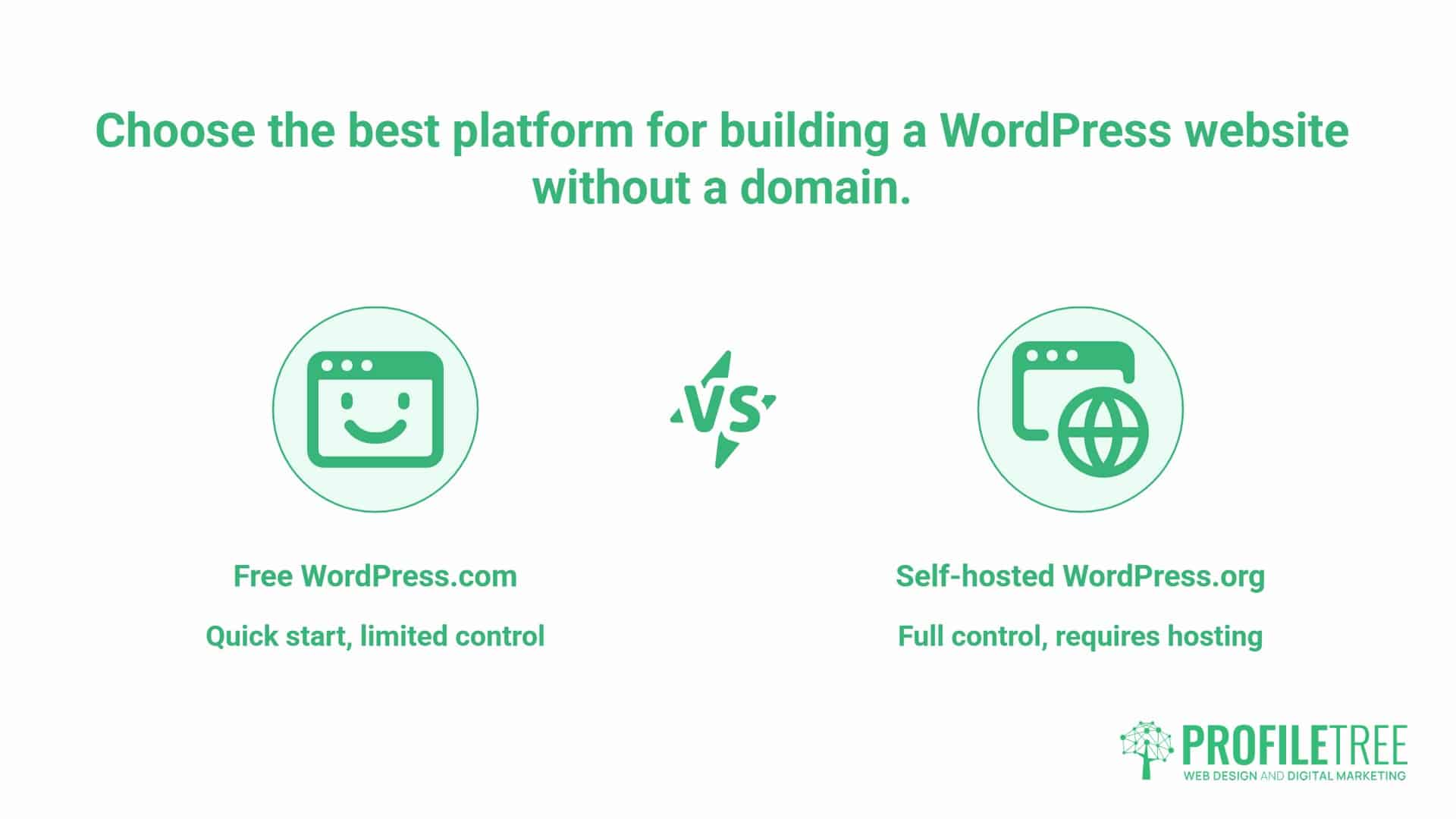
There is no single best platform for building without a domain. The right choice depends on how technical you are, whether you plan to go live later, and how much control you want over the finished site.
| Option | Strengths | Limits |
|---|---|---|
| Free WordPress.com plan | No cost, live in minutes, hosting and SSL included, nothing to install | Subdomain only, 1 GB storage, platform advertising, no plugin uploads, forum support only |
| Self-hosted WordPress (WordPress.org) | Full control, any theme or plugin, scales with the business | Needs hosting and a domain before it works publicly |
| Hosted website builders | Drag and drop, quick for beginners, everything in one account | Less flexibility, harder to move away from later |
| Local install | Free, offline, ideal for testing and learning, no public exposure | Invisible online until you host it, more technical setup |
Free hosted WordPress
A free WordPress.com plan is the fastest way in. Hosting and the builder come bundled, so you can sign up and start adding content within minutes. What you give up is control. You get a subdomain, a limited set of customisation options, adverts served on your pages, and the platform’s own rules about what you publish and how you earn from it.
Self-hosted WordPress
The WordPress.org software is free to download, and a public site still requires hosting and a domain. This is the route most growing businesses end up on, because it gives complete control over design, plugins and functionality. It remains the dominant platform by a wide margin: W3Techs recorded WordPress on 40.2% of all websites and 58.8% of sites running a known content management system on 17 September 2026. That share has eased back over the past year as hosted builders grow faster, so WordPress is not gaining ground automatically any more, and nothing about the trend suggests a business is making a poor choice by building on it.
Hosted website builders
Builder platforms package the content management system, the design tools and the hosting into one product. They are simple to use and good for getting something on screen quickly. You trade flexibility for that convenience, and moving the site elsewhere later tends to be awkward. For a build you intend to grow, a properly planned website design project usually serves a business better than a template it will outgrow inside a year.
Local development
Installing WordPress on your own machine lets you build and test offline at no cost. It suits anyone who wants to experiment without a single page going public. The site stays hidden until you move it to live hosting, so treat it as a staging step rather than a launch. Worth noting: using the WordPress.org software this way does not mean you are skipping hosting altogether. Your own computer quietly acts as the host while you build, which is also why the site disappears the moment you close the laptop.
How Do You Test a No-domain Site on a Phone?
Most guides skip this, and it is the question people actually have. A local build lives on your computer, so your phone cannot reach it by default, and theme problems that only show up on mobile are the expensive kind to discover late.
The cleanest answer now is a hosted preview. WordPress Studio can generate a preview site from any local site, which produces a hosted clone on a temporary address that works from any device and stays reachable whether or not your laptop is awake. A WordPress.com account is required, you can hold up to ten free preview sites at once, and each stays active for seven days after the last update. That is long enough to check a layout on a phone and send the link to someone else for a second opinion.
Two fallbacks still work. If your computer and phone share a Wi-Fi network, most local tools will show your machine’s local address, something in the form 192.168.x.x, which you can open in your phone’s browser. It will not work outside that network. And if you built on a free subdomain rather than locally, the site is already public, so you simply open the subdomain on your phone. Neither substitutes for testing on live hosting, and both catch obvious mobile layout problems early.
How Does ProfileTree Help With the Move From Free to Live?
Most people running a WordPress website without a domain reach a point where the limits cost more than a domain ever would. That is the moment a business owner usually wants help, and it is work ProfileTree handles every week for clients across Northern Ireland, Ireland and the UK.
Planning the build before you commit
A free site is a fine place to test ideas. A site meant to win customers needs structure from the start. ProfileTree’s design and development teams plan the layout, the content and the functionality around what the business actually needs, so you build once instead of rebuilding in a year.
Hosting and the technical move
Moving a site from a free subdomain to its own domain involves hosting, DNS, security and content migration without breaking links along the way. ProfileTree’s hosting and ongoing management covers the setup and the upkeep, so updates, backups and security are handled rather than left to chance.
Getting found once you are live
A custom domain is the start, not the finish. Being found takes proper search engine optimisation and a clear digital strategy that turns visitors into enquiries. For teams who would rather build the skills in-house, ProfileTree also runs digital training covering WordPress, SEO and wider digital marketing.
How Do You Move to a Live Domain Without Breaking the Site?
This is the part most free-build guides leave out, and it is where sites get stuck. Once you have registered a domain and you are ready to point your free or local build at it, a handful of technical steps stand between you and a working live site. Done in the right order, none of them is dramatic.
Start with SSL. Install a certificate for the new domain before you switch anything, so nobody sees a security warning the moment the site goes live. Reputable hosts issue free certificates as standard, so this is usually a matter of activating one in the hosting panel rather than buying anything.
Then deal with the database. Every internal link, image path and menu item on a WordPress site is tied to the address it was built on, whether that was a wordpress.com subdomain or a local development URL. Moving to a new domain means updating every one of those references, which is why copying the files across rarely works cleanly on its own. A migration tool handles that search and replace safely. The official WordPress handbook on migrating a site sets out the manual route through the siteurl and home values if you ever need it, and most business owners are better served letting a plugin or a WordPress developer in Belfast do the work.
Finish the housekeeping. Update the WordPress Address and Site Address settings, set 301 redirects anywhere the old address is still referenced, and check that hard-coded links, contact forms and tracking codes all point to the right place. If the site was ever indexed, even on a free subdomain, add the new domain as a property in Google Search Console and submit an updated sitemap so the change is picked up quickly instead of being treated as a brand new, unranked site.
This sequence is the single biggest reason business owners ask an agency to handle the move rather than attempting it at eleven o’clock the night before a launch date.
What are the Limits of Running a Site With No Domain?
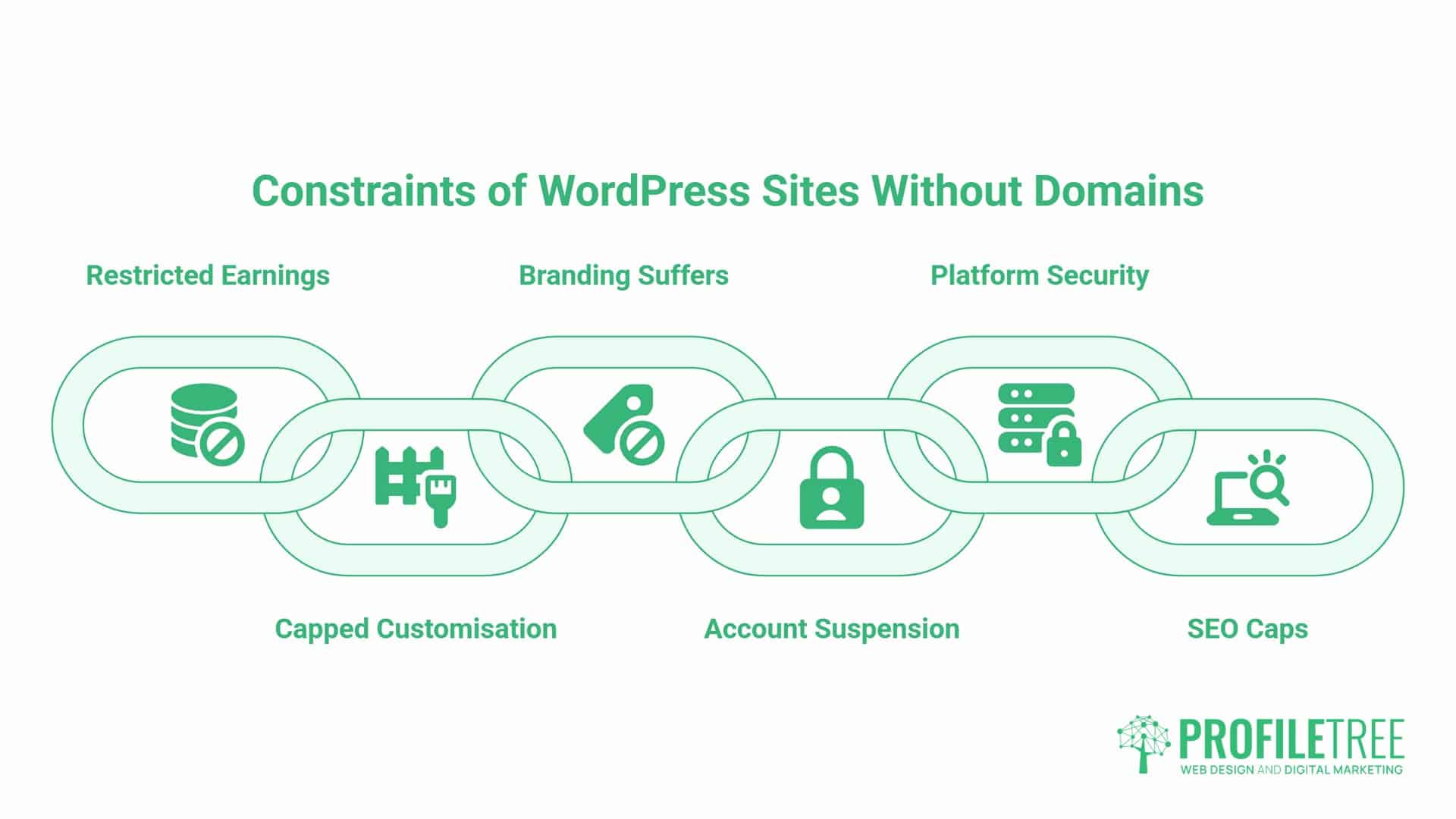
A WordPress website without a domain comes with real constraints, and most of them affect how the site grows and earns. Knowing them upfront saves you from building something you will have to rebuild.
- Earnings are restricted. Free plans limit advertising and selling, so monetising the site is difficult.
- Customisation is capped. Free hosted plans hold back plugin uploads, many themes and a lot of the design controls.
- Adverts appear on your pages. Free WordPress.com sites display the platform’s advertising to visitors, and you have no say over what shows.
- Branding suffers. A subdomain reads as less established than a custom address, which matters when a stranger is deciding whether to trust you.
- Accounts can be suspended. Break the platform’s rules and the site can be taken down.
- Security sits with the platform. You have less control over how the site is protected and no access at server level.
Once a site is earning its keep, the quality of its optimisation and its wider strategy matters far more than whether it started free. A subdomain caps both.
“A free build is a fine sandbox for learning WordPress, but I tell business owners not to mistake it for a foundation. The day you want customers to take you seriously is the day you need your own domain. Build on free if you must, just plan the move before you have content and links you can’t afford to lose.” Ciaran Connolly, founder of ProfileTree.
When Should You Buy a Domain?
Buy one the moment the site needs to be found, trusted or sold from. A few clear signals tell you the time has come.
One warning about price before the signals. Domain registrars advertise a first-year figure and charge a renewal figure, and the two are often very different. The registry behind each extension, Nominet for .uk and .co.uk, sets a wholesale price the registrar pays every year, so a penny in year one always corrects itself later. Find the renewal price before you register, because that is the number you pay for as long as you own the name.
Credibility and branding
A custom domain makes a far stronger first impression than a subdomain. It signals that the business is real, and it lets the web address match the brand. Choosing the name early, even before you are ready to build, keeps it out of the hands of a competitor or a squatter.
Custom email
A domain unlocks a professional email address in the form you@yourbusiness.com, which reads far better than a free generic account when you are dealing with customers and suppliers. For many small businesses this alone justifies the annual fee.
Search visibility and growth
A clear, memorable domain is easier for visitors to recall and share, and it gives you the technical control that search performance depends on. As traffic and content grow, owning the domain and the hosting makes it far simpler to scale, add a shop or build a members area.
Control and ownership
On a free subdomain you are at the mercy of the provider, who can run adverts on your pages or change the terms. Owning the domain gives you control over your own presence. Register early even if you build later, because domain names are unique, and once a name is taken you either pick another or pay the current owner for it.
Getting Started the Right Way
Building a WordPress website without a domain is a sensible way to learn the platform, test a design, or hold off on naming until you are certain. Free hosted plans, local installs and host preview addresses let you create and customise a full site at no cost, with the understanding that a subdomain will always cap how far you take it.
Treat the free build as a starting line rather than a destination. The day you want customers to find you, register a domain, move to proper hosting and give the site room to grow. Plan that move while the site is small, because it is far easier to migrate ten pages than a hundred.
Frequently Asked Questions
Can I create a WordPress website without a domain?
Yes. You can build a WordPress site without buying a domain by using a free WordPress.com subdomain, a local install on your own computer, or a temporary preview address from a host. The site works for development, learning and personal use, and it will not have a memorable public web address. For anything customer-facing, register a domain before you start promoting the site.
Is the WordPress.com free plan still actually free?
It is. The free plan has no expiry date and no credit card requirement, and it includes hosting, an SSL certificate, the block editor and a yoursite.wordpress.com subdomain with 1 GB of storage. The signup flow pushes custom domains hard enough that people assume the free option has gone, so the trick is to skip the domain step rather than back out of it.
I just want to try WordPress without paying for anything. What is the simplest way?
Sign up for the free WordPress.com plan, skip the domain offer and accept the subdomain. That gets you a working, public WordPress site in about five minutes with nothing to install and nothing to pay. If you would rather nobody saw it at all while you experiment, install WordPress Studio on your computer instead and build offline.
Why does my WordPress site break when I move it from a local install to a real domain?
Because the old address is written into the database in hundreds of places, not just in one setting. Links, image paths, menu items and plugin options all store the address the site was built on, so copying the files across leaves every one of those references pointing somewhere that no longer exists. A migration plugin performs a proper search and replace across the database, which is why that route works when a manual copy does not.
How do I get a domain for my WordPress website?
Register one through a domain registrar or a hosting provider. You search for an available name, pay an annual fee and connect it to your hosting. Check the renewal price rather than the first-year price before you buy, and register early, because once a name is taken you must choose another or buy it from the current owner.
Will a site on a free subdomain rank in Google?
It can be indexed, and it starts at a disadvantage. A subdomain on a shared platform carries none of the authority of your own domain, and anything it does earn stays with the platform rather than transferring cleanly to you later. Treat rankings earned on a free subdomain as temporary, and move to your own domain before you invest seriously in content.
Do I need coding skills to build a WordPress website?
No. WordPress uses themes and a visual block editor that let you build and customise a site without writing code. Themes set the design and plugins add features, so most people can assemble a working site with no technical background. The technical work tends to arrive later, at migration and performance rather than at the building stage.
Can I change the design of my WordPress website later?
Yes. You can switch themes or customise an existing one at any point, and changing the design does not delete your content. That is one of the genuine advantages of starting free: the content you write on a subdomain moves with you when the site grows up.