
How Sustainable Practices Improve Digital Content Performance
Table of Contents
Most conversations about sustainable practices in digital content production focus on the planet. The business case, though, is just as strong. A website that serves lean, well-structured digital content uses less server energy, loads faster, ranks better in search, and costs less to maintain over time. For SMEs in Northern Ireland, Ireland, and across the UK, that overlap between environmental responsibility and commercial performance is the most practical reason to start.
This guide covers what sustainable practices in digital content production actually mean for a business owner or marketing manager, how they connect to technical decisions like web design and SEO, and what steps produce the most meaningful results.
What Is Digital Sustainability and Why Does It Matter for SMEs?
Digital sustainability refers to operating online in ways that minimise environmental impact while maintaining or improving business performance. It spans how a website is built, how digital content is produced and stored, how assets are sized and served, and how marketing activity is structured over time.
The terminology matters less than the principle. Whether a business calls it sustainable digital content, green marketing, or simply efficient production, the core idea is the same: every decision about what to publish, where to host it, and how to deliver it carries an energy cost. Managing that cost well is also, in almost every case, managing for better performance.
The environmental cost of digital activity is real. According to the International Energy Agency, data centres accounted for around 1.5% of global electricity consumption in 2024, with sector demand growing at approximately 12% per year over the preceding five years. Each page load, each video stream, and each automated tool running in the background carries a measurable energy cost.
For a small or medium-sized business, the absolute environmental impact is modest. The practical argument for adopting sustainable practices in digital content production is that the same decisions that reduce energy consumption almost always improve performance. Smaller image files load faster. Cleaner code reduces server requests. A focused content strategy produces pages that rank more readily than a bloated archive of thin articles.
Sustainable digital practices are not a separate initiative alongside a marketing strategy. They are the same thing, approached with more discipline.
The Efficiency Dividend: Why Sustainable Content Improves SEO
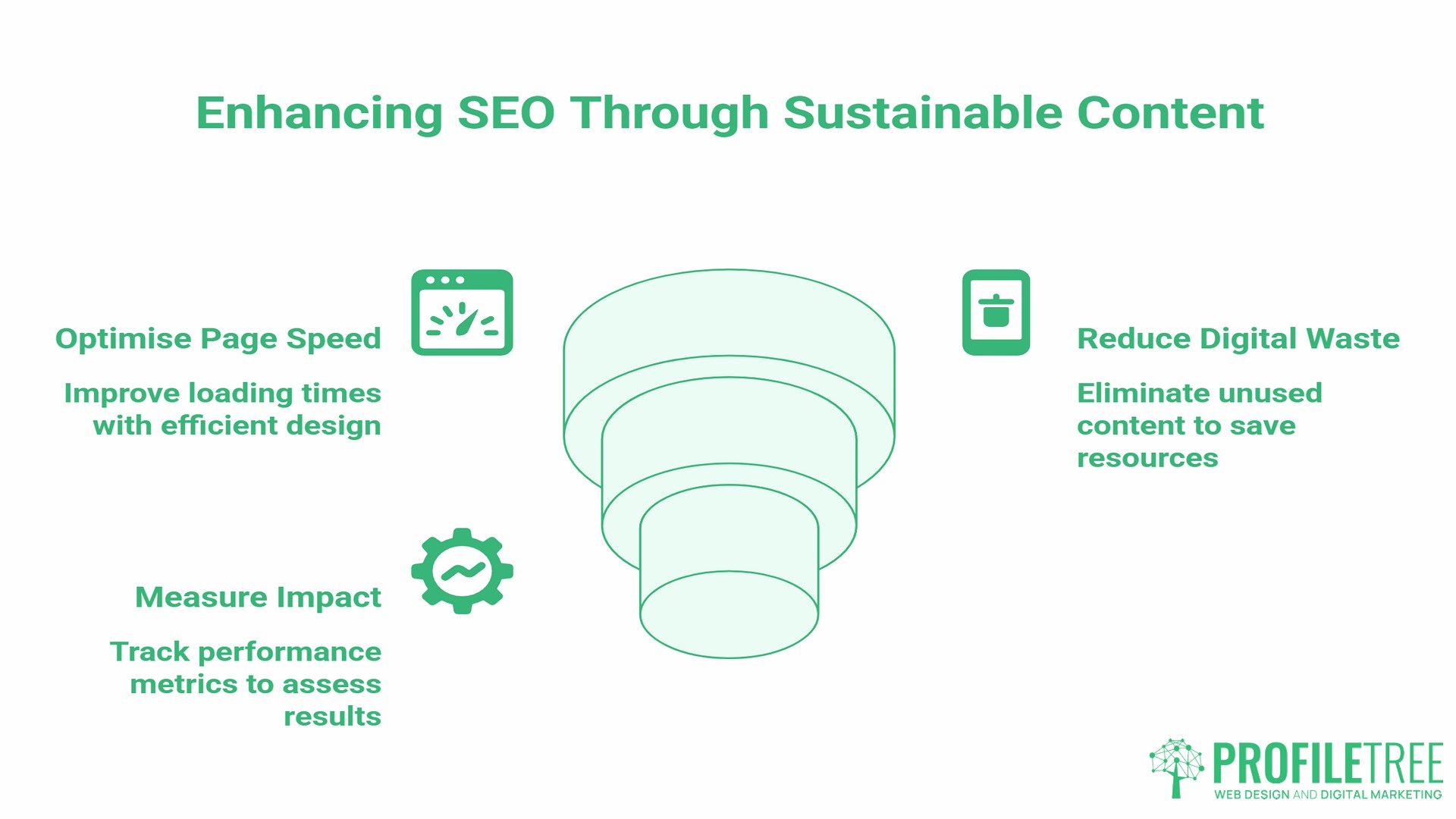
Google’s Core Web Vitals measure page speed, visual stability, and interactivity. These are also the metrics most directly affected by how efficiently a site is built and how well its digital content is maintained.
A page that scores well on Largest Contentful Paint typically uses compressed images in modern formats, minimal render-blocking scripts, and a hosting environment with fast response times. These same choices reduce the energy required to serve that page. Green web design and high-performing web design point to the same technical decisions: efficient code, appropriately sized assets, and a hosting stack that wastes no resources.
Reducing Digital Waste
“Zombie content” is a term used in content marketing for pages that receive no traffic, rank for nothing, and contribute nothing to a site’s topical authority. These pages still consume crawl budget, add to hosting load, and dilute the overall quality signals Google uses to evaluate a site.
A content audit that identifies and consolidates these pages is one of the highest-return sustainable practices available to any SME with an established website. It reduces server load, improves crawl efficiency, and typically produces measurable ranking improvements for the pages that remain. ProfileTree’s content marketing services treat content auditing as a starting point rather than an afterthought, because quality over volume consistently produces better long-term results than publishing for its own sake.
Measuring the Impact of Sustainable Digital Content Decisions
One reason sustainable practices in digital content production remain underused is that their impact is rarely measured. Most marketing teams track traffic, rankings, and conversions. Few track page weight, server requests per session, or the carbon cost of a page load. Adding these metrics does not require specialist tools or significant time.
Google PageSpeed Insights scores each page on performance and flags the specific elements adding the most weight: oversized images, render-blocking scripts, and unused CSS. Addressing the top three issues on any high-traffic page results in measurable improvements in load speed and reduced energy consumption to serve it. Tracking those scores over time, alongside organic traffic data, gives a clear picture of how sustainable digital content decisions translate into commercial outcomes.
This kind of baseline-and-improvement approach also feeds directly into CSR reporting. A business that can show its homepage load time has been reduced following an image format migration has a concrete, verifiable metric to include in an environmental performance section, without needing to overstate its impact or make claims it cannot support.
Five Pillars of Sustainable Digital Content Production
The following areas cover the decisions with the greatest combined environmental and commercial impact for most SMEs.
1. Sustainable Web Design and Hosting
Web hosting powered by renewable energy reduces a site’s direct carbon impact. A number of UK and Irish hosting providers now publish verified green credentials, including renewable energy contracts or carbon offset programmes. When evaluating a provider, look for verifiable third-party certification rather than relying solely on marketing claims.
Beyond the energy source, the architecture of the site itself matters. A WordPress site running a large number of plugins, several of which duplicate functionality, generates more server requests per page load than a tightly configured equivalent. Each additional request adds latency and energy cost. Applying sustainable practices in web design from the outset means specifying sites that do what they need to do, with nothing superfluous running in the background.
The same logic applies to the digital content itself. Pages carrying large uncompressed images, autoloading video, and multiple third-party tracking scripts are not just slow; they are expensive to serve. A well-built WordPress site with clean code and appropriate hosting can serve the same digital content at a fraction of the energy cost of a poorly optimised equivalent.
2. Visual Asset Optimisation
Images and video account for the majority of page weight on most websites. WebP images are typically 25-35% smaller than JPEGs at the same quality. AVIF can reduce file sizes by 50% or more compared to JPEG, which matters for large hero images and product photography. These are not marginal gains: on an image-heavy page, the difference in load time and energy demand is significant.
Video requires more deliberate management. Auto-playing background video is among the highest-cost elements a website can carry, both in terms of data transfer and user experience. Where video serves a genuine purpose, hosting through YouTube or Vimeo rather than self-hosting reduces server load and allows adaptive bitrate streaming, which serves lower-quality versions to users on slower connections rather than forcing full resolution every time.
For businesses producing regular digital content, establishing a consistent file management and archiving protocol prevents ongoing storage waste and keeps production workflows lean.
3. Eco-Friendly Content Strategy and Digital Sobriety
“Digital sobriety” describes the practice of producing and distributing only the digital content that genuinely serves a defined purpose. It is the opposite of publishing to a schedule because the calendar says to, regardless of whether the content adds anything new.
For sustainable content marketing, this means starting with an audit before adding to an existing library, building digital content around specific search intents rather than broad topics, and consolidating related articles rather than maintaining dozens of thin pages on overlapping subjects. The result is a smaller body of content that performs better, costs less to maintain, and places less demand on server resources.
Applying sustainable practices to a content strategy also means being deliberate about the formats you use. A well-structured article with clear headings, a defined audience, and a specific search intent will outperform a longer, less focused piece on every metric that matters: rankings, time on page, and conversion. The goal is not to publish less for the sake of it; it is to make every piece of digital content earn its place.
“The SMEs that perform best in organic search are almost never the ones with the most content,” says Ciaran Connolly, founder of ProfileTree. “They are the ones whose content is focused, accurate, and genuinely useful for the person searching. That approach also happens to be the most sustainable one: produce less, make it count.”
4. AI Tools and Energy Awareness
AI tools have made digital content production faster and cheaper. They have also introduced an energy consideration that most sustainable practices guides have not yet addressed directly.
According to data published by the Brookings Institution, drawing on IEA research, a single query on an advanced generative AI model in 2024 required an estimated 2.9 watt-hours of electricity, nearly ten times the 0.3 watt-hours needed for a conventional Google search. The practical implication for digital content production is not that AI tools should be avoided. It is that using AI to generate high volumes of low-quality digital content, which is then published without substantive editing, produces waste and consumes energy.
Sustainable AI implementation means using generative tools to assist human-led production, not to replace editorial judgement entirely. A team that uses AI to draft outlines, speed up research, and check for structural gaps, while a human writer handles the actual prose and fact-checking, is applying sustainable practices to its digital content workflow in a way that is both more efficient and more likely to produce content that ranks. ProfileTree’s AI implementation work with SMEs approaches this from a practical efficiency standpoint: the goal is to reduce repetitive production overhead while maintaining quality, not to automate digital content output at the cost of accuracy or usefulness.
5. Organic Search as a Sustainable Channel
Paid advertising carries its own energy and resource cost. Every ad impression, click, and retargeting sequence runs on server infrastructure. A poorly targeted paid campaign wastes budget and generates engagement at a lower quality-to-cost ratio than organic alternatives.
Investing in SEO and organic digital content builds a channel that compounds over time without continuous spend. For SMEs with limited marketing budgets, this is both the more sustainable and the more cost-efficient long-term approach. A page that ranks organically for a target keyword delivers traffic without a marginal energy or financial cost per click. ProfileTree’s digital marketing work in Northern Ireland reflects this priority: organic channels built on strong digital content deliver better returns over time than dependence on paid acquisition.
Sustainable Practices in the UK and Ireland: Available Support
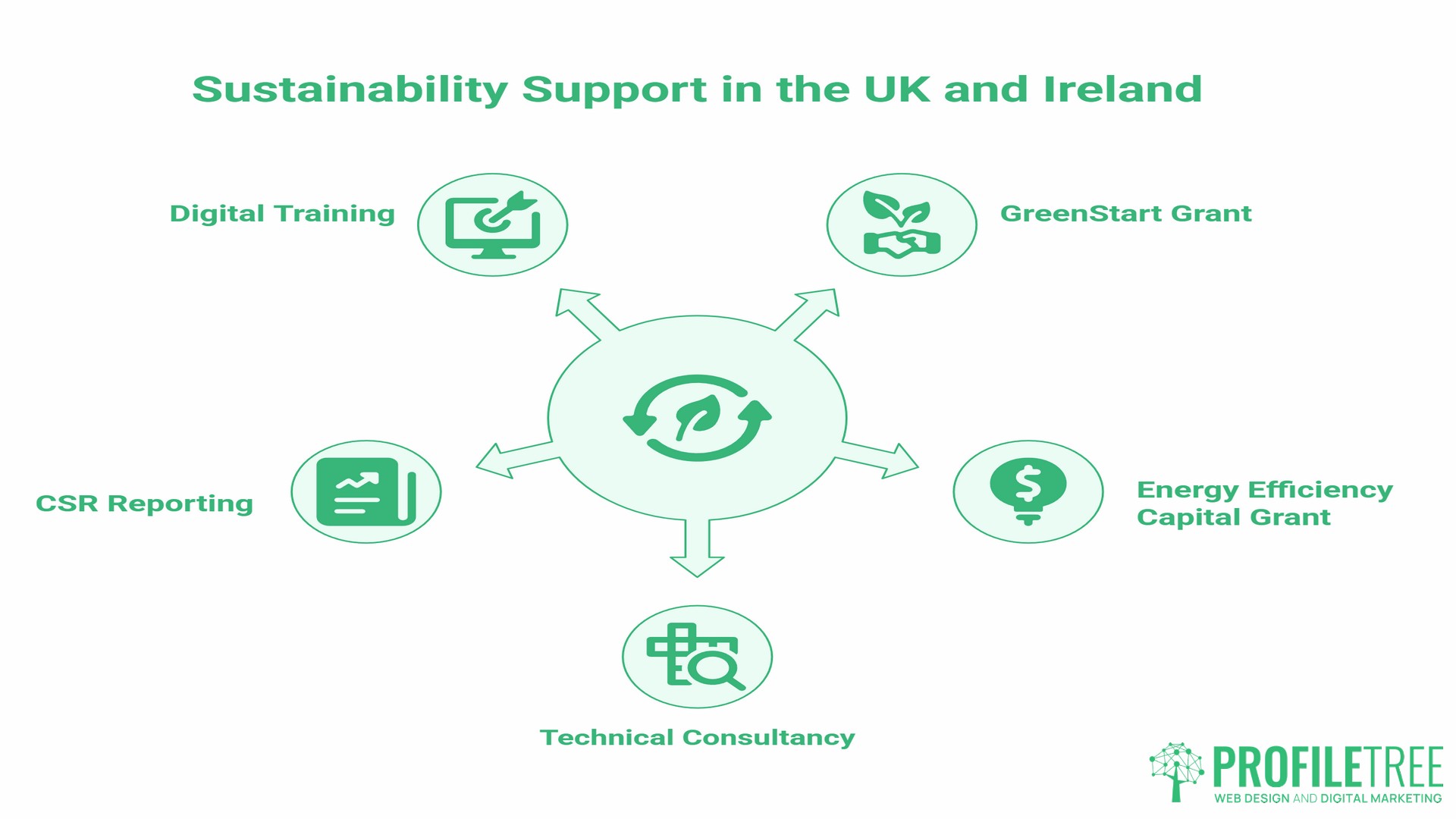
Businesses in Northern Ireland and the Republic of Ireland have access to specific support for sustainability initiatives that larger markets do not always signpost clearly.
In the Republic of Ireland, the GreenStart grant, available through Local Enterprise Offices, supports a training, consultancy, or advisory project of up to 7 days carried out by an external green service provider, with the aim of improving the business’s environmental performance. This can fund work that overlaps with digital infrastructure review, including hosting decisions, energy consumption assessments, and digital content workflow analysis.
In Northern Ireland, Invest NI’s Energy Efficiency Capital Grant is a five-year programme offering businesses grants of up to £150,000 for investments in energy-efficient equipment that reduces energy consumption and carbon emissions. The programme covers a wide range of business types. Invest NI also provides free technical consultancy support for businesses spending over £30,000 annually on energy and resources, to help identify efficiency opportunities before a formal application.
From a reporting standpoint, businesses producing a CSR report can incorporate digital sustainability metrics as a measurable category. The approach involves establishing a baseline using a tool such as Website Carbon (websitecarbon.com) or the Beacon tool from Wholegrain Digital, then documenting improvements following hosting migration, image optimisation, or digital content reduction work. This gives marketing managers a concrete, verifiable output to include in environmental performance reporting.
Digital training plays a direct role here. A marketing team that understands how digital content decisions affect site performance is better placed to consistently apply sustainable practices, without needing external intervention for every decision. ProfileTree’s digital training for SMEs covers practical content and SEO skills that connect directly to this kind of ongoing decision-making.
A Practical Checklist for Sustainable Digital Content Production
The following covers the areas where most SMEs can make measurable improvements to their sustainable practices without significant investment.
Website and hosting
- Confirm your hosting provider uses renewable energy or holds verified green credentials
- Review plugin count on your WordPress site and remove duplicates or unused tools
- Test the current page speed using Google PageSpeed Insights and identify the largest contributing factors
Visual assets
- Convert existing JPEG and PNG images to WebP as a default, with AVIF for large hero images
- Set image upload guidelines that define maximum file sizes before compression
- Remove auto-play video from pages where it serves no clear conversion purpose
Digital content strategy
- Run a content audit to identify pages with zero traffic over the past 12 months
- Consolidate closely related articles rather than maintaining separate thin pages
- Publish on a needs-driven schedule rather than a fixed calendar
AI and production tools
- Use AI tools for editing assistance, outline generation, and research, not for unedited bulk publication
- Audit which AI tools your team currently uses and whether each one serves a clear purpose
- Factor AI energy costs into your digital content production decisions alongside time and budget
Measurement
- Run a baseline carbon test on your homepage using Website Carbon or Beacon
- Record the result and re-test following any significant site or hosting changes
- Include digital sustainability metrics in your next CSR or marketing review
FAQs
What is the environmental impact of digital content production?
Digital content production consumes energy at every stage: through the devices used to create it, the servers that store and serve it, and the networks that distribute it. According to the International Energy Agency, data centres accounted for around 1.5% of global electricity consumption in 2024, with demand growing at approximately 12% per year. Adopting sustainable practices in digital content production reduces the footprint while typically improving page performance.
Is digital marketing more sustainable than print?
Generally, yes, but not unconditionally. Digital marketing eliminates paper, physical distribution, and print waste. It does, however, rely on data centre infrastructure, device manufacturing, and continuous energy consumption. A lean, well-optimised digital presence with a focused content strategy is substantially more sustainable than high-volume print. A bloated digital estate running unnecessary tools and hosting unused digital content is less clear.
How can I measure my website’s carbon footprint?
Website Carbon (websitecarbon.com) provides a free per-page estimate based on data transfer, hosting energy source, and average grid carbon intensity. The Beacon tool from Wholegrain Digital offers similar functionality. Neither gives precise figures, but both provide a consistent baseline for tracking the impact of sustainable practices over time.
What are practical strategies for sustainable video production?
The highest-impact steps are: use LED lighting to reduce power consumption on set; use cloud-based post-production to avoid duplicating large files; host finished digital content on YouTube or Vimeo rather than self-hosting; compress files to the lowest resolution that meets quality requirements; and avoid auto-play on web pages. For teams producing regular digital content, a consistent file management and archiving protocol also prevents ongoing storage waste.
Does using AI increase my carbon footprint?
Yes, to a measurable extent. According to IEA data cited by the Brookings Institution, a single query on an advanced generative AI model in 2024 required an estimated 2.9 watt-hours of electricity, nearly 10 times the energy used by a conventional search query. The larger concern for sustainable digital content practices is indirect: AI tools that lower the barrier to publishing large volumes of low-quality pages encourage behaviour that creates digital waste. Using AI to assist careful, human-led production is both lower in overall energy cost and more likely to produce digital content that ranks and converts.
Are there green business grants available in Northern Ireland or Ireland?
Yes. In the Republic of Ireland, the GreenStart grant is available through Local Enterprise Offices and provides external advisory support to help businesses improve their environmental performance. In Northern Ireland, Invest NI’s Energy Efficiency Capital Grant is a five-year programme offering grants of up to £150,000 for businesses investing in energy-efficient equipment. Both are worth exploring if sustainable practices are part of a broader operational review. Eligibility criteria and availability should be confirmed directly with each body, as programmes are subject to funding rounds.