
Quora Ads Best Practices: A UK Marketer’s Guide
Table of Contents
Quora attracts over 400 million monthly visitors who are actively searching for answers, not passively scrolling a feed. For UK businesses targeting professionals in research mode, that intent gap is significant and largely untapped compared to the crowded Meta and LinkedIn auction.
This guide covers what actually moves the needle on Quora: from pixel setup and UK-GDPR compliance to promoted answer structure, GBP bidding benchmarks, and the reporting integrations that give you clean attribution data. It also addresses the post-click journey, which most Quora guides ignore entirely ,,despite it being where most campaigns fall apart.
Whether you are testing Quora an Quora ads for the first time or looking to improve an underperforming campaign, the practices below are drawn from platform documentation, independent benchmark studies, and applied B2B campaign experience across UK markets.
Technical Foundation: Pixel, GTM, and UK-GDPR Compliance
Before any targeting or creative work begins, the Quora Pixel must be in place and firing correctly. Without it, you cannot build custom audiences, track conversions, or run retargeting. Removing that capability takes away the most cost-effective layers of the platform. Getting the technical setup right from the start saves significant wasted spend later.
Implementing the Quora Pixel via Google Tag Manager
The cleanest implementation method is through Google Tag Manager using a Custom HTML tag. Paste the base Quora Pixel code into the tag, set the trigger to “All Pages,” and publish. This approach keeps the pixel asynchronous, meaning it loads without blocking your page content, which protects Core Web Vitals scores.
Once the base pixel fires, set up event tags for the actions that matter to your campaign: page views on key landing pages, form submissions, and purchase completions. In GTM, each of these becomes a separate Custom HTML tag with the corresponding Quora event code and a trigger tied to the specific page URL or button click. Test every event using the GTM preview mode and the Quora Pixel Helper browser extension before going live.
UK-GDPR and ICO Compliance for the Quora Pixel
UK marketers operating under UK-GDPR and ICO guidance cannot fire the Quora Pixel on page load without explicit user consent. The pixel collects behavioural data for retargeting, which falls under the “strictly necessary” exemption only if it is directly required for a transaction the user has initiated. Advertising pixels do not meet that threshold.
In practice, this means the pixel must fire only after a user has accepted tracking cookies through a compliant consent management platform (CMP). In GTM, configure the Quora Pixel tag to fire on a consent-granted trigger rather than “All Pages.” Most CMPs compatible with GTM publish a data layer event when a user accepts; use that event as your trigger. Firing the pixel before consent is obtained risks ICO enforcement action and, more practically, invalidates the audience data you collect.
The ASA and CAP Code also apply to the ad content itself: claims made in Quora ads must be verifiable, not misleading, and consistent with what the linked landing page actually delivers. If your ad copy references a price, a result, or a specific capability, that claim must be substantiatable.
Connecting Quora Ads Data to Reporting Tools
Quora’s native dashboard provides impression, click, and conversion data at campaign and ad-set level, but most UK marketing teams need that data inside a centralised reporting environment. Quora Ads Manager includes a CSV export function for all standard metrics; this is the most straightforward route for one-off analysis in Excel or Google Sheets.
For automated reporting, Quora data can be pulled into Looker Studio (formerly Google Data Studio) via third-party connectors such as Supermetrics, Windsor.ai, or Porter Metrics. These connectors authenticate with your Quora Ads account and schedule daily data refreshes, allowing you to blend Quora performance with Google Ads, Meta, and LinkedIn data in a single dashboard. For teams with data warehouse requirements, the same connector services support export to BigQuery, PostgreSQL, and Tableau, enabling cross-channel attribution modelling at scale.
When setting up any connector, map Quora’s conversion events to the same naming conventions used across your other platforms. Consistent event naming is what makes cross-channel attribution reliable rather than approximate.
Quora Targeting: Matching Intent to Audience
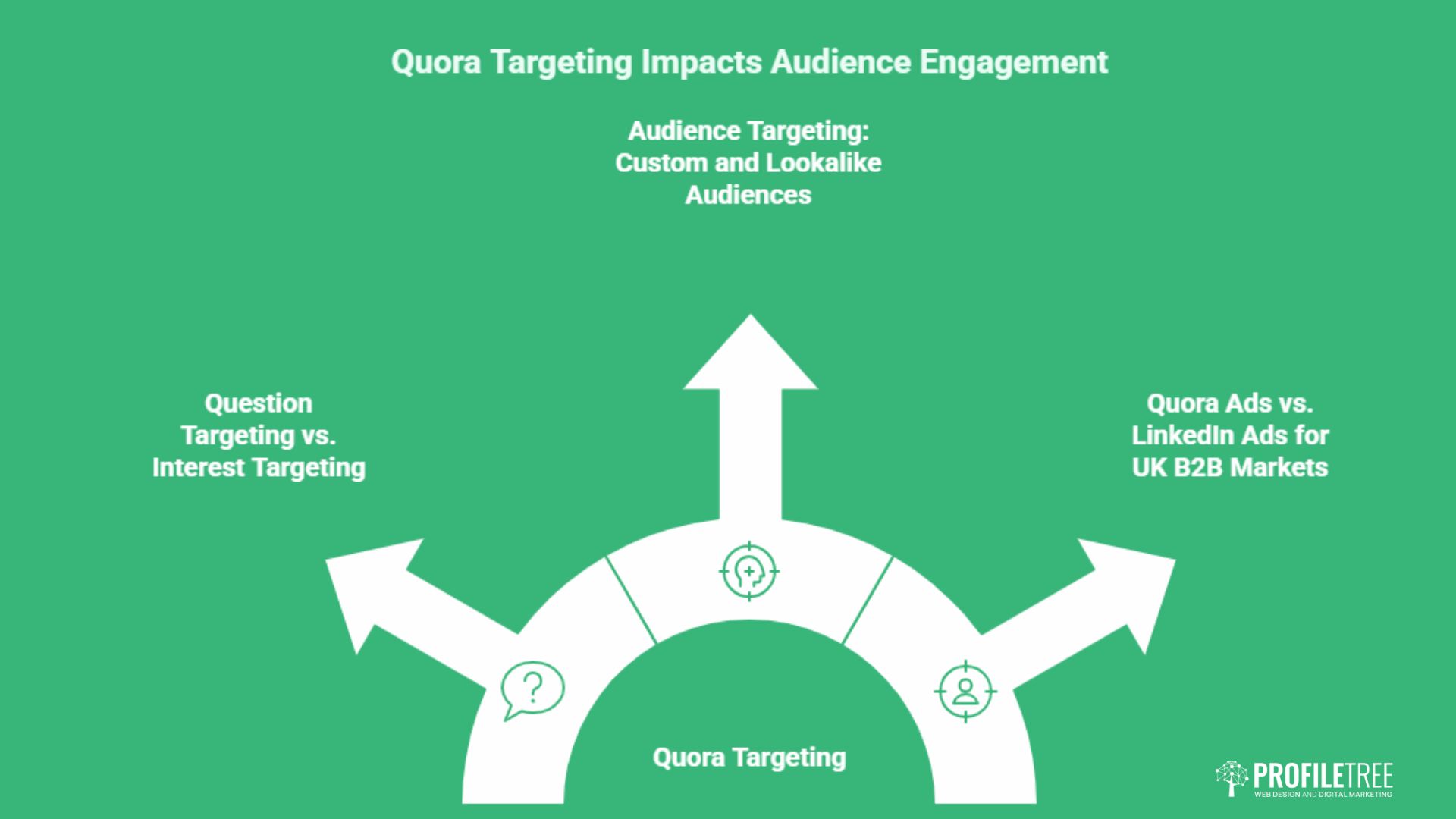
Quora’s targeting options fall into two broad categories: question-level targeting and audience-level targeting. The distinction matters because it determines where in the buyer journey your ad appears. Choosing the wrong type for your campaign objective is one of the most common reasons UK campaigns underperform despite reasonable budgets.
Question Targeting vs Interest Targeting
Question targeting places your ad directly alongside specific Quora questions. A user reading “What is the best CRM for a professional services firm in the UK?” is at a moment of active evaluation. Serving them an ad for your CRM or digital strategy service at that precise moment is about as close to intent-matched advertising as paid media gets outside of Google Search.
Interest targeting reaches users based on their broader topic engagement, not a specific question. It operates more like a contextual display network. The audience is larger, the intent is lower, and CPCs are generally cheaper. This is appropriate for brand awareness campaigns where reach matters more than precision, but it should not be the primary targeting method for lead generation.
For B2B campaigns targeting UK professionals, the recommended starting point is question targeting around the specific problems your service solves. Build a list of 30 to 50 highly specific questions relevant to your industry. Aim for questions that indicate someone is actively evaluating options, not just exploring a topic. Check the answer quality on those questions too: if the existing answers are poor, a well-crafted promoted answer will stand out considerably.
You can find relevant questions directly in the Quora Ads Manager under the “Question Targeting” option. Type a keyword ,and the platform returns a list of matching questions with approximate audience size. Filter for questions with at least a few hundred followers for sufficient volume, but avoid the very high-volume generic questions where your ad will compete with far broader intent.
Audience Targeting: Custom and Lookalike Audiences
Custom audiences on Quora are built from your own data: email lists, website visitors (via the pixel), or users who have engaged with a previous ad. For UK B2B campaigns, uploading a matched email list of existing prospects or past customers allows retargeting with highly specific messaging, such as a case study or a limited-time offer, to people who already know the brand.
Lookalike audiences expand from your custom audience seed to reach Quora users who share similar characteristics. These work well once you have a seed list of at least a few hundred converted customers. Without a quality seed, the lookalike will be too broad to outperform standard interest targeting.
Geographic targeting to the UK or specific regions within it is available at the campaign level. For Northern Ireland-based businesses or those serving specific UK cities, narrowing the geographic target reduces wasted spend on irrelevant markets and tends to improve conversion rates from the traffic that does arrive. Connecting this to broader community engagement strategies on other platforms also strengthens overall brand recall.
Quora Ads vs LinkedIn Ads for UK B2B Markets
The comparison that UK B2B marketers most frequently raise is Quora versus LinkedIn. Both platforms reach professional audiences, but they differ substantially in intent, cost, and targeting precision.
LinkedIn’s primary advantage is job-title and company-size targeting. If you need to reach Finance Directors at UK manufacturing companies with 200 to 500 employees, LinkedIn can approximate that with reasonable accuracy. The trade-off is cost: LinkedIn CPCs in the UK typically range from £5 to £15 or more in competitive verticals, and the user is interrupting a professional feed, not reading content directly related to your solution.
Quora’s advantage is contextual intent. When a user is reading answers to a specific business problem, an ad appearing in that context carries much lower friction than an unsolicited LinkedIn InMail. UK CPCs on Quora typically fall between £0.30 and £2.00, depending on the industry and targeting specificity, with a platform minimum daily spend of around £4.00. The trade-off is that Quora’s job-title targeting is less granular than LinkedIn’s, and the platform’s UK audience, while substantial, is smaller than LinkedIn’s in absolute terms.
Ciaran Connolly, founder of ProfileTree, puts it this way: “Quora sits in a different part of the buyer journey to LinkedIn. On LinkedIn, you’re interrupting a scroll. On Quora, you’re answering a question someone is actively asking. That intent gap usually translates into lower CPCs and stronger lead quality for UK B2B campaigns, particularly in professional services and tech.”
Neither platform replaces the other. For most UK B2B campaigns with limited budgets, starting with question-targeted Quora ads to test intent-matched messaging, then scaling successful angles on LinkedIn to a broader professional audience, is a more capital-efficient sequence than running both at full spend simultaneously. For more on the LinkedIn advertising side of that equation, theLinkedInd overview covers targeting strategy in detail.
For comparison, UK Facebook Ads occupy a different segment again: broader reach, lower average CPCs than LinkedIn, but weaker intent signals than Quora for professional-service queries. The right channel mix depends on your audience’s behaviour, not a blanket platform ranking.
Ad Creative: Promoted Answers and Image Ads
Quora offers several ad formats, but two dominate performance for B2B lead generation: promoted answers and image ads. Each requires a different creative approach, and conflating the two is one of the most consistent reasons UK campaigns generate impressions without generating leads. The platform also has the Quora community context to consider: promotional content that feels native to the Q&A environment outperforms anything that reads like a display ad.
Writing High-Converting Promoted Answers
A promoted answer is a Quora answer that has been boosted with paid spend. It appears in the answer feed of the question you have targeted, visually indistinguishable from organic answers except for the small “Promoted” label. This format works because users on Quora are actively reading answers, not trying to scroll past ads. If your promoted answer is genuinely useful, it will be read.
The structure that consistently outperforms starts with a direct answer to the question in the first two sentences. Do not build to the point; state it immediately. Users who read Quora answers skim the opening and decide within seconds whether to continue. If your first sentence does not address the question, they will not read the rest.
After the direct answer, give one or two paragraphs of supporting context: specific data, a process step, or a framing that adds something the other answers on that question have not covered. This is where information gain matters. If the first three organic answers already cover the basics well, your promoted answer needs to add a perspective or data point that those answers do not have.
The contextual link to your service or resource should appear naturally within the body, not as a closing call to action. A phrase like “this is also why we structure our digital audits around [topic]; the process is outlined here” is less intrusive than “click here to find out more.” One link per promoted answer is the maximum; more than one reads as promotional and damages credibility with the reader.
Quora’s editorial guidelines prohibit answers that are primarily promotional, contain sensationalist claims, use misleading statistics, or make direct solicitations in the opening lines. Ads that violate these guidelines are rejected before going live. The most common rejection reasons are: headline text in title case (Quora requires sentence case in the answer body), exclamation marks in the headline, and first-person claims about your product that are not substantiated in the answer text.
Image Ad Specifications and Best Practices
Image ads appear in the right-hand rail on desktop and inline in the feed on mobile. The recommended image size is 1200 x 628 pixels, JPEG or PNG, under 5 MB. Images with clear visual contrast to the white Quora interface perform better than low-contrast designs that blend into the background.
Avoid stock photography with groups of people in meeting rooms. These images have been used across so many platforms that users have developed an active blind spot for them. Flat illustrations, data visualisations, and product screenshots tend to maintain attention longer. Text within images should be minimal: Quora does not apply a text-coverage rule the way Meta does, but heavy text overlays reduce visual impact.
Headlines for image ads must be in sentence case, under 65 characters, and cannot contain exclamation marks or claims that cannot be substantiated in the body copy. Body text should be under 105 characters for optimal display across placements. Keep the call to action simple and specific: “Read the full guide,” “Get a quote,” or “See the case study” outperform generic CTAs like “Learn more” because they set a clear expectation of what happens next.
Common Ad Rejection Reasons and How to Avoid Them
Beyond the promotional content rules, Quora rejects ads for several technical and policy reasons that are not always clearly documented. Being aware of them before submission avoids frustrating delays between campaign setup and going live.
Title case in headlines is the single most frequent rejection reason. Quora requires sentence case (only the first word and proper nouns capitalised) in all ad text. Copying a headline from a Meta or Google ad without converting the casing will result in rejection. Punctuation rules are also stricter than most platforms: multiple exclamation marks, ellipses used for dramatic effect, and ALL CAPS text all trigger manual review.
Claims about rankings, awards, or being “the UK’s leading” anything require substantiation. If you cannot point to a specific third-party source for the claim, remove it. Quora’s team reviews ads manually for policy compliance before they go live, so a rejection adds a delay of up to 24 to 48 hours to your campaign launch timeline. Building a two-day buffer into your campaign start date is worthwhile.
Budgeting, Bidding, and UK Performance Benchmarks
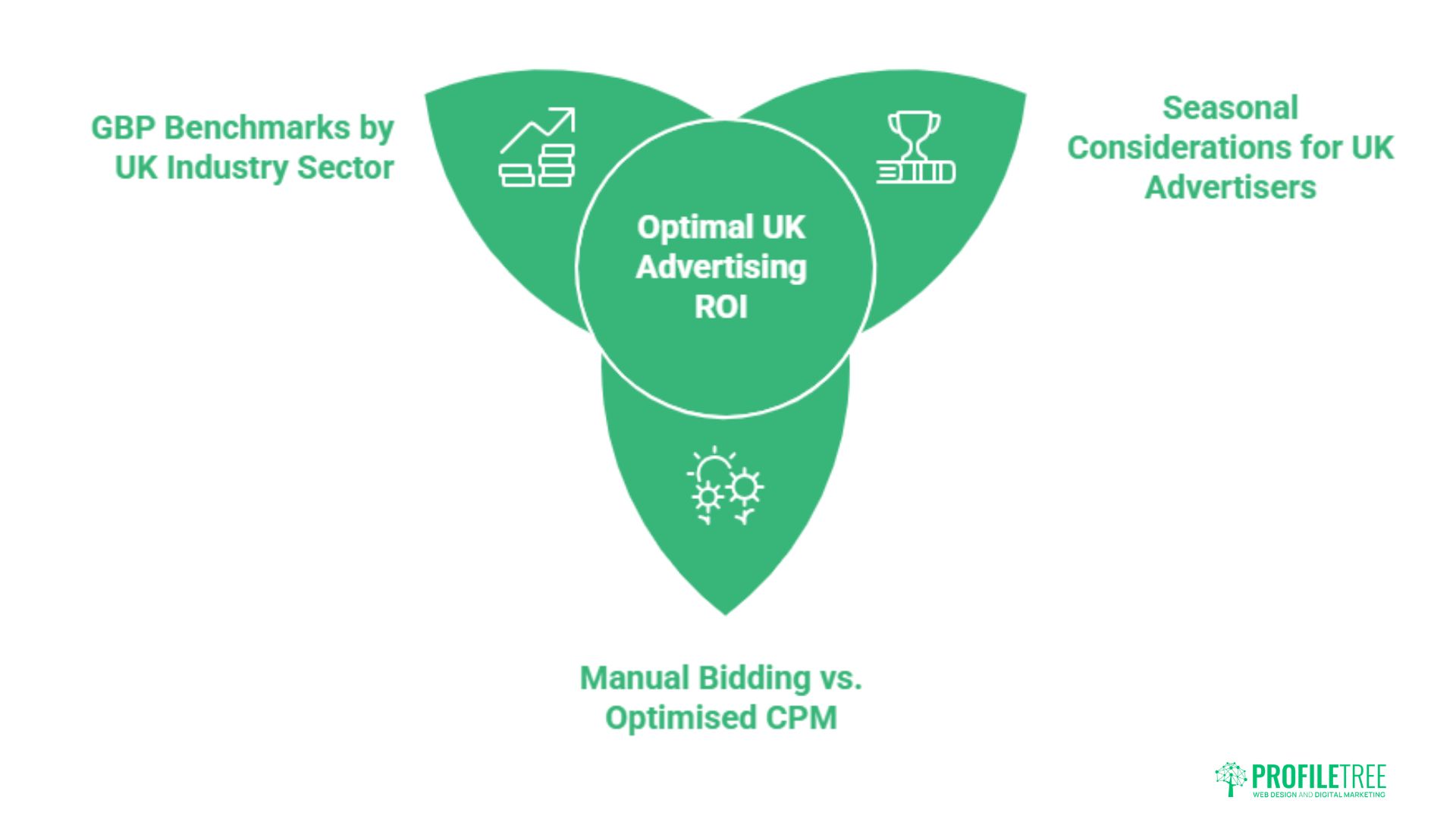
Quora’s auction operates on a second-price model: you pay slightly above the second-highest bid, not your maximum bid. This means your maximum CPC bid sets a ceiling, not the price you actually pay. Understanding how the auction behaves in UK markets allows you to set more efficient bids from the start rather than discovering the effective CPC after a week of overspend.
All prices and figures in this guide are indicative UK examples and correct at the time of writing; use them as a benchmark rather than fixed quotations.
GBP Benchmarks by UK Industry Sector
Benchmark CPCs in the UK vary substantially by sector. Professional services (accountancy, legal, consulting) and SaaS products targeting business decision-makers tend to sit at the higher end of the Quora range, typically £0.80 to £2.00 per click, reflecting stronger competition for those question audiences. Technology and software queries run from £0.50 to £1.50. Education and training, where Quora has strong organic engagement, typically sees CPCs of £0.30 to £0.90. Consumer-facing products and local services tend to be cheaper, often £0.20 to £0.60, but the audience quality for B2B purposes is lower.
Cost per lead (CPL) figures are harder to benchmark because they depend heavily on landing page conversion rates, offer type, and sales cycle length. A reasonable target for UK B2B campaigns is a CPL of £15 to £60 from question-targeted Quora ads, achieved through a combination of low CPCs and a landing page conversion rate of 5 to 15 per cent. This compares favourably to LinkedIn, where CPLs of £60 to £200 are common in the same verticals. Fora broader context on what determines digital marketing ROI, the linked article covers attribution frameworks and budget allocation across channels.
Manual Bidding vs Optimised CPM
Quora offers three bidding options: manual CPC (you set the maximum per click), optimised CPM (the platform bids automatically to maximise conversions within your daily budget), and maximum CPM (you pay per thousand impressions). For new campaigns with no historical data, manual CPC is the safer starting point: it gives you control over spend while the platform’s algorithm learns your audience and conversion patterns.
Once a campaign has accumulated at least 30 to 50 conversions, switching to optimised CPM typically reduces cost per conversion by 15 to 30 pper centbecause the algorithm has enough data to identify the highest-converting audience segments within your targeting parameters. If you switch to optimised bidding too early, the algorithm has insufficient signal and the spend efficiency drops.
Set daily budgets rather than lifetime budgets during the testing phase. Lifetime budgets front-load spend in ways that are difficult to diagnose when a campaign is new. A daily budget of £15 to £25 is sufficient for a UK B2B test campaign targeting niche audiences, and it gives enough volume to produce meaningful performance data within two to three weeks.
Seasonal Considerations for UK Advertisers
UK search behaviour has seasonal patterns that affect Quora performance as much as any other channel. January to March sees strong B2B intent as new budget cycles begin and decision-makers research solutions. The run-up to the UK financial year-end in April creates urgency-driven research behaviour. August is typically softer for B2B as decision-makers take leave. October to November sees another B2B peak before the December slowdown.
Adjusting bids upward during high-intent periods and pulling back during low-intent months is a straightforward way to improve annual CPL efficiency without increasing overall budget. This is particularly relevant for professional services firms and software vendors whose sales cycles align with UK financial planning calendars.
The Post-Click Journey: Landing Pages for Quora Audiences
Most Quora ad guides end at the click. That is where the majority of campaign performance problems actually begin. Quora users arrive at your landing page in a specific cognitive mode: they have been reading long-form answers to a question they care about. They are in information-gathering mode, not buying mode. A landing page designed for a Facebook audience, where users are conditioned to scan and decide quickly, will convert Quora traffic poorly.
Matching Landing Page Depth to Quora Intent
The single most important adjustment for Quora traffic is matching the landing page’s information depth to the intent of the question your ad appeared alongside. If your promoted answer appeared next to “What are the best tools for managing B2B lead generation in the UK?”, the landing page should address that question with depth: specific process information, concrete examples, and enough detail for a reader in research mode to feel they have genuinely learned something.
A generic homepage, a short service overview page, or a pop-up-heavy page with minimal content will cause a high bounce rate and low conversion. Quora users who click through to a resource-light page feel misled by the promise implied in your promoted answer, and they leave immediately. The algorithm registers this behaviour and reduces your ad quality score over time, which increases your CPCs in subsequent auctions.
The most effective landing page formats for Quora traffic are detailed guides, case studies with specific process descriptions, and free tools or assessments that let the user evaluate their own situation. These formats respect the research mindset Quora users bring and give them something of value in exchange for contact information or a conversion action. For social media advertising campaigns more broadly, the same principle applies: match the landing page depth to the platform’s intent level, not just to your campaign’s conversion goal.
Page Experience Signals That Affect Quora Traffic Quality
Quora tracks post-click behaviour indirectly through ad quality signals. Pages with strong Core Web Vitals (fast loading, stable layout, responsive design) do not directly lower your Quora CPCs, but they do improve conversion rates from the traffic you pay for, which reduces your effective CPL. A page that loads in under two seconds on mobile converts Quora traffic measurably better than one that takes four or more seconds, simply because Quora’s mobile audience will not wait.
HTTPS is mandatory for any page receiving Quora ad traffic. Non-secure landing pages are rejected at the ad setup stage. Keep redirects from the ad destination URL to the final page minimal: each redirect adds loading time and increases drop-off before the page even loads.
Tracking Conversions Accurately from Quora
Accurate attribution of Quora-driven conversions requires the pixel event to fire on the confirmed conversion page (a “thank you” or “booking confirmed” page, not the form page itself). Firing the conversion event on form submission without confirming the submission was successful overstates conversions and inflates your ROAS figures.
For businesses using CRM systems such as HubSpot or Salesforce, passing the UTM parameters from Quora ad clicks through to the CRM record allows you to track the full journey from ad impression to closed deal. Set up UTM parameters at the campaign, ad-set, and ad level in Quora Ads Manager, and confirm that your CRM captures UTM data on form submission. This is the only way to calculate true pipeline value from Quora spend rather than relying on last-click conversion counts alone.
Northern Ireland businesses serving both the UK and the Republic of Ireland markets should note that cross-border data flows under the UK-GDPR and the EU GDPR require separate legal bases for processing. If your pixel collects data from both jurisdictions and passes it to a US-based ad platform (including Quora), you need a transfer mechanism in place (typically Standard Contractual Clauses, and this should be reflected in your privacy policy. This is an area where both the ICO (for the UK) and the DPC (for Ireland) have issued enforcement guidance.
Northern Ireland’s dual-regulatory position (under both the Windsor Framework and UK domestic law) is a genuine compliance consideration that most generic ad guides ignore. If your Quora campaigns target users in both jurisdictions, legal review of your data processing documentation is a worthwhile investment before scaling spend. For a broader context on visiting the markets your campaigns may serve, the top cities to visit in Northern Ireland, such as Connolly Cove, provide a useful regional background.
ProfileTree’s digital marketing services include paid media strategy and campaign setup for UK and Irish businesses. If you want to discuss whether Quora fits your current channel mix or need support building a cross-channel attribution model, get in touch with the team.
Conclusion
Quora rewards advertisers who take the platform seriously enough to understand its audience, respect its editorial environment, and build landing pages that deliver on the promise of the promoted content. The campaigns that generate strong UK CPLs are not necessarily the highest-spending ones; they are the ones built around a genuine match between question intent, ad content, and post-click experience. Getting those three elements aligned is where the real performance difference lies. If you want support building that framework, ProfileTree’s digital marketing services cover paid media strategy and campaign setup across UK and Irish markets.
FAQs
How much do Quora ads cost in the UK?
Typical UK CPCs range from £0.30 to £2.00, depending on industry and targeting type. Question-targeted ads in competitive B2B sectors (legal, SaaS, professional services) sit toward the higher end. The minimum daily budget is approximately £4.00. All figures are indicative benchmarks, not guaranteed rates.
Is Quora better than LinkedIn for B2B advertising in the UK?
Quora generally offers lower CPCs and stronger intent signals for specific professional questions, while LinkedIn provides more precise job-title and company-size targeting. For UK B2B campaigns with limited budgets, question-targeted Quora ads often deliver a lower CPL than LinkedIn, particularly for professional services and technology. Most campaigns benefit from using both platforms at different stages of the funnel rather than choosing one over the other.
Can I use Quora Ads for B2C campaigns?
Yes, particularly for high-consideration consumer products such as insurance, higher education, financial products, and premium travel. Quora’s audience for these categories tends to be in active research mode, which suits longer decision-cycle B2C products. For impulse purchases or low-consideration consumer goods, other platforms will generally deliver better results.
Why was my Quora ad rejected?
The most common rejection reasons are: headline text in title case rather than sentence case, exclamation marks or ALL CAPS in ad copy, unsubstantiated superlative claims (“UK’s number one,” “best in class”), and promotional language in the opening lines of a promoted answer. Quora also rejects ads pointing to landing pages with excessive pop-ups, non-HTTPS URLs, or content that does not match the ad’s implied promise. Reviewing Quora’s advertising policies before submission reduces delays.
What is a good CTR for Quora ads?
For image ads, a CTR above 0.1 per cent is considered reasonable. For promoted answers targeting specific high-intent questions, achieving 0.5% or above indicates strong question-to-audience relevance. If CTR is below 0.05 per cent across a campaign, the creative is likely not matching the question audience’s intent, and the promoted answer copy or headline should be revised before adjusting the budget.