
AI Prompt Library: 50+ Templates for Small Businesses
Table of Contents
Transform your business operations immediately with battle-tested AI prompts that deliver professional results without requiring technical expertise or expensive consultants.
Every small business owner in Northern Ireland faces the same challenge: competing against larger companies with bigger budgets whilst managing dozens of tasks daily. AI promises to level the playing field, but without proper prompting techniques, you’re getting perhaps 10% of its potential value. This comprehensive prompt library represents thousands of hours of testing and refinement, distilled into ready-to-use templates that transform ChatGPT, Claude, or other AI tools into your most valuable business partner.
The difference between businesses thriving with AI and those struggling isn’t access to technology—it’s knowing exactly how to communicate with it. When ProfileTree works with Belfast SMEs, we consistently see that businesses using structured, proven prompts achieve results that rival outputs from expensive agencies. These aren’t generic templates; they’re specifically crafted for the unique challenges facing small businesses in competitive markets.
Your AI Prompt Library: Customer Service and Support Prompts

Transform every customer interaction into an opportunity for excellence with prompts that maintain your brand voice whilst delivering efficient, empathetic support.
Email Response Template Generator
“Acting as a customer service expert for [business name], create a professional response to this customer enquiry: [paste customer message]. Maintain a tone that’s professional yet warm, acknowledge their specific concern, provide a clear solution or next steps, include a realistic timeframe, and end with an invitation for further questions. Keep the response under 200 words and ensure it sounds genuinely human, not automated. Include specific details from their message to show you’ve read it carefully.”
Complaint Resolution Framework
“Help me address this customer complaint: [describe situation]. First, analyse what went wrong from the customer’s perspective. Then create a response that: 1) Sincerely acknowledges their frustration without admitting legal liability, 2) Explains what happened without making excuses, 3) Offers a specific resolution that exceeds their expectations, 4) Details steps we’re taking to prevent recurrence, 5) Includes a personal touch that rebuilds trust. Format as both an email and phone script.”
FAQ Development System
“Based on these common customer questions [list questions or describe business], create a comprehensive FAQ section for our website. For each question: Write the question as customers actually ask it (including common misspellings or variations), provide a clear, jargon-free answer in 2-3 sentences, include relevant links or resources, anticipate and address follow-up questions, and add keywords naturally for SEO. Organise by category and priority.”
Live Chat Response Scripts
“Create 10 live chat response templates for common scenarios in a [type of business]: Initial greeting, asking for more information, technical issue acknowledgement, pricing enquiry, availability checking, appointment scheduling, complaint receipt, escalation to human agent, closing satisfied conversation, and following up after resolution. Each should be under 50 words, conversational but professional, and include personalisation placeholders.”
Review Response Generator
“Draft a response to this [positive/negative/neutral] review: [paste review]. Follow these guidelines: Thank them genuinely for their feedback, address specific points they raised, for negative reviews offer to resolve offline, for positive reviews amplify their compliments, include subtle marketing without being promotional, keep it under 150 words, and sign off personally from the owner/manager. Ensure the tone matches our brand voice of [describe voice].”
Content Creation and Marketing Prompts
Generate compelling content that resonates with your audience whilst maintaining consistent brand messaging across all channels.
Blog Post Outline Creator
“Create a detailed blog post outline about [topic] for [target audience]. Include: An attention-grabbing headline with power words, 3-5 key points readers will learn, introduction with a hook and clear value proposition, 5-7 main sections with subpoints, relevant statistics or data points to research, examples or case studies to include, a practical takeaway or action items section, SEO keywords to incorporate naturally, and a compelling conclusion with CTA. Format with clear hierarchy.”
Social Media Content Calendar
Develop a 30-day social media content calendar for a [type of business] targeting [audience] in [location]. Include: Daily post themes (Monday motivation, Wednesday tips, Friday features, etc.), specific post ideas with captions for Facebook, LinkedIn, and Instagram, optimal posting times for our timezone, hashtag strategies for each platform, content mix (educational 40%, promotional 20%, engaging 30%, user-generated 10%), visual content suggestions, and engagement tactics. Format as a spreadsheet-friendly table.”
Email Newsletter Framework
“Write a newsletter about [topic/announcement] for our [frequency] newsletter to [audience size] subscribers. Structure: Subject line with 40-50 characters and urgency/curiosity factor, preview text that complements but doesn’t repeat subject, personal greeting acknowledging relationship length or recent interaction, main content with scannable formatting, secondary article or tip, clear CTA with button text, P.S. section with additional value, and unsubscribe language that’s friendly. Maintain [formal/casual/friendly] tone throughout.”
Product Description Optimiser
“Rewrite this product description to increase conversions: [current description]. Create three versions: 1) Short (50 words) for product cards, 2) Medium (150 words) for category pages, 3) Long (300+ words) for product pages. Include: Emotional benefits before features, sensory language that helps visualisation, social proof elements, urgency without false scarcity, SEO keywords naturally integrated, bullet points for scanning, and clear CTA. Address common objections subtly.”
Case Study Template
Transform this client success story into a compelling case study: [basic information]. Structure: Attention-grabbing headline with specific results, executive summary in 2-3 sentences, client background and challenges faced, solution implementation with specific steps, measurable results with percentages and timeframes, client testimonial quote, key learnings or insights, and CTA for similar businesses. Write in third person, 800-1000 words, suitable for both web and PDF format.”
Sales and Business Development Prompts
Convert more prospects into customers with persuasive, value-focused communication that addresses real business needs.
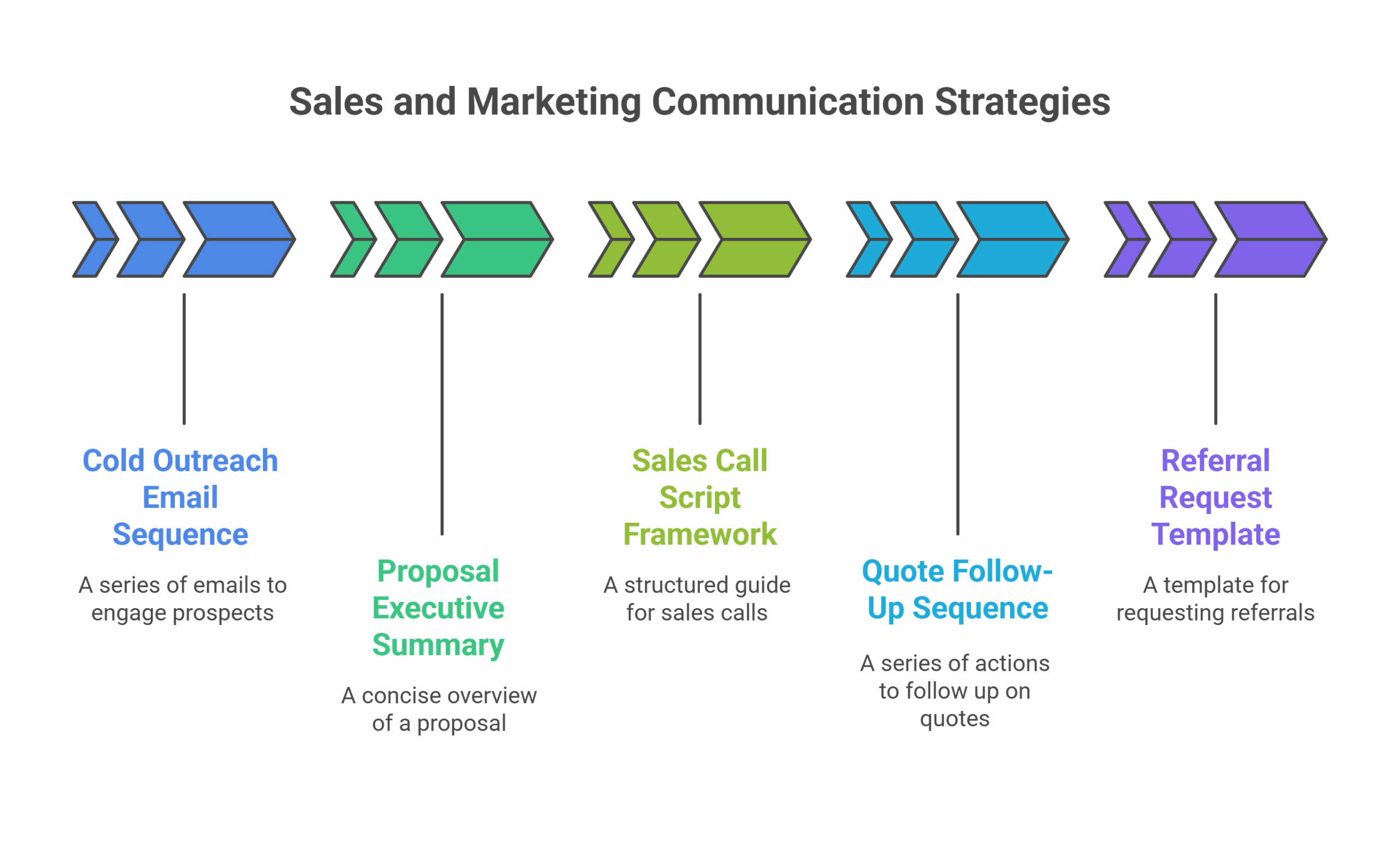
Cold Outreach Email Sequence
“Create a 5-email cold outreach sequence for [product/service] targeting [specific role] at [company type]. Email 1: Brief introduction with specific relevance to their industry, Email 2: Share valuable insight or resource without selling, Email 3: Case study of similar company’s success, Email 4: Address common objection with proof, Email 5: Final soft touch with easy yes/no response. Each email under 150 words, increasingly casual tone, specific subject lines that avoid spam filters.”
Proposal Executive Summary
“Write an executive summary for a proposal offering [service] to [client type]. Include: Opening that mirrors their stated needs, brief credibility statement without boasting, three key benefits using their language, proposed approach in simple terms, investment range with payment options, expected ROI or success metrics, timeline with major milestones, clear next steps, and risk reversal element. Maximum 1 page, scannable format.”
Sales Call Script Framework
“Develop a consultative sales call script for [product/service]. Include: Opening that establishes rapport and agenda, 3-5 discovery questions that uncover pain points, active listening prompts and follow-up questions, brief capability statement tied to their needs, objection handling for top 3 concerns, trial close questions that gauge interest, next steps with specific timeline, and follow-up commitment. Include pause points and expected responses.”
Quote Follow-Up Sequence
“Create a follow-up sequence for quotes/proposals that haven’t received response. Day 3: Friendly check-in ensuring receipt, Day 7: Add valuable information or insight, Day 14: Address potential concerns proactively, Day 21: Share relevant success story, Day 30: Final follow-up with alternative options. Each message different channel (email, phone, LinkedIn), increasingly brief, maintaining professional persistence without annoyance.”
Referral Request Template
“Write a referral request for satisfied customers of [business type]. Include: Personal acknowledgement of their success, specific value they’ve received, soft request for similar connections, easy referral process explanation, incentive without seeming desperate, multiple response options, and gracious close regardless of response. Create versions for email, LinkedIn message, and in-person conversation. Tone should be appreciative, not presumptuous.”
Operations and Productivity Prompts
Streamline business operations and maximise efficiency with prompts that handle routine tasks and complex planning.
Standard Operating Procedure Creator
“Create an SOP for [specific process] that new employees could follow independently. Include: Purpose and scope definition, required resources and access, step-by-step instructions with screenshots placeholders, decision points with criteria, common errors and solutions, quality checkpoints, time estimates for each step, escalation procedures, and related documentation links. Write clearly for someone with no prior knowledge, include safety/legal considerations.”
Meeting Agenda Optimiser
“Transform these meeting topics [list topics] into an effective 60-minute meeting agenda. Include: Time allocations for each item, designated discussion leader, required pre-meeting preparation, specific outcomes expected, decision points marked clearly, parking lot for off-topic items, action item template, and follow-up timeline. Add engagement tactics for virtual meetings. Format for easy screen sharing.”
Project Planning Template
“Break down this project [describe project] into a detailed plan. Include: SMART objectives, deliverables list with acceptance criteria, task breakdown with dependencies, resource requirements (people, tools, budget), risk assessment with mitigation strategies, communication plan with stakeholders, success metrics and KPIs, major milestones with dates, and contingency planning. Format as both narrative and Gantt-chart-ready task list.”
Performance Review Framework
“Create a performance review template for [role] in a small business. Include: Self-assessment questions that encourage reflection, objective performance metrics relevant to role, competency evaluation with examples, goal achievement review from last period, strengths identification with evidence, development areas with specific suggestions, career progression discussion points, two-way feedback opportunity, SMART goals for next period, and action plan with support needed. Maintain constructive, growth-focused tone.”
Workflow Automation Identifier
“Analyse this business process and identify automation opportunities: [describe current process]. For each step, determine: Could this be automated completely, partially automated with human oversight, or must remain manual? Suggest specific tools or methods for automation, estimate time savings and ROI, identify implementation challenges, recommend priority order, and provide integration considerations. Focus on affordable solutions for small businesses.”
Financial Management Prompts
Make informed financial decisions and communicate effectively with stakeholders using prompts designed for financial clarity.
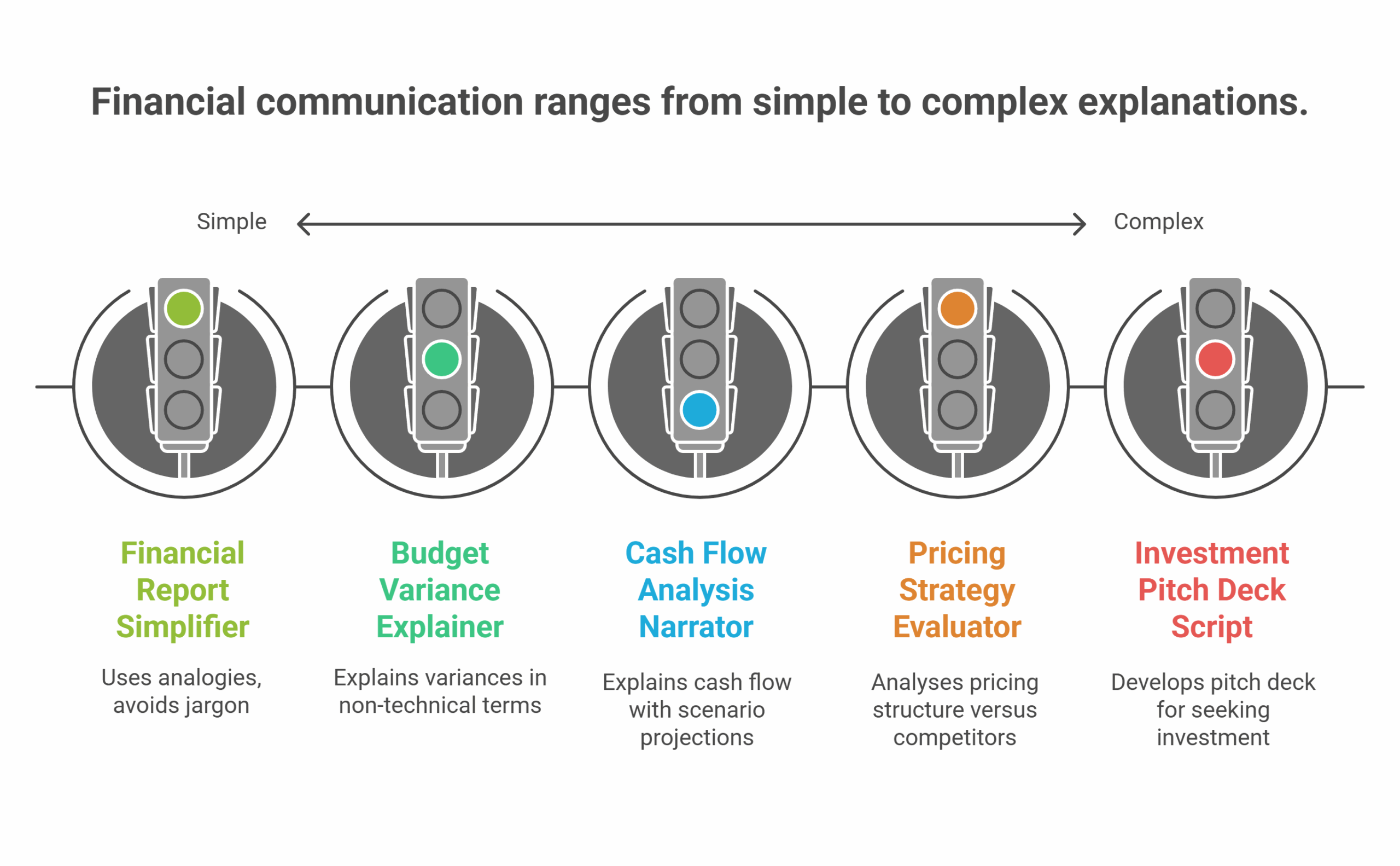
Cash Flow Analysis Narrator
Explain this cash flow situation to [audience – investor/bank/partner]: [provide numbers or scenario]. Create explanation that: Acknowledges current position honestly, identifies key drivers of situation, presents 3-scenario projections (best/likely/worst), outlines specific improvement actions, includes timeline for recovery/growth, addresses likely concerns proactively, and requests specific support needed. Use visuals/charts references where helpful. Maintain confidence while being realistic.”
Pricing Strategy Evaluator
“Analyse this pricing structure for [product/service]: [current pricing]. Consider: Market positioning versus competitors, value perception by target customers, psychological pricing principles, bundle opportunities, tier differentiation logic, discount strategy impact, margin requirements, volume-profit scenarios, and price increase communication. Recommend 3 pricing options with pros/cons, implementation timeline, and customer communication strategy.”
Budget Variance Explainer
“Create a variance report explanation for [stakeholder] about these budget differences: [list variances]. For each variance: Explain in non-technical terms, identify if it’s temporary or ongoing, determine if it’s controllable or external, provide specific correction actions if needed, project impact on year-end, and highlight any positive variances. Format as executive summary with supporting detail. Include lessons learnt section.”
Investment Pitch Deck Script
“Develop a 10-slide pitch deck script for seeking [amount] investment in [business]. Slide flow: Problem/opportunity with market size, solution with unique value prop, business model with unit economics, traction with growth metrics, market analysis with TAM/SAM/SOM, competition with differentiation, team with relevant experience, financial projections with key assumptions, use of funds with milestones, and clear ask with terms. Each slide 30-second script, compelling but honest.”
Financial Report Simplifier
“Translate this financial report into plain English for [non-financial audience]: [paste key figures or describe]. Explain: What the numbers mean for business health, which metrics matter most and why, trends that should concern/encourage, comparison to industry benchmarks, specific actions recommended based on data, and what to watch next period. Use analogies where helpful, avoid jargon, include visual representation suggestions.”
HR and Team Management Prompts
Build strong teams and positive workplace culture with prompts that handle sensitive situations professionally.
Job Description Moderniser
“Update this job description for current market: [paste existing or describe role]. Include: Compelling company introduction focusing on culture/growth, role purpose in one clear sentence, day-to-day responsibilities with realistic percentages, must-have versus nice-to-have qualifications, growth opportunities within role, team structure and reporting, performance success metrics, compensation range and benefits, inclusive language throughout, and clear application process. Optimise for job board SEO.”
Difficult Conversation Script
“Prepare me for this difficult conversation with an employee: [describe situation]. Provide: Opening that’s direct but empathetic, specific behavioural examples not personality attacks, impact statement on team/business, listening prompts for their perspective, collaborative solution development, clear expectations going forward, documentation requirements, follow-up timeline, and escalation if needed. Include phrases to use/avoid, emotional regulation tips.”
Team Building Activity Generator
“Design team building activities for [team size] people with [constraints – remote/budget/time]. Create: 5 activity options with different energy levels, clear objectives beyond ‘fun’, detailed facilitation instructions, required materials and setup, time allocations with flexibility, adaptation for different personalities, debrief questions that reinforce lessons, and follow-up actions to maintain momentum. Focus on psychological safety and inclusion.”
Employee Onboarding Checklist
“Create comprehensive onboarding plan for [role] starting in [timeframe]. Include: Pre-arrival preparation tasks, first day schedule hour-by-hour, week 1 learning objectives, 30-day milestone expectations, 60-day check-in points, 90-day success criteria, key relationships to establish, training modules with delivery method, cultural integration activities, feedback collection points, and mentor/buddy system setup. Format as trackable checklist with owner assignments.”
Exit Interview Analyser
“Structure an exit interview for departing employee in [role/department]. Include: Rapport-building opening acknowledging contributions, role-specific satisfaction questions, management and leadership feedback, team dynamics insights, process improvement suggestions, compensation and benefits perspective, career growth factor analysis, replacement training offer, alumni network invitation, and legal/confidentiality reminders. Create both question list and conversation flow.”
Marketing Strategy Prompts
Develop sophisticated marketing strategies that compete with larger companies whilst maximising limited budgets.
Competitor Analysis Framework
“Conduct detailed competitor analysis for [your business] against [list competitors]. Analyse: Product/service offerings with pricing, unique value propositions, target audience segments, marketing channels used, content strategy and frequency, customer acquisition tactics, retention strategies visible, partnership/integration ecosystem, strengths to learn from, weaknesses to exploit, and opportunities for differentiation. Format as actionable strategy document, not just observations.”
Brand Voice Developer
“Create brand voice guidelines for [business] targeting [audience]. Define: Overall personality in 3-5 adjectives, tone variations for different situations, vocabulary to use/avoid, sentence structure preferences, humour/formality level, cultural references appropriate, emoji/punctuation usage, storytelling approach, crisis communication adjustments, and platform-specific adaptations. Include 10 before/after message examples showing voice application.”
Content Pillar Strategy
“Develop content pillar strategy for [business] in [industry]. Create: 4-5 main content pillars with rationale, subtopics under each pillar (10-15 each), content formats for each pillar, distribution channel mapping, creation resource requirements, performance metrics per pillar, seasonal/timely variations, pillar interconnection opportunities, and 90-day implementation calendar. Include keyword research priorities and competitive gaps.”
Customer Journey Mapper
“Map customer journey for [product/service] from awareness to advocacy. For each stage identify: Customer thoughts/emotions/questions, touchpoints and channels used, content needs and formats, potential friction points, opportunity for delight, metrics to track, technology requirements, team responsibilities, and optimisation priorities. Create both narrative description and visual flow representation. Include post-purchase lifecycle.”
Marketing Campaign Planner
“Design integrated marketing campaign for [objective] with [budget] over [timeframe]. Include: Campaign theme and key messages, target audience personas with media habits, channel strategy with budget allocation, content calendar with production timeline, partnership/influencer opportunities, paid media plan with targeting, measurement framework with KPIs, contingency plans for poor performance, and post-campaign analysis structure. Ensure all elements reinforce core message.”
Customer Research and Insights Prompts
Understand your customers deeply without expensive research firms using prompts that extract actionable insights.
Survey Question Designer
“Create customer survey about [topic] that people will actually complete. Include: Warm opening explaining value and time needed, 8-10 questions maximum mixing formats, logical flow from broad to specific, neutral wording avoiding bias, skip logic for relevance, demographic questions at end, incentive offer if appropriate, and thank you with next steps. Provide question rationale and expected insights from each.”
Interview Guide Builder
“Develop customer interview guide to understand [specific aspect]. Structure: Rapport building introduction, broad opening questions, specific topic exploration, ladder questioning for deeper insights, projection techniques for sensitive topics, scenario/example prompts, priority ranking exercises, magic wand questions, and graceful closing. Include time estimates, follow-up prompts, and note-taking framework.”
Review Analysis Synthesiser
“Analyse these customer reviews [paste reviews or describe patterns] to extract actionable insights. Identify: Recurring themes and frequency, emotional language patterns, specific feature/benefit mentions, comparison to competitors, unmet needs or frustrations, delight factors worth amplifying, segment differences if visible, temporal patterns, and response strategies. Create both summary and detailed findings with verbatim examples.”
Persona Development Template
“Create detailed customer persona based on [available data/observations]. Include: Demographics with psychographics, day-in-life scenario, goals and motivations, challenges and pain points, information sources and influences, buying process and criteria, objections and anxieties, preferred communication style, technology usage, and brand affinities. Make specific enough to guide decisions but not exclusionary.”
Voice of Customer Translator
“Transform this customer feedback [paste feedback] into internal action items. For each piece of feedback: Interpret underlying need not just stated want, assess validity and representativeness, identify root cause if complaint, determine effort versus impact, assign to appropriate team/person, suggest specific response to customer, create success metric, and set review timeline. Maintain customer empathy while being practical.”
Digital Marketing Automation Prompts
Scale your digital presence efficiently with prompts that automate repetitive marketing tasks whilst maintaining personalisation.
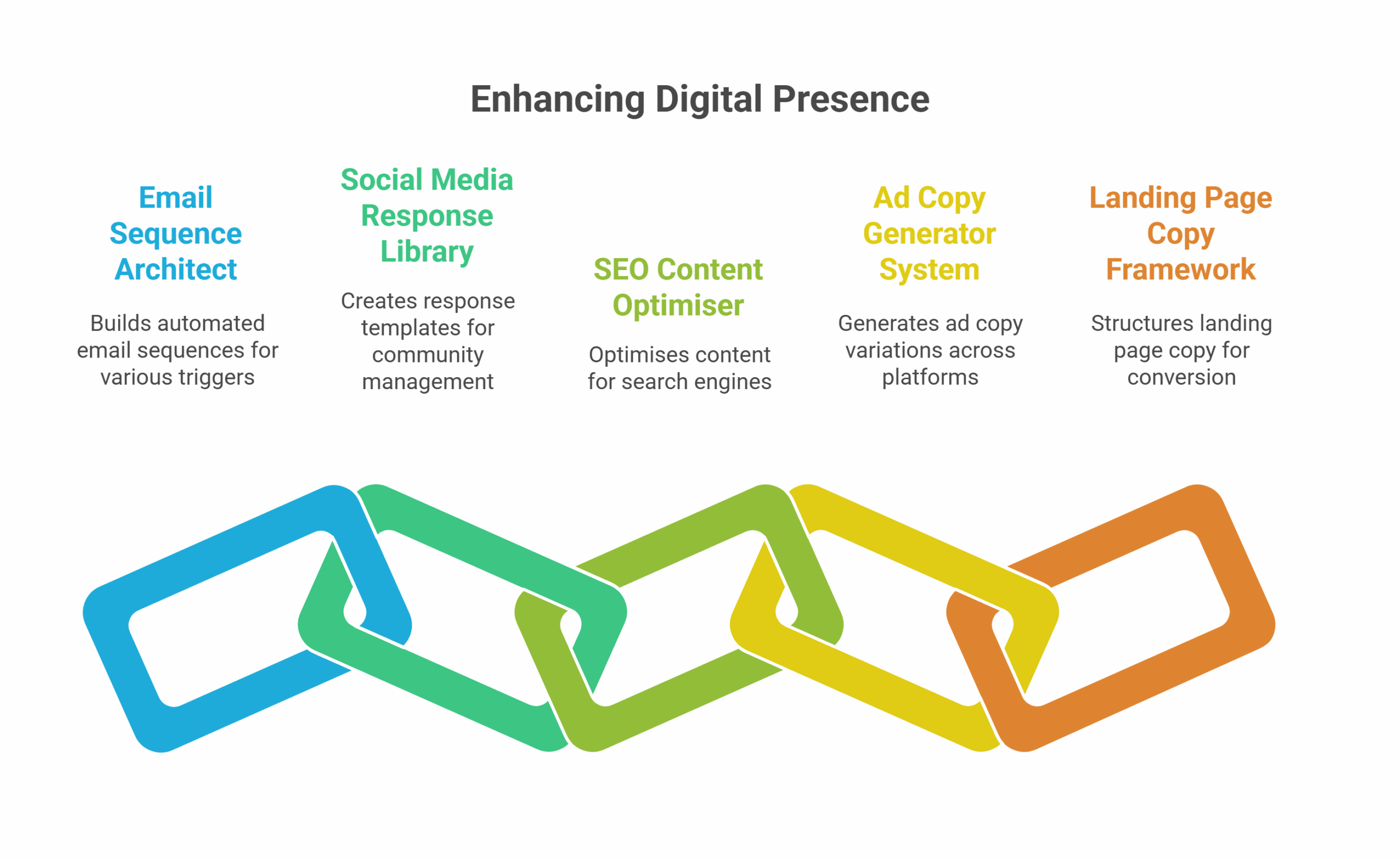
Email Sequence Architect
“Build automated email sequence for [trigger event – signup/purchase/abandonment]. Create: Sequence logic with timing, email purposes and goals, subject lines with A/B variants, preview text strategy, content outline per email, personalisation variables, segmentation rules, performance benchmarks, optimisation triggers, and sunset strategy. Include re-engagement loops and success graduation paths.”
Social Media Response Library
Create response templates for social media community management. Categories: Praise and positive feedback, questions about products/services, technical issues or complaints, pricing and availability enquiries, partnership/collaboration requests, spam or inappropriate content, crisis or sensitive topics, and user-generated content acknowledgement. Each template should be customisable, platform-appropriate, and maintain brand voice whilst sounding human.”
SEO Content Optimiser
“Optimise this content for search engines without sacrificing readability: [paste content]. Analyse and improve: Title tag and meta description, header structure and keywords, keyword density and placement, internal linking opportunities, external linking suggestions, image alt text recommendations, schema markup opportunities, readability score improvements, and content gaps to fill. Provide before/after with explanation of changes.”
Ad Copy Generator System
“Create ad copy variations for [product/service] across platforms. Deliver: 5 Google Ads headlines (30 char max), 3 descriptions (90 char max), 3 Facebook primary text options, 3 Facebook headlines, 3 Instagram captions, 3 LinkedIn sponsored content intros, and 3 Twitter promoted tweet variations. Each should test different angles: benefit-focused, problem-focused, social proof, urgency, and curiosity.”
Landing Page Copy Framework
“Write landing page copy for [offer/product] targeting [audience]. Structure: Above-fold headline and subheadline, value proposition in 3 bullets, problem agitation section, solution presentation, benefit elaboration with proof, social proof integration, risk reversal offer, clear CTA throughout, FAQ section, and urgency without false scarcity. Maintain conversion focus while building trust.”
Business Strategy and Planning Prompts
Make strategic decisions confidently with prompts that analyse complex situations and provide actionable recommendations.
SWOT Analysis Facilitator
“Conduct SWOT analysis for [business/project/decision]. For each quadrant provide: 5-7 specific items not generic statements, evidence or examples supporting each, relative importance weighting, interconnections between quadrants, strategic implications, actionable recommendations, priority matrix for addressing, and monitoring plan. Convert analysis into strategic initiatives with success metrics.”
Business Model Canvas Completer
“Fill out Business Model Canvas for [business concept]. Detail each section: Customer segments with TAM sizing, value propositions with differentiation, channels with cost/efficiency, customer relationships with lifecycle, revenue streams with pricing logic, key resources needed, key activities critical to success, key partnerships with terms, and cost structure with unit economics. Identify assumptions to test first.”
Risk Assessment Matrix
“Create risk assessment for [business decision/project]. For each risk identify: Specific risk description, probability (1-5) with justification, impact (1-5) with explanation, risk score and priority, early warning indicators, prevention strategies, mitigation if occurs, responsible party, review frequency, and acceptable risk threshold. Include interdependencies and cascade effects.”
Growth Strategy Generator
“Develop growth strategies for [business] at [current stage]. Analyse: Market penetration opportunities, market development potential, product development options, diversification possibilities, and partnerships/acquisitions. For each provide: Investment required, timeline to results, success probability, resource requirements, competitive response expected, and exit strategy if fails. Rank by ROI and strategic fit.”
Decision Matrix Builder
“Help decide between these options: [list options] based on [criteria]. Create: Weighted criteria with justification, scoring rubric for consistency, option evaluation with evidence, sensitivity analysis on weights, risk assessment per option, implementation difficulty rating, stakeholder impact analysis, and final recommendation with confidence level. Include devil’s advocate perspective.”
Legal and Compliance Prompts
Navigate legal requirements confidently with prompts that ensure compliance whilst avoiding expensive legal consultations for routine matters.
Terms of Service Customiser
“Adapt standard terms of service for [business type] offering [products/services]. Include: Service description and limitations, user responsibilities and prohibited uses, payment terms and refunds, intellectual property rights, privacy and data handling, disclaimer of warranties, limitation of liability, dispute resolution process, termination conditions, and governing law. Flag areas requiring legal review.”
Privacy Policy Generator
“Create GDPR/UK-compliant privacy policy for [website/app] that collects [data types]. Cover: Data controller information, lawful basis for processing, data types collected and methods, purpose and usage, sharing with third parties, international transfers, retention periods, user rights and exercise process, security measures, cookie policy, and contact information. Write in plain English while maintaining legal adequacy.”
Contract Review Checklist
“Review this contract/agreement for key issues: [describe contract type]. Check for: Clear scope and deliverables, payment terms and conditions, timeline and milestones, intellectual property ownership, confidentiality provisions, liability and indemnification, termination and exit clauses, dispute resolution mechanism, governing law and jurisdiction, and amendment procedures. Highlight red flags and suggest negotiation points.”
Compliance Audit Prompter
“Create compliance checklist for [regulation/requirement] in [industry]. Include: Specific requirements with references, current compliance status fields, evidence needed for compliance, responsible parties, deadline tracking, non-compliance consequences, remediation steps if failing, documentation requirements, audit trail needs, and ongoing monitoring plan. Format for regular review and updates.”
Incident Response Planner
“Develop incident response plan for [type of incident – data breach/complaint/accident]. Include: Immediate actions within first hour, stakeholder notification tree, regulatory reporting requirements, evidence preservation steps, communication templates, investigation process, remediation strategies, lesson learnt process, and prevention improvements. Consider legal, PR, and operational angles.”
FAQs
How do small businesses ensure AI-generated content remains authentic to their brand?
Start by documenting your brand voice characteristics, common phrases you use, and topics you avoid. Include these elements in every prompt as context. Test outputs against your existing content—does it sound like you? Refine prompts based on what feels off. Create prompt templates that embed your brand guidelines, making consistency automatic rather than relying on memory.
What’s the best way to organise and manage a growing library of AI prompts?
Structure prompts hierarchically: Core business functions > Specific tasks > Variations. Use a simple spreadsheet or document with categories, prompt text, example outputs, and performance notes. Tag prompts by frequency of use, department, and effectiveness. Review quarterly to retire underperforming prompts and refine successful ones. Share access across your team but maintain version control.
How can SMEs measure ROI from implementing AI prompts in their operations?
Track time saved on routine tasks before and after prompt implementation. Monitor quality improvements in customer responses, content engagement rates, and conversion metrics. Calculate cost savings from reduced outsourcing or delayed hires. Document error reduction and consistency improvements. Most businesses see 5-10 hours weekly time savings within the first month of systematic prompt use.
Should Northern Ireland businesses customise prompts for local market conditions?
Absolutely. Include specific references to local business environment, regulations, cultural nuances, and market conditions. Mention Northern Ireland, Belfast, or your specific area where relevant. Reference local competitors, events, and economic factors. This localisation makes AI outputs more relevant and authentic to your actual business context rather than generic international advice.
How often should prompt templates be updated and refined?
Review prompt performance monthly but only update when necessary. Major updates quarterly to incorporate new AI capabilities, business changes, or improved techniques. Test variations continuously but implement changes cautiously—sudden prompt changes can disrupt established workflows. Document why changes were made and keep previous versions for reference.
What safeguards should businesses implement when using AI-generated content?
Always human-review AI outputs before public use. Implement fact-checking protocols for statistical claims. Verify legal compliance for regulated industries. Establish clear editing guidelines for tone and accuracy. Create approval workflows for customer-facing content. Never fully automate without oversight. Consider AI as a draft creator, not final publisher.
ProfileTree’s extensive experience helping Northern Ireland SMEs implement AI tools has shown that success comes not from using AI, but from using it strategically. This prompt library provides the foundation, but the real value emerges when you adapt these templates to your specific business context, continuously refining based on results. As AI capabilities evolve, businesses that maintain organised, tested prompt libraries will consistently outperform those using AI casually.