
Google Ads vs SEO: Which Should UK and Irish SMEs Choose?
Table of Contents
Every small business reaches the same crossroads sooner or later: you need more customers online, you have a limited budget, and someone tells you to “just run some Google Ads” while someone else insists you need to “invest in SEO.” Both are right. Both are also incomplete on their own.
This guide is written for business owners and marketing managers in the UK and Ireland who want a straight answer, not a consultant’s hedge. Google Ads and SEO are not rivals. They answer different questions. But understanding which one your business needs most right now, and in what proportion, can save you thousands of pounds and months of wasted effort.
At a Glance: Google Ads vs SEO
| Google Ads (PPC) | SEO | |
|---|---|---|
| Speed | Results from day one | Typically 3 to 6 months minimum |
| Cost model | Pay per click (spend stops, traffic stops) | Ongoing content and technical investment |
| Position on page | Top of results, labelled “Sponsored” | Below ads; positions 1 to 10 organically |
| Sustainability | Rented visibility | Owned visibility that compounds over time |
| Trust level | Lower (users know it is an ad) | Higher (organic results carry more credibility) |
| Best for | New businesses, promotions, fast testing | Established businesses building long-term authority |
| UK CPC range | £1 to £8 (general); £15 to £50+ (legal, finance) | N/A (cost is in content and technical work) |
Think of it this way: Google Ads is a lease. Stop paying and the traffic disappears immediately. SEO is closer to a mortgage. It is harder to build, but once the asset exists, it keeps working.
Which is Better for a New Business: SEO or Google Ads?
For a business that has just launched or is entering a new market, Google Ads is the more practical starting point. You can appear at the top of search results on day one, test which messages resonate with real customers, and generate enquiries while your SEO is still gaining traction.
That does not mean SEO should wait. The two work best in parallel, and the data from your Ads campaigns, specifically which search terms actually convert, gives your SEO strategy a significant head start.
Understanding the UK and Irish Search Landscape
UK and Irish search behaviour has a few characteristics that matter when you are deciding where to spend.
Search intent in the UK trends towards research before purchase. Users frequently check multiple sources before contacting a business. This means organic content that appears across several stages of the research process can influence a decision even if the final click comes from an ad.
GDPR and UK data law also affect how reliably you can track Google Ads performance. Since the phasing out of third-party cookies, attribution has become murkier. A customer who clicks your ad, leaves, and returns directly three days later may not show as an ad-driven conversion in your reporting. This is one reason SEO content, which builds first-party trust and brand recognition, has grown in relative value for UK businesses.
Local competition matters too. For many Northern Ireland businesses, Ads competition is lower and CPCs are cheaper than in London or Dublin, which can make paid search more cost-effective per lead in regional markets.
Google Ads (PPC): Immediate Visibility at a Price
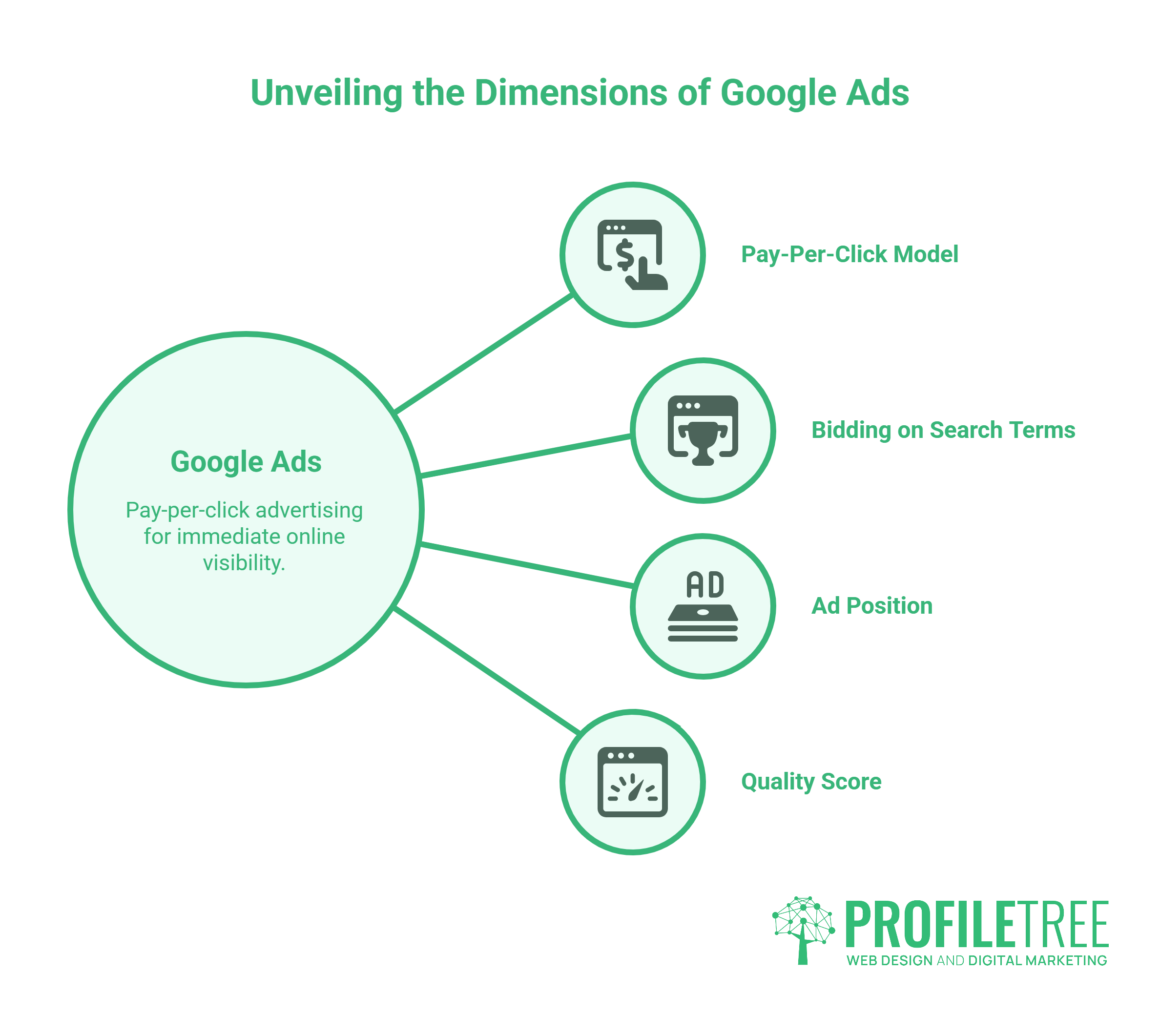
Google Ads operates on a pay-per-click model. You bid on search terms, your ad appears when someone searches those terms, and you pay when they click. Ad position is determined by your bid multiplied by your Quality Score, which is Google’s measure of how relevant your ad and landing page are to the search query.
How the Auction System Works
Many advertisers assume the highest bid always wins. It does not. A well-structured campaign with a highly relevant ad and a fast, focused landing page can outrank a competitor spending twice as much. Quality Score is calculated from three factors: the expected click-through rate of your ad, the relevance of your ad copy to the keyword, and the quality of the landing page the user lands on.
This is where web design and development directly affect your paid search performance. A slow landing page, one that takes more than three seconds to load on mobile, will drag down your Quality Score and increase your cost per click. ProfileTree’s web development service regularly works with businesses to rebuild landing pages specifically for campaign performance, separating them from the main site so they can be tested and optimised independently.
Pros and Cons for UK SMEs
Pros: Instant visibility. Precise geographic targeting (you can limit ads to specific postcodes or radius around your premises). Controllable daily spend. Immediate data on what converts.
Cons: Traffic stops the moment you stop spending. Competitive industries like legal services, financial advice, and trades in urban areas can have CPCs of £15 to £50 per click. Requires ongoing management to avoid budget waste from broad-match terms, irrelevant searches, and poor ad-to-page alignment.
2026 UK Industry CPC Benchmarks
These are approximate ranges based on publicly reported data from Google and industry sources. Actual CPCs vary significantly by campaign quality, targeting, and competition at any given time.
| Industry | Estimated CPC Range (UK) |
|---|---|
| Home services (plumbing, electrical) | £3 to £12 |
| Professional services (accountancy, HR) | £4 to £18 |
| Legal services | £15 to £55 |
| E-commerce (general retail) | £0.50 to £4 |
| SaaS and B2B technology | £6 to £25 |
| Healthcare and private clinics | £4 to £20 |
For a Northern Ireland SME spending £800 per month on Google Ads in a trades or professional services category, a CPC of £5 to £10 means roughly 80 to 160 clicks per month. Whether that is good value depends entirely on what happens after the click.
Match Types and Negative Keywords
One of the most common sources of wasted ad spend is using broad-match keywords without a negative keyword list. A plumber in Belfast bidding on “plumber” in broad match can end up paying for clicks from people searching for “plumber jobs” or “plumber courses.” Building a thorough negative keyword list is not optional; it is the difference between a campaign that generates leads and one that burns through budget with nothing to show for it.
Phrase match and exact match keywords cost more per search impression but deliver far higher relevance and lower cost per conversion. A mix of match types, reviewed monthly against the search terms report, is the baseline for any competently run campaign.
Search Engine Optimisation (SEO): The Long-Term Asset
SEO is the practice of making your website visible in unpaid (organic) search results. It covers three broad areas: technical SEO (making sure Google can crawl and index your pages correctly), on-page SEO (optimising the content and structure of individual pages), and off-page SEO (building the external signals, primarily links from other websites, that tell Google your site is authoritative).
The Compounding Return of Organic Search
The core difference between paid search and SEO is what happens when you stop investing. Stop paying for Ads, and traffic disappears overnight. Slow down your SEO investment, and you might see rankings slip over months, not days. The content and authority you build continues to generate traffic, enquiries, and conversions long after the initial work is done.
For an SME that has been consistently building SEO for two years, the cost per organic visitor is typically a fraction of the cost per paid visitor in the same industry. The difficulty is that the first six to twelve months of SEO investment often produces limited visible return, which makes it harder to justify to a budget holder who is used to seeing immediate results from Ads.
This is addressed more directly in ProfileTree’s guide to maximising ROI from digital marketing campaigns, which covers how to set realistic timelines and measurement frameworks for both channels.
Why Local SEO Is Particularly Valuable for Northern Ireland and Regional UK Businesses
For businesses that serve a defined geographic area, local SEO operates through a different set of signals to national organic search. Google’s Local Pack, the map results that appear above the standard organic listings for queries like “accountant Belfast” or “web designer Derry,” is driven primarily by your Google Business Profile, the consistency of your name, address and phone number across the web, and the number and quality of your reviews.
A business that appears in the Local Pack for its core service terms in its city does not need to outrank national comparison sites or large directories. It only needs to be the most relevant and credible option for users in its area. For many SMEs in Northern Ireland, this is a more achievable target than trying to rank nationally, and it delivers higher-intent traffic because the user is clearly looking for a local supplier.
ProfileTree works with SMEs across Belfast and Northern Ireland on both the technical setup and content strategy needed to build and protect local search visibility. The approach to local ranking for regional businesses is covered in more depth in our digital marketing strategy guide.
The AI Factor: How Google’s AI Overview Changes the Maths
This is the section most Google Ads and SEO comparison guides avoid because it complicates the picture. Google’s AI Overviews, the generated summaries that appear at the top of many search results pages, are reshaping how both channels perform.
What AI Overviews Mean for SEO
When an AI Overview appears for a query, users can often get a direct answer without clicking any organic result. Research across multiple industry sources indicates click-through rates for organic results below an AI Overview are lower than for the same queries without one.
The response to this is not to abandon SEO. It is to build content that is cited within AI Overviews rather than displaced by them. Google’s AI systems pull citations from pages that answer specific sub-questions in a clear, structured format, cover a topic with genuine depth and specificity, and are hosted on sites with established topical authority. An article that gives a genuinely useful, specific answer to “how much do Google Ads cost for a small business in the UK” is more likely to be cited than one that gives a generic overview.
What AI Overviews Mean for Google Ads
AI Overviews do not replace paid ads. Sponsored results continue to appear above and alongside AI-generated content. In some cases, AI Overviews have created more prominent space for ads by pushing organic results further down the page. This makes paid search more attractive for capturing high-intent clicks, but also means the value of organic ranking for purely informational queries is reduced.
The practical implication for UK SMEs is to use Google Ads for high-intent, commercial queries (“emergency plumber Belfast,” “accountant for contractors Northern Ireland”) where the user is ready to contact a business, and to use SEO to capture the research and consideration traffic that AI Overviews are increasingly dominating.
The Hybrid Strategy: Why You Rarely Should Choose Just One
The binary framing of “Ads vs SEO” is useful for understanding the channels but misleading as a decision-making framework. Most businesses that generate consistent, scalable leads from search use both, with the allocation between them changing over time.
Using PPC Data to Inform SEO
Google Ads gives you something SEO cannot provide in its early stages: real conversion data at speed. Running a campaign for sixty days tells you which search terms actually lead to enquiries, not just which terms get clicks. Those converting search terms become the foundation of your SEO content strategy.
A business that spends three months testing keyword groups in Google Ads before building its organic content plan will produce pages that are significantly more commercially focused than one that relies purely on keyword research tools. The search terms report inside Google Ads is one of the most underused assets in digital marketing.
As Ciaran Connolly, founder of Belfast-based digital agency ProfileTree, puts it: “We consistently see businesses spending on Ads with no organic strategy and others investing in SEO with no paid data to validate it. The businesses that grow fastest are the ones treating both channels as one system with two levers.”
Using SEO to Reduce Long-Term Ad Dependency
A business that relies entirely on Google Ads is exposed every time costs increase (UK CPCs have risen year on year as competition has intensified) and has no protection against account suspensions, policy changes, or budget cuts. Building organic authority alongside your paid campaigns creates a safety net and, over time, reduces the volume of paid clicks you need to buy.
A realistic 12-month approach for an SME starting from minimal online visibility might look like this: months one to three, run Ads to generate immediate leads and gather conversion data; months three to six, build out the core SEO content cluster using what the Ads data revealed; months six to twelve, reduce Ad spend on terms where organic rankings are building, and redirect that budget towards terms with higher CPCs where paid search remains the more efficient option.
This approach is covered in more detail in ProfileTree’s digital content marketing strategy guide.
Should I Stop Running Ads Once I Rank Number One Organically?
No. Organic position one and a paid ad on the same search results page together capture significantly more page real estate than either alone. A competitor can appear in the paid results above your organic listing if you stop bidding. For branded searches specifically, where someone types your business name, you should always bid to protect that position regardless of where you rank organically.
Cost Comparison: What Are You Actually Buying?
The honest answer is that both channels cost more than the headline figure suggests. Google Ads charges you per click, but the real cost includes the management time to run campaigns competently, the landing page work needed to convert those clicks, and the ongoing testing required to improve results over time. SEO charges you in content production, technical fixes, and patience, with no guarantee of a specific position or timeline. Neither channel is cheap when done properly. The question is not which costs less, but which cost structure fits your business’s cash flow and growth stage. A business that needs leads next month cannot wait six months for SEO to build. A business that cannot sustain ad spend indefinitely needs the organic foundation SEO provides.
Google Ads Costs
Your Google Ads spend is the direct cost per click multiplied by your monthly click volume. But that is not the full picture. Effective campaign management, which includes ongoing keyword research, negative keyword maintenance, ad copy testing, bid adjustments, and landing page optimisation, typically takes three to eight hours per month at a minimum. If that time is not available in-house, a managed PPC service from a digital marketing agency covers it.
Typical monthly Google Ads spend for SMEs in the UK ranges from £500 to £3,000, depending on the industry and geographic targeting. Below £500 per month, it is often difficult to generate enough data to optimise a campaign meaningfully.
SEO Costs
SEO investment covers content production, technical audits and fixes, and link building. For a business starting from a weak baseline, getting to meaningful organic visibility for competitive terms in the UK typically requires six to twelve months of consistent investment. The monthly cost of agency-managed SEO for SMEs in the UK and Ireland ranges from roughly £500 to £2,500, depending on the scope.
The key difference is trajectory. Ad spend produces a relatively flat return: spend £1,000, get a predictable number of clicks. SEO investment, done consistently, produces compounding returns: a page that ranks for a valuable term in month eight continues generating free traffic in month twenty-four.
ProfileTree’s guide to digital marketing for SMEs explores how to allocate budgets across channels at different stages of business growth.
The “Ads Readiness” Audit
Before spending a pound on Google Ads, check these five points. Running campaigns without them in place is the most common reason SMEs waste their first three months of ad budget.
1. Is your landing page built for conversion? The page a paid visitor lands on should have one goal: a fast load time on mobile, a clear headline that matches the ad, and a contact form or call button above the fold. A general homepage is not a landing page.
2. Is conversion tracking set up correctly? If you cannot see which keywords lead to form submissions or phone calls, you cannot optimise the campaign. Google Tag Manager and Google Ads conversion tracking must be configured before the campaign goes live, not after.
3. Do you have a negative keyword list? Start with at least twenty to thirty negative keywords to block irrelevant traffic from the first day.
4. Is your monthly budget sufficient to generate data? In most UK B2B and professional services categories, a budget of less than £500 per month will produce too few clicks to make statistically meaningful optimisation decisions.
5. Is your Google Business Profile complete and verified? For local businesses, an incomplete profile will limit both your Ads performance (local campaign extensions) and your organic local search visibility.
ProfileTree’s digital training service helps business owners and their teams build the knowledge to manage these foundations themselves. Details are at our digital training page.
FAQs
Which is better for a new business: SEO or Google Ads?
For a new business with no existing online visibility, Google Ads is the more practical starting point. It generates leads while organic authority is being built. Start with a tightly targeted campaign on your most commercially valuable search terms, use the conversion data to inform your SEO content strategy, then gradually increase organic investment as rankings improve. Running both in parallel from month one is the fastest path to sustainable lead generation.
Can Google Ads help my SEO rankings?
Not directly. Running Google Ads does not improve your position in organic search results. Google has confirmed this repeatedly. The indirect benefits are real but indirect: Ads can increase brand searches if users see your ad and later search for you by name, and the conversion data from Ads campaigns helps you build more commercially focused SEO content.
How much should I spend on Google Ads per month in the UK?
There is no universal figure, but for most SMEs in professional services, trades, or B2B, a starting budget of £500 to £1,500 per month is the minimum needed to generate enough data to optimise. Below £500, the click volume in many UK industries is too low to draw reliable conclusions. The right budget depends on your average CPC in your category and how many leads per month you need to justify the spend.
Is SEO dead because of Google AI?
No, but it has changed. AI Overviews reduce click-through rates for some informational queries, but commercial and transactional searches still drive strong organic clicks, and content cited within AI Overviews gains significant visibility. The SEO that is declining is thin, generic content that adds no genuine information gain. Long-form, specific, well-structured content covering a topic in real depth is performing more strongly than ever in terms of AI citation and organic visibility.