
Social Listening Tools: Guide for UK and Irish Businesses
Table of Contents
Social listening tools give small and medium-sized businesses a way to hear what customers, competitors, and communities are saying online, before that information becomes a problem or a missed opportunity. For SMEs across Northern Ireland, Ireland, and the UK, the practical question is not whether to listen but how to do it without a dedicated team or a five-figure software budget.
This guide covers what social listening tools actually do, which options suit different SME budgets and situations, how to build a workable routine around them, and how to connect what you hear to your content, SEO, and digital marketing strategy.
What Social Listening Tools Actually Do
Social listening is the process of tracking online conversations about your brand, your competitors, and your industry, then using what you find to make better business decisions. It goes further than simply checking your notifications or reading comments on your own posts.
A social listening tool monitors keywords, phrases, brand mentions, and topics across social media platforms, forums, review sites, and news sources. The tool then collates that information and, depending on its capability, helps you analyse sentiment, spot trends, and benchmark your brand against competitors.
Social Listening vs Social Monitoring: The Practical Difference
Social monitoring is reactive. You see a comment, you respond to it. Social listening is analytical. You look at a pattern of comments over time, identify what they reveal about customer needs or competitor weaknesses, and use that to inform a decision.
A Belfast restaurant that monitors social media might respond to one review about slow service. A restaurant using social listening would identify that complaints about wait times spike on Friday evenings across the whole sector, then act on that insight before the next weekend.
The distinction matters because it changes how you use the tool. Monitoring keeps you in the conversation. Listening helps you get ahead of it.
How Social Listening Feeds Your Digital Marketing Strategy
Every conversation your audience has online is a signal. When a customer asks a question on a forum that your website does not answer, that is a content gap. When a competitor receives repeated complaints about a specific failing, that is a positioning opportunity. When a regional news story triggers a spike in searches for a service you offer, that is a moment to act.
Social listening tools surface these signals. The work is in translating them into action: a new blog post, an updated FAQ, a keyword added to an SEO campaign, or a social media response that gets shared widely. ProfileTree’s content marketing services are built around this exact listening-to-execution process, turning what SMEs hear from their audiences into content that performs in search.
Social Listening Tools for Small Businesses, by Budget
The tools available to SMEs split sharply. A handful are free or cost a few pounds a month. Above that, dedicated listening platforms jump to several hundred pounds monthly, with very little in between. Note that most social listening tools are priced in US dollars and bill internationally in USD, so UK businesses should factor in the current exchange rate when budgeting. Very few small businesses need enterprise-grade platforms, and the ones that market themselves that way now start in the high hundreds per month. The following breakdown focuses on tools most relevant to SME budgets.
Free and Entry-Level Social Listening Tools
- Google Alerts is the most accessible starting point. Set up alerts for your brand name, key competitors, and important industry terms, and Google will email you when those terms appear in new indexed content. It does not cover social media in real time, but it captures news articles, blog posts, and forum discussions. Cost: free.
- TweetDeck, now X Pro, lets you monitor keyword streams and hashtags on X in a multi-column view. It has not been free since July 2023, and in March 2026 X moved it again, from the $8 Premium tier to Premium+ at $40 per month. For sectors where X remains active, the column view is still the best real-time interface available, but at that price it is no longer an entry-level option and it covers exactly one network.
- AnswerThePublic sits at the intersection of social listening and keyword research. It shows you the questions people are typing into search engines around any topic, which directly informs both content strategy and social listening keyword lists. The free tier gives you three searches a day and the visual question wheel, but not search volume or CPC data, and CSV export is capped. That covers occasional ideation rather than ongoing research.
- Google’s “People Also Ask” and autocomplete are underused free signals. Run a search for your main service in Google and study what the platform suggests. These suggestions reflect real search behaviour and can serve as anchor points for your social listening keyword list.
| Tool | Best For | Indicative Cost | Learning Curve |
|---|---|---|---|
| Google Alerts | Brand and competitor mentions in indexed content | Free | Low |
| TweetDeck / X Pro | Real-time X monitoring, one network only | $40/month (X Premium+ only) | Low |
| AnswerThePublic | Question and keyword discovery | Free (3 searches/day); Individual $11/month annual, ~$15 monthly | Low |
| Mention | Enterprise PR and comms teams | From $599/month, annual contract only | Medium |
| Awario | Competitor and sentiment tracking for SMEs | From $29/month (annual billing); $49/month (monthly) | Medium |
| Buffer | Social publishing with basic listening features | From ~$5/month per channel (annual billing) | Low |
| Hootsuite | All-in-one management with listening add-on | From $99/month per user (Standard); listening is a separate add-on | Medium |
| Brandwatch | Deep analytics for scale-ups | Not published; sales demo required | High |
All prices above are in USD. Pricing changes frequently; verify current plans directly with each provider before purchasing.
Mid-Tier Social Listening Tools for Growing SMEs
- Mention monitors social media, news, blogs and forums in real time with sentiment analysis, and its coverage is genuinely broad. It is no longer an SME option. Mention withdrew its self-serve Solo, Pro and Pro Plus tiers for new customers in July 2025, leaving the Company plan at $599 per month on an annual contract as the only route in. It is also listening-only now: the publishing and reply features were retired in January 2026 and moved to Agorapulse, a separate subscription. Older guides still quoting $41 a month are describing a plan you cannot buy.
- Awario is a practical option for SMEs focused on competitor analysis. It identifies where your competitors are mentioned and what sentiment surrounds those mentions, giving you a clear view of where they are winning and losing customer trust. The Starter plan costs $49 per month on monthly billing, or $29 per month with annual billing. The annual rate makes it one of the more affordable dedicated social listening tools for SMEs.
- Buffer is primarily a social media scheduling tool, but its paid plans include a listening and engagement layer useful for smaller teams. Pricing is structured per social channel rather than as a flat monthly fee: the Essentials plan starts at around $5 per channel per month on annual billing, or $6 per channel per month on a rolling monthly basis. For a business monitoring three channels, that amounts to roughly $15 to $18 per month, which is accessible. For teams managing ten or more channels, costs scale proportionally.
- Hootsuite is worth noting here with an important caveat. Its plans have risen sharply in recent years. The Standard plan starts at $99 per user per month, with Professional at $199 and Advanced at $399. Even the entry tier is a substantial commitment for an SME that only wants listening. Social listening in Hootsuite is also offered as a separate add-on rather than being included in the base plan. For SMEs with a genuine need for all-in-one social media management and listening, Hootsuite can deliver value, but the entry cost requires honest budget consideration.
Advanced Social Listening Tools for Scale-Ups
- Brandwatch is priced for teams with a dedicated digital marketing function, and it does not publish pricing at all. Every figure you see quoted online is second-hand. Expect a sales demo and a four-figure monthly commitment. For most SMEs in Northern Ireland, Ireland, and the UK, Brandwatch is not the right starting point.
- Sprout Social is comparable to Brandwatch for enterprise-oriented teams. Plans run from $79 per seat per month for Essentials up to $399 for Advanced, billed annually. The figure that matters for this article is the social listening add-on, which is priced separately and reported at around $999 per month. That puts genuine listening well beyond typical SME budgets.
The UK and Ireland Context: GDPR, Privacy, and Local Platforms
Is Social Listening Legal Under GDPR?
Yes, with an important distinction. Social listening tools are designed to monitor publicly available data: posts, comments, reviews, and discussions that users have chosen to share openly on public profiles or forums. Accessing this kind of content is generally considered lawful under UK GDPR and the EU General Data Protection Regulation.
What social listening tools cannot and should not do is access private messages, data behind login walls, or information shared in closed groups. Any tool or approach that targets private communications would breach data protection law. The legitimate use case is the monitoring of public conversation, which is not meaningfully different from reading a public review site or a publicly accessible forum.
This does not constitute legal advice. If you are uncertain whether a specific data collection method is compliant for your business, the Information Commissioner’s Office (ICO) in the UK and the Data Protection Commission (DPC) in Ireland both publish relevant guidance.
Listening Beyond X and Facebook: UK and Ireland-Specific Platforms
Most social listening guides are written with a US audience in mind. For SMEs operating in the UK and Ireland, several additional platforms carry meaningful signals.
- Mumsnet is one of the UK’s most active consumer discussion communities. For businesses in retail, childcare, education, home services, and family-oriented sectors, Mumsnet discussions can surface genuine customer opinions that never appear on mainstream social platforms.
- Boards.ie is an established Irish discussion forum that has been active for more than 20 years. The platform faced financial difficulty in 2025 but secured funding to continue operating. While its audience has declined from its peak years, it remains active across a range of categories and is still worth monitoring for businesses targeting the Republic of Ireland market, particularly in consumer goods, property, motoring, and personal finance discussions.
- Reddit’s UK communities (r/unitedkingdom, r/Belfast, r/ireland, r/AskUK) contain active discussions about businesses, services, and local issues. These communities tend to be direct in their opinions, which makes them a useful gauge of unfiltered sentiment.
- Google Business reviews and Trustpilot are worth including in any listening setup. They are indexed content that directly affects local search rankings and purchasing decisions.
How to Build a Social Listening Routine in Under Two Hours a Week
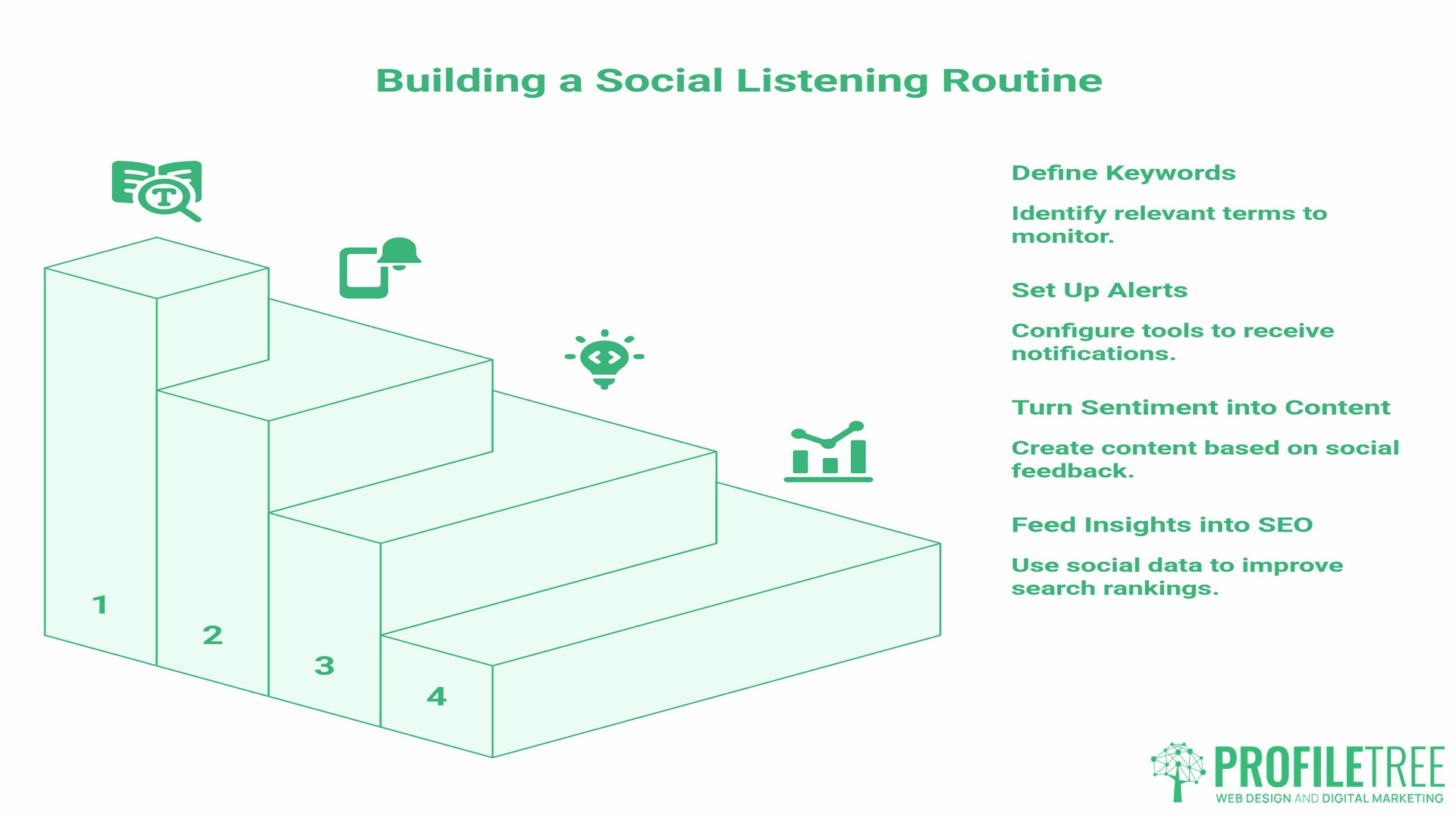
The most common reason SMEs abandon social listening is that it becomes another task that competes for time. The solution is a structured routine rather than ad hoc monitoring.
Step 1: Define Your Keyword Set
Start with four categories of keywords. First, your brand name and common misspellings. Second, your main competitor’s names. Third, your primary services as customers describe them, not as you label them internally. Fourth, local and sector-specific terms relevant to your market.
An example set for a web design agency in Belfast might include: the agency name, “web design Belfast,” “website cost Northern Ireland,” the names of two or three direct competitors, and “web designer” combined with local area names.
Keep the list focused. Ten to fifteen terms consistently monitored will yield more actionable signals than fifty terms checked inconsistently.
Step 2: Set Up Automated Alerts
Configure Google Alerts for each keyword. Set the frequency to daily digest rather than real-time to avoid inbox overload. Set up keyword streams in a paid tool if you have one. Schedule a 20-minute weekly review of what has surfaced.
This is the listening phase. The goal at this stage is collection, not action.
Step 3: Turn Sentiment into Content Ideas
This is where most SMEs stop short. They collect alerts, read them, and move on. The value is in what you do next.
A recurring complaint in your sector becomes a FAQ page or a blog post that addresses the concern directly. A question that appears in forums and on AnswerThePublic becomes a piece of content built around that exact phrasing. A competitor receiving negative comments about a specific shortcoming becomes a service comparison page that highlights your approach to the same issue.
This connection between social listening and content creation is central to how ProfileTree’s digital marketing training approaches content strategy: start with what your audience is actually saying, then create content that answers it.
Step 4: Feed Insights into Your SEO
Social listening is one of the most underused sources of SEO keywords. The language people use in forum discussions and review sites is often closer to natural search queries than the terms an agency would identify through traditional keyword research alone.
If you repeatedly see customers asking “how much does a website cost in Northern Ireland” across different platforms, that phrase is a keyword opportunity. If complaints about a competitor consistently reference a specific failing, the absence of that failing in your service becomes a differentiator worth building content around.
ProfileTree’s SEO services incorporate this kind of qualitative research alongside quantitative keyword data, because the two together produce more accurate targeting than either approach alone.
Common Pitfalls: Why Social Listening Fails for SMEs
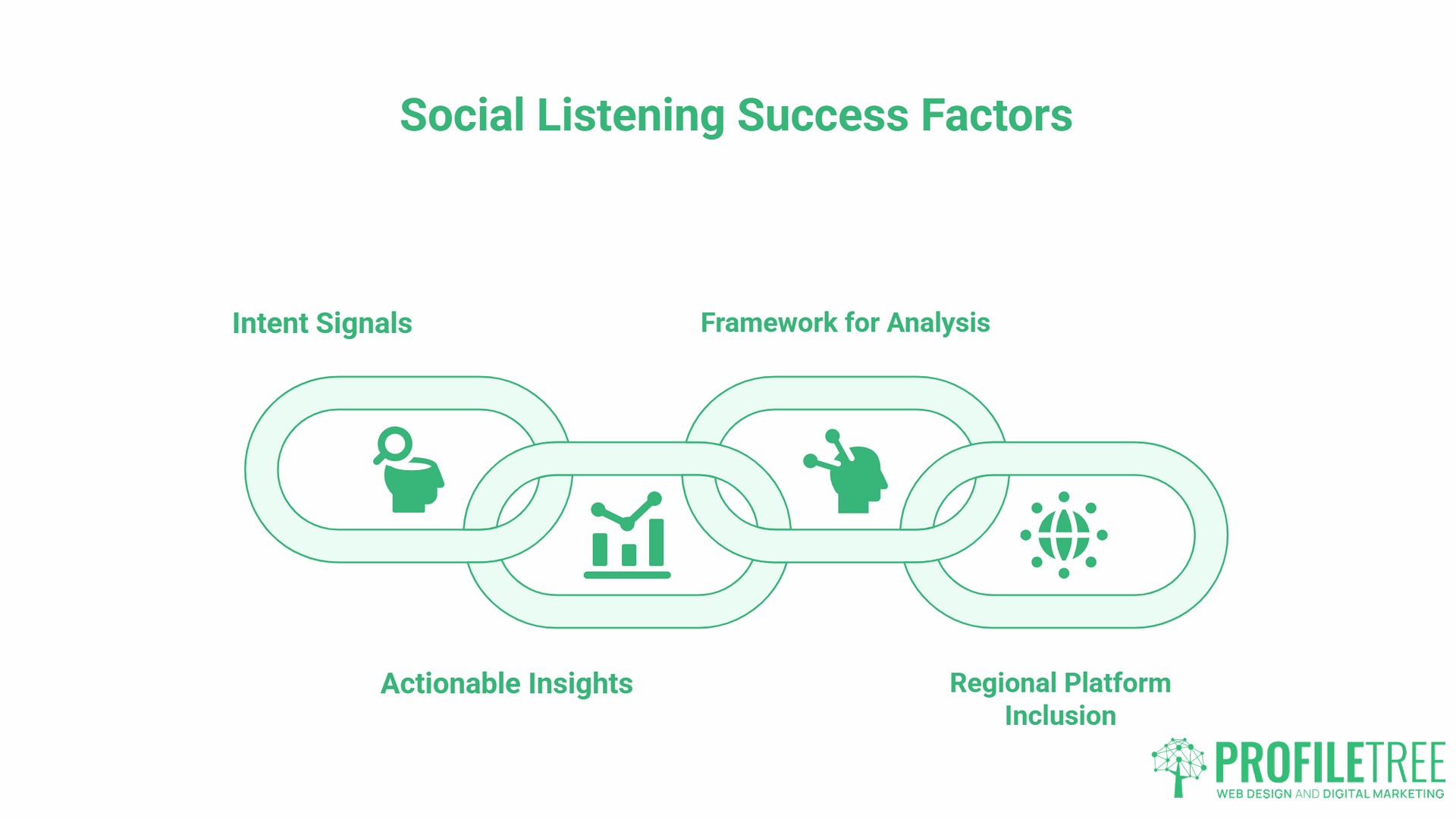
Tracking vanity metrics instead of intent signals. The number of times your brand is mentioned tells you less than the sentiment and context of those mentions. A spike in mentions triggered by a complaint is not good news dressed up as engagement. Focus on what the conversations reveal about customer intent, not on the volume of conversation itself.
No connection to action. Social listening that does not feed into a content calendar, a product decision, or a customer service process is just reading. Build the connection between what you hear and what you do before you start.
Analysis paralysis. Paid tools surface a large volume of data. Without a clear framework for what you are looking for and what you will do with it, the data becomes overwhelming rather than useful. Start with a narrow keyword set and expand gradually.
Ignoring regional platforms. For UK and Irish SMEs, a tool that only monitors mainstream social media is missing a significant portion of relevant conversations. The platforms covered in the previous section deserve a place in your routine.
As Ciaran Connolly, founder of ProfileTree, puts it: “Tools don’t solve problems. The actions you take based on the data do. The SMEs that get value from social listening are the ones that have decided in advance what they will do when they find something.”
Social Listening and Your Digital Training Needs
Many SMEs have access to social listening tools but lack the skills to act on what those tools surface. Knowing that customers are asking a specific question is useful. Knowing how to write a piece of content that ranks for that question, or how to structure a social media response that builds credibility, requires a different kind of knowledge.
ProfileTree’s digital marketing training directly addresses this gap, including how to translate what audiences say into content that performs in search and social. Training is available for teams and for individual business owners who are managing their own digital presence.
Turning Social Listening into a Content and SEO Advantage
The most practical application of social listening tools for UK and Irish SMEs is the direct connection to content marketing and search visibility. The two disciplines reinforce each other when set up correctly.
Social listening identifies what your audience is asking, complaining about, and searching for. Content marketing turns those signals into pages, posts, and resources that answer those needs. SEO gets those pages structured and optimised to appear when the same audience searches Google.
This is the cycle that ProfileTree’s content marketing services are built around. For SMEs that want to manage this process themselves, understanding social listening is the entry point.
Take the Next Step with ProfileTree
Understanding what your customers and competitors are saying online is one part of an effective digital strategy. The harder part is knowing what to do with that information. ProfileTree works with SMEs across Northern Ireland, Ireland, and the UK to build the content, SEO, and digital marketing foundations that turn insight into growth. If you want to discuss how social listening can feed into your broader strategy, get in touch with the team.
Frequently Asked Questions
What are social listening tools for small businesses?
Social listening tools for small businesses are platforms that monitor online conversations about a brand, competitor, or industry topic across social media, forums, review sites, and news sources. For SMEs, the most useful tools combine keyword tracking with sentiment analysis, giving business owners a clear picture of how their brand is perceived and where opportunities exist to improve their marketing or customer service.
What is the best free social listening tool for small businesses?
Google Alerts is the most accessible free option and a practical starting point for any SME. It monitors indexed web content for your chosen keywords and delivers results by email. AnswerThePublic offers a small number of free searches per day, which is useful for question-based keyword discovery. Note that TweetDeck, often recommended as a free option in older guides, has been paid since 2023 and now sits behind X’s $40 Premium+ tier.
How much should an SME budget for social listening?
Start with the free tools. Once you have a clear sense of what you are monitoring and what actions you are taking based on the data, Awario’s Starter plan at $29 per month on annual billing is the most realistic paid step up for an SME, and one of the few dedicated listening tools still priced for small businesses. Most alternatives now start in the hundreds. For the majority of SMEs, free tools plus Awario cover the job.
Is social listening legal under GDPR?
Yes, when done correctly. Social listening tools are built to monitor publicly available data, including content users have posted on public profiles, pages, or forums. This is lawful under UK GDPR and EU GDPR. What is not permissible is accessing private messages or data shared in closed groups. If you are unsure about a specific approach, the ICO (UK) and DPC (Ireland) both publish relevant guidance. This answer is for general information only and does not constitute legal advice.
How does social listening improve SEO?
Social listening surfaces the language your audience uses when discussing problems, asking questions, and describing what they need. This language, particularly from forums, review sites, and community platforms, often maps directly to search queries. Identifying these phrases and building content around them improves the alignment between your pages and the searches your potential customers are actually running. It also surfaces unlinked brand mentions, which represent outreach opportunities for building backlinks.
Can I do social listening if I only use Instagram?
Instagram’s native notifications cover mentions of your account and comments on your own posts, but they do not surface conversations about your brand or sector that happen outside your own profile. A social listening tool, even a free one like Google Alerts, extends your view to review sites, forums, and other platforms where your potential customers are talking. For Instagram-specific listening, Awario offers hashtag and keyword monitoring at a price an SME can justify.
What is the difference between social monitoring and social listening?
Social monitoring is reactive: you respond to what is directed at you. Social listening is analytical: you study patterns across conversations you were not part of and use those patterns to make decisions. Both are useful, but listening is where the strategic value lies for SMEs looking to improve their marketing, content, and customer service over time.