
Location-Based Marketing: A Complete Guide for the UK & Ireland
Table of Contents
Location-based marketing gives businesses a way to reach people at the exact moment they are physically near, or actively searching within, your service area. For SMEs across Northern Ireland, Ireland and the wider UK, that precision matters more than most generic marketing guides acknowledge.
A geofenced campaign that drives someone to a slow, poorly structured mobile landing page will not convert. A business with accurate, structured data and a well-maintained Google Business Profile will appear in AI-assisted local recommendations ahead of a competitor spending far more on advertising. This guide covers what location-based marketing means for a small or medium-sized business, the technology and tactics behind it, what UK and Irish law requires before any location data is collected, and the technical groundwork that must be in place for it to work.
What Is Location-Based Marketing?
Location-based marketing (LBM) is a digital marketing approach that uses a person’s physical location or location history to serve relevant ads, notifications, or content. It sits within the broader discipline of digital marketing strategy and draws on GPS data, Wi-Fi positioning, IP address signals and Bluetooth technology, depending on the tactic in use.
The definition has widened as smartphones have become the primary device for browsing. Location data now feeds Google Maps results and “near me” searches, programmatic advertising, and push notifications sent when a customer is near a specific area.
Why Location Matters for SMEs
For a local business, location data is one of the few areas where a much smaller advertising budget can still compete with a national brand. A well-structured Google Business Profile, a fast mobile-optimised website and a targeted geofencing campaign can put a small Belfast or Dublin business in front of the right customer at the right moment. Small business statistics for the UK consistently show that local visibility, not overall marketing spend, is one of the strongest predictors of footfall for independent retailers and service businesses.
The commercial case comes down to relevance and timing. A consumer searching for “coffee near me” on a Saturday morning is closer to making a purchase decision than someone who sees a generic brand-awareness ad on social media. Location data gives marketers a way to reach people at that specific moment, which is why it sits alongside local SEO as one of the highest-return activities available to a small business.
How Location-Based Marketing Works
Understanding the technology helps when briefing an agency, evaluating a platform or deciding which tactic suits a given budget. The trigger layer is the location signal: GPS coordinates from an app, a Wi-Fi probe request, a beacon ping or an IP address check. The logic layer decides which audience segment a device belongs to and what should happen next. The delivery layer serves ads, notifications, or content. The attribution layer connects the outcome, a store visit, a phone call or a purchase, back to the campaign.
GPS, Wi-Fi and IP Positioning
GPS provides the most accurate positioning outdoors, within a few metres, but it drains the battery and requires explicit app permission. It also degrades indoors and in dense urban areas, where tall buildings reflect satellite signals, which matters for any business running campaigns in Belfast city centre, central Dublin or any UK city with a lot of high-rise development. Wi-Fi positioning uses signals from nearby routers and works well indoors, making it more practical than GPS for high-street environments such as Belfast city centre, Manchester’s Northern Quarter, or Dublin’s Grafton Street. IP-based targeting is the least precise of the three but requires no app and places a device within a city or postcode area.
5G and Location Precision
5G infrastructure improves location accuracy through lower latency and denser cell coverage, which speeds up how quickly location-based ads can trigger and allows more connected devices, including in-store sensors, to feed into a location marketing platform. Coverage across Northern Ireland and rural Ireland remains uneven, so this needs to be factored into planning for any business outside the main urban centres.
Five Ways Businesses Use Location Data
Five tactics account for most location-based marketing activity, and they suit different budgets and business types.
Geofencing draws a virtual boundary around a specific area: a city centre, a business district, an event venue or a competitor’s premises. When a device crosses that boundary, it can trigger an ad, a push notification or a tracking event. A Northern Ireland business might set a geofence around the ICC Belfast during a trade show, serving content only to people who physically attended. The variable that matters most is the size of the fence: too large and the targeting loses relevance, too small and it misses the audience.
Geotargeting restricts ad serving to a defined area, a city, region, postcode or country, without needing a real-time location event. Most paid social and Google Ads campaigns use geotargeting as a baseline layer. For businesses serving both Northern Ireland and the Republic of Ireland, this needs care: the two jurisdictions have different currencies and regulatory frameworks, and a campaign run identically on both sides of the border will usually underperform one that treats each market separately.
Geoconquesting is a specific form of geofencing aimed at a competitor’s physical location rather than a general area, typically used by retailers and hospitality businesses to reach people who are already near a rival’s premises. It is a more aggressive tactic and works best combined with a genuinely differentiated offer, since simply matching a competitor’s message rarely shifts behaviour on its own.
Proximity marketing and beacon technology cover tactics that activate when a device is within a short physical range of a location. Bluetooth beacons, small transmitters placed in a physical space, are the most common tool. When a customer’s phone comes within range and has the relevant app installed, it can trigger a notification, a product recommendation or a loyalty reward. Retail and venue environments are the main use case; for most SMEs without a dedicated app, beacon-based marketing means either building one or integrating with a platform that already has an installed user base, a decision that touches both web development and digital strategy.
IP-based and network-level targeting needs no app or explicit location permission. It associates an IP address with a geographic area, typically city or postcode level, and serves ads to devices on that network. It is less precise than GPS or beacon data but considerably easier to deploy, and it does not trigger the same consent requirements under UK law as app-based tracking.
| Method | Typical Accuracy | Best Use Case | Explicit Consent Required (UK) | Relative Cost |
|---|---|---|---|---|
| GPS (app-based) | 5 to 20 metres | Real-time triggers, loyalty apps | Yes | High |
| Geofencing | 30 to 500 metres | Events, competitor proximity | Yes (app-based) | Medium |
| City/postcode level | City or postcode | Paid social, Google Ads | No (aggregated) | Low |
| Bluetooth beacons | Under 30 metres | In-store, venue | Yes (app and Bluetooth) | Medium to High |
| IP targeting | City or postcode | Display, programmatic | No (aggregated) | Low |
Location-Based Marketing and UK Law: GDPR and PECR
This is the section most location-based marketing guides skip. For UK and Irish businesses, it carries the greatest practical risk and the greatest opportunity to stand apart by doing it properly.
Two pieces of legislation govern location data in the UK. UK GDPR, the retained version of the EU regulation following Brexit, sets the overarching framework for personal data, alongside the Data Protection Act 2018. The Privacy and Electronic Communications Regulations (PECR) sit alongside it and specifically govern electronic marketing communications, including push notifications, SMS, and cookies. The Information Commissioner’s Office publishes detailed guidance on how PECR specifically treats location data, and it is worth reading directly rather than relying on secondary summaries.
What Counts as Location Data Under UK Law
Location data counts as personal data under UK GDPR when it can identify or be linked to a specific individual. GPS data from a mobile app almost always qualifies. Aggregate IP-level data, where no individual can be identified, generally does not, though this depends on how it is combined with other data points. The distinction matters because personal location data needs a lawful basis for collection or processing, and for most marketing purposes, that basis is explicit consent.
Consent Requirements for Location-Based Campaigns
For app-based location tracking, users must actively opt in. Pre-ticked boxes, consent buried in terms and conditions, and implied consent from an app download are not sufficient under UK law. The standard set by the ICO is that consent must be freely given, specific, informed and unambiguous.
The soft opt-in rule under PECR allows businesses to send direct electronic marketing to existing customers without fresh consent in certain circumstances, but it applies only to product and service marketing, not to ongoing location tracking. A soft opt-in cannot justify continuous GPS monitoring of a customer’s physical movements.
Consent Management for Apps and Websites
For any business building or commissioning an app or website that uses location data, the consent flow needs to be designed into the product from the outset rather than added afterwards. A compliant flow needs a clear explanation of what data will be collected, how it will be used and how long it will be kept, a genuine choice to accept or decline without losing core functionality, and a straightforward way to withdraw consent at any time. The consent record itself must be logged and retrievable.
From a web development perspective, this is one of the more technical pieces to get right: GDPR-compliant consent flows and forms need to be built into any project involving marketing tracking from day one, since retrofitting consent management after launch is considerably more work than designing it in from the start.
The Soft Opt-in Myth
A common misconception among UK businesses is that downloading an app implies consent to location tracking. It does not, under either PECR or UK GDPR. Each distinct use of personal data needs its own lawful basis, and for marketing-driven location tracking, that basis is explicit opt-in consent. Working through the practical distinctions here, and what they mean for a specific app or campaign, is exactly the kind of thing worth covering in team-level GDPR training before any business deploys app-based location features for the first time.
Cross-Border Marketing: Northern Ireland and the Republic of Ireland
The island of Ireland presents a genuinely unusual context for digital marketing in Northern Ireland and the Republic that almost no UK or US-produced guide addresses in any practical detail.
A geofence drawn around Newry will capture devices from both sides of the border. A Google Ads campaign targeting “Newry” can bleed into County Louth depending on how the geographic settings are configured. The currency difference between GBP and EUR, regulatory divergence, and measurable differences in search behaviour across the border all affect how a campaign should be built.
Running Separate Campaigns Per Jurisdiction
For businesses operating in border counties, Newry, Dundalk, Enniskillen, Monaghan and Derry among them, the practical recommendation is to run separate campaign sets for each jurisdiction: separate ad sets for Northern Ireland and the Republic, separate landing pages where pricing or regulatory references differ, and separate consent flows that reference the correct supervisory authority. Messaging that references “£10 off” will not convert well in Dundalk, and a campaign served to Derry using EUR pricing will confuse most of its audience. These are not minor edge cases; they affect every location-based campaign operating within roughly 30 to 40 kilometres of the border.
The Regulatory Position Post-Brexit
Northern Ireland remains subject to UK GDPR and PECR, with the ICO as the lead supervisory authority. The Republic of Ireland is regulated by the Data Protection Commission under the EU GDPR. In practice, the substantive consent requirements are closely aligned; both require explicit, informed consent for the use of personal location data in marketing. Compliance documentation, privacy notices and opt-in flows need to reference the correct authority for each jurisdiction, and the wider regulatory picture facing businesses operating across both markets since Brexit is worth understanding beyond location data specifically.
Preparing for AI-Driven Location Discovery
The way people find local businesses is changing faster than most SME marketing guides acknowledge. The standard “near me” search is giving way to something more agentic: AI assistants in phones, browsers, and apps now make location-aware recommendations without the user typing a query at all.
When someone asks an AI assistant to find somewhere to get lunch near St George’s Market, or to book a plumber in Lisburn this afternoon, the assistant draws on structured data, primarily from Google’s Knowledge Graph, Google Business Profile and schema markup on the business’s own website, to generate its answer. The businesses that appear in those answers are not necessarily the ones with the biggest advertising budget. They are the ones whose data is structured clearly enough for an AI system to parse and trust, which is a big part of what AI implementation actually means for a small business, rather than something abstract.
What This Means for Your Website
Local SEO and structured data are no longer just about ranking in traditional search results; they are the foundation that determines whether an AI assistant recommends a business at all. That comes down to three things in practice. First, the Google Business Profile needs to be complete, accurate and actively maintained, with services, opening hours and recent posts included. Second, the website needs LocalBusiness schema markup that clearly names the business, location, service types and contact details in a format a machine can read. Third, the content on the site needs to answer the specific questions an AI assistant is trying to answer on a user’s behalf: what the business does, where it is, what it charges and what customers say about it.
Schema Markup and Local Discovery
Schema markup from Schema.org is the structured data language search engines and AI systems use to categorise web content. For a local business, the most relevant schema types are LocalBusiness (or a specific subtype such as Restaurant, MedicalBusiness or ProfessionalService), PostalAddress, GeoCoordinates and OpeningHoursSpecification. Adding these does not need a large budget, but it does need proper technical implementation, either directly in the site’s HTML or through a CMS plugin with schema support, and it is the kind of technical SEO add-on that pays for itself once a business is relying on AI-driven discovery for any meaningful share of local enquiries.
“For most SMEs in Northern Ireland, the highest-value location marketing work is still the fundamentals: a complete and accurate Google Business Profile, a fast mobile website, and location-specific content that matches what people are actually searching for in their area,” says Ciaran Connolly, founder of ProfileTree. “The more advanced tactics layer on top of that base, but without it, they rarely perform as expected.”
Location Data in a Cookie-less World
Third-party tracking cookies are steadily losing their usefulness as browsers restrict them further, and first-party data, information a business collects directly rather than buys from a broker, is becoming the more durable foundation for local targeting. A Google Business Profile, an accurate customer list, and a website with proper schema and consent management are all first-party assets that a small business already controls, which puts SMEs in a reasonably strong position compared with businesses that build their marketing entirely around third-party ad targeting.
Building the Technical Foundation for Location-Based Marketing
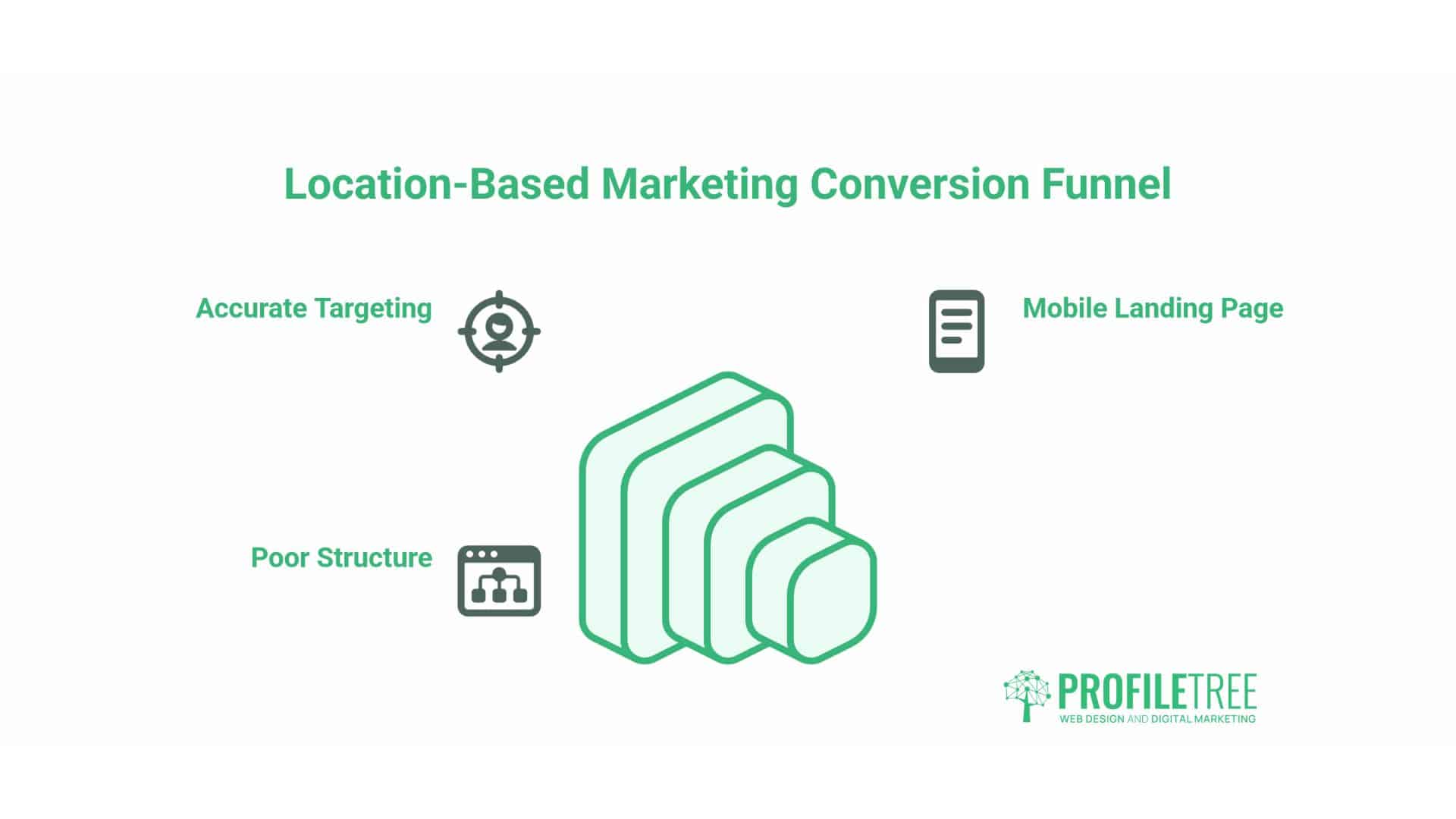
Location-based marketing fails at the last step far more often than it fails at the targeting stage. A geofence campaign that drives someone to a slow, poorly structured mobile landing page will not convert, regardless of how accurate the targeting was.
Mobile Performance and Landing Pages
Most location-triggered interactions happen on mobile devices; anyone receiving a push notification or seeing a geofenced ad is almost certainly on a phone. If the landing page takes more than three seconds to load or is not optimised for mobile interaction, the campaign’s conversion rate will be limited, no matter how well-targeted the audience is. Web design work that involves location marketing needs to account for this from the outset. Page speed, clear mobile calls to action, minimal form fields and fast-loading images are the baseline, not optional extras, and this is exactly the kind of technical groundwork a proper website development project should cover before any paid targeting starts.
Content Marketing as a Local Strategy
Paid location targeting is one route to local visibility; organic local content is the other, and for many SMEs, it is the more cost-effective long-term investment. City- and region-level content, landing pages, blog posts and guides targeting specific geographic search intent, drive traffic from “near me” and location-qualified searches without ongoing ad spend. A Belfast-based florist ranking organically for “same-day flower delivery Belfast” is using location-based content marketing. A Derry restaurant that appears in voice search results for “restaurants open now near Guildhall Square” is benefiting from well-structured local content and an accurate Google Business Profile. This organic local content layer is exactly the kind of work that sits inside a wider digital marketing strategy rather than existing on its own, and it overlaps with video marketing, where a short local explainer or venue walkthrough supports the same search intent.
Analytics and Attribution for Physical Conversions
Measuring location-based campaigns needs more thought than measuring standard digital campaigns, because the conversion event is often physical: a store visit, a phone call, a walk-in enquiry, rather than a form submission or online purchase. Google Ads store visit conversions, call tracking and Google Business Profile Insights all contribute to the picture, and specialist geofencing platforms typically include footfall attribution in their own reporting. The step most often missed is defining what success looks like before a campaign starts, so the measurement framework is set up to capture the right data from day one.
What This Looks Like Across Different SME Sectors
The right combination of tactics depends heavily on the type of business and how customers already search for it.
A trades business, a window and door installer, or an electrician typically gets more value from geotargeted search content and an accurate, review-rich Google Business Profile than from beacon-based tactics, since most enquiries start with a “near me” search rather than a walk-past of physical premises. A car dealership benefits from combining geotargeted paid reach around its forecourt with genuinely local content, service area pages and location-specific stock information, since buyers often compare several dealerships within a set driving radius before visiting any of them. A restaurant or hospitality business sits closest to the beacon and proximity end of the spectrum, since footfall in a specific street or retail area is a meaningful part of its customer base, alongside the same Google Business Profile fundamentals every local business needs. A solicitor’s practice or other professional service firm tends to rely almost entirely on organic local search and a trustworthy, well-structured website, since location-based advertising is a poor fit for a purchase decision that rarely happens on impulse.
None of this needs a large budget to start. It needs an accurate sense of how a specific type of customer actually searches, and a website and Google Business Profile built to answer those searches effectively.
Measuring Success: KPIs for Location Campaigns
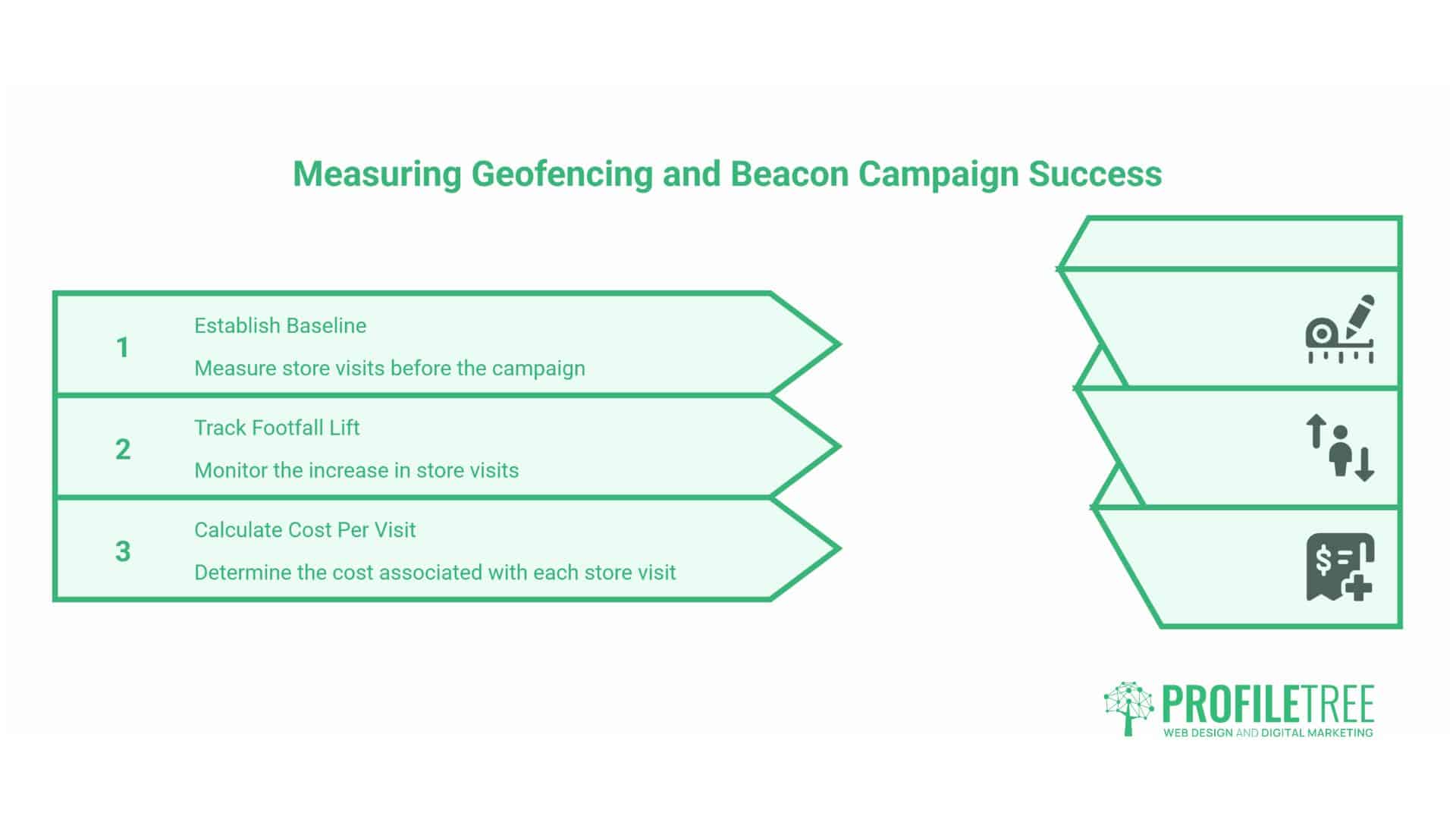
The right measurement framework depends on the tactic. For geofencing and beacon campaigns, footfall lift, the increase in store visits attributable to the campaign, and cost per store visit are the two figures that matter most, and both need a baseline measurement period before the campaign starts to mean anything. For geotargeted paid social and search, click-through rate by location, conversion rate by location and cost per local lead are more useful than national averages, since local performance often varies more than the headline numbers suggest. For organic local content, Google Business Profile Insights (views, calls, direction requests) and ranking position for location-qualified search terms are the practical indicators to track month on month.
A Practical Starting Sequence for UK and Irish SMEs
For most small and medium businesses, the right starting point is not a complex beacon deployment or a programmatic geofencing campaign. It is the foundation that makes location-based marketing measurable before any budget goes into targeting, and it maps closely onto a standard audit, plan, deliver, monitor and refine approach to digital strategy rather than being a separate exercise, which is exactly the kind of groundwork covered in ProfileTree’s digital training sessions for teams building this capability in-house.
Start by auditing the Google Business Profile for completeness: services, opening hours, photos and recent posts. This is the single most valuable step for local discovery and costs nothing beyond time. Add the LocalBusiness schema to the website if it is not already there, and check the current implementation using Google’s Rich Results Test. Create or improve at least one location-specific landing page that targets the primary service area with clear, locally relevant content and accurate NAP (name, address, phone) data. Set up call tracking and, where possible, store visit conversion measurement before running any paid location campaigns. Only after that foundation is in place does it make sense to test a simple geotargeted paid social or Google Ads campaign, rather than starting with more complex geofencing infrastructure before the basics are covered.
Location-Based Marketing Statistics: What the Data Shows
Statistics in this space need to be read carefully. Much of what circulates online comes from vendor studies and platforms with a commercial interest in showing high success rates, rather than from independent research. A few data points from more credible sources are worth understanding on their own terms. Google’s own data consistently shows “near me” searches growing on mobile devices year on year, with restaurants, retail and professional services among the highest-volume local search categories. Ahrefs’ research into AI Overview citations found that pages covering multiple sub-questions within a topic are 161% more likely to be cited, which is directly relevant to how local content should be structured. Vendor statistics about click-through rates and conversion uplifts are best treated as indicative rather than definitive; actual performance depends on audience, category, geographic area and the quality of the technical foundation behind the campaign, not on an average drawn from a platform’s global customer base.
Location-based marketing works when the technical, legal and strategic foundations are in place before the targeting starts. For most SMEs in the UK and Ireland, that means local SEO, structured data and a fast mobile website first, paid location targeting second. Getting the sequence right the first time is considerably cheaper than fixing it after a campaign has already spent its budget on the wrong foundation.
Getting the Foundation Right Before the Targeting Starts
Location-based marketing works when the technical, legal and strategic foundations are in place before any targeting budget gets spent. Skipping that order, not poor creative or the wrong platform, is the most common reason campaigns underperform.
For most SMEs in the UK and Ireland, the sequence that holds up is local SEO and structured data first, a fast, properly consented mobile website second, and paid location targeting only once those two are solid. Getting that order right the first time costs less than fixing it after a campaign has already spent its budget against the wrong foundation.
FAQs
What is location-based marketing?
Location-based marketing uses a person’s physical location to deliver relevant ads, content or notifications. It covers geofencing, geotargeting, beacon marketing and locally optimised organic content.
Is location-based marketing the same as geofencing?
No. Geofencing is one tactic within the broader category. Location-based marketing also includes geotargeting, geoconquesting, beacon and IP-based targeting and locally optimised search content.
Is location-based marketing legal in the UK?
Yes, provided location data is collected with explicit, informed consent under UK GDPR and PECR. Aggregate, non-identifying data, such as city-level IP targeting, carries lighter consent requirements.
How accurate is location targeting in UK cities?
It varies by method. GPS is accurate to a few metres outdoors but degrades indoors, which makes Wi-Fi positioning more reliable in city centres such as Belfast or Manchester. Beacons are most precise in-store; IP targeting resolves to the city or postcode level.