
How to Become a UX Designer in the UK and Ireland
Table of Contents
The demand for UX designers across the UK and Ireland has not collapsed under the weight of AI, despite what anxiety-driven headlines suggest. What has changed is the bar. Recruiters in Belfast, Dublin, London, and Manchester are no longer impressed by a bootcamp certificate and three Figma mockups lifted from a tutorial. They want designers who understand human behaviour, who can articulate a design decision under pressure, and who know how to work alongside AI tools rather than pretend they don’t exist.
This guide covers the practical path from zero to employable: the skills that actually matter in 2026, the education routes available in the UK and Ireland specifically, what a portfolio needs to include, and how to break into a market where junior roles attract hundreds of applicants. It also addresses the questions most career guides avoid, including whether UX design is still worth pursuing and what the honest timeline looks like.
What Is UX Design and What Has AI Changed?
UX (User Experience) design is the discipline of shaping how people interact with digital products: websites, apps, software interfaces, and increasingly voice and AI-driven systems. A UX designer’s job is to understand what users need, identify where products fail them, and create experiences that are functional, clear, and worth returning to.
The role has always involved research, wireframing, prototyping, testing, and iteration. What 2026 has added is a layer of AI-assisted workflow that compresses some of those stages significantly.
What AI Has Changed About the Job
Figma’s AI features now generate layout variants and auto-annotate designs. Tools like Relume produce wireframe structures from a text prompt in seconds. ChatGPT and similar models speed up persona development, competitive analysis, and early-stage research synthesis. Midjourney handles moodboards that used to take a designer an afternoon.
This does not mean UX design is disappearing. It means the designers who understand why a layout decision works, who can conduct a usability session and interpret the findings, and who can challenge a product brief on the basis of user data are more valuable than ever. The tools have changed; the thinking hasn’t.
“The designers getting hired right now aren’t the ones who know how to use every AI tool,” says Ciaran Connolly, founder of ProfileTree. “They’re the ones who use those tools to do better work faster, and who can still explain every decision they made to a stakeholder who doesn’t care about the tool at all.”
The question “Is UX a dying career?” appears frequently in search results. The short answer: no. The long answer is that entry-level roles focused purely on UI execution are under pressure, while roles that blend research, strategy, and cross-functional communication remain in demand. The title is also shifting. Many employers now post for “Product Designer” roles that cover UX responsibilities under a broader remit.
Is UX Design Still a Good Career in the UK and Ireland?
Honest market analysis matters here, because most guides on this topic are written by bootcamp providers who have a financial interest in your enrolment.
Demand Across UK and Irish Markets
London remains the largest market for UX roles in the UK, with Dublin not far behind as a hub for multinational tech companies operating their European operations from Ireland. Outside those centres, Belfast, Manchester, Edinburgh, and Bristol all have active tech communities with genuine UX hiring.
The Northern Ireland market is smaller but has distinct advantages: lower competition per role, lower cost of living, and a growing cluster of digital and fintech businesses. ProfileTree’s own work with SMEs across Northern Ireland and Ireland reflects this growth firsthand.
The Junior Saturation Problem
The difficulty is real and worth naming. Many junior UX roles in 2025 and 2026 attracted 300 to 600 applications. A significant portion of those applicants completed the same Google UX Design Certificate, have portfolios with the same three case study types, and describe their process in nearly identical language.
This is not a reason to avoid the field. It is a reason to approach it differently, which this guide addresses in the section on portfolios and job applications.
Salaries: UK and Ireland Benchmarks
| Level | London | Dublin | Manchester / Belfast |
|---|---|---|---|
| Junior (0–2 years) | £28,000–£38,000 | €30,000–€40,000 | £22,000–£30,000 |
| Mid-weight (2–5 years) | £42,000–£60,000 | €45,000–€65,000 | £32,000–£45,000 |
| Senior (5+ years) | £65,000–£90,000 | €70,000–€95,000 | £48,000–£65,000 |
| Lead / Principal | £90,000–£120,000+ | €95,000–€120,000+ | £60,000–£85,000 |
Note: Figures are indicative ranges based on published job advertisements. They do not constitute guaranteed salary data.
Freelance UX designers in the UK typically charge £300 to £600 per day at mid-weight level, rising to £700 to £1,000+ for senior specialists. Remote work has moderated some of the London premium, though the highest-paying roles still cluster in London and Dublin.
The 5-Step Roadmap to Becoming a UX Designer
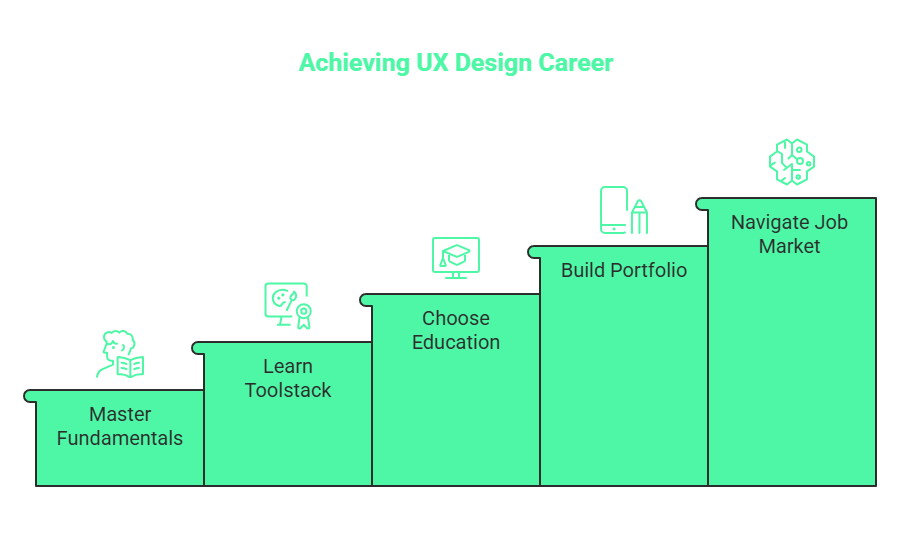
This is the practical sequence. Each step builds on the previous one, and skipping ahead typically results in a portfolio that looks polished but fails to demonstrate real design thinking.
Step 1: Master the Fundamentals
Before you open Figma, understand why products fail their users. Read Don Norman’s The Design of Everyday Things. Study the core principles of information architecture, cognitive load, accessibility (WCAG 2.2 is the current UK standard), and the basics of user research. These are the foundations that separate designers who can explain their decisions from those who can only describe their tools.
The skills that consistently appear in UK and Irish job descriptions for 2026 junior roles include: user research (both qualitative and quantitative), wireframing, prototyping, usability testing, accessibility knowledge, and the ability to present and defend design decisions in a cross-functional team. Soft skills matter as much as technical ones. Collaboration, written communication, and the ability to receive and act on critical feedback are cited as differentiators by design leads reviewing junior applications.
Step 2: Learn the 2026 Toolstack
The core tools you need to be competent in:
- Figma is non-negotiable. It is the industry standard for wireframing, prototyping, and design handoff. Learn its component and auto-layout systems, not just how to draw shapes. Figma AI features (first rolled out in late 2024 and expanded since) are worth understanding, even if you use them selectively.
- Figjam or Miro for collaborative workshopping and mapping exercises.
- Maze or Useberry for unmoderated usability testing. Lookback for moderated remote sessions.
- Notion or Confluence for research documentation and design system notes.
For AI-assisted workflows: Relume for rapid wireframe scaffolding from text prompts; ChatGPT or Claude for research synthesis, persona drafts, and survey analysis; Midjourney or Adobe Firefly for visual moodboarding. These are not shortcuts that replace design thinking; they are tools that handle the time-consuming groundwork so you can focus on the harder decisions.
Understanding how design connects to front-end development is also useful. You do not need to code, but knowing what is and isn’t feasible to build, and how to communicate with developers, removes friction from every project.
Step 3: Choose Your Education Path
The UK and Ireland offer more routes into UX than most guides acknowledge.
| Path | Typical Cost | Time Investment | Recruiter Perception |
|---|---|---|---|
| Self-taught | £0–£500 (courses and tools) | 12–24 months | Strong if portfolio quality is high |
| Online bootcamp | £2,000–£9,000 | 3–9 months full-time | Mixed; certificate alone carries little weight |
| University degree | £9,250/year (England) | 3–4 years | Strong for larger companies; not required |
| Level 4 UX Apprenticeship (UK) | Funded by employer/levy | 18–24 months | Highly regarded; combines work and study |
| Springboard+ (Ireland) | Heavily subsidised / free for eligible candidates | 6–12 months | Well regarded for career changers |
The Level 4 Digital User Experience Professional Apprenticeship in England is worth knowing about. Employers take on apprentices, and the training is funded through the Apprenticeship Levy, meaning the cost to the individual is typically zero.
The Institute for Apprenticeships lists approved providers. In Northern Ireland, Higher Level Apprenticeships in digital fields are available through the Department for the Economy. In Ireland, Springboard+ offers subsidised upskilling programmes at partner universities, specifically designed for career changers.
ProfileTree runs digital training programmes for businesses and professionals that cover practical digital skills, and we’ve seen first-hand how structured, skills-first learning outperforms credential-chasing for people entering the industry.
Google’s UX Design Professional Certificate (available via Coursera) is a reasonable starting point for fundamentals, and it is structured enough to complete in 6 months part-time. Its limitation is that it has been completed by hundreds of thousands of people, which means a certificate alone does not distinguish you from anyone. Use it to learn; build something original to stand out.
Step 4: Build a Portfolio That Passes the Recruiter Test
The single biggest reason junior candidates are rejected in 2026 is a portfolio full of tutorial re-creations and generic case studies. Design leads at UK agencies and tech companies report seeing the same five case study types repeatedly: a food delivery app, a hotel booking redesign, a mental health app, a bank app, and a fitness tracker. These are useful for practising skills, but they do not demonstrate the ability to work on real problems with real constraints.
What a Strong Junior Portfolio Needs
A minimum of three case studies, each documenting the full process: problem definition, research methods, synthesis, ideation, wireframes, testing, iterations, and final outcome. The case study must show what you tried that didn’t work, not just the polished final screens.
At least one case study based on a real problem. Options include: volunteering for a charity or community organisation, pro bono work for a local small business, contributing to an open-source project, or identifying a genuine usability failure in an existing product and documenting a rigorous redesign process with real user testing.
Accessibility considerations visible throughout. If your case studies don’t reference WCAG or contrast ratios, that is a gap.
A written narrative that explains decisions, not just describes them. “I chose this layout because testing showed users missed the primary CTA when it was placed below the fold” is useful. “I designed an intuitive interface” is not.
The visual quality of your portfolio site matters. Platforms like Notion, Cargo, or a custom-built site on Squarespace or Webflow are all acceptable. The site itself should demonstrate visual and UX sensibility.
The concept of portfolio analysis applies beyond investment contexts: knowing what to include, what to cut, and how to position your strongest work is a strategic decision that most candidates underinvest in.
Step 5: Navigate the UK and Irish Job Market
Most advertised junior roles attract far more applications than they can meaningfully review. The most effective routes to your first role are therefore often not the most obvious ones.
Networking with specificity: Attending UXPA UK events, local meetups, and design community gatherings is not about handing out CVs. It is about building relationships with practitioners who will hear about roles before they are posted publicly. A warm introduction to a hiring manager changes the application experience entirely.
The hidden job market: Many junior roles at smaller agencies and scale-ups are filled through referrals or direct outreach before being posted. Identifying 20 to 30 companies in your target city whose work interests you and reaching out with a specific, considered message (not a generic “I’d love to work for you”) is a legitimate and often underused approach.
Tailored applications over volume: A well-researched application for 10 roles will outperform a generic application sent to 100. Read the company’s case studies, understand their clients, and write a cover letter that shows you have.
Platforms like LinkedIn, Indeed, and Workable are the standard places to search. For Northern Ireland specifically, Nijobs.com and Jobs.ie cover the Irish market alongside the main UK boards.
If you’re considering freelancing as a route in, understanding the broader digital agency career landscape gives context for how UX fits within agency structures and what clients actually need from designers.
The Junior Bottleneck: Standing Out Among 500 Applicants
The honest version of career advice acknowledges that the junior UX market in the UK and Ireland is difficult. The certificate is not enough. The bootcamp portfolio is not enough. What tends to separate candidates who get interviews from those who don’t comes down to a small number of factors.
A specific area of interest. Designers who position themselves as “UX for fintech” or “UX researcher with a background in healthcare” are more memorable than generalists. You don’t have to specialise permanently, but a clear focus sharpens your portfolio and makes you easier for a recruiter to place.
Evidence of research thinking. The fastest way to stand out from a field of UI-focused portfolios is to show rigorous user research. A single case study with five user interviews, a synthesis process you can explain clearly, and design decisions traced directly to research findings demonstrates more than ten polished screens from a design sprint.
AI literacy without AI dependency. Show that you use AI tools as part of your workflow, but that your thinking is yours. Hiring managers are increasingly asking candidates to walk through a design decision live, precisely because AI has made it easy to produce polished-looking work that the designer can’t actually explain.
A portfolio that loads quickly and works on mobile. A UX designer’s portfolio site that is slow, broken on smaller screens, or difficult to navigate sends an immediate signal.
Understanding how design decisions connect to technical constraints in adjacent fields like CAD and technical drawing illuminates a broader truth: design disciplines reward practitioners who understand both the creative and the practical limits of their medium.
Career Paths Within UX Design
UX is not a single career track. As you develop, it is worth knowing where the specialism can lead.
UX Research focuses on understanding users through interviews, surveys, usability testing, and data analysis. It is the most academically rigorous specialism and tends to be valued most in larger organisations with dedicated research functions.
Interaction Design focuses on how users move through a product: flows, transitions, micro-interactions, and the logic of navigation. It sits closer to the product decision-making process.
UI Design handles the visual layer: typography, colour, component design, and visual consistency. In smaller teams, UX and UI are often combined into a single role. In larger ones, they are separate disciplines.
Product Design is the catch-all title increasingly used by companies that want designers who span research, UX, and UI and can contribute to product strategy. It is the most employable framing of the discipline in 2026.
Service Design extends UX thinking beyond digital interfaces to entire customer journeys, including offline touchpoints. It is common in the public sector and healthcare organisations.
Conversational and Voice UX is an emerging specialism covering chatbot flows, voice interface design, and AI interaction patterns. Demand is growing as more products incorporate AI-driven conversation.
Continuous Learning and Staying Current

The field moves quickly enough that stopping learning when you get your first job is a reliable way to become obsolete. The areas worth tracking in 2026 include AI-assisted design, accessibility standards (the European Accessibility Act comes into full force in June 2025 for digital products), and the evolving role of design systems as organisations scale.
Reliable ongoing resources include:
Nielsen Norman Group (nngroup.com) for evidence-based UX research and methodology. UX Collective on Medium for practitioner writing. Smashing Magazine for both UX and front-end content. UX Matters for longer analytical pieces. The Interaction Design Foundation offers structured online learning at a reasonable annual cost.
For the community, the UXPA (User Experience Professionals Association) has a UK chapter and holds regular events. Local Slack communities and Meetup.com groups exist in most major UK and Irish cities.
The skills you build in UX transfer across digital disciplines. The ability to understand how visual communication shapes user behaviour — whether in a screen interface or a technical document — is a durable, cross-industry capability.
Conclusion
Becoming a UX designer in the UK or Ireland in 2026 is achievable, but it requires a more considered approach than it did three years ago. The path is: build genuine research skills, develop a portfolio that demonstrates real problem-solving rather than polished execution, connect with the industry through community and direct outreach, and pursue the education route that fits your circumstances rather than the most expensive one.
If you’re working in a business that’s investing in its digital presence and considering how UX design fits into that, the team at ProfileTree works with organisations across Northern Ireland, Ireland, and the UK on web design and digital strategy that puts user experience at its centre. Get in touch to talk through what that looks like for your organisation.
FAQs
Do I need to know how to code to become a UX designer in 2026?
No. Coding is not a requirement for UX roles. Understanding the basics of how websites and applications are built is useful — it helps you communicate with developers and design within realistic constraints — but you are not expected to write production code.
How long does it take to transition into UX from a different career?
For most people studying part-time alongside existing work, 12 to 18 months is a realistic timeline from starting to the first job offer. Full-time study through a bootcamp or intensive programme can compress this to 6 to 9 months, but only if portfolio development runs alongside the coursework.
What is the best UX bootcamp in the UK?
There is no single answer, and anyone who gives you one probably has an affiliate arrangement. The questions that matter more: Does the programme include mentorship from working practitioners? Does it have an outcomes data set you can verify? Brand recognition matters less than the quality of mentorship and the projects you produce.
Can I get a UX job in Ireland without a degree?
Yes. The Irish market, particularly within multinational tech companies based in Dublin, prioritises demonstrable skills and portfolio quality over formal qualifications. Springboard+ courses at Irish universities carry weight with employers because they are university-validated and structured around industry needs.
Are there UX design apprenticeships in Northern Ireland?
Higher Level Apprenticeships (HLAs) in digital fields are available in Northern Ireland through the Department for the Economy, with providers including Belfast Metropolitan College and the Ulster University. The digital skills apprenticeship landscape is narrower than in England, but options exist and are expanding.