
Landing Page Design: Single Pages Engineered for Conversion
Table of Contents
A landing page has one job: convert visitors into leads, customers, or subscribers. Unlike general website pages that serve multiple purposes, landing pages focus entirely on driving a specific action. Every element either supports conversion or undermines it.
This singular focus makes landing pages powerful marketing tools—and makes their design fundamentally different from standard web design. Effective landing pages require an understanding of conversion psychology, persuasion architecture, and what actually makes people take action online.
ProfileTree designs landing pages that convert. We understand the difference between pages that look good and pages that perform well. This page explains landing page design: what makes landing pages effective, when you need them, and how strategic design dramatically improves conversion rates.
What Landing Pages Are (And Aren’t)
Clarity about landing pages prevents confusion:
What Landing Pages Are
Standalone pages. Separate from the main website navigation, focused on a single purpose.
Conversion-focused. Designed entirely around getting visitors to take one specific action.
Campaign-connected. Typically receives traffic from ads, emails, or specific marketing efforts.
Action-oriented. A clear call to action that dominates the page’s purpose.
Distraction-free. Minimal navigation, no competing objectives, focused attention.
What Landing Pages Aren’t
Homepage. Homepages serve multiple purposes; landing pages serve one.
Service pages. Service pages inform broadly; landing pages convert specifically.
Blog posts. Content pages educate; landing pages persuade.
General website pages. Website pages support exploration; landing pages direct action.
The distinction matters because design principles differ significantly.
When You Need Landing Pages
Landing pages suit specific situations:
Paid Advertising Campaigns
Google Ads. Visitors from search ads are expecting specific information and clear action paths.
Social media ads. Traffic from Facebook, LinkedIn, or Instagram ads needs to be focused on conversion.
Display advertising. Banner ad traffic requires relevant, converting destinations.
Sending paid traffic to general website pages wastes advertising spend. Landing pages maximise ad investment returns.
Email Marketing Campaigns
Promotional emails. Offers requiring dedicated conversion pages.
Newsletter links. Specific content or offers warranting focused pages.
Nurture sequences. Campaign stages benefiting from targeted landing experiences.
Email campaigns with custom landing pages outperform those linking to general pages.
Lead Generation
Gated content. Ebooks, whitepapers, and guides require email capture before access.
Webinar registration. Event sign-ups benefiting from focused conversion pages.
Free consultations.Service businesses offering initial consultations.
Newsletter subscriptions.Email list building through compelling offer pages.
Lead generation landing pages capture contact information effectively.
Product or Service Launches
New offerings. Introducing specific products or services.
Limited promotions. Time-sensitive offers require urgency.
Event promotion. Conferences, workshops, and courses need registration.
Launch landing pages concentrate attention on new offerings.
Testing and Optimisation
A/B testing. Comparing different approaches to find what converts best.
Message testing. Evaluating different value propositions.
Offer testing. Comparing different offers to identify winners.
Landing pages enable controlled testing impossible with multi-purpose pages.
Anatomy of High-Converting Landing Pages
Effective landing pages share common elements:
Above-the-Fold Impact
The visible area before scrolling must:
Capture attention. A compelling headline stops visitors immediately.
Communicate value. Clear value proposition answering “what’s in it for me?”
Establish relevance. Confirm that visitors are in the right place.
Begin persuasion. Initial credibility and benefit communication.
Show call-to-action. At least visibility of the conversion opportunity.
First impressions determine whether visitors stay or leave.
Compelling Headlines
Headlines make or break landing pages:
Benefit-focused. Communicating what visitors gain, not what you offer.
Specific. Concrete outcomes rather than vague promises.
Relevant. Matching the ad, email, or source that brought visitors.
Urgent when appropriate. Creating motivation to act now.
Clear. Immediately understandable without effort.
Headlines should pass the “so what?” test—making visitors want to learn more.
Persuasive Body Content
Content supporting conversion:
Problem acknowledgement. Demonstrating understanding of visitor challenges.
Solution presentation. How does your offer address their problems?
Benefit elaboration. Specific outcomes they’ll experience.
Feature translation. What’s included, framed as benefits.
Objection handling. Addressing concerns before they become barriers.
Content should build desire while removing obstacles.
Trust Elements
Credibility supporting conversion:
Testimonials. Customer quotes demonstrating real results.
Social proof. Numbers show others have chosen you.
Credentials. Qualifications, certifications, and awards.
Guarantees. Risk reversal reduces conversion anxiety.
Security signals. Payment safety, privacy assurance.
Trust elements overcome visitors’ scepticism.
Strong Calls-to-Action
The conversion moment itself:
Clear button text. Specific action words, not generic “submit.”
Visual prominence. Standing out clearly from surrounding content.
Benefit reinforcement. Reminding of value at the point of action.
Reduced friction. Minimal form fields, simple process.
Repeated placement. Multiple CTA opportunities throughout the page.
Calls to action should make conversion easy and obvious.
Social Proof Integration
Evidence others have converted:
Testimonials. Customer statements with names, photos, and specifics.
Case studies. Brief success stories demonstrating results.
Client logos. Recognisable businesses building credibility.
Statistics. Numbers showing popularity or effectiveness.
Reviews. Third-party validation from review platforms.
Social proof provides the reassurance uncertain visitors need.
ProfileTree’s digital strategy services help define landing page strategies that align with broader marketing objectives.
Landing Page Types
Different purposes require different approaches:
Lead Generation Landing Pages
Purpose: Capture contact information in exchange for value.
Typical offer: Ebooks, guides, webinars, consultations, assessments.
Key elements: Compelling offer description, brief form, benefit bullets, testimonials.
Success metric: Form submissions, lead quality.
Click-Through Landing Pages
Purpose: Warm visitors before sending to sales or checkout pages.
Typical use: E-commerce, SaaS trials, high-consideration purchases.
Key elements: Product benefits, social proof, persuasive content, prominent button.
Success metric: Click-through rate to next step.
Sales Landing Pages
Purpose: Directly sell products or services.
Typical format: Long-form pages with comprehensive persuasion.
Key elements: Extensive benefits, objection handling, testimonials, pricing, and guarantees.
Success metric: Sales, revenue.
Event Registration Pages
Purpose: Sign up attendees for webinars, workshops, and events.
Typical elements: Event details, speaker information, agenda, registration form.
Key elements: Clear date/time, value proposition, speaker credibility, urgency.
Success metric: Registrations.
Coming Soon Pages
Purpose: Build anticipation and capture interest before launch.
Typical use: Product launches, website launches, service introductions.
Key elements: Teaser content, email capture, and countdown elements.
Success metric: Email sign-ups, early interest indicators.
Landing Page Design Principles
Principles guiding effective landing page design:
Single Focus
One page, one goal. Every element supports a single conversion objective.
No distractions. Remove navigation, links, and competing calls to action.
Clarity over cleverness. The obvious purpose is immediately apparent.
Ruthless editing. If it doesn’t support conversion, remove it.
Message Match
Ad-page alignment. Landing page matching the promise that brought visitors.
Consistent messaging. Same language, same offer, same visual style.
Expectation fulfilment. Visitors find exactly what they expected.
Relevance confirmation. Immediate clarity that they’re in the right place.
Friction Reduction
Minimal form fields. Only essential information requested.
Simple language. Easy to understand without effort.
Clear process. Obvious next steps and expectations.
Fast loading. No patience-testing delays.
Mobile optimisation. Easy conversion on any device.
Urgency and Scarcity
Time limits. Deadlines create motivation to act now.
Limited availability. Scarcity of spots, units, or offers.
Consequence of waiting. What’s lost by delaying?
Authentic urgency. Real limitations, not manufactured pressure.
Visual Hierarchy
Important elements are prominent. Headlines, CTAs, key benefits emphasised.
Eye flow direction. Design guides attention toward conversion.
Contrast for CTAs. Buttons stand out clearly.
White space usage. Avoiding overwhelming visual clutter.
Landing Page Optimisation
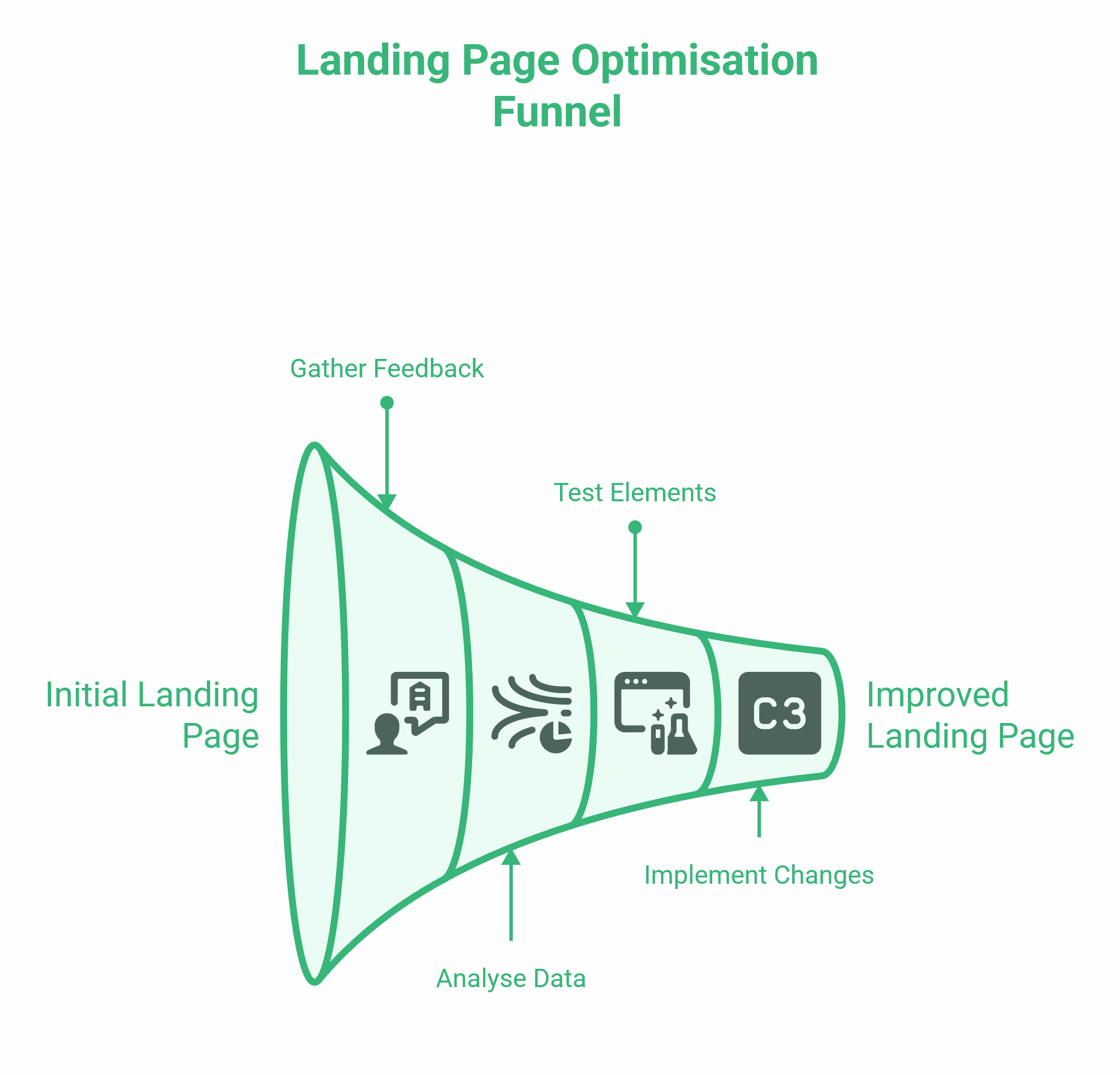
Landing pages should improve over time:
A/B Testing
Headline testing. Different benefit angles and phrasings.
CTA testing. Button colours, text, and placement.
Form testing. Field quantity, order, labels.
Image testing. Different visuals supporting conversion.
Layout testing. Structure variations affecting engagement.
Testing identifies what actually converts, not what we assume will.
Conversion Rate Benchmarks
Average landing page conversion: 2-5%
Good landing page conversion: 5-10%
Excellent landing page conversion: 10%+
Top performers: 25%+ (unusual but achievable in specific contexts)
Your benchmark depends on the industry, the offer, and the quality of traffic.
Metrics to Track
Conversion rate. Percentage of visitors taking action.
Bounce rate. Visitors leaving without engagement.
Time on page. Engagement depth indicator.
Scroll depth. How far do visitors read?
Form abandonment. Where form completion fails.
Source performance. Which traffic sources convert best?
Data guides optimisation decisions.
ProfileTree’s SEO services can help drive organic traffic to landing pages where appropriate.
Landing Page Investment
What does landing page design cost?
Investment Ranges
Basic landing pages (£500-1,000): Template-based design, standard form, essential elements. Suitable for simple lead capture.
Professional landing pages (£1,000-2,000): Custom design, conversion optimisation, persuasive copy, A/B testing setup. Suitable for significant campaigns.
Advanced landing pages (£2,000-4,000): Fully custom design, professional copywriting, advanced functionality, comprehensive optimisation. Suitable for high-value campaigns.
Landing page systems (£4,000-8,000): Multiple connected pages, campaign sequences, advanced tracking, ongoing optimisation. Suitable for sophisticated marketing operations.
Return Calculation
Landing page investment should return measurably:
Example calculation:
- Campaign budget: £5,000/month in ads
- Current conversion rate: 2% (100 leads)
- Landing page investment: £1,500
- Improved conversion rate: 4% (200 leads)
- Additional leads monthly: 100
- Lead value: £50
- Monthly additional value: £5,000
- ROI payback: Less than one month
Small conversion improvements on high-traffic pages yield substantial returns.
Landing Pages vs Website Pages
Understanding the distinction:
When to Use Landing Pages
- Paid advertising campaigns
- Specific offer promotions
- Lead generation campaigns
- A/B testing requirements
- High-value conversion goals
- Campaign-specific messaging
When Website Pages Suffice
- Organic search traffic
- General service enquiries
- Information-seeking visitors
- Brand awareness goals
- Multi-stage buyer journeys
Many businesses need both—landing pages for campaigns, website pages for organic presence.
Our Landing Page Process
ProfileTree creates landing pages through a focused process:
Strategy and Planning
Goal definition. Specific conversion objective and success metrics.
Audience understanding. Who’s landing, what they need, what motivates them.
Offer refinement. What we’re offering, why it’s valuable, and why to act now.
Traffic source alignment. Where visitors come from, what they expect.
Design and Copy
Persuasion architecture. Structure supporting conversion psychology.
Compelling copy. Words that persuade, not just inform.
Visual design. Appearance supporting conversion goals.
Trust element integration. Testimonials, credentials, guarantees.
Mobile optimisation. Conversion effectiveness on all devices.
Development and Launch
Technical build. Fast-loading, properly functioning implementation.
Form integration. Connection to CRM, email systems, or data capture.
Tracking setup. Analytics, conversion tracking, and A/B testing capability.
Testing verification. Cross-device, cross-browser functionality confirmation.
Optimisation Support
Performance monitoring. Tracking conversion rates and metrics.
A/B testing. Systematic improvement through testing.
Ongoing refinement. Continuous improvement based on data.
“Landing pages are precision instruments,” observes Ciaran Connolly, ProfileTree founder. “General websites serve broad purposes—information, credibility, exploration. Landing pages serve single purposes—conversion. When every element focuses on one goal, conversion rates improve dramatically. The difference between a good landing page and a mediocre one might be 2% versus 8% conversion—that’s four times the leads from the same traffic.”
FAQs
How is landing page design different from website design?
Landing pages focus entirely on single conversion goals, removing navigation and distractions. Website pages serve multiple purposes and encourage exploration. Design principles differ significantly—landing pages prioritise persuasion architecture over general usability.
How long should a landing page be?
Length depends on the offer’s complexity and visitors’ awareness. Simple offers with ready-to-act visitors work with short pages. Complex offers or cold traffic often need long-form pages to build understanding and desire. Testing reveals the optimal length for your situation.
Should landing pages have navigation menus?
Usually not. Navigation provides escape routes, reducing conversion. Most effective landing pages remove standard navigation, keeping visitors focused on the conversion goal. The only links should support conversion.
Can landing pages rank in Google?
Landing pages can rank, but typically aren’t optimised for SEO. Their focused nature and minimal content often limit ranking potential. Most landing page traffic comes from paid ads, email, or direct links rather than organic search.
How many landing pages do I need?
One page per campaign, offer, or audience segment. Different ads should often have different landing pages matching specific messages. More targeted pages typically convert better than generic alternatives. ProfileTree’s content marketing services can support the development of landing page content.
What’s a good conversion rate for landing pages?
Industry averages are 2-5%, good performance is 5-10%, and excellent is 10%+. Your benchmark depends on the industry, the offer, and the quality of traffic. Focus on improving your own rates rather than hitting arbitrary targets.