
Digital Value Proposition: How to Define, Build and Test Yours
Table of Contents
A digital value proposition is a clear statement of what your business offers online, who it is for, and why someone should choose you over the alternatives available to them. It covers the website, the app, the content, and every digital channel a customer touches before they ever speak to a person. That definition is simple. Getting it right is not, and most businesses either write something that sounds like a slogan or skip the exercise and hope the website speaks for itself.
What Is a Digital Value Proposition?
A digital value proposition (DVP) answers the question a potential customer is silently asking every time they land on your site: why should I stay here, and why should I buy from you rather than the next result down the page? It names the specific value delivered through digital channels, which means the website, apps, online customer experience, and digital communications, rather than the business in general.
You will also see this called an online value proposition, or OVP, a term popularised by digital marketing strategist Dave Chaffey. The two are interchangeable. What matters is the thinking behind them.
The digital channel changes what customers expect, and that is why the distinction earns its place. A proposition that works in a physical shop (“knowledgeable staff, personal service, twenty years in the trade”) has to be translated into something a website can actually deliver. If the site cannot demonstrate those qualities within the first few seconds, the proposition breaks down before it reaches the customer at all.
Digital Value Proposition vs Traditional Value Proposition
The core purpose does not change when you move online. You are still answering why someone should choose you. What changes is the mechanism.
| Traditional Value Proposition | Digital Value Proposition | |
|---|---|---|
| Delivery | In-person, printed, spoken | Website, app, email, social |
| Proof | Staff, premises, word of mouth | Reviews, speed, UX, content |
| Differentiation | Product features, location, price | Digital experience, personalisation, data |
| Customer feedback | Slow, anecdotal | Measurable, close to real time |
| Iteration speed | Slow | Fast |
A traditional high-street retailer might lead with expert advice and a thirty-day return policy. Its digital value proposition has to answer different questions. Can I find what I need quickly? Is the checkout easy? Will I trust you with my card details?
For SMEs across Northern Ireland and Ireland, this distinction is particularly relevant. Plenty of established businesses have a clear, well-earned local reputation that simply does not translate to their website. ProfileTree’s web design work with SMEs often starts by identifying the gap between how a business is perceived offline and what its digital presence actually communicates.
Value Proposition vs USP vs Mission Statement
These terms get used interchangeably, and the confusion causes real problems. Businesses end up with a mission statement on the homepage where a value proposition should be.
| Focus | Goal | Typical audience | |
|---|---|---|---|
| Value proposition | The specific benefit and the reason to believe it | Convert a visitor into an enquiry | Prospective customers |
| Unique selling proposition (USP) | The one thing that makes you different | Sharpen positioning against competitors | Prospective customers and the internal team |
| Online value proposition (OVP) | The benefits available only through digital channels | Give a visitor a reason to act on-site | Website and app visitors |
| Mission statement | Why the business exists | Guide internal culture and decisions | Staff, investors, partners |
| Employee value proposition (EVP) | The benefits of working there | Attract and retain staff | Current and prospective employees |
A USP is narrower than a value proposition. IKEA is the clearest illustration: the USP is flat-pack furniture with Scandinavian design, while the full value proposition takes in the price point that self-assembly makes possible, the breadth of the range, and the fact that customers transport and build the products themselves. One is a single differentiating claim. The other is the whole bundle, including the trade-offs a customer accepts in exchange for the price.
A mission statement answers a different question again. It is about purpose rather than persuasion, and it is rarely what a first-time visitor needs in the first five seconds.
The 6Cs Framework Behind a Strong Digital Value Proposition

The 6Cs framework was proposed by Dave Chaffey in 2004 as a model of online customer motivation, specifically to help define the online value proposition, and it is set out in Digital Marketing Excellence by Chaffey and PR Smith. It remains the most widely used model for the job. It structures what is otherwise a vague exercise. A strong proposition does not need to excel at all six at once, but it does need to be deliberate about which ones it prioritises and honest about which ones it is only average at.
Content, Customisation and Community
These three address what a brand communicates, how it adapts to the individual, and the sense of belonging it creates.
Content covers the quality, depth, and relevance of the information, media, and resources on your digital platforms. It drives search visibility, authority, and the ability to answer customer questions before anyone has to ask. Two service businesses offering identical work can be perceived very differently based on how clearly each one explains what it does online.
Customisation is the degree to which the experience adapts to the individual user. That ranges from showing recently viewed products through to adjusting page content based on referral source, industry, or intent signals. Customisation reduces friction and makes the experience feel relevant rather than generic.
Community covers the networks, forums, user groups, and social environments a brand facilitates or takes part in. For B2B businesses that might mean industry forums, LinkedIn groups, or customer advisory boards. For B2C it might mean a loyalty programme or a review culture. Community creates switching costs that have nothing to do with price.
Convenience, Choice and Cost Reduction
The remaining three cover the practical experience of transacting.
Convenience is how easy it is to find, evaluate, and buy from you digitally. Site speed, mobile responsiveness, checkout flow, search functionality, support channels. It is the most commonly underestimated of the six. Businesses invest heavily in content and product quality, then lose customers to a slow page load.
Choice is the range of products, services, pricing tiers, or delivery options available online. For some businesses depth of choice is the primary proposition. For others a deliberately narrow, well-explained range is the differentiator. Frame it around what the customer needs rather than what the business can supply.
Cost Reduction is the most frequently misunderstood of the six. It does not mean being cheapest. It means the total cost of doing business with you digitally is lower: fewer errors, faster resolution, self-service tools that cut the need for support, and transparent pricing that removes the cost of uncertainty.
| The 6Cs | Customer benefit | What the business has to have in place |
|---|---|---|
| Content | Informed decisions, trusted guidance | Consistent publishing, genuine expertise |
| Customisation | A relevant, personalised experience | Data collection, segmentation capability |
| Community | Belonging, peer validation | Platform management, active participation |
| Convenience | Interaction without friction | UX investment, technical performance |
| Choice | The right option at the right tier | Catalogue depth or clarity about curation |
| Cost Reduction | Lower total cost of transacting | Pricing transparency, self-service tools |
Other frameworks exist and are worth knowing about, though running several at once produces confusion rather than clarity. Alexander Osterwalder’s value proposition canvas maps customer jobs, pains, and gains against your products, pain relievers, and gain creators, and it is a strong companion exercise if you want to interrogate the customer side in more depth before applying the 6Cs.
The four types of value (functional, monetary, social, psychological) are a useful sense-check on whether your proposition is leaning on price alone. And it is worth accepting that one business often needs value propositions at several levels: a company-level statement, a segment-level version for distinct audiences, and a product-level version for individual services. Pick the 6Cs as your working structure and treat the others as diagnostic prompts.
How AI Search Changed What a Digital Value Proposition Has to Do
When the 6Cs were formalised, personalisation meant putting a returning customer’s first name in an email. AI has shifted the baseline across several of the Cs at once, and businesses that have not revisited their digital value proposition since are describing a standard that competitors now meet as a matter of course.
Customisation has become an expectation, not a differentiator
Generative AI and machine learning moved customisation from a nice-to-have to a baseline. Recommendation engines that once needed substantial engineering investment are now available to SMEs through standard plugins. When one competitor shows a visitor the three products most likely to match their intent and another shows the same twelve items to everyone, the gap is visible to the customer even if they could not name it.
For service businesses, AI-driven customisation might mean a chatbot that qualifies visitor intent before directing them to a specific service page, or a landing page that adjusts its headline based on the search that brought the visitor in. These are affordable and increasingly common.
Your proposition now has to be legible to a machine
Most advice treats a value proposition purely as website copy aimed at a human deciding whether to scroll. That is no longer the whole picture. AI Overviews and assistants such as ChatGPT and Claude now summarise businesses for people who never visit the site directly, which means the proposition has to be extractable as well as persuasive.
In practice that means stating who you serve, what you do, and where you are based in plain factual sentences rather than only in stylised headline copy. A sentence like “ProfileTree is a Belfast-based digital agency offering website development, SEO, and digital marketing strategy for SMEs across Northern Ireland, Ireland, and the UK” is far easier for an AI system to extract and repeat accurately than a clever tagline.
Consistent phrasing across every page, rather than a different variation on each one, helps those systems build an accurate picture of what the business actually does. Keeping that language stable is a discipline problem more than a writing problem, which is why consistency in brand voice is worth treating as a governance rule rather than a style preference.
A page that only defines a term no longer earns a citation. Pages with structured, self-contained answers and some original thinking are the ones that get surfaced, which makes content quality a direct expression of the digital value proposition in AI-mediated search rather than a separate SEO concern.
Why UK and Irish Businesses Struggle With Value Positioning
The UK service sector has a specific problem here. Most businesses in crowded markets, including accountancy, law, recruitment, web design, and digital marketing, have been trading long enough to feel established but have never committed to a clear position. The result is a run of nearly identical websites saying similar things, each with a different logo.
There is a cultural factor too. UK business culture is broadly more cautious about bold claims than its US equivalent. That caution is understandable, since overstatement damages credibility in a sceptical market, but it produces hedged language that fails to communicate genuine strengths. “We work with a range of clients across various sectors” is the defensive version of a proposition that could, with more specificity, be persuasive.
The commoditisation trap hits professional service firms hardest. When buyers cannot easily tell providers apart on technical capability, price becomes the default basis for comparison. A clear digital value proposition puts non-price factors back on the table: specialism, process, track record, outcome.
“The businesses that do well online are not always the ones with the best product,” says Ciaran Connolly, founder of ProfileTree. “They are the ones who have worked out how to communicate their value clearly before the customer even speaks to them.”
A vague proposition is worse than no proposition, because it creates the illusion that the work is done. “Quality service” and “competitive prices” are claims every competitor already makes. The businesses that get this right tend to be almost uncomfortably specific. Instead of “quality web design,” a sharper version reads as “websites structured to rank and convert, reviewed against Search Console data every month.” Harder to write. Much easier to believe.
How to Build a Digital Value Proposition in Five Steps
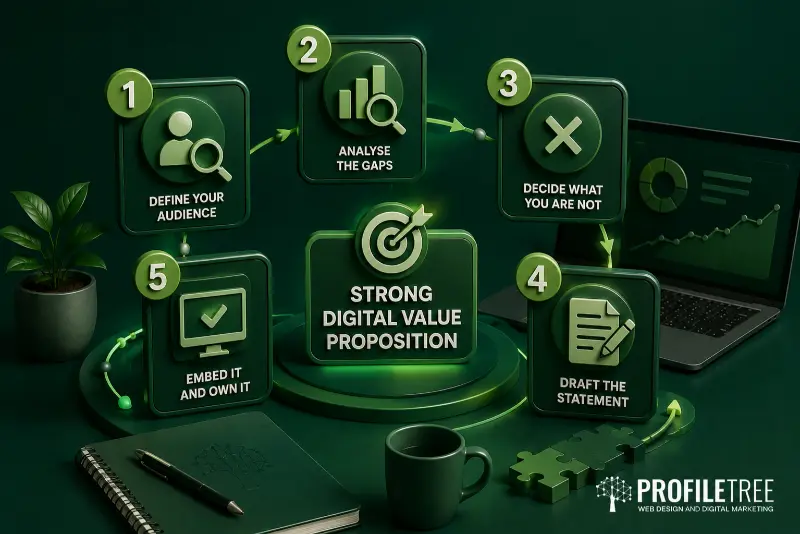
Building a digital value proposition is a strategic exercise rather than a copywriting task. The words come last. The thinking comes first, and it requires making decisions most businesses prefer to avoid: who exactly you serve, what you are genuinely better at, and what you are willing to stop claiming.
Step 1: Define the audience and the friction they hit online
A proposition written for everyone works for no one. Start with the problem the customer faces online rather than the solution you offer. Common friction points include not being able to find a local supplier they trust, finding the category confusing and having no way to compare options, having been burned by vague quotes and opaque pricing, or wanting to buy at eleven at night when the phone number only works Monday to Friday.
Get the audience definition tight. A digital agency serving Belfast hospitality businesses has a fundamentally different proposition from one serving London e-commerce brands, even where the service list is identical. Use customer research, sales conversations, and review data to understand how the audience describes its own problems, because the most effective propositions use the customer’s vocabulary rather than the business’s internal terminology. A structured pass through free market research tools beats guesswork about what customers value.
Step 2: Map your 6Cs against competitor gaps
Review your top three to five competitors’ digital presences through the lens of the 6Cs. Where are they weak? Where are they strong? Your proposition should emphasise the Cs where you can genuinely outperform them, not the ones where you are broadly equivalent.
This step requires honest assessment, and it is where businesses overreach. If your site’s convenience is poor, a convenience-led proposition will not survive contact with the user experience. Fix the capability before claiming it. A structured competitive environment analysis makes this less subjective than a quick look at four rival homepages.
Then map what you can actually do. Relevant digital capabilities might include a fast, well-structured site that answers questions without requiring a phone call, a transparent pricing page, a booking system that works properly on mobile, a content library that educates before the customer commits, or a live chat staffed by real people during business hours. If the website cannot currently deliver the proposition you want to make, that is not a reason to abandon the exercise. It is a brief for the next web project.
Step 3: Decide what you are not
Most businesses skip this step, and the omission is visible in the resulting proposition. A strong digital value proposition requires exclusion. Deciding who you are not for, what you do not do, and what you are not the cheapest option for gives the statement the specificity that makes it credible to the people it is aimed at.
An agency serving every sector from hospitality to manufacturing, every budget from £500 to £500,000, and every project type from brochure sites to full e-commerce platforms cannot hold a strong proposition for any of those audiences. The message dilutes until it means nothing to anyone. Committing to a position means accepting that some potential customers will decide you are not for them. That is the point.
Step 4: Draft the statement, not a slogan
Write the full sentence before trying to shorten it into something punchy. A structure that works:
[Product or service] helps [target audience] who want to [achieve goal or remove friction] by [digital capability], unlike [the common alternative], which [has this limitation].
Worked through for a Belfast solicitors’ firm: “A fixed-fee conveyancing service helps first-time buyers in Northern Ireland who want cost certainty, delivered by publishing full pricing online and offering document tracking through a client portal, unlike firms who only quote after an initial consultation.”
That is an internal test rather than website copy. If you cannot complete the sentence with specific, verifiable content, the proposition is not ready. Once it holds up, the headline comes out of it. The headline has to carry the primary outcome in plain language, and the one to three sentences underneath add the audience, the mechanism, or the proof point the headline cannot hold on its own. A proposition that only works as a slogan usually means the underlying thinking was skipped.
Step 5: Embed it, then agree who owns it
A proposition that lives only on the homepage functions as a slogan rather than a proposition. It should be visible and reinforced across the whole journey: page headlines, navigation labels, email subject lines, chatbot opening messages, and the structure of service descriptions. When the customer’s experience matches the promise, trust follows.
Search plays a direct role here. If the proposition uses the language customers actually search for, the page is more likely to appear when they look for what you offer. A proposition written in internal terminology can be invisible to new buyers searching in plain language, which is why aligning on-page copy with real search terms is both a communication decision and an SEO one.
Finally, agree ownership. A digital value proposition cannot belong to the marketing team alone. It has to be understood by everyone who affects the customer experience: product, customer service, operations, leadership. A marketing team promoting a frictionless digital experience while customer service fields complaints about a broken checkout undermines both. Set a review at least annually, with extra reviews triggered by a technology shift, a competitor move, or a notable change in customer behaviour.
Digital Value Proposition Examples From the UK and Ireland
Most guidance on this topic leans on the same American reference points, which makes it harder for a UK or Irish SME to see how the thinking applies closer to home. Uber calls “tap a button, get a ride” its core promise, and still uses the line today. It is a fair illustration of simplicity. Dollar Shave Club showed that a subscription pitch can win on directness rather than prestige. Both are worth a look for structure. The examples below are closer to the market most readers are trading in.
Monzo: convenience and community
Monzo built its early positioning on transparency and control: real-time transaction notifications, instant spending breakdowns, spending categorisation, and no hidden fees, at a point when traditional banks were widely seen as opaque about charges and slow to build anything mobile-first. The proposition was never “a bank account”. It was closer to “understand your money in real time, without hidden charges”.
The community element was deliberate as well. Monzo’s community forum, where users discuss features and financial topics, creates a sense of ownership that branch networks cannot replicate. The instructive part for SMEs is that none of this was built on budget or scale. It came from identifying the friction points that mattered most to a specific audience and removing them.
Starling Bank: transparency as the whole proposition
Starling followed a similar path, competing against long-established high street banks by emphasising fee transparency and a fully digital experience, aimed at customers who had grown frustrated with branch-dependent banking. The lesson for a smaller business is that “we are clearer than the incumbents about what this costs” is a legitimate proposition in any sector where opacity is the norm.
Octopus Energy: positioning into a trust gap
Octopus entered a UK energy market with low customer trust and positioned around renewable sourcing and more responsive customer service, at a point when large incumbents were widely criticised for both. What Monzo, Starling, and Octopus share is specificity. Each names the exact frustration with the existing options in its sector, then states plainly how it differs. None of them lean on “customer-focused” or “market-leading”.
Gymshark: community and content ahead of commerce
Gymshark anchored its proposition in community and content, with product range acting as a supporting element rather than the driver. The brand built its digital presence around an identity rather than a catalogue, using athlete partnerships, social content, and a user-generated community to create belonging before the transaction. Its channels consistently produce training and lifestyle material with nothing to do with selling a specific item. For a service business, the equivalent is producing genuinely useful guidance that builds authority in a specialism. The transaction follows the trust, which is the whole argument for treating content marketing as proposition work rather than publishing volume.
Stripe: cost reduction that is not about price
Stripe targets a specific audience, developers, and addresses their pain points directly. Choice is expressed through integration flexibility rather than product volume: the API documentation, pre-built components, and third-party integrations mean a developer can build almost any payment flow without switching providers. The cost reduction is both financial and cognitive. Pricing is predictable, documentation cuts implementation time, and error handling reduces support load. The proposition is the lowest total cost of building and maintaining a payment system, which is a different claim from the lowest price.
For B2B service businesses this transfers directly. An agency’s proposition might be built around reducing the total cost of marketing ownership: the most transparent, the easiest to measure, and the fastest to adapt when priorities change.
Traditional businesses making the transition
Businesses that started offline face a particular challenge, in that they have real credibility their website does not yet reflect. Greggs addressed this with click-and-collect ordering through its app. It did not change what Greggs is; it changed how customers interact with it. The digital proposition (order ahead, skip the queue) sits on top of a product people already trust.
The same logic runs through IKEA. The offline proposition is flat-pack furniture with Scandinavian design at a price point made possible by customers doing the assembly and transport themselves. The digital version has to carry that trade-off honestly: detailed product specifications, room planning tools, stock visibility by store, and delivery options priced clearly enough that the customer can decide whether to collect instead. Where the digital experience hides the trade-off, the proposition weakens.
B2B and professional services
B2B propositions are underrepresented in most guides on this topic, and the pattern is identical: identify the friction, map the capability, state the value.
A Northern Ireland logistics company might lead with real-time delivery tracking and a named account manager, so a customer always knows where a shipment is and has someone to call if it does not arrive. The digital tool and the human backup together address the specific anxiety B2B buyers have about deliveries.
Professional services is where propositions are most often vague, and the sector is badly served by advice written for SaaS. A regional accountancy firm sharpening “quality accountancy services” into “management accounts delivered within five working days of month-end, so decisions do not wait on the books” has done the work. The specificity does what “quality” never can, and the digital capabilities behind it (automated reporting, a client portal, video summaries) are what make it different from every other firm in the area.
Tailoring the Proposition to Your Business Model
Different business models need different emphasis within the digital value proposition, and applying the same weighting across all of them is a common cause of flat, generic copy.
E-commerce: the proposition has to address friction in the purchase journey. Navigation clarity, payment security, delivery speed, and returns policy are the points customers weigh before committing. Real-time order tracking and a mobile-optimised checkout are baseline expectations now rather than differentiators, so claiming them as a selling point signals that the business has not looked at its competitors recently.
B2B services: clients buying B2B services are managing risk as much as buying value. A proposition addressing reliability, communication, and measurable outcomes tends to outperform one built on credentials alone. “You will know what is happening, and you will be able to measure whether it worked” answers the actual worry.
Financial services: transparency and accessibility are the differentiators. Clear information on rates, fees, and process; secure and convenient digital payment options; and guidance that does not require an in-person appointment. The proposition is built on reducing the anxiety that surrounds financial decisions.
Local service businesses: for tradespeople, clinics, solicitors, and similar, the proposition usually centres on reducing uncertainty. Can the customer find out quickly whether you cover their area, what you charge, and when you are available? A well-structured local services page on a clean, fast site often does more work than a campaign.
How to Stress-Test and Measure a Digital Value Proposition
Writing the proposition is the easy part. Knowing whether it works requires deliberate testing and then measurement over time, and the two are different jobs.
Five tests before you build around it
The five-second test. Show the homepage to someone unfamiliar with the business. After five seconds, ask what the company does, who it serves, and why they should choose it. Gaps in their answer are gaps in the proposition.
The competitor swap test. Paste the proposition into a document and replace your company name with a direct competitor’s. If it still reads as plausible, the statement is not doing enough differentiation work.
The “so what?” test. Read each sentence and ask what it means for the customer. Keep asking until you reach a concrete outcome, or until you realise the sentence is not earning its place.
Live testing. If you run paid search, test headline variants. Click-through rate is an honest proxy for whether the message lands with buyers at the moment of search, and it is one of the cheapest ways to validate language before applying it site-wide. LinkedIn posts and email subject line variants work the same way.
The customer language audit. Compare the language in your proposition with the words customers use in reviews, enquiry emails, and discovery calls. A gap between how you describe what you do and how customers describe what they got is a sign the proposition is missing what actually matters to buyers.
Tracking it in GA4
You cannot measure a proposition directly, but you can measure its effects. GA4’s event-based structure is the most practical tool for this.
Engagement rate by landing page. GA4 counts a session as engaged if it lasts longer than ten seconds, or includes a key event, or includes two or more page views. Any one of the three is enough, since the conditions are joined with OR rather than AND.
Check the engagement timer on your data stream before reading anything into the number, because the ten-second default is configurable up to sixty seconds and a stream left on a higher setting will report a lower engagement rate for the same behaviour. Engagement rate is engaged sessions as a share of total sessions, and it is a better proxy for proposition effectiveness than the old bounce rate.
Rather than chasing a universal benchmark, compare each key service page against your own site average and against its own trend after a messaging change. A page performing well below the rest of the site usually signals a disconnect between what the title tag promises and what the page delivers.
Conversion by audience segment. GA4’s audience builder lets you segment by new versus returning, device, geography, and acquisition channel. If the proposition is built on convenience and mobile users convert at a materially lower rate than desktop, the convenience promise is not being kept on mobile. The size of the gap that matters depends on your sector and your own baseline.
Sales cycle length. A clear proposition should shorten the cycle by helping prospects establish fit quickly. A drawn-out decision process can indicate unclear differentiation rather than genuine indecision, particularly in B2B.
Lifetime value signals. For repeat purchase or subscription models, GA4’s predictive metrics, including purchase probability and predicted revenue, give a forward-looking read. Customers who return and spend more are validating the proposition.
High churn after the first transaction suggests the proposition overpromised or the post-purchase experience underdelivered. Pairing GA4 with your CRM to track retention by acquisition channel is worth the setup effort, since customers acquired through content often show higher lifetime value than those from paid channels.
| GA4 signal | Which part of the proposition it tests | How to read it |
|---|---|---|
| Engagement rate by page | Content, Convenience | Compare against your own site average, not an external benchmark |
| Conversion rate by device | Convenience | Look at the size and direction of the mobile-to-desktop gap |
| New vs returning conversions | Community, Customisation | A weak return rate points to a weak loyalty proposition |
| Scroll depth on service pages | Content | Falling scroll depth after a rewrite is a content signal |
| Key events by traffic source | All six Cs | Identifies which channel validates the proposition best |
Reviewing it as customer expectations shift
A digital value proposition is not a one-time exercise. Customer expectations change, technology changes, and competitors adapt. Brands that treat the proposition as a fixed document and the website as a static brochure tend to lose ground to those treating both as working tools.
The most visible example of forced adaptation was the pandemic. Businesses whose proposition was built entirely around in-person experience had to find a digital equivalent quickly, and chains including Starbucks and McDonald’s accelerated mobile ordering to shift their propositions towards convenience and contactless purchase. Those were structural repositions rather than minor updates.
For most SMEs the triggers are less dramatic: a new competitor, a shift in expectations around response times, or a technology that makes something previously difficult straightforward. The question to ask regularly is a simple one. Does the digital presence still reflect what the business offers, and does it remove the friction customers actually face?
Putting Your Digital Value Proposition to Work
A digital value proposition is the underlying logic of how a business communicates its worth online. Get it right and everything that follows, from website copy to SEO to sales conversations, has something real to build on. Get it wrong and even strong marketing spend works against you, because the message does not match the experience.
Start with the friction point. Be honest about what you can actually deliver digitally. Use the 6Cs to decide where you are genuinely stronger than the alternatives, write the full statement before the headline, and then check it against real behaviour in GA4 rather than internal opinion. Most UK and Irish businesses already have a real differentiator. The problem is usually that it is buried in language that could belong to any competitor on the page.
For SMEs working through how to position a digital presence, ProfileTree’s digital marketing strategy and website development work is built around exactly this kind of structured thinking, and video production is often the fastest way to communicate a proposition where trust matters more than price.
FAQs
What is a digital value proposition?
A digital value proposition is a statement explaining what your business offers online, who it serves, and why a customer should choose you over the alternatives. It covers how your website, app, or digital channels deliver value, rather than only what your product or service does in general. The useful test is whether a first-time visitor could repeat it back to you after ten seconds on the site.
What is the difference between a value proposition and an online value proposition?
A value proposition covers everything a business offers across every channel. An online value proposition, or OVP, is the digital subset: the benefits a customer can only get from your digital presence. A business might deliver excellent in-person service as part of its broader proposition while its OVP covers the website, app, or platform experience specifically. In practice “online value proposition” and “digital value proposition” are used interchangeably.
What are the 6 elements of an online value proposition?
The 6Cs are Content, Customisation, Community, Convenience, Choice, and Cost Reduction. Content covers the quality and relevance of your digital information. Customisation means adapting the experience to the individual. Community describes the networks and belonging a brand facilitates. Convenience addresses ease of interaction. Choice covers the range available digitally. Cost Reduction covers the total financial and cognitive cost of transacting online, which is a broader idea than price.
What is the difference between a value proposition and a USP?
A USP is a single differentiating claim. A value proposition is the full bundle of benefits a customer receives, including the reason to believe the claim. IKEA is the standard illustration: the USP is flat-pack furniture with Scandinavian design, while the value proposition includes the price point that self-assembly makes possible and the trade-off the customer accepts in exchange for it.
How do you write a digital value proposition?
Identify the friction your customer faces online, map your genuine digital capabilities against it, decide explicitly who you are not for, then draft the full statement using a structure such as: [service] helps [audience] who want to [outcome] by [capability], unlike [alternative], which [limitation]. Write the headline afterwards. If you cannot complete that sentence with specific, verifiable detail, the proposition is not ready to go on a website.
How long should a value proposition be?
One headline sentence, ideally under fifteen words, followed by two or three supporting sentences. The whole thing should be readable in under ten seconds. If it needs a full paragraph to explain, it is not yet clear enough to put on a page.
Can a small business have a strong digital value proposition without a large budget?
Yes, and often more effectively than larger competitors. Small businesses can concentrate on two or three of the Cs they genuinely excel at rather than competing across all six. Community and Content give the highest return for limited budgets because they are built on expertise rather than infrastructure. A local service business producing useful content for a specific audience can hold a stronger position than a national competitor with a generic digital presence.
Can a business have more than one value proposition?
Yes, where it genuinely serves distinct audiences with distinct needs. A company-level statement can sit alongside segment-level and product-level versions, provided they do not contradict one another. What causes problems is a single compromise proposition written to speak to everyone, which connects with no one.
How often should a digital value proposition be reviewed?
At minimum once a year, built into the annual marketing planning cycle. Additional reviews should be triggered by a major technology shift, a competitor move, or a change in customer expectations. If it has not been looked at since before AI search tools took hold, it is overdue, because the baseline on customisation and content has moved.
Does a digital value proposition affect SEO performance?
Yes, in two ways. A proposition built around specific audience benefits produces content that answers real search queries clearly, which improves ranking potential and click-through rate. It also lifts engagement signals such as session duration and return visits. A page that delivers on its promise keeps visitors engaged, while one that overpromises produces exit patterns that work against it.