
AI Skills Development for Irish Businesses: Workshops & Consulting
Table of Contents
Competitive businesses across Ireland leverage artificial intelligence to automate time-intensive manual processes, predict customer behavioural patterns, generate scalable content, and execute data-driven strategic decisions. At the same time, hesitant organisations continue questioning AI’s business relevance. The performance gap between AI-enabled enterprises and technologically reluctant companies expands continuously throughout Irish markets, creating sustainable competitive disadvantages for late adopters.
AI Skills Development for Irish Businesses addresses workforce enhancement rather than replacement, equipping teams with technological capabilities that exponentially multiply individual effectiveness and organisational productivity. Strategic AI implementation transforms human potential through intelligent tool integration that augments existing skills rather than substituting human judgment and creativity with automated processes.
ProfileTree’s proven AI Skills Development for Irish Businesses programs have systematically transformed hundreds of organisations from AI-curious observers to AI-powered market leaders through practical training approaches that deliver quantifiable results within weeks rather than extended implementation periods. The comprehensive curriculum focuses on immediate application and measurable business outcomes rather than theoretical understanding that fails to generate operational improvements.
AI Skills Development for Irish Businesses encompasses strategic technology adoption that addresses specific organisational challenges through customised training programs designed for Irish market conditions and business contexts. Successful participants develop tool selection, workflow integration, and performance measurement competencies that support sustainable competitive advantages in increasingly AI-enhanced business environments.
The transformation process emphasises practical skill acquisition, which enables teams to implement AI solutions confidently within existing operational frameworks while maintaining the service quality and customer relationships that define business success.
The AI Skills Crisis Facing Irish Businesses
Ireland stands at a critical juncture where AI adoption determines future competitiveness. Dublin’s tech giants already employ thousands of AI specialists, but SMEs from Cork to Galway struggle to understand where to begin. The skills gap isn’t just technical – it’s strategic, operational, and cultural. Business leaders in Belfast boardrooms and Limerick offices recognise AI’s importance but lack clear pathways to implementation. This paralysis costs Irish businesses millions in lost productivity and missed opportunities daily.
The misconception that AI requires computer science degrees keeps practical applications out of reach for most Irish workers. Marketing managers in Temple Bar agencies don’t need to understand neural networks – they need to know how AI can segment audiences and personalise campaigns. Accountants in Belfast firms don’t require coding skills – they need to understand how AI automates reconciliation and detects anomalies. The fundamental skills gap lies in practical application, not theoretical knowledge.
Cross-border complexities add another layer for businesses operating between Northern Ireland and the Republic. Regulatory frameworks, currency considerations, and market dynamics require nuanced AI strategies. A Newry manufacturer selling in both markets needs AI solutions that handle sterling and euro pricing, UK and EU compliance, and distinct customer preferences. Generic AI training fails to address these specific challenges facing Irish businesses.
The rapid pace of AI development creates moving targets for skills development. What seemed cutting-edge six months ago now appears basic. ChatGPT transformed from novelty to necessity within weeks. Irish businesses investing in static training find themselves perpetually behind. Success requires continuous learning approaches that evolve with technology while focusing on practical business outcomes.
Local talent retention becomes increasingly complex as international companies poach AI-skilled workers with remote positions. Young professionals trained in Dublin or Belfast receive offers from London, New York, or Singapore firms offering salaries that Irish SMEs can’t match. Building internal AI capability requires more than training – it demands career development paths that retain talent within Irish businesses.
Understanding AI Readiness in Irish Organisations
AI readiness assessment in Irish organisations requires systematically evaluating current technological infrastructure, employee digital literacy levels, and existing data management practices that determine how quickly teams can adopt and benefit from AI implementation. Most Irish businesses overestimate their AI preparedness while underestimating the foundational changes needed in workflows, data quality standards, and staff mindsets that successful AI adoption demands, making an honest readiness assessment the critical first step before investing in training programs or technology solutions.
Assessing Current Digital Maturity
Digital foundation assessment reveals whether organisations can support AI initiatives. Many Irish businesses still struggle with basic digitalisation – paper processes, disconnected systems, and data silos. AI implementation on weak digital foundations fails inevitably. Cork manufacturers using spreadsheets for inventory can’t suddenly implement predictive maintenance. Galway retailers without integrated POS systems can’t deploy AI-driven demand forecasting.
Data quality evaluation uncovers the raw material for AI success. Inconsistent customer records, incomplete transaction histories, and unstructured information limit AI potential. Irish businesses often discover their data isn’t AI-ready despite years of collection. Clean, organised, accessible data provides AI’s foundation. Without it, even the best AI tools produce unreliable results.
Technology infrastructure analysis identifies capability gaps requiring attention. Legacy systems standard in established Irish businesses often can’t integrate with modern AI platforms. Cloud adoption, API availability, and processing capacity determine AI possibilities. Waterford companies running 10-year-old servers face different challenges than Dublin startups born in the cloud.
Process documentation exposes automation opportunities and obstacles. Many Irish SMEs operate on institutional knowledge rather than documented procedures. AI requires clear process definitions to replicate and improve. Family businesses in Donegal relying on generational knowledge need formalisation before AI implementation. This documentation often provides immediate value even before AI deployment.
Cultural readiness assessment gauges organisational appetite for change. Traditional industries across Ireland sometimes resist technological transformation. Construction firms in Limerick, agricultural businesses in Tipperary, and hospitality companies in Killarney each have distinct cultural considerations. Understanding and addressing cultural barriers proves as essential as technical preparation.
Identifying AI Opportunities Specific to Irish Markets
Sector-specific applications reveal immediate AI value for different industries. Irish pharmaceutical companies in Cork use AI for drug discovery and quality control. Tourism businesses along the Wild Atlantic Way deploy AI for personalised trip planning. Financial services in Dublin’s IFSC implement AI for fraud detection and compliance. Each sector has unique applications delivering rapid returns.
Size-appropriate solutions ensure SMEs aren’t overwhelmed by enterprise-scale AI. A 10-person marketing agency in Galway needs AI tools different from those of a 500-employee manufacturer in Belfast. Micro-businesses benefit from AI-powered tools like Canva or Grammarly. Medium enterprises might implement CRM-integrated AI. Understanding scale-appropriate applications prevents over-investment and under-utilisation.
Regional opportunities highlight location-specific AI advantages. Border counties benefit from AI handling multi-currency transactions. Coastal communities use AI for weather-dependent business planning. Rural areas deploy AI, compensating for geographic isolation. Urban centres leverage AI to manage congestion and demand patterns. Location creates unique AI applications beyond generic solutions.
Competitive differentiation through AI provides sustainable advantages. First movers in traditional Irish industries gain significant leads. The first construction company using AI for project estimation, the first restaurant chain implementing AI-driven menu optimisation, and the first farm adopting precision agriculture – each gains advantages that competitors struggle to match.
Export enablement through AI helps Irish businesses compete globally. Language translation, market analysis, and cultural adaptation become manageable through AI. Kilkenny craft producers can sell internationally. Sligo software companies can support global customers. AI removes barriers that previously limited Irish businesses to local markets.
ProfileTree’s Comprehensive AI Training Framework
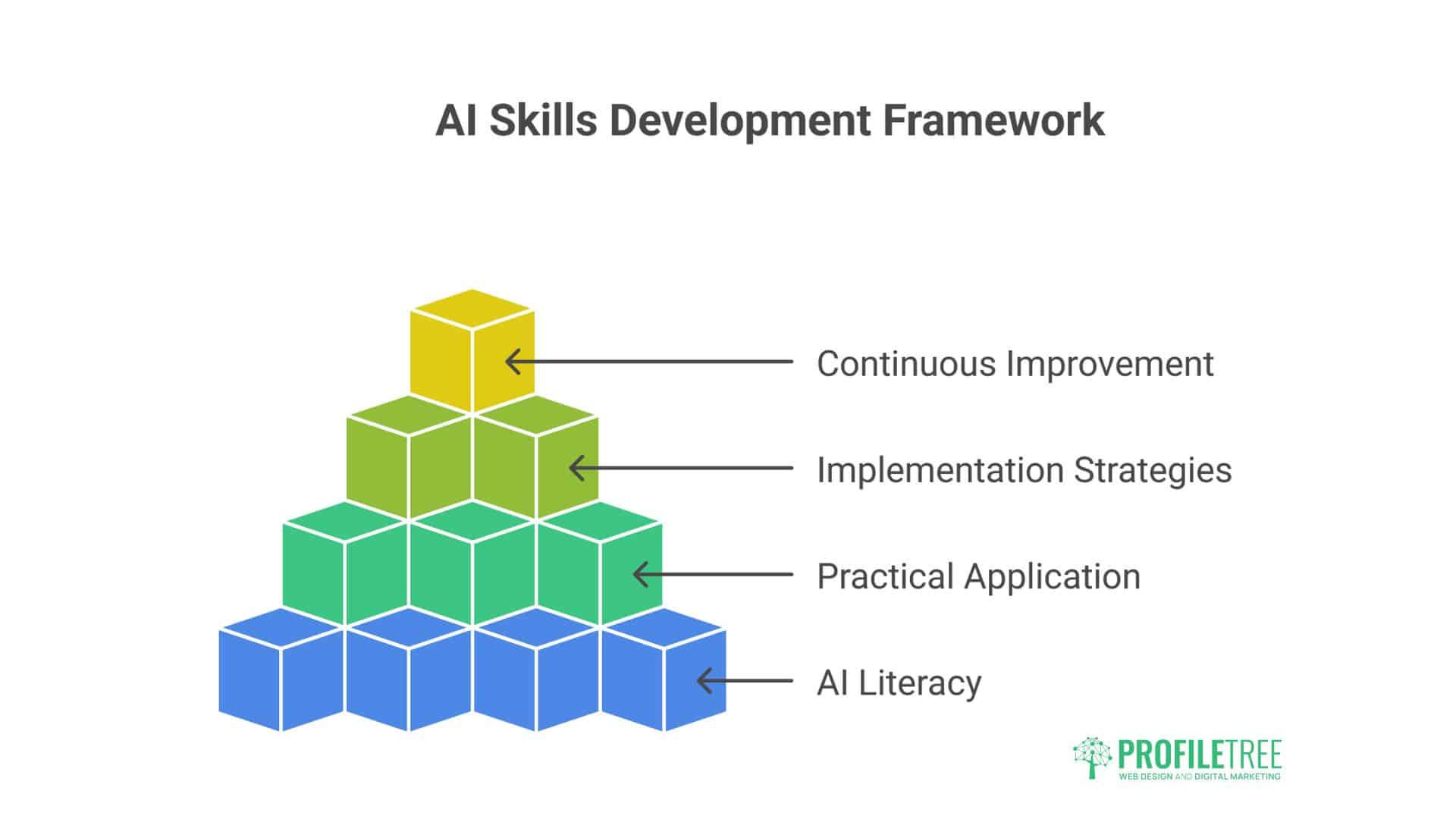
ProfileTree’s comprehensive AI training framework integrates theoretical understanding with hands-on practical application through structured learning pathways that address different skill levels, from AI literacy fundamentals through advanced implementation strategies tailored to specific industry contexts. The methodology combines workshop-based group learning, individual coaching sessions, and real-world project implementation support that ensures participants understand AI concepts and confidently apply them within their actual business operations while measuring tangible outcomes and continuous improvement opportunities.
Workshop Programmes for Immediate Impact
Executive AI literacy workshops transform leadership understanding in a single session. CEOs and directors across Ireland gain practical AI knowledge without technical complexity. These intensive sessions cover AI capabilities, implementation strategies, and ROI measurement. Leaders leave with clear action plans rather than vague inspiration. Belfast executives particularly appreciate our no-nonsense approach, cutting through hype to deliver practical insights.
Department-specific workshops address unique functional needs. Marketing teams learn AI-powered content creation and campaign optimisation. Sales departments discover lead scoring and predictive analytics. Operations explore process automation and optimisation. Finance understands AI-driven forecasting and risk management. Each workshop delivers immediately applicable skills relevant to daily work.
Hands-on tool training provides practical experience with actual AI platforms. Participants use ChatGPT, Claude, Midjourney, and other tools during sessions. They create real content, analyse actual data, and solve genuine business problems. This practical approach ensures skills transfer to the workplace immediately. Irish businesses report 80% skill retention from hands-on training versus 20% from theoretical presentations.
Cross-functional workshops break down silos hindering AI adoption. Mixed teams from different departments collaborate on AI projects. Marketing works with IT to understand technical requirements. Sales partners with operations to optimise customer journeys. These collaborative sessions build internal AI champions across organisations. Waterford companies find cross-functional training particularly effective for company-wide transformation.
Industry-specific workshops address sector challenges directly. Retail workshops focus on inventory optimisation and customer personalisation. Manufacturing sessions emphasise predictive maintenance and quality control. Healthcare training covers patient data analysis and diagnostic assistance. This specialisation ensures relevance and immediate applicability.
Structured Course Programmes
Foundation courses establish core AI understanding for all staff levels. These six-week programmes cover AI fundamentals, practical applications, and ethical considerations. Employees gain confidence using AI tools and identifying opportunities. No technical background is required—just curiosity and willingness to learn. These courses transform AI from mysterious technology to a practical tool.
Intermediate programmes develop deeper capabilities for regular AI users. They are twelve-week courses exploring advanced features, integration strategies, and customisation options. Participants learn prompt engineering, workflow automation, and performance optimisation. These skills enable independent AI implementation without constant support. Limerick businesses appreciate structured progression from basics to advanced applications.
Advanced certification programmes create internal AI specialists, providing six months of intensive training to develop technical and strategic AI expertise. Participants master multiple AI platforms, understand implementation methodologies, and can lead transformation projects. These internal specialists reduce dependence on external consultants. Investment in advanced training pays dividends through sustained internal capability.
Continuous learning subscriptions maintain skill currency as AI evolves. Monthly updates, quarterly workshops, and ongoing support ensure skills remain relevant. New tool introductions, feature updates, and best practice sharing keep teams current. This subscription model suits businesses wanting sustained development rather than one-off training.
Blended learning approaches effectively combine online and in-person elements. Self-paced online modules provide flexibility for busy professionals. In-person workshops offer hands-on practice and peer learning. Virtual sessions enable participation from multiple locations. This flexibility accommodates diverse learning preferences and practical constraints facing Irish businesses.
Our comprehensive AI training services deliver measurable transformation for Irish businesses.
Consulting Services for Transformation Projects
AI strategy development aligns technology adoption with business objectives. We analyse your market position, competitive landscape, and growth ambitions. Together, we identify AI applications delivering maximum impact. Strategic roadmaps guide phased implementation, avoiding overwhelming change. Dublin enterprises value our pragmatic approach, balancing ambition with achievability.
Implementation planning translates strategy into actionable projects. Detailed project plans specify tasks, timelines, resources, and success metrics. Risk assessments identify potential obstacles and mitigation strategies. Budget forecasts prevent financial surprises. This planning rigour ensures successful execution rather than abandoned initiatives.
Vendor selection guidance navigates the overwhelming AI marketplace. We evaluate tools against your specific requirements, budget, and technical constraints. Independent recommendations avoid vendor bias. Proof-of-concept projects validate solutions before significant investments. Irish businesses save thousands through informed tool selection.
Change management support ensures organisational adoption. Technical implementation without cultural change fails inevitably. We develop communication strategies, training plans, and adoption incentives. Resistance gets addressed proactively rather than reactively. Employee concerns receive genuine consideration. This human focus ensures AI enhances rather than threatens workforce.
Performance optimisation consulting improves existing AI implementations. Many Irish businesses have AI tools delivering below potential. We audit current usage, identify improvement opportunities, and implement optimisations. Simple adjustments often provide dramatic improvements. Continuous optimisation ensures sustained value from AI investments.
Practical AI Applications for Irish Business Functions
Practical AI applications span all core business functions, with marketing teams using AI for personalised email campaigns and social media content generation. At the same time, sales departments leverage predictive analytics for lead scoring and customer relationship management optimisation. Operations teams implement AI for inventory forecasting and supply chain management, human resources departments utilise AI for candidate screening and employee performance analysis, and finance teams apply AI for fraud detection, expense categorisation, and financial forecasting, improving accuracy while reducing manual processing time and associated errors.
Marketing and Sales Transformation
Content generation at scale revolutionises marketing productivity. AI creates blog posts, social media content, and email campaigns in minutes, not hours. Irish marketing teams produce 10x more content without sacrificing quality. Proper AI configuration maintains local references, cultural nuances, and brand voice. Galway agencies report 300% productivity improvements using AI content tools effectively.
Customer segmentation through AI reveals hidden patterns in buyer behaviour. Machine learning analyses purchase histories, browsing patterns, and engagement metrics. Micro-segments emerge that humans would never identify. Targeted campaigns to these segments achieve unprecedented relevance. Belfast retailers discover customer groups they didn’t know existed.
Lead scoring automation prioritises sales efforts on the highest-value prospects. AI analyses hundreds of signals to determine purchase probability. Sales teams focus on warm leads rather than cold calling. Conversion rates improve while effort decreases. Dublin B2B companies report 40% higher close rates using AI lead scoring.
Personalisation engines deliver individual experiences at scale. Every website visitor sees relevant products, every email contains personalised recommendations, and every customer journey adapts to personal preferences. This mass personalisation was impossible before AI. Irish e-commerce businesses achieve Amazon-level personalisation without Amazon resources.
Predictive analytics accurately forecasts future customer behaviour. Churn prediction identifies at-risk customers before they leave. Lifetime value calculations guide acquisition spending. Demand forecasting prevents stock-outs and overstock. Cork businesses make proactive decisions rather than reactive responses.
Operations and Efficiency Optimisation
Process automation eliminates repetitive tasks that consume employee time. Invoice processing, data entry, and report generation happen automatically. Staff focus on valuable activities requiring human judgment. Error rates drop while processing speed increases. Waterford manufacturers save thousands of hours annually through intelligent automation.
Supply chain optimisation through AI prevents disruptions and reduces costs. Demand forecasting, route optimisation, and inventory management improve dramatically. AI predicts supplier delays, identifies alternative sources, and optimises order quantities. Irish businesses navigate post-Brexit complexity using AI-powered supply chain management.
Quality control automation detects defects that human inspectors miss. Computer vision instantly identifies visual defects. Pattern recognition spots anomalies in production data. Predictive models anticipate quality issues before they occur. Limerick manufacturers achieve Six Sigma quality levels using AI inspection.
Resource scheduling optimisation efficiently balances multiple constraints. Staff rotas, equipment allocation, and project scheduling become mathematical optimisation problems. AI finds optimal solutions considering all variables simultaneously. Irish hospitals, universities, and logistics companies report 20% efficiency improvements through AI scheduling.
Predictive maintenance prevents equipment failures before they occur. Sensor data analysis identifies degradation patterns preceding breakdowns. Maintenance happens exactly when needed – not too early, not too late. Downtime reduces dramatically while maintenance costs decrease. Manufacturing and utilities across Ireland save millions through predictive maintenance.
Financial Management and Analysis
Automated bookkeeping reduces accounting workload by 70%. AI categorises transactions, reconciles accounts, and identifies discrepancies. Month-end close processes that took days now take hours. Accountants focus on analysis rather than data entry. Small Irish businesses access enterprise-level financial management through AI.
Fraud detection systems identify suspicious patterns that humans overlook. Machine learning analyses transaction patterns, spotting anomalies. Real-time alerts prevent losses before they escalate. Continuous learning reduces false positives. Irish financial institutions prevent millions in fraud using AI detection.
Cash flow forecasting becomes accurate through AI pattern recognition. Historical data, seasonal patterns, and external factors are analysed simultaneously. Businesses anticipate cash crunches months in advance. With reliable forecasts, financing decisions improve. Treasury management transforms from reactive to proactive.
Investment analysis through AI evaluates opportunities comprehensively. Market data, financial statements, and economic indicators get processed instantly. Risk assessments consider thousands of variables. Portfolio optimisation happens continuously. Irish investment firms compete globally using AI-powered analysis.
Regulatory compliance automation ensures adherence to complex requirements. AI monitors transactions for compliance violations. Reports are generated automatically with the required information. Audit trails maintain themselves. The burden of compliance reduces while accuracy improves. Cross-border businesses handle multiple regulatory frameworks efficiently.
Customer Service Excellence
Chatbot implementation cost-effectively provides 24/7 customer support. AI handles routine queries instantly, freeing human agents for complex issues. Customers get immediate responsesat any time. Support costs reduce while satisfaction improves. Irish businesses serve global customers across time zones efficiently.
Sentiment analysis identifies unhappy customers requiring intervention. AI analyses customer communications, detecting emotional states. Frustrated customers are escalated to senior agents. Positive feedback is acknowledged appropriately. Proactive service prevents negative reviews and builds loyalty.
Ticket routing optimisation ensures queries reach appropriate agents quickly. AI analyses query content to determine required expertise. Technical issues route to technical support, and billing queries go to accounts. This intelligent routing reduces resolution time and improves first-contact resolution.
Knowledge base automation keeps support documentation current. AI identifies common queries requiring documentation. Answers get generated and refined based on successful resolutions. Self-service improves as knowledge bases grow. Support burden reduces as customers find answers independently.
AI translation makes multilingual support affordable. Irish businesses can now serve international customers without multilingual staff. Real-time translation enables communication across language barriers. Market expansion becomes feasible for smaller companies, making the world accessible to Irish SMEs.
Building Internal AI Capabilities
Building internal AI capabilities requires establishing systematic knowledge transfer processes that create AI champions within each department who can train colleagues, troubleshoot implementation challenges, and identify new automation opportunities as business needs evolve. Sustainable capability development involves creating documentation systems, best practice libraries, and regular skill assessment programs that ensure AI competencies remain current and accessible rather than concentrated in individual employees who may leave the organisation, taking critical knowledge with them.
Creating AI Champions Within Your Organisation
Champion identification finds natural AI advocates within existing teams. Early adopters, technology enthusiasts, and continuous learners make ideal champions. These individuals exist in every Irish organisation regardless of industry. They need recognition, support, and empowerment to drive change. Waterford companies report faster adoption when internal champions lead initiatives.
Champion training goes beyond basic AI skills to include change leadership. Technical knowledge combines with communication skills and project management. Champions learn to translate technical capabilities into business benefits. They bridge gaps between IT departments and business units. This hybrid expertise proves invaluable for successful transformation.
Community building connects champions across departments and locations. Regular meetings, shared projects, and peer learning accelerate capability development. Online forums enable continuous knowledge sharing. Success stories inspire broader adoption. Irish organisations with strong champion communities achieve 3x faster AI adoption.
Recognition programmes celebrate champion contributions and successes. Public acknowledgement, career advancement, and financial rewards motivate continued engagement. Champions become role models, inspiring others. Their success stories demonstrate AI’s practical value. Investment in recognition generates returns through accelerated adoption.
Succession planning ensures champion knowledge transfers to others. Documentation, mentoring, and gradual handovers prevent single points of failure. New champions emerge as experienced ones advance. Organisational capability grows rather than depending on individuals. This sustainability ensures long-term AI success.
Developing AI Governance Frameworks
Ethical guidelines ensure AI deployment aligns with organisational values. Fairness, transparency, and accountability principles guide implementation decisions. Bias detection and mitigation become standard practices. Irish businesses build trust through responsible AI use. These frameworks prevent reputational damage from AI misuse.
Data governance policies protect privacy while enabling AI innovation. Clear rules about data collection, usage, and retention provide boundaries. GDPR compliance is built into AI systems from the design. Employee and customer data receive appropriate protection. Cross-border operations between the UK and Ireland require particular attention.
Risk management frameworks identify and mitigate AI-related risks. Technical failures, security breaches, and decision errors are anticipated. Contingency plans are prepared for various scenarios. Regular audits ensure controls remain effective. Irish financial services lead in sophisticated AI risk management.
Quality assurance processes ensure AI outputs meet required standards. Accuracy testing, performance monitoring, and continuous improvement become routine. Human oversight prevents AI errors from reaching customers. Feedback loops improve system performance over time. Quality standards maintain trust in AI-generated outputs.
Compliance monitoring ensures AI usage meets regulatory requirements. Industry-specific regulations get incorporated into AI governance. Regular assessments verify continued compliance. Documentation provides audit trails for regulators. Irish healthcare and financial services excel at compliance-focused AI governance.
Measuring AI Impact and ROI
Baseline establishment enables accurate impact measurement. Pre-AI performance metrics provide comparison points. Productivity, quality, and satisfaction measurements happen before implementation. This data proves AI value objectively. Without baselines, impact claims remain subjective opinions.
KPI development specific to AI initiatives tracks relevant progress. Traditional metrics might miss AI’s unique impacts. New measurements capture automation rates, decision accuracy, and innovation metrics. Balanced scorecards incorporate AI-specific indicators. Irish businesses develop sophisticated AI performance frameworks.
Attribution modelling connects AI implementation to business outcomes. Improved performance might have multiple causes requiring careful analysis. Controlled experiments isolate AI impact from other factors. Statistical analysis validates causation, not just correlation. This rigour justifies continued AI investment.
Cost-benefit analysis calculates an accurate AI return on investment. Implementation costs include training, tools, and transformation expenses. Benefits encompass productivity gains, cost reductions, and revenue increases. Intangible benefits like employee satisfaction get quantified where possible. Most Irish businesses achieve positive ROI within 12 months.
Continuous improvement protocols ensure sustained value from AI investments. Regular performance reviews identify optimisation opportunities. Feedback collection guides enhancement priorities. Technology updates get evaluated and implemented systematically. This continuous refinement maximises long-term AI value.
Overcoming Common AI Adoption Barriers: AI Skills Development for Irish Businesses
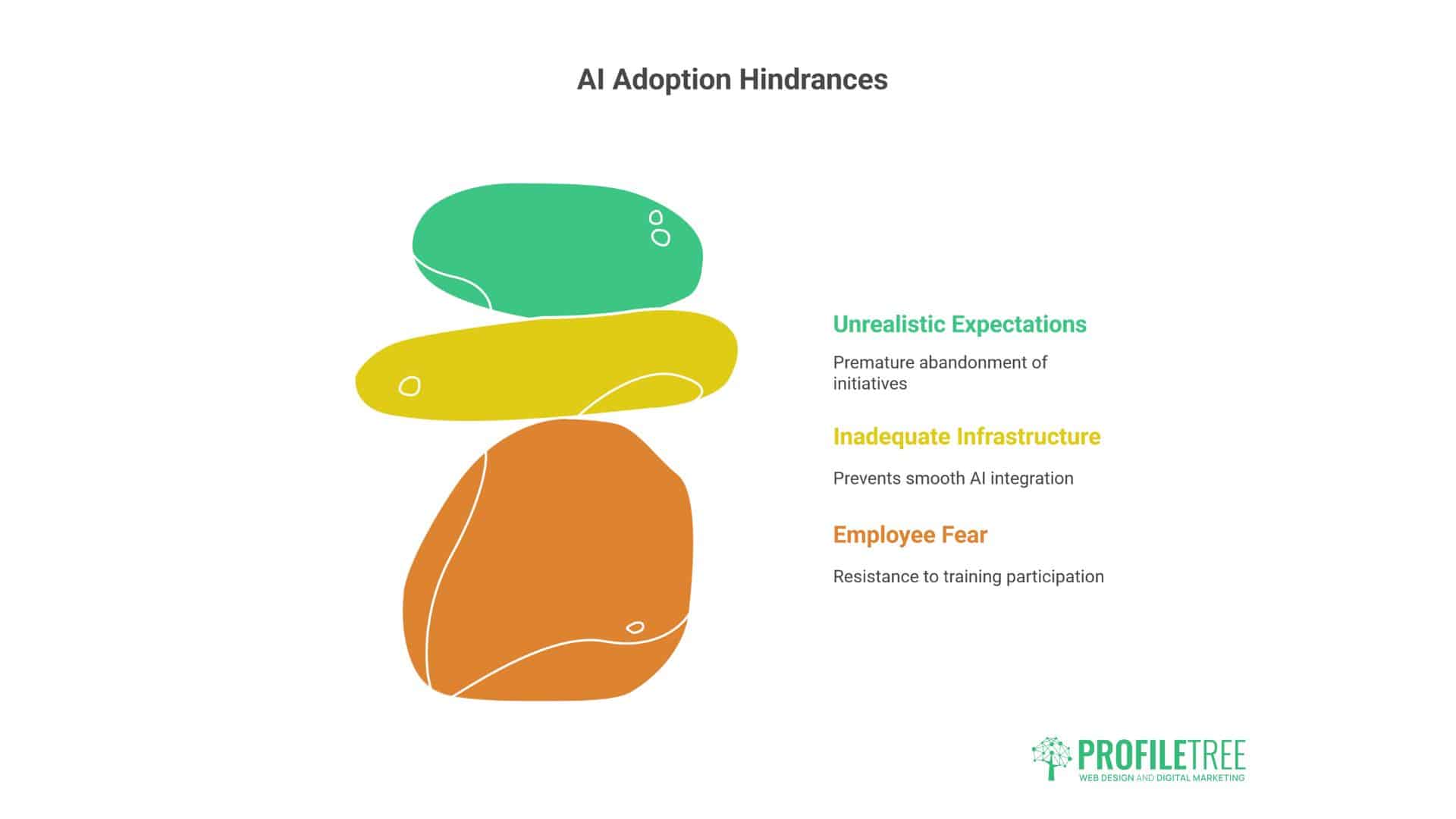
Common AI adoption barriers include employee fear of job displacement, which creates resistance to training participation, inadequate technical infrastructure, which prevents smooth AI tool integration, and unrealistic expectations about immediate results, which lead to premature abandonment of AI initiatives. Overcoming these obstacles requires transparent communication about AI’s role in augmenting rather than replacing human capabilities, strategic infrastructure investment planning that supports AI implementation, and realistic timeline setting with milestone celebrations that maintain momentum during the gradual learning curve that characterises successful AI adoption.
Addressing Skills and Knowledge Gaps
Foundational education programmes build basic AI literacy across organisations. Every employee understands AI fundamentals regardless of role. Myths get dispelled while realistic expectations are set. Fear transforms into curiosity through understanding. Irish organisations report reduced resistance after comprehensive education programmes.
Practical training focuses on job-specific applications rather than general theory. Accountants learn AI tools for accounting, and marketers master marketing-specific AI. This relevance ensures engagement and retention. Generic training fails, while specific training succeeds. Belfast businesses achieve 90% skill retention through role-specific training.
Mentoring programmes pair AI-confident staff with those requiring support. Peer learning proves more effective than formal training alone. Questions get answered in context. Confidence builds through supported practice. These programmes create sustainable skill development beyond initial training.
Documentation and resources provide ongoing support for independent learning. Video tutorials, quick reference guides, and FAQ documents enable self-service. Internal wikis capture organisational knowledge. External resources get curated and shared. This knowledge infrastructure supports continuous capability development.
External expertise supplements internal capabilities where needed. Consultants provide specialised knowledge for complex implementations. Contractors handle technical tasks beyond internal skills. Partnerships access capabilities without permanent hiring. This flexible approach ensures access to required expertise.
Managing Cultural Resistance
Communication strategies directly address fears about job displacement. Honest discussions acknowledge concerns while explaining AI’s augmentation role. Success stories from similar organisations provide reassurance. Employee input shapes implementation approaches. Transparent communication builds trust essential for adoption.
Participation approaches involve sceptics in AI projects early. Hands-on experience often converts doubters into advocates. Small wins build confidence for larger initiatives. Voluntary participation prevents forced adoption backlash. Irish organisations find inclusive approaches more successful than mandates.
A benefit demonstration shows personal advantages from AI adoption. Time savings, reduced tedium, and skill development become apparent. Work-life balance improves as mundane tasks disappear. Career prospects are enhanced through AI skills. Personal benefits motivate adoption more than organisational benefits.
Change pace management prevents overwhelming transformation fatigue. Gradual implementation allows adjustment and learning. Quick wins maintain momentum without causing panic. Regular pauses enable consolidation before advancing. This measured approach ensures sustainable transformation.
Support systems help struggling employees adapt successfully. Extra training, peer support, and patience prevent anyone from being left behind. Alternative roles accommodate those unable to adapt. Dignity and respect maintain morale during transition. Successful transformation includes everyone willing to try.
Explore our comprehensive digital training services designed for practical business transformation.
Budget and Resource Constraints
Phased implementation spreads costs over manageable periods. Starting small proves concepts before significant investments. Success funds expansion through demonstrated returns. This approach suits cash-conscious Irish SMEs. Gradual implementation reduces financial risk while building confidence.
Free and low-cost tools provide entry points for limited budgets. ChatGPT, Claude, and Copilot offer free tiers that are sufficient for initial adoption. Open-source alternatives exist for many commercial tools. These options enable experimentation without financial commitment. Sligo startups build AI capabilities using entirely free tools.
Shared services models reduce individual organisation costs. Industry associations offer group training discounts. Businesses share AI consultant costs for everyday challenges. Cloud-based AI platforms provide enterprise capabilities without infrastructure investment. Collaboration makes AI accessible to smaller organisations.
Government support programmes fund AI adoption for qualifying businesses. Enterprise Ireland, InterTradeIreland, and local enterprise offices offer grants. Tax incentives reduce AI investment costs. These supports make AI adoption financially viable for more businesses. Awareness and application assistance maximise support utilisation.
ROI-focused prioritisation ensures resources target the highest-value applications. Quick wins fund subsequent phases. High-impact, low-cost implementations go first. This strategic sequencing maximises value from limited resources. Careful prioritisation delivers transformation within constraints.
FAQs
What’s the typical investment required for AI training in Irish businesses?
Introductory AI literacy workshops start from €500 per person for group sessions. Comprehensive training programmes range from €2,000 to €5,000 per employee. Executive strategy sessions cost €3,000-€10,000. Ongoing consulting runs €1,500-€5,000 monthly. However, government grants often cover 50-70% of training costs. Free tools and online resources enable starting with minimal investment. Most Irish SMEs begin with a total investment of €5,000-€10,000, seeing returns within 3-6 months.
How long before we see real results from AI training?
Immediate productivity improvements appear within days of hands-on training. Participants report 20-30% time savings on routine tasks immediately. Significant operational improvements emerge within 4-6 weeks. Cultural transformation takes 3-6 months. Full ROI typically appears within 6-12 months. Belfast businesses using our programmes average 40% productivity improvement within three months.
Do employees need technical backgrounds for AI training?
Absolutely not. Our programmes require no coding or technical knowledge. We teach practical application, not computer science. Marketing managers, accountants, and salespeople succeed equally. Basic computer skills and curiosity suffice. Over 80% of our participants have non-technical backgrounds. The key is the willingness to learn and experiment.
Can AI training help with Brexit-related challenges?
AI significantly helps manage Brexit complexity: automated customs documentation, multi-currency handling, and regulatory compliance become manageable. Supply chain AI predicts and mitigates disruption. Market analysis AI identifies new opportunities. Border businesses particularly benefit from AI managing cross-border complexity. We include Brexit-specific applications in our Irish business training.
What’s the difference between online and in-person AI training?
In-person training provides hands-on practice, immediate feedback, and peer learning. Online training offers flexibility, self-pacing, and cost savings. Blended approaches combine both advantages. In-person training suits initial training and complex topics, while online works for ongoing development and refreshers. Most successful programmes combine both delivery methods.
How do we retain staff after AI training investment?
Create clear career pathways for AI-skilled employees. Provide challenging projects that utilise new skills. Offer competitive compensation reflecting enhanced capabilities. Build internal communities that maintain engagement. Recognise and reward AI innovation. Most importantly, demonstrate organisational commitment to AI transformation. Employees stay where their skills are valued and developed.
Is AI training suitable for traditional industries?
Traditional industries often benefit most from AI training. Agriculture uses AI for precision farming, construction employs AI for project management, hospitality implements AI for personalisation, and manufacturing adopts AI for quality control. Every industry has AI applications. We specialise in making AI relevant to traditional Irish businesses.
What ongoing support is available after initial training?
Our programmes include follow-up sessions, online communities, and help desk support. Monthly webinars introduce new tools and techniques. Quarterly workshops address emerging challenges. Annual refreshers maintain skill currency. Consulting support helps with specific implementations. This continuous support ensures sustained transformation rather than one-off training.
Transform Your Business with AI Today
The gap between AI-enabled businesses and those still hesitating widens daily. Every day, companies without AI skills fall further behind competitors who’ve already transformed their operations. But the opportunity remains open to Irish firms ready to act decisively. Our combination of world-class training, practical support, and continuous development ensures your transformation succeeds.
ProfileTree stands as Ireland’s leading AI training and consulting partner. Our proven programmes have transformed hundreds of businesses across every county and industry. From Belfast tech startups to Cork manufacturers, Galway retailers to Dublin financial services, we’ve delivered measurable results that justify every euro invested.
Our AI training services go beyond basic skills to create lasting organisational capability. We don’t just teach tools – we transform cultures, build capabilities, and deliver competitive advantages that compound over time. Our blend of workshops, courses, and consulting ensures comprehensive support throughout your AI journey.
The question isn’t whether to invest in AI skills but how quickly you can build them. Your competitors are already automating, optimising, and innovating with AI. Your customers expect AI-enhanced experiences. Your employees want AI skills for career development. The convergence of necessity and opportunity makes action imperative.
Take the first step today. Whether you need executive workshops to build leadership understanding, comprehensive training programmes for workforce transformation, or strategic consulting for major initiatives, ProfileTree provides the expertise, experience, and local knowledge to ensure success. Contact us now to discuss how AI skills development can transform your Irish business from struggling with change to leading it. The future belongs to AI-enabled organisations – make sure yours is among them.