
Content Trends in Northern Ireland: What Works Now
Table of Contents
Content trends for Northern Ireland work differently from national UK advice. Mobile-first habits, uneven rural broadband, a sharp ear for fake local voice and a live cross-border audience all change what performs here. AI assistants now answer ahead of the results page, so clear, question-led pages with real regional detail carry more weight than polish.
Marketing managers here keep asking the same thing: which content trends for Northern Ireland actually move the needle, and which are just noise borrowed from London or Dublin playbooks? It’s a fair question. Most trend round-ups are written for a national audience and quietly assume one currency, one regulator and one set of cultural reference points, none of which hold once you’re across the Lagan or the border.
This region doesn’t behave like the rest of the UK, and the brands winning attention in Belfast, Derry and beyond worked that out early. What follows is the honest version: the shifts worth acting on, the ones safe to skip, and a checklist you can run against your own pages this week.
The Northern Ireland Content Market Right Now
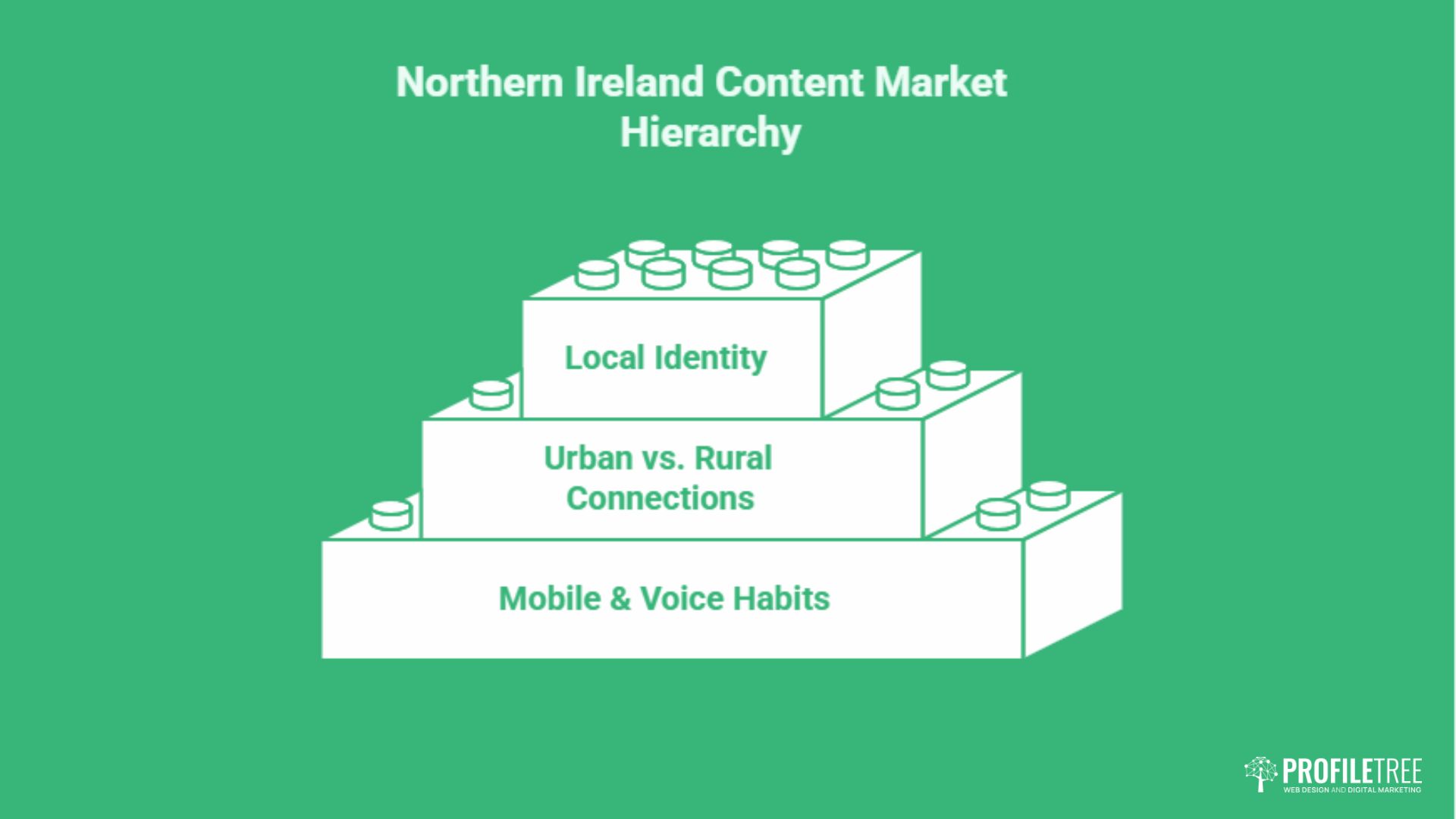
Content trends in Northern Ireland only make sense against the conditions on the ground, so start there before chasing any tactic. Audience habits, infrastructure and identity all shape what gets read, watched and shared here, so a strategy built for a national UK audience won’t land cleanly.
The region also carries a strong sense of place. Content reflecting local conditions, from broadband realities to the way people actually talk, consistently outperforms material written for nobody in particular. The trends below cover the habits, the voice and the formats that decide what works.
Mobile and Voice Habits Set the Baseline
Most people here reach content through a phone first, and that isn’t a small detail. Smartphone ownership across Northern Ireland tracks at the upper end of UK figures in Ofcom’s market reporting, and that single fact changes everything from page weight to how questions get phrased into a search bar or a smart speaker.
Voice and conversational search reward content that answers a full question quickly. Someone asking their phone “where’s the best coffee in Derry?” expects a direct reply, not a 300-word preamble. Pages built around real questions, with tight answers up top, pick up that traffic. ProfileTree’s voice search statistics break down how fast the behaviour is growing.
So you’re writing for spoken queries as well as typed ones. Full-sentence questions as subheadings, with 40 to 50-word answers directly beneath, give voice assistants something clean to read aloud. That same structure feeds the AI answer boxes now appearing above traditional results, so the effort works twice.
Urban and Rural Sit on Different Connections
Belfast and Derry enjoy strong fibre and broad 5G coverage, while parts of Fermanagh and Tyrone still run on slower, patchier links. Heavy pages punish rural readers hardest, and they’re the constraint that should set your build standard. Compressed images and lean code are a regional necessity here, not a nicety.
That gap shapes format choices too. A data-heavy interactive piece might sing in a Belfast tech office and stall on a rural connection, which is why testing across real devices matters more in this market than in denser ones.
Local Identity Drives Engagement
Regional pride is a genuine engagement signal. Content featuring recognisable places, local businesses and shared cultural touchpoints earns trust faster than polished but placeless material, and the lift in social media sales tends to follow content that feels rooted in a specific community.
This plays out in small choices. Naming the street, the venue, or the local event in place of a generic stand-in tells a reader you know the place. Original photography of real local settings does the same job for search engines, which increasingly weight unique visual content over stock imagery. Placeless content’s cheaper to produce, but it competes against everyone. Local content competes against far fewer rivals and converts a warmer audience.
The “Norn Iron” Voice: Authenticity Versus Gimmickry
Local dialect is one of the strongest tools available here, and one of the easiest to get wrong. Used well, a touch of local phrasing signals you belong here. Forced, it reads as a brand cosplaying as a local, and Northern Irish audiences spot that instantly.
Why Dialect Shapes Search and Trust
People search the way they speak. A reader hunting for “the best craic this weekend” is using language that no national keyword tool will surface. Mapping those real phrases into headings, intros, and FAQs captures intent competitors miss entirely.
Trust follows the same logic. A well-placed “wee” or a knowing local reference humanises a brand, but only when the surrounding content already earns credibility on substance.
There’s a research angle here too. Standard keyword tools, built on aggregate data, rarely surface the local variants people actually type. Checking Google Trends for regional phrasing, reading the questions that appear in local Facebook groups, and noting how customers describe their own problems in enquiries all reveal language a national tool would miss. Those phrases then become headings and FAQ questions matching real intent, which is exactly the kind of self-contained, question-led content that earns citations in AI answers.
The Authenticity Scale
Think of local voice on a spectrum. At one end, natural phrasing a local writer would use without thinking. At the other, slang stuffed in to prove a point. The safe zone’s light, occasional, and genuine. The risk zone is constant, performative, and obvious. A practical rule is roughly an 80/20 balance of professional to colloquial register in B2B content, with more latitude in B2C.
Getting this consistent across every channel is where most brands slip. ProfileTree’s guide to brand voice consistency covers how to document tone so a casual local register never tips into caricature.
A simple test helps. Read the line aloud and ask whether a colleague from Belfast or Armagh would actually say it, or whether it sounds like a brand performing localness. If it passes that test, it usually belongs in the safe zone. If it makes you wince, cut it. That costs nothing.
Where Brands Get It Wrong
The common failure is treating dialect as decoration. Slapping a stock phrase onto an otherwise generic campaign won’t fool anyone and can actively damage credibility. Blandness is a real risk in this market, but misjudged boldness costs more, because it signals you don’t understand the audience you’re courting.
Ciaran Connolly, founder of ProfileTree, puts it plainly: “Local voice works when it is earned, not bolted on. We tell clients to write the way they would actually speak to a customer in Belfast, then edit back rather than pile slang on. The brands that get loyalty here are the ones that sound like they belong, because they do.”
AI-Assisted Discovery and How People Find You Now
A growing share of local research never reaches a blue link at all. People ask ChatGPT, Copilot, Gemini or Perplexity for a recommendation, or they read the AI summary at the top of a Google results page and stop there. For Northern Irish businesses, that shifts the goal from ranking a page to being the source an assistant quotes when someone asks about a service in Belfast, Lisburn or Enniskillen.
What Changes When an Assistant Answers First
Assistants pull short, factual passages, and they’re fussy about what they’ll take. They favour pages that state an answer plainly, name the entities involved and cover several related sub-questions in one place. Google’s own documentation on AI features in Search points at the same basics: important content in text form, sensible internal links, decent page experience and structured data matching what’s visible on the page.
The practical consequence is that a page can lose clicks and gain influence at the same time. A piece cited in an assistant’s answer shapes the decision even when nobody visits it, which is why brand mentions and consistent naming now carry weight alongside traffic.
Here’s how the main discovery routes differ in this market:
Discovery route What it rewards What fails Google organic search Depth, topical coverage, genuine local detail Thin pages, placeless copy, recycled national advice AI assistants and AI summaries Self-contained answers, clear entity naming, factual statements Vague claims, buried answers, marketing language Short-form video Faces, places, a local register, fast hooks National trends copied without adaptation Local social groups and forums Real participation, plain answers, named people Drive-by promotion and link drops Structuring Pages So Assistants Can Quote You
Write each section so it’ll stand alone. Lead with a direct answer in the first sentence or two, then support it with evidence, caveats and examples. Keep sections tight enough that a model can lift one cleanly without needing the paragraphs around it.
Naming matters as much as structure. State the plain facts an assistant needs: what the business does, where it operates, which areas it serves and what it charges or how quoting works. Vague positioning statements don’t give a model anything to repeat. A sentence like “the studio serves hospitality clients across Belfast and the north coast” is quotable. “We deliver outstanding results for our partners” is not.
Tables and question-led headings help for the same reason. Both create clean extraction points, and both force you to answer a question instead of circling it.
Where AI Gets Northern Ireland Wrong
Models trained largely on global data regularly confuse Northern Ireland with the Republic, apply the wrong currency, cite the wrong regulator or mix up jurisdictional rules on things like consumer protection and shipping. If your content states these facts clearly, you become the correction and not the casualty.
This cuts the other way too. Audiences here are more sceptical of obviously machine-written copy than larger markets, placing a premium on human storytelling. ProfileTree’s work on AI content detection shows why a careful human edit now reads as a quality signal in its own right.
The Dual-Market Strategy: Content for the Border Economy
Few markets ask a brand to address two jurisdictions at once the way Northern Ireland does. A single piece of content often needs to speak to British and Irish readers whose currency, expectations, and cultural references differ. Treating that as a complication misses the opportunity it creates.
One Audience, Two Jurisdictions
Readers in Belfast and readers in Cork respond to different cues. Currency’s the obvious one, with prices landing in pounds for some and euros for others. Beyond money, references to bank holidays, regulators, and shipping all shift across the border, and content ignoring this feels written for someone else.
For brands targeting both sides, ProfileTree’s cross-cultural content marketing approach shows how one core message can flex for distinct audiences without diluting either.
Tone matters as much as detail. A Northern Irish reader and a reader in Dublin or Galway share a great deal, but identity is sensitive territory, and clumsy assumptions read as tone-deaf to one side or the other. The safer path is to lead with the value and the practical information, then adjust surface cues like currency, examples, and references for each audience. One well-made core asset with two tailored framings usually beats two thinner pieces written in isolation.
Handling Currency and Compliance
Pricing’s the sharpest dual-market problem. Options include dual-currency landing pages, IP-based geo-targeting that serves the right figures automatically, or clear on-page notes explaining both. Each carries trade-offs in build cost and maintenance, so the right call depends on how much cross-border revenue is genuinely on the table.
Post-Brexit arrangements also colour consumer psychology around shipping and sourcing, and content acknowledging this directly tends to convert better than content pretending the border does not exist.
Delivery messaging is a good example. A reader in the Republic wants to know upfront whether an order ships from within the EU or crosses a customs boundary, because that affects timing and cost. Spelling this out in product and landing-page copy removes a hesitation that quietly kills conversions. The brands handling it well treat clarity as a selling point, not a disclaimer.
Any prices and figures used in your content should be marked as indicative and dated, so readers treat them as a benchmark and not a fixed quotation.
Turning the Border Into an Advantage
The brands that thrive position dual-market fluency as a strength. A business that can credibly serve customers in both Belfast and Galway has a wider reach than a single-market rival, and tourism interest in the region gives content a ready hook for audiences on both sides.
Video and the Formats Carrying Reach
Format choices matter as much as the message itself, because attention is scarce and platforms reward particular shapes. Short-form video and considered AI use are the two shifts with the clearest payoff, provided both stay rooted in local relevance.
Short-Form Video Leads the Way
Vertical video on TikTok, Reels and Shorts dominates discovery among younger audiences in Belfast and Derry, and it increasingly drives B2B reach too. Local hospitality spots, tech firms hiring talent and creative studios all use it to put a human face on the brand.
The craft’s in adapting trends to a local register, not copying them wholesale. ProfileTree’s breakdown of short-form video covers how the format earns reach, and the regional appetite shows up clearly in the TikTok statistics.
Using AI Without Losing Local Texture
AI tools earn their place when they sharpen local relevance, not when they churn out generic copy faster. Drafting, idea generation and personalisation all benefit, but a model trained on global data doesn’t understand Northern Irish detail without a human steering it.
A workable division of labour is to let AI handle the scaffolding while people own the substance. Use it to outline, to suggest angles or to draft a first pass, then bring in local knowledge, real examples and a human ear for tone before anything is published. The detail that earns trust here, a specific street, a named local client, a turn of phrase only a local would use, is precisely what a general model cannot invent.
The Local Creator Economy
Northern Irish micro-influencers, with audiences in the low thousands, often outperform bigger names for trust and engagement on hyperlocal topics. Partnering with creators embedded in food, tech or culture communities puts content in front of audiences that already trust the messenger, which matters far more here than raw follower counts.
The economics favour this approach too. Several micro-partnerships usually cost less than one large placement and spread reach across distinct communities in Belfast, Derry and the rural counties. The content also feels native rather than sponsored, because a local creator already speaks the register the audience expects. For brands building a long-term presence, nurturing a handful of these relationships beats chasing one-off reach.
Putting It Into Practice: The Local-First Checklist
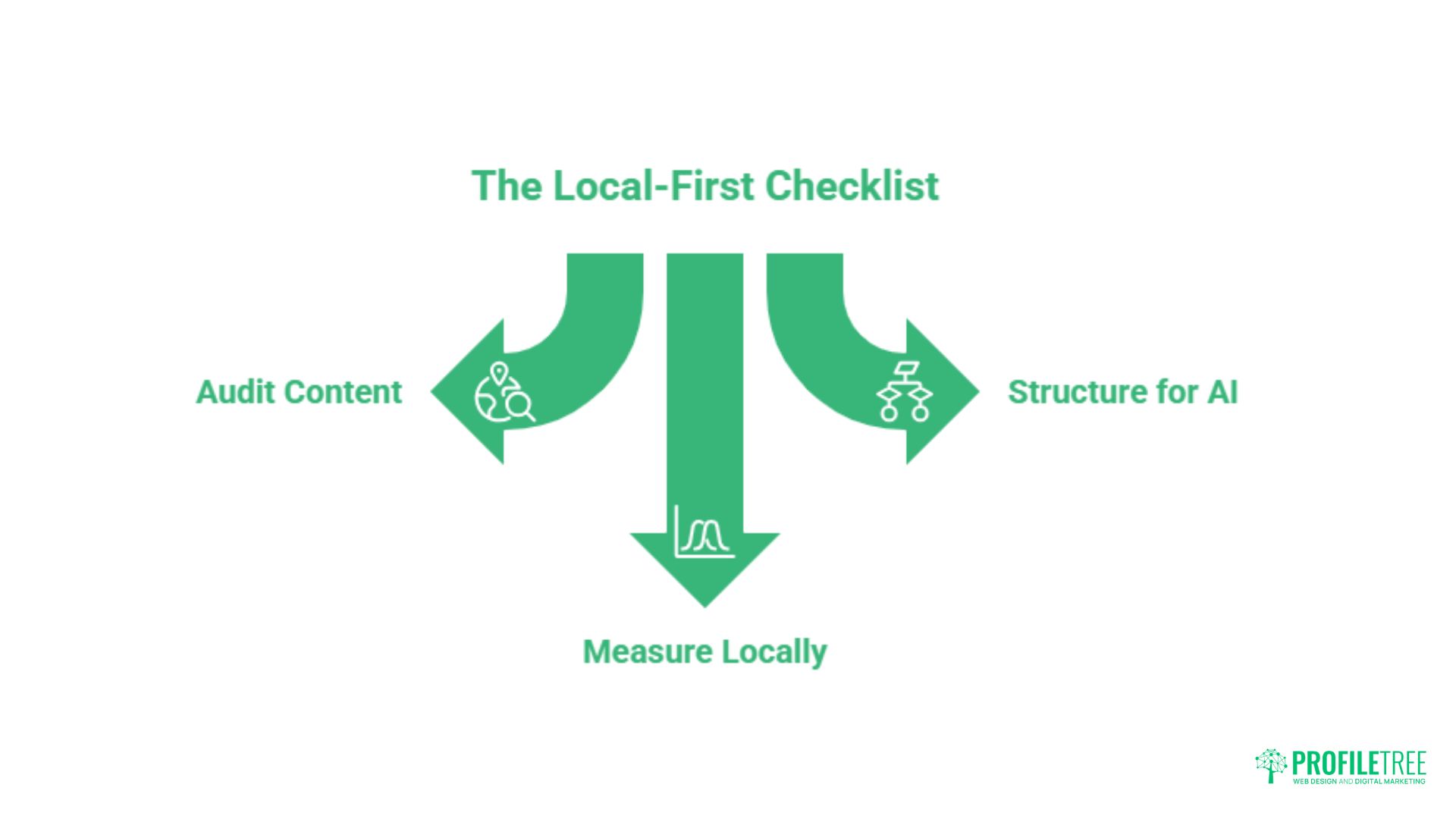
Trends don’t matter unless they change what you publish. This section turns the thinking above into checks you can run against any page before it goes live, so regional relevance is built in and not bolted on.
Audit Content for Regional Relevance
Start by asking whether each page would feel local to a reader in Belfast or Derry. Look for recognisable places, genuine local references, and language matching how people actually search. Pages that pass read as written here. Pages that fail read as imported, and readers here can tell.
Run the audit against your highest-traffic pages first, since those carry the most authority and the most to gain. A quick scoring sheet helps: award a point for local place names, local examples, dialect-aware phrasing, original imagery, and a region-specific FAQ. Anything scoring low is a candidate for a focused rewrite, not a full rebuild. You’re sharpening, not starting over.
Structure for Search and AI Citation
Lead each section with a direct answer, then support it. Use clear question-led headings, keep sections self-contained, and add a structured FAQ. This shape helps featured snippets, voice results, and AI answer engines extract your content cleanly. Solid technical foundations support all of it, and ProfileTree’s content strategy guide shows how to plan a cluster, not a single post.
Measure What Matters Locally
Track impressions, clicks, and position segmented by region, watch cross-border traffic from the Republic separately, and tie conversions to local actions like enquiry forms. Month-on-month growth in local organic sessions is the number proving a strategy is working, and it tells you which trends deserve more investment.
Search Console makes most of this straightforward once you filter by country and by query. Watch in particular for pages with high impressions and low clicks, which usually signal a title or angle missing what local searchers want, not a topic that has failed. Fixing the framing on those pages often recovers more traffic than publishing something new, and it protects the rankings you already hold.
Where to Start This Week: Content Trends for Northern Ireland
Pick your three highest-impression pages and run the local-first audit on those first. Add one genuine regional detail to each, rewrite the opening section so the answer arrives in the first two sentences, and check that any price or jurisdictional claim is correct for both sides of the border. Those three moves address search ranking, AI citation, and conversion at once.
Blandness costs more than boldness in this tight-knit market. Build regional relevance into every piece, measure it locally and refine fast, and you’ll reach an audience that competitors from outside the region struggle to touch. If you’d like help shaping content for Northern Ireland and the wider Irish market, talk to the team about content marketing services built for this region.
FAQs
Is TikTok effective for B2B marketing in Northern Ireland?
Yes, particularly for recruitment and for putting a human face on Belfast and Derry tech firms. Short-form video builds the familiarity that longer sales cycles depend on. Treat it as an awareness channel, not a direct lead source, and adapt trends to a local register rather than copying national content wholesale.
How do I handle pricing in content for a dual NI and ROI audience?
Three approaches work: dual-currency landing pages showing pounds and euros, IP-based geo-targeting that serves the right figures automatically, or clear on-page notes explaining both. Geo-targeting costs more to build and maintain, so choose based on how much cross-border revenue is realistically in play. Date every figure and mark it indicative.
How do I get my content cited by AI assistants?
Answer questions directly, early, and in plain text. Assistants extract short self-contained passages, so lead each section with a two-sentence answer and state the facts plainly: what you do, where you operate, and how pricing works. Cover related sub-questions on one page, and keep naming consistent across your site and profiles.
What are the most popular social media platforms in Northern Ireland?
Short-form video leads among younger audiences, with TikTok and Instagram strongest in urban hubs. Facebook still carries local community groups and older demographics, and LinkedIn matters for B2B reach in Belfast. Behaviour varies sharply by age and by county, so for most SMEs here, two channels done properly beat five kept ticking over.