
What is Augmented Reality? AR Benefits and ROI for UK Businesses
Table of Contents
Augmented reality has moved from a science fiction concept to a practical business tool. For UK companies exploring digital transformation, AR offers measurable advantages in customer engagement, operational efficiency, and competitive positioning. This guide examines how businesses can implement AR solutions that deliver tangible returns.
Understanding Augmented Reality Technology
Augmented reality overlays digital information onto physical environments through mobile devices, tablets, or wearable technology. Unlike virtual reality, which creates entirely new environments, AR enhances the existing world around you.
The technology works by using device cameras and sensors to map physical space, then rendering digital elements that appear anchored to real-world objects. When you point your phone at a room and see how furniture would look in that space, you’re experiencing AR in action.
Core AR Technologies and Components
Modern AR systems rely on several technical foundations. Computer vision allows devices to recognise and track physical objects in real-time. This tracking capability enables digital content to maintain proper positioning as you move around.
Sensor fusion combines data from multiple sensors, including cameras, gyroscopes, accelerometers, and GPS, to create accurate spatial awareness. The more sensors working together, the more stable and convincing the AR experience becomes.
3D modelling and rendering engines create the digital assets that overlay onto your view. These need optimisation to load quickly over UK 4G and 5G networks whilst maintaining visual quality.
The global AR market reached a valuation of $198.4 billion in 2025, with over 1 billion active users worldwide. Investment in AR technology increased 98% between 2021 and 2022, reflecting strong commercial confidence in the sector.
Types of AR Implementation
AR experiences can be categorised into four main types, each suited to different business applications.
Marker-based AR utilises visual triggers, such as QR codes, to initiate experiences. When a customer scans a product code, they might see additional product information, demonstration videos, or virtual try-on features. This approach works well for packaging, print advertising, and point-of-sale materials.
Markerless AR operates without specific visual markers, instead using GPS coordinates, built-in sensors, or spatial mapping. Location-based AR applications can trigger content when customers enter particular areas, making this valuable for retail stores, museums, and outdoor marketing campaigns.
Projection-based AR casts digital light onto physical surfaces, creating interactive displays that respond to touch and movement. Retailers utilise this technology for window displays and in-store demonstrations that capture attention without requiring customers to use their own devices.
Superimposition-based AR replaces or enhances existing views with digital alternatives. This technology enables virtual try-on experiences for furniture, clothing, and cosmetics, allowing customers to preview products in their own environment before making a purchase.
AR Applications Across Business Sectors
Different industries adopt AR for specific operational and commercial benefits. The technology addresses distinct problems in various sectors, including retail, healthcare, education, tourism, and manufacturing.
AR in Retail and E-commerce
Retail businesses face a persistent challenge: customers want to know how products look and fit in their lives before committing to purchase. AR removes this uncertainty by bringing products into customer environments.
IKEA pioneered this approach with their Place app, allowing shoppers to position furniture virtually in their rooms at true-to-scale dimensions. This reduces returns by helping customers make informed decisions about size, style, and placement.
Fashion retailers use AR for virtual try-on experiences. Customers see how glasses, watches, or clothing look on them through their phone cameras. This approach proved particularly valuable when physical stores closed during COVID restrictions.
TopShop introduced virtual changing rooms as early as 2011, demonstrating that forward-thinking retailers recognised AR’s potential years before widespread adoption. The technology has continued to improve since then, with enhanced tracking and more realistic rendering.
Businesses in retail develop AR experiences integrated with existing e-commerce platforms. This includes WebAR solutions that work directly in browsers, eliminating the need for app downloads and thereby reducing friction in the customer journey.
Healthcare and Medical Training
Healthcare organisations use AR for precision surgical planning, remote diagnostics, and medical education. Surgeons can overlay patient scans onto their field of view during operations, showing exactly where to make incisions or locate specific anatomical structures.
Medical students benefit from AR anatomy education. Rather than relying solely on textbooks or cadavers, they can explore 3D models of organs, systems, and conditions through their devices. This interactive learning improves retention and understanding.
Pharmaceutical companies utilise AR to illustrate how medications function within the body, rendering complex biochemical processes transparent and comprehensible to both medical professionals and patients.
For NHS trusts and private healthcare providers, AR reduces training costs whilst improving outcomes. The technology allows practitioners to practice procedures repeatedly in realistic conditions before working with actual patients.
Education and Training Applications
Educational institutions adopt AR to create engaging learning experiences that hold students attention and improve comprehension. Historical sites become interactive when students point devices at buildings or artefacts, revealing how they looked in different time periods.
Science education benefits significantly from AR. Complex concepts, such as molecular structures, planetary movements, or cellular processes, become three-dimensional and manipulable. Students can rotate, zoom, and explore subjects that would otherwise remain abstract.
Language learning apps use AR to label real-world objects with foreign language vocabulary. Point your phone at a chair, and it displays the word in Spanish, French, or Mandarin. This contextual learning proves more effective than traditional flashcards.
UK schools and universities develop educational AR content that aligns with curriculum requirements. Video production teams can create AR-enhanced learning materials that are compatible with various devices and platforms.
Tourism and Cultural Heritage
Tourism boards and cultural institutions utilise AR to enhance visitor experiences without the need for expensive physical installations. Tourists exploring Belfast, Edinburgh, or Cardiff can access historical information, guided tours, and reconstructions through AR apps.
The Sagrada Familia in Barcelona offers AR tours that show Gaudí’s architectural vision and construction techniques. Visitors understand the building’s complexity without needing a guide for every group.
Museums overlay additional context onto exhibits. When visitors point devices at paintings or artefacts, they see artist interviews, historical context, or interactive demonstrations. This depth of information would clutter physical spaces, but works well through AR.
For Northern Ireland tourism initiatives, we create AR experiences that highlight local history and attractions, making heritage accessible to international visitors who may not be able to join guided tours.
Manufacturing and Maintenance
Manufacturing businesses reduce downtime and training costs through AR-assisted maintenance. Technicians wearing AR glasses see step-by-step repair instructions overlaid on equipment, with arrows pointing to specific components and animated demonstrations of procedures.
Volkswagen pioneered this approach with its MARTA app, providing mechanics with instant access to repair guidance. This reduces the time technicians spend searching for information and minimises errors that could damage expensive equipment.
Quality control processes benefit from AR inspection systems. Rather than checking against separate documentation, inspectors see specifications and measurements overlaid on actual components, speeding up verification whilst reducing mistakes.
For UK manufacturers, we develop AR maintenance systems that are integrated with existing asset management platforms, creating seamless workflows that enhance efficiency without disrupting operations.
AR vs VR: Understanding the Technology Split
Businesses often confuse augmented reality with virtual reality. Whilst both create digital experiences, they serve different purposes and require different investments.
Immersion and Environment
AR keeps users grounded in physical reality whilst adding digital elements. You remain aware of your surroundings, seeing both real and virtual objects simultaneously. This makes AR suitable for situations that require spatial awareness, such as maintenance work or retail shopping.
VR replaces physical surroundings entirely with simulated environments. Users wear headsets that block external views, immersing them completely in digital spaces. This total immersion suits training simulations, gaming, and virtual tourism where physical context doesn’t matter.
Hardware Requirements
AR works with devices most people already own. Smartphones and tablets offer sufficient processing power and camera quality to deliver convincing AR experiences. Some applications use dedicated AR glasses, but these remain optional rather than essential.
VR demands specialised headsets that block physical view whilst displaying stereoscopic 3D imagery. These headsets cost considerably more than smartphones and require dedicated space for safe use, limiting accessibility compared to AR.
Interaction Models
AR allows interaction with both physical and digital objects. You can manipulate virtual furniture whilst avoiding real obstacles, or point at actual products to access digital information. This dual interaction makes AR versatile for commercial applications.
VR interaction occurs entirely within a digital space, utilising controllers or hand tracking. Users navigate virtual environments disconnected from physical locations, which works well for training scenarios or design visualisation, but less effectively for customer-facing applications.
Business Application Comparison
AR excels in situations requiring connection to physical products, spaces, or processes. Retail visualisation, maintenance guidance, and location-based marketing benefit from AR’s ability to enhance rather than replace reality.
VR suits are applications where physical presence adds no value. Training simulations, virtual property tours, and design reviews are well-suited for VR because users don’t require physical context.
For most UK SMEs, AR offers better ROI because it reaches customers through devices they already own, requires no dedicated space, and integrates naturally into existing customer journeys.
Implementing AR: Strategy and Technology Choices
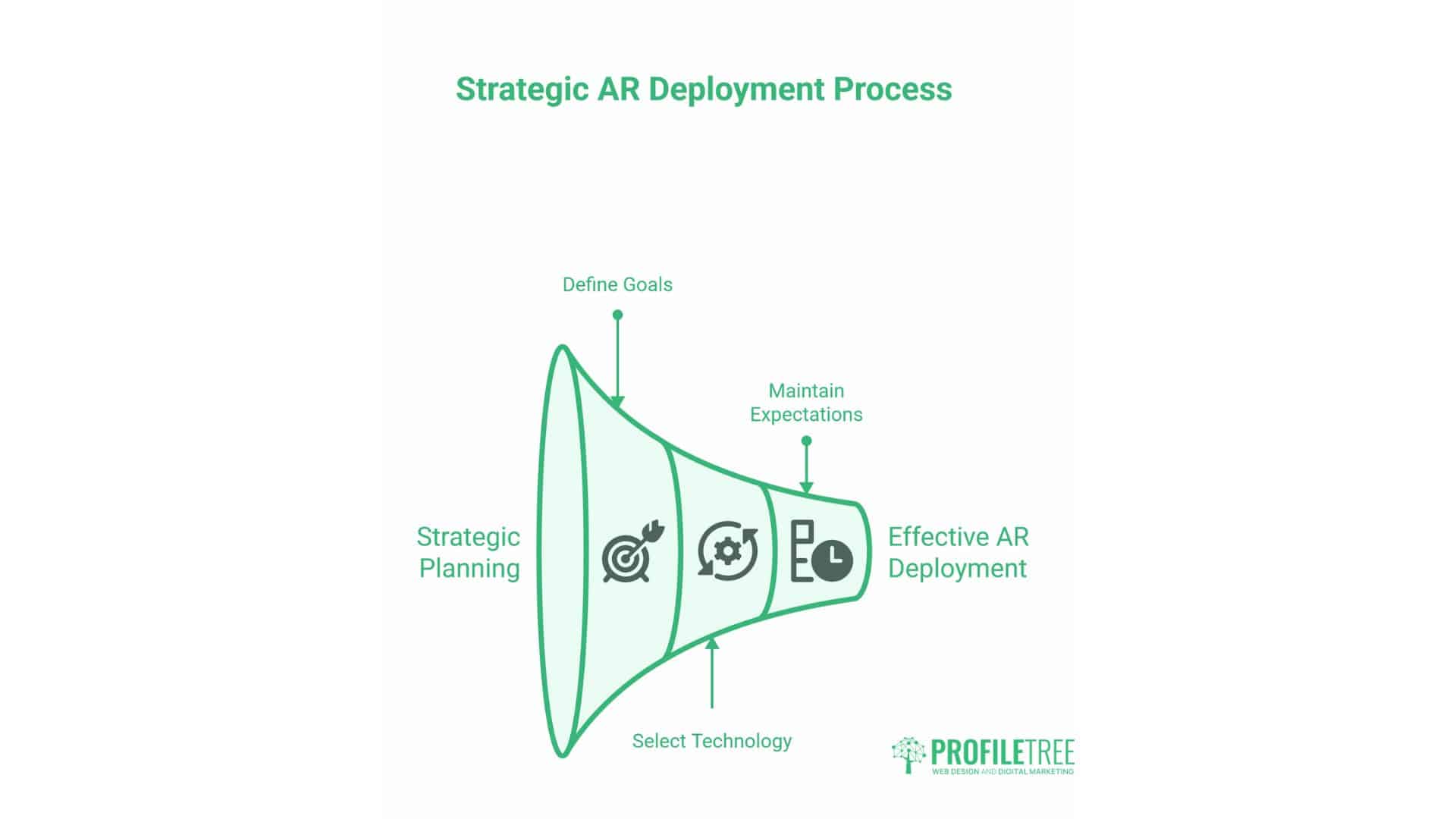
Successful AR implementation requires strategic planning rather than opportunistic experimentation. Businesses need clear objectives, appropriate technology choices, and realistic performance expectations.
Defining AR Objectives
Start by identifying specific business problems AR might solve. Vague goals like “be innovative” or “engage customers” provide insufficient direction for development teams.
Strong AR objectives include measurable outcomes. “Reduce product returns by 15% through virtual try-on” or “decrease maintenance call-out time by 20 minutes per incident” give clear success criteria.
Consider your audience’s technical capability and access to devices. Consumer-facing AR works best with WebAR that requires no app installation. Internal training applications might justify dedicated apps if staff use company-provided devices.
WebAR vs Native App Development
WebAR runs directly in mobile browsers without downloads. Users scan QR codes or click links, then interact with AR content immediately. This removes friction that causes potential customers to abandon experiences.
Native AR apps offer more sophisticated features and better performance, but require users to find, download, and install applications. Industry data shows that 75% of users abandon brand experiences that require app downloads for one-time interactions.
For UK retailers and marketing campaigns, WebAR provides an optimal balance between capability and accessibility. WebAR experiences work seamlessly across iOS and Android devices, requiring only a modern browser and access to the camera.
Technology Framework Selection
AR development relies on various frameworks, each with its own specific strengths and associated costs.
8th Wall provides exceptional world tracking, allowing digital objects to remain precisely positioned as users move around. Monthly licensing fees make this suitable for enterprises and high-budget campaigns. UK retail brands use 8th Wall for product visualisation that needs photorealistic quality and rock-solid stability.
Zappar offers strong image tracking capabilities through its ZapWorks platform. As a UK-based company, Zappar understands local market requirements and provides responsive support. This framework suits mid-sized businesses that require professional-quality services without enterprise pricing.
Open-source frameworks like A-Frame, Three.js, and MindAR provide developers with complete control, eliminating recurring licensing costs. These require more development time but work well for simple product viewers or custom technical integrations.
Model-Viewer from Google provides basic 3D visualisation suitable for e-commerce “view in room” features. Whilst limited compared to full AR platforms, Model-Viewer integrates easily with existing websites at zero licensing cost.
| Framework | Tracking Quality | Cost Level | Best Use Case |
|---|---|---|---|
| 8th Wall | Exceptional | High (SaaS) | Enterprise Retail / Real Estate |
| Zappar | High | Mid-Range | Marketing / Packaging / Education |
| MindAR | Moderate | Zero (Open Source) | Simple Web Integration / Prototypes |
| Model-Viewer | Basic | Zero (Google) | E-commerce “View in Room” |
When selecting frameworks, consider that whilst 5G rollout continues across London, Birmingham, and other major UK cities, rural connectivity varies significantly. Select solutions that support progressive loading, allowing users on slower connections to avoid freezing.
GDPR and Privacy Compliance
AR applications accessing device cameras must comply with UK GDPR and ICO guidelines. Users need clear information about what data you collect, how you process it, and how long you retain it.
Camera access triggers system permissions on both iOS and Android. Your application must explain why camera access is necessary before requesting permission. Vague or unclear requests reduce permission grants, limiting the reach of your AR experience.
Processing camera data client-side (on the user’s device) rather than server-side reduces privacy concerns and compliance complexity. When camera data never leaves the device, you avoid data controller obligations for that information.
Privacy-first AR experiences collect only essential data, process information locally where possible, and provide transparent privacy notices that meet ICO requirements.
Accessibility Considerations
AR experiences must be accessible to users with different abilities. WCAG 2.2 guidelines apply to AR content just as they do to websites.
Provide alternative ways for users who cannot or prefer not to use AR features to access information. Text descriptions, standard images, and conventional navigation should offer equivalent information to AR content.
Consider colour contrast and text size in AR overlays. Information must remain readable across different lighting conditions and viewing distances—test AR experiences in various environments before launch.
For public sector projects and large enterprises, accessibility compliance isn’t optional. Digital agencies develop AR solutions that meet WCAG 2.2 Level AA standards, with documentation to prove compliance for procurement processes.
Asset Optimisation
3D models must strike a balance between visual quality and file size. AR experiences that take 30 seconds to load typically lose most users before they can display content.
Keep 3D assets under 3MB for consumer-facing experiences. Use texture compression, mesh optimisation, and level-of-detail techniques to maintain visual quality whilst reducing bandwidth requirements.
Test loading times on 4G networks, not just office Wi-Fi. What loads instantly on your development system might frustrate customers on mobile data connections.
Video production and animation teams create optimised 3D assets specifically for AR applications, balancing quality with performance across UK network conditions.
Measuring AR Performance and ROI
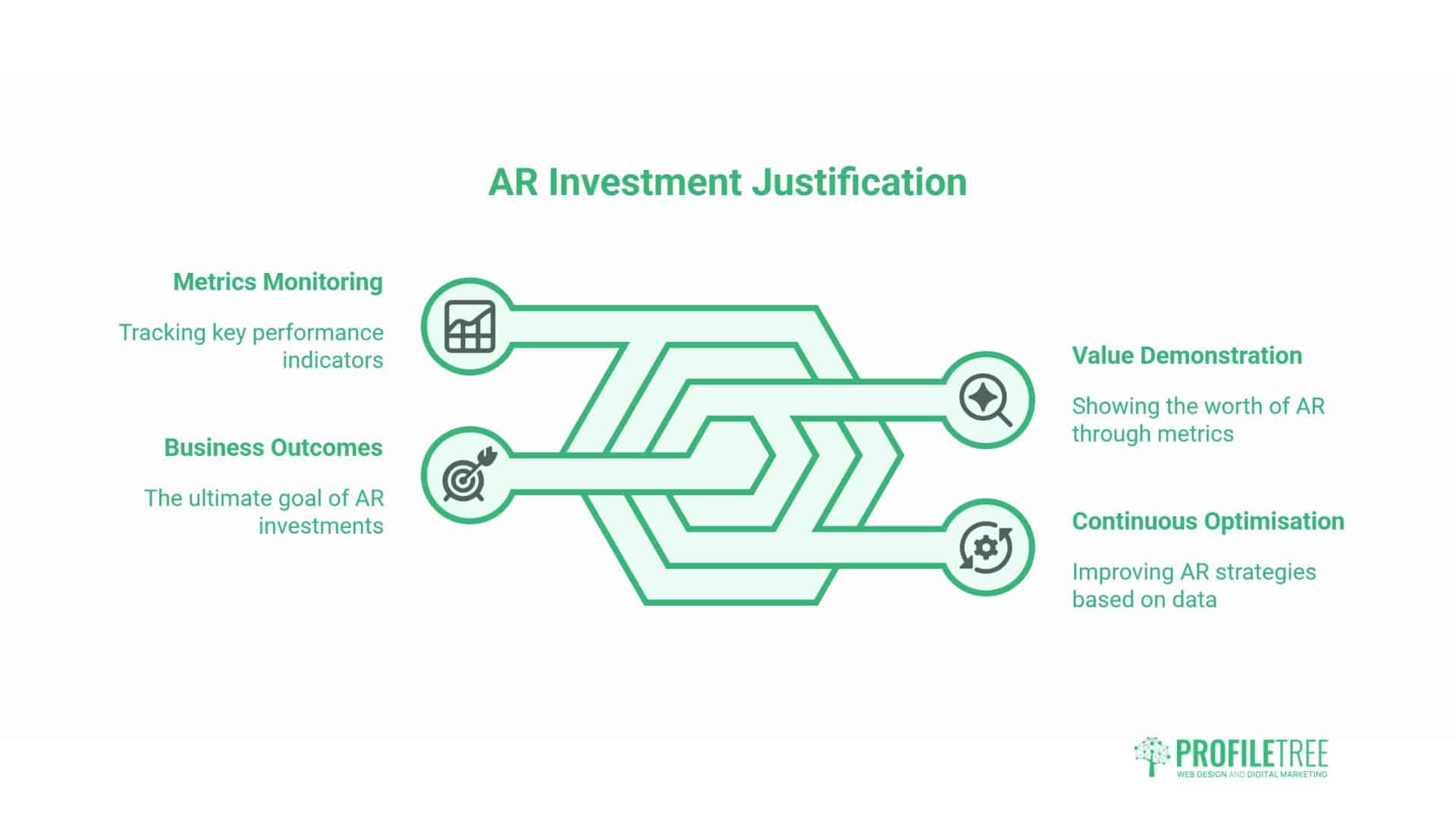
AR investments require justification through measurable business outcomes. Tracking the right metrics proves value and guides ongoing optimisation.
Engagement Metrics
Interaction duration measures the time users spend engaging with AR experiences. A more extended engagement indicates compelling content that holds the attention. Compare this against standard product page dwell times to quantify the impact of AR.
Completion rates indicate the percentage of users who start AR experiences and complete the intended actions. If only 30% of users who launch your AR try-on actually view products, you’ve identified a key drop-off point that requires attention.
Share rates indicate whether users find AR experiences worth sharing with others. Social sharing extends reach beyond your direct marketing efforts, providing free amplification.
Commercial Metrics
Conversion lift compares purchase rates between customers who use AR features and those who don’t. Strong AR implementations show 2-4x conversion improvement over standard product pages.
Average order value often increases when customers use AR. Confidence from virtual try-on encourages customers to buy more expensive options or add complementary products.
Return rates decrease when AR helps customers make informed decisions. If customers accurately visualise products before purchase, fewer items come back as unsuitable.
Customer acquisition costsimprove when AR experiences generate organic social sharing and word-of-mouth recommendations, reducing the need for paid marketing.
Operational Metrics
Support call reduction measures how AR training or product information reduces the need for customer service contacts. If maintenance technicians access AR guidance instead of calling support, you save both time and money.
Training time reduction quantifies how AR instruction accelerates the onboarding process. Compare time-to-competency for staff trained with AR against traditional methods.
Error rate reduction shows how AR guidance improves accuracy in manufacturing, maintenance, or assembly processes.
Building Your Business Case
Calculate AR ROI using specific financial impacts rather than soft benefits. Vague claims about “engagement” or “innovation” don’t justify budget allocation.
Structure ROI calculations like this:
Costs:
- Framework licensing (if applicable)
- Development labour
- 3D asset creation
- Hosting and bandwidth
- Ongoing maintenance
Returns:
- Increased conversion rate × average order value × annual traffic
- Reduced returns × average processing cost
- Decreased support calls × average handling cost
- Reduced training time × number of employees × hourly cost
Testing and Optimisation
Launch AR experiences with measurement frameworks in place. Use analytics platforms that track AR-specific interactions, not just page views.
A/B test different AR approaches. Try various interaction models, visual styles, and placement options to identify what drives the best results.
Collect qualitative feedback through user surveys or interviews. Quantitative data shows what happens, but qualitative research explains why.
Regular optimisation based on performance data improves ROI over time. AR isn’t “set and forget” technology—it requires ongoing refinement.
AR Technology Trends and Future Developments
The AR landscape continues to shift as new capabilities emerge and adoption spreads across various sectors. Businesses planning AR investments should understand where the technology is heading.
WebAR Growth
Browser-based AR has removed the friction that previously limited adoption. When experiences are launched directly from links or QR codes, businesses can reach broader audiences without relying on app store dependencies.
Web standards like WebXR improve browser AR capabilities with each release. Modern browsers support more sophisticated tracking, better rendering, and wider sensor access than previous versions.
This trend favours businesses with web development capabilities. WordPress and web development expertise directly translates into WebAR implementation, enabling clients to manage AR content through familiar systems.
Generative AI Integration
Generative AI tools increasingly complement AR experiences. Rather than pre-creating every possible product variation, businesses use AI to generate customised 3D models on demand.
AI chatbots guide users through AR experiences, answering questions and suggesting relevant features. This combination of conversational AI and visual AR creates more helpful, personalised interactions. AR represents another channel where artificial intelligence enhances customer experience and operational efficiency.
5G Network Expansion
Faster mobile networks enable more sophisticated AR experiences with less local processing. Complex rendering can happen server-side, with results streamed to devices.
This reduces hardware requirements, allowing older devices to access advanced AR features. Businesses can reach a wider audience without compromising the quality of their experience.
However, UK 5G coverage remains inconsistent outside major cities. Design AR experiences that work across connection speeds rather than assuming universal 5G access.
Wearable AR Devices
Smart glasses continue to develop, though mainstream adoption remains years away. Apple’s Vision Pro and Meta’s Ray-Ban Stories show competing visions for wearable AR.
For businesses, this means planning for multiple AR form factors. Experiences designed for smartphone screens need adaptation for glasses, smartwatches, or future devices.
Early movers gain experience implementing cross-platform AR before competitors, positioning themselves as technology leaders.
Selecting an AR Development Partner
AR implementation success depends heavily on choosing the right development partner. Technical capability matters, but sector expertise and strategic thinking matter more.
Essential Partner Capabilities
Look for development teams with proven AR projects in your sector. Retail AR differs significantly from healthcare AR, and a generic experience won’t translate.
Check whether partners develop WebAR or only native apps. WebAR offers a better reach for most commercial applications, so partners focused solely on app development may miss out on optimal solutions.
Examine case studies for measurable results, not just visually appealing graphics. Did implementations increase conversion? Reduce returns? Improve training efficiency?
Ask about ongoing support and optimisation. AR experiences require monitoring and refinement after launch, not just initial development.
Questions for Potential Partners
What framework would you recommend for our specific use case? Strong partners explain why specific technologies suit your requirements rather than pushing preferred solutions.
How do you handle GDPR compliance for camera data? Partners should articulate clear privacy approaches meeting UK regulations.
What metrics will you track to prove ROI? Vague answers about “engagement” signal weak strategic thinking. Look for specific commercial or operational metrics.
Can you provide references from similar projects? Speaking with previous clients reveals whether partners deliver promised results and support.
How do you optimise for UK network conditions? Partners should understand that AR experiences must function across various connectivity types, not just in controlled environments.
FAQs
What is the difference between AR and VR?
AR overlays digital content onto physical reality through phone cameras or glasses, while keeping you aware of your surroundings. VR creates completely new environments that replace what you see, requiring headsets that block physical view. AR enhances reality; VR replaces it.
How much does AR development cost?
WebAR projects start around £5,000 for simple product visualisation, whilst sophisticated retail experiences with custom 3D assets range from £15,000 to £ 50,000. Native AR apps cost more due to platform-specific development. Ongoing framework licensing adds £500-2,000 monthly, depending on traffic and chosen platform.
Do customers need special apps for AR?
WebAR works directly in mobile browsers without downloads. Users click links or scan QR codes, then interact immediately. This removes the friction that causes 75% of potential users to abandon experiences requiring app installations.
Which industries benefit most from AR?
Retail achieves strong ROI through virtual try-on and product visualisation, resulting in reduced returns. Healthcare utilises AR for surgical planning and medical training, while manufacturing benefits from AR maintenance guidance and quality control. Tourism and education create engaging experiences through AR content.
Taking Action on AR Opportunities
AR has moved beyond experimental technology to a proven business tool. UK companies now have the frameworks, case studies, and development partners needed for successful implementation.
Begin by identifying the specific business challenges that AR might address. Strong candidates include situations where customers need product visualisation, staff require training guidance, or physical limitations prevent a full customer experience.
Evaluate WebAR first before considering native apps. Browser-based experiences reach broader audiences with less friction, providing better ROI for most commercial applications.
Build privacy compliance and accessibility into AR projects from the start. UK regulations demand both, and retrofitting compliance adds cost and delays.
Measure performance through commercial metrics rather than soft engagement statistics. Conversion lift, return reduction, and training time savings justify investment more effectively than impressions or interactions.
Growing Your Business Online
Understanding emerging technologies and digital marketing strategies is essential for modern business success, but implementation requires both expertise and a comprehensive approach. ProfileTree helps businesses across Northern Ireland, Ireland, and the UK achieve measurable growth through integrated digital services, including professional web design, SEO, content marketing, video production, and AI implementation.
From building high-performance websites that drive conversions to developing digital marketing strategies that generate qualified leads, our Belfast-based team combines technical expertise with business-focused thinking. Whether you’re launching your digital presence or looking to improve existing results, we create solutions aligned with your specific business objectives. Contact ProfileTree to discuss how we can help your business grow online.