
Thought Leadership on Professional Platforms: A Definitive Guide
Table of Contents
Most professionals understand that thought leadership matters. What trips them up is where to put the effort. Scatter content across every platform, and it never gains traction. Commit to one channel and risk missing audiences who spend their time elsewhere.
The platforms worth your attention as a UK professional or business leader are Quora, LinkedIn, and Medium. Each attracts a different audience, rewards different types of content, and sends a different signal to search engines. Used together, they create a presence that compounds over time.
This guide covers how to build genuine authority on each platform, adapt your approach for B2B audiences in the UK and Ireland, and turn content written once into presence earned everywhere.
Building Authority on Quora
Quora sits in a unique position among professional platforms. Founded in 2009, it built its early reputation around expert-driven answers and that reputation still holds in Google’s eyes: well-written Quora answers consistently appear in organic search results, giving your content a second life beyond the platform itself.
Understanding What Quora Rewards
Quora’s algorithm surfaces answers that receive upvotes, generate comments, and hold readers through to the end. It is not a volume game. One answer that genuinely solves a problem will outperform ten that pad out space.
For B2B professionals, this is good news. The questions your potential clients type into Google: “how to choose a web designer for a small business,” “is SEO worth it for a local company,” “what does a digital marketing agency actually do” appear on Quora in close to identical form. Answering these well puts your expertise in front of people at exactly the moment they are looking for it.
High-performing answers tend to share a structure: a direct answer to the question in the first two sentences, supporting evidence or a specific example in the body, and a practical takeaway at the end. Quora readers scroll quickly. If your first sentence hedges, they leave.
The Authority Profile Audit
Your Quora profile does more work than most people realise. Before a reader finishes your answer, many will check who wrote it. A profile that lists a vague job title and no credentials loses trust that the answer itself built up.
Topic-specific bios are particularly powerful. Quora allows you to set a different bio for each topic area you write about. A web designer can show their development credentials on technology questions and their business background on marketing ones. This specificity signals expertise far more effectively than a single generic bio.
The profile should state your role, your company (with location), one concrete credential (years in business, number of projects, a relevant qualification) and what you specialise in. Keep it under 60 words. Shorter bios get read; longer ones get skimmed.
Finding Questions Worth Answering
Not all questions are equal. A question with 50,000 followers and 200 existing answers is hard to break into. A question with 8,000 followers and three mediocre answers is an opportunity.
The Quora Ads Manager provides free keyword research data even if you never run a paid campaign. Use it to identify question volume before committing time to an answer. Filter for questions relevant to your service area (web design in Belfast, digital marketing for Northern Ireland businesses, SEO for professional services), and you will find threads that competitors from London or the US have ignored entirely.
For thought leadership specifically, look for “evergreen” questions: those that remain relevant regardless of news cycles. “How do I build a professional brand online?” will still attract readers in five years. “What was the best digital marketing tactic in March 2024?” will not.
Quora Compliance and Platform Etiquette
Quora’s moderation is active, and its spam filters are sensitive. The platform’s “Be Nice, Be Respectful” policy extends to how you promote your business. Dropping a link to your website in every answer is the fastest route to having your account restricted.
A practical approach: for every five answers you post, include a contextual link in no more than one. When you do link, it should genuinely expand on the point you have made, provide a relevant guide, a case study, or a service page that directly addresses the question. Links forced into answers that don’t need them get downvoted and flagged. Links that readers click for more information are shared.
For UK businesses specifically, follow local Quora Spaces related to your industry and region. These smaller, focused communities have higher engagement rates than broad topic feeds, and building a reputation within them carries weight.
LinkedIn as a Thought Leadership Channel
LinkedIn has changed significantly as a publishing platform over the past few years. The algorithm now favours dwell time and comments over passive likes, which means the content that performs best is content that makes people stop and think , or disagree. For UK B2B professionals, it remains the highest-intent professional network available.
The Difference Between Posting and Publishing
Most LinkedIn activity consists of posts: short updates, shares, and reactions. Publishing is different. LinkedIn Articles give your content a permanent URL, make it indexable by search engines, and signal to the platform that you are a serious contributor rather than a casual user.
For LinkedIn in UK business contexts, the distinction matters because LinkedIn surfaces articles in profile search results. When a potential client looks you up, they see your articles before they see your timeline activity. A profile with three well-written articles on your area of expertise looks like an expert. A profile with only post history looks like someone who has an opinion but no backing.
The cadence that tends to work for professionals managing their own presence: one short-form post two or three times a week, and one article every two to three weeks. Short posts test ideas and generate quick engagement. Articles establish credentials and rank in search.
What LinkedIn’s Algorithm Rewards in 2026
LinkedIn’s ranking signals have shifted toward what it calls “meaningful engagement”: comments that contain more than five words, shares to personal feeds (not just company pages), and saves. Posts that generate a wave of single-word comments, “Great!” and “Congrats!”, receive less distribution than posts that spark genuine conversation.
This has practical implications for thought leadership content. Opinion pieces, contrarian takes backed by evidence, and specific predictions about your industry tend to outperform generic advice. A post that begins “Most businesses in Northern Ireland are missing this one aspect of their digital strategy” performs differently from one that begins “Here are five digital marketing tips.” The first creates curiosity and invites a response.
The LinkedIn Industries feature is worth using properly. Connecting your profile to the correct industry category affects which content the algorithm shows you and which audiences your content reaches. Professionals who set their industry to “Marketing and Advertising” see different distribution patterns than those categorised under “Information Technology and Services,” even if their actual work overlaps significantly.
The Executive Presence Approach
For business owners and senior leaders, LinkedIn thought leadership is partly personal branding and partly company building. The two are not the same thing, and trying to do both in the same post usually achieves neither.
Personal presence on LinkedIn comes from the founder or leader’s individual account. It covers opinions, lessons from real work, and a genuine perspective. The company page content covers services, team updates, and industry news. Both have a role, but the personal account typically generates significantly more organic reach. LinkedIn favours individual voices over branded pages in the feed algorithm.
If you are building an executive presence as part of your personal development as a business leader, start by writing about things you genuinely know and have experienced. The most-shared LinkedIn content from business owners tends to be specific and honest rather than broad and polished. A post about a mistake that cost a client project, and what you changed because of it, will reach further than a post about your agency’s values.
Company Pages and Their Supporting Role
Company pages are most effective when they amplify individual content rather than replace it. Sharing a team member’s article, commenting on an employee’s post from the company account, and resharing customer success content all generate visibility without requiring the company page to generate original thought leadership on its own.
For SMEs without a dedicated social media resource, this is a more sustainable model than attempting to maintain both a personal and company presence at full volume. Choose one to lead (usually the founder’s personal account) and use the company page to support and distribute that content.
Medium and Long-Form Publishing
Medium is often overlooked by UK businesses, partly because it feels like a US platform and partly because its early reputation for long, meandering personal essays put off business writers. Neither perception reflects what Medium actually is in 2026: a distribution network for long-form professional content with a built-in audience of several hundred million monthly readers.
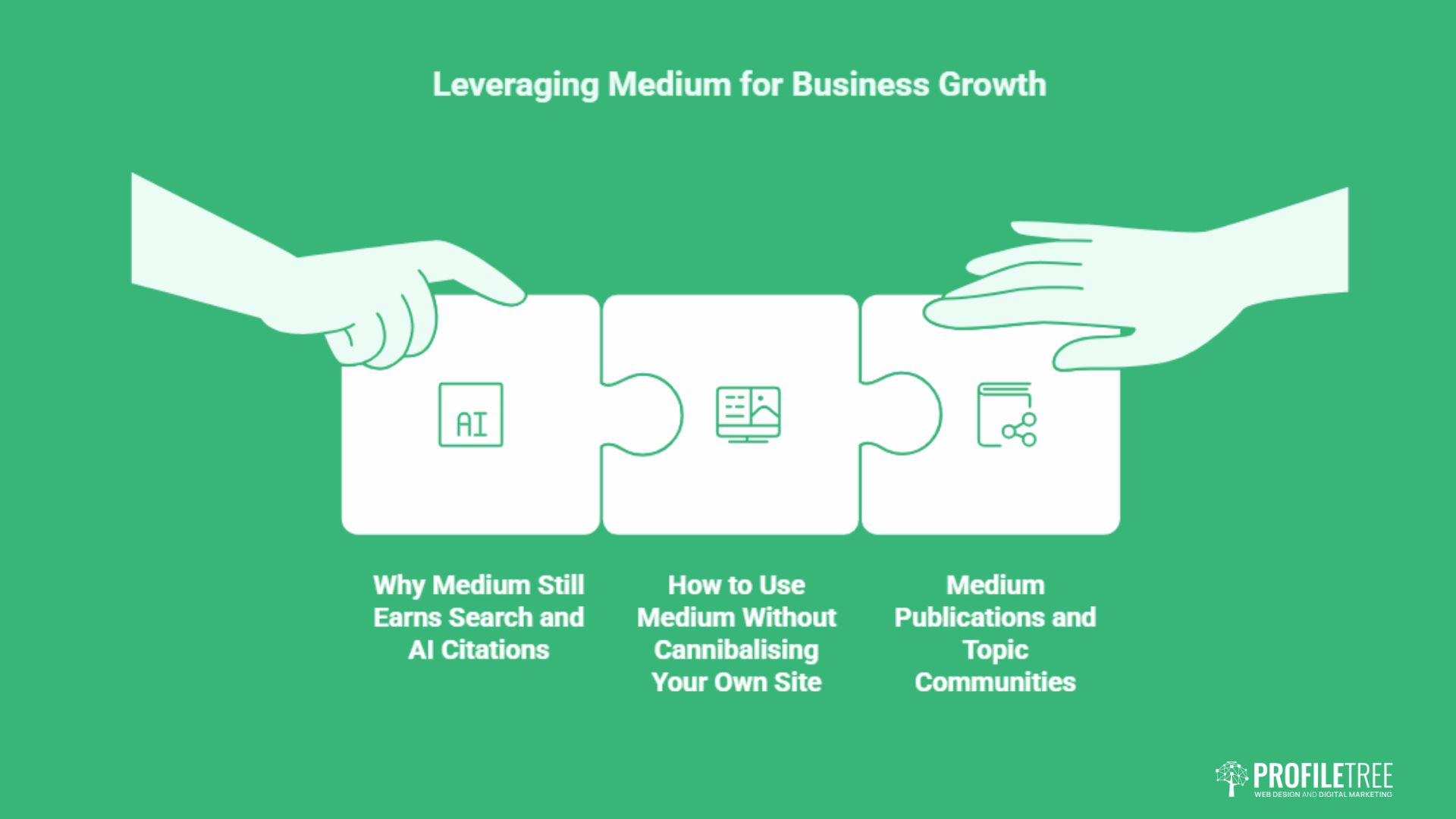
Why Medium Still Earns Search and AI Citations
Medium articles rank in Google. This is the primary reason to use the platform as a thought leadership channel. When you publish a well-structured, specific article on Medium, you are effectively placing content on a domain with significant authority: one that Google trusts and indexes quickly.
For topics that your own site does not yet rank for, Medium offers a shortcut. Publishing an article on Medium about a subject adjacent to your core services (say, a digital agency writing about AI tools for small businesses) can rank within weeks, placing your name and brand in front of readers who would not find your own website for that query. This makes Medium particularly useful for testing new content angles before investing in a full-service page on your main domain.
AI citation behaviour further rewards Medium content. Perplexity, ChatGPT, and Google AI Overviews all draw on Medium articles for answers to professional and business questions. A well-structured Medium article with clear headings, a direct answer in the first paragraph, and specific supporting details stands a reasonable chance of appearing in an AI-generated answer to a relevant query.
How to Use Medium Without Cannibalising Your Own Site
The risk with Medium is duplicating content that should live on your own domain. Search engines can penalise both the original and the copy when the same content appears in two places without canonical tags pointing to the original.
The approach that avoids this: use Medium for content that complements rather than mirrors your site. If your website has a detailed guide to web design for SMEs, your Medium article might cover a specific angle within that topic (say, what to expect from the discovery phase of a web project) that links back to the full guide. Medium becomes a spoke pointing toward your site’s hub, not a parallel site doing the same job.
Medium also allows canonical tag settings. If you want to republish an existing article from your site on Medium for broader distribution, set the canonical URL to point to your own domain. This tells search engines where the authoritative version lives, and Medium’s readers still see the full content. Content marketing strategy should always account for where canonical authority sits before republishing anything.
Medium Publications and Topic Communities
Medium’s publication feature allows writers to contribute to established topic communities with existing readerships. Getting accepted to a relevant publication in your industry (digital marketing, business strategy, technology) immediately extends your distribution to an audience that already follows that subject area.
For UK professionals, publications focused on business, technology, and entrepreneurship tend to have the strongest engagement. Pitch a specific article rather than a general topic. Editors of Medium publications receive dozens of pitches; one that arrives with a clear title, a one-sentence summary of the information gain, and a brief credential check gets read first.
The Multi-Channel Content Flywheel
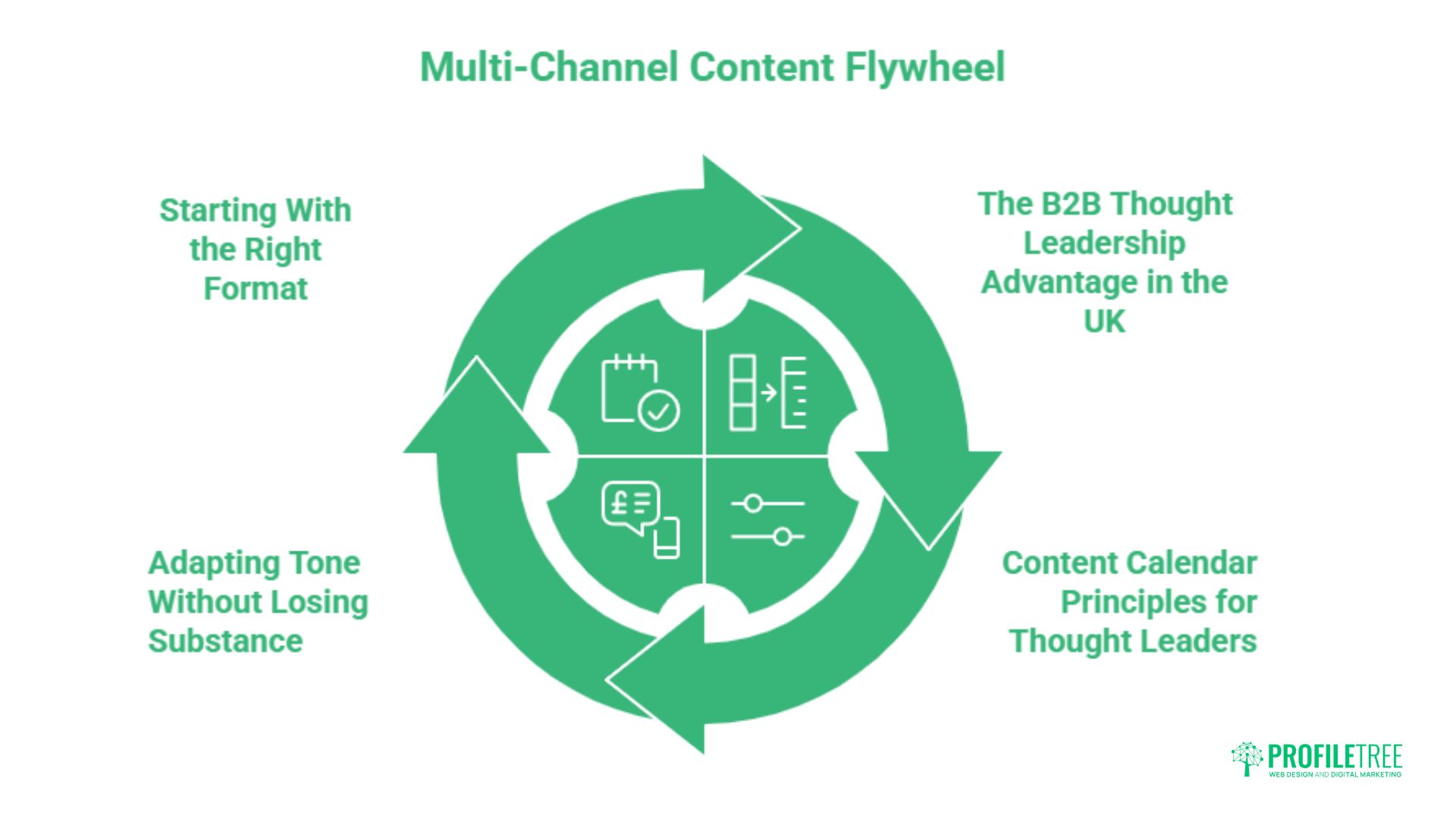
The professionals who build the strongest thought leadership presence are not writing different content for each platform from scratch. They are writing once and distributing intelligently. This approach, sometimes called a content flywheel, starts with one substantial piece of thinking and extends it across every channel where their audience is present.
Starting With the Right Format
The flywheel starts with a piece of content that has genuine depth: a Quora answer to a complex question, a LinkedIn Article on a specific professional topic, or a Medium piece drawing on real project experience. This is the “origin content.” Everything else derives from it.
A Quora answer that generates strong engagement tells you something important: the question resonates with a broad audience. That same topic becomes a LinkedIn post the following week, framed slightly differently for a professional audience who may not use Quora. It becomes a Medium article a fortnight later, expanded with context and detail that a Quora answer doesn’t allow. It eventually informs an update to a service page on your website.
“Professionals across Northern Ireland often ask us which single platform they should focus on,” says Ciaran Connolly, founder of ProfileTree. “The honest answer is that no single platform builds authority in isolation. The thought leaders who gain real traction use one platform to test ideas, then distribute those ideas everywhere their audience already spends time.”
This approach also solves a practical problem: most business owners and senior leaders do not have time to generate original content for five platforms. The flywheel model requires original thinking only at the start. Distribution takes time, but significantly less than creating from scratch each time.
Adapting Tone Without Losing Substance
Each platform expects a different register. Quora readers want directness: get to the answer fast, back it with specifics, and leave them with something they can act on. LinkedIn rewards a slightly more personal tone: observations from direct experience, opinions stated clearly, and a professional context that a general audience can follow.
Medium sits between long-form journalism and professional commentary. A Medium article can take its time in a way that a LinkedIn post cannot. Readers who click through to a Medium piece have self-selected for depth; give them structure, data where it exists, and a genuine point of view rather than a consensus summary of other people’s opinions.
Maintaining a consistent brand voice across all three platforms matters for recognition. The tone adapts; the underlying perspective should not. If your professional view is that most small businesses over-invest in social media and under-invest in SEO, that view should come through (appropriately calibrated) whether you are answering a Quora question, writing a LinkedIn post, or publishing a Medium article.
The B2B Thought Leadership Advantage in the UK
UK and Irish B2B markets are significantly underserved by platform-specific thought leadership content. Most how-to guides for Quora, LinkedIn, and Medium cite American examples: Casper mattresses, Silicon Valley startups, and brands with marketing teams of twenty people. Northern Ireland and Irish businesses (professional services firms, digital agencies, manufacturers, healthcare providers) rarely see themselves reflected in that content.
This gap is a genuine opportunity. A solicitor in Belfast writing about what UK GDPR changes mean for small businesses, or a digital agency in Dublin addressing common questions about the Windsor Framework and cross-border ecommerce, is producing content that no US guide will ever provide. Regional specificity is not a limitation; it is a differentiator.
The cities and business communities of Northern Ireland are covered in depth at Connolly Cove’s guide to Northern Ireland: useful context for professionals building regionally specific thought leadership content who want to ground their writing in the places they serve.
Content Calendar Principles for Thought Leaders
A sustainable content calendar for multi-platform thought leadership does not require daily output. It requires consistency and a clear sense of what each platform is for in your overall strategy.
A practical structure for a business owner or marketing manager working alongside core responsibilities: one substantial origin piece per fortnight (a Quora answer, a LinkedIn Article, or a Medium piece) followed by shorter derivative content (LinkedIn posts, brief follow-up Quora answers to related questions) in the days that follow. This creates a rhythm without demanding the level of output that burns most people out within two months.
Plan content themes quarterly rather than posts weekly. Identify three or four subjects your business genuinely has expertise in, and spend three months producing content that addresses different questions within those themes. This builds topical depth across the platforms rather than scattered, unconnected expertise. The brand storytelling that emerges from this approach is both more credible and more effective at generating the entity associations that AI systems use when recommending businesses.
Measuring What Actually Matters
Upvotes on Quora and likes on LinkedIn are vanity metrics unless they correlate with something commercially meaningful. Thought leadership takes time to generate returns; the mistake most businesses make is measuring the wrong things in the early months and concluding it isn’t working.
Platform Analytics Worth Tracking
Quora’s answer analytics show views, upvotes, shares, and (critically) which answers appear in search results. An answer that is indexed by Google and appears for a relevant query has value beyond the platform itself. Track this in Google Search Console by filtering for Quora referral traffic and noting which answers drive clicks through to your site.
LinkedIn provides analytics on reach, impressions, and engagement rate per post and article. The metric most worth monitoring is profile views in the week following a high-performing piece of content. Thought leadership that reaches the right audience generates profile visits and, for many B2B professionals, connection requests or direct messages from potential clients. This is the commercial signal.
Medium’s Partner Programme provides read ratio data, the percentage of readers who finish the article versus those who open it. A high read ratio (above 40%) tells you the content held attention. A low one tells you the opening paragraph is not delivering on its promise. Both are useful signals for improving future content.
GA4 and Brand Search Lift
The most useful long-term measure of thought leadership ROI is brand search lift: whether more people are searching for your business name over time. Set up a comparison in Google Search Console between branded queries (your business name and variations) month on month. Sustained thought leadership activity across platforms should produce gradual growth in branded search, as people who encounter your content decide to find out more about the business behind it.
In GA4, create a segment for sessions originating from Quora, LinkedIn, and Medium referrals. Track not just volume but behaviour: average session duration, pages per session, and conversion events (contact form submissions, phone number clicks, email link clicks). Referral traffic from thought leadership content tends to convert better than organic search traffic because the visitor has already formed a positive impression of the author before arriving on the site.
Connecting thought leadership output to digital marketing performance requires patience. Most business owners see meaningful results within 6 to 9 months of consistent activity, not 6 to 9 weeks. The businesses that stop before that threshold rarely know how close they were.
When to Ask for Help
Thought leadership strategy is manageable for individuals and small teams, until it isn’t. The point at which most businesses benefit from external support is when they have validated that the approach works (traffic, profile visits, and direct enquiries are increasing), but cannot maintain the output alongside everything else they are responsible for.
At that stage, the options are: a dedicated in-house content role, a freelance thought leadership writer who understands your sector, or an agency that handles strategy and distribution. Each has trade-offs on cost, control, and authenticity. Whichever route you take, the briefing process is the same: the business leader provides the ideas, experiences, and professional judgements; the writer or agency turns those inputs into platform-ready content. The thinking must be genuine even when the execution is shared.
ProfileTree’s content marketing and social media marketing teams work with SMEs across Northern Ireland, Ireland, and the UK to build exactly this kind of presence. The starting point is always the same: understanding what the business actually knows that its audience doesn’t, and building a distribution strategy around that knowledge.
Conclusion
Authority built on Quora, LinkedIn, and Medium compounds in a way that paid advertising does not. An answer written today can rank in search for three years. An article published this quarter can appear in an AI-generated answer to a client’s question eighteen months from now. The investment is front-loaded; the returns arrive later and keep arriving. For businesses serious about personal development and long-term brand authority, starting this process now rather than later is the most practical decision.
Ready to build a thought leadership strategy that works for your business? Talk to the ProfileTree team about a content approach matched to your expertise and your audience.
FAQs
Is Quora still worth using for B2B thought leadership?
Yes. Quora answers rank in Google and appear in AI-generated responses from tools like ChatGPT and Perplexity. For B2B professionals, the platform’s question-and-answer structure means you can reach potential clients at the exact moment they are researching a problem your business solves. The key is quality and consistency rather than volume.
How is thought leadership on LinkedIn different from regular posting?
Regular LinkedIn activity (short posts, reactions, shares) builds social presence. Thought leadership publishing (Articles, long-form perspectives, and opinion pieces backed by evidence) builds credibility and search visibility. LinkedIn Articles are indexed by Google, appear in profile search results, and signal expertise to platform visitors before they ever read your timeline. Both have a role, but Articles carry more weight for professional authority-building.
Can I link to my website in every Quora answer?
No. Including a link to your website in most or all of your answers will trigger Quora’s spam filters and can result in your account being restricted. A practical approach is to include a contextual link in no more than one in every five answers, and only where the linked page genuinely expands on what the answer covers. Forced links get downvoted; useful links get clicked and shared.
How do I find UK-specific questions to answer on Quora?
Use Quora’s search function with location-specific terms (Belfast, Northern Ireland, UK, Ireland) alongside your topic keywords. Follow UK-based Quora Spaces relevant to your industry. The Quora Ads Manager also provides question volume data that lets you identify threads with genuine audience size before investing time in an answer.
How long before thought leadership content generates business leads?
Most businesses see meaningful commercial signals (profile visits, direct messages, and inbound enquiries) within six to nine months of consistent multi-platform activity. Results depend on the quality and specificity of the content, how well it matches what potential clients are already searching for, and how clearly the content connects to the business’s services. Businesses that track branded search volume alongside platform analytics get the clearest picture of progress.