
Finding Your Social Media Voice: UK & Ireland Brand Guide
Table of Contents
Most brands treat their social media voice as an afterthought. They choose a few adjectives in a brand guidelines document, file them away, while individual team members post however they like. The result is a disjointed presence that tells search algorithms nothing about who the brand is.
This guide covers what a social media voice is, why finding your voice on social media is harder in the UK than most US guides acknowledge, how to adapt your voice across platforms without losing brand consistency, and how to define it clearly enough that even an AI tool can replicate it accurately.
What Is Social Media Voice? (And Why Most Brands Get It Wrong)

Your social media voice is the consistent personality your brand expresses across every post, reply, caption, and comment. It is not what you say; it is how you say it. Two brands can write about the same topic and come across as completely different organisations. That social voice (the consistent character that makes your content instantly recognisable) is what this guide is about.
Voice vs Tone: The Essential Distinction
Voice and tone are not interchangeable, and conflating them is the most common mistake brands make. Voice is permanent; tone is situational.
Your brand voice doesn’t change. If it’s direct, sceptical, and occasionally dry, that holds whether you’re posting about a product launch or a customer complaint. Tone adjusts for context: warmer when responding to something difficult, punchier when joining a trending conversation.
A useful analogy: your voice is the instrument; your tone of voice is the song you’re playing on it. Ryanair’s social media voice is provocative and self-aware. Their tone on a complaint thread differs from their tone on a viral meme, but the instrument is the same.
Why do brands get this wrong? They try to build a voice by committee, which produces something safe and forgettable. Or they adopt a US-trained framework that doesn’t account for how British and Irish audiences actually respond to marketing language online. The result is a voice on social media that could belong to anyone.
The Cultural Nuance: Why the US Style Often Fails Here
Most social media voice frameworks in circulation were built by American SaaS companies for American audiences. The tone of voice guidance they offer is technically sound; the cultural assumptions behind it rarely translate to the UK and Ireland.
The core difference is in what reads as authentic. American brand voice frameworks tend to favour enthusiasm, affirmation, and aspirational framing. Phrases like “We’re so excited to share this!” are baseline-normal in US brand communication. In the UK and Ireland, they register as hollow. The social media tone that performs well here is understated rather than amplified, which is why US-built brand personality guides so often fall flat without adaptation.
UK and Irish audiences have a higher tolerance for self-deprecation, understatement, and opinions. Brands that acknowledge imperfection, take a stance, or poke gentle fun at themselves tend to earn more genuine engagement than those projecting relentless positivity.
| Dimension | US Default Style | UK/Ireland Style |
|---|---|---|
| Enthusiasm | High energy, exclamation-forward | Measured, earns enthusiasm |
| Self-description | “World-class”, “leading”, “best” | Factual, proof-led, often self-aware |
| Failure/mistakes | Avoided or glossed over | Acknowledged; seen as trustworthy |
| Humour | Upbeat, inclusive, inoffensive | Dry, ironic, sometimes provocative |
| CTA style | “Join thousands of happy customers” | “Have a look” or “worth reading” |
This doesn’t mean UK brands should be cold or negative. It means your social media voice should sound like a knowledgeable colleague giving a straight answer, not a motivational speaker trying to close a sale. Innocent Drinks understood this; their absurd, conversational voice worked because it felt like a real person wrote it.
For businesses in Northern Ireland and the Republic of Ireland, there’s a further layer. Local audiences can spot imported brand language instantly. A social media voice built on authentic regional references and real local examples builds credibility faster than any brand values statement.
The Platform Pivot: One Voice, Many Tones
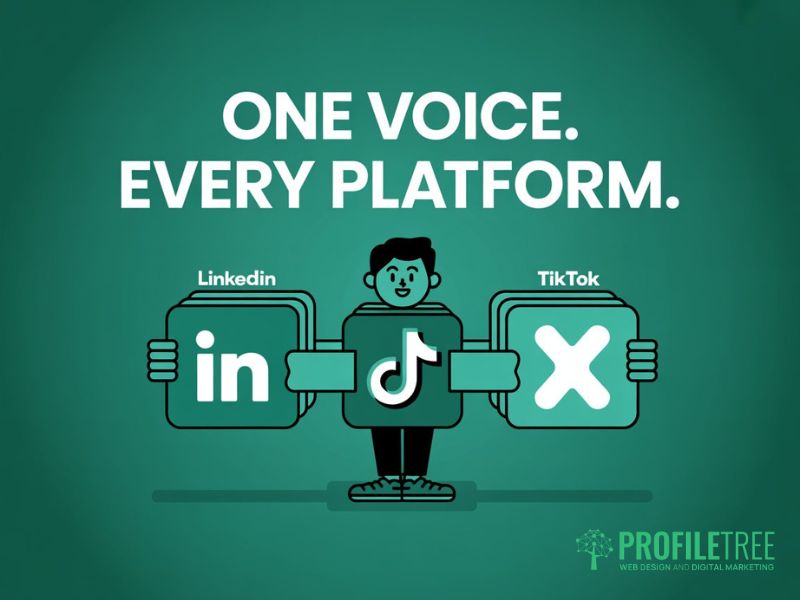
The biggest challenge in managing a social media voice is keeping it consistent when each platform demands something different. LinkedIn content would die on TikTok, and vice versa. The answer isn’t separate voices; it’s understanding how far you can stretch your tone of voice before it stops sounding like your brand.
Think of it as a rubber band: your brand voice is the centre, and every platform pulls in a different direction. Stretch too far, and it snaps. Knowing that the snap point matters more than knowing what format to post in.
“The brands that handle this best think about platform tone before they think about content format,” says Ciaran Connolly, founder of ProfileTree, a Belfast-based digital marketing agency. “Most teams do it the other way round: they decide what they’re posting and then try to match the platform. You need to know how your social media voice adapts on each channel before you start creating.”
LinkedIn: The Professional Authority
Finding your voice on social media often starts with LinkedIn, where audiences expect substantive content rather than polished marketing. Posts that perform here share a genuine point of view backed by experience. Your social media voice on LinkedIn should be authoritative but never stuffy; first-person observations and honest assessments outperform bland updates.
Monzo’s LinkedIn content is a useful reference point. They share internal thinking and honest reflections on what worked and what didn’t. It’s the same brand that appears on TikTok, but the social media tone is more considered, and the sentences are longer. The professionalism is structural, not a personality transplant.
TikTok and Instagram Reels: The Entertaining Disruptor
Short-form video platforms reward speed, specificity, and a willingness to look human. Your voice here can be more relaxed without abandoning brand values. The stretch is in delivery, not in what you fundamentally believe.
Ryanair’s TikTok account is widely studied for good reason. Their voice elsewhere is transaction-focused. On TikTok, they’re self-deprecating and willing to be the butt of the joke. It works because the underlying attitude (we’re a budget airline, we know it) is consistent with everything else they communicate. They’re leaning into one aspect of their brand personality, not pretending to be something different.
For most SMEs, the equivalent is showing the people behind the business rather than the polished product. A 45-second video of a team member explaining something they know well, without a script, will usually outperform a produced brand video. Finding your voice here means committing to looking real; the social media tone that lands best on short-form video is direct, specific, and a little unguarded.
X (Twitter) and Threads: The Real-Time Conversationalist
These platforms reward opinions and speed. Your voice here should be direct. Long-form explanations rarely work; a useful fact or a genuinely funny observation in under 200 characters will do more for brand recognition than a carefully crafted thread.
The key is having a point of view. Your voice on social media platforms built for conversation has to stand for something, even if that something is just a clear professional opinion. Brands that try to be neutral on everything become invisible. You don’t need to be controversial; you need to be specific. “We think X is worth paying attention to because Y” is a voice. “We’re excited to explore all the opportunities” is not.
For businesses that want structured guidance on how to manage voice consistently across all channels, ProfileTree’s social media marketing services cover strategy, content production, and channel management for SMEs across Northern Ireland and beyond.
How to Define Your Social Media Voice: A 4-Step Framework
Saying “we want to sound friendly and professional” is not a voice definition. It’s what every brand says. A usable voice definition is specific enough that a new team member can produce content that sounds recognisably like you.
Step 1: The Audience Audit
Before defining your social media voice, document who you’re speaking to. This is a language exercise. Look at comments, customer emails, and how your best customers describe their problems. The phrases they naturally use should shape how you communicate.
Practically, review three to five months of social comments and recent reviews, noting recurring words. If your customers consistently describe their problem as “wasting hours” rather than “inefficiency”, your voice should speak to the hours, not the efficiency. This is how you build a voice that sounds like it understands the audience, rather than one that sounds like it studied them.
Understanding your audience is foundational to effective digital strategy development; it shapes every content decision you make.
Step 2: The Three-Word Personality Test
Choose three adjectives that describe your brand personality. The constraint matters. If you give yourself ten words, you end up with a list of things every brand wants to be (helpful, trustworthy, professional) and no actual character. The goal is a brand personality specific enough to produce a recognisable social voice: one that a new team member could read and immediately understand.
Three words force you to prioritise. A financial services firm might land on: measured, direct, sceptical. A coffee shop: local, unhurried, opinionated. A B2B software company: precise, patient, real.
Each word should pass two tests. First, it should be specific enough that its opposite is plausible: if you choose “direct”, the alternative would be “evasive” or “verbose”. Generic choices like “friendly” fail because their opposites aren’t realistic brand options. Second, each word should change how you write a sentence. If your word is “sceptical”, you’d challenge a claim rather than repeat it.
Step 3: Building the Voice Chart
A voice chart translates your brand personality words into practical writing guidance. Four columns: the characteristic, a brief description, what it looks like, and what to avoid. It turns a brand principle into something a copywriter can actually use.
| Characteristic | Description | Do | Don’t |
|---|---|---|---|
| Direct | Say the thing; don’t build up to it | “This approach works. Here’s why.” | “It’s important to consider the various aspects of…” |
| Dry | Let understatement do the work | “Not our finest hour. We’ve fixed it.” | “We’re so sorry for any inconvenience caused!” |
| Opinionated | Take a position; don’t hedge | “Most social media advice ignores this.” | “There are many perspectives on this topic.” |
Teams building their voice framework will find ProfileTree’s digital training programmes cover the strategic and practical sides of brand communication for in-house teams.
Step 4: The Cringe Audit
Before publishing, read the content back as if you were a sceptical member of your target audience. The cringe audit is a five-point check:
- Does it sound like someone trying to be relatable rather than actually being relatable?
- Does it use a trend or phrase that you would never say in person?
- Does it lean on vague enthusiasm rather than a specific point?
- Would a competitor swap their name in and still make it work? (If yes, it’s too generic.)
- Does it read like something written by a committee rather than a person?
If one or more answers are yes, the content isn’t ready. This audit is quick and catches errors that no grammar tool will find.
AI-Proofing Your Voice: Keeping Human Connection in the Feed
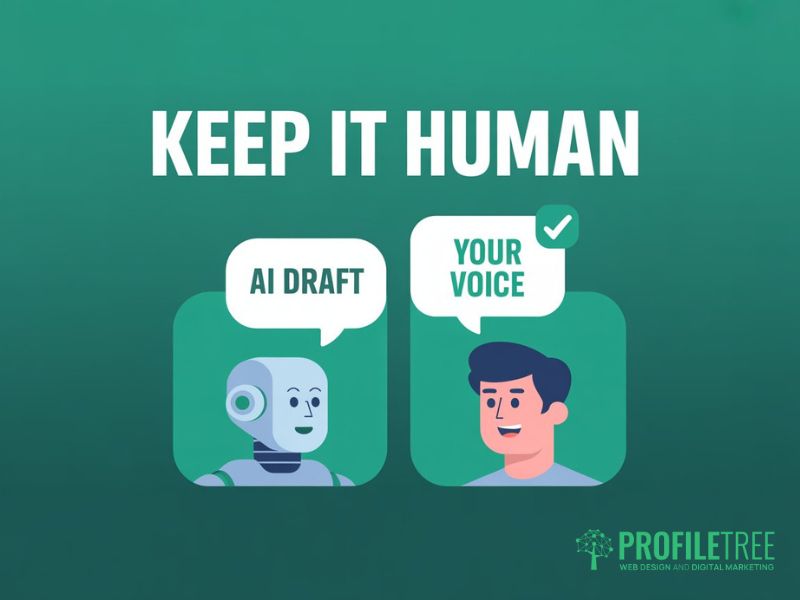
Most marketing teams now use AI tools to produce social content, and this creates a real risk to their social media voice. These models default to the most common patterns in their training data, drawn from millions of pieces of generic brand communication. Without clear guidance, AI-generated posts sound like every brand at once: enthusiastic, breathless, and impossible to attribute to anyone.
The solution is to write style guidelines specific enough that an AI tool can follow them. This is not about adding “write in a friendly tone of voice” to a prompt. It’s about documenting your social media voice precisely enough that the output is recognisable as yours, and that means finding your voice first, then codifying it.
Writing Effective Voice Guidelines for AI Tools
An effective AI voice brief has four parts: a short description of your brand voice (three sentences on who you are, what you believe, and how you sound); your three-word brand personality list with one-sentence explanations; a list of phrases to avoid; and two to four example posts that show your voice at its best.
The example posts are the most important part. AI tools are pattern-matchers; given a clear example, they replicate structure and cadence far more accurately than they can from abstract descriptions.
Avoid telling AI tools to “sound human” or “avoid AI writing”. These instructions describe the problem rather than the solution. Give the tool specific constraints instead: no exclamation marks in the first sentence, never open with “We’re excited”, always include a specific fact. Constraints produce better outputs than aspirations.
If your team is still building confidence in how to use AI tools effectively for marketing, ProfileTree’s AI training for businesses provides practical, hands-on guidance tailored to SMEs across Northern Ireland and Ireland.
Sector-Specific Challenges: Voice in Regulated Industries
Regulated industries face a specific tension when building a social media voice: compliance requirements push their brand voice towards language that is dry, passive, and forgettable. Legal, financial, and healthcare brands in the UK operate under FCA, SRA, and CQC guidance, none of which were written with social media in mind.
The answer is to separate what you say from how you say it. The factual content of a financial services post might be constrained; the social media tone you use to frame it is not. A defined brand personality helps regulated brands hold a consistent character without causing compliance issues. How you introduce a disclaimer and whether it reads like a human wrote it are within your control.
Healthcare brands often default to clinical language when their audience wants to feel understood. “We provide full, patient-centred care across all service lines” and “We know waiting for results is hard” are both compliant. One sounds like a person.
Measuring the Return on a Strong Brand Voice
A distinctive brand voice is not purely a creative concern. Kantar BrandZ 2024 research links highly distinctive brand identities to above-average long-term value creation. Nielsen data consistently shows brand recall is higher for brands with a consistent communication style.
The metrics that correlate with a well-defined social media voice are comment rate, share rate, and the ratio of new to returning engagers. Fifty likes and no comments mean you’ve reached people. Twenty likes and fifteen comments mean you’ve connected.
Practically, measure social voice effectiveness by tracking comment sentiment and whether your tone descriptors appear in unsolicited comments. If your three words are “direct, dry, opinionated” and followers call your content “refreshing”, your voice is landing. If the feedback is “informative”, you’re producing useful content without a distinctive social media voice. Finding your voice and measuring whether it’s working are two sides of the same process; the tone of voice signals in your comments section are the most honest data you have.
ProfileTree’s content marketing services help businesses develop and maintain a consistent brand voice across blog, social, and email, with content strategy grounded in real performance data.
FAQs
1. What is the difference between brand voice and tone?
Brand voice is your fixed personality: the consistent character your brand expresses across all communications. Your social media tone is how that character adapts by platform and situation. Voice doesn’t change; tone shifts with context.
2. How do I find my social media voice?
Start with the four-step framework above: audit your audience language, choose three brand personality adjectives, build a do/don’t voice chart, and run a cringe audit on your existing content. The clearest signal of your authentic social voice is usually in your best-performing posts; look at what those have in common and codify it.
3. Should my voice be different on TikTok versus LinkedIn?
Your voice on social media stays consistent across platforms; your social media tone adapts. The brand personality and core character remain the same. Think of the same person at a conference versus a team lunch: recognisably the same social voice, tonally very different.
4. What are some strong social media voice examples from the UK?
Innocent Drinks built an entire brand identity on a warm, self-aware social voice, which makes them a useful model for finding your voice on social media without sounding forced. Monzo’s tone of voice stays consistent whether they’re announcing a feature or handling a complaint. Ryanair’s social media voice has become one of the most studied brand strategies in European aviation, and in each case, the brand personality is specific, and the social voice is clearly distinct from competitors.
5. How do I explain my brand voice to an AI writing tool?
Give the tool specific constraints rather than abstract descriptions. Include your three brand personality words with one-sentence explanations, a list of phrases to avoid, and two to four example posts. AI tools match patterns far more accurately than they interpret intentions.