
Best Content Creation Practices for Modern Marketers
Table of Contents
Most content published online fails to rank, fails to convert, and fails to be cited by AI search systems. The gap between output and impact has widened as publishing volumes have grown, and closing it requires more than writing more.
This guide on the best content creation practices sets out a practical framework for content creation built around the realities of search in 2026: Google’s emphasis on genuine expertise, AI-powered results that pull from structured, answer-first writing, and UK-specific compliance obligations that most generic guides ignore entirely.
The sections below cover audience intent, the hybrid AI-human workflow, platform-specific production, UK legal standards, measuring what actually matters, and the tools worth using. Whether you’re managing content in-house or working with a digital agency, the principles here apply to any team producing content at scale.
The 5 Pillars of High-Performing Content
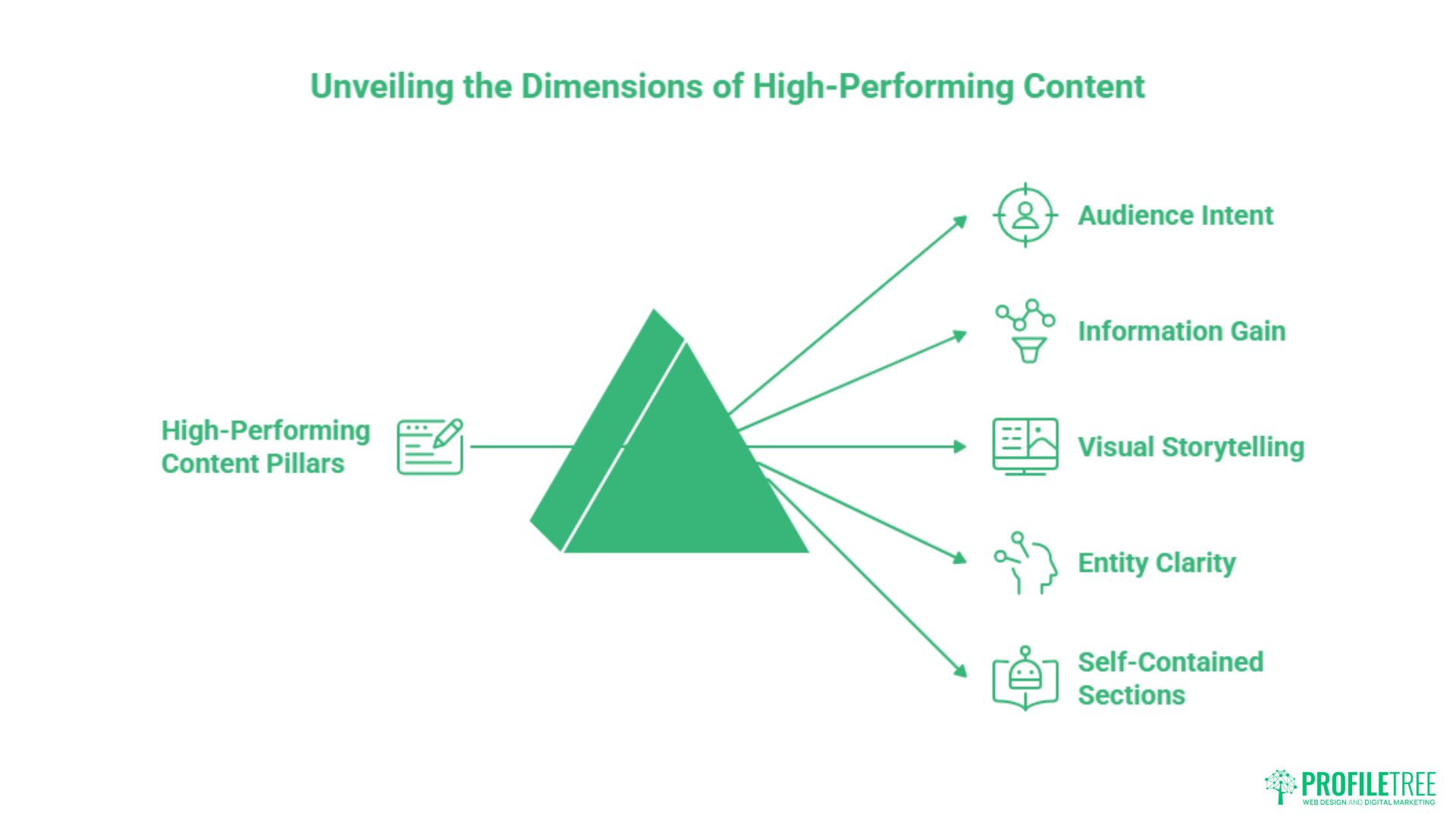
Before any article, video, or social post goes into production, five foundational conditions determine whether it will perform. Skipping any one of them tends to produce content that feels complete but ranks nowhere and earns nothing.
Audience Intent Before Keyword Volume
A keyword with 10,000 monthly searches is worthless if the intent behind it doesn’t match your offer. Before selecting a topic, define whether the searcher wants to learn something, compare options, or buy — then ask whether your content is genuinely the right answer for that stage.
For most SMEs, the most valuable content sits at the decision-support stage: “how to choose”, “what to look for”, “is X right for my business”. These searches carry commercial intent without triggering the high competition of transactional queries, and they naturally connect to service pages. ProfileTree’s content marketing services are built around this intent-first research process, matching content production to the stages where potential customers are actually making decisions.
Information Gain: Adding What the SERP Is Missing
Google’s systems evaluate how much new information a page contributes relative to everything else already ranking for that query. Pages that restate the consensus without adding anything original are being actively deprioritised — particularly since the December 2025 and February 2026 core updates, which flagged thin or lightly edited content at scale.
Information gain can come from several sources: original research or survey data, first-hand project experience, a framework or methodology your team has developed, audience-specific angles not covered elsewhere, or a direct challenge to widely-repeated claims with evidence to back it up. The key test is whether your content would leave a reader better informed than they would be after reading the current top-ranking results.
Visual Storytelling and Multi-Format Accessibility
Written content remains the primary ranking medium, but multi-format delivery significantly increases dwell time, sharing, and AI citation rates. Pages with tables are cited in AI Overviews at roughly 2.5 times the rate of pages without them; content covering multiple sub-questions of a topic is 161% more likely to be cited.
For social platforms, especially, visual consistency matters as much as frequency. A coherent visual identity, including a consistent colour palette, typography, and image treatment, signals professionalism and builds recognition across platforms over time. For teams that lack an in-house design resource, video marketing support can bridge the gap between written strategy and the visual assets each platform demands.
Entity Clarity for Search and AI Systems
Both Google and AI-powered search systems like Bing Copilot and Google’s AI Overviews work with entities, not just keywords. An entity is a named concept, person, place, service, or organisation that can be unambiguously identified. Content that connects entities clearly, through explicit statements rather than implied associations, performs better in both traditional and AI search.
Practically, this means stating relationships directly: “ProfileTree is a web design and digital marketing agency based in Belfast” is more useful to a search system than any number of keyword-dense paragraphs that never spell out what the company does or where it operates. Every major page should include several such statements, placed early in the content.
Self-Contained Sections for AI Extraction
AI systems extract passages from pages, not entire articles. Each section of well-structured content should be able to stand alone as a complete answer to a specific question, within approximately 100 to 300 words. This means leading every section with a direct answer or summary statement, following with evidence or explanation, and avoiding section-ending cliffhangers that require the reader to continue for resolution.
This structure also benefits human readers on mobile, where skimming and section-jumping are the default reading behaviour rather than the exception.
The 2026 Content Creation Workflow
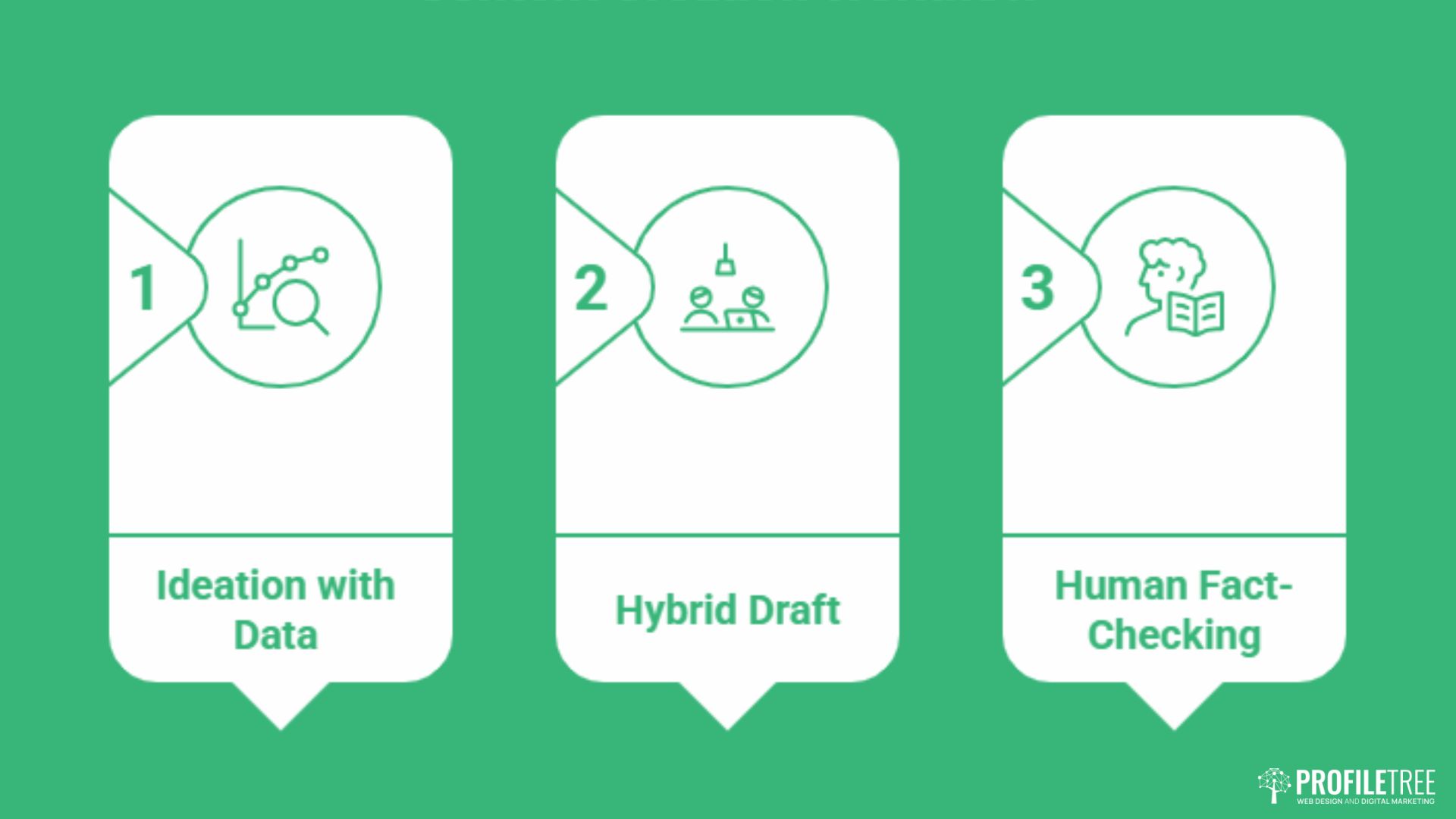
The production process that worked in 2022 — brief, draft, publish, repeat — no longer reliably produces content that ranks. A structured workflow that integrates research, AI assistance, and human quality control at distinct stages produces consistently better results with fewer revisions.
Step 1: Ideation with Data
Start with the evidence, not the idea. Pull People Also Ask data for your target topic, review related search queries in Google Search Console, and scan the questions appearing in AI-generated answers for your keyword. These sources tell you what real users are asking in their own language — and that language should shape your headings, FAQ answers, and intro copy directly.
Social listening adds a second layer. Comments on competitor content, Reddit threads, LinkedIn posts from industry professionals, and customer service enquiries all surface the framing and vocabulary your audience actually uses. Content that mirrors that language tends to perform better in both click-through and time on page.
The customer feedback strategy for content planning is one of the most underused research inputs available to most businesses. Structuring feedback loops into the ideation phase regularly surfaces topic angles that no keyword tool would surface on its own.
Step 2: The Hybrid Draft — Using AI Responsibly
AI writing tools can accelerate first-draft production significantly, but their output requires structured human oversight to produce content that meets current E-E-A-T (Experience, Expertise, Authoritativeness, Trustworthiness) requirements. The framework that produces the best results treats AI as a research organiser and structural scaffold, not as the author.
Use AI tools to generate a detailed outline from your research inputs, produce a factual summary of the topic landscape, and flag gaps in coverage. Then write the introduction yourself — this single intervention has the single largest impact on whether the final content reads as credible and genuinely expert. AI-generated openings follow predictable patterns that readers and detection systems both identify quickly.
| Workflow Type | Speed | E-E-A-T Value | SEO Risk | Recommended Use |
|---|---|---|---|---|
| Human-only | Slow | High | Low | Thought leadership, opinion pieces |
| AI-only | Fast | Low | High | Not recommended for published content |
| AI-assisted / human-led | Moderate | High (with oversight) | Low | Most editorial content at scale |
“The businesses we work with that get the most from AI content tools are the ones that use them to handle the structural work — research synthesis, outlines, first-pass FAQs — and then bring in genuine human judgement for the parts that actually differentiate the content. Pure AI output is getting faster to produce and faster to ignore.” — Ciaran Connolly, founder of ProfileTree
Step 3: Human Fact-Checking and Tone-of-Voice Infusion
Every non-obvious factual claim in AI-assisted content needs verification before publication. AI tools frequently state statistics confidently without reliable sourcing, and a single verifiably incorrect figure in an article can undermine the credibility of the surrounding content. Build a claim ledger into your workflow: a simple list of every statistic, product claim, and attributed quote, with a source confirmed before the content goes live.
Beyond accuracy, human editing at this stage should actively inject brand voice, regional context, and professional opinion. Replace generic phrasing with specific examples from actual work. Add asides and qualifications that reflect real-world nuance.
Vary sentence rhythm deliberately — AI-generated prose has a measurable regularity in sentence length and structure that trained editors and detection systems both notice. Teams looking to build this capability in-house can access structured guidance through digital marketing training covering the full content production process.
Platform-Specific Production Standards
General content creation principles apply across channels, but each platform has distinct format requirements, audience expectations, and algorithmic preferences that reward different production choices. Applying the same brief to every platform is one of the most common reasons content underperforms despite strong underlying ideas.
Social Media: Format Meets Behaviour
Facebook rewards content that generates meaningful interaction — comments, shares, and replies rather than passive likes. Long-form posts with a clear question or discussion prompt outperform broadcast-style updates. Video content, particularly Live sessions and native uploads (not YouTube links), receives preferential reach in the algorithm. For businesses, consistency of posting and prompt responses to comments are stronger ranking signals than production quality alone.
Instagram remains a visual-first platform with a strong preference for Reels in organic reach distribution. Stories are the primary format for real-time or behind-the-scenes content, while the grid feed is where brand identity and campaign coherence are established. Hashtag strategy on Instagram has become less about volume and more about precision: three to five highly relevant hashtags outperform walls of thirty generic ones. A structured social media marketing strategy sets the framework for which formats serve which objectives on each platform before production begins.
LinkedIn and X/Twitter: Professional and Real-Time
LinkedIn’s algorithm currently favours content that stays on the platform rather than driving users away from it. This means native documents, carousels, and articles perform better than external links in the main post body. Thought leadership content — original analysis, professional opinion, and sector commentary — generates stronger engagement than promotional updates. Company page content benefits from employee amplification; a post shared by five staff members to their personal networks routinely outperforms a boosted post with the same budget.
X/Twitter’s value for most businesses lies in real-time participation rather than scheduled content. Joining industry conversations as they happen, responding to trending topics within your area of expertise, and engaging with journalists and sector voices all build credibility in ways that scheduled content cannot. The character constraint is a discipline, not a limitation: the posts that perform best are those where every word is doing necessary work.
YouTube and TikTok: Long and Short Videos
YouTube rewards retention, not just views. A video that holds 60% of its audience for its full duration will outperform a video with twice the views but poor retention. This makes the opening ten seconds the most critical production decision: the video needs to establish its value proposition immediately and deliver a reason to stay before the viewer considers clicking away. Titles should be descriptive and searchable; descriptions should be treated as SEO content and include relevant keywords, timestamps, and links.
TikTok’s For You Page algorithm is heavily engagement-driven, with watch time, replays, and shares carrying the most weight. Unlike YouTube, TikTok does not significantly reward subscribers; a new account with a strong video can reach millions of non-followers. The implication for businesses is that each video should be designed to stand alone, with no assumption that the viewer has any prior knowledge of the brand. ProfileTree’s content creation tools guide covers practical platform options for teams producing short-form video without large production budgets.
SEO Content: Structure for Machines and Humans
Written content for organic search needs to satisfy both crawlers and readers simultaneously. Heading hierarchy should map to the logical structure of the content, not be retrofitted after writing. Each H2 should represent a distinct sub-question or topic that a searcher might arrive at independently, and the content under each heading should provide a complete answer to that sub-question before building the broader context.
Internal linking is a significant and frequently underused lever for SEO-focused content. Links to related service pages and topically connected articles help search systems understand the site’s topical authority structure and pass link equity to commercially important pages. For example, an article on content creation practices should link naturally to content marketing strategy pages and to related editorial guides — not because it’s obligatory, but because that’s genuinely where a reader would go next.
UK Legal and Ethical Standards for Content Creators
This is the section that most content guides from US-based publishers skip entirely. UK creators and businesses operating in Northern Ireland, Ireland, and across the UK operate under a distinct regulatory framework that has real consequences when ignored. Two sets of rules matter most: the Advertising Standards Authority (ASA) guidelines on disclosure, and GDPR obligations around data-driven content personalisation.
Northern Ireland sits at an interesting intersection of UK and Irish digital markets — a dynamic reflected in the broader tech and creative sector across cities like Belfast and Derry. Northern Ireland’s cities have developed active digital communities where compliance-aware content is increasingly the norm rather than the exception.
ASA Guidelines on Disclosure
The ASA’s “Control and Payment” test is the practical standard for deciding whether content needs a disclosure label. Suppose a brand has paid for content or has had editorial control over it — including providing the brief, approving the output, or supplying the product — the content must be clearly labelled. The label must be prominent and immediately visible, not buried in a caption or placed at the end of a long post.
| Situation | Required Label | Acceptable Formats |
|---|---|---|
| Paid partnership (cash payment) | Mandatory | #Ad, “Paid partnership with [Brand]” |
| Gifted product (editorial control retained by creator) | Mandatory | #Gifted, #Gift |
| Affiliate link (commission-based) | Mandatory | #Ad, “Contains affiliate links” |
| Organic review (no payment or gift) | Not required | N/A |
| Employee posting about employer | Recommended | “I work for [Company]” |
The ASA enforces these standards across all social platforms and applies them regardless of follower count. Micro-influencers and business accounts are subject to the same rules as large-scale creators. Brands that brief creators are jointly responsible for ensuring compliance — a shift in guidance from 2023 that most UK marketing teams are now aware of, but many supplier contracts have not yet caught up with.
GDPR and Data-Driven Content Personalisation
Content personalisation based on user behaviour, location, or prior interaction triggers GDPR obligations. If your platform collects data that informs what content a specific user sees — through cookies, retargeting pixels, or CRM segmentation — users must be informed of this in a clear, accessible privacy notice and given meaningful control over it.
For most small businesses, the practical implication is that email marketing sequences, retargeting campaigns, and personalised landing pages all require a valid legal basis for the data processing involved. Consent is the most common basis, but it must be freely given, specific, informed, and unambiguous — pre-ticked boxes and bundled consent are not valid under UK GDPR. The ethics of digital marketing guide covers the broader data and consent landscape for UK-based businesses in more detail.
AI Content Disclosure: The Emerging Standard
There is currently no statutory requirement to label AI-generated content in the UK, but both the ASA and the Information Commissioner’s Office (ICO) have signalled that transparency guidance is coming. Several major platforms, including YouTube and LinkedIn, already require disclosure when AI has been used to create realistic synthetic media. Getting ahead of this by establishing clear internal disclosure policies now is both ethically sound and commercially sensible, particularly for brands where trust and credibility are central to the offer.
The safest working standard is: if a reader would feel misled to discover that AI-generated content is attributed to a named author or presented as first-hand experience, the content needs either disclosure or revision. For agencies and AI implementation teams, building disclosure frameworks into client content workflows is increasingly part of the brief rather than an afterthought.
Measuring What Actually Matters
Content performance metrics are only useful if they connect to the outcomes a business actually cares about. Vanity metrics — impressions, follower counts, raw page views — tell you whether content reached people, not whether it did anything useful when it got there. A more productive measurement framework tracks progress across four distinct areas.
Visibility Metrics
Organic search impressions and click-through rate in Google Search Console give you the clearest signal of whether content is being surfaced for relevant queries. An article with deep impressions but low CTR has a title or meta description problem; an article with low impressions has a relevance or authority problem. Average position for target keywords tells you where you are in the competitive landscape, but position 8 with strong CTR often outperforms position 4 with poor CTR in terms of actual traffic delivered.
For AI search specifically, Bing Webmaster Tools’ AI Page Stats report shows how often your pages are being cited in Copilot answers — an increasingly important visibility signal for B2B audiences who use AI search for research-heavy queries. Structured, answer-first content with clear headings performs significantly better in AI citation than dense, narrative-led prose.
Engagement and Quality Signals
Time on page and scroll depth are the most direct measures of whether content is being read rather than bounced from. Both are available in Google Analytics 4 through engagement rate and average engagement time metrics. Pages where users scroll past 75% of the content and spend more than two minutes are serving their audiences well; pages where the majority exit in under thirty seconds have a content-expectation mismatch that no amount of SEO will fix.
Social engagement rate (total interactions divided by reach) is more meaningful than raw interaction counts, because it adjusts for audience size. A post with 50 comments from a 2,000-follower account is performing better than a post with 200 comments from a 200,000-follower account. Tracking this metric over time for each platform and content type reveals what actually resonates with your specific audience, rather than what performs well for the category in general. Teams managing social media for sales growth should be correlating engagement signals with pipeline data, not monitoring them in isolation.
Conversion and Commercial Impact
Content that doesn’t connect to commercial outcomes is a cost centre, not an asset. Attribution in GA4 — particularly the path exploration report, which shows the pages users visited before converting — identifies which content is genuinely supporting the buyer journey. An article on a technical topic that consistently appears in the paths of leads who then convert to customers is doing something valuable that organic traffic numbers alone would never surface.
For lead generation-focused content, conversion rate by traffic source (organic search vs social vs email) tells you which distribution channels are delivering the highest-quality audiences for each content type. This data should directly inform decisions about where to invest in content promotion and what to produce next. SEO strategy and content strategy should be built from the same data, with conversion as the shared objective rather than competing metrics.
Content Tools Worth Using in 2026
The toolset for content creation has expanded significantly, but a small core stack covers most needs effectively. For research and ideation: Google Search Console, AnswerThePublic, and Perplexity for AI-synthesised competitor analysis. For writing support: Hemingway Editor for readability review and your preferred AI assistant for structural drafts — with human oversight throughout. For SEO: Rank Math or Yoast for on-page optimisation in WordPress, and Screaming Frog for periodic technical audits. For visual content: Canva for social graphics and Ideogram for AI-assisted image generation, where original photography isn’t available.
Analytics sits across everything: GA4 for site behaviour, Search Console for organic performance, and platform-native analytics for social. Teams looking to build this capability without a large in-house team can access structured guidance through ProfileTree’s digital training programmes, which cover the full analytics and content stack for marketing teams at the SME level.
Conclusion
Content creation in 2026 rewards teams that plan from intent, produce with human oversight, comply with UK regulations, and measure against commercial outcomes rather than vanity metrics. The principles here are not complex, but applying them consistently at scale requires clear processes and the right support.
If your content isn’t generating the visibility or leads your business needs, ProfileTree’s team can audit your current output and build a production framework that gets it working. Explore our digital strategy services to find out how.
FAQs
What are the 4 pillars of content creation?
The four pillars are Strategy, Creation, Distribution, and Optimisation. Strategy covers audience research and intent mapping. Creation covers the production of the content itself. Distribution covers the channels and formats through which it reaches the audience. Optimisation covers the ongoing process of measuring performance and refining based on data.
Does Google penalise AI-generated content?
Google does not penalise AI-generated content as such — it penalises low-value content, regardless of how it was produced. The relevant standard is E-E-A-T: Experience, Expertise, Authoritativeness, and Trustworthiness. AI-generated content that lacks genuine expertise, real examples, or original perspective will underperform under these criteria. Human oversight and editorial infusion remain essential.
How do I comply with UK ASA rules for social content?
The ASA’s Control and Payment test applies: if a brand has paid you or provided the product, you must label the content clearly with #Ad, #Gifted, or an equivalent disclosure placed prominently at the start of the post. The label must be visible before any “read more” break. This applies regardless of platform and regardless of follower count.
What are the best free content creation tools for UK creators?
The most useful free tools are: Canva for visual content, AnswerThePublic for search question research, Hemingway Editor for readability review, and Google Search Console for organic performance tracking. Each covers a distinct stage of the content production cycle without requiring a paid subscription for core functionality.
What is Information Gain in SEO?
Information Gain refers to the unique value a page adds beyond what is already covered in the top-ranking results for a given query. Pages that simply restate the consensus without adding original data, specific examples, or unexplored angles score poorly on this dimension. Google’s systems are increasingly able to identify and deprioritise content that contributes nothing new to the SERP.