
Authenticity on Social Media: Why It Matters for Your Brand
Table of Contents
Authenticity on social media means sharing honest, consistent, and human content that reflects your real values rather than a curated performance. Brands and individuals who show up genuinely build more loyal audiences, earn higher engagement rates, and convert followers into customers far more reliably than those projecting a polished but hollow image. For SMEs, it is one of the highest-return social media practices available.
Most social feeds are performances. Polished photos, rehearsed captions, engagement bait dressed up as opinion. And the audiences watching have noticed. Trust in brands on social media has been falling steadily, and the platforms most rewarding real, unfiltered content, including TikTok, Instagram Reels, and LinkedIn, are sending a clear signal about what works now.
“Audiences are sharper than most brands give them credit for,” says Ciaran Connolly, founder of digital agency ProfileTree. “They can tell the difference between a brand that genuinely shares its perspective and one that’s running a content checklist. The businesses we see building real traction on social media are the ones willing to show the work, the thinking, and occasionally the mistakes.”
This guide sets out what authenticity on social media actually looks like in practice, why it works, and how to build it without abandoning professionalism or strategy. The focus throughout is practical: what you can change in your own content this week, not abstract principles about “finding your voice.”
What Authenticity on Social Media Actually Means
Authenticity on social media is not the same as informality. It does not mean posting without thought, being unfiltered to the point of unprofessionalism, or abandoning your brand standards. What it means is consistency between who you say you are and what your content actually shows.
A business can be highly polished and still be authentic. A solo creator can be rough and unedited and still be performing. The distinction is whether the content reflects real values, real knowledge, and real personality, or whether it is engineered purely to game reach metrics.
The Three Pillars of Authentic Social Content
Three qualities consistently separate authentic accounts from inauthentic ones, regardless of platform or industry.
- Consistency over time. Authentic accounts have a recognisable perspective. The tone, values, and content focus stay broadly stable across weeks and months, even as individual posts vary. Accounts that shift entirely based on whatever is trending read as untrustworthy because they clearly have no real centre.
- Visible humanity. This applies to businesses as much as to individuals. Behind-the-scenes content, honest reflections on what is and is not working, team members with names and faces rather than a faceless corporate voice, mistakes acknowledged rather than quietly deleted. Audiences engage with people, not brand identities alone.
- Genuine expertise or perspective. Authentic content has a point of view. It says something. The accounts with real authority on social media are the ones willing to take a position, share a specific insight from their own experience, or explain why they think the prevailing advice is wrong. Generic tips and recycled information add nothing to a feed already full of generic tips and recycled information.
What Authenticity Is Not
A few common misunderstandings are worth naming directly. Authenticity is not the same as oversharing. Sharing personal struggles or business difficulties can build connection, but only when it serves the audience and is proportionate to the context. Authenticity is not a licence to be unstrategic. The most effective authentic accounts think carefully about what they share and why. And authenticity is not a shortcut. Building a genuine audience on social media takes time; it is not a viral hack.
Why Authenticity Matters for Businesses and Brands
The case for authenticity is not purely philosophical. There are measurable commercial reasons why it performs better than polished inauthenticity, particularly for SMEs operating without the budget of large consumer brands.
It Builds the Trust That Drives Purchases
Purchase decisions are increasingly influenced by how a brand presents itself on social media before any direct contact. A business whose social presence feels genuine, consistent, and honest signals trustworthiness in a way that a perfectly curated but impersonal feed does not.
Sprout Social’s research on brand authenticity consistently finds that consumers are more likely to buy from, recommend, and remain loyal to brands they consider genuine. The mechanism is straightforward: trust lowers the psychological cost of buying. When someone already feels they know and believe a brand, the conversion step is shorter.
For service businesses in particular, where the buying decision involves significant trust in the provider, this matters enormously. A Belfast accountancy firm, a Northern Ireland solicitor, and a digital agency are all businesses where a prospective client’s confidence in the people behind the brand is part of the evaluation. Social content that shows real thinking from real people contributes to that confidence in a way that stock imagery and promotional copy simply do not.
It Drives Better Engagement Signals
Platform algorithms on Instagram, LinkedIn, TikTok, and Facebook all reward content that generates genuine engagement: saves, shares, meaningful comments, and direct messages. Authentic content, which provokes real reactions because it says something real, tends to outperform polished but generic content on every one of these signals.
This creates a compounding effect. Higher engagement signals push content to more people. More people see content that resonates genuinely. More of those people follow or engage further. The accounts growing fastest on most platforms right now are not the ones with the biggest production budgets; they are the ones saying the most specific, honest things to the most specific audiences.
A well-structured social media marketing strategy combines this authentic voice with consistent scheduling, platform-specific formatting, and a clear picture of who the target audience is. Authenticity without strategy tends to burn out; strategy without authenticity tends to plateau.
It Protects Long-Term Brand Reputation
Inauthentic brand behaviour on social media gets called out. Whether it is a business promoting values it visibly does not hold internally, a brand jumping on a trend with no genuine connection to it, or content clearly written by AI and published without editorial judgment, audiences notice and respond.
The Edelman Trust Barometer tracks this pattern across industries and years: trust, once lost through perceived inauthenticity, takes far longer to rebuild than it took to lose. Authentic accounts, by contrast, tend to attract an audience predisposed to give the benefit of the doubt when things go wrong, because they have already built genuine goodwill.
How to Build an Authentic Social Media Presence
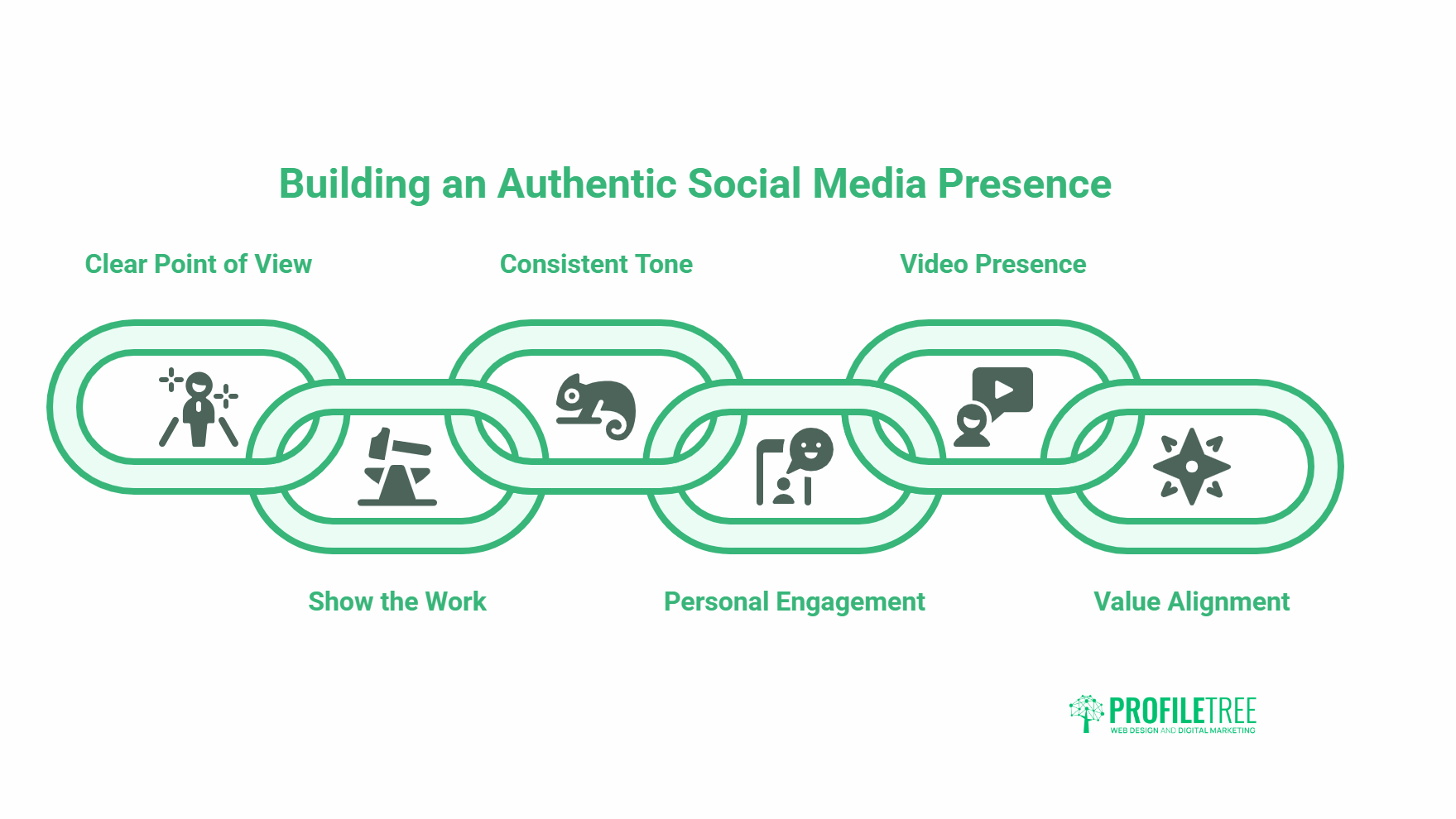
The practical question is how to actually do this, not just in theory but in a content workflow that is sustainable alongside running a business. These approaches work across B2B and B2C contexts and apply whether you are managing social in-house or working with an agency.
Start with a Clear Point of View
The single most important step is deciding what your brand actually thinks about the topics in your industry. Not what is safe or consensus-approved, but what your actual experience has shown you. What do you disagree with that most others in your sector seem to accept? What do you think your clients consistently get wrong before they work with you? What would you tell a new entrant to your industry that no one told you?
These are the starting points for content with a genuine perspective. Write them down. Not as ready-to-publish posts, but as a reference point for the kind of thinking that should run through your content, whether that is a LinkedIn article, a 30-second video, or a longer thought leadership piece.
Show the Work, Not Just the Result
The most consistently high-performing business content on social media is process content. Not “look what we achieved” but “here is how we approached a problem and what we learned.” Before-and-after. Decision-making explained. A project that did not go as planned, and what changed as a result.
This kind of content works because it demonstrates expertise in a format audiences can actually evaluate. Anyone can claim a result. Showing the thinking and the methodology is harder to fake, more useful to the audience, and far more credible as a signal of real capability.
For businesses working on content marketing across multiple channels, this process-first approach also generates more reusable material. A detailed case study becomes several short videos, a LinkedIn post, an FAQ section, and a client-facing reference document.
Be Consistent in Tone Across Platforms
Authenticity does not mean being identical on every platform; the format, length, and content emphasis should adapt to where you are. But the core voice, the values, and the basic personality should be recognisably the same whether someone finds you on LinkedIn, Instagram, or TikTok.
Inconsistency in tone is one of the quickest ways to erode trust. If a brand is warm and self-deprecating on Instagram but corporate and stiff on LinkedIn, audiences reading both will notice the performance. The platforms may require different content styles, but they do not require different personalities.
Respond to Comments and Messages Like a Person
Engagement is part of authenticity. Responding to comments with templated phrases, ignoring direct messages, or only engaging when the conversation is positive signals that the account is a broadcast channel rather than a presence with a genuine interest in its audience.
Practical commitment: set aside 15 to 20 minutes each day to respond to comments and messages personally. This is not scalable indefinitely as an account grows, but at the stages most SMEs operate at, personal responses are one of the highest-return activities on social media.
Use Video to Establish Genuine Presence
Video is the most effective format for conveying authenticity because it is the hardest to fake convincingly. A person speaking directly to the camera, explaining something from real experience, is a qualitatively different signal than a graphic with text. Even low-production video, where the content is specific and the speaker clearly knows what they are talking about, consistently outperforms high-production but generic content.
For businesses not yet using video regularly, starting with one short explainer or opinion piece per week is usually more effective than attempting a polished monthly production. Consistency and specificity matter more than production quality at most audience sizes. Video marketing can be built gradually, starting with formats and topics where the expertise is already established.
Align Content with Your Actual Business Values
Audiences increasingly evaluate brands on whether the values they project socially match how they actually behave. A business posting about sustainability that shows no evidence of sustainable practice. An agency posting about client success with no client voices in sight. A company that talks about culture but whose team never appears in content. These gaps register, consciously or not, as inauthenticity.
The practical check: read back through the last two months of your social content and ask whether someone who had never heard of your business would come away with an accurate picture of what you do, who you do it for, and what you actually stand for. If the answer is no, that gap is where to focus next.
Authenticity in the Age of AI Content
The rise of AI-generated content has made authenticity both more valuable and more pressured. Audiences are increasingly good at identifying content produced entirely by AI, and its prevalence has raised the threshold for what human, genuine content needs to achieve to stand out.
Using AI tools to assist with drafting, research, or editing is not incompatible with authentic content. What damages authenticity is publishing AI output unchanged, without editorial judgment, specific knowledge, or a real perspective added. The question is always whether the content reflects genuine thinking from real people, regardless of what tools were used in the process.
For businesses exploring AI training for their marketing teams, the most important skill is learning how to direct, edit, and add value to AI-assisted content rather than simply accepting its output. ProfileTree’s AI and digital strategy work with SMEs consistently shows that the brands using AI most effectively are the ones that treat it as a production tool rather than a replacement for thinking.
A clear digital strategy helps determine where AI genuinely assists your content process and where human expertise is irreplaceable. Trying to automate authenticity invariably produces content that has neither strategic focus nor genuine personality.
Authenticity and Social Media: A Quick Reference
| Authentic Content Signals | Inauthentic Content Signals |
|---|---|
| Specific opinions backed by experience | Generic tips with no original perspective |
| Consistent tone and values across time | Tone that shifts with every trend |
| Visible people and process behind the brand | Faceless corporate content only |
| Honest engagement with comments and questions | Broadcast-only; minimal or templated responses |
| Content that shows the work, not just the outcome | Claims without evidence or explanation |
| AI used as a tool with human editorial oversight | AI output published without judgment or editing |
How ProfileTree Helps Businesses with Social Media
Building an authentic social presence consistently is harder than it looks. Most businesses understand the principle but struggle with the execution: maintaining a regular posting schedule, developing genuine content ideas, and aligning social activity with broader commercial objectives at the same time as running everything else.
ProfileTree’s digital marketing team works with SMEs across Northern Ireland, Ireland, and the UK to build social media strategies that combine genuine brand voice with clear commercial structure. The work covers content planning, platform-specific strategy, video content, and training for in-house teams who want to manage their own presence more effectively.
For businesses at an earlier stage, digital training through ProfileTree’s Academy gives teams the practical skills to handle social media content themselves, with a clear understanding of what drives results on each platform.
Frequently Asked Questions
What does authenticity on social media mean for a business?
For a business, authenticity on social media means that the content you publish reflects your actual values, expertise, and personality rather than a performance designed to look good. It includes showing the people behind the brand, sharing genuine perspectives on your industry, and maintaining a consistent voice over time. Audiences distinguish quickly between brands that mean what they say and those going through the motions.
Why does authenticity matter more now than a few years ago?
Two factors have raised the stakes. First, AI-generated content has flooded most platforms with generic, impersonal material, which means genuinely human content stands out more than it used to. Second, audiences have become more sophisticated at identifying content that exists to game algorithms rather than to communicate something real. Trust is harder to earn and easier to lose than it was five years ago.
Can a brand be authentic and still be strategic about social media?
Yes, these are not in conflict. Authenticity means the content reflects real values and genuine knowledge; it does not mean posting without thought or planning. The most effective accounts combine a clear strategic framework with genuine voice. Strategy tells you what to focus on and when; authenticity determines how you say it.
How do you maintain authenticity when using AI for content?
Use AI as a drafting and research tool rather than as a publisher. Every piece of AI-assisted content should go through editorial judgment: adding specific knowledge, adjusting for your actual voice, removing generic phrases, and verifying any claims before publishing. Content that has been genuinely edited and improved by a person who knows the subject reads differently to raw AI output, and audiences notice the difference.
How can you tell if your social media content is coming across as authentic?
The clearest signals are in how people engage: genuine comments that respond to the specific thing you said rather than generic affirmation, direct messages from people who connected with a particular piece of content, and followers who refer to your past content when they get in touch. High reach with low meaningful engagement often signals content being seen but not believed.
Does authenticity look different on different platforms?
The format and tone adapt to each platform, but the underlying authenticity should be consistent. LinkedIn rewards professional insight and honest industry perspective. Instagram and TikTok reward visual storytelling and personality. The same brand can operate authentically across all of them by understanding what each platform’s audience values and expressing the same genuine voice in the appropriate format for each.
What is the connection between authenticity and brand trust?
Trust is built when what a brand says matches what it does, consistently over time. Authentic social media content contributes to trust because it gives audiences evidence of who the brand actually is, not just what it wants to be seen as. Audiences who trust a brand are more likely to buy, recommend, and stay loyal when things occasionally go wrong, making authenticity one of the most commercially valuable qualities an SME can develop.
Conclusion
Authenticity on social media is not a trend to adopt and move on from. It is the direction the most effective brand content is moving in, driven partly by audience sophistication and partly by the saturation of impersonal AI content across every platform. For SMEs, the opportunity is real: genuine perspective and visible expertise are differentiating at a time when most content is not.
If you want support building a social media presence that reflects your brand honestly and drives real commercial results, talk to ProfileTree’s social media marketing team.