
Prompt Engineering for Business: A Practical UK Guide
Table of Contents
Most AI projects do not fail because the technology is weak. They fail because the people using it cannot describe what they want clearly enough for the model to deliver it. That gap between human intent and machine output is exactly where prompt engineering lives.
For businesses across Northern Ireland, Ireland, and the wider UK, the skill has shifted from a developer curiosity into something marketing managers, operations leads, and business owners now use daily. The quality of your prompts shapes the quality of everything the AI gives back.
This guide walks through what prompt engineering actually is, the techniques that hold up in real work, how UK sectors apply it under their own rules, and where the skill is heading. Practical examples sit alongside the theory throughout.
What Prompt Engineering Is and How It Works
Prompt engineering is the practice of writing clear, structured instructions that guide a large language model, such as GPT-4, Gemini, or Claude, towards an accurate and useful response. Get the instruction right, and the model does most of the heavy lifting. Get it vague, and you spend longer correcting output than you saved.
The discipline sits at the meeting point of plain communication and a working knowledge of how these systems behave. You do not need to code, but you do need to think about structure. Our work on business AI prompts shows how small wording changes shift results dramatically.
The Core Elements of a Good Prompt
Every dependable prompt does a few things at once. It sets the role the model should adopt, supplies context, states the task plainly, and defines the format of the answer. Skip any one of these, and the output drifts.
Think of it as a brief you would hand a new staff member. You would not say “write something about us” and walk away. You would explain who the audience is, what tone fits, and what a finished piece looks like. The model needs the same courtesy.
A useful habit is to write the output format last and make it explicit: “respond as three bullet points, each under fifteen words”, or “return a table with two columns”. Models follow format instructions reliably, and a defined shape saves you from reformatting the answer by hand afterwards.
How the Model Reads Your Words
Language models break text into tokens and predict the most probable next token based on everything before it. That is why early words in a prompt carry weight, and why contradictions confuse the output. Clear, front-loaded instructions reduce the room for the model to guess wrong.
Understanding this behaviour separates casual users from people who get consistent results. It also explains why the same prompt can need adjusting between models, a point worth keeping in mind as you build your own library.
Why Structure Beats Length
A short, well-ordered prompt usually outperforms a long, rambling one. Delimiters, numbered steps, and labelled sections help the model separate your instructions from your examples. If you are training a team on this, our staff AI training approach starts with exactly this principle.
Once the basics are in place, the techniques below are where the real gains come from.
Core Prompting Techniques That Work
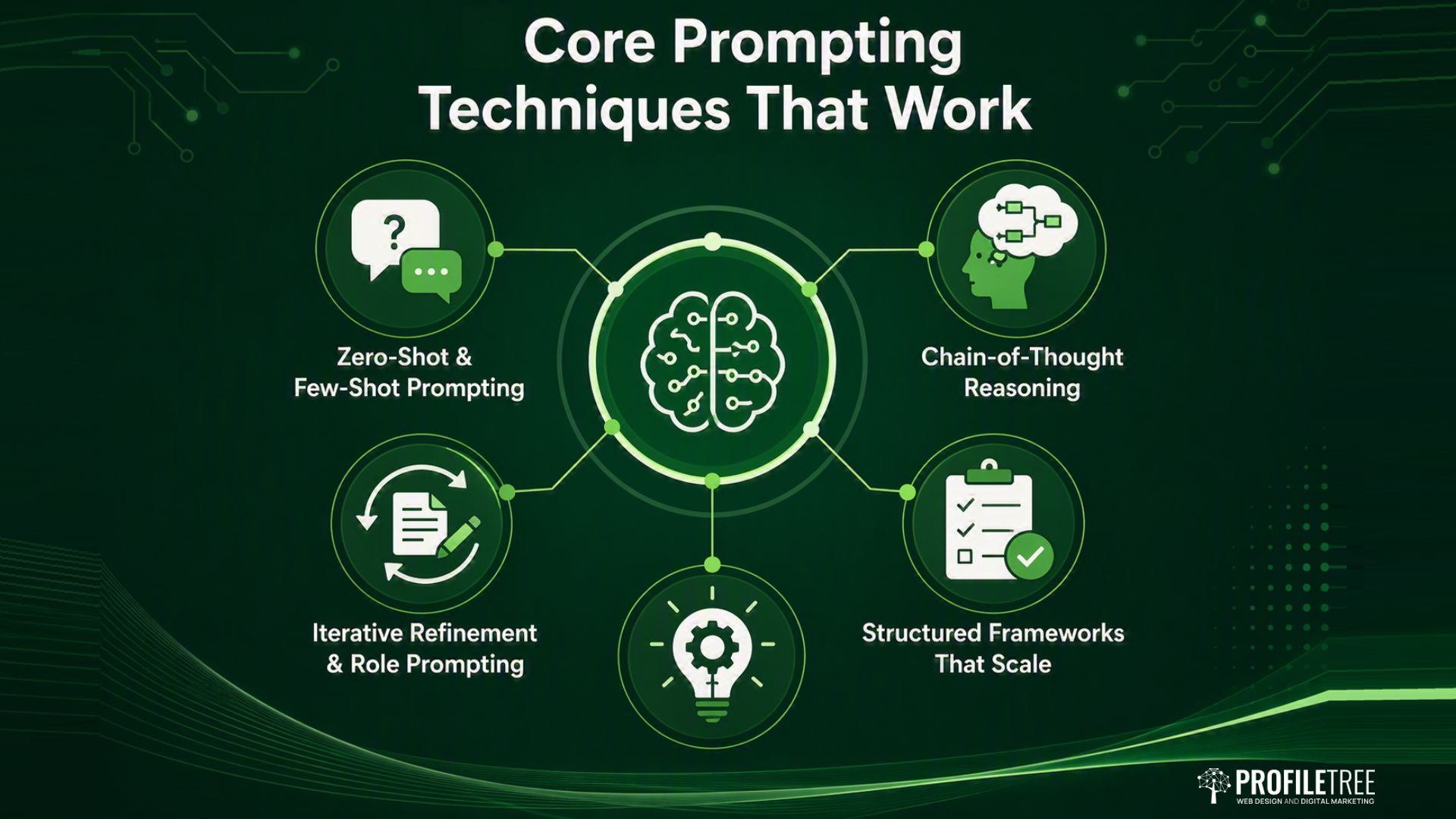
A handful of methods do most of the work in professional settings. Learning these five gives you a foundation that transfers across tools and tasks, whether you are drafting copy or analysing a spreadsheet.
Zero-Shot and Few-Shot Prompting
Zero-shot prompting asks the model to complete a task with no examples. It works well for simple, common requests. Few-shot prompting gives the model two or three worked examples first, which sharpens accuracy on anything specialised or format-sensitive.
If you need a consistent product description style across hundreds of items, few-shot is the practical choice. Show the pattern once or twice, and the model holds it. Marketers exploring this often start with our guide to AI SEO prompts.
The choice between the two comes down to how unusual your task is. A request the model has seen a million times, summarise this article, needs no examples. A request shaped by your own house style, your own categories, or an unusual output format almost always improves when you show rather than tell.
Chain-of-Thought Reasoning
Asking a model to “work through this step by step” before giving a final answer improves performance on anything that needs logic. The reasoning becomes visible, which also makes errors easier to spot and correct.
This matters most for tasks like cost calculations, eligibility checks, or multi-stage planning. The extra words cost little, and the reliability gain is real.
There is a related technique worth pairing with it: asking the model to verify its own answer. A follow-up instruction like “now check that working for errors and correct anything wrong” catches mistakes the first pass missed. For anything a customer or regulator will see, that second look is cheap insurance.
Iterative Refinement and Role Prompting
No first prompt is perfect. Iterative refinement treats prompting as a loop: you write, review the output, adjust, and run again. Keeping notes on what worked turns scattered attempts into a repeatable method.
Role prompting sits alongside this. Telling the model to respond “as a UK tax adviser” or “as a plain-English editor” frames the entire answer. Combined with refinement, it gives you control without technical complexity. Comparing how each major model responds to these methods helps; see our take on using ChatGPT for a worked example.
Moving Beyond “Act As A…” With Structured Frameworks
Once the individual techniques feel natural, a repeatable framework keeps your prompts consistent. Rather than reinventing the instruction each time, a framework gives you a checklist to run through, which is what turns prompting from a knack into a method a whole team can share.
Two structures are worth knowing. RTF (Role, Task, Format) is quick and suits everyday requests. CREATE (Character, Request, Examples, Adjustments, Type, Extras) is fuller and suits complex or high-stakes work where precision matters. The table below shows where each fits.
| Framework | What it covers | Best for |
|---|---|---|
| RTF | Role, Task, Format | Fast everyday tasks: emails, summaries, simple drafts |
| CREATE | Character, Request, Examples, Adjustments, Type, Extras | Detailed analytical or compliance-sensitive work |
| Chain-of-Thought | Step-by-step reasoning before the answer | Logic, calculations, multi-stage decisions |
| Few-Shot | Two or three worked examples up front | Consistent formatting across many outputs |
Pick one framework and stick with it long enough to learn its rhythm. Switching constantly stops the habit from forming. Most teams settle on RTF for daily work and reach for CREATE when the stakes rise. habit from forming. Most teams settle on RTF for daily work and reach for CREATE when the stakes rise.
Sector-Specific Use in the UK Market
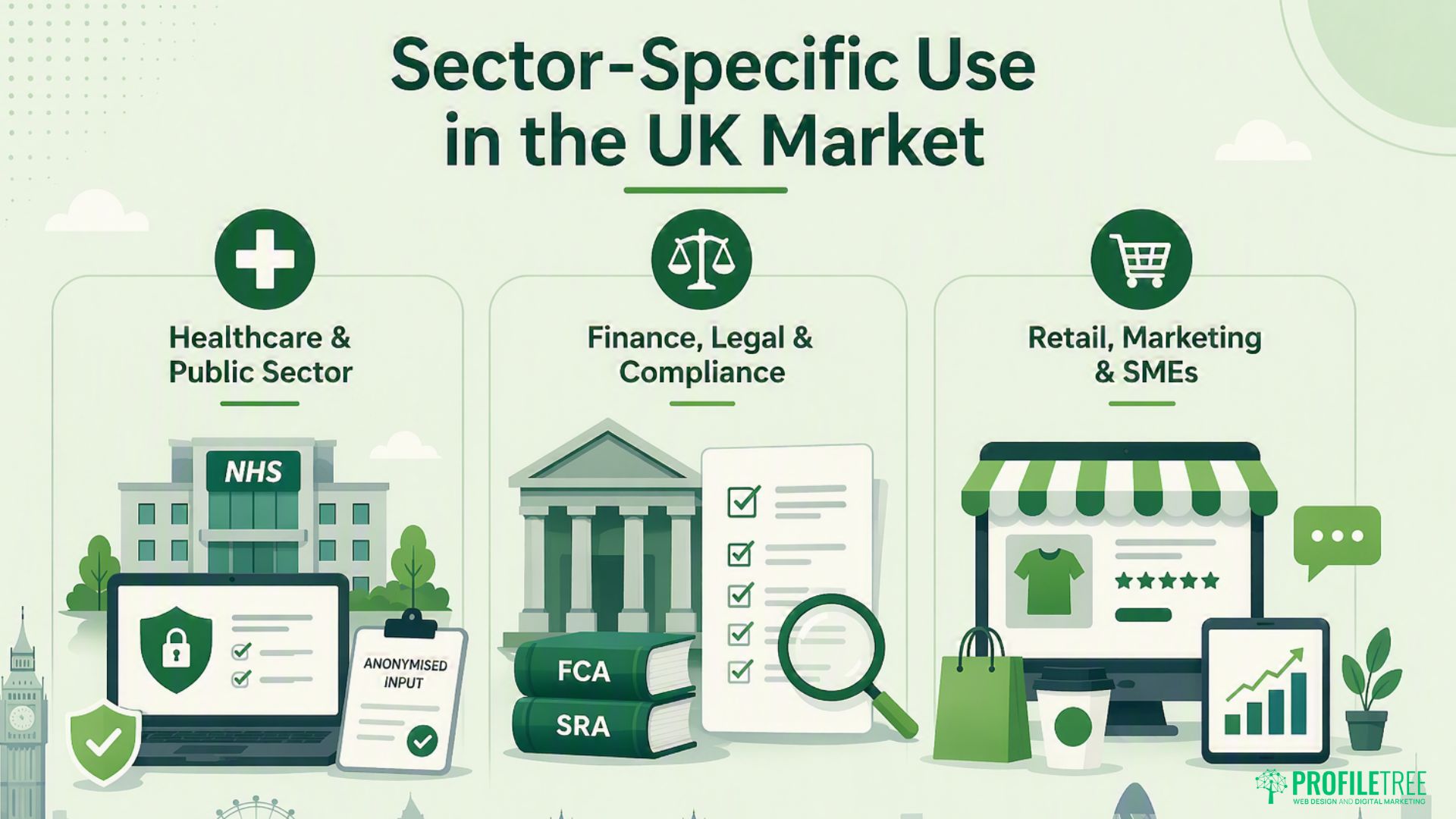
Generic advice only goes so far. UK organisations operate under rules that shape how they can use AI, and prompt design has to reflect that. The examples below show how the same skill adapts across regulated and commercial settings.
Healthcare and Public Sector
NHS teams and public bodies handle sensitive data, so prompts must avoid feeding personal information into consumer AI tools. Well-designed prompts work with anonymised inputs and stay inside approved enterprise environments.
The skill here is framing tasks so the model assists with drafting, summarising, or research without ever touching identifiable patient detail. That discipline is a prompt design choice as much as a policy one.
A practical example: a clinic administrator can ask a model to draft a generic appointment-reminder template, specifying tone, reading age, and accessibility, without naming a single patient. The output is reusable across hundreds of cases, and no personal data ever enters the tool. The prompt does the protecting.
Finance, Legal, and Compliance
Financial firms answering to the FCA and legal practices following SRA guidance need outputs that respect those frameworks. Compliance-aware prompts build the relevant rules and terminology directly into the instruction, reducing the review burden later.
A prompt that specifies “use UK regulatory language and flag any claim that needs verification” produces a far safer draft than an open request. Building this into wider operations is where a clear digital strategy pays off.
Legal teams apply the same logic to contract review and research. A prompt can ask the model to summarise a clause in plain English while explicitly noting that the output is a draft for solicitor review, not advice. That framing keeps the tool useful and the professional firmly in control.
Retail, Marketing, and SMEs
Smaller businesses often see the fastest returns. Product descriptions, campaign ideas, and customer replies all respond well to structured prompting, and the barrier to entry is low.
The trick is consistency. A shared prompt library keeps brand voice steady across a team, even when several people are generating content. Many SMEs we work with treat prompting as part of their broader AI implementation journey rather than a standalone tool.
Take a small online retailer with one part-time marketer. A saved prompt that produces an on-brand product description from a few bullet points lets that one person output the volume a larger team once handled. The cost saving is real, and the quality stays even because the instruction, not the individual mood, drives the result.
Skills, Careers, and Risk in Prompt Engineering
Prompt engineering has moved from novelty to recognised capability, with real demand and real pitfalls. This section covers what the career looks like in the UK and Ireland, and the risks every business should plan for.
To see how the techniques translate into day-to-day practice, this ProfileTree walkthrough is a useful starting point:
Exploring Prompt Engineering as a Career Path
Yes, though the job title is shifting. Pure “prompt engineer” roles are giving way to broader “AI specialist” positions that combine prompting with workflow design and oversight. The underlying skill remains valuable across both.
In London, Dublin, and Manchester tech hubs, demand sits with people who can connect AI output to genuine business outcomes, not just write clever instructions. Portfolio evidence, a saved library of prompts that solved real problems, often matters more than a certificate.
On pay, ranges vary widely by role and seniority, and titles are still settling, so treat any figure as a moving benchmark rather than a fixed rate. What holds steady is that prompting paired with a second skill, marketing, operations, or compliance, commands more than prompting alone. All prices and figures in this guide are indicative UK examples and correct at the time of writing; use them as a benchmark rather than fixed quotations.
The Skill Without a Degree
You do not need a computer science degree or Python to prove competence. A documented set of prompts, with before-and-after results showing the improvement you achieved, demonstrates the skill directly to an employer.
This practical route suits career-changers well. Structured learning speeds it up, which is why our digital training programmes focus on applied work rather than theory alone.
Managing Bias, Security, and GDPR
The risks are as important as the benefits. Prompt injection, where hidden instructions hijack a model’s behaviour, is a live security concern for any business exposing AI to public input. Reviewing outputs for bias before they reach customers is equally essential.
UK GDPR adds another layer: company and personal data fed into a model may leave your control unless you use enterprise tools with proper data residency. The team at ProfileTree, a Belfast-based digital agency, treats these safeguards as the starting point of any AI rollout, not an afterthought. For wider context on the rules, the UK Information Commissioner’s Office publishes detailed AI guidance.
The ProfileTree Approach and What Comes Next
Tools change quickly, but the discipline of clear instruction endures. This final section covers how ProfileTree helps businesses build skills and where prompt engineering is likely heading.
How ProfileTree Builds the Capability
“The people who’ll still be valuable in two years aren’t the ones who memorised clever prompts. They’re the ones who understand their own business well enough to know when the AI’s answer is wrong. That judgment doesn’t come from a template.” According to Ciaran Connolly, founder of ProfileTree.
The work begins with understanding your goals, then moves to hands-on sessions where staff build and test prompts against real tasks. Ongoing support keeps the skill current as models evolve. Northern Ireland and Irish firms exploring this can pair it with broader strategy planning for the strongest results.
Is Prompt Engineering a Fading Skill?
Some predict that better models will make careful prompting unnecessary. The more likely path is evolution into “AI orchestration”, coordinating multiple AI agents and checking their work, where contextual judgment matters more, not less.
Template copying will fade. Understanding why a prompt works and adjusting it for a specific business need will keep its value. That judgment is hard to automate away.
The shift mirrors what happened with search. Knowing the right keywords once felt like a specialist skill; now the value lies in interpreting results and acting on them. Prompting follows the same curve, moving from a standalone trick towards a baseline skill woven into how teams plan, write, and decide.
Building Your First Prompt Library
Start small. Pick three tasks your team does often, write a strong prompt for each, and save the versions that work. Over a few weeks, you will have a practical asset that saves real time and keeps quality steady.
This compounding approach beats chasing the latest technique. A modest, well-tested library used daily delivers more than an elaborate one nobody opens. ProfileTree, the Belfast digital agency, helps teams build exactly these libraries as part of applied training. To see how the wider region approaches digital growth, this guide to the top cities to visit in Northern Ireland offers useful local context.
Conclusion
Prompt engineering rewards clarity over cleverness. The businesses getting value from AI are not using secret techniques; they are writing structured instructions, testing them, and saving what works. Treat the skill as a team capability, respect the data and compliance rules that apply to your sector, and build a small library you actually use. Start with three tasks this week.
Ready to build practical AI skills across your team? Explore ProfileTree’s digital training and turn prompting into a working business capability.
FAQs
Do I need to learn Python to be a prompt engineer?
No. Prompt engineering is about clear instruction and structured thinking, not coding. Understanding the logic of how models process text helps, but you can become highly effective using plain language alone. A documented portfolio of working prompts proves the skill far better than any programming qualification.
What is the best AI tool for prompt engineering?
It depends on the task. GPT-4 handles logic and analysis well, Claude is strong for longer-form writing and nuanced prose, and image models like Midjourney suit visual work. Most professionals learn the strengths of two or three tools and switch between them rather than relying on one.
Are prompt engineering jobs available in the UK?
Yes, though increasingly under titles like “AI specialist” rather than “prompt engineer”. Demand concentrates around London, Dublin, and Manchester tech hubs, with growing interest from regional SMEs. Roles that link AI output to business results are the most secure.
How do I protect my data when prompting?
Use enterprise versions of AI tools or API access with clear data handling terms, never feed personal or confidential data into consumer chat tools, and confirm data residency under UK GDPR. Anonymise inputs wherever possible.
What is prompt injection?
Prompt injection is a security exploit where hidden or malicious text overrides an AI’s original instructions, causing it to behave in unintended ways. It is a real concern for any business exposing an AI system to public or untrusted input.