
How AI Search Engines Choose Which Sites to Cite
Table of Contents
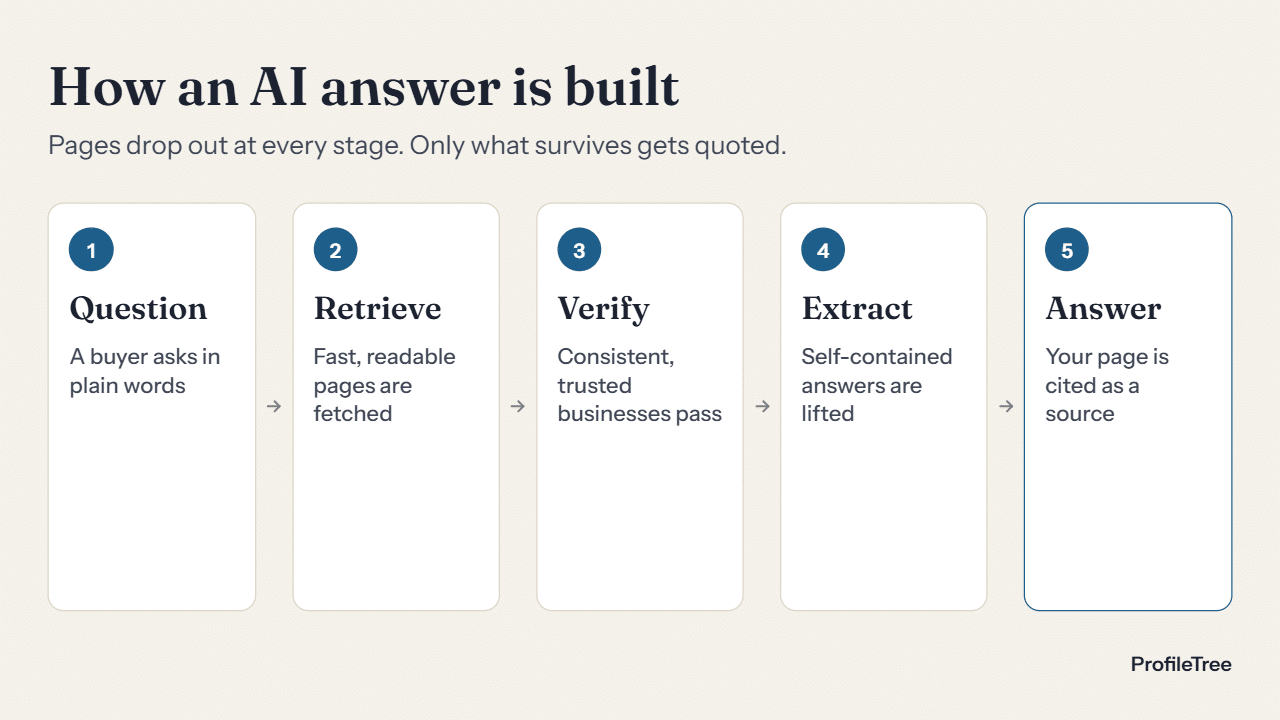
AI search engines cite websites that are easy to crawl, tied to a real and identifiable business, structured so a single passage can be lifted out and reused, and backed up by mentions elsewhere on the web. Miss any one of those and a page can rank in Google while ChatGPT, Copilot and Google’s own AI Overviews quietly ignore it.
That gap is what AI SEO exists to close, and it matters more each month. Buyers now read an answer at the top of the page before they ever reach the blue links, and being the source behind that answer is a different job from ranking beneath it.
This guide walks through the four things that decide the outcome: how AI crawlers read the web, why entity clarity builds trust, what makes a passage quotable, and why outside mentions act as votes. It closes with the order an SME site should tackle them in.
How AI Crawlers Read the Web Differently from Google
Googlebot and the crawlers behind AI answers are not the same tool doing the same job, and treating them as interchangeable is the most common mistake we find in AI SEO audits for Irish businesses. Googlebot has spent two decades cataloguing the web on a rolling schedule. The bots feeding AI answers are faster, fussier and far more selective, which changes what you need to get right first.
Retrieval, not Indexing
Google builds a permanent index it can search later. Many AI systems work the other way: they fetch pages the moment a query arrives, then write a reply from whatever comes back quickly. GPTBot, ClaudeBot, PerplexityBot and Bing’s own infrastructure all lean this way, and the difference between how AI models handle crawling and indexing shapes everything downstream.
If a page cannot be read in the moment, it cannot be quoted in the moment, which puts real weight on how fast and how cleanly it loads. There is no second pass to catch a page that was too slow the first time.
The Response-Time Budget
A retrieval crawler often works to a time limit. If your page needs eight seconds of client-side JavaScript before the text appears, a bot on a budget may give up and use a competitor instead. Server-side rendering, or at least a fast static HTML fallback, has become a live concern again rather than a solved one, which is where a well-built site earns its keep.
Picture a Belfast firm on a heavy page-builder theme. The design looks fine to a visitor who waits, but a crawler sampling the first few hundred milliseconds sees a near-empty shell. Trimming third-party scripts and moving the main copy higher in the source code often does more than any new writing would.
Speed alone is not the whole story, though. What a bot sees also has to match what a browser sees.
Serving Bots and Browsers the Same Page
Pages that change constantly, or that quietly show different content to bots than to people through aggressive personalisation or A/B testing, create inconsistency that makes AI systems less willing to reuse them. Stable structure, even when the words are refreshed often, tends to help. Anyone curious about the mechanics can see it in action in how ChatGPT retrieves live results before it answers.
Access is only step one. Once a crawler can read the page, it has to work out whether the business behind it is real.
Why Entity Clarity Decides Whether You Get Cited
Entity clarity is the factor most small sites get wrong, and it is rarely a writing problem. It is a consistency problem. Before an AI system will cite a business as a source, it needs reasonable confidence that the business exists, operates where it claims to, and does what it says. This section covers what that signal is, how repetition builds it, and how to audit your own.
What Counts as a Clear Entity Signal
Models and the retrieval systems beside them build associations from how often, and how consistently, entities appear together across the web. A name paired with one location and one service category, repeated the same way across dozens of independent sources, reads as a strong signal. The same name with three addresses and two spellings reads as noise, which is why steady brand identity feeds citation as much as recognition.
The strength of that signal grows with a particular kind of phrasing.
Semantic Triples and Repeated Phrasing
“ProfileTree, a Belfast-based digital marketing agency” carries more weight than “ProfileTree” on its own, because it packs three facts (the name, the place, the service) into one sentence. Repeated across a company’s own pages, its guest articles and its directory listings, that phrasing forms a semantic triple a machine can extract with confidence. Building it deliberately is part of good SEO services rather than an afterthought.
Consistent phrasing only pays off, of course, if the underlying details actually agree with each other.
Auditing Your Name, Address and Services
The fix is unglamorous: check every place the business appears online for spelling variants, outdated addresses, old company names and mismatched service descriptions, then correct them. Clean, matching details on your Google Business listing and across directories give a system the verified summary it prefers to draw on.
A quick version of the audit is worth running today: search the business name in quotes, open the first couple of pages of results, and note every version of the address, phone number and description on show. Most firms are surprised how many old listings and pre-rebrand names still float around, each one nudging a system towards doubt.
Ciaran Connolly, founder of ProfileTree, puts it plainly: “AI systems don’t reward the business that shouts loudest. They reward the one that’s easiest to verify, and verification comes down to saying the same true things about yourself, in the same way, everywhere you appear online.”
What Turns a Passage into a Citation
Access and a clear entity get you into the running. Extraction decides the result. AI systems rarely quote a whole article; they pull a passage of roughly 40 to 100 words and build an answer around it. A page can be well written throughout and still earn nothing if none of its passages survives being lifted out of context. Four habits make that survival more likely.
Put the Answer First
Compare “there are several factors that influence citation” with “AI systems cite pages that are crawlable, clearly attributed and corroborated elsewhere.” The second can be dropped straight into an answer; the first makes the reader wait. Section headings that pose a question, answered in the first sentence beneath, map almost exactly onto how people search when they type a query.
Getting to the point fast is worth little, though, if the point itself is vague.
Give Figures a Date
“Traffic increased significantly” tells a system nothing it can safely reuse. “Organic traffic rose 34% between March and September” (as an illustration) gives it something concrete, time-bound and checkable. Where you hold genuine first-hand numbers, showing them with a figure and a timeframe lifts the odds of being picked up, and simple analytics tools are usually enough to surface them.
The same logic suits service pages, not just blog posts. “Projects delivered since 2011” says more than “years of experience,” and a number a reader can picture is a number a system can lift into an answer.
Dated figures do their best work when the page around them is easy to scan.
Build Tables and Question-led Headings
A table gives a system a self-contained unit that does not depend on the prose around it, whether that is pricing tiers, feature differences or a breakdown of crawler behaviour. Ahrefs’ research on AI Overview citations found that most cited pages sit somewhere in Google’s top 100 and that structured, comparison-led formats do well for research questions. Turning long articles into scannable, well-labelled sections is ordinary structured content work, applied with extraction in mind.
One caveat is worth keeping in mind: a table only helps if its rows still make sense stripped of the text around them, so label the columns clearly and skip any shorthand that only the full article explains.
Structure helps a machine read a page. Phrasing decides whether the page sounds like an answer at all.
Write The Way People Ask
Grounding-query data shows that the phrases triggering citations look like spoken questions, closer to “how do I get my tweets to trend” than “twitter trending tips.” Writing to answer a real question, and steering clear of the flat, generic phrasing that reads as machine-made, both help; the same instincts behind spotting AI writing tell apply here in reverse. It is a familiar pattern: the same technology that lets tutoring software adapt to learners by reading how they actually engage is the technology deciding which of your sentences to trust.
Why Outside Mentions Act as Votes
A site can be perfectly crawlable, clearly branded and neatly structured, and still struggle if nobody else is talking about it. Third-party mentions are corroboration, and corroboration is one of the clearest trust signals a system has. This section looks at why that is, how reviews add a countable version of it, and how to earn mentions that actually count.
Corroboration Works like Fact-Checking
One source making a claim carries some weight. Five independent sources making the same claim carry much more. A business mentioned only on its own domain looks, from the outside, hard to tell apart from one that barely exists; a business referenced in trade press, local coverage and guest articles looks established. Spreading presence across several marketing channels is how that footprint grows.
The effect is cumulative rather than instant, and it builds up before any single query is ever typed, which is why a system treats an established footprint as a signal it can lean on. Some of that corroboration can even be counted, which machines like.
Reviews as a Countable Signal
A steady volume of reviews with a stable rating gives a system a number it can quote directly. A firm that can accurately state a five-star rating from several hundred reviews is handing over something concrete, in the same way a dated statistic beats a vague claim. Surfacing that signal where both people and crawlers see it matters for local search in particular.
Showing reviews as plain text, rather than trapping them inside a widget a crawler cannot read, is a small technical detail with an outsized payoff. If the rating only lives inside an embedded script, a retrieval system may never see the number at all.
Reviews build slowly. So does the wider set of mentions, and how those mentions are worded changes their value.
Guest Contributions with Entity-rich Phrasing
A mention that names the business, its location and its service together does more work than a bare link. This is where digital PR and guest writing earn results that on-site content cannot reach on its own. Well-planned sharing content with independent publishers, phrased as “a Belfast-based digital marketing agency” rather than a bare brand name, is precisely what gets reused by systems building an entity profile.
None of this happens overnight, but it compounds. Each accurate, well-phrased mention makes the next one slightly more likely to be trusted.
Where an SME Site Should Start
For a small team without the resources to rebuild everything at once, order of operations is the whole game. The factors above sort neatly into a sequence, cheapest and most foundational first, and this section sets out that running order across four moves.
Fix Entity Consistency and Crawlability First
Start with the details that cost time rather than money: audit the name, address and service description everywhere they appear, then confirm AI crawlers can reach your content without long rendering delays and that robots.txt is not blocking bots you actually want. These foundations underpin everything else, and they are well within reach for most SMEs using AI today.
Server logs are the quiet win here. Most owners have never looked, and a five-minute check often shows GPTBot or PerplexityBot calling daily, sometimes more often than Googlebot, which tells you the crawlers are already interested, and the task is to make each visit count.
With the groundwork sound, attention moves to the pages themselves.
Rewrite Priority Pages for Direct Answers
Take the handful of pages most likely to answer common customer questions and restructure their openings and headings so the answer comes first and the detail follows. This single change tends to produce the fastest visible shift in citation behaviour, and it fits naturally into an existing content strategy rather than replacing it.
A useful check at the outline stage is to read each heading aloud as a question and confirm the sentence beneath answers it on its own. If it leans on the paragraph before it to make sense, it will not survive being quoted.
Once the answers lead, the next lift comes from the evidence sitting beside them.
Add Data and Useful Structure
Replace vague claims with real, dated figures, and add at least one genuinely useful table or comparison to your major articles. Where original data does not exist yet, start collecting it, because first-hand numbers are among the hardest signals for a competitor to copy quickly. A few practical AI SEO prompts can speed up the drafting without inventing anything.
All of this is worth far more when you can see whether it is working.
Track Monthly and Build Beyond the Site
Watch which pages gain or lose citation share month to month so you can adjust on evidence rather than guesswork, and pair that with steady outreach for accurately phrased third-party mentions. Even a light setup in Google Analytics gives you a baseline to measure progress against.
Getting Cited Comes Down to the Basics
AI citation is not separate from SEO. It is the same fundamentals- crawlability, a clear entity, direct answers and outside corroboration- applied to a system that verifies differently from Googlebot. The sites gaining ground are the ones fixing the unglamorous things first, then tracking what changes and adjusting based on evidence rather than guesswork. If you want a second pair of eyes on where your pages stand, ProfileTree’s SEO support is a good place to start.
FAQs
How do AI search engines cite websites?
They fetch pages at query time, pull a short passage of roughly 40 to 100 words, and build an answer around it. The passages that get chosen sit on fast, crawlable pages, come from a clearly identifiable business, and answer a question directly in their first sentence.
Which AI search engine is most likely to cite my website?
It depends on your setup, but Bing-based systems and Copilot tend to show changes fastest because they crawl and refresh often. The core signals (crawlability, entity clarity and corroboration) help you across ChatGPT, Perplexity and Google’s AI Overviews at the same time, so it is rarely worth optimising for just one.
Do backlinks still matter for AI citations?
Yes, but framing matters as much as the link. Independent mentions act as corroboration, and a mention that names your business, location and service together does more work than a bare link or a passing reference.
How long does it take to start appearing in AI answers?
Technical and structural fixes can show up within weeks on faster platforms. Entity clarity and third-party mentions compound over months rather than days, so treat it as a steady programme, not a one-off task.
Does adding an FAQ section improve citation rates?
Often, yes, when the questions are phrased the way customers actually ask them and answered directly underneath. FAQ pairs work as ready-made, extractable answers that map cleanly onto how people query an AI assistant.