
Custom AI Training: Scaling UK and Irish Business Efficiency
Table of Contents
Organisations implementing customised AI training achieve 312% superior tool adoption rates compared to generic educational programs, with employees consistently utilising AI systems daily rather than abandoning technology after standardised workshops that fail to address specific operational contexts. ProfileTree has developed and delivered bespoke AI education initiatives for over 500 organisations spanning Belfast manufacturing facilities to London financial institutions, creating targeted learning experiences that directly address individual company tools, established workflows, and strategic business objectives.
Generic AI training programs fail when identical curricula are applied to different business contexts. Teaching Donegal tourism operators the duplicate theoretical content as Manchester logistics companies waste valuable training resources while failing to generate practical workplace applications. Teams require hands-on competency development using actual organisational systems, addressing specific operational challenges within relevant industry frameworks rather than abstract AI possibilities that don’t translate into immediate productivity improvements.
Custom AI Training Programmes for Irish & UK Businesses: Tailored Learning That Transforms Operations addresses this precision requirement through strategic curriculum design that transforms artificial intelligence from corporate buzzword into measurable competitive advantage. The customisation approach ensures training investments generate lasting operational improvements rather than temporary awareness increases that fade without practical application opportunities.
This comprehensive analysis reveals how tailored AI education programs revolutionise workforce capabilities across diverse industry sectors through systematic methodologies that address unique organisational requirements. The framework encompasses proven design principles, implementation strategies that ensure sustainable behavioural change, and specific approaches that enable Irish and UK businesses to achieve sustainable competitive positioning through strategic AI adoption and internal capability development.
Why Generic AI Training Fails Your Business
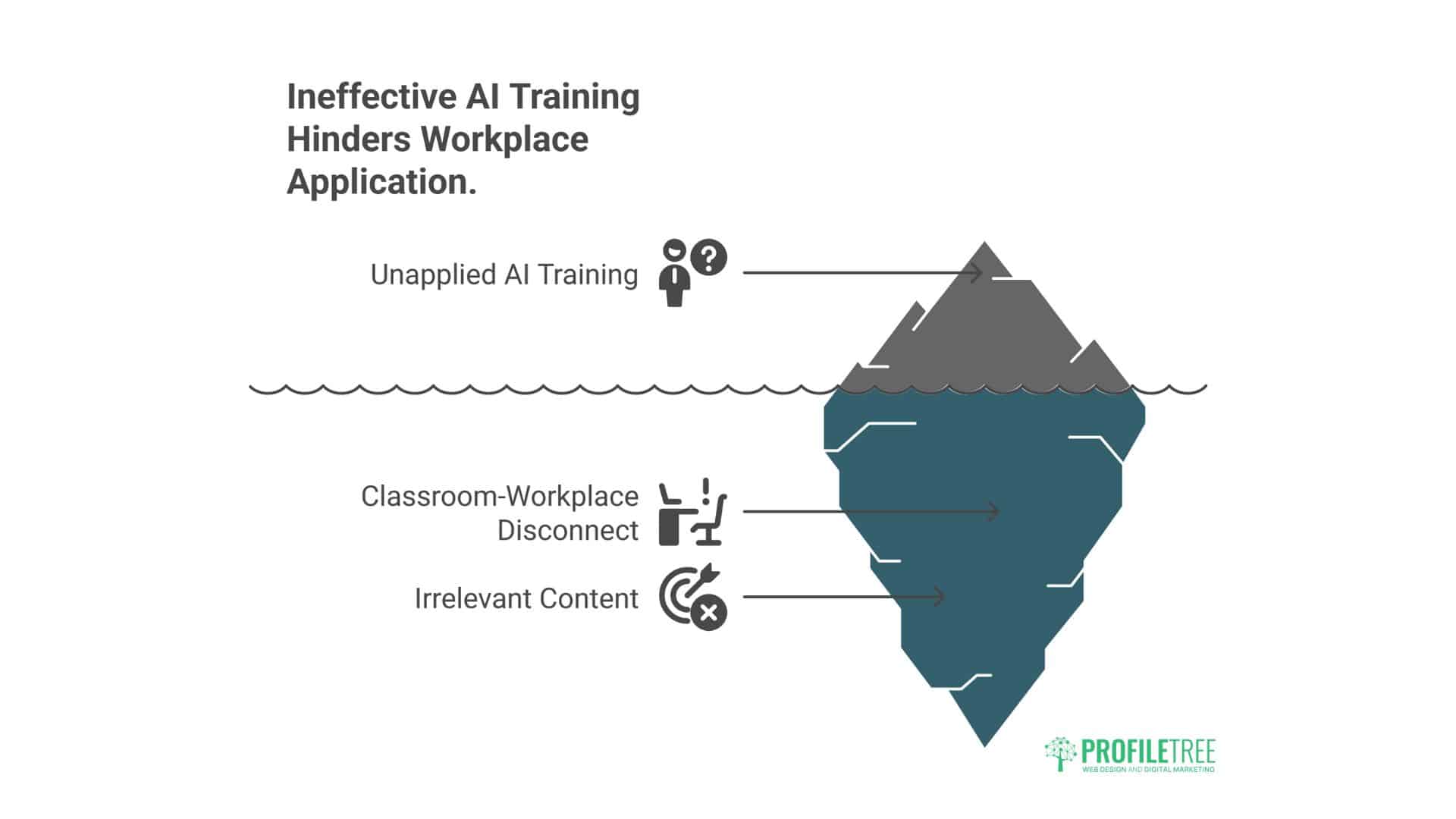
The AI training industry pumps out standardised courses promising transformation. Reality? 78% of employees never apply generic AI training to their actual work. The disconnect between classroom examples and workplace reality creates an unbridgeable gap. Your accounts team learning about AI in manufacturing, or your sales force studying healthcare AI applications, gains nothing actionable.
Industry-specific challenges demand sector-focused solutions. A Cork pharmaceutical company needs AI training to address regulatory compliance, quality control, and research applications. Dublin retail chains require customer service automation, inventory prediction, and personalisation strategies. Generic training that addresses neither serves anybody effectively.
Tool proliferation compounds the problem. Your business likely uses specific software, platforms, and systems. Training your team on ChatGPT when you’ve invested in Microsoft Copilot, or teaching general AI principles when you need Salesforce Einstein expertise, creates frustration rather than capability.
Cultural and operational contexts matter enormously. A family-run Galway business operates differently from a Birmingham tech startup. Hierarchical corporations need different change management approaches than flat-structure creative agencies. Generic training ignores these crucial dynamics, leading to resistance and rejection.
The pace of AI evolution makes generic content obsolete quickly. What worked six months ago might be irrelevant today. Your business needs training aligned with your current tools, upcoming implementations, and strategic roadmap – not yesterday’s generic best practices.
The ProfileTree Approach: Designing Your Perfect Programme
Our bespoke AI training design process begins with profound discovery and understanding of your unique ecosystem before creating content.
Business Context Analysis
We examine your complete operational landscape:
Current technology stack mapping reveals integration opportunities. Understanding which systems you use, how they connect, and where AI can add value shapes training priorities.
Workflow documentation identifies automation potential. We analyse how work happens, not theoretical processes, finding specific AI applications that save time and improve quality.
Skills assessment establishes baseline capabilities. Some teams need foundational AI literacy, while others require advanced implementation training. Mixed-ability groups need carefully structured programmes accommodating all levels.
Cultural evaluation shapes delivery approaches. Change-resistant cultures need strategies that are different from those of innovation-embracing environments. We design training that works with your culture, not against it.
Sector-Specific Customisation
Every industry faces unique AI opportunities and challenges:
Manufacturing and Production
- Predictive maintenance using sensor data
- Quality control through computer vision
- Supply chain optimisation with machine learning
- Production scheduling using AI forecasting
- Safety monitoring through intelligent systems
Retail and E-commerce
- Customer service chatbot implementation
- Personalisation engine deployment
- Inventory management through demand prediction
- Dynamic pricing strategies using AI
- Visual search and recommendation systems
Tourism and Hospitality
- Booking optimisation and revenue management
- Multilingual customer service automation
- Experience personalisation for guests
- Review analysis and reputation management
- Predictive staffing based on demand patterns
Professional Services
- Document automation and analysis
- Client insight generation from data
- Proposal and report writing assistance
- Research acceleration using AI tools
- Time tracking and billing optimisation
Healthcare and Life Sciences
- Patient data analysis and insights
- Appointment scheduling optimisation
- Clinical documentation assistance
- Research literature review automation
- Compliance monitoring and reporting
Tool-Specific Training Modules
We build training around your actual technology investments:
Microsoft Copilot Integration
- Word document creation and editing
- Excel data analysis and visualisation
- PowerPoint presentation generation
- Teams meeting summaries and action items
- Outlook email management and scheduling
Google Workspace AI
- Docs writing assistance and editing
- Sheets formula generation and analysis
- Slides design and content creation
- Meet transcription and summary features
- Gmail smart compose and response
Salesforce Einstein
- Lead scoring and prioritisation
- Opportunity insights and forecasting
- Case classification and routing
- Email and activity capture
- Predictive analytics dashboard usage
Custom and Specialised Tools
- Industry-specific platform training
- Proprietary system integration
- API usage for custom workflows
- Data pipeline automation
- Reporting and analytics tools
Building Programmes That Drive Real Change
Effective AI training programmes that drive real organisational change require systematic behavioural design principles focusing on habit formation, peer accountability systems, and incremental skill building rather than overwhelming participants with complex theoretical concepts they cannot immediately apply. Sustainable change occurs through structured practice sessions, ongoing mentorship support, and performance measurement frameworks that reinforce new behaviours while providing clear feedback loops demonstrating progress and maintaining motivation throughout the learning journey.
Curriculum Architecture
Practical bespoke training follows a structured progression:
Foundation Level (Weeks 1-2)
- AI fundamentals contextualised to your industry
- Ethical considerations and responsible use
- Data privacy and security protocols
- Company-specific AI policies and guidelines
- Hands-on introduction to your chosen tools
Application Level (Weeks 3-4)
- Department-specific use cases
- Workflow integration techniques
- Productivity enhancement strategies
- Quality improvement through AI
- Collaborative AI working methods
Advanced Level (Weeks 5-6)
- Complex problem-solving with AI
- Custom automation creation
- Data analysis and insights generation
- Innovation and experimentation frameworks
- Training others and scaling adoption
Mastery Level (Ongoing)
- Continuous learning pathways
- Emerging technology exploration
- Strategic AI implementation planning
- ROI measurement and optimisation
- Centre of excellence development
Delivery Methodologies
Different organisations require different learning approaches:
Intensive Bootcamps Concentrated 2-3 day programmes for rapid capability building. Belfast tech companies often prefer this approach, getting teams operational quickly.
Distributed Learning: Weekly 2-hour sessions over several months. Suit organisations unable to release staff for extended periods. Popular with NHS trusts and public sector bodies.
Hybrid Programmes: Combining self-paced online modules with live workshops. Accommodates diverse schedules whilst maintaining personal interaction. Ideal for multi-location businesses.
Train-the-Trainer Models: Developing internal champions who cascade knowledge. Cost-effective for large organisations. We train your trainers to maintain long-term capability.
Executive Briefings: Condensed strategic sessions for leadership teams. Rather than hands-on tools, focus on AI strategy, governance, and transformation planning.
Practical Learning Approaches
Theory without practice fails. Our programmes emphasise hands-on application:
Real Project Integration Participants work on actual business challenges during training. A Limerick manufacturer might optimise its production schedule, and a London law firm could automate its contract review process.
Sandbox Environments: Safe spaces for experimentation without affecting live systems. Mistakes become learning opportunities rather than business risks.
Peer Learning Groups: Cross-functional teams share discoveries and solutions. Accounts might teach sales their Excel AI tricks whilst marketing shares content generation techniques.
Mentorship Programmes: Ongoing support beyond initial training. Regular check-ins ensure continued progress and address emerging challenges.
Measuring Success: KPIs and ROI Frameworks
Custom AI training success measurement requires tracking specific behavioural changes, including daily tool usage rates, task completion time reductions, and workflow efficiency improvements, rather than focusing on course satisfaction scores or completion percentages that don’t correlate with business outcomes. ROI frameworks must combine quantitative metrics such as productivity gains, error reduction rates, and cost savings with qualitative assessments, including employee confidence levels and decision-making quality improvements that demonstrate comprehensive value creation beyond immediate operational benefits.
Adoption Metrics
Track actual behaviour change, not just training completion:
Daily Active Users of AI tools should reach 70%+ within three months. Lower rates indicate training gaps or tool misalignment.
Feature Utilisation Depth measures whether teams use advanced capabilities or stick to basics. Progressive feature adoption indicates practical training.
Cross-Department Spread shows organic knowledge transfer. Successful programmes see AI usage spreading beyond initial trainees.
Productivity Indicators
Quantify efficiency gains:
Time Savings Per Task typically range from 20% to 60% for well-trained teams. Document before-and-after task completion times.
Output Quality Improvements through AI assistance. Error rates should decrease whilst consistency increases.
Innovation Metrics tracks new AI use cases discovered by teams. Practical training empowers creative problem-solving.
Business Impact Measures
Connect training to bottom-line results:
Revenue Per Employee often increases 15-30% post-training as AI multiplies individual capacity.
Customer Satisfaction Scores improve through better service, faster responses, and personalised experiences.
Competitive Advantage Indicators include market speed, service differentiation, and operational excellence.
ROI Calculation Framework
Training ROI = (Gain from Training – Cost of Training) / Cost of Training × 100
Example for a 50-person company:
– Custom training investment: £25,000
– Productivity gains (30 mins/day/person): £312,000 annually
– Tool optimisation savings: £50,000 annually
– Total benefit: £362,000
– ROI = (£362,000 – £25,000) / £25,000 × 100 = 1,348%
Sector Deep Dives: Tailored Solutions in Action
Sector-specific AI training solutions address unique industry challenges and regulatory requirements, with healthcare organisations requiring HIPAA-compliant AI tools and training protocols. At the same time, manufacturing companies need predictive maintenance and quality control applications that integrate with existing production systems. Real-world implementations demonstrate how tailored approaches deliver measurable results: financial services firms achieving 45% faster loan processing through custom AI workflows, while retail businesses reducing inventory costs by 30% through demand forecasting training programs designed specifically for their product categories and seasonal patterns.
Manufacturing: Derry Precision Engineering Case Study
Challenge: A Traditional manufacturing company is struggling with quality control and predictive maintenance.
Custom Programme Elements:
- Computer vision training for defect detection
- IoT sensor data analysis for equipment monitoring
- Supply chain AI for demand forecasting
- Safety compliance automation
- Production optimisation algorithms
Implementation Approach:
- 4-week intensive programme
- Hands-on training using actual production data
- Integration with existing MES systems
- Ongoing support for 6 months
Results:
- 43% reduction in defect rates
- 67% decrease in unplanned downtime
- £1.2M annual savings
- 100% operator adoption within 3 months
Retail: Cork Fashion Chain Transformation
Challenge: Multi-store retailer needing customer personalisation and inventory optimisation.
Custom Programme Design:
- Customer service chatbot development
- Personalisation engine configuration
- Visual search implementation
- Inventory prediction models
- Dynamic pricing strategies
Delivery Method:
- Hybrid online/in-person over 8 weeks
- Store manager intensive followed by staff rollout
- Real-time practice with actual customer data
- Peer learning across locations
Outcomes:
- 34% increase in average order value
- 56% reduction in stock-outs
- 78% customer service query automation
- 23% improvement in conversion rates
Professional Services: Belfast Accountancy Firm
Challenge: Senior partners wanting to modernise without disrupting established processes.
Bespoke Training Components:
- Document analysis and extraction
- Automated report generation
- Client communication enhancement
- Regulatory compliance checking
- Predictive analytics for client insights
Programme Structure:
- Executive strategy session
- Department-specific workshops
- Individual coaching for partners
- Junior staff accelerator programme
- Quarterly advancement sessions
Impact:
- 50% reduction in document processing time
- 89% faster report generation
- 34 additional billable hours per person monthly
- 45% improvement in client satisfaction
Overcoming Implementation Challenges
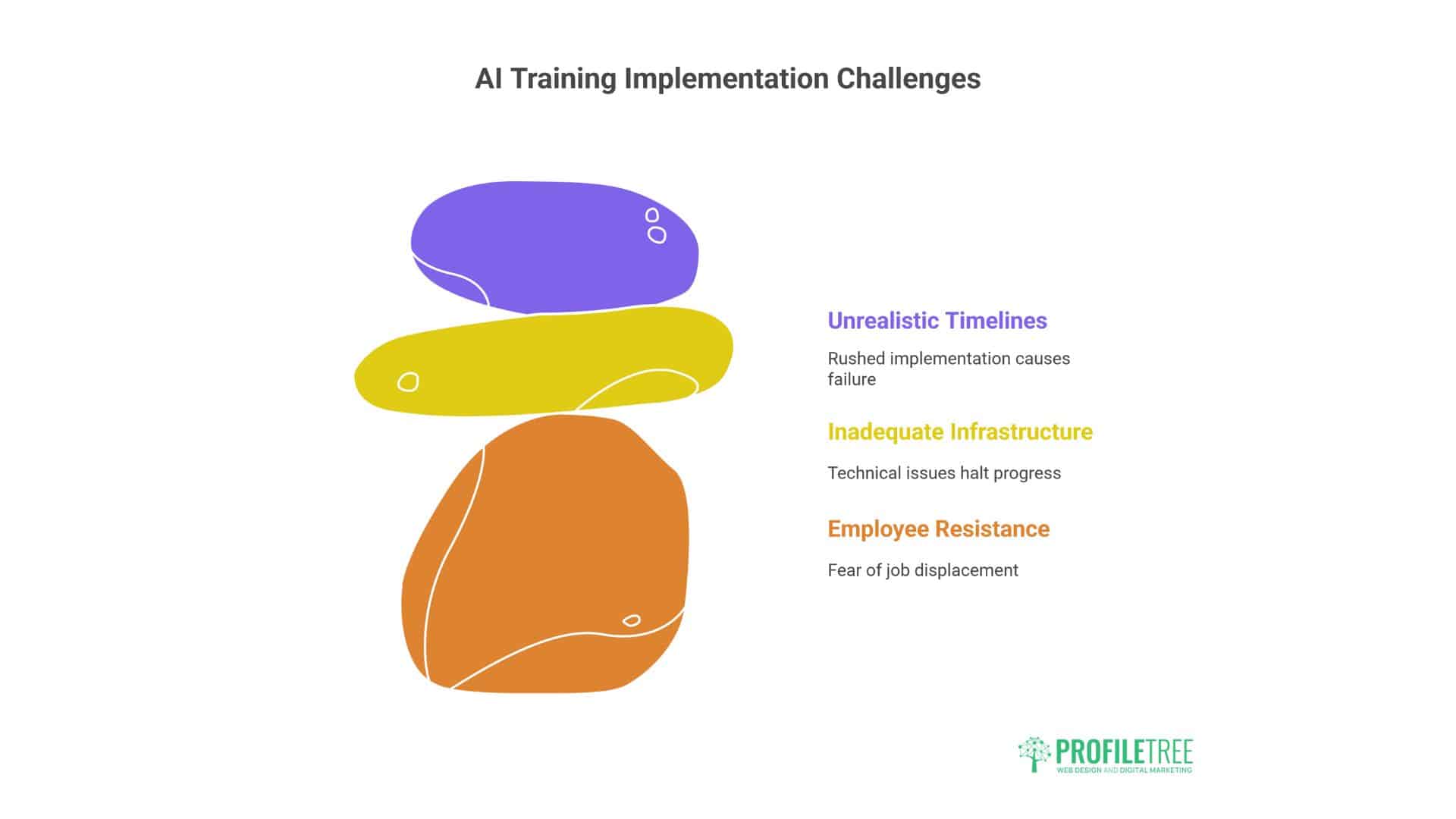
Common AI training implementation challenges include employee resistance to change, inadequate technical infrastructure, and unrealistic timeline expectations that can derail well-designed programs without proper change management strategies. Successful challenge mitigation involves proactive communication about benefits rather than threats, phased rollouts that allow gradual adaptation, stakeholder buy-in from leadership levels, and contingency planning for technical issues that ensures training continuity despite inevitable infrastructure or connectivity problems that could otherwise halt progress completely.
Challenge 1: Resistance to Change
Problem: Employees fear AI will replace them or disrupt comfortable workflows.
Solution: Frame AI as an assistant, not a replacement. Show how it eliminates mundane tasks, allowing focus on valuable work. Include job security assurances in training communications.
Challenge 2: Varying Technical Abilities
Problem: Mixed skill levels from digital natives to technophobes.
Solution: Create multiple learning tracks with common convergence points. Pair technically confident staff with those needing support. Celebrate all progress levels.
Challenge 3: Time and Resource Constraints
Problem: Operational demands limit training availability.
Solution: Modular micro-learning fitting into natural breaks. Record sessions for asynchronous consumption. Create just-in-time training materials for immediate application.
Challenge 4: Maintaining Momentum
Problem: Initial enthusiasm wanes without reinforcement.
Solution: Regular refreshers, advanced sessions, and celebration of wins. Create AI champion networks, maintaining energy. Implement gamification and recognition programmes.
Challenge 5: Measuring Intangible Benefits
Problem: Some AI benefits resist easy quantification.
Solution: Develop proxy metrics for intangibles. Employee satisfaction surveys, innovation indices, and customer feedback provide qualitative evidence supporting quantitative measures.
The ProfileTree Advantage
Our AI training services culminate years of designing and delivering transformative learning experiences. We don’t just teach AI—we architect capability transformation that is aligned with your strategic objectives.
Digital strategy consultation ensures AI training supports broader transformation goals, maximising investment returns.
Our AI enhancement services demonstrate practical AI applications, inspiring teams about possibilities.
Content marketing expertise shows how AI amplifies creative capabilities rather than replacing human insight.
“The difference between AI success and failure isn’t the technology – it’s how well your people understand and apply it to your specific context,” explains Ciaran Connolly, ProfileTree founder. “We’ve seen identical tools deliver 10x returns for trained teams whilst untrained teams abandon them within weeks. Customisation makes that difference.”
Future-Proofing Through Continuous Learning
Future-proofing AI training requires establishing continuous learning frameworks that adapt to rapidly evolving technologies. This ensures teams maintain competitive advantages as new AI capabilities emerge and existing tools become obsolete or superseded by more advanced alternatives. Sustainable learning systems involve regular skill assessments, emerging technology monitoring, peer knowledge sharing networks, and flexible curriculum updates that enable organisations to pivot quickly when breakthrough AI developments reshape industry standards and competitive landscapes.
Emerging Technology Integration
AI evolves rapidly. Programmes must accommodate:
Generative AI Advancement – New models and capabilities emerge monthly and require curriculum updates and refresher training.
Automation Evolution – RPA and AI convergence creates new possibilities requiring expanded skill sets.
Industry-Specific Tools – Vertical AI solutions need targeted training as they emerge and mature.
Regulatory Changes – AI legislation and compliance requirements demand ongoing education updates.
Building Learning Cultures
Sustainable AI adoption requires organisational change:
Innovation Time – Allocating hours for AI experimentation encourages discovery and adoption.
Knowledge Sharing – Regular show-and-tell sessions spread successful AI applications organically.
Failure Celebration – Learning from AI experiments that don’t work accelerates overall progress.
External Learning – Conference attendance, online courses, and peer networking maintain cutting-edge knowledge.
Scaling and Evolution Strategies
Phase 1: Foundation (Months 1-3)
- Core team training
- Initial use case implementation
- Success measurement framework
- Cultural groundwork
Phase 2: Expansion (Months 4-6)
- Department-wide rollout
- Advanced capability development
- Process integration
- ROI demonstration
Phase 3: Transformation (Months 7-12)
- Organisation-wide adoption
- Strategic AI initiatives
- Competitive differentiation
- Continuous improvement culture
Phase 4: Leadership (Year 2+)
- Industry thought leadership
- Customer value creation
- Supply chain integration
- Market disruption
Investment Considerations
Custom AI training investment decisions require careful cost-benefit analysis that considers upfront training expenses and ongoing support costs, productivity gains during implementation periods, and long-term competitive advantages that justify initial expenditure through sustained operational improvements. Strategic investment planning should allocate budgets across training delivery, infrastructure upgrades, change management support, and performance measurement systems while establishing realistic ROI timelines that account for gradual adoption curves rather than expecting immediate transformation that may lead to premature program cancellation due to unrealistic expectations.
Programme Pricing Structures
Starter Programmes (£5,000-15,000)
- 10-20 participants
- 2-3 day intensive or 4-week distributed
- Core tool training
- Basic customisation
- 30-day follow-up support
Professional Programmes (£15,000-40,000)
- 20-50 participants
- 4-6 week comprehensive training
- Multiple tool integration
- Extensive customisation
- 90-day support and refreshers
Enterprise Programmes (£40,000-150,000)
- 50+ participants
- 3-6 month transformation programme
- Complete AI strategy development
- Fully bespoke curriculum
- 12-month partnership support
Ongoing Partnerships (£2,000-10,000 monthly)
- Continuous learning programmes
- Regular updates and advancement
- Strategic advisory services
- Innovation partnership
- Unlimited support access
Funding and Support Options
UK Funding Sources
- Innovate UK Smart Grants
- Skills Development Scotland funding
- Apprenticeship Levy utilisation
- Regional Growth Fund support
- Digital Boost programmes
Irish Funding Opportunities
- Enterprise Ireland digitalisation grants
- Skillnet Ireland training networks
- Regional Enterprise Development Fund
- Online Retail Scheme
- IDA Ireland transformation support
Success Stories from Our Programmes
Real success stories from custom AI training programmes demonstrate measurable transformation across diverse organisations: a Belfast engineering firm reduced project planning time by 55% through tailored AI workflow training. In comparison, a Dublin marketing agency increased client campaign performance by 67% using custom analytics training designed for their specific client portfolio. Additional documented results include a Cork manufacturing company that eliminated 80% of quality control errors through specialised AI vision training, and a Cardiff logistics firm that optimised delivery routes to achieve 40% fuel cost reductions while improving customer satisfaction scores through AI-powered predictive scheduling training tailored to their operational constraints and service requirements.
Global Manufacturing Leader – Birmingham
Participants: 200 employees across three sites Duration: 6-month comprehensive programme Investment: £120,000
Outcomes:
- 45% productivity improvement
- £4.2M annual cost savings
- 89% employee satisfaction with AI tools
- 15 new AI use cases identified and implemented
Regional Healthcare Provider – Dublin
Participants: 75 clinical and administrative staff Duration: 8-week hybrid programme Investment: £35,000
Results:
- 60% reduction in administrative burden
- 34% improvement in patient satisfaction
- 2 hours daily saved per clinician
- 100% GDPR compliance maintained
Boutique Legal Firm – Belfast
Participants: 12 partners and associates Duration: 4-week intensive Investment: £18,000
Achievements:
- 70% faster contract review
- 45% increase in billable hours
- 90% reduction in research time
- 3 new service offerings developed
Implementation Roadmap
Custom AI training implementation follows a structured roadmap that begins with a comprehensive organisational assessment and stakeholder alignment, progresses through pilot program development and testing phases, and then scales to full deployment with continuous monitoring and optimisation cycles. This systematic approach typically spans 12-16 weeks from initial consultation through program completion, ensuring each implementation stage builds upon previous successes while addressing emerging challenges through iterative refinement that maintains momentum and delivers measurable results at predetermined milestones.
Week 1: Discovery and Design
- Stakeholder interviews
- Current state assessment
- Tool audit and selection
- Curriculum framework development
- Success metrics definition
Week 2-3: Content Development
- Custom material creation
- Real-world scenario building
- Assessment design
- Support resource development
- Platform configuration
Week 4: Pilot Delivery
- Small group testing
- Feedback collection
- Content refinement
- Delivery optimisation
- Final adjustments
Weeks 5-8: Full Programme Delivery
- Cohort training sessions
- Hands-on workshops
- Individual coaching
- Progress monitoring
- Support provision
Weeks 9-12: Embedding and Optimisation
- Reinforcement sessions
- Advanced modules
- Success celebration
- ROI measurement
- Future planning
Take Action: Transform Your Workforce Today
The AI revolution isn’t coming—it’s here. Businesses with properly trained teams gain insurmountable advantages, while others struggle with generic knowledge that never translates to practical application.
Your competition is already moving. Every day without a strategic AI capability, the market share is lost, efficiency is unrealised, and opportunities are missed. But generic training won’t close this gap – you need programmes explicitly designed for your business, industry, and challenges.
ProfileTree stands ready to design and deliver your organisation’s perfect AI training programme. Our proven methodologies, deep industry expertise, and track record of transformation ensure your investment provides measurable returns.
Contact us today to begin designing your custom AI training programme. Let’s transform your workforce from AI-curious to AI-capable, driving competitive advantage through strategic capability development.
FAQs
How long does custom programme development take?
Typically, 2-4 weeks from initial consultation to first delivery. Complex enterprise programmes may require 6-8 weeks for complete customisation.
Can you train our trainers to deliver internally?
Absolutely. Train-the-trainer programmes create sustainable internal capability. We provide materials, support, and certification for your trainers.
What if our tools change after training?
Our programmes include change management modules and update pathways. Modular design allows easy adaptation to new tools.
How do you handle confidential information during training?
Strict NDAs, secure environments, and the option to use sanitised data. Many programmes run entirely on-premises for maximum security.
What’s the minimum group size for custom training?
We’ve designed programmes for as few as 5 participants. Smaller groups often achieve deeper learning and faster implementation.
Can you accommodate global teams across time zones?
Yes, through asynchronous modules, recorded sessions, and regional delivery times. We’ve successfully trained teams across 15 countries simultaneously.
How quickly will we see ROI?
Initial productivity gains appear within 2-4 weeks. Significant ROI typically manifests within 60-90 days. Full transformation benefits emerge over 6-12 months.