
How to Build a Social Media Team Structure for Your Business
Table of Contents
Most businesses that struggle with social media are not short of content ideas. They are short of structure. Without clearly defined roles, posts go out inconsistently, analytics get ignored, and whoever is “doing social” ends up covering six jobs badly instead of one job well.
Building a proper social media team changes that. This guide covers the core roles you need, three team models suited to different business sizes, a practical scaling roadmap for SMEs moving from a solo manager to a small department, and UK and Ireland salary benchmarks to help with budgeting. It also addresses the compliance responsibilities that UK and Irish teams often overlook.
Whether you are making your first social media hire or restructuring an existing setup, the principles apply whether you build in-house, work with an agency, or run a hybrid of both.
What Is a Social Media Team, and Why Does Structure Matter?
A social media team is the group of people responsible for planning, producing, publishing, and measuring a brand’s presence across social platforms. That sounds simple, but the work spans at least five distinct disciplines: strategy, content creation, community management, paid advertising, and performance analysis. In most small businesses, these functions are bundled into a single person. That person burns out, or the output suffers, or both.
Structure matters because each discipline requires different skills and different working rhythms. A content creator who is also expected to run paid campaigns and respond to comments all day will consistently underperform across at least two of those areas. Defined roles allow people to work to their strengths and give you a clear picture of where you have gaps.
Good structure also protects social media ROI. A social media team with clear ownership of each function operates very differently from a loose arrangement where everyone does a bit of everything. When nobody owns a function, nobody is accountable for it. When a specific person owns analytics, the numbers actually get reviewed. When someone owns community management, response times stay consistent. The operational discipline that comes with clear roles is what separates brands that grow their audiences from brands that maintain a presence for its own sake.
Core Social Media Team Roles and Responsibilities
These five roles cover the full range of functions a mature social media team needs. In smaller teams, one person may cover two adjacent roles. In larger organisations, each may become a team in its own right.
The Social Media Manager
The strategic lead. They set the content calendar, own the channel strategy, brief the creative team, and report on performance. This role connects social activity to broader marketing objectives and ensures the team works toward outcomes, not just outputs. A Social Media Manager needs strong analytical skills alongside creative instincts, the ability to read performance data, and the ability to adjust strategy, which distinguishes a good manager from a prolific poster.
Content Creator and Designer
The engine of daily output. Content creators produce the copy, images, short-form video, and graphics that make up most of what an audience sees. In smaller teams, one person covers both writing and visual design. In larger teams, these are split into separate specialist roles. This is typically the role with the highest daily task volume, and it is the first place where output quality degrades when the team is understaffed. Platforms like Instagram, TikTok, and LinkedIn each have distinct content norms; a strong content creator understands the difference rather than recycling the same format across all channels.
Community Manager
The face of the brand online. Community managers handle inbound comments and messages, moderate discussions, flag escalations, and maintain the brand’s tone in public interactions. This role is often undervalued and treated as customer service admin rather than a strategic function. In practice, a skilled community manager builds the audience loyalty that drives organic reach. Response time and reply quality are measurable, and both directly affect how platforms rank content in feeds.
Paid Social Specialist
Manages paid campaigns across Meta, LinkedIn, TikTok, and other platforms. This role requires a different skill set from organic social: campaign structure, audience targeting, budget pacing, conversion tracking, and A/B testing. Combining this with organic management is workable at low spend levels, but once a business is regularly spending more than £3,000 to £5,000 per month on paid social, a dedicated specialist pays for itself in improved return.
Data Analyst
Responsible for tracking, reporting, and translating performance data into recommendations. This role is often the last to be filled and the most valuable once in place. Without dedicated analysis, social media activity runs on gut instinct and vanity metrics. With it, the team can identify which content formats drive traffic, which campaigns convert, and where the budget should shift. The right analytics tools make this role significantly more efficient, regardless of team size.
Three Social Media Team Structure Models
There is no single correct structure. The right model depends on your business size, the number of channels you operate, and the volume of content you need to produce.
The Centralised Model
One team handles all social media activity across the whole organisation. There is a clear chain of command, a unified brand voice, and a single set of workflows and approval processes. This model suits single-brand businesses of most sizes and is the default for most SMEs. Its strength is consistency; its weakness is that it can become a bottleneck when content volume grows or when multiple business units require separate treatment.
The Hub-and-Spoke Model
A central team sets strategy, maintains brand standards, and handles paid social, while individual departments or regional offices produce their own content within those guardrails. This model suits multi-brand businesses, franchises, or organisations with distinct regional audiences. It requires clear governance, documented brand guidelines, and a content approval process that does not slow output to a crawl. Many UK businesses with both a national brand and regional operations find this model the most practical.
The Agile or Pod Model
Small cross-functional teams work on specific campaigns or channels rather than being organised by role. A pod might include a strategist, a creator, and an analyst who own one platform entirely. This model suits fast-moving e-commerce brands or agencies managing multiple clients. It offers speed and ownership but requires strong coordination to avoid inconsistency across pods. At smaller business sizes, it adds unnecessary complexity; it becomes valuable once a team exceeds eight to ten people.
The Scaling Roadmap: From Solo Manager to Small Department
Most SMEs do not need a full social media team from day one. The question is not “what is the ideal structure?” but “what does the structure need to look like at this stage, and when does the next hire make sense?”
Stage 1: The Solo Manager
A single generalist handles strategy, content creation, publishing, community management, and basic reporting. This is workable when channel volume is low and content demands are modest. The risk is that creative output, community response, and strategic thinking all suffer when bundled together. A solo manager can sustain this for one or two channels at low posting frequency. When output requirements grow, quality typically drops first, usually in community response time or content consistency.
Stage 2: The First Hire
The first hire should almost always be a content creator. Strategy can remain with the manager; community management can be split. But content production is the task that most reliably overwhelms a solo setup. If the business regularly spends on paid social, a paid specialist takes priority instead.
The trigger points that signal it is time: posting frequency has dropped below the target schedule more than twice in a month, response times to comments and messages consistently exceed 24 hours, or paid campaigns are running without regular optimisation.
Stage 3: A Small Team
By this stage, the business needs at minimum a Social Media Manager, a dedicated content creator, and someone with analytical responsibility. Community management and paid social may still sit with the manager or creator, but dedicated ownership of analytics prevents reporting from being permanently deprioritised. Documented workflows, a shared content calendar, and a clear approval process become non-negotiable at this stage.
In-House vs Agency
Many UK SMEs reach Stage 2 and face a choice: hire or outsource. A full-time mid-level content creator costs approximately £28,000 to £35,000 per year in salary alone, plus employer NI contributions, equipment, and software licences. A retained social media agency typically charges between £800 and £3,000 per month, depending on scope. At lower budgets, an agency offers broader skill coverage and more flexibility. At higher volumes, particularly when brand voice requires nuance or community management needs a daily in-house presence, it becomes more efficient.
The hybrid model, where strategy and community stay in-house while content production is agency-managed, is increasingly common among mid-sized UK businesses. ProfileTree’s social media services are structured to support this kind of blended approach.
2026 UK and Ireland Social Media Salary Benchmarks
The figures below reflect typical ranges drawn from current UK job market data. All figures are approximate and intended solely as planning benchmarks. Verify against current sources before making hiring decisions. Employer NI contributions (13.8% on earnings above the secondary threshold) and pension costs are not included in these figures.
| Role | London | UK Regions (incl. Belfast) | Dublin / Ireland |
|---|---|---|---|
| Social Media Executive / Coordinator | £26,000 – £32,000 | £22,000 – £28,000 | €28,000 – €35,000 |
| Social Media Manager | £35,000 – £48,000 | £28,000 – £38,000 | €38,000 – €52,000 |
| Content Creator / Social Designer | £28,000 – £38,000 | £24,000 – £32,000 | €30,000 – €40,000 |
| Paid Social Specialist | £35,000 – £50,000 | £28,000 – £42,000 | €38,000 – €52,000 |
| Community Manager | £26,000 – £34,000 | £22,000 – £30,000 | €28,000 – €38,000 |
| Head of Social / Social Media Director | £55,000 – £80,000+ | £42,000 – £60,000 | €55,000 – €75,000+ |
Agency-side salaries tend to run five to ten per cent below in-house equivalents at junior and mid levels, compensated by faster career progression and broader platform exposure. The true cost of a £30,000 hire is typically £36,000 to £38,000 once employer costs are factored in.
For SMEs where direct employment costs are prohibitive, hiring a marketer on a fractional or part-time basis is worth considering, particularly for strategic or analytical roles that do not require a daily presence.
Governance and Compliance for UK Social Media Teams
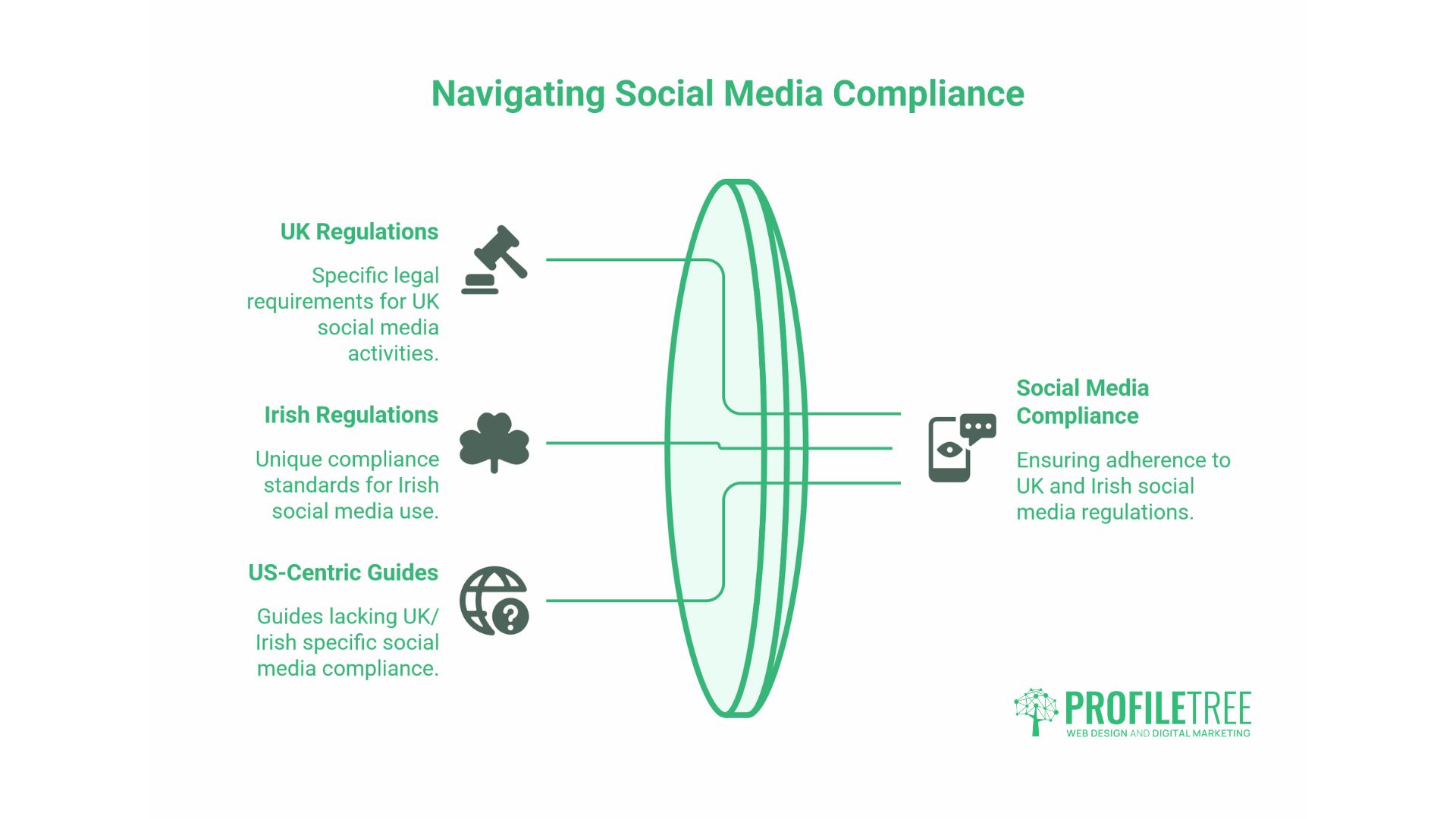
Compliance is the area most often absent from social media team planning and the one most likely to create problems. UK and Irish businesses have specific obligations that US-centric guides rarely address.
ASA and CAP Code Requirements
The Advertising Standards Authority (ASA) and the Committee of Advertising Practice (CAP) govern advertising across all UK digital channels, including social media. Any post that promotes a product or service, whether paid or organic, must comply with CAP Code rules on truthfulness, substantiation, and disclosure. For social media teams, the most common compliance point is influencer and gifting disclosure: any content produced under a commercial arrangement must be clearly labelled as an ad.
This is not optional. ASA enforcement has become significantly stricter since 2022, and brands, rather than just individual creators, are now held accountable when disclosure requirements are not met. Building a disclosure checklist into the content approval workflow as a required step before any commercial content goes live is the practical way to manage this.
GDPR and Community Management
Community managers collect data every time they engage with followers who have provided contact details, submitted forms, or interacted with campaigns that feed into CRMs. GDPR applies to this data regardless of the platform from which it originates. The key requirements are: ensure any data collected through social campaigns has a lawful basis; provide clear privacy information when running competitions or lead generation activities; and have a process for handling data subject requests received through social channels.
For most SMEs, the risk is not intentional misuse but accidental non-compliance through unclear workflows. The person running a competition on Instagram may not realise that entries constitute personal data under GDPR. Training the team on these basics, particularly community managers who interact with audience data daily, is part of building a properly structured operation. The broader obligations are covered in our guide to digital marketing compliance.
Building Compliance Into the Workflow
The most effective approach is to make compliance structural rather than reactive. This means a content approval step that checks for required disclosures before publication, a brief document for any influencer or gifting activity that specifies labelling requirements, and a clear escalation path for community managers when they receive sensitive messages or complaints. For businesses subject to sector-specific rules, such as financial services, healthcare, or legal, additional obligations apply on top of the ASA/CAP baseline.
Tools for Social Media Team Management
The right tools depend on team size and workflow complexity. At the solo or two-person level, a scheduling tool and a shared content calendar cover most needs. As the team grows, the requirements shift toward collaboration, approval workflows, and integrated analytics.
Scheduling platforms such as Buffer, Later, and Hootsuite handle publishing across multiple channels and provide basic analytics. Project management tools like Asana or Trello work well for content calendar management and approval tracking. For analytics at a more serious level, native platform insights typically suffice for smaller teams, while larger operations benefit from consolidated dashboards that pull data from multiple platforms.
Social listening tools become relevant when community volume reaches a point where manual monitoring becomes unworkable. For most SMEs, native notifications and a shared inbox protocol handle the same function at a fraction of the cost.
Measuring Social Media Team Performance
Defining success means agreeing in advance on which metrics matter for which objectives. Vanity metrics, follower counts, and likes are the wrong primary measures for most businesses. The more useful KPIs fall into three categories.
Engagement metrics (comments, shares, saves, click-through rates) indicate how content is landing with the audience. Reach and impressions indicate how effectively content is being distributed. Business-outcome metrics, social-driven website traffic, lead form completions, and direct conversions connect social activity to commercial results. The last category is the one most often missing from social media reporting and the one that justifies headcount and budget decisions.
Role-specific accountability makes performance reviews meaningful and prevents a social media team from running on vanity metrics. A community manager’s performance is best measured against response time and sentiment trends, not total follower growth. A paid social specialist is accountable for cost per result, not organic reach. For practical guidance on connecting social media activity to commercial outcomes, see our overview of SME social media best practices.
Building Brand Identity Across the Team
Maintaining a consistent brand voice becomes harder as a team grows. When one person runs all channels, the voice is naturally consistent. When three or four people are writing, designing, and responding to comments, inconsistency creeps in unless there are documented standards.
A brand voice document does not need to be complicated. It needs to cover: the words and phrases that are on-brand and off-brand, the tone for different scenarios (promotional posts, community responses, complaint handling), and examples of what good looks like across each channel. The community manager’s response to a negative comment should feel like it comes from the same brand as the content creator’s campaign post.
“Creating a solid brand identity on social media isn’t just about being seen, it’s about being remembered,” says Ciaran Connolly, founder of ProfileTree. “In a sea of content, it’s the authentic voice and tailored messaging that build real connections.”
The voice document should be part of onboarding for every new team member, and the Social Media Manager should review and update it regularly as platforms and audience expectations shift.
Ongoing Training and Development
Social media platforms change faster than most other marketing disciplines. Algorithm updates, new ad formats, and shifts in audience behaviour can make last year’s best practices counterproductive this year. A team that does not invest in ongoing development will gradually fall behind without necessarily realising it.
The most practical approach for SMEs is to build learning time into the working week rather than treating it as optional. Platform certifications, Meta Blueprint, LinkedIn Marketing Labs, and Google’s digital marketing qualifications are free and keep skills current. For teams adopting AI tools into their workflows, the skills gap between early and late adopters is widening rapidly. Training staff to use AI for content ideation, brief-writing, and performance analysis without losing the human judgement that distinguishes good social content is a specific challenge most teams are now navigating.
Conclusion
A well-structured social media team does not require a large headcount. It requires clarity about who owns what, when the next hire should happen, and how performance is measured against real business outcomes. Start with the roles your current output genuinely demands, build the compliance framework before you need it, and scale based on the trigger points that signal your existing structure is no longer sufficient.
FAQs
What is the first role to hire for a social media team?
Usually, a content creator’s strategy can stay with the manager, but content production is the first thing to suffer when one person is stretched too thin. If you are already spending more than £3,000 per month on paid social without dedicated optimisation, a paid specialist takes priority instead.
How many people should be in a social media team?
One to three people cover most SME needs across three to five channels. Larger organisations with high content volume and active paid programmes typically run four to eight. The right number comes from the output you need, not a set formula.
Should the social media team sit within marketing or PR?
Marketing is the standard in most UK organisations, with the Social Media Manager reporting to a Head of Marketing. Where the brand’s social presence is primarily reputation-driven, in financial services, healthcare, and the public sector, a closer link to PR makes sense.
Is it cheaper to hire a team or use a social media agency in the UK?
At lower activity levels, an agency is almost always more cost-effective. A retained agency at £1,200 to £2,500 per month covers a range of skills for less than a single mid-level hire including employer costs. As volume grows and daily responsiveness becomes critical, in-house becomes more efficient.