
Social Media Crisis Management: Best Practices for Brands
Table of Contents
A single post, screenshot, or viral clip can put years of brand-building at risk within minutes. For UK businesses, the stakes are higher than ever: the pace of social media, tightening domestic regulations, and the rise of AI-generated disinformation mean that an outdated crisis playbook is as dangerous as having no plan at all.
This guide on social media crisis management walks through what constitutes a social media crisis in 2026, how to build a response framework your team can actually use under pressure, and what UK-specific legal obligations apply when things go wrong.
You will find a tiered severity matrix, a 60-minute response protocol, regulatory compliance guidance from the ASA and ICO, and a data-driven reputation recovery roadmap, everything a marketing director or communications lead needs before a crisis, not during one.
What Constitutes a Social Media Crisis in 2026?
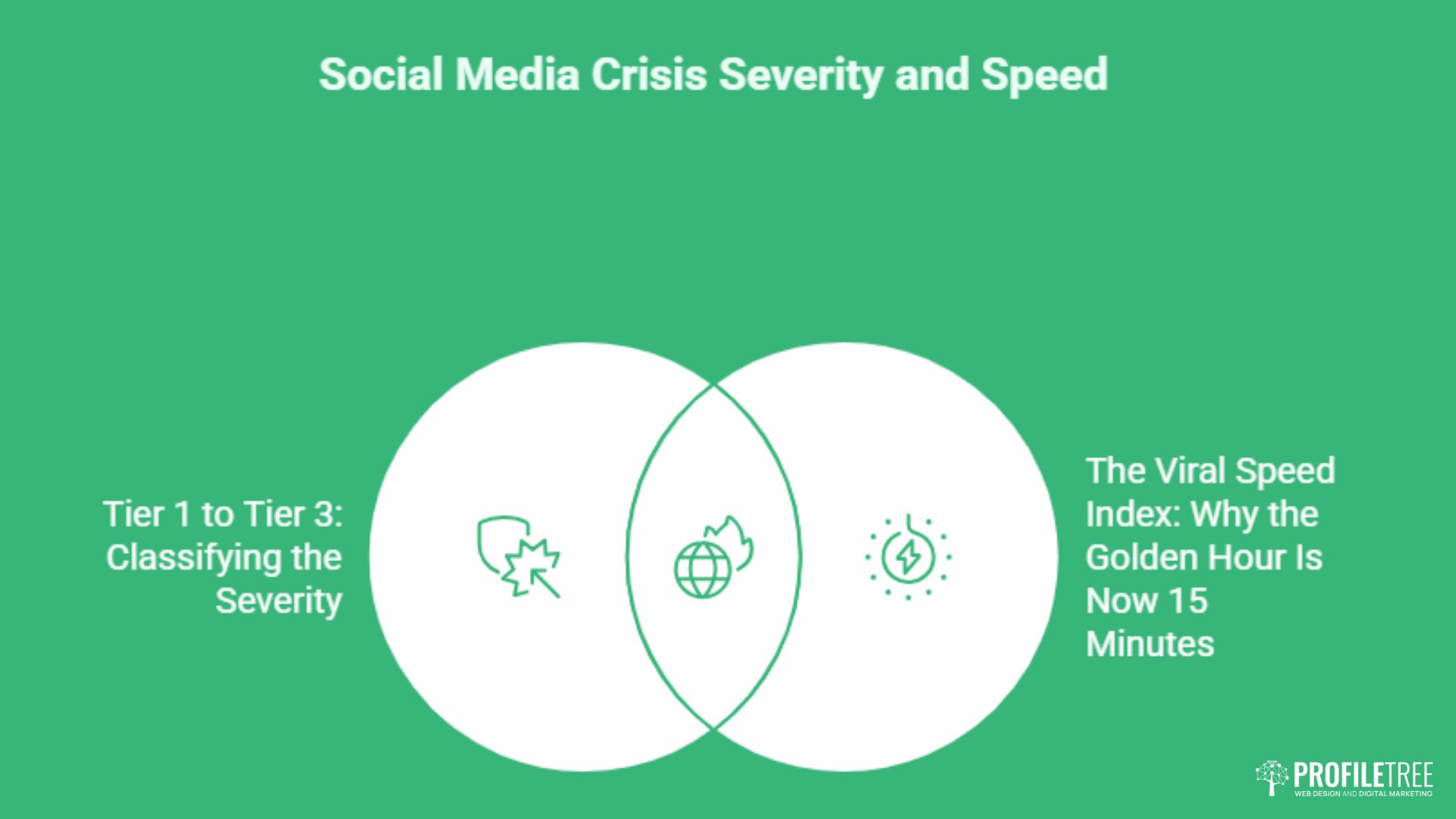
Not every negative comment is a crisis. Treating routine customer complaints as high-alert situations drains team resources and trains people to react disproportionately. The first discipline in crisis management is calibration: distinguishing between noise and a genuine reputational threat. The sections below define what a crisis actually is and how quickly one can develop.
Tier 1 to Tier 3: Classifying the Severity
A useful starting point is a three-tier severity model. Tier 1 covers isolated complaints or minor negative sentiment that can be resolved through standard community management, typically a direct reply or a private message. Tier 2 applies when a story gains traction across multiple accounts or platforms, attracting media interest or influencer amplification.
Tier 3 represents an existential reputational threat: coordinated boycotts, verified misinformation about your business, regulatory investigations, or content that has gone nationally or internationally viral.
Each tier demands a different response level. Tier 1 is handled by your social media team. Tier 2 escalates to senior marketing leadership. Tier 3 activates the full crisis team, including legal counsel, the executive team, and external PR support if available. The classification decision should take no longer than five minutes after detection; delay at this stage compounds every subsequent problem.
| Tier | Volume Signal | Sentiment Severity | Response Level | Colour Code |
|---|---|---|---|---|
| 1 — Inconvenience | Low (isolated posts) | Mild negative | Social media team | Green |
| 2 — Reputational Risk | Medium (cross-platform) | Moderate, media interest | Marketing leadership | Amber |
| 3 — Existential Threat | High (viral, national) | Severe, coordinated | Full crisis team + legal | Red |
The Viral Speed Index: Why the Golden Hour Is Now 15 Minutes
Speed expectations have shifted dramatically. The old “golden hour” rule, giving communications teams 60 minutes to issue a first response, no longer reflects how content moves in 2026. Research from social listening platforms consistently shows that viral content reaches peak sharing velocity within 10 to 20 minutes of the first amplifying repost. On short-form video platforms, that window is even shorter.
This does not mean brands should rush out unverified statements. It means the internal alert system, escalation protocol, and pre-approved response templates must be in place before a crisis occurs. The first public-facing response does not need to resolve anything; it needs to acknowledge the situation and confirm the team is aware. That alone can dampen sentiment escalation by 30-40% in the early window, according to Edelman’s crisis communications research.
Effective social media management includes understanding how platform algorithms amplify emotionally charged content. Platforms actively surface posts that generate high engagement, which means outrage spreads faster than clarification. Your crisis monitoring setup must account for this asymmetry.
The 2026 Threat Landscape: AI, Deepfakes, and Disinformation
The nature of online reputational threats has changed fundamentally. Brands once faced the risk of a disgruntled customer post going viral or a poorly worded campaign attracting backlash. Those risks still exist, but they now sit alongside something more technically complex: AI-generated attacks. This section covers how to identify synthetic brand threats and what UK law says about them.
Identifying AI-Generated Brand Attacks
AI-generated disinformation against brands takes several forms. Deepfake videos can place a CEO in a fabricated interview, making the CEO say things the individual never said. Synthetic audio clips can be spliced into call recordings to imply wrongdoing. Mass-produced fake reviews, generated at scale by large language models, can distort a brand’s public rating profile within hours. These are not hypothetical scenarios; incidents of this type have affected businesses across multiple sectors since 2024.
The verification protocol when suspected AI content surfaces should follow three steps. First, do not respond publicly until the content has been reviewed for authenticity. Second, use a reverse video or image search tool to check whether the asset appears elsewhere online with different attribution.
Third, contact the platform directly to request an emergency takedown under synthetic media policies, which most major platforms now have in place. If the content involves a named individual within your organisation, that person’s legal team should be notified immediately.
For a broader context on how technology is reshaping brand risk, ProfileTree’s AI transformation services cover how artificial intelligence tools are being applied on both sides of the reputational risk equation, from threat detection to response automation.
ProfileTree’s AI-enhanced marketing services include threat monitoring tools that flag suspicious account activity before it escalates. Account compromise can allow bad actors to post directly from a verified brand profile, creating a crisis that appears to originate internally.
The Legal Reality: Section 179 of the UK Online Safety Act
The UK Online Safety Act, which came into full effect in stages through 2025, places new obligations on businesses that operate online platforms or community spaces. Section 179 imposes duties of care regarding what Ofcom defines as “priority illegal content,” including certain categories of disinformation that could cause serious harm.
For most marketing teams, the practical implication is this: if your brand’s community pages or forums host user-generated content, you have a legal responsibility to moderate that content proactively, not just reactively.
During a crisis, this matters because a failure to remove harmful user-generated content from your own channels can expose the company to regulatory action, even if the content originated with a third party. The duty of care extends to brand-owned social accounts with comment functionality. Legal review of your community moderation policies should happen before a crisis, not during one.
This connects directly to broader digital strategy planning obligations that UK brands already navigate, including ASA advertising standards, data protection law, and sector-specific regulations.
The 60-Minute Response Protocol
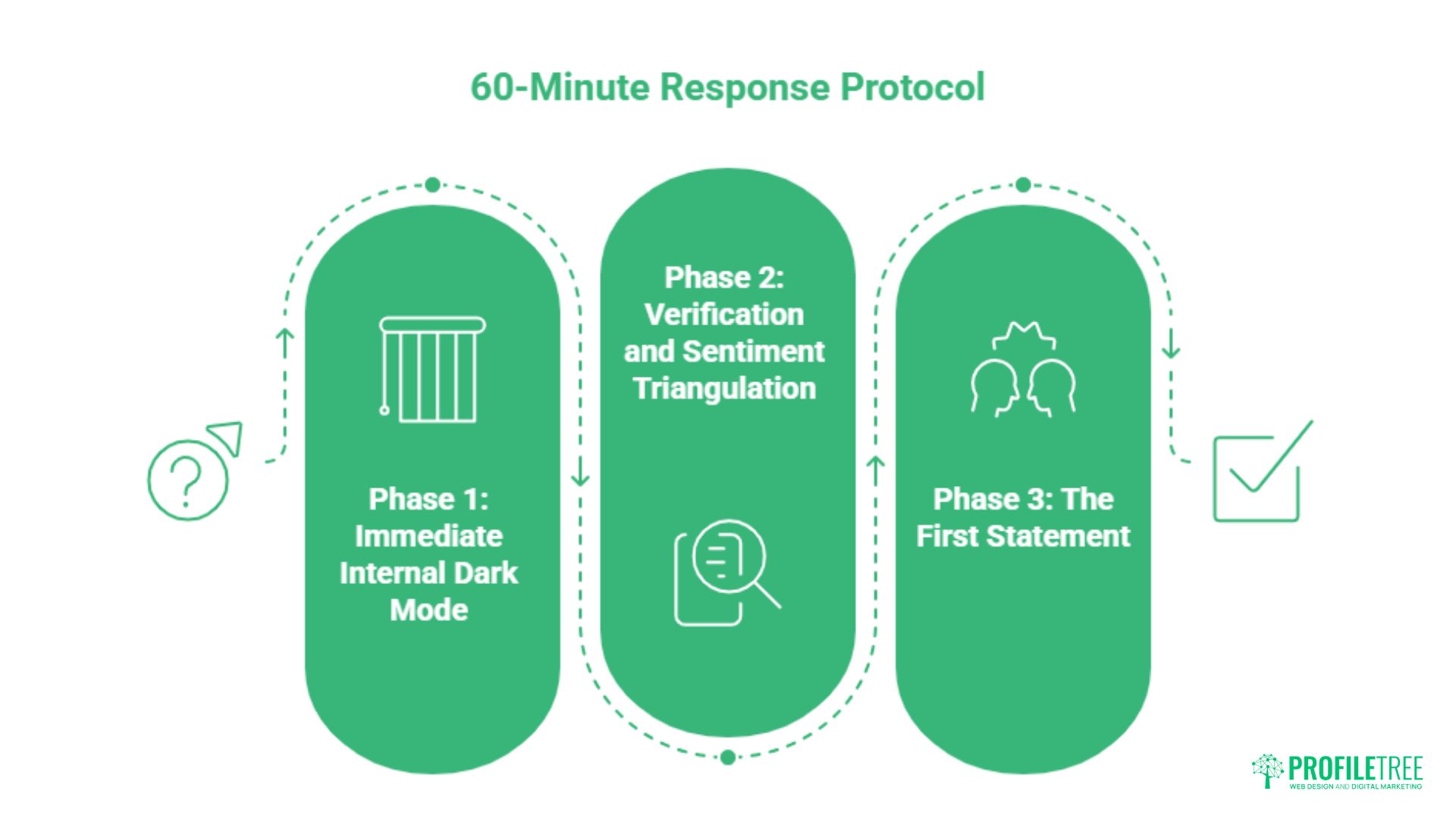
Speed and accuracy are not mutually exclusive, but they do require structure. The protocol below is built around three distinct phases that your team can move through in sequence during the first hour of a crisis. Each phase has a clear objective, so team members know exactly what they are responsible for and when to escalate.
Phase 1: Immediate Internal Dark Mode
The first action when a crisis is detected is to pause all scheduled content output. Every automation tool, pre-scheduled post, and campaign set to publish must be suspended immediately. Posting business-as-usual content during an active crisis, even content that was planned weeks in advance, signals tone-deafness and generates secondary criticism that compounds the original problem.
This pause applies across all brand-owned channels: social media, email newsletters, paid social ads, and any influencer or partner content that your team controls. Assign one person the responsibility for the dark mode action specifically; this task gets missed during the chaos of a developing crisis if it is not someone’s explicit job. The checklist below covers the minimum tools to pause:
- Social media scheduling tools (Buffer, Hootsuite, Sprout Social, or equivalent)
- Email marketing platform automations and triggered sequences
- Paid social ad campaigns, particularly any that carry promotional or celebratory messaging
- Influencer and partner posts scheduled for the next 48 hours, if contractually possible to pause
Phase 2: Verification and Sentiment Triangulation
Before any public statement is drafted, the team needs three pieces of verified information. First, what exactly is being said and by whom? Second, how far has it spread and on which platforms? Third, is the underlying claim true, partially true, or false?
Sentiment triangulation means cross-referencing what is happening on at least three channels before drawing conclusions. A post gaining traction on X may be negligible on LinkedIn and Instagram, or it may be spreading across all three simultaneously. The platform spread determines the tier classification and the scale of the response required.
A professionally managed social media marketing programme includes dedicated listening tools that track brand mentions, keyword spikes, and sentiment shifts as a standing operational practice, not something switched on when trouble begins. Real-time alerts are the only way to catch a Tier 2 situation before it becomes Tier 3.
Phase 3: The First Statement
The first public statement has one job: acknowledge that the brand is aware of the situation and is taking it seriously. It does not need to resolve anything, assign blame, or provide a full account of what happened. Attempting to do all of those things in the first statement is the most common mistake brands make; it leads to inaccuracies that then become a secondary crisis.
On the question of using humour or meme culture in a crisis response: the answer in 2026 is almost always no. A small number of high-profile examples from brands with established comedic identities have created the impression that a witty response can defuse a crisis. For the vast majority of businesses, this approach backfires. The audience perceives it as the brand not taking the issue seriously, which increases negative sentiment rather than reducing it.
A verified, measured response that is ten minutes slower than competitors is always preferable to a fast but factually wrong statement that requires correction. Each correction undermines trust incrementally.
“The brands that recover fastest from social media crises are rarely the ones who responded quickest,” says Ciaran Connolly, founder of ProfileTree. “They’re the ones who responded accurately. In an environment where AI can generate a fake CEO statement in seconds, the credibility gap between a verified response and a hasty one has never been wider.”
UK Regulatory Compliance During a Crisis
UK brands face a regulatory environment that most global crisis management guides simply do not address. The Advertising Standards Authority, the Information Commissioner’s Office, and Ofcom each have jurisdiction over different aspects of how a brand communicates during a crisis. Getting the response right is not just a reputational issue; it carries legal implications.
ASA Guidelines on Crisis Comms and Correction Posts
The ASA’s remit covers paid advertising and, since 2023, organic brand posts on social media where they are promotional in nature. During a crisis, brands sometimes publish correction or clarification posts that inadvertently make a new advertising claim. For example, stating that your product “has never caused harm” in response to safety allegations creates a comparative claim that the ASA could investigate if a competitor or complainant challenges it.
The practical guidance is to keep crisis communications factual, neutral in tone, and entirely free of promotional language. Refer to what the brand is doing to address the issue, not to how good the brand or product is. Any public statement issued during a crisis should be reviewed against the CAP Code’s honesty and substantiation requirements before publication.
This also applies to influencer and partner content. If a brand instructs an influencer to post supportive content during a crisis without disclosing the commercial relationship, that constitutes an undisclosed ad under ASA rules, and the enforcement risk sits with both the brand and the creator.
GDPR and Data Breaches: Managing the Social Fallout
If a crisis involves a data breach or the unauthorised exposure of customer information, UK GDPR applies immediately and with specific timelines. The ICO must be notified within 72 hours of becoming aware of a qualifying breach. This is a legal obligation, not a discretionary one, and failing to report within the window is itself a compliance failure that carries separate penalties.
On the social media side, the communications challenge is managing what you can and cannot say publicly while the ICO investigation is open. Brands are generally advised to confirm that they are aware of an incident, are investigating it, and will contact affected individuals directly. Anything beyond this that speculates on cause, scale, or culpability before the investigation is complete can prejudice the ICO process and create additional legal exposure.
A strong social media content strategy, established well before a crisis, should include pre-approved language templates for data breach scenarios. Drafting these under pressure, with legal counsel unavailable and the press calling, produces poor outcomes.
The overlap between digital compliance and brand communication is where digital strategy planning pays dividends, covering data handling obligations, advertising standards, and the consumer protection rules most relevant to UK SMEs.
| Body | Jurisdiction | Crisis Scenario | Key Obligation |
|---|---|---|---|
| ASA | Advertising standards | Misleading correction post or undisclosed influencer content | CAP Code compliance on all public-facing brand statements |
| ICO | Data protection | Data breach affecting customers | 72-hour notification window; communicate factually with affected users |
| Ofcom | Online Safety Act | Harmful user-generated content on brand-owned platforms | Proactive moderation duty; removal of priority illegal content |
The Recovery Cycle: From Crisis to Business as Usual
Most crisis management guides end when the immediate storm passes. The recovery phase is where reputational capital is actually rebuilt, and it is where most brands underinvest. The sections below cover both the practical and strategic dimensions of recovery, including a timeline framework based on available sentiment data.
Post-Crisis Analysis and Reputation Rebuilding
Within 48 to 72 hours of the crisis subsiding, the team should conduct a structured post-mortem. This is not a blame exercise; it is a diagnostic one. The questions to answer are: at what point did the monitoring system detect the issue, how long did internal escalation take, was the first statement accurate, did the communication strategy hold across all channels, and what would have been done differently with 24 hours of advance notice?
Document the answers and update the crisis management plan accordingly. A crisis plan that is not revised after every significant incident is outdated by definition. The brands that recover most effectively are those that treat each crisis as a training exercise that improves the next response.
Reputation rebuilding requires a deliberate content strategy, not just a return to normal posting. The first content after a crisis should be demonstrably audience-serving: genuinely useful, honest, and free of any promotional framing. ProfileTree’s content marketing services include post-crisis editorial planning that acknowledges the incident, demonstrates what changed, and shows concrete action taken, an approach significantly more effective at rebuilding trust than content that simply pivots away from what happened.
Maintaining a consistent tone throughout the recovery phase is particularly important, and it is one of the areas where a documented digital strategy support framework pays off. Audiences notice when the register becomes defensive, unusually upbeat, or markedly different from the pre-crisis norm. Consistency signals stability.
The Normalcy Timeline: A Data-Driven Recovery Window
A question senior stakeholders consistently ask is: how long will it take for sentiment to return to baseline? The honest answer is that it depends on the crisis’s tier, whether the resolution was handled well, and whether the underlying issue was genuinely addressed or merely communicated around.
For Tier 1 crises handled promptly, sentiment typically normalises within 3 to 7 days. Tier 2 situations with a clear and credible resolution generally see sentiment return to pre-crisis levels within 3 to 6 weeks. Tier 3 crises, particularly those involving verified wrongdoing or significant regulatory action, follow a longer arc: research from the Reputation Institute and Weber Shandwick indicates a 3 to 6 month window before public sentiment stabilises, with full recovery taking 12 to 18 months, depending on media attention and follow-up incidents.
The 30-60-90 day roadmap for Tier 3 recovery typically looks like this. In the first 30 days, the focus is on transparency and action: publishing the post-incident report, making operational changes visible, and engaging directly with affected groups.
Days 31 to 60 shift toward demonstrating improvement: third-party audits, regulatory sign-offs where applicable, and positive community engagement. From day 61 to 90, the brand can begin reintroducing brand-building content, with performance marketing held back until organic sentiment has demonstrably shifted.
A thoughtful content marketing approach during the recovery phase is not optional. Audiences and search engines both reward brands that demonstrate accountability through editorial content, case studies, and honest reporting on what changed internally.
ProfileTree’s social media marketing team works with UK and Irish SMEs on both crisis preparation and post-incident content strategy. If your current plan has not been reviewed since your last incident or in the past 12 months, that is the first gap to close.
Conclusion
Social media crisis management is not a document that sits in a shared folder until needed. It is a set of practised skills, defined roles, and tested systems that only work when rehearsed. UK brands that invest in pre-crisis preparation, from monitoring infrastructure to regulatory literacy to team training, recover faster, with less reputational damage, and with stronger stakeholder relationships on the other side.
The brands that handle crises best are the ones that have thought about it seriously before anything goes wrong. Review your plan now, not after the next incident forces you to.
Review Your Crisis Readiness With ProfileTree
ProfileTree works with SMEs across Northern Ireland, Ireland, and the UK on social media strategy, content planning, and digital communications. Whether your team needs structured digital training to handle a crisis confidently, or your business needs a proactive social media marketing strategy that reduces reputational risk from the outset, our team can help.
You can also explore how businesses across the region are navigating digital challenges at Connolly Cove’s guide to Northern Ireland, which captures the regional business and cultural context that shapes how local brands communicate.
FAQs
What is the first thing a brand should do in a social media crisis?
Pause all scheduled content immediately. Automated posts, email campaigns, and paid social ads must stop before any public statement is drafted. Once output is paused, assemble the crisis team and classify the situation using your tier framework to determine the appropriate response level.
How does the UK Online Safety Act affect brand responses?
The Act creates a statutory duty of care for brands that operate social channels with comment functionality. You are legally required to proactively moderate harmful user-generated content, not just after complaints arrive. During a crisis, allowing misinformation to accumulate on your own channels while preparing a public statement can attract separate Ofcom enforcement action.
How long does it take for a brand’s reputation to recover?
Tier 1 situations handled promptly typically normalise within 3 to 7 days. Tier 2 crises generally stabilise within 3 to 6 weeks. Tier 3 crises involving regulatory action or significant public harm follow a 3 to 6 month stabilisation window, with full recovery taking up to 18 months. Brands that publish transparent post-incident reports and make visible operational changes consistently recover faster.
Is “no comment” a valid social media crisis strategy?
Rarely. Silence is almost always read as confirmation of the worst version of events. If legal counsel has advised against commenting during an active investigation, a holding statement acknowledging the situation without detail is preferable to no statement at all. For AI-generated disinformation specifically, silence is particularly damaging because the false narrative fills the vacuum.
What tools help detect a crisis early?
AI-driven social listening platforms such as Brandwatch, Mention, and Sprout Social track brand mentions, keyword spikes, and sentiment shifts in real time across multiple platforms. Google Alerts for the brand name and key spokespeople adds a basic secondary layer at no cost. Monitoring must be continuous; by the time a crisis is visible on a feed, it has typically been building for 20 to 40 minutes.