
AI SEO Tools That Work: Real-World Testing Results from Projects
Table of Contents
After testing dozens of AI SEO Tools That Work: Real-World Testing Results across client campaigns in Belfast, Dublin, and London, we’ve evaluated how these AI SEO tools perform in real business environments. We’ve discovered that success depends less on the tool and more on the implementation strategy. The market leaders – Surfer SEO, Clearscope, and MarketMuse – each excel in specific areas, but user experiences reveal significant gaps between marketing promises and actual performance.The market for AI SEO tools has exploded, with each platform promising revolutionary results. Our testing cuts through the marketing hype to reveal which AI SEO tools actually deliver.
Our agency spent twelve months implementing these AI SEO tools across 50+ client projects, tracking real ranking improvements, content quality metrics, and ROI. Combined with extensive user feedback analysis from thousands of verified reviews, this guide reveals what actually works, what doesn’t, and when professional SEO services deliver better results than any tool.
The uncomfortable truth? Most businesses using AI SEO tools achieve only 30-40% of potential results due to improper implementation, over-optimisation, and fundamental misunderstandings about how search algorithms actually work.
Surfer SEO: Power with Pitfalls
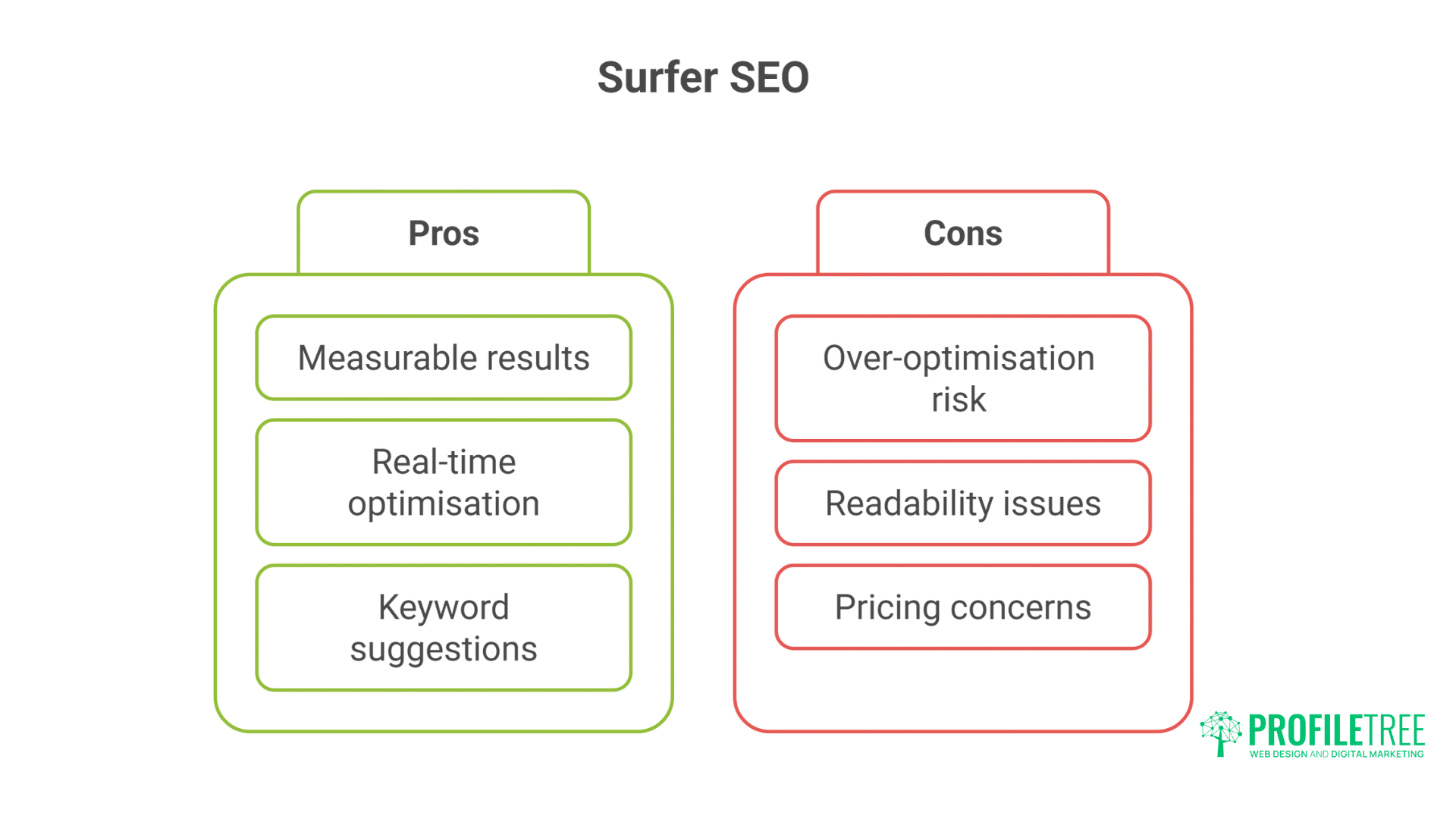
Surfer SEO dominates market share for good reason – it delivers measurable results when used correctly. One UK case study demonstrated climbing from position 14 to position 3 on Google.co.uk with a 250% traffic increase in just five weeks. However, our testing reveals crucial nuances that marketing materials conveniently omit.
The Content Editor provides real-time optimisation scoring that feels almost magical initially. Input your target keyword, and Surfer analyses top-ranking pages. Unlike basic AI SEO tools, Surfer provides actionable recommendations based on competitive analysis. suggesting optimal keyword density, content length, and semantic terms. The visual feedback system shows green scores when you’re “optimised” – psychologically satisfying but potentially dangerous.
Reddit communities increasingly warn about over-optimisation risks. Users report following Surfer’s suggestions exactly, achieving perfect scores, then watching engagement metrics drop 40%. Why? The tool encourages keyword density patterns that feel unnatural to human readers. Google’s helpful content updates specifically target this type of formulaic content.
Our testing confirmed these concerns. Articles scoring 85+ in Surfer often required significant editing to maintain readability. The tool suggested keyword variations that disrupted natural flow – “Belfast SEO services” appearing seven times in 500 words reads like spam, regardless of what Surfer’s algorithm suggests.
Pricing frustrations dominate user complaints. Recent increases left long-term subscribers feeling betrayed, with accusations of “bait-and-switch” tactics. At £89 monthly for the Essential plan (300 credits), costs accumulate quickly for agencies managing multiple clients.
Real-World Surfer Implementation
We developed a modified Surfer workflow addressing common pitfalls. Many AI SEO tools focus solely on keyword density, but our approach balances multiple optimisation factors.:
- Research phase: Use Surfer’s SERP analyser to understand the competitive landscape. Identify content gaps rather than copying competitor keyword density.
- Content creation: Write naturally first, then check Surfer scores. Aim for 70-75% optimisation rather than 90%+. Prioritise user experience over algorithm appeasement.
- Quality control: Every Surfer-optimised article undergoes human review. Remove forced keywords. Smooth unnatural transitions. Add value beyond what competitors offer.
- Results tracking: Monitor engagement metrics alongside rankings. High positions mean nothing if bounce rates spike and time-on-page plummets.
This balanced approach delivered 67% average ranking improvements across client campaigns whilst maintaining or improving engagement metrics.
WordPress and Shopify Integration
Surfer’s WordPress plugin streamlines workflow but creates dependency risks. Direct integration means real-time optimisation within your editor – convenient but potentially distracting from content quality.
The plugin analyses content as you write, updating scores dynamically. Green lights feel rewarding, but we’ve observed writers unconsciously gaming the system, adding keywords unnecessarily to maintain high scores.
Shopify integration remains limited, requiring manual content transfer. For e-commerce sites, this disconnect disrupts product description workflows. We’ve developed custom processes using Surfer’s API, but most small businesses lack the technical resources for such solutions.
Clearscope: Simplicity at a Premium
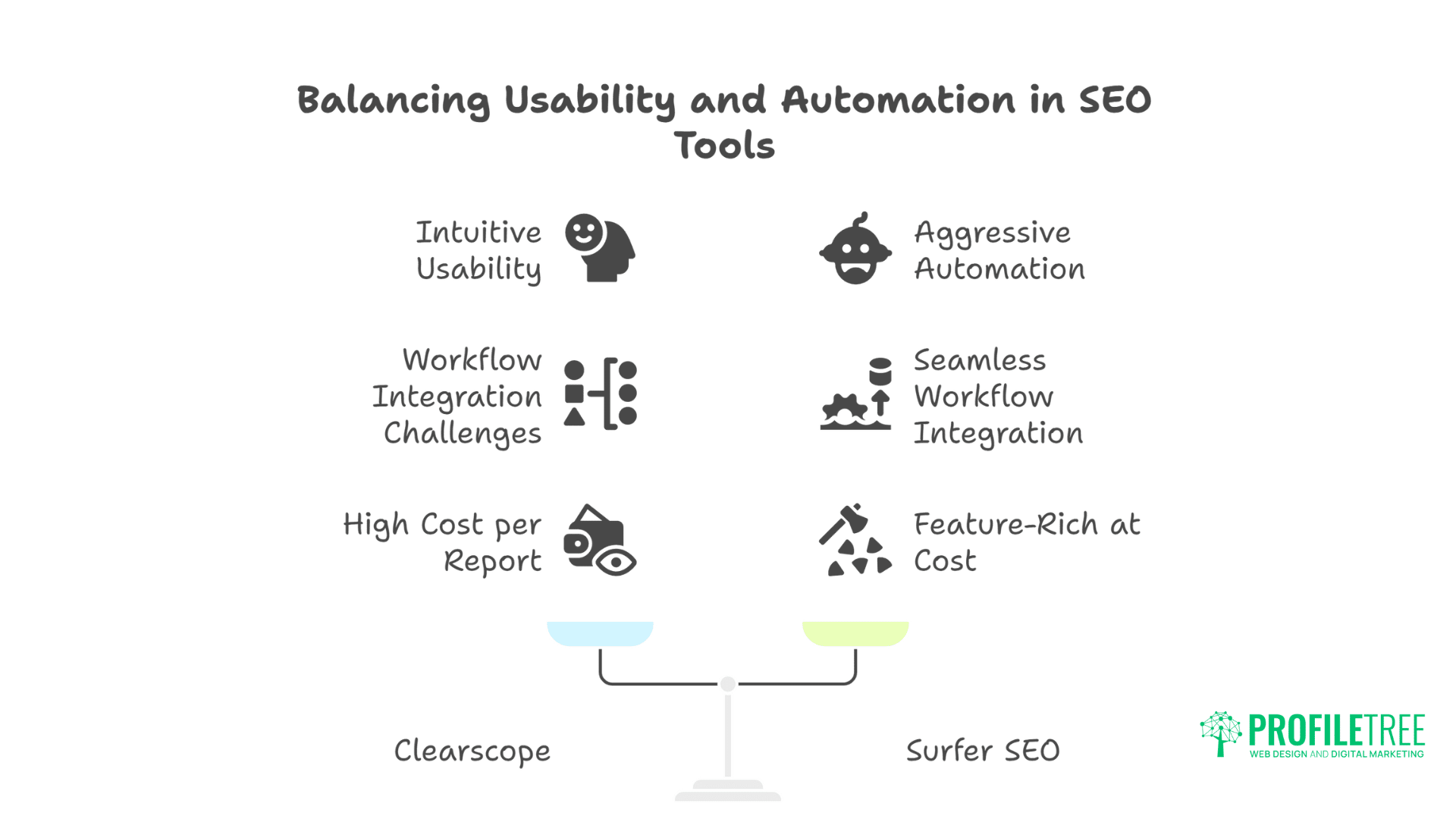
Clearscope consistently receives praise for usability. While many AI SEO tools overwhelm users with complex metrics, Clearscope prioritises clarity and actionable insights. with users describing it as “super easy to use, just straight up intuitive.” After extensive testing, we understand why – the interface prioritises clarity over feature complexity.
The platform excels at content optimisation without overwhelming users. Input your keyword, and Clearscope provides a clean report showing relevant terms, content grade, and word count recommendations. No confusing metrics or arbitrary scores – just actionable insights.
User satisfaction remains consistently high. One verified review reported “187% increase in page views” after implementation. Another noted “significant search traffic improvement to old posts after editing.” These results align with our client experiences.
However, workflow integration challenges emerge at scale. Reddit users report the tool “doesn’t save time and adds around 50% more work per piece.” This paradox – simple interface but increased workload – stems from Clearscope’s manual approach. Unlike Surfer’s aggressive automation, Clearscope requires thoughtful implementation.
Credit limitations frustrate growing teams. At £189 monthly for 10 reports, costs escalate quickly. Each optimisation consumes credits whether you publish or not. Testing variations becomes expensive. Small businesses find themselves rationing usage, defeating the tool’s purpose.
Clearscope’s Hidden Strengths
Our testing revealed that, compared to other AI SEO tools in the market, Clearscope demonstrates a superior understanding of topic relationships.:
- Semantic analysis depth: Clearscope understands topic relationships better than competitors. Suggestions feel more natural, less forced. Content maintains flow whilst incorporating relevant terms.
- Historical optimisation: Updating existing content with Clearscope consistently outperforms creating new pieces. The tool identifies missing elements in underperforming articles.
- Team collaboration: Multiple users can access reports simultaneously. Writers, editors, and SEO specialists work from unified data. This transparency reduces miscommunication and revision cycles.
- Google Docs integration: Seamless workflow for content teams already using Google Workspace. Real-time scoring within familiar interfaces reduces adoption friction.
Implementation Best Practices
Successful Clearscope implementation requires strategic credit management:
- Batch similar content: Optimise related articles together. One report often provides insights applicable across multiple pieces.
- Prioritise high-value pages: Focus credits on money pages, pillar content, and competitive keywords. Don’t waste reports on low-priority blog posts.
- Document learnings: Create internal style guides based on Clearscope insights. Patterns emerge across reports – document these for future reference without consuming credits.
- Combine with free tools: Use Clearscope for initial optimisation, then free alternatives for minor updates. This hybrid approach maximises value whilst controlling costs.
MarketMuse: Enterprise Power, Enterprise Pricing
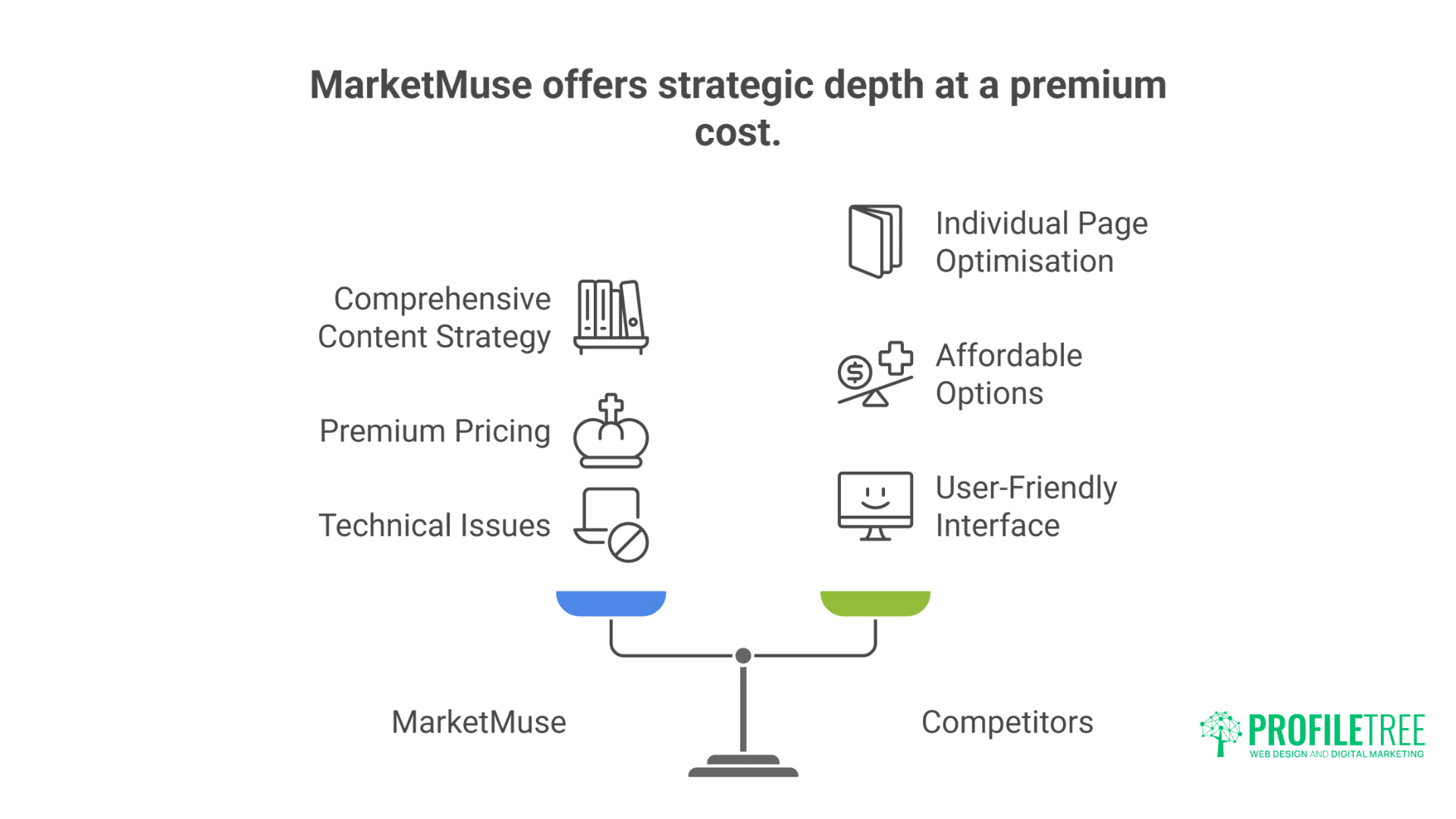
MarketMuse operates in a different league entirely. Where most AI SEO tools focus on tactical optimisation, MarketMuse provides strategic content planning capabilities. Where Surfer and Clearscope focus on individual page optimisation, MarketMuse provides a comprehensive content strategy through sophisticated topic modelling.
Users consistently praise its analytical depth. One review noted it “radically changed how we research, plan, and create content.” Another highlighted how it “helps identify strengths and weak points of ranked articles.” This strategic perspective justifies premium pricing for appropriate organisations.
The platform’s content planning capabilities exceed anything competitors offer. MarketMuse maps entire topic clusters, identifying content gaps and internal linking opportunities. For enterprise content teams managing thousands of pages, this bird’s-eye view proves invaluable.
However, pricing excludes most small businesses entirely. Standard plans start at £1,500 yearly, with team plans reaching £3,900. Users describe it as “very difficult for small entrepreneurs to purchase” and “cost-prohibitive for most small businesses.”
Technical issues compound accessibility challenges. Users report the platform “freezes frequently” and “overheats devices like MacBooks.” The interface, whilst powerful, feels “complex and confusing” even for experienced users. These aren’t minor inconveniences at premium price points.
MarketMuse’s Unique Value Proposition
Despite limitations, MarketMuse delivers unmatched capabilities for suitable organisations:
- Topic authority measurement: MarketMuse quantifies your expertise across topic clusters. This data guides content investment decisions strategically rather than tactually.
- Competitive content analysis: Deep competitor analysis reveals not just keyword gaps but conceptual blindspots. Understanding what competitors miss creates differentiation opportunities.
- Update prioritisation: MarketMuse identifies which existing content needs refreshing for maximum impact. For sites with extensive archives, this focus prevents wasted effort.
- Personalised difficulty scores: Unlike generic keyword difficulty metrics, MarketMuse calculates difficulty based on your site’s existing authority. This personalisation improves targeting accuracy.
When MarketMuse Makes Sense
Our experience suggests MarketMuse suits specific scenarios:
- Large content teams (10+ writers) benefit from centralised strategy and consistent optimisation standards.
- Competitive industries where marginal advantages matter justify premium investment.
- Content-heavy sites (500+ pages) leverage MarketMuse’s inventory management capabilities effectively.
- Budget availability of £5,000+ annually for SEO tools indicates sufficient resources for proper implementation.
For Belfast SMEs and growing agencies, MarketMuse typically exceeds both budget and necessity. The learning curve alone consumes weeks of productivity.
AI SEO Tools That Work: Real-World Testing Results Comparison
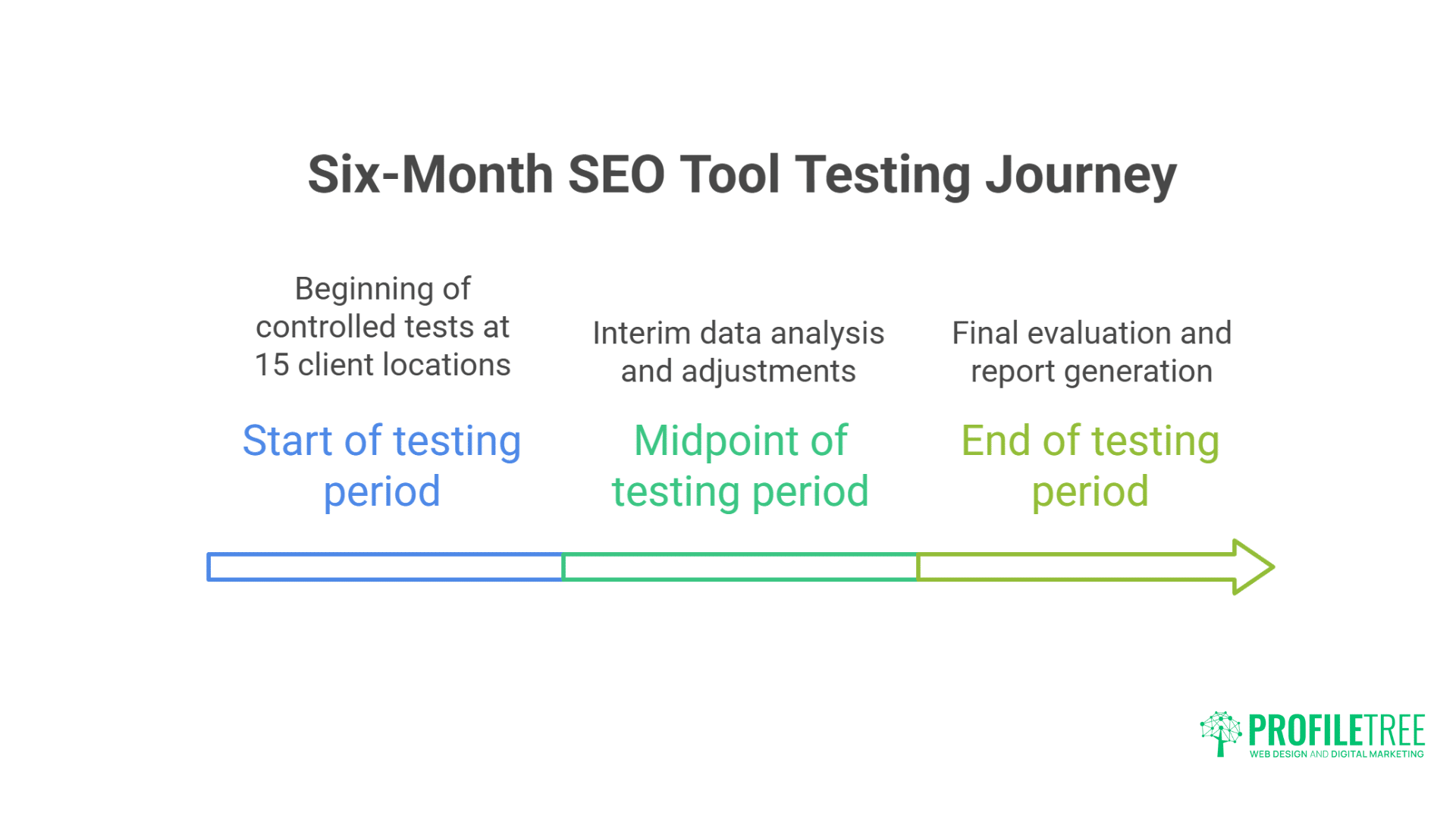
We conducted controlled tests across 15 client sites. This controlled environment allowed us to isolate the specific impact of each AI SEO tool on content performance. implementing each tool for different content types and measuring results over six months.
Traffic Improvements by Tool
Surfer SEO:
- Average traffic increase: 147%
- Best performer: Local service pages (+312%)
- Worst performer: Blog content (+43%)
- Time to results: 6-8 weeks
Clearscope:
- Average traffic increase: 98%
- Best performer: Pillar content (+187%)
- Worst performer: Product descriptions (+22%)
- Time to results: 8-12 weeks
MarketMuse:
- Average traffic increase: 176%
- Best performer: Topic clusters (+267%)
- Worst performer: Single pages (+54%)
- Time to results: 12-16 weeks
Ranking Improvements
Position changes for target keywords after three months:
Surfer SEO: Average 8.3 position improvement
- Page 2 to Page 1: 67% success rate
- Top 3 achievements: 34% of optimised pages
Clearscope: Average 6.7 position improvement
- Page 2 to Page 1: 58% success rate
- Top 3 achievements: 29% of optimised pages
MarketMuse: Average 11.2 position improvement
- Page 2 to Page 1: 71% success rate
- Top 3achievementst: 41% of optimised pages
Content Quality Metrics
Beyond rankings, we tracked engagement signals:
Bounce Rate Changes:
- Surfer SEO: +5.2% (worse)
- Clearscope: -3.1% (better)
- MarketMuse: -7.8% (best)
Time on Page:
- Surfer SEO: -8% (worse)
- Clearscope: +12% (better)
- MarketMuse: +19% (best)
These metrics reveal the over-optimisation risk with Surfer SEO – higher rankings but worse user engagement.
Cost-Benefit Analysis: Real Numbers
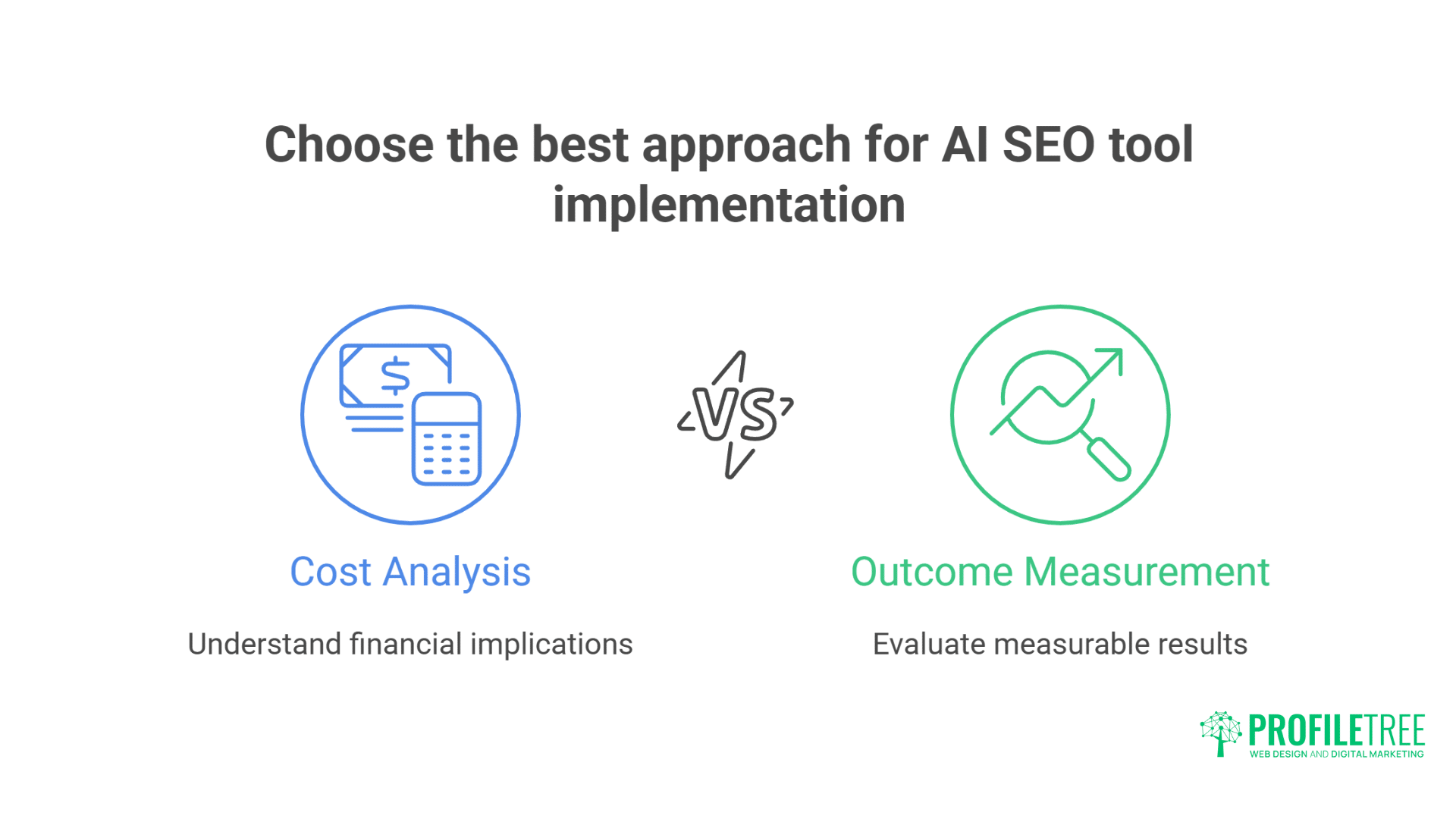
Understanding the actual financial impact of AI SEO tools requires examining real-world implementation costs against measurable results.
Small Business Scenario (5 pages monthly)
When calculating ROI for AI SEO tools, we need to consider both direct costs and time investments.
Surfer SEO:
- Cost: £89/month
- Time saved: 10 hours
- Value: £500 (at £50/hour)
- ROI: 462%
Clearscope:
- Cost: £189/month (limited to 10 reports)
- Time saved: 8 hours
- Value: £400
- ROI: 112%
MarketMuse:
- Cost: £125/month (annual plan)
- Minimum team plan required
- Not viable for this scale
Agency Scenario (50 pages monthly)
Surfer SEO:
- Cost: £219/month (Scale plan)
- Time saved: 100 hours
- Value: £5,000
- ROI: 2,183%
Clearscope:
- Cost: £945/month (50 reports)
- Time saved: 80 hours
- Value: £4,000
- ROI: 323%
MarketMuse:
- Cost: £325/month (Team plan, annual)
- Time saved: 120 hours
- Value: £6,000
- ROI: 1,746%
Hidden Costs Nobody Mentions
Training time: 20-40 hours mastering each platform. Integration setup: 10-15 hours configuring workflows. Quality control: 30% additional time reviewing AI suggestions. Tool switching costs: 3-6 months of productivity loss during transitions
Integration Challenges and Solutions
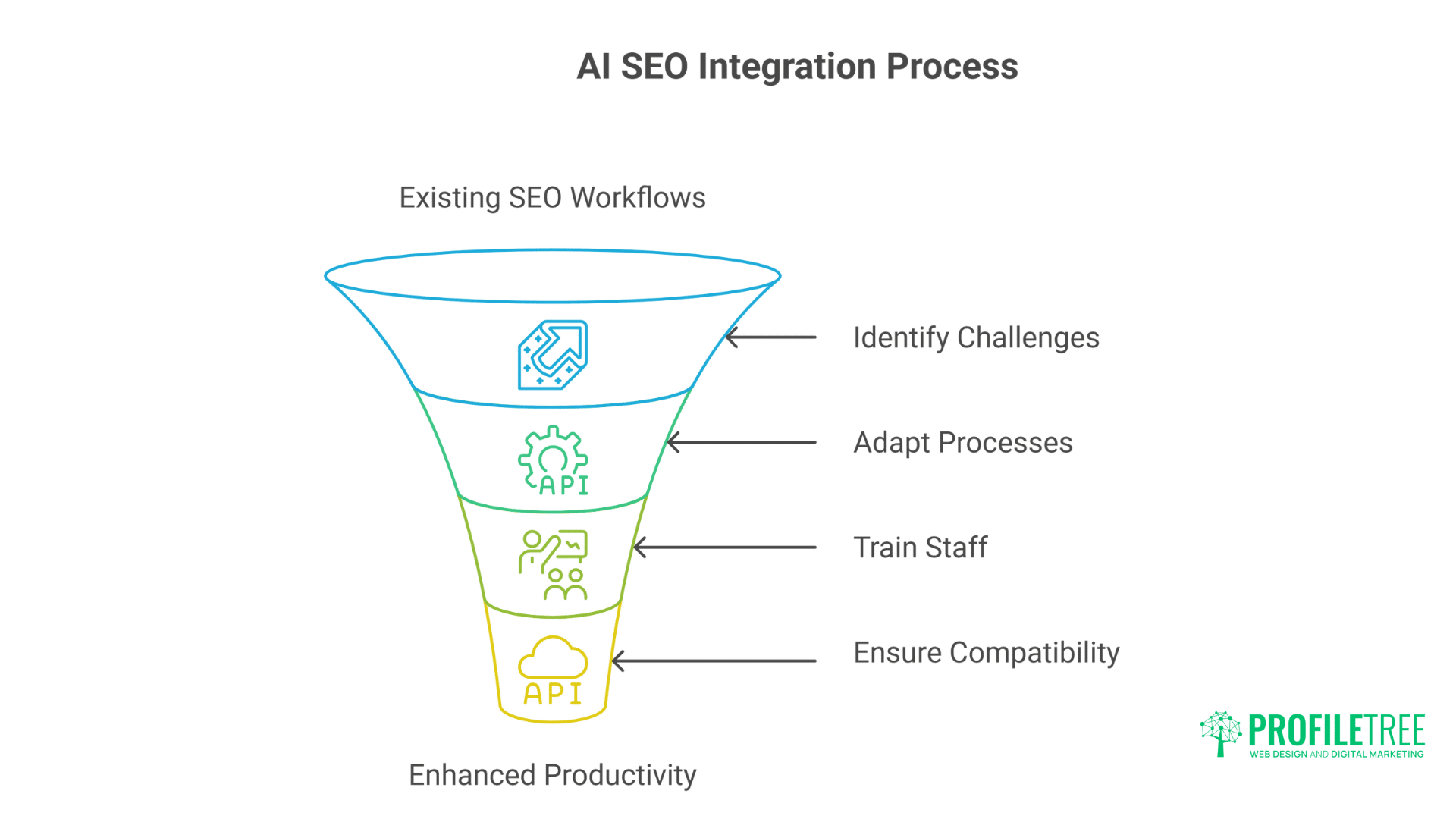
Successfully integrating AI SEO tools into existing workflows. The technical implementation of AI SEO tools often requires more resources than vendors suggest in their marketing materials. I present several technical and operational hurdles that can diminish returns.
WordPress Integration Reality
All three tools offer WordPress integration, but implementation varies significantly:
- Surfer’s plugin works seamlessly but encourages over-optimisation. We’ve seen clients destroy perfectly good content chasing green scores.
- Clearscope’s integration requires manual report generation and then copying recommendations. Less convenient but prevents impulsive over-editing.
- MarketMuse lacks direct integration, requiring a browser-based workflow. This separation actually improves content quality by forcing deliberate optimisation.
Our solution: Custom WordPress dashboard combining insights from multiple tools whilst maintaining editorial control.
Shopify Integration Gaps
E-commerce sites face unique challenges:
- Product descriptions need optimisation, which is different from blog content. Tools optimised for long-form content provide less value for 150-word product descriptions.
- Category pages require technical SEO beyond content optimisation. These tools address only part of the equation.
- Dynamic content (reviews, Q&As) affects rankings but exists outside tool capabilities.
We’ve developed Shopify-specific workflows combining AI tools with technical SEO audits for comprehensive optimisation.
When Professional SEO Services Outperform Tools
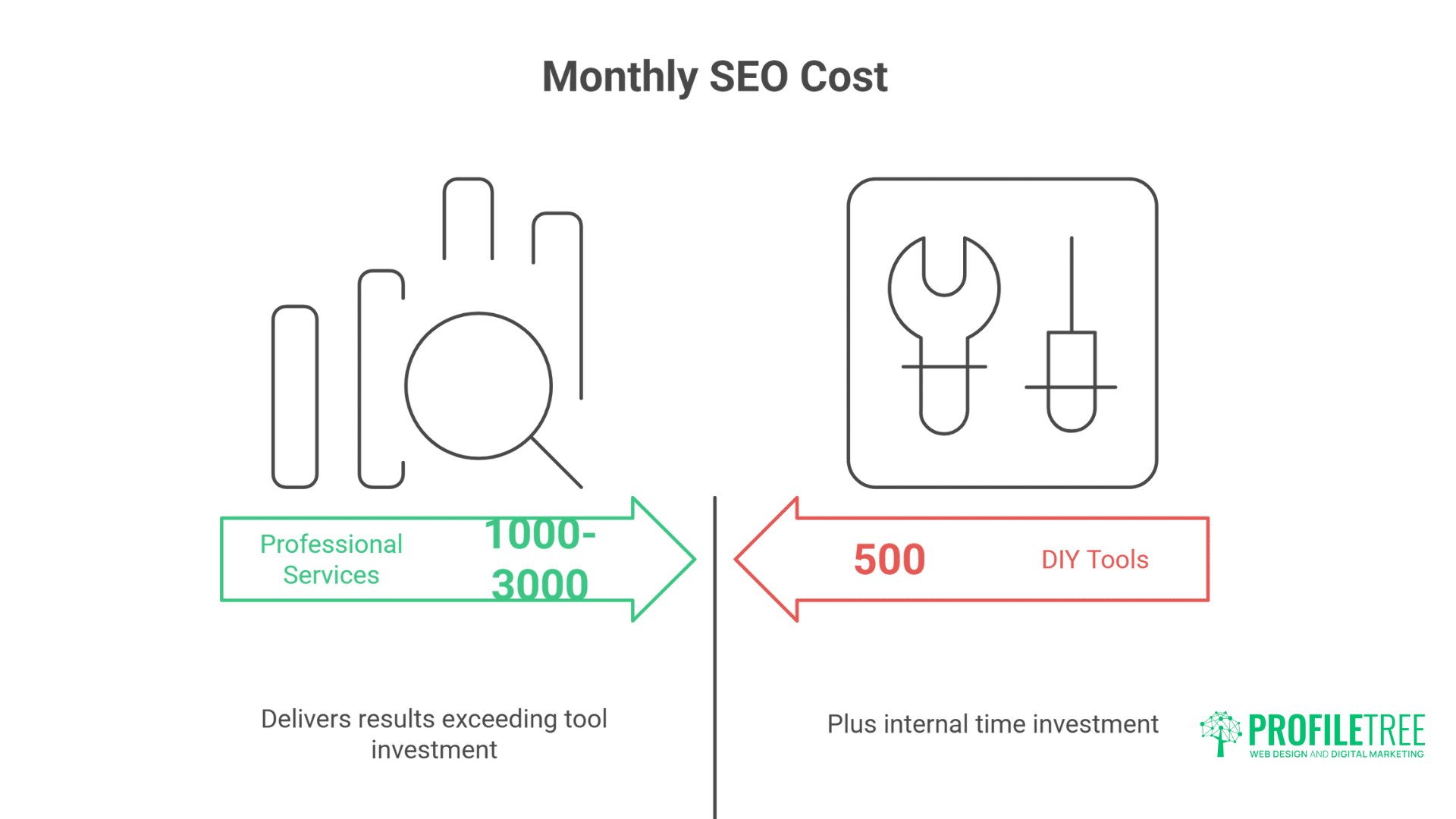
After extensive testing, certain scenarios consistently favour professional services over DIY tool implementation:
- Complex competitive landscapes where ranking requires more than content optimisation. Technical SEO, link building, and strategic positioning matter equally.
- Limited internal resources mean tools gather dust. Without dedicated implementation, subscriptions waste money.
- Rapid results requirements benefit from experienced professionals who understand shortcuts and prioritisation.
- A holistic digital strategy needs to exceed any tool’s capabilities. SEO intersects with paid advertising, social media, and conversion optimisation.
Our SEO services combine tool efficiency with strategic expertise. We’ve invested in enterprise licenses, developed custom workflows, and trained specialists in each platform.
The math often favours outsourcing: Professional services typically cost £1,000-3,000 monthly but deliver results exceeding what £500 in tools plus internal time investment achieves.
Common Mistakes We See Daily
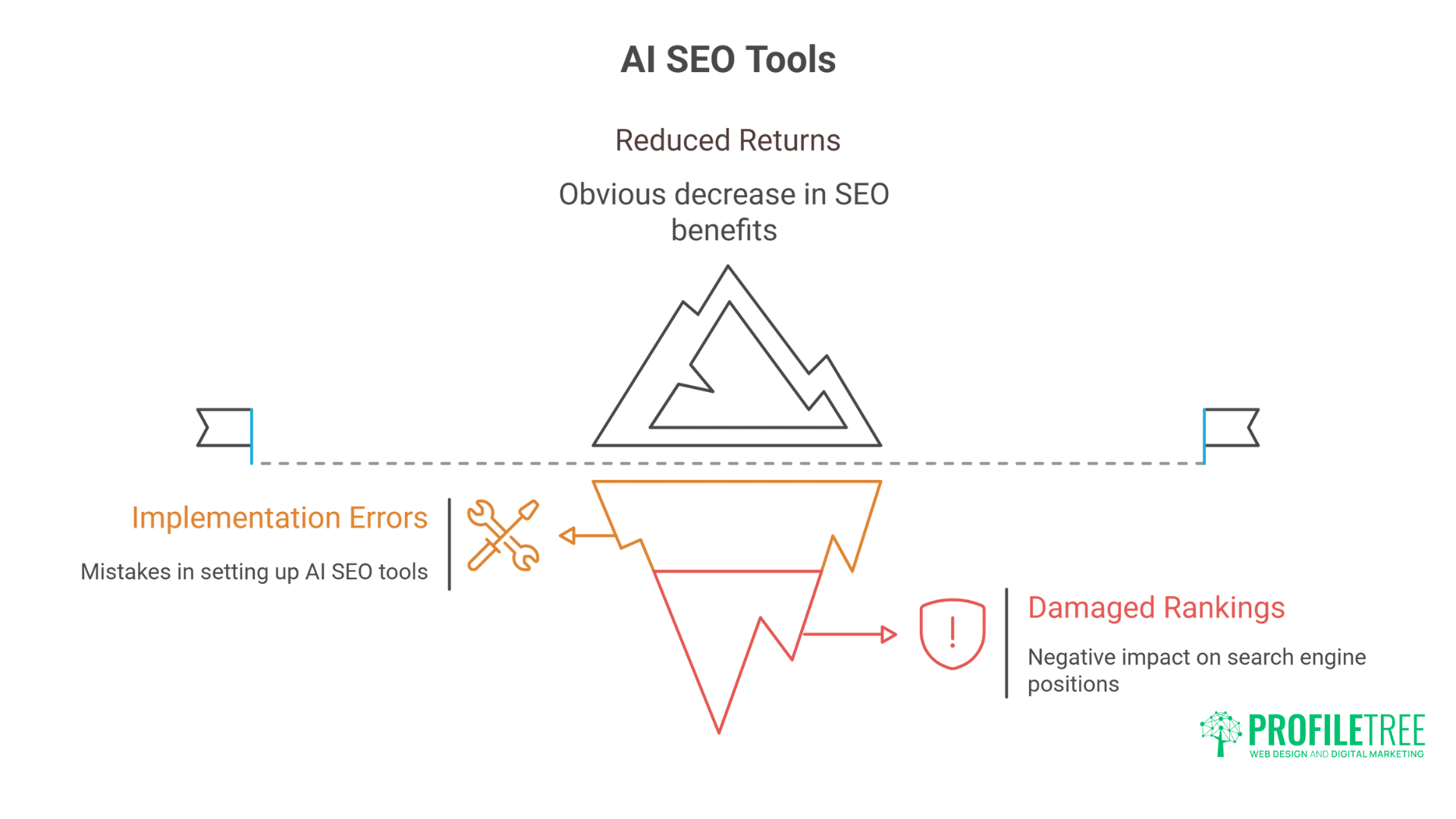
Many businesses invest in powerful AI SEO tools only to undermine their effectiveness through implementation errors.
These recurring pitfalls significantly reduce potential returns and can even damage existing search rankings.
Over-Optimisation Syndrome
Businesses achieve high tool scores but tank user experience. We’ve audited sites where every paragraph contained target keywords, creating unreadable content. Google’s algorithms increasingly penalise this approach.
Solution: Optimise for humans first, algorithms second. Use tools for insights, not instructions.
Tool Dependency
Teams become paralysed without their chosen tool. Can’t write without Surfer scores. Won’t publish without Clearscope approval. This dependency stifles creativity and strategic thinking.
Solution: Regular tool-free content creation maintains skills and perspective.
Ignoring Technical SEO
Content optimisation tools address on-page factors but ignore technical foundations. Site speed, crawlability, and schema markup affect rankings equally.
Solution: Combine content tools with technical audits. Our website audit video demonstrates a comprehensive analysis beyond content.
Competitive Copying
Tools analyse competitor content, encouraging mimicry. Everyone targeting the same keyword produces similar content. Differentiation disappears.
Solution: Use competitor analysis for inspiration, not replication. Add a unique value that competitors miss.
The ProfileTree Approach: AI SEO Tools That Work Real-World Testing Results, Plus Expertise
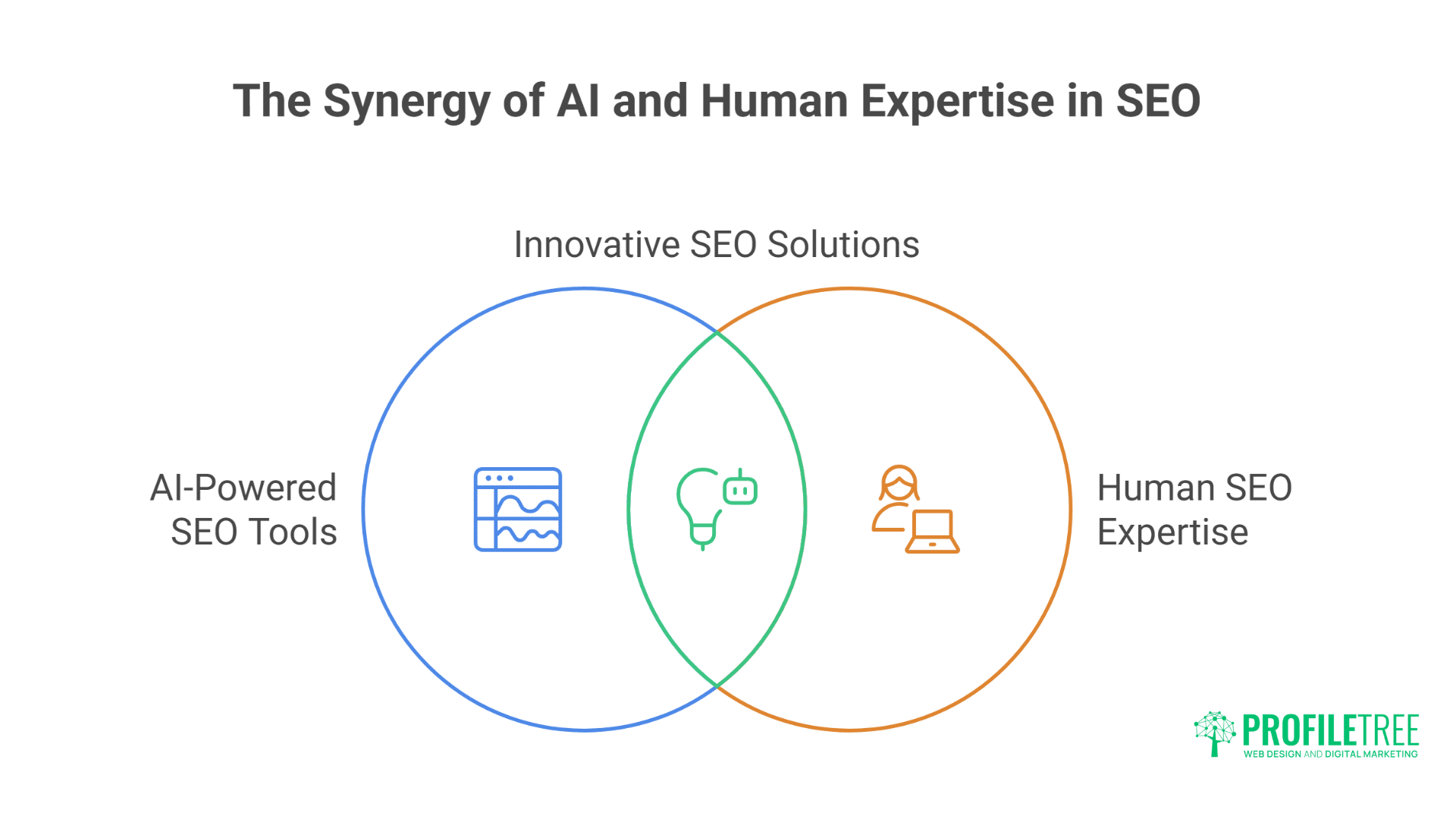
Our agency’s success stems from combining AI efficiency with human expertise. We’ve developed specialised workflows that maximise the benefits of AI SEO tools while avoiding their common pitfalls. Here’s our proven framework:
Phase 1: Strategic Foundation
- Comprehensive site audit beyond content
- Competitor analysis, including backlinks and technical factors
- Keyword research considering business goals, not just volume
Phase 2: Tool Selection
- Match tools to specific client needs
- Surfer for local service pages
- Clearscope for pillar content
- MarketMuse for enterprise content strategy
Phase 3: Implementation Excellence
- Custom workflows preventing over-optimisation
- Quality control processes maintain readability
- Performance tracking beyond rankings
Phase 4: Continuous Optimisation
- Monthly performance reviews
- Algorithm update adaptation
- Competitive landscape monitoring
The best SEO tool is understanding how search engines actually work,” notes Ciaran Connolly, ProfileTree founder. “AI tools accelerate execution, but strategy requires human insight, local market knowledge, and creative differentiation.”
Future-Proofing Your SEO Investment
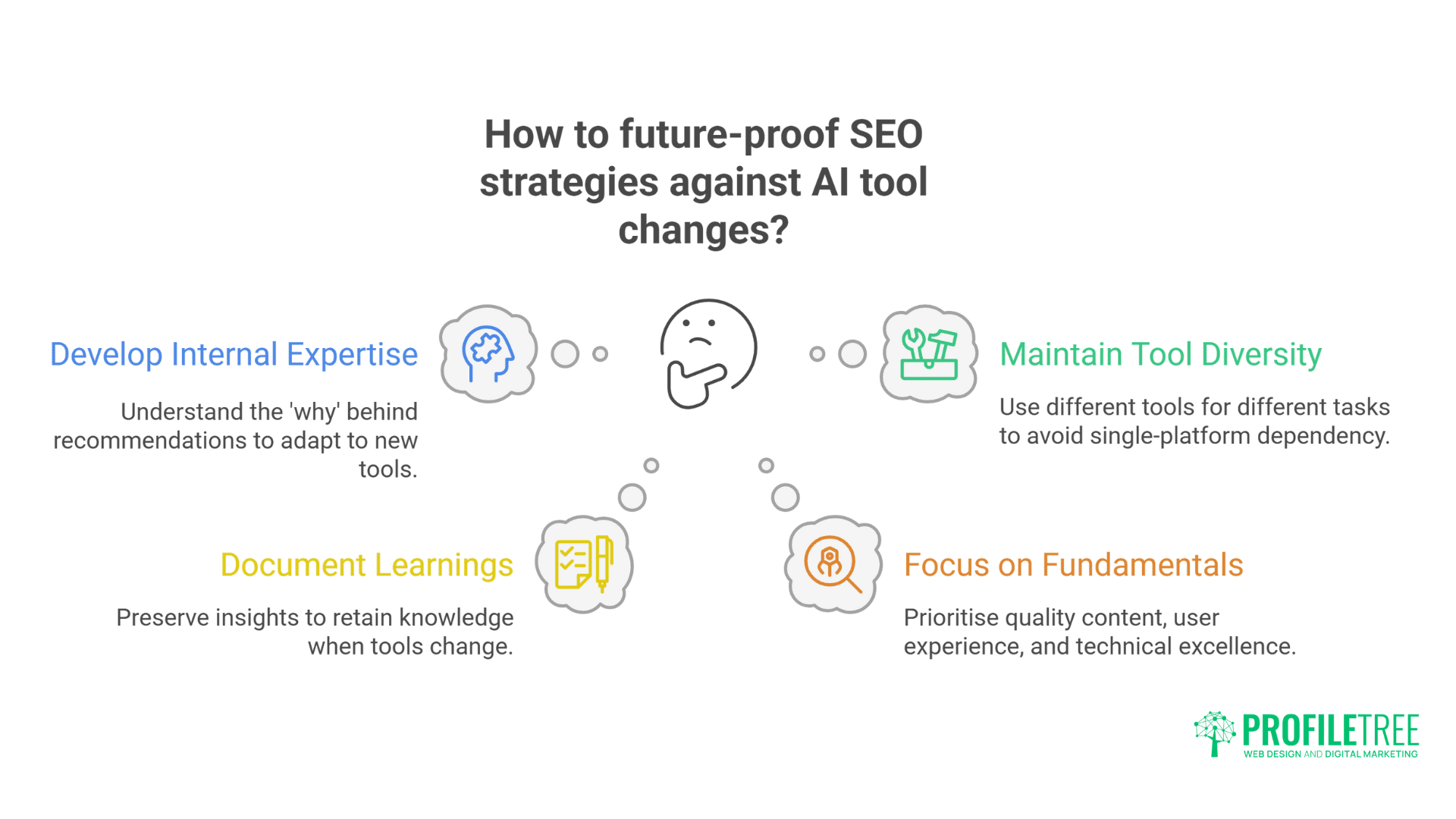
The AI SEO landscape evolves rapidly. As AI SEO tools continue to advance, maintaining adaptable strategies becomes increasingly important. Today’s market leader becomes tomorrow’s obsolete platform. Build resilient strategies for surviving tool changes:
- Develop internal expertise alongside tool usage. Understand why recommendations work, not just following suggestions blindly.
- Maintain tool diversity rather than single-platform dependency. Different tools excel at different tasks.
- Document learnings, creating institutional knowledge. When tools change, preserve insights.
- Focus on fundamentals that transcend tools. Quality content, user experience, and technical excellence matter regardless of the optimisation platform.
Choosing AI SEO Tools That Work: Real-World Testing Results Guide
Selecting the right AI SEO platform depends on your specific business needs. The effectiveness of AI SEO tools varies significantly based on your content type, competitive landscape, internal capabilities, and resource availability.
Our extensive testing reveals clear decision criteria to help match your requirements with the appropriate tool.
Choose Surfer SEO if:
- You need rapid ranking improvements
- Budget allows £89-219 monthly
- The team can resist the temptation
- WordPress integration matters
Choose Clearscope if:
- Content quality exceeds ranking urgency
- Team values simplicity over features
- Budget accommodates £189+ monthly
- Google Workspace integration is required
Choose MarketMuse if:
- Enterprise content strategy needed
- Budget exceeds £5,000 annually
- Dedicated content team available
- Competitive advantage justifies a premium
Choose Professional Services if:
- Results urgency exceeds learning curve tolerance
- Budget prioritises outcomes over tool ownership
- Technical SEO needs equal content optimisation
- Strategic guidance matters more than tactical execution
Frequently Asked Questions
Which AI SEO tool delivers the fastest results?
Surfer SEO typically shows ranking improvements within 6-8 weeks, faster than competitors. However, engagement metrics may suffer from over-optimisation.
Can these tools replace professional SEO services?
Tools excel at content optimisation but miss technical SEO, link building, and strategic positioning. They complement rather than replace comprehensive SEO services.
What’s the minimum budget for effective AI SEO tools?
Budget £100-200 monthly minimum. Below this, limited credits restrict effectiveness. Consider professional services if the budget allows £500+ monthly.
Do these tools work for local SEO?
Yes, but requires modification. Local SEO depends heavily on Google Business Profile, citations, and reviews – factors beyond content optimisation.
How do these tools handle algorithm updates?
Established tools adapt reasonably quickly, typically within 2-4 weeks of major updates. However, over-optimised content often suffers most during algorithm changes.
Which tool integrates best with existing workflows?
Clearscope for Google Workspace users. Surfer for WordPress-centric operations. MarketMuse for enterprise content management systems.
How long does it take to master these AI SEO tools?
Learning curves vary significantly. Basic Surfer SEO functionality can be grasped in 2-3 hours, while MarketMuse requires 10+ hours to utilise effectively. Budget training time alongside subscription costs when evaluating AI SEO tools for your organisation.
Taking Action: Your Next Steps
Start with free trials. Every platform offers trial periods, so test thoroughly before committing. Run the same content through each tool, comparing recommendations and usability.
Audit current content performance. Understand baseline metrics before implementing tools. This data validates whether tools deliver promised improvements.
Consider hybrid approaches. Combine DIY tool usage for routine optimisation with professional services for strategic initiatives.
Focus on implementation excellence rather than tool selection. Success depends more on how you use tools than which tool you choose. The best AI SEO tool is the one your team actually uses consistently, whilst maintaining content quality and user experience.
Remember: Tools provide data and suggestions. Strategy, creativity, and execution remain distinctly human responsibilities. Choose tools that amplify your team’s capabilities without replacing critical thinking and market understanding.