
SEO Copywriting in Belfast: Website Copy Written to Be Found
Table of Contents
ProfileTree provides SEO copywriting services from its Belfast office for businesses across Northern Ireland, covering service pages, blog posts, long-form guides and the meta titles and descriptions shown in search results. Each page is planned around the searches your customers already make, written by a human editor and checked against our editorial standard before it goes live.
Good copy works best as part of a wider search programme because better writing cannot fix a website that Google struggles to crawl or a site that few other websites link to. Our SEO Belfast service handles that wider work and starts with a free audit of your website, so you can see what is holding your pages back before any writing begins. This page covers the copywriting on its own: what it includes, how a project runs and what it costs.
SEO Copywriting Is Planned Around What Customers Search For
Standard copywriting is written to persuade a reader who has already arrived. SEO copywriting has a second job, which is to bring that reader to the page in the first place, and that job changes how the persuasion is written.
Every service page has two readers. The first is Google, which reads the title, the headings and the opening paragraphs to decide which searches the page deserves to appear for. The second is the person who clicks, and that person only arrives if the first reader was satisfied. A common weakness in the pages we review is that they were written entirely for the second reader, so they read well and are seldom found.
Take an accountancy practice in Lisburn whose services page talks about “tailored financial solutions”, a phrase nobody searches for. This is an illustrative example rather than a client page, but the pattern is common. The people who might hire the practice type things like “accountant for a limited company” or “self assessment help near me”, and if those words and the questions behind them are missing from the page, Google has little reason to show it. Fixing a page like this usually means moving the facts a buyer needs to the top, and that is why an SEO copywriter starts with the searches a page already earns or could earn, so the persuasion reaches people who are already looking.
For an existing website, your Search Console data shows those searches and the position each one reaches. Pages sitting just off the first page of results are usually the cheapest to improve because Google has already judged them relevant. For a new page, the evidence comes from keyword research, the questions in Google’s “People also ask” boxes and the kind of page Google currently ranks for each search.
What Our SEO Copywriting Covers
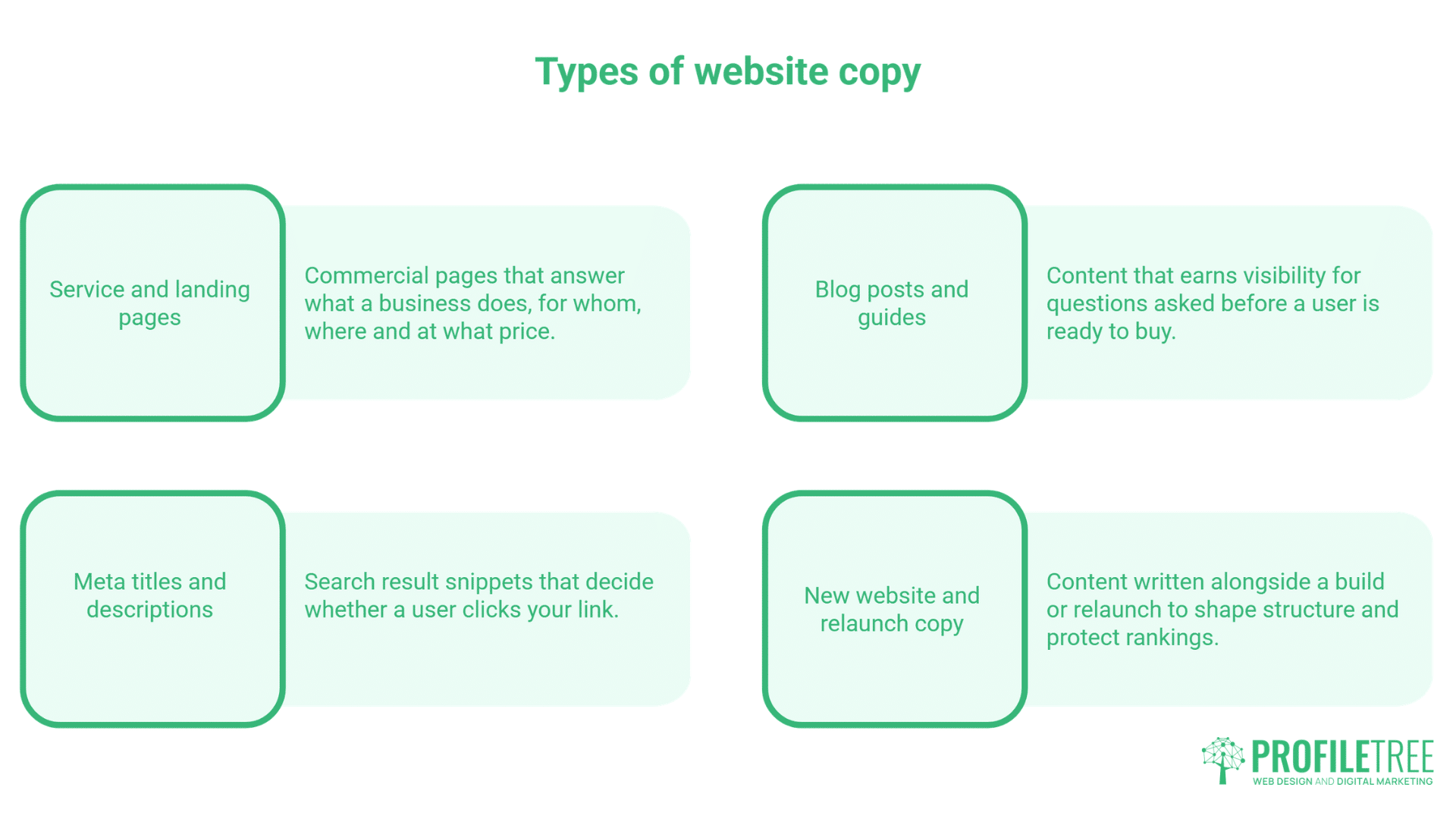
You can commission one type of copy or several. Each has its own brief because a service page is read by someone comparing providers, while a guide is read by someone still working out what they need, and the structure, length and calls to action differ between them.
Service Pages and Landing Pages
Service pages carry the most commercial weight on a business website because the person reading them is usually close to making an enquiry. Most of that weight lies in the opening, which readers use to decide whether to stay and which AI assistants such as ChatGPT and Google’s AI Mode tend to quote when they answer a question. A strong opening states what the business does, for whom, where and at roughly what price, in plain sentences that would still make sense if they were lifted out of the page.
Here is an illustrative kitchen fitter’s page written two ways. The weak version opens “Welcome to our website, where quality and craftsmanship come first”, which gives neither Google nor the buyer anything to work with. The stronger version reads: “We design and fit kitchens for homes across Belfast and Lisburn, from replacement doors to full rebuilds, with most fitted kitchens costing between [price band] and [price band] and taking around [number] days on site.” It answers the search and gives an AI assistant a sentence it can repeat, without being any longer than the first. The same thinking runs through the rest of the page.
| Element | Weak version | Stronger version | Recommendation |
| Opening line | A welcome or a statement about values | What you do, for whom, where and the price range | Rewrite the first 50 words before anything else on the page |
| Headings | Labels such as “Our Services” or “About Us” | Statements that answer a buyer’s question | Use headings a reader could skim to get the whole argument |
| Proof | “Trusted by many local businesses” | A named client, sector or result the business can stand behind | Replace every vague claim with a specific one or delete it |
| Price | “Contact us for a quote” | A starting price or a typical range | Publish a range wherever your pricing allows it |
Every service page we write is at least 1,200 words, reached by answering the buyer’s questions rather than by repeating the keyword, and ends with a questions section your developer can mark up with FAQ schema. We build that section from the questions your own customers ask, which makes it more useful to a buyer than a set of generic answers.
Blog Posts and Long-form Guides
Blog content earns visibility for the questions people ask before they are ready to buy, and it passes that authority to your service pages through internal links. We plan articles in groups, with one main guide on a topic supported by shorter articles that each answer a single related question and link back to it. Posts run to at least 1,500 words. Longer guides of 2,000 words or more also carry a short table of contents, a comparison table and a questions section.
Meta Titles and Meta Descriptions
The title and description shown in Google often decide whether a searcher clicks your result or the one above it. We write them as a separate deliverable for every page, with titles under 60 characters that put the service and place first, and descriptions of 150 to 160 characters that give a specific reason to click. Neither carries a year, so they do not go out of date.
Copy for New Websites and Relaunches
Copy is often left until the last weeks of a website project and written in a hurry, which is how sites launch without keyword mapping or internal links. When we write alongside a build, the keyword research shapes the sitemap and page structure from the start, and we work directly with your designer or developer. For a relaunch, existing pages can be rewritten before the new site goes live, which protects the searches the old pages already rank for.
Headings Should State Answers Because People Scan Them First
Many visitors scan a service page by its headings, and so do the systems that build AI answers. A heading such as “Our Process” tells them nothing, while a heading such as “Most kitchen fits take two to three weeks from survey to handover” (an illustrative example) tells them the thing they wanted to know and invites them to read the detail underneath. Written this way, the headings on a page form a summary that works on its own, so a reader who skims still leaves with the main facts and a reason to read further.
Each section under a heading should then deal with one question and open with its answer. Sections that try to cover three topics at once are hard to scan and hard for Google to match to a search, so we would rather add a heading than stretch a section.
Working With A Copywriter in Belfast
Every project starts with a written brief that names the main search for each page, the questions it must answer and the pages it should link to, and you approve the brief before any writing starts. The writer then speaks to the person in your business who knows the subject, by video call or in person in Belfast. That conversation supplies the examples, prices and opinions that make the copy specific to you, so a little preparation makes a large difference to the first draft.
Before the call, it helps to gather a few things:
- The questions customers ask most often on the phone or by email, in their own words, because those are frequently the searches they typed before they found you.
- Your real prices or price ranges and what changes them, since a page without any price information loses buyers who are comparing options.
- The jobs you turn down or the customers you are not right for, which lets the copy filter out enquiries that waste your time.
- One or two recent pieces of work the customer has agreed you can mention, with the sector, the town and what changed.
The draft then comes to you for review, and we make your amends. Before anything is published or handed to your developer, we check it against our editorial standard: every figure attributed to a named source or removed, one H1 with headings in order, UK spelling and dates throughout, and every internal link pointing to a live page.
Our Editors Write the Copy and AI Tools Support The Research
AI tools help our editors with research tasks such as grouping keywords and summarising sources. Google’s guidance on AI-generated content says it judges pages on quality rather than on how they were produced. The qualities it describes in its advice on helpful, people-first content, such as first-hand experience and a clear author, are the ones an unedited AI draft tends to lack, and they come from the conversation with your team.
Ciaran Connolly, founder of ProfileTree, describes the principle behind our briefs: “The principle that has guided over 1,000 projects is that the content has to serve the reader first. Not the search engine, not the brief, not the client’s preference for certain phrases. If the copy genuinely answers what the person was searching for, Google will figure that out. If it doesn’t, no amount of keyword optimisation will make up the difference.”
Copy for Buyers in Northern Ireland, Great Britain and the Republic
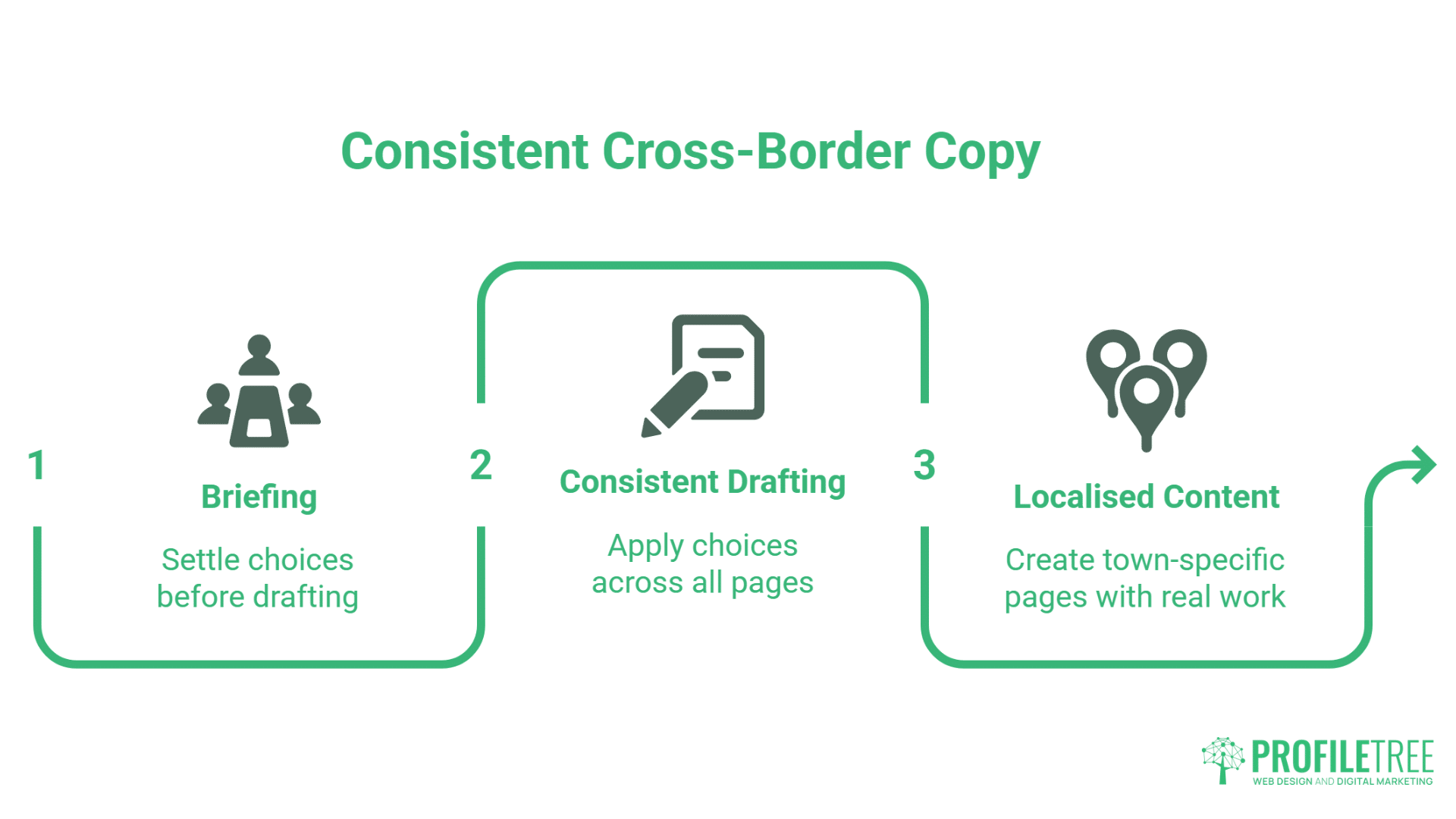
Many Northern Ireland businesses sell into Great Britain, and the Republic of Ireland as well as at home, and a page written for one market can quietly lose the other two. Prices may need to appear in both sterling and euro, and place names matter more than people expect: customers search for both Derry and Londonderry, and a page that uses only one name can miss part of its audience. We settle these choices in the brief, before drafting, so they are consistent across every page on the site.
Town names belong on a page where the business does real work in that area, ideally with a description of the work. Repeating Lisburn, Newry and Bangor down a page to catch searches reads badly and runs against Google’s spam policies on keyword stuffing. Separate pages for individual towns are a different job from service copy, and they only work when each one carries real local content instead of a shared template with the town name swapped.
SEO Copywriting Pricing
Every piece includes the brief, the writing, the editorial check, a meta title and a meta description, with schema recommendations noted for your developer. The figures below are starting points, and the final quote depends on how much research a topic needs and how much source material your team can supply.
| Content type | Typical length | Price |
| Blog post | 1,500 to 2,000 words | From £150 |
| Long-form guide or pillar page | 3,000 words or more | £400 to £800 |
| Service page or landing page | 1,200 to 2,000 words | From £250 |
| Full website copy for a new build or relaunch | Depends on the sitemap | £2,000 to £5,000 |
| Monthly content retainer | Agreed volume | Quoted on brief |
A service page written well once keeps earning visits for as long as its facts stay accurate. We recommend reviewing service copy at least once a year so that prices, examples and figures stay current.
Request a Copywriting Quote
ProfileTree is a Belfast web design and digital marketing agency, founded in 2011 and based at the McSweeney Centre, with more than 1,000 projects completed and more than 500 Google reviews with a 5.0 rating. Send the pages you need written or the website you want reviewed to hello@profiletree.com, or call 028 9568 0364, and we will reply with a draft brief and a quote.
FAQs About SEO Copywriting Services Belfast
How long does new copy take to show results in Google?
There is no fixed timescale, because the result depends on where the page starts and what it competes with. A rewritten page that already sits on the second page of results can move within weeks of Google recrawling it, since Google has already judged it relevant. A new page on a young website competing for a busy search usually takes several months, and the pace depends on the site’s existing authority and the strength of the pages already ranking.
What is the difference between copywriting and SEO copywriting?
Copywriting is written to persuade the reader. SEO copywriting is written to persuade the reader and to be found by them, so the work begins earlier, with keyword research, a decision about what kind of page Google rewards for the search, and a plan for headings, meta copy and internal links.
Can you rewrite pages that already exist on our website?
We can, and refreshing existing pages is often the quickest win, particularly for pages Google already shows just off the first page of results. We start from your Search Console data, keep the URL unchanged so the page keeps its history, and rewrite the copy around the searches it is closest to winning.
Who handles the rest of the SEO work if we only buy copywriting?
Copywriting can be bought on its own, and you can pair it with an in-house marketer or an existing provider who looks after the technical side.
Do you write for businesses outside Belfast?
We write for businesses across Northern Ireland, Great Britain and the Republic of Ireland, and the process is the same wherever you are based. Meetings take place by phone or video call, or at our Belfast office at the McSweeney Centre if you would prefer to meet in person.
Why is SEO copywriting more expensive than standard writing?
The price reflects the process that precedes and follows the writing itself. A typical piece involves keyword research and competitor analysis, writing and structural optimisation, an editorial QA pass, meta copy production, and internal link mapping. A standard copywriter delivers words. An SEO copywriter delivers a page optimised to rank.