
AI for Customer Onboarding: A Practical Guide for SMEs
Table of Contents
When a new client signs up for your service, every minute of confusion erodes the trust you worked hard to earn. For SMEs across Northern Ireland, the Republic of Ireland, and the wider UK, the window between a signed contract and a confident, active customer is where long-term loyalty is either built or lost. AI for customer onboarding is no longer a tool reserved for large enterprise SaaS companies; it is rapidly becoming the practical advantage that helps smaller digital services businesses reduce early churn, cut manual administration, and deliver a faster, more personalised start to every client relationship.
AI automation for customer onboarding addresses one of the most persistent challenges growing businesses face: the inability to deliver a consistent, high-quality onboarding experience at scale without proportionally increasing headcount. This guide breaks down the highest-impact use cases for AI client onboarding, how to implement them in a way that is compliant with UK and Irish GDPR, and how to build a hybrid model that keeps your team focused on the work that actually builds lasting relationships.
Why Manual Onboarding Is Failing SMEs at Scale
Most SMEs still manage client onboarding through a patchwork of emails, PDFs, shared folders, and manual check-ins. At low volume, this approach is workable. As the client base grows, it breaks down, leading to inconsistent communication, missed follow-ups, and a time-to-value (TTV) window that stretches from days to weeks.
Time-to-value is the point at which a new client first experiences a meaningful, measurable result from your service. The longer this window remains open, the higher the risk of early disengagement. A client who does not feel informed, capable, and actively supported within the first 30 days is significantly more likely to disengage before they ever reach the growth stage of the relationship.
The problem for growing SMEs is not effort; it is scale. A customer success team of three cannot personalise AI user onboarding for 50 new clients a month with the same quality they could manage for five. AI for customer onboarding closes this gap without requiring proportional investment in headcount. It handles the repeatable, high-volume layer of the onboarding journey so your team can focus on the interactions that genuinely require human judgment.
For many of ProfileTree’s clients, professional services firms, digital product businesses, and agencies across Belfast and Dublin, implementing AI automation for customer onboarding has been a turning point in both client retention and internal efficiency. Our AI transformation services are built around this exact challenge: helping NI and Irish SMEs move from reactive, manual onboarding to a structured, AI-augmented process that scales with their growth.
5 High-Impact Use Cases for AI in Onboarding
AI is not a single product; it is a category of techniques and tools applied across different stages of the client journey. Understanding which applications deliver the greatest return for your specific business model is the first step in building an effective AI onboarding strategy. The following five use cases represent the highest-value starting points for SMEs in digital services, professional services, and product-led businesses.
Personalised Learning Paths and Interactive Tours
Every new client arrives with a different level of digital familiarity, business goals, and starting point. A one-size-fits-all onboarding guide treats all of them identically, which means it serves none of them particularly well. AI user onboarding solves this by dynamically adapting the experience to each individual’s behaviour.
AI-driven digital onboarding platforms analyse how users move through your product or service interface in real time, which features they engage with, which steps they skip, and where they hesitate. A client who navigates confidently through setup is shown advanced functionality sooner; a client who stalls at a basic step receives additional guidance without manual intervention.
This kind of personalised AI user onboarding shortens time-to-competency consistently, not just for clients lucky enough to catch a team member at the right moment. Customer onboarding analytics from these platforms also give your team clear visibility into which onboarding stages are working and which are creating friction.
Automated Document Verification and KYC
For professional services, businesses, accountants, solicitors, financial advisers, and regulated digital service providers, AI client onboarding involves substantial document handling. Identity verification, contract signing, compliance declarations, and data processing agreements all create friction when managed manually, and errors in this layer carry regulatory consequences.
AI-powered OCR (optical character recognition) and document processing tools can verify uploaded identity documents, extract data from contracts, and cross-reference information against compliance requirements in a fraction of the time a human reviewer would take. This is particularly relevant under UK and Irish GDPR frameworks, where demonstrable accuracy in data collection and consent management is non-negotiable.
Automating this layer of AI client onboarding does not remove human accountability; it removes the repetitive, error-prone manual processing so that your team reviews exceptions and edge cases rather than routine submissions. The result is a faster, more accurate compliance layer that also generates the customer onboarding analytics you need for audit and reporting purposes.
AI-Powered Predictive Support
One of the most powerful applications of AI for customer onboarding is predicting where a client is likely to encounter difficulty before they actually do. Reactive support waiting for a client to raise a query or fall silent is inherently too slow for the critical first 30 days.
Predictive analytics models, trained on historical AI onboarding data, identify the stages where clients most frequently slow down or disengage. The system then triggers proactive interventions at exactly those points, such as a relevant help article, a prompt to book a call, or a short tutorial, before frustration sets in. This “just-in-time” approach is a defining characteristic of effective AI-driven digital onboarding: the right resource reaches the right client at the right moment, without a team member having to monitor every account manually.
Customer onboarding analytics from predictive support systems also give your customer success managers a clear risk dashboard, highlighting which new clients are progressing on track and which require direct human attention.
Sentiment Analysis for Early Risk Detection
Onboarding communications emails, chat messages, and support tickets carry signals indicating whether a client is engaged, uncertain, or beginning to disengage. These signals are subtle and impossible to monitor manually across a growing client base.
Sentiment analysis tools, powered by natural language processing, flag these signals automatically and alert your team to accounts requiring immediate attention. A client expressing low-level frustration may not phrase it as a complaint, but AI-enhanced client onboarding systems read the emotional register and route the conversation appropriately. For lean customer success teams, this triage capability ensures effort is focused on the accounts that need it most. The customer onboarding analytics produced by sentiment tools also provide a longer-term record of client health across the full onboarding period.
Content Localisation and Multi-Language Support
For businesses operating across Northern Ireland, the Republic of Ireland, and international markets, content localisation during onboarding matters more than it might initially appear. A client in Dublin and a client in London may be using the same platform but expect subtly different communication styles, regulatory references, and terminology. AI automation for customer onboarding handles this adaptation automatically.
AI-driven digital onboarding tools can localise welcome emails, help documentation, and guided walkthroughs to match a client’s regional context without requiring multiple manual content variants. ProfileTree’s AI chatbot solutions support multilingual queries in real time, removing language barriers at the support level and ensuring that every client, regardless of location, receives onboarding communications that feel relevant and professionally considered.
Navigating the Compliance Gap: AI, GDPR, and the UK Framework
This is the section that most AI-for-onboarding guides skip entirely, and it is arguably the most important one for any business operating in the UK or Ireland. Implementing AI for customer onboarding without a clear compliance framework is not a risk worth taking, particularly for regulated sectors where client data and automated decision-making intersect.
The UK GDPR and EU GDPR, which continue to apply in the Republic of Ireland, place specific obligations on businesses using automated decision-making in client-facing processes. If your AI onboarding system is making decisions that materially affect a client’s experience, routing them to a different service tier, declining a document submission, or automatically sending or withholding a communication, those decisions may be subject to data minimisation requirements, transparency obligations, and, in some cases, the right to human review.
This does not make AI-enhanced client onboarding unviable. It means it needs to be structured correctly from the start.
Data Minimisation
Only collect and process the data you actually need for the onboarding purpose. AI systems have a tendency to absorb every available data point; your implementation must define explicit boundaries around what data feeds the model and how long it is retained after the onboarding period ends.
Purpose Limitation
Data collected during AI client onboarding must not be used for purposes the client did not consent to at the point of collection. If you are using onboarding behavioural data to train a predictive model, that use must be transparently disclosed.
Human-in-the-Loop Requirements
Where AI onboarding is involved in significant decisions, particularly in financial services, legal services, or healthcare, GDPR Article 22 and the UK AI Safety framework require that a human can review and override automated decisions. Build this review layer into your workflow from the outset, not as a retrofit.
Transparency
Clients should know when they are interacting with an AI-powered system rather than a person. This is both a regulatory expectation and a trust issue. Research consistently shows that clients are comfortable with AI assisting them, but they object strongly to being misled about it.
ProfileTree’s AI transformation consultancy helps SMEs map their existing onboarding flows against UK and Irish GDPR requirements before any technical AI implementation begins, ensuring your AI-driven digital onboarding is compliant from day one.
The Hybrid Model: Balancing Human Expertise with AI Efficiency
The most effective AI customer onboarding implementations are not fully automated. They are hybrid systems in which AI handles the high-volume, repeatable, data-intensive layer while human expertise is reserved for strategic relationship-building, the work that your clients actually hired you to do.
Think of it as two parallel lanes. AI automation for customer onboarding manages the admin layer: document intake, progress tracking, automated guidance prompts, FAQ responses, and sentiment flagging. Your customer success team manages the relationship layer: introductory strategy calls, complex problem-solving, escalation handling, and the bespoke consultancy that no onboarding AI can replicate.
This division actually elevates the role of your customer success team rather than diminishing it. Instead of spending the majority of their time answering the same setup questions for every new client, they are freed to focus on the high-value interactions that genuinely differentiate your service. For many SMEs, this reallocation of team time is the single most important benefit of AI-enhanced client onboarding, more significant, in practical terms, than the direct cost savings.
The transition from manual to hybrid AI onboarding is more straightforward than it might appear. Audit your current onboarding workflow and categorise every task as either repeatable or relational. Repeatable tasks, such as sending welcome emails, collecting documents, answering common setup questions, and tracking progress milestones, are candidates for AI automation. Relational tasks, strategy sessions, account reviews, and escalation conversations remain with the team. Most SMEs find that 50–70% of their current onboarding activity is genuinely repeatable once it is mapped out clearly.
Implementation Roadmap: From Manual Process to AI-Augmented Onboarding
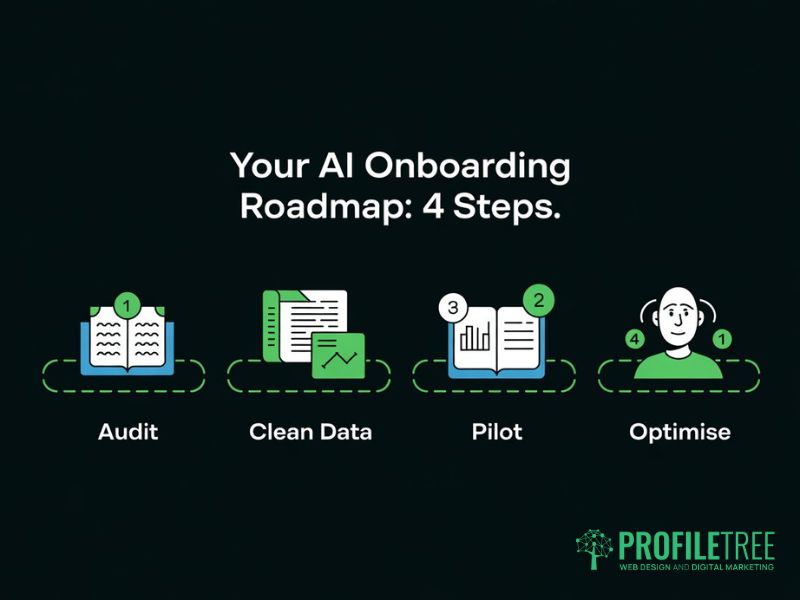
Moving from a manual workflow to an effective AI for customer onboarding system does not require a full technology overhaul. A phased approach lets you validate improvements at each stage before committing further.
Step 1: Audit Your Current Onboarding Flow
Document every step your team takes from the initial welcome communication to the point where a client is fully active. Identify where delays, errors, and support queries most frequently arise. This is the foundation of your AI client onboarding strategy. Use the customer onboarding analytics already available in your CRM as a starting point; most businesses have more performance data than they realise.
Step 2: Clean Your Data
AI-driven digital onboarding systems are only as reliable as the data they learn from. If your CRM records are incomplete or your onboarding metrics are tracked inconsistently, no AI onboarding tool will produce reliable outputs. Consolidate and clean your client data before implementing anything. This step is unglamorous but non-negotiable.
Step 3: Pilot One Use Case
Choose the single highest-impact use case for most SMEs; this will be automated document handling or predictive support, and run a controlled pilot with a defined cohort of new clients. Measure time-to-value, support query volume, and client satisfaction scores before and after. The results define the business case for broader AI automation for customer onboarding across your workflow.
Step 4: Integrate and Optimise
Once the pilot demonstrates clear improvement, integrate the AI layer into your standard process and expand to additional use cases. Review the customer onboarding analytics your system generates regularly, introduce human review where outputs are inconsistent, and refine based on real client behaviour.
ProfileTree’s digital marketing and AI services support SMEs through each stage of this roadmap, from initial audit to full AI-enhanced client onboarding implementation and team training.
Selecting the Right AI Onboarding Tools for Your Business
The market for AI customer onboarding tools has expanded significantly, but not every category suits every business type or budget. Matching the right tool to your specific onboarding challenges rather than adopting the most heavily marketed platform is what separates a successful implementation from an expensive experiment.
Digital Adoption Platforms (DAPs): These sit on top of your existing product or service interface and deliver real-time guided walkthroughs for new users. They are the most direct expression of AI user onboarding in practice, and best suited to businesses with a web application or client portal that clients must learn to navigate independently.
Conversational AI and Chatbots: AI-powered chat interfaces that handle common onboarding questions, route support queries, and provide availability outside business hours. This is typically the fastest entry point for AI automation for customer onboarding. ProfileTree builds custom AI chatbot solutions tailored to individual business workflows, providing SMEs with responsive AI onboarding support without the overhead of a large support team.
Predictive Analytics Platforms: These analyse historical client data to forecast behaviour and trigger proactive interventions. The customer onboarding analytics they generate are particularly valuable for teams managing high volumes of concurrent onboarding processes, though they require at least 12 months of client interaction data to function reliably.
Document Processing and OCR Tools: Automated intake, verification, and classification of client documents. Essential for regulated industries and any business running a compliance-heavy AI client onboarding process.
CRM-Integrated AI Modules: HubSpot, Salesforce, and Zoho all include native AI features supporting AI-driven digital onboarding. For SMEs already using these platforms, activating and configuring the built-in modules is often the fastest route to improved AI customer onboarding without a separate technology investment.
Building the Foundation for Long-Term Client Relationships
The goal of AI for customer onboarding is not to remove the human element from your client relationships; it is to ensure that human expertise is deployed where it genuinely matters: in the strategic conversations and complex judgements that only your team can make well.
The practical opportunity for SMEs across Northern Ireland, Ireland, and the UK is straightforward. AI automation for customer onboarding handles repeatable work at scale. Customer onboarding analytics provide visibility so your team acts on the right accounts at the right time. AI-driven digital onboarding adapts the experience to each individual without manual intervention. AI-enhanced client onboarding frees your best people to focus on the relationships that drive retention and referrals.
The AI customer onboarding experience you deliver in the first 30 days sets the tone for everything that follows. Investing in it is not a technology decision; it is a commercial one.
ProfileTree’s AI transformation services help SMEs design and implement AI client onboarding workflows that are practical, compliant, and built for the NI and Irish business landscape.
FAQs
1. How do I make sure AI for customer onboarding is GDPR compliant?
Build your AI onboarding implementation around three core principles: data minimisation (only process what the onboarding purpose genuinely requires), purpose limitation (do not use onboarding behavioural data for unrelated purposes without fresh consent), and transparency (inform clients clearly when AI is involved in their experience). For any automated decisions that materially affect a client, particularly in regulated sectors, ensure a human review mechanism is built into the workflow. If you are uncertain where the compliance line falls in your specific context, take legal advice before implementation rather than retrofitting controls later.
2. Can AI replace my customer success team?
No. AI automation for customer onboarding handles the repeatable, data-driven layer of the onboarding process, including document intake, progress tracking, automated guidance, common support queries, and sentiment triage. Your customer success team is freed from routine administration and can redirect that time toward strategic relationship-building, complex problem-solving, and the human conversations that determine whether a client remains loyal long-term. AI-enhanced client onboarding changes the composition of the team’s work; it does not eliminate the need for the team.
3. What is the fastest way to start with AI onboarding?
Begin with a conversational AI layer, a chatbot, or an automated FAQ system attached to your onboarding communications or client portal. This requires minimal data infrastructure, delivers immediate value by reducing the volume of routine support queries, and gives you a practical foundation to build more sophisticated predictive and analytics tools on top of as your confidence and data volume grow.
4. How does AI reduce time-to-value for new clients?
By predicting where clients are likely to encounter difficulty and surfacing relevant guidance before they need to ask for it. Rather than waiting for a client to raise a support ticket or fall silent, AI-driven digital onboarding triggers proactive interventions, such as a tutorial, a prompt to book a call, or a direct alert to their account manager at precisely the points in the journey where onboarding AI data shows the highest risk of friction. The result is a shorter, smoother path from sign-up to first meaningful result.
5. Is AI customer onboarding suitable for high-touch, enterprise-level clients?
Yes, and arguably more so than for self-serve users. AI enables a level of personalisation that a human team cannot consistently deliver at scale. For enterprise AI client onboarding, this means journeys that adapt to a client’s setup, regulatory environment, and the pace of different stakeholders within their organisation. The AI manages the complexity mapping and routine progress tracking; the human relationship manager focuses on the strategic conversations that drive account growth.