
Local SEO for Contractors: How to Win More Work in Your Area
Table of Contents
Local SEO for contractors means making your business visible when people in your area search for the services you offer. The key elements are a well-maintained Google Business Profile, consistent contact details across directories, location-specific website content, and a steady stream of genuine client reviews. These signals tell search engines your business is the relevant local answer.
When someone needs a plumber, electrician, builder, or landscaper, their first move is a Google search. “Electrician Belfast,” “builder near me,” “roofing contractor Northern Ireland.” Local SEO for contractors is what determines whether your business appears at that moment or whether a competitor does. It is not a complicated discipline, but it does require consistent attention to a specific set of factors: your Google Business Profile, your website’s local signals, your directory listings, and your reviews.
This guide covers each of those areas in practical terms, with the steps that actually influence local search rankings for trades and contracting businesses. It is written for contractors across Northern Ireland, Ireland, and the UK who want more enquiries from people in their area, not just more website traffic in general.
ProfileTree’s SEO services include local search strategy for trades and contracting businesses across Northern Ireland, Ireland, and the UK.
Google Business Profile for Contractors

Your Google Business Profile (GBP) is the most visible element of your local SEO. It controls your appearance in the map pack, the knowledge panel on the right side of search results, and local search listings. Most people searching for a contractor will see your GBP before they ever reach your website.
Setting Up and Completing Your Profile
Claim your GBP if you have not already done so, then work through every section. Your business name should match exactly what appears on your signage and official documents. Your address must be precise, your phone number current, and your website URL correct. Choose the most specific category available for your trade: “Plumbing Contractor,” “Electrical Contractor,” or “General Contractor” rather than a broad alternative. Add secondary categories if you cover multiple trades.
Write a business description that explains what you do, where you work, and what types of projects you take on. Use the language your customers actually use, not trade jargon. “Kitchen fitting Belfast” and “bathroom renovation Antrim” are more useful in a description than technical terminology that a homeowner would not search for.
Photos, Posts, and Keeping Information Current
Upload photos of completed projects regularly. Before-and-after images of real jobs give potential clients a clear picture of the quality of your work and the scale of projects you can handle. Include photos of your team and your branded vehicle if you have one. Google weighs GBP profiles with frequent photo activity more favourably than static profiles.
Keep your opening hours accurate and update them for bank holidays or planned closures. Add your services list with descriptions of each. Use the posts feature to share recent project completions or seasonal offers. A GBP that looks actively maintained signals to both Google and to potential clients that the business is operational and engaged.
Appearing in the Local Map Pack
The local map pack is the three-business block that appears at the top of Google results for location-based searches. For most contracting queries, appearing here generates far more enquiries than ranking on page one of organic results below it. The three main factors that influence map pack placement are proximity to the searcher, the relevance of your GBP category and content to the search query, and prominence, which Google measures partly through your review volume and quality and partly through backlinks to your website.
Consistent effort across all three factors, rather than focusing on just one, is what builds and maintains a map pack position over time.
Website Optimisation and Keywords
Your GBP gets you into local results. Your website is what converts those visits into enquiries. The two need to work together, and that means your website must also send clear, specific local signals to search engines.
ProfileTree’s website design service builds locally optimised site structures for trades and contracting businesses, and the development team handles the technical foundations that underpin strong local search performance.
Keyword Research for Contractors
Start with the services you offer and the areas you cover. A kitchen fitter based in Belfast who also takes jobs in Lisburn and Antrim has three geographic dimensions to work with for every service. “Kitchen fitter Belfast,” “kitchen fitter Lisburn,” and “kitchen fitter Antrim” are different keyword targets, and each can support a different page on your website.
Long-tail keywords, those with four or more words, are worth particular attention for contractors. “Emergency plumber Belfast weekend,” “loft conversion contractor Northern Ireland cost,” and “how much does a new bathroom cost in Belfast” are the kinds of specific queries that indicate high purchase intent. Someone searching for a general term like “plumber” may just be curious. Someone searching “emergency boiler repair Belfast” is ready to make a call.
Use Google’s autocomplete suggestions and the “People also ask” section in search results to find the actual language your potential clients are using. These are the questions being typed into Google, and answering them clearly on your website is one of the most reliable ways to attract qualified local traffic.
On-Page SEO for Contractor Websites
Each service you offer should have its own dedicated page, and each page should target a specific keyword and location. A single “services” page that lists everything you do will not rank as strongly for any individual term as a focused page would. Title tags and meta descriptions should include both the service and the location. Your H1 should match the primary term you want that page to rank for.
The first 100 words of each page matter more than most contractors realise. Google reads them to understand what the page is about. Get to the point quickly: state what service you offer, where you offer it, and who it is for. Do not bury that information after three paragraphs of general background.
Technical SEO and Mobile Performance
A slow or mobile-unfriendly website will not rank well, regardless of how good the content is. Most searches for trades and contractors happen on mobile devices, often by people in the middle of a problem: a leaking pipe, a broken boiler, a roof that needs attention. Your website needs to load fast, display correctly on a phone screen, and make it easy to find your phone number and call with a single tap.
Use Google PageSpeed Insights to identify specific performance issues. A logical site structure, where your homepage links to individual service pages which in turn link to relevant project examples and FAQs, helps both search engines and visitors find what they need without confusion. An SSL certificate (HTTPS) is a basic requirement.
Content, Citations, and Backlinks
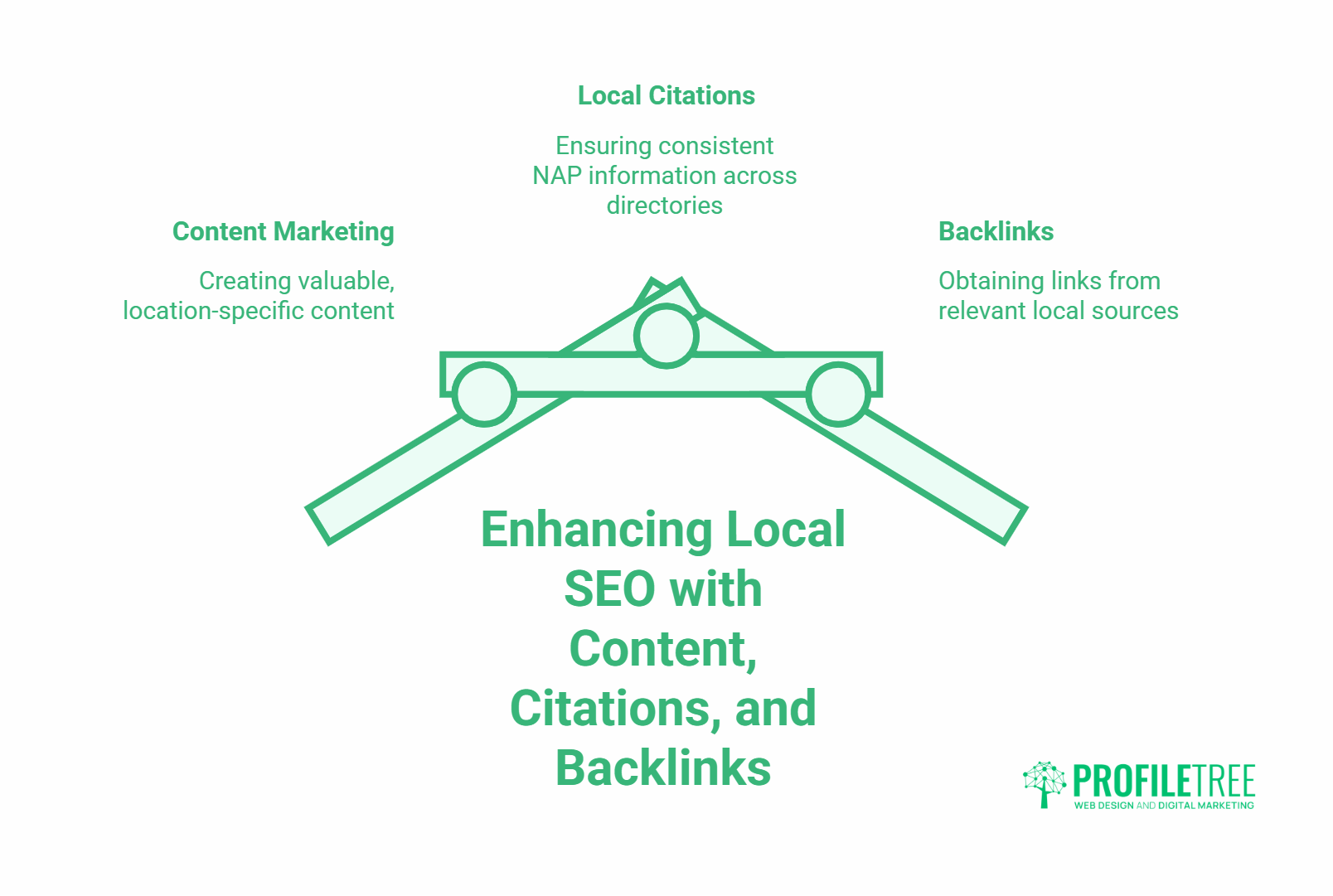
Ranking in local search requires more than a well-set-up GBP and a tidy website. Content that demonstrates genuine expertise, consistent citations across directories, and backlinks from relevant local sources all contribute to the authority signals that search engines use to rank local businesses.
Creating Content That Attracts Local Clients
ProfileTree’s content marketing service helps trades and contracting businesses produce the kind of substantive, location-specific content that builds rankings and earns enquiries.
The most effective content for contractors answers the questions potential clients are already asking: how much does a particular job cost, how long does it take, what should they look for when choosing a contractor, and what questions should they ask before signing a quote. This kind of content is useful, searchable, and positions your business as the competent, trustworthy option before a client has even made contact.
Project case studies are particularly valuable. A clear write-up of a recent job, including the challenge the client faced, the work your team carried out, the materials used, and the outcome, gives search engines indexable content specific to your service and location, and gives potential clients the social proof they need to get in touch. You do not need to identify clients by name; the project detail is what matters.
Local Citations and Directory Listings
A citation is any mention of your business name, address, and phone number (NAP) on another website. Google uses citations as a trust signal: consistent NAP information across reputable directories confirms that your business is legitimate and established at that location. The information must be identical everywhere it appears; a discrepancy as small as “Road” versus “Rd” in your address creates an inconsistency that undermines local ranking confidence.
Start with the major general directories: Yell, Thomson Local, and Google Business Profile itself. Then move to directories specific to the trades: Checkatrade, TrustATrader, Rated People, and any sector-specific directories relevant to your trade. Your local Chamber of Commerce and regional business networks add further citation sources and connect you to local community signals that strengthen geographic relevance.
Building Local Backlinks
Backlinks from relevant local websites tell Google that other credible sources consider your content worth referencing. For contractors, this means pursuing links from local business organisations, trade associations, suppliers, local press coverage of completed projects, and community sponsorships. A mention in a local newspaper article, a link from a local business directory you have joined, or coverage from a community event your company has supported all generate the kind of local backlinks that move local rankings.
The quality of the linking source matters far more than the number of links. A single link from a respected regional publication or a well-regarded trade body is worth more than dozens of links from low-authority directories. Aim for relevance and genuine geographic connection rather than volume.
Reviews, Social Media, and Tracking Performance
The practical work of local SEO extends beyond your website and directories. Reviews shape both your rankings and your reputation. Social media builds brand recognition that supports local search performance. And tracking what is working allows you to focus effort where it is producing results.
Getting and Managing Google Reviews
Google reviews are a direct local ranking factor. The number, recency, and average rating of your reviews all influence how prominently your business appears in local search results. Ask satisfied clients to leave a review at the natural close of a job, when the experience is fresh, and the outcome is positive. A follow-up text message or email with a direct link to your Google review page removes friction and significantly increases the likelihood that they will follow through.
When a negative review appears, respond promptly and professionally. Acknowledge the issue, offer to resolve it, and keep specific details offline. A measured response demonstrates professionalism to everyone reading the exchange, not just the person who left the review. Contractors who respond constructively to negative reviews consistently outperform those who either ignore them or respond defensively.
Social Media for Local Contractor Visibility
ProfileTree’s social media marketing service helps trades and contracting businesses build a consistent, credible presence on the platforms where local clients spend time.
Social media does not directly influence Google rankings, but it supports local SEO indirectly. Facebook is the most relevant platform for most residential contractors: homeowners looking for tradesperson recommendations frequently turn to local Facebook groups. An active business page with photos of recent work, genuine client reviews, and prompt responses to messages builds the kind of trust that generates referrals and direct enquiries.
Instagram works well for contractors whose work is visually compelling: landscapers, kitchen fitters, tilers, and decorators. Strong before-and-after images attract engagement from exactly the kind of audience that might need your services. LinkedIn is more relevant for commercial contractors seeking to connect with property developers, facility managers, or business clients.
Digital Strategy: Connecting the Moving Parts
ProfileTree’s digital strategy service helps contracting businesses align their SEO, content, social media, and web presence into a coherent plan rather than a collection of disconnected activities.
Google Analytics shows where your website visitors are coming from and which pages they spend time on. Google Search Console shows which queries your pages appear for, which positions they hold, and where click-through rates are low relative to your ranking. For most contractors, these two free tools provide everything needed to identify where local SEO effort is paying off and where attention is needed.
Measuring What Matters
Track the metrics that connect to actual business outcomes: the number of calls generated by your GBP, the volume of contact form submissions from your website, and the specific queries driving impressions and clicks in Search Console. Position rankings are a useful indicator, but enquiry volume is the number that matters. A contractor ranking fifth for “kitchen fitter Belfast” but generating ten enquiries a month is doing better than one ranking second but generating three.
ProfileTree’s digital training programmes cover Google Analytics, Search Console, and local SEO fundamentals for business owners who want to understand and manage their own online performance.
Starting Your Local SEO Strategy as a Contractor
The contractors who see the clearest results from local SEO start with the foundation: a complete Google Business Profile, consistent NAP details across directories, dedicated service and location pages on their website, and a reliable process for collecting reviews after each job. Get those right before adding content or paid activity on top. ProfileTree’s SEO team works with trades and contracting businesses across Northern Ireland, Ireland, and the UK to build that foundation and develop it into a sustainable source of local enquiries.
FAQs: Local SEO for Contractors
How long does local SEO take to produce results for a contracting business?
Most contractors see meaningful movement in local search positions within three to six months of consistent effort. Completing a Google Business Profile, auditing directory listings for accuracy, and building a review base can improve map pack visibility within weeks. Organic ranking improvements for competitive terms like “builder Belfast” or “electrician Northern Ireland” typically take six to twelve months of sustained activity. The timeline depends on how established your current online presence is and how competitive your local market is for your trade.
What is the most important factor in local SEO for contractors?
Your Google Business Profile is the single most important starting point. An incomplete or inaccurate profile is the most common reason contractors fail to appear in local search results despite having a website. After the GBP, consistent NAP information across directories and a genuine approach to collecting reviews are the next most impactful factors. These three elements, maintained consistently, will outperform a more complex strategy that neglects the basics.
Do contractors need a website to rank in local search?
You can appear in the map pack without a website, but having one significantly improves your rankings and your ability to convert visitors into enquiries. A website gives Google more signals about what you do, where you do it, and how established your business is. It also gives potential clients somewhere to see examples of your work, read reviews, and find your contact details without having to leave the search results and rely only on what fits in a GBP listing. For most trades, a website with dedicated service pages and location pages will outperform a GBP-only presence over time.
How do contractor reviews affect local search rankings?
Reviews influence local rankings directly through the number, recency, and average rating of your Google reviews. Google treats a strong, recent review profile as a trust signal that your business is active and well-regarded. They also influence click-through rates: a contractor with 4.7 stars and 45 reviews will attract more clicks than a competitor with no reviews, even if both appear at the same position in search results. Asking clients for a review at the natural close of each job, rather than in occasional bulk requests, produces the most consistent and credible review profile.
Should contractors have separate pages for each service and each location?
Yes. Each major service should have its own dedicated page targeting a specific keyword, and each area you serve should ideally have its own location page with genuinely local content. A single “services” page listing everything you do will not rank as strongly for any individual term as a focused, detailed page would. The same applies to locations: a roofing contractor serving Belfast, Lisburn, and Bangor will rank more strongly in each area with dedicated pages than with a single page that mentions all three locations in passing.
How often should contractors update their local SEO strategy?
Review your local SEO performance at least quarterly. Check your Google Business Profile for accuracy, look at your Search Console data to see which queries are generating impressions and which are converting to clicks, and assess whether your review count has grown. Google’s algorithm updates periodically shift which factors carry the most weight, so strategies that work well today may need adjustment. The fundamentals, a complete GBP, consistent citations, good reviews, and locally relevant website content, remain stable even as the weighting of specific factors shifts.