
Contextual Advertising: Targeting Without Tracking
Table of Contents
Contextual advertising places ads based on what a person is reading or watching right now, not what they did online last month. A running shoe ad appears on a marathon training article. A cloud software ad runs beside a piece on remote team management. The ad fits the moment without requiring any personal data about the person viewing it.
That distinction matters more than ever. Stricter privacy regulations, browser-level tracking restrictions, and the ongoing decline of third-party cookies have made user-behaviour targeting increasingly unreliable. Contextual targeting fills that gap cleanly: it reads the content, not the user. For businesses looking to run display advertising that is both effective and compliant with UK and Irish privacy law, it is worth understanding how this works in practice, not just in principle.
This guide covers the mechanics of modern contextual advertising, how it compares to behavioural targeting, what the privacy regulations actually require, and how to put contextual campaigns into operation through programmatic platforms.
What Is Contextual Advertising?
Contextual advertising is a display targeting method that serves ads based on the subject matter of the page or media the user is consuming at that moment. A web crawler or AI model analyses the content of a page, identifies its primary topics, keywords, and sentiment, then matches ads from relevant categories against that analysis.
The process happens automatically and at scale. An advertiser running a campaign for accounting software might target pages categorised under “business finance”, “tax planning”, or “SME operations”. When a user lands on a page that matches those categories, the ad serves. The advertiser never needed to know who that user is.
This is fundamentally different from the retargeting model that dominated digital advertising through the 2010s, where ads followed users from site to site based on browser cookies recording their history. Contextual advertising has no interest in history. It cares only about the current environment.
How Modern Contextual Advertising Works
The technology behind contextual targeting has changed considerably over the past decade. Early systems matched ads to pages using basic keyword lists. A page mentioning “running” got running shoe ads, even if the article was about the running of a business. Modern contextual systems use natural language processing (NLP) and, increasingly, computer vision to understand the meaning and sentiment of content, not just its surface keywords.
Page Crawling and Semantic Analysis
When a user requests a page, the publisher’s ad server triggers a bid request that includes a contextual signal packet. A crawler or pre-bid tool has already scanned the page and produced a semantic classification: the topics covered, the entities mentioned, the tone (positive, neutral, negative), and a brand safety score. That signal travels with the bid request into the programmatic auction.
Advertisers using a Demand-Side Platform (DSP) such as Google Display and Video 360 (DV360) or Amazon DSP can filter their bids based on these contextual signals. A campaign set to target “financial services, positive sentiment, brand-safe” will only bid on pages that match all three parameters. The result is ad placement that reflects the content environment without needing a cookie on the user’s device.
Multimodal AI: Analysing Video, Images, and Audio
Contextual targeting is no longer limited to written web pages. Modern AI systems analyse live video streams, audio content, and images using computer vision and audio transcription models. A connected TV (CTV) ad can now be served based on the scene playing on screen: a cooking segment triggers kitchenware ads; a travel documentary about Scotland triggers whisky or outdoor equipment ads in real time.
In podcast advertising, audio transcription models convert speech to text, classify the topic, and match pre-roll or mid-roll ad slots to relevant categories. This is why podcast advertising has become a significant contextual channel: listeners who engage with a personal finance podcast are, at that moment, demonstrably interested in money. The ad placement reflects the content rather than a probabilistic model of the listener’s browsing history.
For brands running video campaigns, this multimodal approach opens up targeting options that did not exist five years ago. ProfileTree’s video marketing services increasingly factor in contextual placement alongside production, because where a video ad runs is as important as how well it is made.
Pre-Bid Contextual Filtering in the Programmatic Pipeline
One aspect that most introductory guides skip over is how contextual signals integrate into programmatic bidding before the auction, not after. Tools such as Integral Ad Science (IAS), DoubleVerify, and Oracle Grapeshot operate as pre-bid contextual adapters. They classify inventory before bids are submitted, so advertisers can exclude categories such as news content with a negative sentiment score, political content, or pages covering sensitive topics, without wasting money bidding on impressions that then fail a post-impression brand safety check.
The practical benefit: budgets are spent only on genuinely suitable placements. This makes contextual targeting more efficient than many advertisers initially expect. The filtering happens in under 100 milliseconds, well within the window of a standard programmatic auction.
Contextual vs. Behavioural Targeting: The Practical Difference
Both methods aim to serve relevant ads, but the mechanisms and the data they require are entirely different. Understanding that difference is essential for any business building a digital advertising strategy under current privacy constraints.
| Factor | Contextual Targeting | Behavioural Targeting |
|---|---|---|
| Targeting signal | Current page content and topic | Historical user browsing and profile data |
| Cookie dependency | None | High (third-party cookies or device IDs) |
| Consent requirement (UK GDPR) | Typically not required for targeting | Requires explicit opt-in consent |
| Personal data processed | No | Yes |
| Brand safety control | High (content-based filtering) | Lower (ad follows user regardless of context) |
| Scale post-iOS 14.5 | Unaffected | Significantly reduced (opt-in rates 20-40%) |
The scale reduction in behavioural targeting following Apple’s App Tracking Transparency (ATT) framework is worth pausing on. When ATT launched, average opt-in rates across iOS apps were reported at around 25% in early studies, meaning roughly three-quarters of iPhone users were no longer trackable through the mobile advertising ecosystem. That did not affect contextual campaigns at all. Contextual targeting operates the same way regardless of consent status, because it never processes personal data in the first place.
Why Privacy Regulations Make Contextual Targeting the Safer Choice
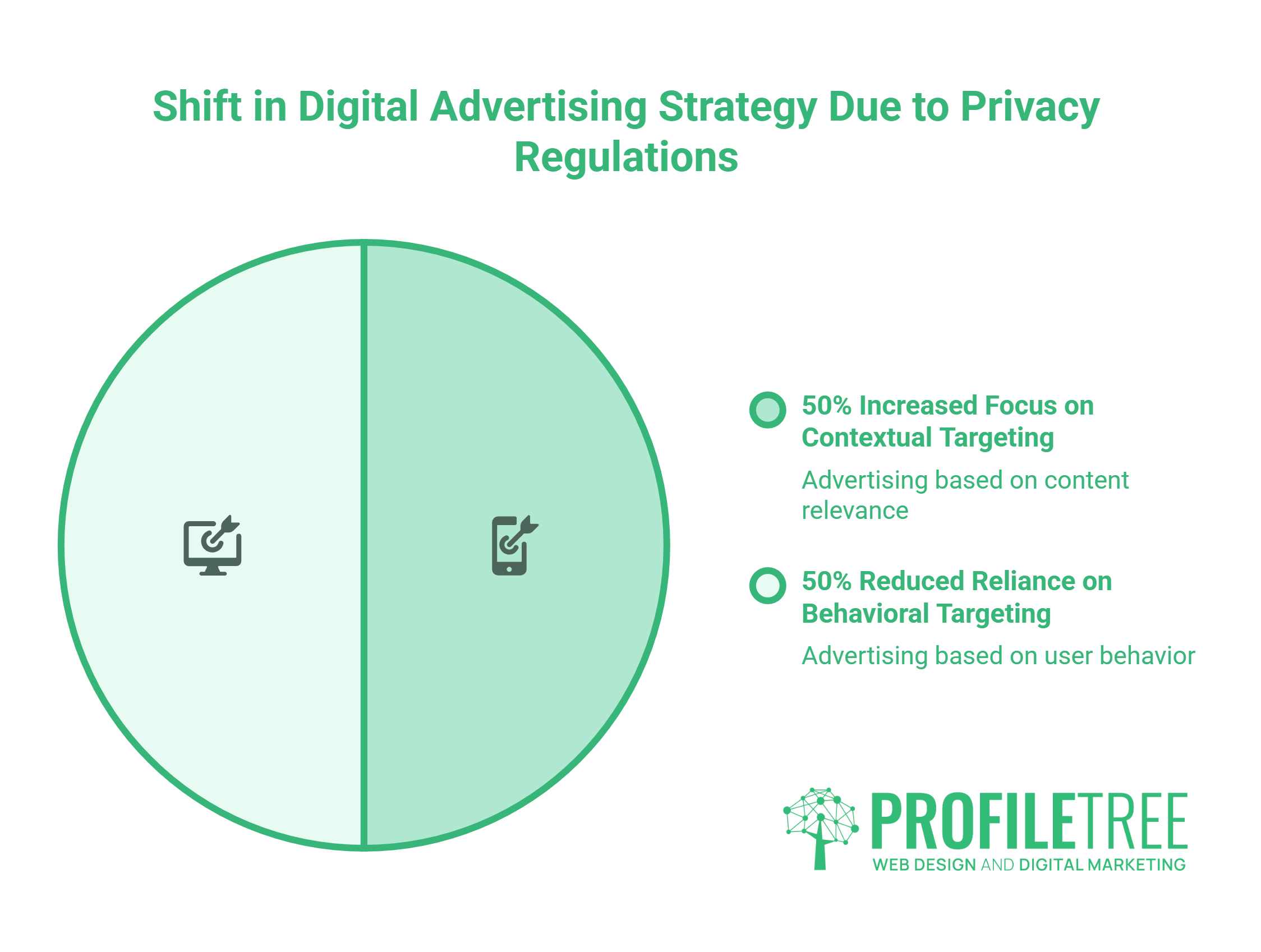
The regulatory environment for digital advertising in the UK and Ireland has tightened substantially since the original GDPR came into force in 2018, and ongoing enforcement action has clarified where the lines are drawn. Understanding the specific requirements, rather than treating “privacy compliance” as a vague concept, changes how you plan your advertising mix.
UK ICO Guidance and PECR Requirements
In the UK, the Privacy and Electronic Communications Regulations (PECR) sit alongside UK GDPR and govern the use of cookies and similar tracking technologies. The Information Commissioner’s Office (ICO) has been clear in its published guidance: placing non-essential tracking cookies on a user’s device requires freely given, specific, and informed consent. Consent must be as easy to withdraw as to give.
Contextual advertising that does not use tracking cookies or fingerprinting technologies falls outside the PECR consent requirement. The ad is served based on the content of the page, not data stored on the user’s device. This is a material compliance advantage. Businesses running behavioural retargeting campaigns are required to present compliant consent mechanisms and honour withdrawal; businesses running pure contextual campaigns are not relying on those mechanisms at all.
Irish DPC Enforcement and What It Means for Irish Businesses
Ireland’s Data Protection Commission (DPC) has issued several high-profile enforcement decisions in recent years, including significant fines against large platforms for consent mechanism failures. The DPC’s position on cookie consent is consistent with the ICO’s: consent for non-essential tracking must be unambiguous and freely given, and pre-ticked boxes or “legitimate interest” claims for tracking purposes are not compliant.
For businesses operating across Northern Ireland, Ireland, and the wider UK, contextual advertising reduces the compliance surface area. There are no consent banners to build correctly, no consent management platforms to maintain, and no audit trail of consent records to manage for targeting purposes. The ad placement is based on publicly available content analysis, not personal data processing.
A well-designed digital strategy accounts for these regulatory realities rather than treating privacy law as a future problem. The “cookieless future” that was discussed as a looming transition as recently as 2023 is now the operating environment. Browsers have moved, regulators have acted, and the advertising stack has adapted.
The Post-Cookie Reality for Media Buyers
Google’s decision to maintain third-party cookie support in Chrome, announced in mid-2024, was widely reported as a reprieve for behavioural advertisers. The reality is more nuanced. While third-party cookies still function in Chrome, the combination of Safari’s Intelligent Tracking Prevention, Firefox’s enhanced tracking protection, iOS ATT, and active ICO enforcement means that a significant proportion of the addressable audience is already unreachable through cookie-based targeting. The infrastructure is fragmenting regardless of Chrome’s position.
Contextual targeting does not fragment in this way. A page about home renovation is classifiable as “home improvement” whether the reader uses Safari, Chrome, Firefox, or a browser you have never heard of. The signal is the content, not the device or the user.
Types of Contextual Targeting Available Today
Contextual targeting covers a range of approaches, from broad category matching to granular semantic alignment. Understanding the options helps in building a campaign that balances scale with precision.
Category and Vertical Targeting
The most commonly used form: advertisers select content categories from a taxonomy (typically IAB standard categories), and their ads serve across all inventory classified under those categories. A legal services firm might target “law, government and politics” and “business and finance”. Category targeting delivers scale quickly and is the right starting point for most programmatic contextual campaigns.
Keyword and Sentiment Targeting
More granular than category targeting. Advertisers build keyword lists that reflect the language of the pages they want to appear alongside. A cybersecurity company might target keywords including “data breach”, “endpoint protection”, “ransomware”, and “GDPR compliance”. Sentiment filtering can then exclude pages where these terms appear in a negative context, for instance, a news article reporting a major breach rather than one advising on prevention.
Placement and Channel-Level Targeting
At the most specific level, advertisers can target named publishers or specific placements directly. A B2B software company might buy placements on named trade publications within a contextual deal, rather than relying on open programmatic inventory. This approach sacrifices scale for environmental quality and is typically used for brand-building campaigns where the publication’s authority matters as much as the audience.
Implementing Contextual Campaigns Programmatically
Running contextual advertising through a programmatic DSP is not as technically complex as it might appear, but the setup choices affect performance significantly. Here is a practical walkthrough of the key steps.
Platform Setup and Contextual Signal Configuration
In Google’s DV360, contextual targeting options sit within the targeting tab at the line item level. Advertisers can target by keyword lists, content categories, topics, and placement lists. For contextual-first campaigns, keyword lists and topic targeting are the primary tools. Build keyword lists around the language of your target audience’s content environment, not just the language of your product.
In Amazon DSP, contextual signals layer on top of Amazon’s own first-party shopping data. A campaign targeting gardening content combined with Amazon’s contextual signal for “lawn and garden” purchasers is a hybrid approach: contextual placement with first-party signal enrichment. This is closer to behavioural targeting and requires corresponding consent handling, but it illustrates how the boundary between methods is not always absolute.
Pre-Bid Brand Safety and Contextual Filtering
Connecting a brand safety tool such as IAS or DoubleVerify to your DSP allows pre-bid filtering by contextual category, sentiment score, and viewability threshold. For most advertisers, this is a worthwhile cost. Serving ads on brand-safe, contextually relevant inventory at a slightly higher CPM produces better outcomes than serving on cheap inventory that passes none of those filters.
Set up category exclusions for content types that conflict with your brand (news, politics, gambling, adult content, and so on), then layer on positive keyword inclusion lists. The combination of exclusion and inclusion filtering narrows the inventory pool to the placements that genuinely suit the campaign.
Campaign Structure for Contextual Campaigns
Separate contextual campaigns from any behavioural or retargeting campaigns running simultaneously. This makes performance analysis meaningful: you can attribute results to the targeting method rather than trying to separate intermingled signals. Run contextual campaigns with CPM or viewable CPM (vCPM) bidding initially to gather impression and engagement data, then optimise toward CPA or conversion goals once you have enough data to set realistic targets.
Ciaran Connolly, founder of ProfileTree, puts it plainly: “The businesses that will perform best in the next phase of digital advertising are those that understand their content environment, not just their audience profile. Contextual targeting rewards brands that know where their customers’ attention actually is.”
Contextual Advertising for SMEs in Northern Ireland and Ireland
Much of the existing writing on contextual advertising addresses large enterprise advertisers with significant programmatic budgets and in-house ad operations teams. The reality for most SMEs across Northern Ireland, Ireland, and the UK is different: smaller budgets, less internal resource, and a greater reliance on agency support or self-serve platforms.
The good news is that contextual targeting is accessible at a smaller scale through Google Ads’ Display Network, which supports topic targeting, keyword-based contextual targeting, and placement targeting without requiring a DSP contract or a large minimum spend. A local business running a display campaign can target pages about home improvement, food, or finance within a defined geographic area and a modest daily budget. The mechanics are the same as enterprise programmatic; the interface is just more accessible.
For SMEs considering a shift in their digital advertising approach, the starting point is usually a clear understanding of what their customers are reading and watching when they are in the mindset most relevant to the product or service. That question, rather than demographic targeting lists, defines a good contextual strategy. ProfileTree’s content marketing services often work alongside contextual advertising planning, because the two disciplines reinforce each other: strong content on your own site builds authority, while contextual advertising places your brand alongside strong content elsewhere.
Display advertising also connects naturally with SEO strategy. Contextual display campaigns build brand familiarity among audiences who are in the research phase, which tends to increase branded search volume and improve organic click-through rates over time. The channels are not competitors; they operate at different points in the same journey.
If you are building out your digital presence from scratch, the foundational elements matter before advertising spend: a website that converts, clear service pages, and a content strategy that gives contextual advertisers something relevant to appear alongside. ProfileTree’s website design and website development work is regularly paired with digital advertising planning for exactly this reason.
Measuring Contextual Campaign Performance
Measuring contextual advertising performance requires a different mindset from performance marketing metrics built around retargeting. Because contextual targeting reaches users at an earlier stage of awareness, direct last-click attribution will understate its contribution.
Metrics That Reflect Contextual Value
The metrics most relevant to contextual campaigns are viewability rate, view-through conversions (conversions from users who saw but did not click an ad), brand lift (measured through survey tools in DV360 or Amazon DSP), and time-to-conversion for new users acquired during contextual campaigns. Comparing the average order value or conversion rate of users who were exposed to contextual ads versus those who were not, using a holdout test, gives a cleaner picture of actual contribution.
Click-through rate (CTR) for display advertising is generally low across all targeting methods, usually well under 1%. A contextual campaign with a 0.08% CTR is not failing; that figure is within the normal range for upper-funnel display. The question is whether the users who did click, or who later converted after seeing the ad, show better downstream value than users acquired through other channels.
A/B Testing Contextual vs. Behavioural Segments
Where both contextual and behavioural campaigns are running, setting up a proper holdout test between them produces data that matters for budget allocation. The test needs a clean separation of audiences (contextual-only versus behavioural-only groups, no overlap) and a long enough run time to gather statistically meaningful conversion data. Four to six weeks is a minimum for most SME-level budgets; shorter tests produce noisy results.
If your primary metric is cost per acquisition, compare CPA across both segments. If the contextual segment is within 20-30% of the behavioural segment’s CPA while reaching audiences that the behavioural segment cannot (due to consent drop-off), the contextual investment is probably justified even at a slightly higher cost per conversion.
Tracking and analysis sit within ProfileTree’s digital strategy work, and it is worth getting the measurement framework right before scaling any display campaign. Poor attribution setups are the most common reason SMEs conclude that display advertising does not work for them, when the actual problem is that they were measuring the wrong things.
AI and the Next Stage of Contextual Targeting
The role of artificial intelligence in contextual advertising extends well beyond the classification systems already described. Two developments are worth tracking for anyone planning a contextual strategy over the next two to three years.
Generative AI and DCO: Creative That Matches the Context
DCO systems generate ad creative variants in real time based on contextual signals. If the page being viewed is about marathon training, the system serves an ad variant with running imagery and copy referencing race preparation. If the page is about gym workouts, a different variant with weights imagery and recovery language serves instead, even within the same campaign for the same product. The targeting remains contextual; the creative adapts to the context.
This is moving from experimental to mainstream in larger programmatic campaigns, and the tooling is filtering down to mid-market advertisers. It requires a content strategy that produces enough raw creative assets to feed the system, which is where ProfileTree’s content marketing and video production capabilities become relevant to advertising operations.
AI-Powered Contextual Advertising in Business Operations
For businesses looking to understand how AI is reshaping their marketing options more broadly, contextual advertising is one of the cleaner examples: AI doing classification work at a scale and speed no human team could replicate, applied to a problem (ad placement) with a direct commercial outcome. ProfileTree’s AI marketing services cover this territory, from understanding where AI adds genuine value in advertising to AI training for business teams who want to make informed decisions about their own technology choices.
Getting Started: Practical Steps for Businesses New to Contextual Advertising
For a business that has not run contextual campaigns before, the path from interest to live campaign does not need to be complex. Three things matter before any budget is spent.
First, define the content environments where your customers are most likely to be in a receptive mindset. A solicitor’s firm targeting business owners might focus on legal news, business finance publications, and SME advice sites. A building materials supplier might focus on architecture and construction trade publications. The content environment is the strategy; the technical targeting is just the implementation.
Second, the destination has to be ready. Contextual advertising that drives traffic to a slow, unclear, or unconvincing landing page wastes every pound spent on targeting. Audit your website before scaling spend. This includes load speed, mobile performance, and whether hosting and site management are stable enough to handle traffic spikes without affecting user experience.
Third, set realistic measurement expectations and agree on them before launch. Upper-funnel display advertising builds awareness before conversion. Measuring it purely on the immediate last-click revenue will produce misleading conclusions. Agree on the metrics that reflect the campaign’s actual objective.
Social media advertising can run alongside contextual display as a complementary awareness channel: ProfileTree’s social media marketing services often sit within the same broader campaign architecture. The platforms are different; the strategic logic is the same.
Frequently Asked Questions
What is an example of contextual advertising?
A running shoe brand serves a display ad on a website publishing a guide to marathon training. The ad appears because the page content matches the advertiser’s contextual targeting parameters, not because the reader has searched for running shoes or visited a sports retail site recently. The relevance is immediate and environmental.
Is programmatic advertising contextual?
Programmatic advertising is a buying method, not a targeting method. It describes the automated, real-time auction process for purchasing ad inventory. Contextual targeting is one of several methods you can use within a programmatic campaign to determine which inventory to bid on. You can run contextual targeting programmatically, but programmatic campaigns can also use behavioural targeting, demographic targeting, or retargeting. The two terms describe different layers of the same system.
What is the difference between contextual and behavioural targeting?
Contextual targeting matches ads to the content of the page being viewed. Behavioural targeting matches ads to a profile of the user built from their browsing history across multiple sites. Contextual targeting requires no personal data and no cookies. Behavioural targeting depends on third-party cookies, device IDs, or other tracking mechanisms and requires explicit user consent under UK GDPR and PECR.
Does contextual advertising work without cookies?
Yes, by design. Contextual targeting analyses the content of the page, not data stored on the user’s device. No cookie is required to classify a page about mortgage rates as belonging to the “personal finance” content category. This makes contextual advertising fully functional regardless of a user’s consent choices, browser settings, or device type.
Does contextual targeting require GDPR consent under UK ICO and Irish DPC rules?
Pure contextual targeting that does not process personal data or place non-essential tracking cookies typically does not require consent under PECR or UK GDPR. The ad is served based on publicly available content analysis. This contrasts with behavioural or retargeting advertising, which requires a compliant consent mechanism. It is good practice to confirm this with a privacy solicitor for your specific implementation, particularly if your DSP or contextual partner stores any signal data that could be classified as personal.