
What is Brand Trust? A Practical Guide for UK and Irish Businesses
Table of Contents
Brand trust is the confidence a customer has that your business will consistently deliver what it says it will. It is not a feeling you can manufacture through a clever campaign. It is the accumulated result of every interaction, every promise kept, and every time a customer’s expectations were met or exceeded.
For SMEs across Northern Ireland, Ireland, and the wider UK, brand trust has never mattered more — and never been harder to earn. A 2024 Edelman Trust Barometer survey found that 81% of consumers need to trust a brand before they will buy from it. Yet trust in businesses fell across the UK over the same period, driven largely by economic pressure, greenwashing scandals, and the growing ease of sharing negative experiences online.
This guide explains what brand trust actually means, how it is built and measured, and what to do when it breaks down — with specific context for UK and Irish businesses navigating today’s market.
Defining Brand Trust: The Three Pillars
Brand trust rests on three distinct but interdependent foundations. Understanding each one matters because a weakness in any single pillar undermines the whole structure, even if the other two are strong.
Competence
Competence trust means customers believe you can deliver what you promise. A web design agency that produces sites on time and to the brief builds competence and trust. A restaurant that consistently serves good food builds competence and trust. This pillar erodes quickly when a business overpromises, misses deadlines, or delivers poor quality.
Integrity
Integrity trust means customers believe you are honest and that your values align with theirs. This includes pricing transparency, honest reviews, clear terms and conditions, and accurate marketing claims. In the UK, the Competition and Markets Authority (CMA) and the Advertising Standards Authority (ASA) both enforce standards here, particularly around greenwashing. A brand that claims environmental credentials it cannot substantiate faces both regulatory and reputational consequences.
Benevolence
Benevolence trust means customers believe you have their best interests at heart, not just your own. This is the most difficult pillar to build and the most powerful when you achieve it. It shows up in after-sales support, in how complaints are handled, in accessible pricing for smaller customers, and in the way a business communicates during difficult periods.
The table below shows what happens when each pillar fails independently.
| Pillar | When it fails | Customer response |
|---|---|---|
| Competence | Marketing claims are misleading, and pricing is unclear | Customers stop buying, leave negative reviews |
| Integrity | Marketing claims are misleading, pricing is unclear | Customers feel deceived; share warnings |
| Benevolence | Support is poor, complaints go ignored | Customers feel used; long-term churn increases |
Why Brand Trust Matters for UK and Irish SMEs Right Now
The economic context matters. The cost-of-living pressures of recent years have fundamentally shifted how UK and Irish consumers evaluate brands. Trust is no longer primarily about aspirational identity — the luxury badge or the lifestyle association. For most purchasing decisions, it’s about value, transparency, and reliability.
Customers in the current climate are asking different questions before they buy: Is this price fair? Will this business still support me after the sale? Are the reviews genuine? Will this product do what the website claims? These questions are practical and sceptical, and they require practical answers.
For SMEs, this shift is actually an advantage over large brands. A local business in Belfast or Dublin can demonstrate trust through direct relationships, visible ownership, and community connection in ways that a multinational cannot replicate. The challenge is ensuring that those trust signals are visible and consistent both online and offline.
Attention and engagement in the digital age have also become harder to hold. Customers are exposed to more marketing than ever, and their filters are stricter. Content that reads as promotional but delivers no genuine value is ignored or, worse, actively shared as an example of poor practice.
How to Build Brand Trust: Seven Practical Strategies
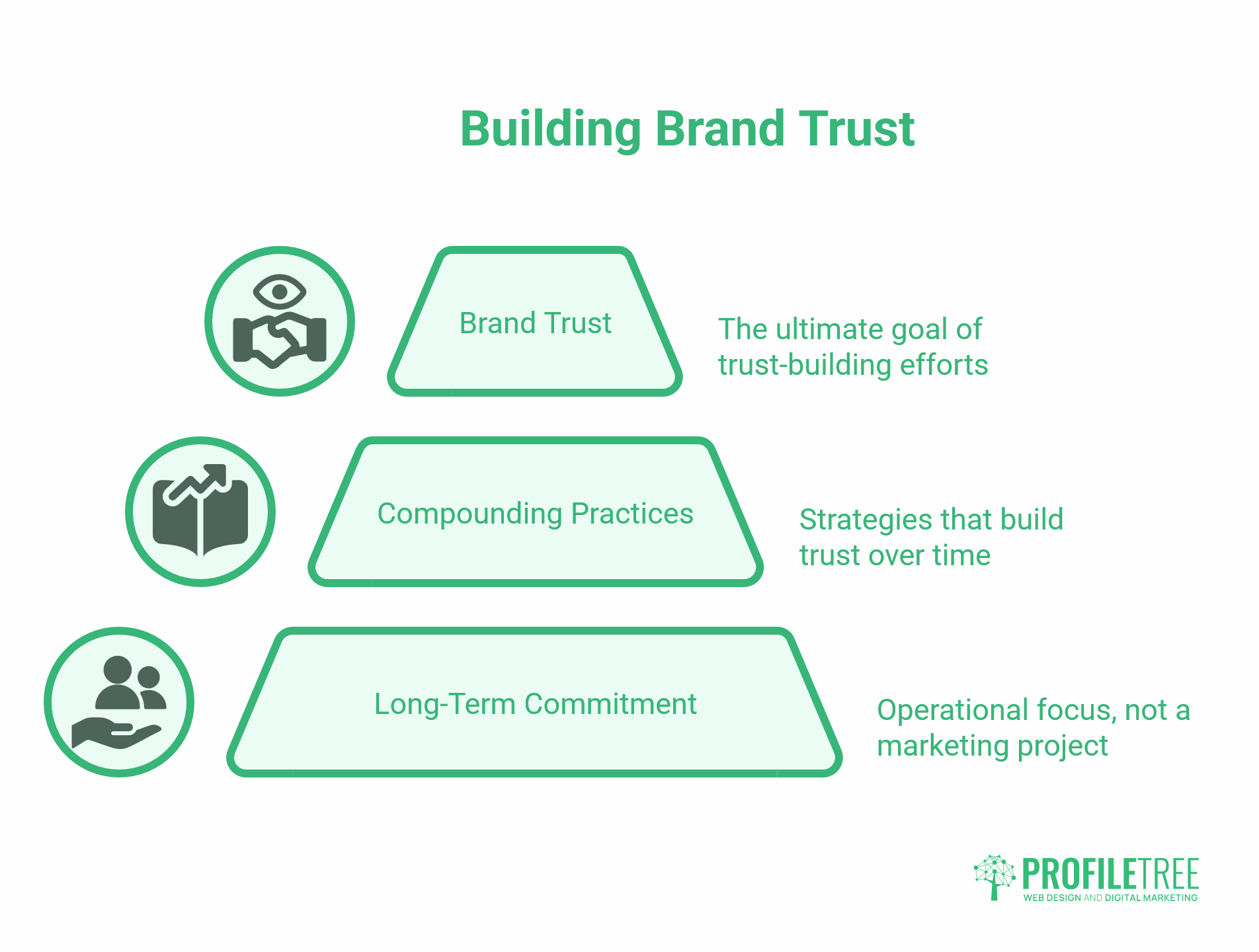
Building brand trust is a long-term operational commitment, not a marketing project. The strategies below are not one-off campaigns; they are practices that compound over time.
1. Make Your Pricing Transparent
Hidden fees, unclear subscription terms, and surprise charges at checkout are among the fastest ways to destroy consumer trust. UK consumers in particular have become acutely sensitive to pricing opacity. If your pricing is complex, explain it clearly. If it varies by project, explain why and what drives the variation. A business that helps customers understand what they are paying for builds far more trust than one that obscures its fees.
2. Treat Complaints as Opportunities
How a business responds when something goes wrong tells customers far more about its values than its marketing ever will. A fast, genuine, resolution-focused response to a complaint can convert a dissatisfied customer into a loyal advocate. A defensive or dismissive response will be screenshot and shared. Train your team to treat every complaint as a trust-building moment, not a threat.
3. Show Your Credentials Consistently
Author pages, team profiles, accreditations, professional memberships, and case studies all signal expertise and legitimacy. Google’s E-E-A-T framework (Experience, Expertise, Authoritativeness, Trustworthiness) is a search ranking factor, but it is also a useful checklist of the trust signals your website should convey. If your business has been operating for ten years or has completed a significant number of client projects, say so clearly and specifically.
4. Use Social Proof Effectively
Customer reviews, testimonials, and case studies are among the most powerful trust signals available to SMEs. ProfileTree has over 450 five-star Google reviews, proof points that carry more weight than any amount of self-promotional copy. Third-party review platforms (Google, Trustpilot, Which?) carry more credibility than testimonials on your own website, because customers know they cannot be edited or withheld.
5. Keep Your Claims Honest
This sounds obvious, but marketing pressure frequently pushes businesses toward exaggeration. The CMA’s Green Claims Code, introduced in 2021 and actively enforced since 2023, specifically targets businesses that make vague or unsubstantiated environmental claims. The ASA regularly upholds complaints against brands using terms like “sustainable,” “eco-friendly,” or “net zero” without supporting evidence. Accurate claims, even modest ones, build more trust than inflated ones that unravel under scrutiny.
6. Be Consistent Across All Channels
Trust requires consistency. A brand that communicates warmly on social media but delivers cold, automated customer service emails creates cognitive dissonance. Your tone, your promises, your visual identity, and your values should be recognisable across every touchpoint from your website to your delivery packaging to how your team answers the phone.
Social media marketing for SMEs plays a significant role in shaping customers’ first impressions of a brand.
7. Deliver on the Basics, Every Time
Research consistently shows that brand trust is built more reliably through operational consistency than through high-concept brand purpose campaigns. Customers remember whether their order arrived on time, whether the product worked as described, and whether their question was answered quickly. Purpose-washing, attaching grand social or environmental narratives to brands that cannot demonstrate basic operational reliability, actively damages trust when customers see through it.
“The businesses we work with that have the strongest reputations in their sectors are almost always the ones that have focused on consistent delivery and honest communication over time,” says Ciaran Connolly, founder of ProfileTree. “Trust is not built in a campaign. It is built in every customer interaction, month after month.”
How to Measure Brand Trust
Brand trust is not intangible. It can be tracked through a defined set of metrics. The table below provides a practical scorecard for SMEs.
| Metric | What it measures | Good benchmark | How to track |
|---|---|---|---|
| Net Promoter Score (NPS) | Likelihood to recommend | 50+ (B2C), 40+ (B2B) | Post-purchase survey |
| Review rating | Public perception of quality | 4.5+ across 50+ reviews | Google, Trustpilot, Facebook |
| Repeat purchase rate | Loyalty and satisfaction | 25%+ (varies by sector) | CRM or e-commerce platform |
| Branded search volume | Unprompted brand recall | Month-on-month growth | Google Search Console |
| Customer satisfaction (CSAT) | Transaction-level experience | 80%+ | Post-interaction survey |
| Social sentiment | Tone of unprompted mentions | Majority positive | Social listening tools |
| Complaint resolution rate | Response to failures | 95%+ resolved | Support platform data |
Brand Trust vs Brand Loyalty: Understanding the Difference
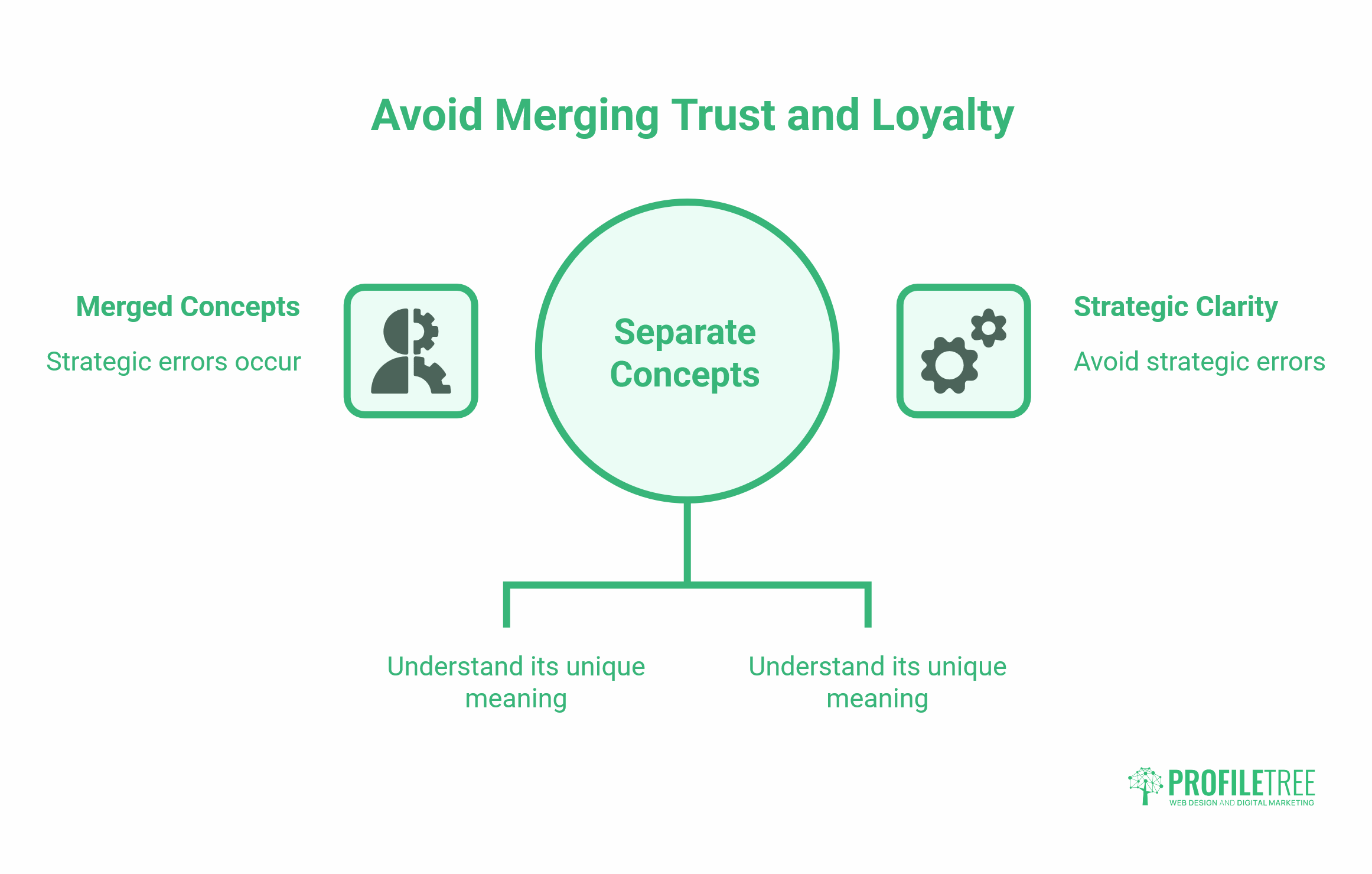
These two concepts are related but distinct, and conflating them leads to strategic mistakes.
Brand trust is about belief: do customers believe your business will deliver? Brand loyalty is about behaviour: do customers choose you repeatedly, even when alternatives exist?
Trust is a prerequisite for loyalty, but loyalty is not guaranteed by trust alone. A customer can trust a brand completely and still switch to a competitor offering a lower price or a more convenient location. Loyalty is built on trust through added-value loyalty programmes, personalised service, community belonging, and ongoing relevance.
The practical implication for SMEs is that trust-building work is foundational. It does not immediately generate loyalty or repeat purchase. It creates the conditions for loyalty to develop. Campaigns and promotions can build loyalty among customers who already trust you; they rarely work on customers who do not.
The Trust Recovery Roadmap: Repairing Damage After a Crisis
Every business will face a moment where trust is tested: a product recall, a service failure, a public complaint, a data breach, or a media story. The brands that recover are not those that respond fastest — they are those that respond most honestly.
The four-stage framework below applies to trust recovery at any scale, from a single negative review to a sector-wide reputational challenge.
Stage 1: Acknowledge
Acknowledge the failure clearly, publicly, and without qualification. Do not lead with excuses or context. A statement that begins “Whilst we understand your frustration…” signals that the business is defending itself rather than accepting responsibility. A statement that begins “We got this wrong, and we are sorry” signals that trust is the priority.
Stage 2: Amend
Make it right, specifically and practically. Refund, replace, resolve — and do so without making the affected customer fight for it. The amendment should be proportionate to the harm caused and, where possible, visible to the people who witnessed the original failure.
Stage 3: Audit
Identify the root cause. A genuine trust recovery effort requires understanding what went wrong operationally, not just managing the communication. If the failure was a one-off, say so and show what safeguards are now in place. If it was systemic, acknowledge that and communicate the changes being made.
Stage 4: Achieve
Demonstrate through action over time. Trust recovery is never completed in a press release or a social media post. It is evidenced through consistent behaviour that contradicts the failure. This may take months. Measuring the metrics listed in the scorecard above will show whether trust levels are returning to baseline.
AI Video and Brand Trust: A Supporting Role
AI video technology has become a practical tool for businesses looking to communicate more consistently — a foundation of trust-building. Tools that allow SMEs to create explanation videos, personalised follow-up communications, and educational content without significant production budgets have a genuine role in a trust-building strategy.
The critical caveat is transparency. UK consumers are increasingly aware of AI-generated content, and the trust implications cut both ways. AI that enables a business to communicate more frequently and helpfully builds trust. AI that is used to create fabricated testimonials, synthetic social proof, or misleading visual content destroys it.
Brand Trust Signals Your Website Must Have
Your website is often the first place a prospective customer decides whether to trust your business — before they read a single review, speak to anyone on your team, or compare your pricing. That judgement happens fast, and it is based on specific signals rather than general impressions.
Visible Contact Information
A physical address, phone number, and named contact point signal that a real business stands behind the website. A contact form alone is not enough. Customers who cannot quickly confirm that your business is reachable tend to leave without enquiring.
Genuine Team Profiles
Real photographs of real people, with names and roles, are one of the most underused trust signals available to SMEs. Stock photography of generic office scenes does the opposite — it signals that the business is hiding rather than presenting itself.
Third-Party Review Integration
Displaying your Google or Trustpilot rating directly on your site, with a live link to the source platform, carries far more credibility than written testimonials you have curated yourself. Customers know the difference.
Clear Pricing or a Transparent Quote Process
You do not need to publish fixed prices for every service, but you do need to explain how pricing works and what drives it. A page that gives no indication of cost forces customers to enquire blindly, and many will not bother.
Building Brand Trust Through Your Digital Presence
Your website is often the first place a prospective customer forms a trust judgement about your business. ProfileTree’s web design team regularly audits client sites for trust signals: visible contact details, clear pricing or pricing frameworks, team pages with real photographs, case studies with specific outcomes, and review integration from third-party platforms.
A well-designed, fast, and clearly structured website communicates competence before a word is read. A slow, outdated, or poorly organised site sends the opposite signal — regardless of how strong the business behind it actually is. If your current site is not reflecting the trust your business has earned, it is worth addressing that gap before investing further in marketing.
A strong content marketing strategy also builds trust incrementally, by consistently providing useful information without asking for anything in return. Over time, this positions a business as a knowledgeable and reliable resource in its field, which is exactly the kind of trust that translates into commercial relationships.
ProfileTree works with SMEs across Northern Ireland, Ireland, and the UK on digital strategies that build lasting brand trust, from web design and content marketing through to SEO and AI implementation.
Conclusion
Brand trust is not built in a single campaign or a well-timed press release. It is built through operational consistency, honest communication, and a commitment to putting the customer’s experience ahead of short-term commercial convenience. For SMEs in Northern Ireland, Ireland, and the UK, that consistency is both the challenge and the competitive advantage — because the businesses that get it right earn something no budget can buy.
FAQs
What is the simplest definition of brand trust?
Brand trust is the confidence customers have that a business will consistently deliver on its promises. It is built through repeated positive experiences, honest communication, and operational reliability.
How long does it take to build brand trust?
There is no fixed timeline. Trust accumulates through consistent behaviour over months and years. Businesses that focus on delivering reliably and communicating honestly tend to see measurable improvements in trust metrics within 6 to 12 months, but the strongest reputations are built over much longer periods.
What are the three pillars of brand trust?
The three pillars are competence (the ability to deliver), integrity (honesty and transparency), and benevolence (acting in the customer’s best interests). All three are necessary; a weakness in any one undermines the others.
How can a small business build brand trust quickly?
Focus on the basics: respond to enquiries quickly, deliver what you promise, handle complaints well, and ask satisfied customers for reviews. Transparency about who you are and how you work through team pages, clear pricing, and genuine testimonials also build credibility faster than any advertising campaign.