
Crisis Management in Marketing: The Definitive Guide for UK and Irish Brands
Table of Contents
In the digital environment, crisis management in marketing is not a specialism reserved for large corporations with dedicated communications departments. It is a practical requirement for any business whose reputation is visible online, which, in 2026, means every business. A crisis can take many forms: a complaint that goes viral on social media, a ruling from the Advertising Standards Authority, a data breach, a negative news cycle, or an operational failure that becomes public before leadership is even aware of it.
What separates brands that recover quickly from those that suffer lasting damage is rarely the crisis itself. It is the quality of the preparation behind the response. This guide covers the full arc of marketing crisis management from initial triage through regulatory compliance, communication protocols, and post-crisis brand rehabilitation, written specifically for SMEs operating in the UK and Ireland, where the regulatory environment and market sensitivities create challenges that US-centric guides rarely address.
The Anatomy of a Marketing Crisis: Social Media Incident vs. Structural Failure
Not every negative comment is a crisis. One of the most costly errors a marketing team can make is treating a routine complaint as a PR emergency, halting campaigns, issuing public statements, and triggering full escalation protocols for an issue that a single customer service response would have resolved.
Equally damaging is the reverse: treating a genuine structural crisis as a social media squall, responding with platitudes when the situation demands substantive action.
The distinction matters because the response must match the nature of the problem. A social media incident, a poorly worded post, a misread tone, and a frustrated customer require speed, tone correction, and careful community management. A structural crisis, a product safety issue, a data breach, an ASA ruling, or a senior staff misconduct allegation requires legal review, stakeholder communication, and a coordinated multi-channel response.
The starting point for any crisis management plan is a triage system that helps your team make this distinction quickly, under pressure, before the situation escalates beyond your control and the narrative slips away.
The Crisis Severity Matrix: Triage Your Response
The matrix below provides a consistent, pre-agreed framework for assessing any incident. Use it before deciding whether to escalate, respond publicly, or pause advertising.
| Level | Characteristics | Stakeholders Involved | Recommended Action |
|---|---|---|---|
| 1 | Isolated negative comment or review. No media pickup. Limited reach. | Customer service team | Monitor and respond within 2 hours. No escalation required. |
| 2 | Complaint gaining social traction. Small volume of shares or comments. No media involvement. | Social media manager, marketing lead | Media pickup or influencer amplification. Reputational risk to the brand. Increasing volume of customer complaints. |
| 3 | Issue prepared holding statement. Convene the crisis team. Review advertising spend immediately. | Marketing director, PR lead, legal if required | Regulatory body involvement (ASA, CCPC, ICO). Significant media coverage. Customer trust was materially affected. |
| 4 | Regulatory body involvement (ASA, CCPC, ICO). Significant media coverage. Customer trust materially affected. | CEO or MD, legal counsel, full crisis team | Suspend relevant campaigns. Legal review of all communications before publication. Proactive media engagement. |
| 5 | Existential brand event. Major data breach, product harm, criminal allegation, or national media cycle. | Board level, external PR counsel, legal team | Full crisis protocol. Dedicated response coordination. External specialist support required. |
ProfileTree’s ProfileTree Founder, Ciaran Connolly, emphasises that “regularly updated crisis management plans and risk assessments are non-negotiable in safeguarding a brand’s digital health.” The severity matrix is the mechanism that makes those plans operational. It removes ambiguity from high-pressure decision-making and prevents the twin errors of over-reaction and under-reaction.
Building Your Crisis Management Plan
A crisis management plan is only useful if it exists before a crisis begins. Assembling a response strategy mid-incident is the equivalent of designing a fire exit while the building is burning. The document itself matters less than the process of building it because that process surfaces the decisions, contacts, and responsibilities that cannot be improvised under pressure.
A robust plan must include:
Roles and Responsibilities: A clear delineation of who does what, avoiding confusion during high-pressure situations. Every team member should know their specific remit before any incident occurs.
Contact Lists: Names, direct numbers, and out-of-hours contacts for all team members, key stakeholders, any retained legal advisors, and external agency support. Include platform-specific emergency contacts for your key social channels.
Response Templates: Pre-approved draft messages, holding statements, social responses, and email notifications to customers that can be quickly adapted to the specific incident. Having even a skeleton message reduces response time under pressure and prevents unreviewed communications from being issued in the heat of the moment.
Monitoring and Assessment Tools: Social listening platforms, Google Alerts, and analytics dashboards configured to flag sentiment shifts or unusual spikes in brand mention volume. This infrastructure needs to be set up before a crisis, not during one.
Escalation Thresholds: The severity matrix above defines when situations move from one level to the next and who assumes responsibility at each level. This must be documented and agreed in advance.
Forming the Crisis Response Team
The composition of your crisis response team should map to the level of incident your business is most likely to face. For most SMEs in the UK and Ireland, a lean, pre-briefed team of five to six people is sufficient for all but a Level 5 event.
- Team Leader: Oversees the crisis response, ensuring clear communication and decisive action across all workstreams.
- PR Specialist: Manages external communications and media relations, including any journalist enquiries.
- Legal Advisor: Provides guidance on what can and cannot be communicated, and liaises with any regulatory bodies where required.
- Digital Marketer: Monitors online sentiment, leads the social and content response, and manages paid media decisions during the incident.
- Customer Service Coordinator: Maintains customer relations, manages incoming enquiries, and ensures frontline staff are briefed on approved messaging.
- Technical Support: Addresses website updates, system alerts, and any technical issues arising from the incident itself, including promptly publishing crisis statements on the website.
For SMEs without the in-house resource to staff all six roles, ProfileTree’s digital marketing strategy service can provide the external capacity to cover the digital and communications functions during a live crisis.
The 24-Hour Protocol: A Step-by-Step Response Framework
Speed of response is consistently identified as the most important variable in determining the scale of reputational damage from a marketing crisis. The first 24 hours set the narrative. Delay cedes control to other journalists, disgruntled customers, or competitors. The protocol below provides a framework that can be adapted to any Level 3 or above incident.
Hour 1: Assess and Contain
Convene the core crisis team, or whoever is immediately available. Assign one person to monitor all incoming social mentions, media coverage, and customer communications in real time — this person does nothing else for the duration. Confirm the severity level using the matrix. Pause all scheduled social content immediately: posts written in normal conditions read poorly in a crisis context and give the impression of tone-deafness. Brief customer service on what to say and, equally importantly, what not to say while the situation is being assessed. Do not issue any public statement at this stage unless the incident is already generating active media coverage.
Hour 4: Establish the Facts and Prepare Communications
Before issuing any public statement, establish what is actually known and what is not. The most damaging crisis responses are those that contradict themselves because they were issued before the full picture was clear. Draft a holding statement: a short, factual acknowledgement that the issue is known and is being addressed. Issue this on the channels where the crisis is most active. If regulatory bodies may be involved, the ASA, ICO, or CCPC must conduct a legal review of the statement before publication. Do not admit liability in a holding statement; acknowledge the situation and commit to a further update.
Hour 12: Communicate with Substance
By this point, enough should be known to move beyond the holding statement to a substantive response. Tone matters enormously here. In the UK and Ireland, audiences are highly sensitive to corporate language that sounds managed rather than genuine. Transparency over silence is the correct default. Acknowledge the issue clearly, take responsibility where appropriate, and communicate the concrete steps being taken. Avoid hedging language, passive voice, and vague commitments. A well-produced video statement from a senior leader, not a polished production, but a direct, honest on-camera address, consistently outperforms written statements in audience reception during a crisis. ProfileTree’s video production service is used for exactly this type of high-stakes communications work, where authenticity and production quality are both required.
Hour 24: Review, Adapt, and Continue Monitoring
Assess how the response has been received. Review social sentiment, customer service enquiry volume, and media coverage tone. Adjust messaging where necessary. Confirm that all paid advertising placements are contextually appropriate. Continuing to run a promotional campaign in the immediate aftermath of an unresolved crisis significantly compounds reputational damage. Brief all internal teams on what has been communicated externally so that no conflicting messages are issued through any channel.
Escalation protocols should be agile, allowing dynamic responses that match the pace of digital trends. The 24-hour framework is the structural container that makes agility possible. It provides the guardrails within which fast decisions can be made safely.
Social Media Crisis Management: Speed and Coordination
Social media is where most marketing crises first become visible, and where the quality of the initial response is judged in real time. During a crisis, social platforms are not channels for promotional messaging; they are a communication infrastructure. Their function shifts entirely to stakeholder management.
Social listening tools are fundamental to both early crisis detection and response management. By monitoring brand mentions, keyword usage, and emerging conversations, it is possible to identify potential issues before they reach critical mass. Platforms such as Hootsuite and Brandwatch provide real-time analysis, but the configuration matters as much as the tool. Alerts must be set for spikes in mention volume and negative sentiment shifts, not simply tracked passively.
Community managers serve as the frontline of crisis communication on social platforms. They represent the brand’s voice under conditions that require both speed and accuracy. A crisis response playbook for community managers, pre-approved responses, escalation triggers, and clear moderation guidelines ensure consistent, appropriate reactions to varied scenarios without requiring senior sign-off on every individual reply.
Ciaran Connolly, ProfileTree Founder, observes that “it is not just about weathering the storm, it is about emerging stronger.” In social media crisis management, emerging stronger means that the quality of the public-facing response, its speed, its tone, and its consistency become part of the brand story itself, not merely damage limitation.
Navigating the UK and Ireland Regulatory Landscape
Most crisis management content focuses exclusively on the court of public opinion. In the UK and Ireland, a significant proportion of marketing crises involve a regulatory dimension that requires a distinct class of response. Treating an ASA ruling or an ICO notification as purely a PR problem is a material error.
The Advertising Standards Authority (ASA) regulates all advertising in the UK, including social media posts, influencer content, email marketing, and paid digital campaigns. An ASA ruling against a brand is not simply a legal outcome; it generates its own media coverage and becomes part of the brand’s permanently searchable history. Rulings are published on the ASA website and remain publicly accessible indefinitely. The ASA can mandate the removal of advertising, require public corrections, and refer persistent non-compliers to Trading Standards for further action.
In Ireland, the Competition and Consumer Protection Commission (CCPC) is responsible for consumer protection and can take enforcement action against misleading advertising or unfair commercial practices. The Advertising Standards Authority for Ireland (ASAI) operates a self-regulatory complaints and adjudication process with its own code of standards.
On data breaches, the Information Commissioner’s Office (ICO) in the UK and the Data Protection Commission (DPC) in Ireland are the relevant supervisory authorities. A data breach involving personal data must be reported to the relevant authority within 72 hours of the organisation becoming aware of it. This is a legal obligation, not a communications decision, but the public-facing response to a data breach is absolutely a marketing crisis management issue that requires careful coordination between the legal and communications functions.
One practical point that is often overlooked: if your brand receives a complaint to the ASA, do not withdraw the creative immediately without legal guidance. Withdrawal can be interpreted as an admission that the advertising was in breach. Take legal advice first, and ensure all communications about the complaint are routed through an approved spokesperson.
Specific Considerations for Northern Ireland
Brands operating in or communicating to audiences in Northern Ireland face sensitivities that are genuinely distinct from those in Great Britain or the Republic of Ireland. Community identity, political association, and the specific cultural context of different areas of Northern Ireland create communication risks that do not exist to the same degree elsewhere in the UK.
Content that would be considered uncontroversial in London or Dublin can carry very different resonance in Belfast or Derry. Imagery, language choices, sporting associations, and even colour schemes can carry unintended significance for specific audiences. This is not a reason to avoid the Northern Ireland market; it is a reason to approach communications with localised expertise and genuine contextual understanding.
From a regulatory perspective, Northern Ireland currently operates under a dual regime in some areas as a consequence of the Windsor Framework. Marketing teams should be aware that product claims, labelling standards, and certain consumer protection rules may differ from GB-only standards for specific product categories. Legal review of any campaign with a Northern Ireland-specific audience is advisable for brands not already familiar with the landscape.
Brand Rehabilitation: Managing the Recovery Phase
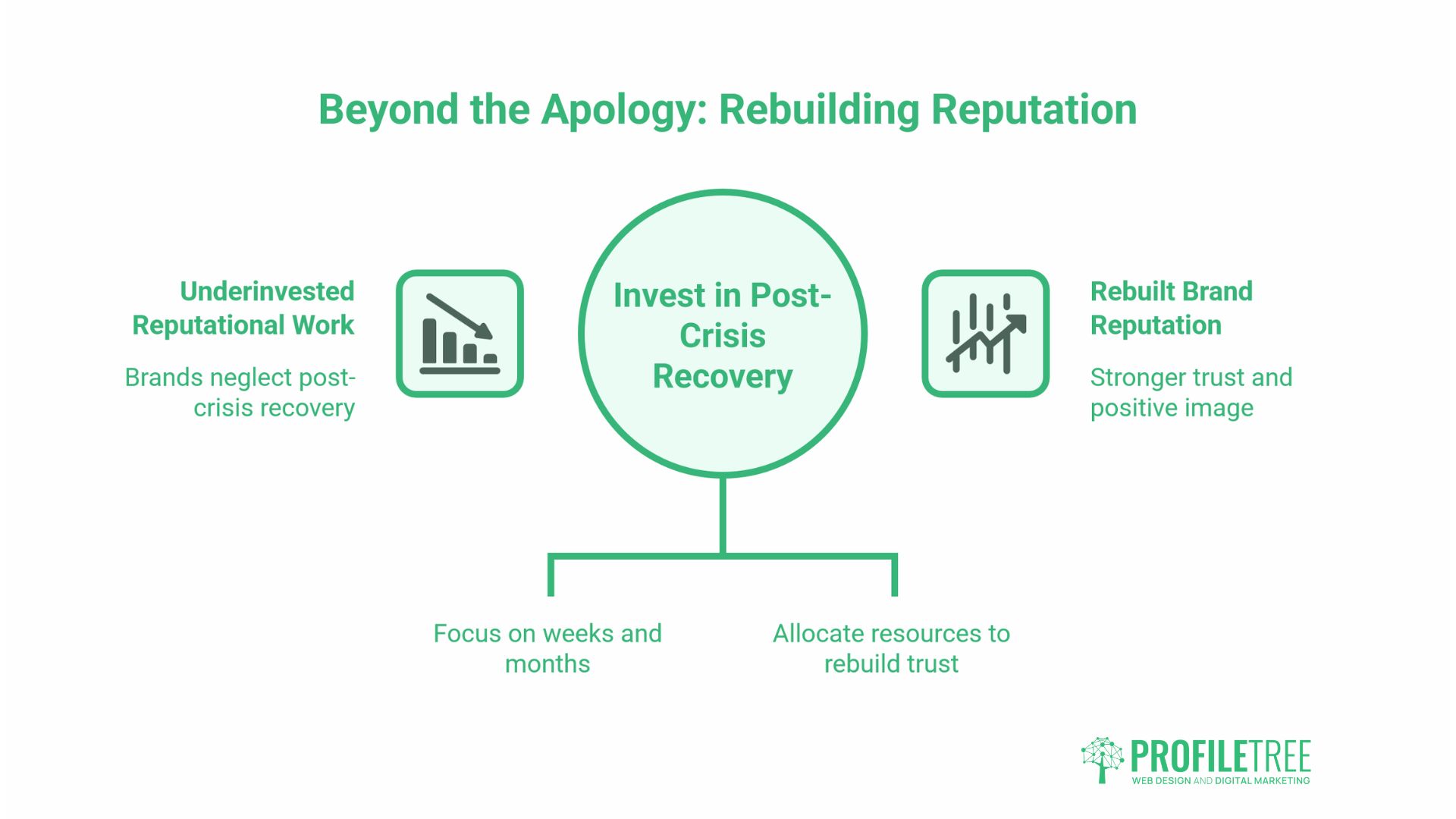
Most crisis management guidance stops at the apology. What happens in the weeks and months that follow is where the real reputational work is done and where most brands significantly underinvest.
Post-crisis brand rehabilitation is a structured process, not a single campaign. It requires reassessing the channels, content, and messaging that define how your brand communicates, and rebuilding audience confidence through consistency over time.
The first decision is where to direct marketing spend in the immediate aftermath. The recovery phase is not the moment for aggressive promotional campaigns or discounting. It is the moment for content that demonstrates competence, transparency, and genuine value to the audience. Educational content, practical guides, behind-the-scenes transparency, and evidence of operational changes made in response to the crisis significantly better serve the rehabilitation function than promotional messaging.
SEO plays a specific role in post-crisis recovery that is frequently overlooked. Negative news coverage and ASA rulings generate indexed content that appears in brand search results. A sustained content programme, properly optimised for the brand’s core keywords, gradually displaces negative results from the visible SERP. This is a medium-term strategy, typically operating over a six to twelve-month horizon, but it is the most durable tool available for reputation repair in search. ProfileTree’s content marketing service is used by brands across the UK and Ireland for exactly this kind of sustained, SEO-focused publishing programme.
For SMEs with limited in-house resources, the post-crisis phase is where agency support has the clearest demonstrable return. Managing a multi-channel rehabilitation programme, sustained content production, SEO strategy, paid media pacing, and social listening across a six to twelve-month period requires capacity that most small marketing teams cannot maintain alongside normal business operations.
Real-World Lessons from UK Marketing Crises
The most instructive crisis management lessons come from documented public cases. Three UK and Ireland examples illustrate different aspects of response quality.
BrewDog has navigated multiple distinct crises in recent years, including regulatory challenges with the ASA over advertising claims and a widely covered open letter from former employees raising concerns about workplace culture. The company’s responses were inconsistent across these incidents. Some demonstrated genuine transparency and commitment to operational change. Others were characterised by a defensive tone that extended the media cycle rather than closing it. The lesson is straightforward: the quality of the response is as important as its speed. A rapid but dismissive response prolongs a crisis; a slower but substantive one can close it.
British Airways experienced a significant data breach in 2018 that resulted in one of the largest GDPR fines recorded at the time. The communications response moved quickly to acknowledge the breach, establish customer-facing communications channels, and comply with regulatory requirements. However, the scale of the incident meant that sustained reputation management work was necessary for years afterwards. The lesson is that regulatory compliance and public communications are distinct activities that must be managed simultaneously through distinct but coordinated workstreams.
Ryanair has navigated numerous ASA rulings over advertising claims across many years. Their approach, robust engagement with the regulatory process, and continuation of brand-level marketing while specific claims are under review demonstrate a sophisticated understanding of how to separate an operational crisis from broader brand maintenance. Not every organisation has the resources to operate at this level of sophistication, but the underlying principle applies to any business: do not conflate the specific incident with the brand as a whole.
Preparing Your Team: Training, AI, and Digital Capability
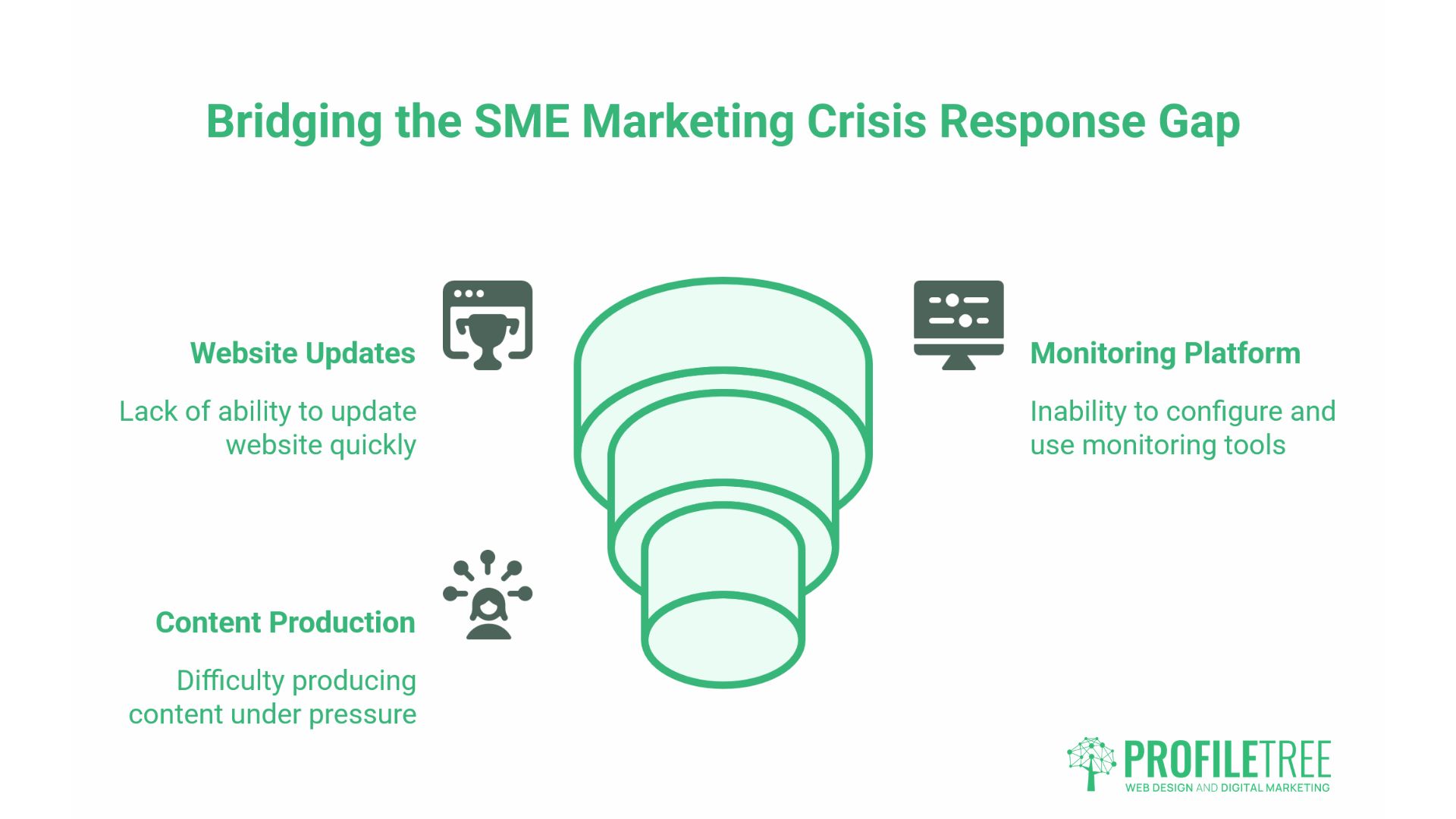
The most common reason SME marketing teams cannot execute a crisis response effectively is a capability gap, not a planning gap. Nobody on the team can update the website quickly. Nobody has configured the monitoring platform. Nobody can produce written content at speed under pressure. These are training and tooling problems, not strategy problems.
Digital training, including practical workshops on social listening tools, content production under time pressure, and website management, closes these gaps before they become crisis vulnerabilities. ProfileTree’s digital training service works with SME teams across Northern Ireland, Ireland, and the UK to build the in-house capability that makes crisis protocols executable rather than aspirational.
AI implementation is increasingly relevant to crisis management specifically. AI tools now make rapid content drafting, sentiment monitoring, and social response significantly more accessible for teams without a dedicated resource. The practical application of AI in a crisis context, what it can accelerate, where human review remains essential, and how to integrate it into a live response workflow is a component of ProfileTree’s AI implementation and transformation service.
Proactive investment in team capability is the recognition that the cornerstone of a resilient digital marketing strategy is not the ability to predict the future, but to be prepared for it with the right tools and training.
Conclusion
Marketing crises are not predictable, but the capacity to manage them is entirely within your control. A severity matrix, a documented 24-hour protocol, regulatory awareness, and a post-crisis rehabilitation strategy are not specialist instruments; they are basic infrastructure for any business operating in a digital environment. For brands in the UK and Ireland, localising this infrastructure to reflect the specific regulatory reality and market sensitivities of these markets is what separates a generic plan from one that will function under real pressure.
Contact ProfileTree to discuss how crisis preparedness planning integrates with your wider digital marketing strategy.
FAQs
What are the five stages of crisis management in marketing?
Pre-crisis preparation, crisis identification, crisis response, crisis management, and post-crisis recovery. Preparation carries the most weight — the remaining four stages depend entirely on the groundwork laid before any incident occurs.
What is the difference between an issue and a crisis?
An issue is a developing problem that has not yet caused material reputational damage. A crisis has crossed that threshold; it is already affecting audience perception, attracting media attention, or triggering regulatory involvement. The tipping point is when external actors, rather than the brand, are defining the narrative.
How do I respond to an ASA complaint about my advertising?
The ASA will contact you directly and give you a defined period to respond. Do not withdraw the advertisement before taking legal advice, as doing so can complicate your position. Route all communications about the complaint through an approved spokesperson only.
Should negative comments be deleted during a social media crisis?
In most cases, no. Deleted content is rapidly screenshotted and shared, compounding the original problem. Moderate and respond rather than remove. The exception is content that is legally actionable, defamatory material, personal data, or content that violates platform terms.