
Cross-Functional Training: A Guide for UK and Irish SMEs
Table of Contents
Cross-functional training is one of the most practical investments a business can make in its people. For SMEs across the UK and Ireland, it addresses a problem that is becoming harder to ignore: teams that cannot communicate across departments, digital tools that only one person knows how to use, and a workforce that struggles to adapt when circumstances change.
This guide covers what cross-functional training means in practice, why it matters for UK and Irish businesses right now, how to implement it without burning out your team, and where digital capability, the area where most SMEs actually fall down, fits into the picture.
What Is Cross-Functional Training?
Cross-functional training is the process of teaching employees skills and knowledge beyond their primary job role, enabling them to contribute meaningfully across departments or functions within an organisation.
It is distinct from general upskilling, which typically deepens expertise within a single role. Cross-functional training deliberately broadens capability. A customer service representative learning how the product team’s QA process works is one example. A sales manager gaining a working understanding of SEO and digital marketing so they can better articulate value propositions online is another.
The goal is a workforce that is more connected, more adaptable, and less vulnerable to the departure or absence of any individual.
Cross-Functional Training vs Cross-Training: What’s the Difference?
These two terms are often used interchangeably, but they describe different things.
Cross-training typically means teaching someone to perform a similar task in a parallel role, such as a barista learning to operate the till or a warehouse operative learning to cover a colleague’s packing station. The scope stays narrow.
Cross-functional training is broader in ambition. It involves moving knowledge across departmental lines: a finance team member learning the basics of digital marketing analytics, or an HR manager understanding how an AI implementation project changes the skills an organisation needs. The purpose is strategic agility, not just operational cover.
| Cross-Training | Cross-Functional Training | |
|---|---|---|
| Definition | Learning similar tasks within one function | Learning across different departments or disciplines |
| Typical goal | Operational resilience and cover | Strategic agility and collaboration |
| Example | A barista trained on the till | A marketer trained in basic data analysis |
| Time horizon | Days to weeks | Months, ongoing |
A Skills Matrix for Your First Audit
Before choosing who trains in what, most SMEs benefit from mapping current capability against what the business actually needs. A simple matrix, team members down one side and competencies across the top, is the most practical starting point.
| Team member | SEO fundamentals | Basic video/scripting | CMS updates | AI tools | Content writing |
|---|---|---|---|---|---|
| Example: Sales lead | Working knowledge | None | None | Basic | Working knowledge |
| Example: Ops manager | None | None | Working knowledge | None | None |
| Example: Marketing exec | Strong | Working knowledge | Working knowledge | Working knowledge | Strong |
Score each cell as None, Working knowledge, or Strong. The gaps that appear, usually a single point of failure on CMS access or a total absence of AI tool familiarity, are where a cross-functional programme should start.
Why UK and Irish Businesses Are Prioritising Cross-Functional Skills
The UK has faced a persistent skills shortage in specialist digital and technical roles, and many SMEs cannot fill those gaps quickly enough through external hiring alone. Cross-functional training has emerged as a practical response. Rather than waiting to recruit the skills a business needs, organisations are developing them internally by expanding what existing staff can do.
In Northern Ireland specifically, this matters for the growth ambitions of the region’s tech and fintech sectors. As Belfast-based SMEs scale and take on more complex digital operations, managing their own SEO, producing video content, running organic social campaigns, or integrating AI tools into their workflows, they need teams capable of working fluidly across those functions. A team where only one person understands the website and another handles social media is structurally fragile.
For Irish businesses navigating growth across both jurisdictions, cross-functional capability also reduces the risk of knowledge silos forming as headcounts rise. A team of twelve can better absorb the departure of a specialist when two or three colleagues share a working understanding of that person’s domain.
Key Benefits of a Cross-Functional Training Programme
The returns go well beyond the training room, and they apply whether you are managing a team of eight or eighty.
Reduced silo mentality. When teams have no understanding of how other departments work, they tend to optimise for their own function at the expense of the wider business. Shared language across teams makes collaboration a natural behaviour rather than an awkward exception.
Business continuity. If a single employee holds all the knowledge for a critical function, their absence through illness, resignation, or holiday creates a genuine operational risk. When more than one person can manage the CMS or run a basic analytics report, the business keeps moving.
Employee retention. Employees who feel their skills are developing are less likely to look elsewhere. This works alongside how you attract people in the first place; if that side of the equation needs attention too, our guide to social media recruiting for UK SMEs covers the other half of the talent picture.
Innovation and problem-solving. A team member with a grounding in both customer service and digital analytics is better placed to notice patterns in user behaviour that a specialist working in isolation would miss.
Leadership development. Managers who only understand their own function tend to make decisions that reflect it. Cross-functional exposure produces managers who can broker genuine alignment between, say, a web development team and a marketing department.
Cost efficiency. Versatile employees reduce dependency on external contractors and temporary hires. Whichever training budget model you use, our breakdown of fixed-price versus time-and-materials pricing is a useful comparison if you’re weighing up how to structure spend on a training programme against other project costs.
The Hidden Barrier: Preventing Skill Decay
Most guidance on cross-functional training assumes that once someone is trained, they stay trained. In practice, skills that are not used regularly fade quickly, particularly technical and digital skills, where tools and platforms change every few months.
A marketing executive who spends one afternoon learning the basics of content planning, then does not touch it again for six months, will have lost most of that working knowledge by the time it is needed. The same applies to AI tools: an operations team member trained on a new AI assistant during onboarding but who never uses it day-to-day reverts to old habits within weeks.
Three approaches reduce skill decay in practice:
Rotation days. A fixed day each month or quarter where the cross-trained skill is actually used, even for a small, low-stakes task, keeps it current. A sales manager who reviews one analytics report every month retains far more than one who reviews it once during a training session.
Secondary task assignments. Building the cross-functional skill into someone’s actual job description, even as a small percentage of their time, rather than treating it as a one-off session, gives the skill a reason to stay active.
Short refreshers over long retraining. A 20 to 30-minute refresher every quarter is more effective than a single half-day session that is never revisited. Little and often outperforms long and rare for workplace learning retention.
The Legal and Contractual Side: UK and Ireland
This is the area most generic training guidance ignores entirely, yet it is often the first question UK HR managers ask when cross-functional training is proposed.
Can you require an employee to undertake cross-functional training?
In most cases, yes, but with important caveats. UK employment contracts frequently include a flexibility clause or “other duties as required” provision, which gives employers latitude to ask staff to take on tasks outside their primary role. However, asking an employee to perform substantially different work on a permanent basis, without agreement, may constitute a unilateral change to terms and conditions, which carries legal risk. ACAS guidance on varying an employment contract sets out the practical position for UK employers in more detail.
The practical guidance for most UK SMEs is straightforward: frame cross-functional training as a development opportunity, get buy-in before mandating it, and check that the additional scope does not effectively become a second job without corresponding recognition.
In Ireland, similar principles apply under the Unfair Dismissals Act and the Terms of Employment (Information) Acts. Significant changes to an employee’s role should be agreed upon, not imposed.
The UK Apprenticeship Levy
UK businesses with an annual payroll above £3 million pay into the Apprenticeship Levy, and many do not use their full entitlement. Where cross-functional training maps to a recognised Apprenticeship Standard, for example, a Digital Marketing Apprenticeship, a Data Analyst Standard, or a Team Leader/Supervisor programme, Levy funds can legitimately be used to cover the cost. Smaller businesses can access co-investment funding. This is a practical funding route worth exploring with your training provider before assuming that a cross-functional programme must come from the general training budget.
How to Implement Cross-Functional Training: A 5-Phase Framework
Understanding the benefits of cross-functional training is the easy part. Turning that understanding into a programme that works, without disrupting day-to-day operations or overwhelming your team, is where most businesses need a clearer plan.
Phase 1: Conduct a Skills Gap Audit
Use the skills matrix above to map what your team currently knows against what the business needs across functions. Competencies might include SEO fundamentals, social media management, basic video production, data analysis, content writing, or proficiency with AI tools, depending on your business. This audit surfaces the gaps that matter most and prevents training from being allocated by seniority rather than need.
Phase 2: Identify Internal Mentors
Cross-functional training does not always require an external provider. In many organisations, the most efficient first step is structured peer-to-peer knowledge sharing, pairing team members who have expertise in one area with colleagues who would benefit from exposure to it. Formalising this as a mentoring arrangement, with allocated time and clear objectives, converts informal knowledge into repeatable organisational capability. Where the skills gap is too specialist for anyone internally to mentor, a formal Knowledge Transfer Partnership is worth considering as an alternative route to building that capability in-house.
Phase 3: Incentivise Participation
Employees who feel cross-functional training is being done to them, rather than for them, will disengage or resist. Connecting training to visible career pathways, pay band reviews, or formal recognition is far more effective than mandating attendance. Where possible, give employees some agency over which cross-functional skills they develop, within a defined range.
Phase 4: Run Pilot Programmes Before Scaling
A full-company cross-functional training initiative launched without testing tends to collapse under its own weight. A better approach is to identify one department or team, design a focused programme for them, run it over six to eight weeks, and evaluate what worked. Short, focused sessions of 20 to 30 minutes consistently outperform day-long workshops for retention and application in working environments.
Phase 5: Measure ROI and Refine
The metrics that matter most are not just satisfaction scores. Track internal mobility rate, how often staff move between functions, time-to-resolution for cross-departmental problems, and whether the trained skill is still visibly in use three months on. These indicators connect training investment to business outcomes and justify continuing or expanding the programme.
Common Pitfalls: Why Cross-Functional Training Fails
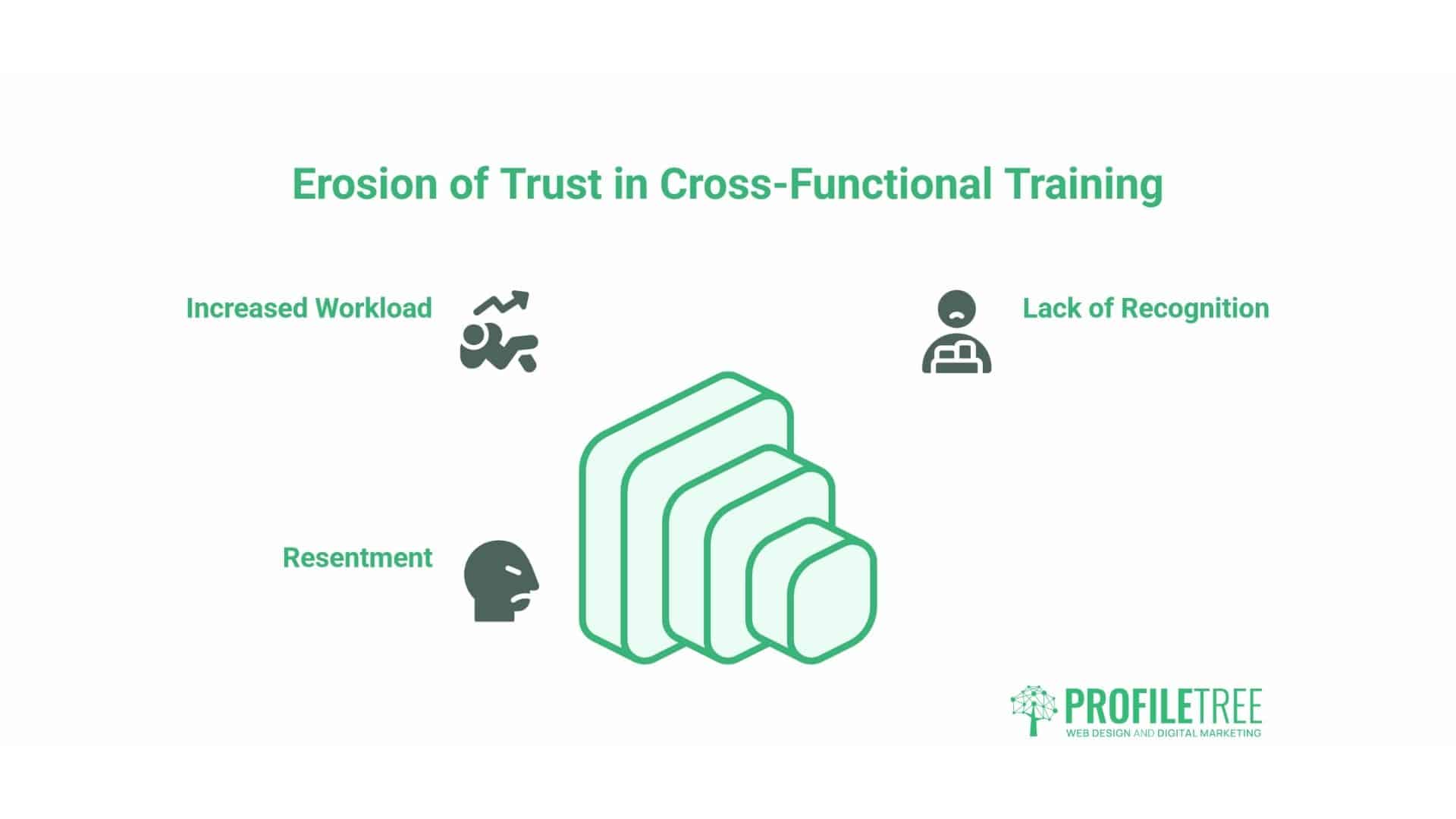
The quiet hiring problem. When cross-functional training is used primarily to extract more labour from existing staff rather than genuinely developing them, it erodes trust quickly. If the result of a training programme is that one person is now responsible for tasks previously handled by two, without any adjustment to their role or recognition, resentment follows.
Breadth without depth. There is a real risk of producing staff who are a little bit capable in many areas but expert in none. Cross-functional training is most effective when it gives employees a solid working knowledge of adjacent functions, enabling them to collaborate and contribute rather than creating interchangeable generalists.
Training without application. Skills that are taught but never used atrophy quickly, as covered above. If a customer service team member learns basic SEO principles but never has the opportunity to contribute to content decisions, the training produces no lasting value.
Getting Buy-In from Leadership
Cross-functional training programmes rarely fail because the concept is wrong. They fail because leadership was not sufficiently invested from the start. When senior decision-makers see cross-functional training as a cost rather than a strategic asset, it tends to be under-resourced and the first thing cut when budgets come under pressure.
Securing genuine leadership buy-in requires framing the conversation in terms that matter at that level: business continuity, competitive capability, and return on investment. A programme pitched as “developing our people” will always lose out to a more urgent operational priority. The same programme, pitched as “reducing exposure to key-person risk and accelerating digital capability”, speaks directly to the concerns that occupy most SME leadership teams.
A few approaches consistently help. Connect training to a live business problem: if the organisation is about to implement a new digital tool, launch a content strategy, or restructure a team, cross-functional training has a clear and immediate role to play. Start with a small, visible pilot rather than asking leadership to commit to a company-wide rollout in one step. Quantifying the cost of not training: the risk of a key employee leaving, the cost of a contractor brought in to fill a capability gap, or the delayed return on a technology investment that the team cannot fully use are all costs that cross-functional training directly reduces.
Where Digital Services Actually Fit Into a Cross-Functional Programme
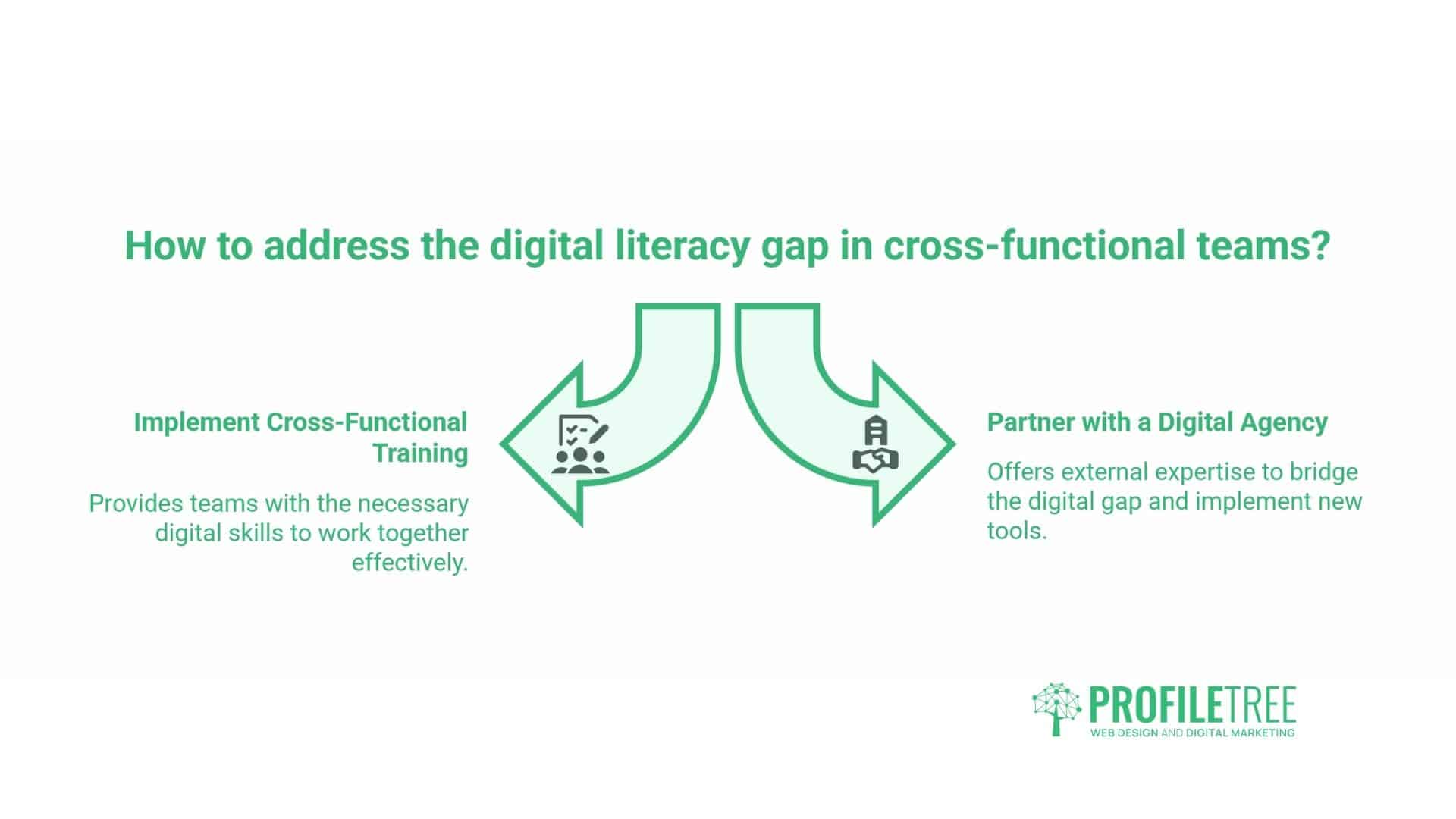
For many UK and Irish SMEs, the most pressing cross-functional gap is digital. Teams where marketing, operations, and leadership have fundamentally different levels of digital literacy struggle to implement new tools, make sense of data together, or produce content at the pace the market demands. This is where a cross-functional programme and an agency relationship genuinely intersect, not as a sales pitch, but because the two problems are connected.
SEO and digital marketing strategy. A skills gap audit often reveals that only one person in the business understands how SEO or a wider digital marketing strategy actually works. Cross-training a second team member, even to a working knowledge level, means someone else can brief an agency, interpret a monthly report, or sense-check a proposal, rather than the whole relationship depending on one person’s availability.
Content marketing. The customer service representative who learns basic SEO principles, mentioned earlier as a common example of cross-functional training, becomes genuinely useful when that knowledge is applied to real content marketing decisions, such as determining which customer questions should be added to an FAQ page or fed into a wider content hub.
Video production and animation. A team member who picks up basic scripting or shot-planning knowledge as part of their cross-functional development is not being trained to replace a video production team. They become a far better internal client for one, able to brief a shoot clearly, give useful feedback on a rough cut, or scope a short animation explainer without needing every decision explained from scratch.
YouTube marketing. The same logic applies to YouTube marketing. A marketing generalist who understands the basics of what makes a video discoverable, titles, thumbnails, and watch time can work far more effectively alongside a specialist team producing the content itself.
Website management. The CMS example given earlier in this guide, where more than one person can manage the website, is one of the most common and most practical forms of cross-functional training an SME can invest in. It is also a direct business continuity measure: agencies handling web development or web design work more effectively with a client team that includes at least two people who can log in, make a basic content change, and understand what a WordPress hosting or maintenance report means.
AI implementation and transformation. As organisations introduce new digital tools (AI content assistants, CRM platforms, marketing automation systems, analytics dashboards), they consistently find that adoption fails not because the tools are too complex, but because too few people across the team understand them well enough to use them confidently. Cross-functional training that includes digital literacy components, including basic AI tool familiarity, directly accelerates the return on any technology investment. ProfileTree’s AI training and implementation programmes and digital training courses through Future Business Academy are built around exactly this challenge: helping teams across functions, not just the marketing department, build the working digital knowledge they need to use new tools from day one.
As Ciaran Connolly, founder of ProfileTree, puts it: “The businesses that get the most out of an agency relationship are rarely the ones with the biggest budget. They’re the ones where two or three people on the client side actually understand what’s being delivered and why.”
A website redesign or a new content marketing strategy produces far better results when the internal team involved in briefing, reviewing, and managing it has the cross-functional digital knowledge to contribute meaningfully. That combination of agency expertise and an informed client team consistently outperforms either working in isolation.
Making Cross-Functional Training Part of How Your Team Works
Cross-functional training is not a luxury reserved for large organisations with dedicated learning and development departments. For UK and Irish SMEs, it is one of the most cost-effective ways to build a team that is resilient, collaborative, and adaptable as the business grows.
The thread running through this guide is simple: knowledge held by one person is a risk, and knowledge trained once and never used decays anyway. The businesses that get this right treat cross-functional training as an ongoing habit, not a one-off initiative, and connect it to the digital skills their teams actually need day to day.
If your organisation is reviewing how your team works across departments, or planning a digital marketing strategy review or an AI implementation project, that’s the right moment to build cross-functional training from the start. Get in touch with ProfileTree to talk through where your team’s digital skills gaps sit.
FAQs
What is cross-functional training?
Cross-functional training equips employees with skills beyond their primary roles, enabling them to contribute meaningfully across departments. The aim is a more adaptable, collaborative, and resilient organisation.
What is an example of cross-functional training?
A customer service representative learning the product team’s QA process, or a sales manager gaining a working knowledge of SEO, are both practical, common examples.
What is the difference between cross-training and cross-functional training?
Cross-training involves similar tasks within a function’s operational scope, such as a colleague learning to run the till. Cross-functional training moves knowledge across departmental lines to build strategic capability and improve collaboration.
What are the main benefits of cross-functional training?
Reduced dependency on key individuals, stronger cross-departmental collaboration, and improved employee retention are consistently the three benefits SME leaders notice first.