
Self-Paced or Instructor-Led Training: How to Choose
Table of Contents
Most UK and Irish businesses do not fail at training because they pick the wrong topic. They fail because they pick the wrong delivery method for that topic, then wonder why completion rates sag, and skills never reach the job.
The choice between self-paced and instructor-led training shapes cost, completion, compliance, and how well learning actually sticks. Get it right,t and a modest budget goes a long way. Get it wrong and money disappears into half-finished modules or expensive workshops nobody remembers.
This guide on choosing self-paced or instructor-Led training breaks down both methods, sets them against UK and Ireland realities such as CPD and the Apprenticeship Levy, looks at inclusive design for neurodivergent staff, and shows why blended learning is usually the smarter answer.
Understanding the Two Core Training Methods
Before weighing one method against the other, it helps to be precise about what each term covers. The labels get used loosely, and that vagueness is part of why so many training budgets miss the mark. Three definitions matter for any decision-maker allocating a quarterly budget.
What Self-Paced Training Really Means
Self-paced training lets a learner move through material on their own schedule, with no fixed sessions. It usually runs through digital modules: recorded video, reading, quizzes, and interactive tasks that someone can open at 7 amm or 11 pm. The defining feature is learner control over timing and repetition.
That control is the headline benefit. A learner who already understands a topic skips ahead, while one who finds it hard replays a section until it lands. For teams scattered across Belfast, Dublin, and remote home offices, this removes the scheduling headache entirely.
What Instructor-Led Training Covers
Instructor-led training (ILT) puts an expert in front of learners in real time, whether in a room or over video. It runs on lectures, discussion, demonstrations, and group tasks, and it gives a structured, guided experience with a clear start and finish.
The live element is what people pay for. Questions get answered on the spot, misunderstandings get corrected before they harden, and a tutor can read the room and slow down when faces go blank. For complex or sensitive subjects, that responsiveness is hard to replicate.
Where VILT and Asynchronous Video Sit
Two middle options matter for 2026 planning. Virtual instructor-led training (VILT) keeps the live tutor but moves the room online, cutting travel costs while holding on to real-time interaction. Asynchronous video sits closer to self-paced: a recorded expert session learners watch when it suits, with discussion handled separately.
These middle grounds explain why a strict either-or choice rarely fits. Most strong programmes borrow from across the spectrum, a point worth holding onto. If your team is weighing up broader skills planning, the ProfileTree guide to choosing training courses walks through how to match a method to an outcome rather than a fashion.
Weighing the Strengths and Trade-Offs of Each
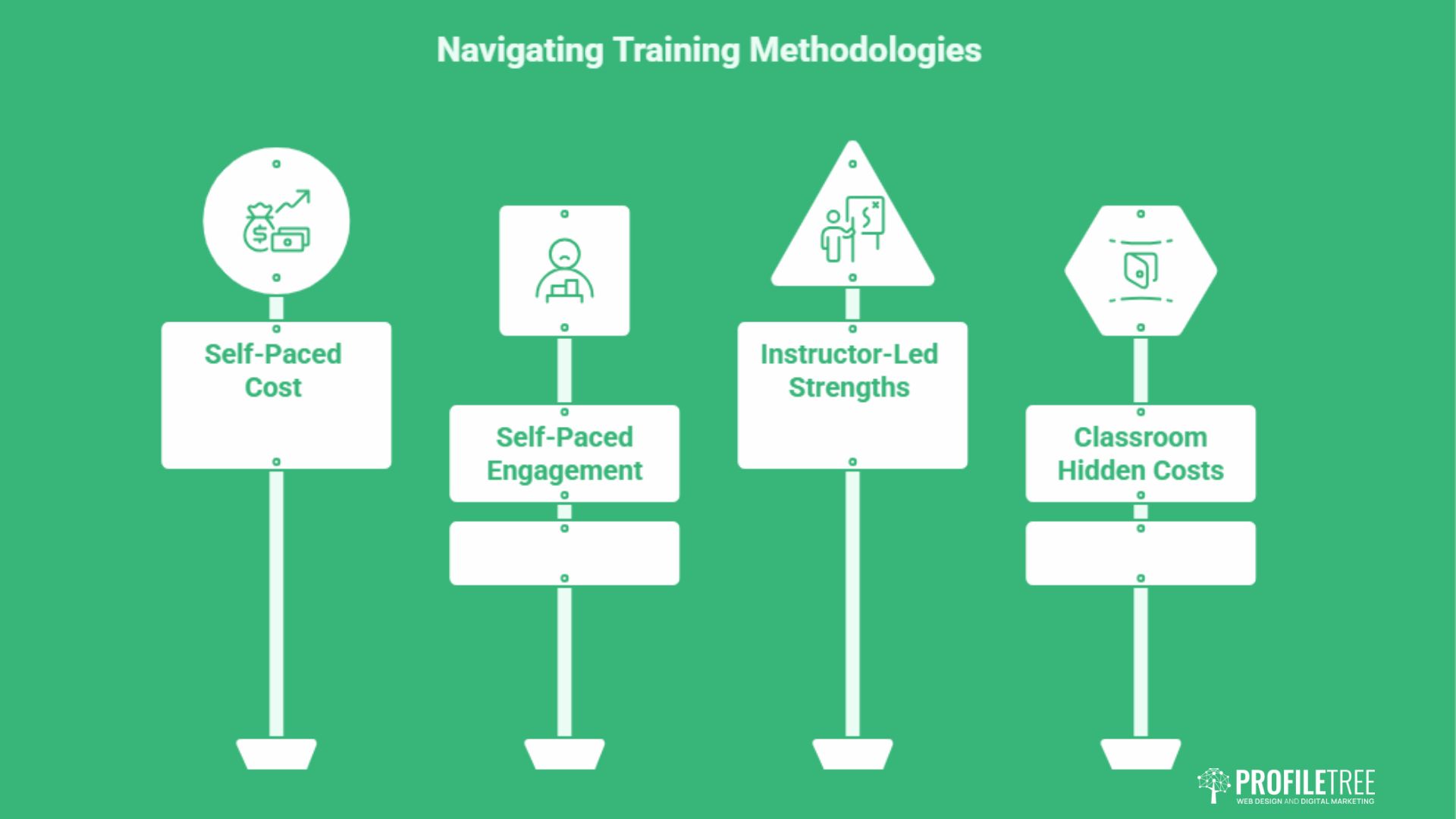
Neither method wins outright. Each carries genuine strengths and equally genuine costs, and the right pick depends on the subject, the people, and the budget. Looking at both sides honestly stops a business from buying the wrong thing on enthusiasm alone.
Why Self-Paced Wins on Cost and Scale
Self-paced training scales almost for free once built. The development cost is paid up front, then ten learners or ten thousand cost much the same to serve. There are no repeat tutor fees, no room hire, and no travel. For onboarding, compliance refreshers, and foundational skills, the maths is hard to argue with.
Flexibility is the second draw. Staff fit learning around shifts, school runs, and client deadlines, which lifts the odds that training actually gets done. For SMEs trying to upskill a stretched team without pulling everyone off the floor at once, this matters a great deal.
The Engagement Gap Self-Paced Creates
The catch is motivation. Without a fixed session and a tutor expecting attendance, modules drift to the bottom of the list, and completion rates fall. Learners who thrive on structure can stall, and the isolation of solo study chips away at the sense of shared progress that keeps people going.
Feedback is the other weak spot. Automated quizzes cannot probe a half-formed answer the way a person can, so misunderstandings can settle in unchallenged. This is exactly where good programme design, and sometimes a light-touch human check-in, earns its keep.
What Instructor-Led Training Does Better
ILT shines on anything that needs nuance, practice, or real-time correction. Leadership skills, difficult conversations, hands-on technical work: these benefit from a tutor watching, adjusting, and feeding back as it happens. Group discussion adds perspectives that a solo module never could.
Structure is the quieter benefit. A scheduled session creates accountability, and a skilled tutor keeps a group moving through a logical sequence so nothing essential gets skipped. People who struggle to self-direct often do their best learning here. To see how this plays out in practice, the ProfileTree project management training resource shows where live delivery pulls ahead.
The Hidden Costs of the Classroom
Live delivery is the pricier route, and the headline tutor fee is only part of it. In-person sessions add travel, accommodation, venue hire, and printed materials, and even VILT carries licensing or platform costs. Then there is the productivity hit of taking a whole team off work at the same time.
None of this makes ILT a bad value. It makes it valuable that has to be justified by the subject. Spending classroom money on something that a recorded module could teach is the most common waste in corporate learning.
The UK and Ireland Context Most Guides Ignore
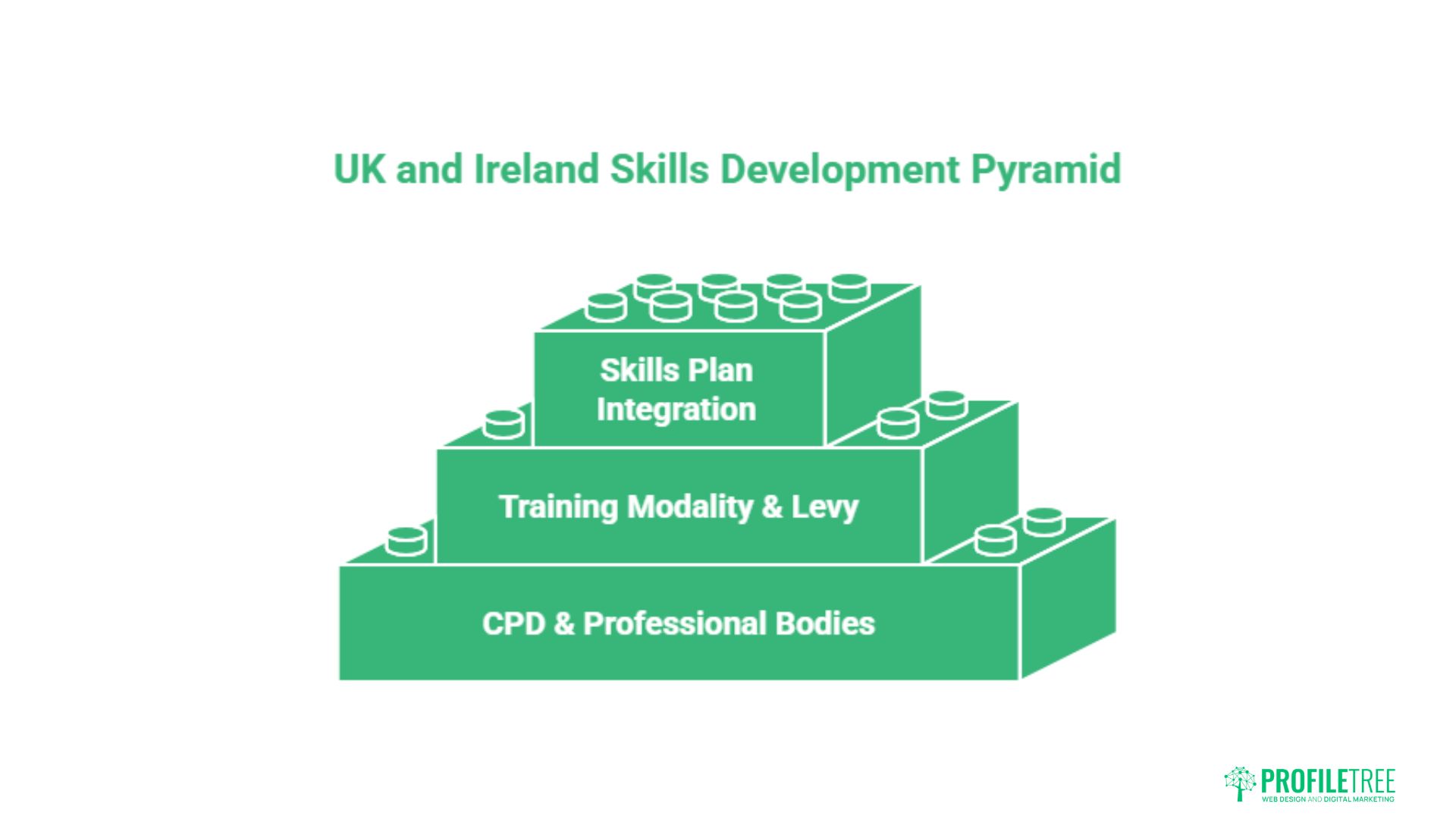
Generic comparison articles skip the part that actually constrains UK and Ireland businesses: regulation and recognised standards. Training modality is not just a learning-design choice locally. It interacts with funding rules and professional requirements that carry real money and compliance weight.
CPD Requirements and Professional Bodies
Many UK and Ireland professionals must log continuing professional development hours, and the bodies overseeing them, such as the CIPD, increasingly accept both self-paced and live formats provided the learning is structured and evidenced. The detail that trips people up is evidence: a casual video watch rarely counts, while a module with assessment and a completion record usually does.
For employers, the practical lesson is to build proof into self-paced content from the start. The CIPD guidance on professional standards sets out what recognised development looks like, and structured modules with tracked outcomes map onto it cleanly. The ProfileTree overview of continuing professional development covers how to keep records audit-ready.
Training Modality and the Apprenticeship Levy
The UK Apprenticeship Levy adds a sharper constraint. Levy-funded apprenticeships require a set proportion of off-the-job training, and how that training is delivered affects what can be counted. Self-paced and instructor-led hours can both qualify, but only when they are planned, recorded, and clearly tied to the apprenticeship standard.
This is where modality choice becomes a funding question, not just a preference. The official apprenticeship funding rules spell out what counts as eligible training. Businesses that map their delivery method against those rules early avoid clawbacks and wasted levy pots later.
Building Modality Into a Wider Skills Plan
Compliance aside, modality should answer to a skills strategy rather than the other way round. A business that knows which capabilities it needs over the next year can decide, topic by topic, whether self-paced scale or live depth serves better. That planning view also keeps spending honest.
Regional context shapes this, too. Northern Ireland and the wider UK and Ireland market have a strong appetite for digital upskilling, and ProfileTree, the Belfast digital agency, builds training around that demand. For teams thinking about location and growth more broadly, ConnollyCove’s look at the top cities in Northern Ireland offers useful regional colour. The ProfileTree development resources tie individual growth back to business goals.
Designing Training That Includes Everyone
Inclusive design is the other blind spot in most comparison content. The choice of modality affects neurodivergent learners directly, and getting it right is both a fairness issue and a performance one. Staff who can learn in a way that suits them simply learn more.
How Self-Paced Supports Neurodivergent Learners
Self-paced modules suit many learners with ADHD or dyslexia because they allow cognitive breaks, replays, and control over pace. A learner can pause when focus dips, return when it returns, and revisit dense material without the pressure of a watching room. Captions, transcripts, and adjustable playback help further.
The benefit is concentration on the learner’s own terms. Removing the demand to keep up with a group in real time takes away a common source of stress, and the learning that follows tends to be deeper and more durable.
Creating Safe Spaces in Live Sessions
Live training is not off the table for inclusive design; it just needs thought. Clear agendas shared in advance, predictable structure, smaller groups, and the option to contribute in writing rather than aloud all lower the barrier. Good tutors give processing time instead of demanding instant answers.
The social scaffolding of a live group, used well, can support learners who feel adrift studying alone. The aim is a session where different minds can take part comfortably, not one built only for the most confident voice in the room.
“The businesses that get the best return on training treat accessibility as a design decision made at the start, not a fix bolted on at the end. When you build a module so a dyslexic learner and a time-pressed manager can both use it well, everyone benefits, and the completion data shows it.” Ciaran Connolly, founder of ProfileTree.
Embedding Inclusion Across Both Methods
Inclusion is not a feature of one modality. It is a habit applied to whichever method you choose, from clear language and flexible assessment to genuine choice in how people show what they have learned. Teams that build this into delivery widen the pool of staff who can progress.
Practical support helps here. The ProfileTree guides to self-development skills and sustainable training programmes show how to keep learning accessible and repeatable, le rather than a one-off event that fades.
Matching the Method to the Job: A Practical Framework
The cleanest way to decide is to stop asking which method is better and start asking which fits this subject, this audience, and this budget. A simple matrix turns a vague debate into a quick, defensible call. The table below sets out where each method tends to earn its place.
| Subject type | Best fit | Why |
|---|---|---|
| Compliance refreshers | Self-paced | High volume, low nuance, needs tracking and scale |
| Software and tools | Self-paced or VILT | Step-by-step content suits replay and practice |
| Leadership and soft skills | Instructor-led | Needs role-play, feedback, and real-time nuance |
| Technical or hands-on skills | Instructor-led or blended | Practice with correction matters |
| Onboarding basics | Self-paced | Consistent, repeatable, cost-efficient at scale |
When Should the Budget Be Decided
If the topic sits in the middle and could go either way, cost becomes the tie-breaker. Self-paced wins when learner numbers are high, and the content will be reused, because the build cost spreads thinly. Live delivery wins for small groups learning something genuinely complex, where the per-head cost is justified by the depth gained.
A three-year view sharpens this. Self-paced is capital spent once; instructor-led is an operating cost paid every time it runs. Mapping spend across that horizon stops a cheap-looking option from becoming expensive on repeat. The ProfileTree notes on budgeting for training set out how to model both.
When the Subject Should Decide
Some topics override the budget. Anything where a mistake is costly, or where skill only forms through practice and feedback, points firmly to live delivery regardless of headline price. Trying to teach difficult conversations or safety-critical procedures through a quiz is a false economy.
The reverse holds too. Forcing a simple, well-documented topic into a classroom wastes money that scaled digital content would have saved. Let the nature of the skill, not habit, drive the format.
When the Learner Should Decide
The third lens is the people. A self-directed, digitally confident team gets more from self-paced freedom, while learners who need structure and accountability do better with scheduled sessions. Knowing your workforce is part of the decision, not a detail.
This is where digital capability and method meet. As more learning moves online, teams comfortable with digital tools open up the cheaper, more flexible options. The ProfileTree resource on AI team training shows how lifting baseline digital skills widens the methods a business can use well.
Why Blended Learning Usually Wins
For most organisations, the smartest answer is not one method but a deliberate mix. Blended learning takes the scale of self-paced and the depth of live delivery and uses each where it is strongest. Treating the choice as binary is the mistake; treating it as a design problem is the fix.
The Flip Model in Practice
A common pattern puts the groundwork into self-paced modules first. Learners absorb concepts, definitions, and basics on their own time, then arrive at a live session ready to apply rather than to be lectured. The tutor’s time goes to discussion, practice, and problem-solving instead of repeating facts.
This flip raises the value of every live hour, which is the expensive hour. It also respects the prep work learners did, so sessions move faster and reach further. The reinforcement afterwards, again self-paced, helps the learning settle.
Watch the demonstration
This short overview from ProfileTree’s training work shows how structured digital learning and live support fit together in a real programme.
Keeping Engagement High in a Blended Model
Blended design also fixes the engagement gap that pure self-paced learning suffers from. Scheduled check-ins and live touchpoints give learners deadlines and a sense of being seen, which lifts completion. The structure of ILT and the flexibility of self-paced learning stop being rivals and start covering each other’s weaknesses.
Done well, this protects the company culture, too. Fully solo learning can erode the shared experience that binds a remote-first team, and a few live moments restore it. The ProfileTree look at outsourcing training, covering when to build this in-house and when to bring in support.
Conclusion
The right method depends on the subject, the budget, the people, and the rules you work under. Self-paced learning scales cheaply and suits foundational content, while instructor-led delivery earns its cost on complex or sensitive skills. For most UK and Ireland businesses, a blended approach, designed inclusively and mapped against CPD and funding rules, gives the strongest return.
Ready to build training that fits your team and your budget? Talk to ProfileTree about digital training and turn this decision into a plan.
FAQs
Which is more cost-effective for small teams?
For very small groups, instructor-led training can carry a lower upfront cost because there is no module to build, just a session to run. Self-paced learning becomes a better value as numbers grow, since the build cost is paid once and then spread across everyone who takes it. The break-even point depends on how often the content will be reused, so a small team with a topic they will teach repeatedly may still favour self-paced.
How does self-paced training affect completion rates?
Completion can dip without the accountability of a scheduled session, as modules slide down the priority list. The fix is design rather than abandonment: progress tracking, manager visibility, short module lengths, light gamification, and occasional live check-ins all lift completion. A blended structure that adds a few human touchpoints tends to solve the motivation problem that pure self-paced learning creates.
Can self-paced learning meet UK CPD requirements?
Yes, provided the learning is structured and evidenced. Professional bodies generally accept self-paced study when it has clear objectives, assessment, and a record of completion. A casual video watch with no proof rarely counts, so the key is building tracking and assessment into the module from the start so learners can demonstrate genuine, structured development when they report their CPD hours.
Is instructor-led training better for leadership skills?
Generally yes. Leadership development relies on role-play, real-time feedback, reading group dynamics, and practising difficult conversations, all of which need a live tutor and other people in the room. Self-paced content can teach the underlying theory efficiently, but the practice and nuance that turn theory into capability come from instructor-led or blended delivery.
What is VILT?
VILT stands for virtual instructor-led training. It keeps the live tutor and real-time interaction of classroom learning but delivers it online, which removes travel and venue costs while preserving the ability to ask questions and join group discussions. It sits between fully self-paced study and in-person sessions, and it has become a practical default for distributed UK and Ireland teams.