
Social Media and Other Technologies: The Complete Integration Guide
Table of Contents
Social media and other technologies no longer exist in separate lanes. The platforms most people use daily have become entry points for a wider stack of emerging technologies in social media: AI-generated content recommendations, augmented reality filters, blockchain-based data ownership, and IoT-connected device posts. For businesses trying to build a coherent digital presence, understanding how these social media technologies work together is no longer optional.
This guide covers five technology integrations reshaping social media right now: artificial intelligence and machine learning, augmented and virtual reality, blockchain, the Internet of Things, and 5G. For each, we explain how it works in practice and what it means for businesses using social platforms. ProfileTree, a Belfast-based digital marketing agency founded in 2011, has seen each of these make a measurable difference across its client base in Northern Ireland and the UK.
AI and Machine Learning in Social Media
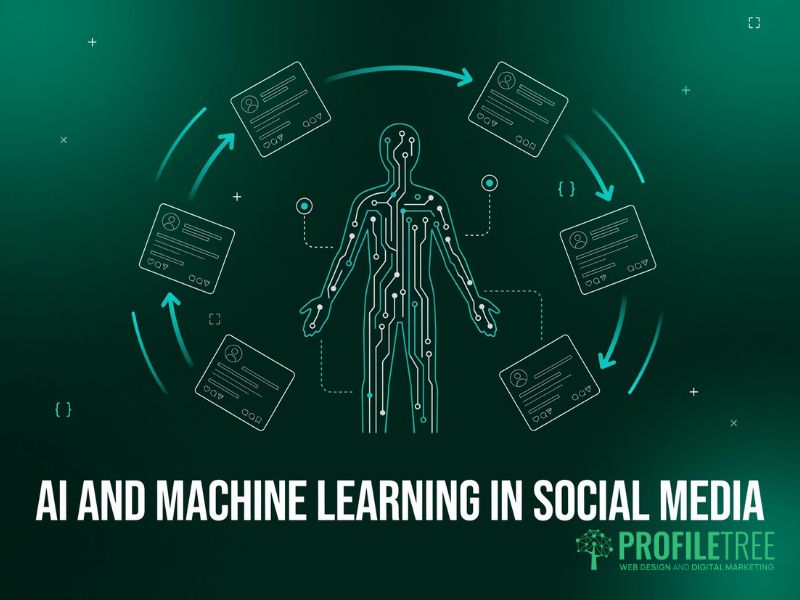
Artificial intelligence is the most significant emerging technology in social media right now, shaping nearly every interaction across every major platform. The integration of social media and other technologies, particularly AI-driven social media management tools, has enabled businesses of any size to run targeted, data-informed campaigns that previously required specialist teams. ProfileTree, founded in Belfast in 2011, has tracked this shift across over 1,000 client projects in Northern Ireland and the UK.
Content Recommendations and Feed Personalisation
AI algorithms analyse user behaviour, preferences, and interaction patterns to determine which posts, ads, and accounts appear in each person’s feed. That’s why two people following the same accounts see entirely different content. For businesses, posting quality and engagement signals matter more than volume. Platforms reward content that earns genuine interaction.
Predictive analytics sits alongside this. AI social media management tools can forecast which content’s likely to generate the most interaction and surface the best times to post. You don’t need data expertise to act on them.
AI Social Media Management Tools
The market for AI social media management tools has expanded considerably since 2022. Platforms such as Buffer, Hootsuite, and Sprout Social now automate scheduling, flag underperforming content, and draft copy variations for A/B testing. For SMEs in Northern Ireland, these tools close a real gap: they deliver the kind of social media management that previously required a full-time analyst, for a fraction of the cost.
How to integrate social media management tools with work platforms is one of the most common questions ProfileTree receives. Most major AI social media management tools connect natively to Google Workspace, Microsoft 365, Slack, and popular CRM systems through API integrations. ProfileTree’s social media marketing services help Northern Ireland businesses configure these integrations so social data flows into existing reporting structures.
AI-Powered Customer Service and Chatbots
AI chatbots using natural language processing handle a large proportion of first-contact customer service on social platforms. They operate across Facebook Messenger, Instagram DMs, and WhatsApp Business, providing round-the-clock responses to routine enquiries without human involvement. A well-configured chatbot handles appointment bookings, product questions, and complaint triage without adding headcount.
The limitation is quality. If they’re poorly configured, chatbots frustrate customers and damage brand reputation. ProfileTree works with clients to set up chatbot flows that escalate correctly to human agents when a query falls outside their scope.
Image Recognition and Content Moderation
Machine learning now powers the tools that automatically tag visual content, detect inappropriate material, and identify branded assets across platforms. For advertisers, image recognition enables product tagging from photos: a customer’s post featuring a branded item can be linked to that product’s purchase page automatically. For platform safety teams, the same technology flags policy violations before human moderators review them.
For SMEs looking to move into structured AI adoption, ProfileTree’s AI training programme covers how to apply artificial intelligence practically across content creation, social scheduling, and performance analysis. It’s built for business owners and marketing managers who want to use these social media technologies without a large technical overhead.
AI Applications in Social Media: Quick Reference
| Application | How it works | Business impact |
|---|---|---|
| Content recommendations | Analyses engagement signals to rank content in feeds | Higher-quality posts reach more relevant audiences |
| AI scheduling tools | Machine learning forecasts optimal posting windows | More effective content planning without data expertise |
| Chatbots | NLP-powered automated responses in DMs and comments | 24/7 customer service without added headcount |
| Image recognition | Identifies products, faces, and branded assets in photos | Enables product tagging and automated moderation |
| Content moderation | Flags policy violations before human review | Faster enforcement at scale across large accounts |
Augmented Reality and Virtual Reality
The integration of social media and other technologies is perhaps most visible in augmented reality, which overlays digital elements onto the physical world. Virtual reality replaces the physical world with a digital environment. Both have moved well beyond novelty and into mainstream social media use. Social media and augmented reality have converged in ways that are already commercially actionable without specialist hardware.
AR Filters and Brand Experiences
Instagram and TikTok have made AR filters a native content format. Users apply virtual effects to photos and videos, animated overlays, product try-ons, and environment changes and share them as standard posts or Stories. Social media and augmented reality are directly connected on these platforms: AR is built into the camera interface.
Snapchat pioneered branded AR Lenses, letting businesses commission custom effects tied to campaigns. A retailer can let customers virtually try on sunglasses. An event can create a shareable filter that drives awareness every time someone uses it. These aren’t expensive to produce at a basic level, and shareability drives organic reach that paid advertising alone doesn’t replicate.
VR and Immersive Social Spaces
Virtual reality’s integration with social platforms is still maturing. Fully immersive environments, where users meet, collaborate, or socialise as avatars in three-dimensional spaces, exist and are growing, but widespread adoption depends on headset accessibility. For most UK SMEs, virtual reality social presence isn’t an immediate priority; it’s a medium-term consideration worth tracking.
Where virtual reality has immediate commercial relevance is in events. A VR conference space allows attendees to move through the event, interact with exhibitors, and participate in presentations in ways that flat video calls can’t replicate. As headset prices continue to decrease, it’ll become more viable for mid-market business events across the UK and Ireland.
Social Commerce and AR Try-On
Facebook and Instagram have integrated social media and augmented reality directly into advertising. AR ads let users interact with products virtually before purchasing: trying on eyewear, placing furniture in their living room, testing a lipstick shade. It removes the key objection in online retail around appearance and fit. Conversion rates on AR-enabled ads are consistently higher than on standard image ads.
For businesses considering social commerce as part of their digital marketing services, augmented reality product integration is worth evaluating as part of campaign planning, particularly for product-led brands where appearance or fit drives the purchase decision.
Blockchain Technology and Social Media
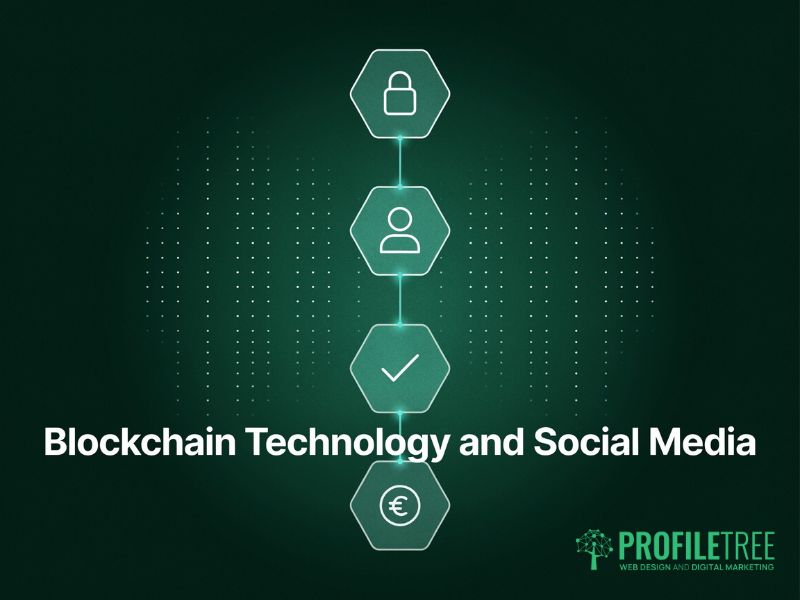
Blockchain social media represents one of the more structural shifts in how platforms could operate. It’s a decentralised digital ledger recording transactions in an unalterable sequence. Its applications for social media and other technologies address the platform model’s most persistent problems: data ownership, content authenticity, and creator monetisation, making it the area carrying the most regulatory weight for long-term social media strategies.
Data Ownership and Privacy
On conventional social platforms, user data is held and monetised by the platform itself. Users generate the content and the engagement; the platform captures the commercial value. Blockchain social media systems allow users to maintain ownership of their data, control how it’s used, and potentially receive direct compensation for their contributions.
It isn’t yet mainstream, but it addresses a concern that UK and Irish businesses operating under UK GDPR and the Irish Data Protection Act 2018 will recognise immediately. Decentralised storage eliminates the single point of failure that makes centralised databases attractive targets for breaches.
Content Authenticity and Misinformation
Blockchain social media infrastructure can provide a verifiable record of where content originated and whether it has been altered. In a media environment where deepfakes, AI-generated images, and edited screenshots circulate widely, a blockchain-verified content chain creates a mechanism for establishing authenticity. It has real implications for brand management: a business can prove the provenance of its official communications, and platforms can flag unverified content more reliably.
For businesses concerned about online brand misrepresentation, this is a developing area worth monitoring. The infrastructure isn’t yet widely deployed, but several platforms and standards bodies are actively building practical blockchain social media verification systems. It’s moving faster than most businesses realise.
Tokenised Creator Economies
Blockchain enables social platforms to build token-based reward systems where users earn cryptocurrency for creating content or contributing to governance. It shifts the incentive structure away from pure engagement metrics towards contribution quality. For businesses running ambassador programmes, token economies create compensation structures that are transparent and auditable.
The Internet of Things and 5G
The Internet of Things connects physical devices, home appliances, industrial sensors, and wearables to the internet, enabling them to send and receive data automatically. The integration of social media and other technologies is nowhere more practical than here: the Internet of Things creates a category of social content that doesn’t require human initiation. 5G provides the network infrastructure that makes this possible at scale.
IoT and Automated Social Content
Smart home devices and wearables are already integrated with social platforms at a consumer level. Fitness trackers post workout completions automatically. Smart speakers surface social content in response to voice queries. Security cameras send alerts through social-connected notification systems. At a business level, the Internet of Things means operational data can feed directly into social communications without manual intervention.
A manufacturer with IoT-equipped equipment can post real-time output milestones automatically. A hospitality business with smart booking systems can share live availability updates. A retailer with connected inventory management can alert customers when a product’s back in stock. None of these requires manual input once the integration’s configured.
Wearables and Health Data Sharing
Fitness trackers and smartwatches integrated with social platforms have created a category of health-related social content that drives community engagement. For businesses in health, sport, or wellness, this is a format their audience is already generating. Building brand presence through challenges, shared goals, or branded activity tracking is a form of social marketing that the Internet of Things has made structurally easier.
5G and Real-Time Social Experiences
5G’s primary contribution to social media technologies is removing the bandwidth and latency constraints that have historically made high-quality real-time content difficult to deliver at scale. Live streaming at broadcast quality, simultaneous multi-camera feeds, real-time interactive overlays: these become technically straightforward on a 5G network in a way that 4G couldn’t reliably support.
For businesses using live video as part of their social strategy, whether for product launches, events, Q&A sessions, or behind-the-scenes content, 5G substantially raises the quality floor. Buffering, dropped connections, and pixelated video are far less common, which means the professional standard audiences now expect is achievable without studio infrastructure.
In Northern Ireland, 5G coverage has expanded across Belfast and major towns, with operators extending reach beyond urban centres. For businesses in the region, the practical benefits of high-quality live social content are no longer limited to city locations. A manufacturer in Co. Antrim or a tourism business on the north coast can now run broadcast-quality live streams from the site.
5G also accelerates the augmented reality and virtual reality integrations covered earlier. The real-time data transfer required for high-quality AR experiences is viable on 5G in ways it wasn’t on previous networks. The convergence of social media and other technologies, particularly 5G, AR, and AI, is creating a faster content environment that demands more from businesses.
Technology Integration: Risk and Opportunity Summary
| Technology | Key opportunity | Key risk | Priority for SMEs |
|---|---|---|---|
| AI / ML | Personalised advertising reach and AI social media management | Algorithm dependency | High — immediate |
| AR / VR | Interactive brand experiences and social commerce | Development cost and accessibility | Medium — product-led brands |
| Blockchain | Content authenticity and blockchain social media ownership | Still early-stage infrastructure | Low — watch and wait |
| IoT | Automated real-time social content from connected devices | Data privacy and integration complexity | Medium — sector-dependent |
| 5G | High-quality live streaming and AR/VR enablement | Coverage gaps outside urban areas | High — growing coverage |
What This Means for Businesses in Northern Ireland
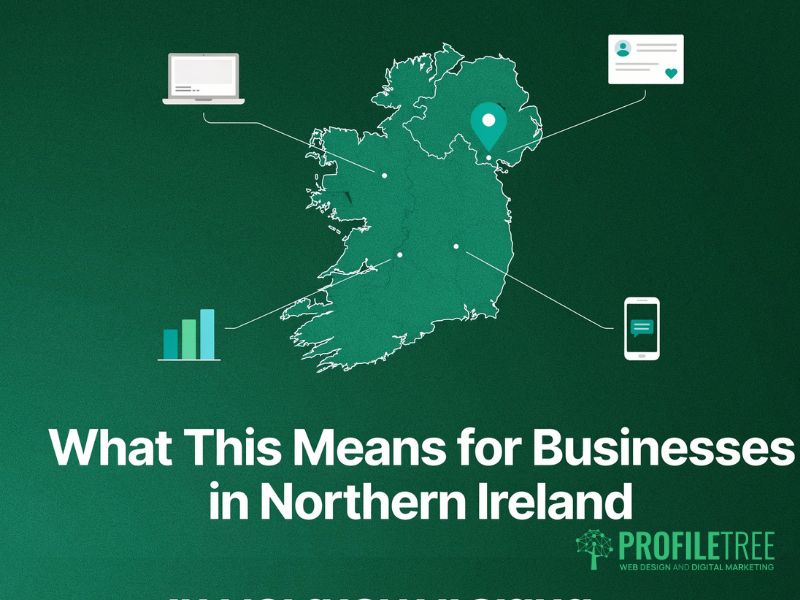
These five social media technologies don’t operate independently. The most effective strategies integrate several: AI social media management tools for content planning, augmented reality for product-led campaigns, the Internet of Things for operational transparency, and 5G-quality live content for community building. The best results come from treating social media and other technologies as one connected system.
“The businesses that will build the strongest digital presence over the next five years are the ones that understand social media as a layer on top of other technologies, not a separate thing they check separately. AI, automation, and the connected device world are already reshaping how content gets created, distributed, and acted on. SMEs in Northern Ireland have an opportunity to move early. The tools are accessible, and the competitive space here isn’t yet saturated with businesses using them well.”
— Ciaran Connolly, Founder, ProfileTree
ProfileTree has worked with over 1,000 businesses across Northern Ireland, Ireland, and the UK since 2011, configuring AI social media management tools, building augmented reality campaigns, and training teams on emerging social media technologies through our digital training services. The goal is always practical, measurable progress rather than chasing trends.
If you’re at an earlier stage in thinking about how artificial intelligence will change your approach to social platforms, ProfileTree’s AI transformation services offer a structured starting point, from a tools audit to team training to strategy integration.
Choosing Where to Start
Social media and other technologies are converging in ways that change the practical reality of running a digital presence. Artificial intelligence makes advertising more precise and social media management more efficient. Augmented reality creates interactive formats that static posts can’t match. Blockchain social media is building new frameworks for data ownership and content verification. The Internet of Things generates a new category of automated operational content. And 5G is removing the technical barriers that have historically limited real-time social experiences.
None of these social media technologies requires a large budget to start with. The most useful first step for UK and Irish SMEs is to identify which emerging technology in social media connects most directly to their existing business model. Don’t try to adopt everything at once. Start with AI social media management tools, assess whether augmented reality fits your product, and review the Internet of Things and 5G as part of a broader infrastructure conversation when you’re ready.
FAQs
1. What are the main emerging technologies in social media right now?
The five emerging technologies in social media with the most immediate business relevance are artificial intelligence, augmented reality, virtual reality, blockchain, and the Internet of Things, all accelerated by 5G. AI and augmented reality are already fully integrated into the platforms most UK businesses use daily. The Internet of Things and blockchain social media are developing quickly, and understanding how social media and other technologies interact across these five areas gives businesses the clearest framework for planning ahead.
2. What are the best AI social media management tools for SMEs?
The AI social media management tools best suited to SMEs are those that integrate scheduling, analytics, and content suggestions into a single platform. Buffer, Hootsuite, and Sprout Social all offer AI-assisted features at accessible price points. How to integrate social media management tools with work platforms such as Microsoft 365 or Slack depends on the tool; most offer native API connections or Zapier integrations. ProfileTree’s AI training programme covers selection and configuration with a practical NI context.
3. How are social media and augmented reality used in marketing?
Social media and augmented reality converge most visibly in AR filters, branded Lenses, and AR-enabled ads. On Instagram, TikTok, and Snapchat, businesses can commission custom augmented reality effects that users interact with and share organically. Facebook and Instagram’s AR ad formats allow product try-on directly within the platform, removing a key objection in online retail and driving measurably higher conversion rates than standard image ads, making it one of the highest-ROI applications of emerging technologies in social media for product-led businesses.
4. Is blockchain social media relevant for small businesses right now?
For most SMEs, blockchain social media is worth understanding but not yet worth building a strategy around, as the infrastructure is still developing. Where it becomes relevant sooner is in brand protection: businesses in finance, healthcare, and legal should monitor blockchain social media verification tools as they mature. Creator businesses may also find token-based platforms worth exploring as alternative monetisation routes alongside conventional social media technologies.
5. What should businesses in Northern Ireland prioritise when integrating social media and other technologies?
Start with AI social media management tools, the scheduling platforms, and AI-assisted content tools available today, which are affordable and immediately useful for improving performance across social media technologies. Once those are in place, assess whether augmented reality or the Internet of Things connects to your product or operations. ProfileTree’s digital training programme covers all emerging technologies in social media with a practical, Northern Ireland-specific context.