
How to Create Engaging Product Descriptions: The SME Guide
Table of Contents
Your product description is doing a job even when you are not. Every time a potential customer lands on your page, that copy either closes the gap between curiosity and purchase or lets them click away to a competitor. For SME owners across Northern Ireland, Ireland, and the UK, knowing how to create engaging product descriptions is one of the highest-return skills in your entire marketing toolkit.
This guide gives you a practical, step-by-step framework for writing product and service descriptions that rank in search and actually convert. We will cover how to structure your copy, how web design and layout support your words, how to write for UK audiences specifically, and where AI tools help and where they get businesses into trouble.
Why Your Product Descriptions Are Your Silent Sales Team
Most business owners think of product descriptions as admin. You fill in the box, you list what the product does, and you move on. That mindset costs sales.
Knowing how to create engaging product descriptions is, in effect, knowing how to run a sales conversation at scale without you in the room. It is working at midnight, on mobile, when a customer in Derry or Dublin is comparing three options and deciding in under two minutes. The quality of that copy determines whether they buy from you or from someone else.
This matters especially for SMEs. Larger brands can rely on brand recognition to carry weak copy. Smaller businesses cannot. Your product page has to do the persuasive work that a face-to-face conversation would do in a shop.
The role of the product description in the customer journey runs across three stages. At awareness, it helps search engines understand what your page is about and serves the right searchers. At consideration, it addresses objections, builds confidence, and differentiates your offer. At decision, it gives the customer a concrete reason to act now rather than returning to browse later. Writing with all three stages in mind is what separates useful product description writing from filler copy.
The Anatomy of a High-Converting Product Page
Why Web Design and Copy Must Work Together
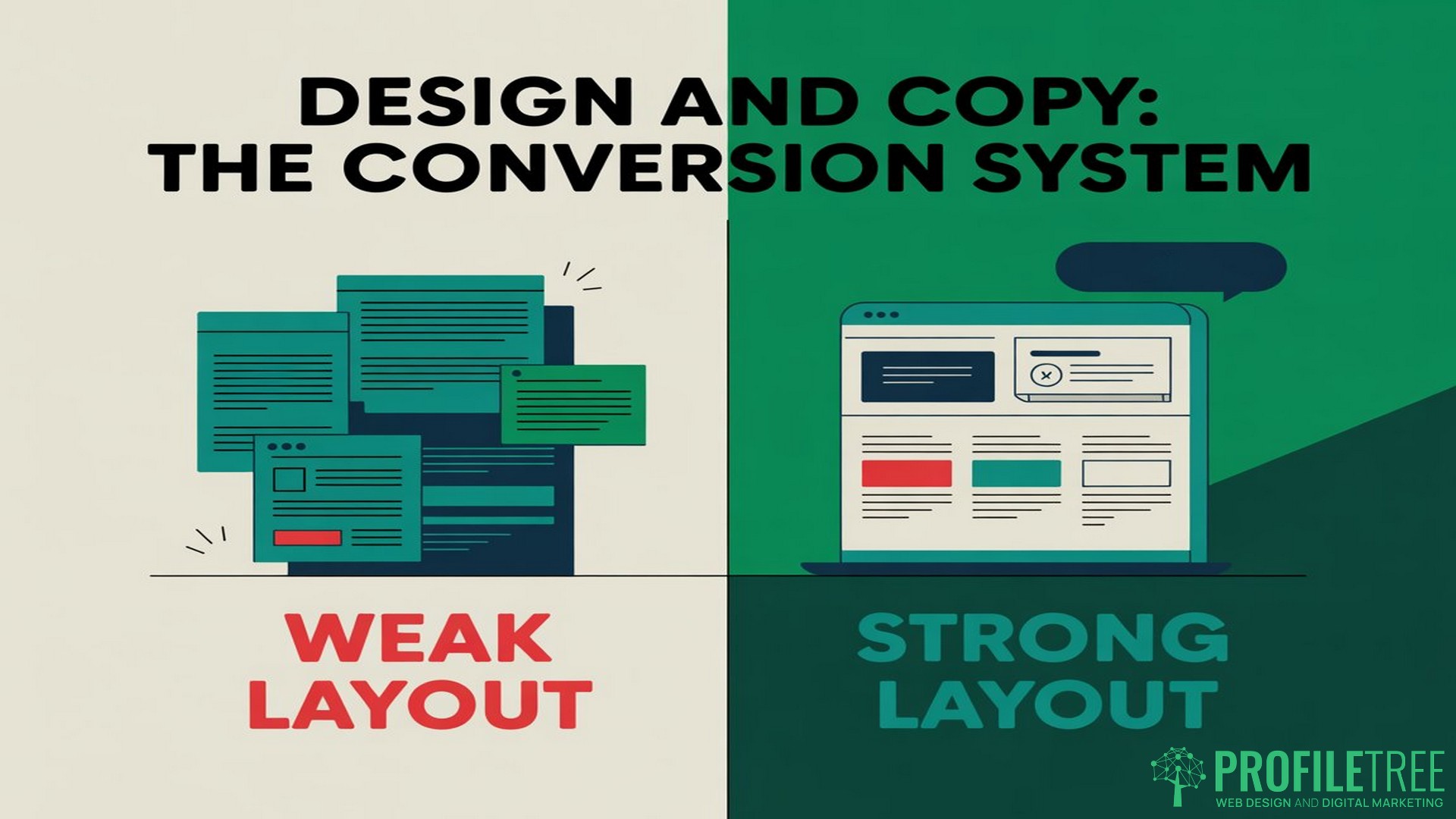
Even the best product description writing fails if the page around it is poorly structured. This is one of the most consistently overlooked points in product description guides, particularly those aimed at e-commerce beginners.
If your font is too small, your images take three seconds to load, or your call-to-action button is buried below the fold on mobile, your copy will not be read in full, regardless of how well it is written. The words and the design are not separate decisions. They are part of the same conversion system.
Ciaran Connolly, founder of ProfileTree, makes this point directly with clients: “We see businesses invest in strong copy and then publish it on pages where the layout is actively working against them. White space, hierarchy, and mobile performance are not design luxuries. They are conversion factors.”
For UK SMEs building or upgrading their websites, this means briefing your web designer on how the product description structure should look on the page, not just providing the text. The best descriptions are written to sit within a specific layout, with scan-friendly formatting built in from the start.
ProfileTree’s web design services are built around this principle: that pages need to serve both readers and search engines, with design decisions grounded in how buyers actually behave.
Layout Decisions That Affect Whether Your Copy Gets Read
The placement of your key benefit statement matters. If your strongest selling point is buried in paragraph three, most mobile users will never see it. Eye-tracking research by the Nielsen Norman Group found that web users typically read only around a quarter of the text on any given page, scanning rather than reading in full, particularly on a first visit.
Structure your product descriptions with the most compelling information first. Follow this with supporting detail, specifications, and trust signals. Bullet points work well for key features and delivery information. Longer prose works better for the emotional or contextual sell. Most high-performing product pages use both, with a clear visual hierarchy separating them.
The Three Cs of Copy That Converts
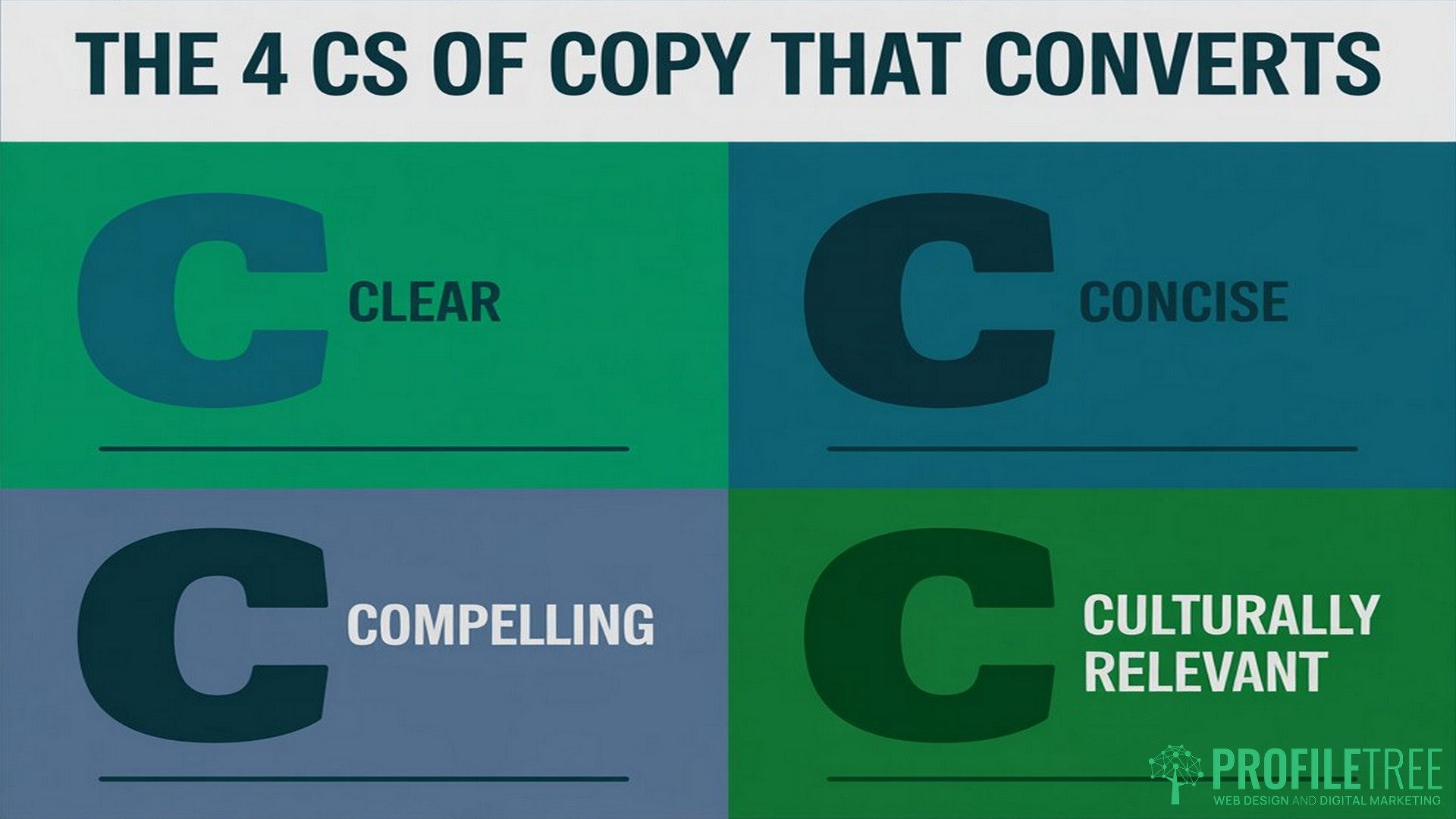
The “3 Cs” is a framework that appears frequently in guidance on creating engaging product descriptions, and for good reason. Clear, Concise, and Compelling covers the fundamentals. For UK SMEs, we add a fourth: Culturally Relevant.
- Clear means your customer immediately understands what the product is and who it is for. Ambiguity kills conversion. If someone has to work to understand your offering, they will not.
- Concise means respecting the reader’s time. A practical starting point for most products is 150 to 300 words. Exceptions exist for technical products or services where customers need more information to make a confident purchase. But length should be driven by what the buyer needs, not by a desire to fill space.
- Compelling means the description creates desire, not just understanding. This comes from focusing on outcomes rather than features. “100% merino wool” is a feature. “Stays warm without the bulk, so it works under a suit or over a base layer on a Scottish hillside” is compelling.
- Culturally Relevant is where UK and Irish SMEs can genuinely differentiate from the US-centric advice that dominates most guides. UK consumers respond to different trust signals, different terminology, and different tonal registers than American shoppers. We return to this in detail below.
A Step-by-Step Framework for SME Owners
Step 1: Define Your Buyer Before You Write a Word
Product description writing that converts starts not with the product, but with the person buying it. Who are they? What do they already know? What are they worried about? What does a successful purchase look like for them three months after they buy?
For SMEs in Northern Ireland and Ireland, this often means thinking about a specific customer you have actually spoken to, rather than a theoretical persona. Use the language your customers use when they call, email, or leave a review. That phrasing is often more effective in product copy than anything a marketing guide suggests.
Step 2: Lead With the Problem the Product Solves
The most common mistake in product description writing is starting with what the product is, rather than what it does for the customer.
Consider the difference:
| Weak Opening | Stronger Opening |
|---|---|
| “The X300 is a stainless steel insulated travel mug with a 500ml capacity.” | “Keeps coffee hot for six hours. Fits standard car cup holders. Doesn’t leak in your bag.” |
| Our consulting service covers a full audit of your digital marketing channels. | Most SMEs we work with are paying for digital marketing that isn’t generating leads. This service finds where the budget is going and what needs to change.” |
The weaker version leads with specification. The stronger version leads with the customer’s problem and the outcome they want. Both product descriptions can contain the same information; it is the order and emphasis that changes.
Step 3: The “So What?” Test for Every Sentence
Once you have a draft, read each sentence and ask, “so what?” If the answer is not obvious, the sentence is not earning its place.
“Made from premium materials” fails the test. So what? Why does that matter to this buyer?
“Made from reinforced nylon that doesn’t crack in sub-zero temperatures, so it works through a Northern Ireland winter without needing to be replaced” passes. It connects the feature to a specific outcome for a specific audience.
Apply this to every feature claim in your product descriptions.
Step 4: Build in Trust Without Over-Promising
UK consumers are sceptical of superlatives. “Best in class,” “unbeatable quality,” and “world-leading” land differently here than in American copy. They read as promotional rather than informative, and they can undermine the credibility of an otherwise strong description.
Trust in UK and Irish product pages comes from specificity rather than claims. Precise dimensions, material grades, delivery timeframes, and return policies build more confidence than adjectives. Where you do include social proof, real customer language in reviews carries more weight than internally written testimonial copy.
Product Description Writing for SEO
Strategic Keyword Placement Without Sounding Like a Robot
Good product description writing for SEO is not about keyword stuffing. When you create engaging product descriptions that also rank, the difference is ensuring that the language your customers use to search appears naturally in the places search engines weigh most heavily.
For a product description, that means the H1 and page title, the first 100 words of body copy, any H2 or H3 subheadings used within longer descriptions, and the meta description. Secondary and long-tail variations should appear in the body copy where they fit naturally.
The phrase you are targeting should read as though you would say it out loud in a conversation. If a sentence sounds like it was written for a search engine rather than a person, it needs rewriting. Google’s quality guidance is explicit on this point, and it has been for years.
For UK SMEs, localised search terms are worth specific attention. “Product description writing services UK” and “how to write service descriptions for your website” are searches with genuine commercial intent and lower competition than the broad head terms. Including region-specific language where relevant, county, city, or industry references, helps pages appear for local searches that are closer to a buying decision.
ProfileTree’s SEO services include product page audits that identify where existing copy is failing to capture search demand, and what changes would improve both rankings and click-through rates.
The Meta Description Problem on This Page
The GSC data for this page shows something worth examining. Several keywords, including “product description” and “product description writing,” rank in position 1 or near the top of Google’s results yet still generate zero clicks. That is a meta description and title tag problem, not a content problem.
When your page appears in search, and nobody clicks, it means the snippet Google is showing does not match what the searcher is looking for. Rewriting the meta description to reflect genuine search intent and making the title tag actively competitive with other results is as important as rewriting the article itself.
Using AI to Create Engaging Product Descriptions Without Losing Your Voice
AI tools can significantly accelerate product description writing, but they come with risks that most “use ChatGPT” guides skip entirely.
The main risk is hallucination. AI writing tools can invent product specifications, claim features that do not exist, and generate copy that sounds plausible but is factually wrong. For physical products, especially, publishing AI copy without verification can result in customer complaints, returns, and trading standards issues in the UK.
The practical workflow that actually works looks like this:
- Write the core facts yourself: product name, key features, materials, dimensions, and the main problem it solves. This takes five minutes per product.
- Feed those facts into your AI tool with a clear brief. Specify the tone, the audience, the word count, and any terminology to avoid.
- Review the output critically. Read every factual claim. Does this match your product? Check every sentence.
- Rewrite the opening paragraph yourself. AI-generated introductions are the most immediately recognisable element of AI copy. A human-written first paragraph makes the entire description feel more credible.
- Check the output against your brand voice. Does it sound like you? If not, adjust until it does.
This is what ProfileTree’s content marketing service delivers for clients who need product and service descriptions at scale: human oversight built into every step of an AI-assisted workflow. The output is faster than writing entirely from scratch and more reliable than publishing raw AI copy.
For SMEs exploring AI implementation more broadly, ProfileTree’s AI implementation service helps businesses build these workflows into their operations in a way that is practical and auditable.
Accessibility in Product Descriptions
This section is absent from most competitors’ guides, creating a genuine gap for SME owners to fill.
Accessible product copy helps visually impaired shoppers using screen readers navigate and understand your products. It also improves your SEO, because the same practices that make content accessible to screen readers make it more parseable by search engine crawlers.
Concretely, this means writing descriptive alt text for every product image that conveys the same information the image provides. It means using a clear, logical heading structure on product pages rather than relying on visual design to indicate hierarchy. It means writing in plain English rather than jargon, and keeping sentences short enough to be read naturally aloud.
For UK businesses, accessibility is not purely a best-practice recommendation. The Equality Act 2010 has been interpreted to require that websites be usable by disabled people. While enforcement is not consistent, the legal risk is real and growing.
UK and Irish Localisation: Where Most Guides Fall Short
Every major guide to creating engaging product descriptions is written from a US perspective. That creates specific problems for UK and Irish businesses that warrant direct attention.
- Spelling and terminology: UK spellings build trust with UK buyers. “Optimise,” “colour,” “jewellery,” and “grey” signal that the copy was written for them. American spellings, even minor ones, can register subconsciously as foreign and reduce confidence.
- Delivery language: UK customers expect to see “delivery” rather than “shipping,” “postcode” rather than “zip code,” and “despatch” or “dispatch” rather than “fulfillment.” These are small signals that add up.
- Pricing and VAT: UK consumer-facing product copy should typically display VAT-inclusive prices. Where prices are shown ex-VAT, this needs to be clearly signalled. Ambiguity around pricing creates friction at checkout.
- Consumer rights language: UK buyers have stronger statutory rights for returns than in many other markets. Referencing your returns policy in product descriptions or nearby trust signals reduces purchase anxiety without requiring you to over-promise.
For SMEs that need support getting these details right across a large product catalogue, ProfileTree’s digital training programmes cover content writing, SEO, and e-commerce strategy for teams who want to build this capability in-house.
From Weak Pages to Revenue-Generating Assets
The businesses that create engaging product descriptions consistently, across their whole catalogue, not just their hero products, have a structural advantage over those that treat copy as an afterthought. Every page is an opportunity to rank, convert, and build trust.
Start with your three or four worst-performing product pages. Apply the framework above. Test the rewrites against the originals over four to six weeks. The data will show you what is working and provide a clear basis for continuing improvement across your catalogue.
Frequently Asked Questions
How long should a product description be?
For most products, a practical starting point is 150 to 300 words. Technical products, services, or high-consideration purchases often benefit from longer descriptions, as customers need more information before they commit. The goal when creating engaging product descriptions is to write the shortest copy that answers all the buyer’s likely questions and removes the main objections. Length should serve the buyer, not fill a word count target.
Does using the same product description across multiple pages hurt SEO?
Yes. Duplicate content across product variants or category pages is a known issue. Google typically indexes only one version, so the others get little or no search visibility. The practical solution for variants is to use canonical tags pointing to the primary page, combined with genuinely differentiated copy that makes the variant meaningfully different from the original.
Can ChatGPT write product descriptions for my business?
It can produce a first draft quickly, but raw AI output carries real risks. AI tools can hallucinate specifications, adopt the wrong tone, and produce copy that sounds generic. The most effective approach is a human-in-the-loop workflow where the writer provides the facts, reviews the output, and rewrites the opening and any factually sensitive sections before publishing.
What are the 3 Cs of product description writing?
Clear, Concise, and Compelling. For UK and Irish audiences, we add a fourth: Culturally Relevant. This means using UK spelling and terminology, addressing UK-specific concerns around delivery and returns, and writing in a tone that matches how your actual customers communicate.
How do I write product descriptions for a service business rather than a physical product?
Service descriptions follow the same logic as product descriptions: lead with the problem you solve, not a list of what you do. Replace features with outcomes and process steps. Replace specifications with timeframes, inclusions, and what the client will have at the end of the engagement. Service descriptions also benefit more from social proof than product descriptions do, because customers cannot examine the product before buying.
Should I include the price in my product description?
For consumer-facing e-commerce in the UK, price should be displayed prominently on the page but not necessarily embedded in the description text itself. VAT-inclusive pricing for consumer sales is expected. When pricing is flexible or the model is quote-based, focus the description on value and include a clear call to action to guide customers to the next step.