
BigCommerce for UK Retailers: Is It the Right Platform for Your Business?
Table of Contents
If you’re evaluating ecommerce platforms for a growing retail business, BigCommerce will come up quickly. It’s a well-established open SaaS platform used by businesses from independent traders to large-scale wholesalers, and it has some genuine strengths worth understanding before you commit.
This guide covers what BigCommerce actually does well, where it falls short for smaller UK businesses, how it compares to Shopify on total cost, and what support you’ll need beyond the platform itself to turn it into a functioning online store.
What Is BigCommerce?
BigCommerce is a cloud-hosted ecommerce platform that lets businesses build and manage an online store without owning or maintaining the underlying server infrastructure. It handles hosting, security, and software updates while giving merchants a dashboard to manage products, orders, pricing, and sales channels.
Its defining characteristic is the company’s “open SaaS” model. Unlike a fully closed platform, BigCommerce offers extensive API access, allowing developers to integrate it with external systems, including ERP software, CRM tools, warehouse management systems, and marketing platforms, without being locked into a proprietary app marketplace.
Who Uses BigCommerce?
BigCommerce is used across a wide range of business sizes. In the UK market, it’s found among independent retailers scaling beyond a basic Shopify setup, wholesale businesses running B2B operations alongside a consumer-facing store, and mid-market brands with complex product catalogues and multi-channel sales requirements. It’s less common among micro-businesses or sole traders, where the cost and configuration complexity tend to outweigh the benefits.
BigCommerce Pricing for UK Merchants
BigCommerce offers four main pricing tiers. As of 2026, the Standard, Plus, and Pro plans are available on monthly or annual billing, with the Enterprise tier priced on request.
| Plan | Monthly Cost (approx.) | Annual Revenue Cap | Key Differentiator |
|---|---|---|---|
| Standard | £28/month | £50,000 | Core store features |
| Plus | £73/month | £150,000 | Customer groups, stored cards |
| Pro | £262/month | £400,000 | Custom faceted search, Google reviews |
| Enterprise | Custom | No cap | Priority support, custom features |
One point worth flagging for UK merchants: BigCommerce does not charge transaction fees on any plan. You pay your payment processor’s standard rate (typically 1.4% to 2.9% for card payments through providers such as Stripe or PayPal), but BigCommerce itself takes nothing. This is a meaningful difference from Shopify, which charges transaction fees of 0.5% to 2% unless you use Shopify Payments.
BigCommerce vs Shopify: The Real Cost Comparison
The headline platform fees tell only part of the story. The more accurate comparison accounts for what each platform includes natively versus what you need third-party apps to achieve.
Shopify’s app library is extensive, which is often cited as a strength. In practice, it means many of the features built into BigCommerce require paid apps on Shopify. For a UK merchant running a mid-volume store, this can add £150-£400 per month in app subscriptions, before accounting for transaction fees.
| Feature | BigCommerce | Shopify |
|---|---|---|
| Transaction fees | None | 0.5% to 2% (waived with Shopify Payments) |
| B2B / wholesale pricing | Built in (B2B Edition) | Requires third-party app |
| Product options and variants | Up to 600 options per product | Up to 100 variants per product |
| Multi-currency | Native | Native (Shopify Payments required) |
| Abandoned cart recovery | From the Basic plan | Requires a third-party app |
| Custom checkout | Developer access on all plans | Shopify Plus only (£1,650+/month) |
For businesses doing under £50,000 annually, Shopify’s lower entry price and simpler setup often make more practical sense. For businesses exceeding £150,000 annually, particularly those with B2B requirements or complex product configurations, BigCommerce’s native feature set tends to produce a lower total cost.
“BigCommerce makes sense for businesses that have outgrown their current platform but aren’t ready for the full complexity of a headless build,” says Ciaran Connolly, founder of Belfast-based digital agency ProfileTree. “The key question is always whether the platform can be set up and managed properly, because a poorly configured BigCommerce store will underperform a well-configured Shopify store every time.”
Setting Up a BigCommerce Store
Getting a BigCommerce store live involves three main areas: theme setup, product catalogue configuration, and back-end settings. What the platform handles natively and where you’ll need outside input are worth understanding before you start.
Themes and Storefront Design
BigCommerce includes a free theme library alongside a paid marketplace. The default theme, Cornerstone, is clean and functional, well-suited for general retail. For businesses wanting a design that reflects a specific brand identity, a custom theme build or significant template modification is usually required.
This is where a professional web design service becomes relevant. The platform gives you the infrastructure; converting a template into a store that actually reflects your brand, guides visitors through a logical customer journey, and converts browsers into buyers requires design and development work that goes beyond theme selection. ProfileTree’s web design team works with ecommerce platforms, including BigCommerce, to build storefronts that are both well-designed and commercially structured.
Product Catalogue and Inventory
BigCommerce handles large catalogues well. Products support up to 600 option combinations per SKU (compared to Shopify’s 100-variant limit), making it suitable for businesses with complex product ranges, such as clothing with multiple sizes, colours, and fits, or industrial suppliers with product variants across multiple specifications.
Inventory management includes real-time stock tracking across multiple sales channels. When a product sells on your BigCommerce store, on Amazon, or through a social media channel, its stock levels are automatically updated across all platforms. This prevents overselling and keeps your product data accurate without manual intervention.
UK-Specific Considerations
BigCommerce’s global infrastructure works well for UK merchants, but several settings require deliberate configuration to function correctly in the UK. Payment gateways, VAT compliance, and shipping integrations all require setup that goes beyond the platform defaults.
Payment Gateways
BigCommerce supports over 65 payment gateways, including the major UK options: Stripe, PayPal, Opayo (formerly Sage Pay), Worldpay, Barclaycard, and Klarna. Multi-currency checkout is available natively, which matters for UK merchants selling to EU customers or managing sales in both GBP and EUR following the changes to cross-border trade.
VAT and Tax Compliance
BigCommerce integrates with Avalara for automated VAT calculation, which handles UK VAT rates, reduced rates for specific product categories, and the complexities of cross-border EU trade post-Brexit. For businesses selling digital goods to EU consumers, MOSS compliance can be configured through the same integration. This is not set up automatically; it requires proper configuration, and mistakes here create compliance risk.
Shipping Integrations
UK shipping integrations include Royal Mail Click & Drop, DPD, Evri, and DHL. These connect your BigCommerce order management to your carrier accounts, generating labels, tracking references, and fulfilment updates from within the platform. For businesses managing higher-order volumes, integration with a 3PL provider is also possible via the BigCommerce API.
BigCommerce SEO: What the Platform Does and Doesn’t Do
BigCommerce includes a solid set of built-in SEO settings: customisable URL structures, editable title tags and meta descriptions at product and category level, automated XML sitemap generation, canonical URL management, and structured data output for product pages.
These are genuinely useful foundations. A well-structured BigCommerce store gives search engines a clear picture of your product catalogue without the technical debt that often accumulates on older platforms.
The limits become apparent beyond the basics. Platform-level SEO settings don’t determine how well your store ranks. Category page architecture, internal linking structure, page speed, content strategy across product descriptions and supporting articles, and the overall authority of your domain all matter more than which boxes you tick in the dashboard.
For most UK retailers, the gap between “BigCommerce SEO settings configured” and “this store ranks and drives organic revenue” requires ongoing SEO work. ProfileTree’s SEO services support ecommerce businesses at both the technical and content levels, from initial site architecture through to ongoing search visibility.
B2B Functionality
BigCommerce has invested significantly in B2B features, particularly through the BigCommerce B2B Edition, which is available on Plus plans and above. This is worth examining if you run wholesale alongside a consumer-facing store, or if your primary market is trade customers rather than end consumers.
B2B Edition features include customer-specific price lists, quote requests and approval workflows, corporate account hierarchies (so a company’s multiple buyers can operate under one account), net payment terms, purchase order support, and a separate buyer portal for trade customers. These features are native to the platform rather than dependent on third-party apps, which simplifies setup and reduces ongoing subscription costs compared to building the same functionality in Shopify.
For UK wholesalers and distributors considering a move from legacy systems, this B2B capability is often the primary reason BigCommerce is considered.
Multichannel and Marketing Tools
BigCommerce’s Channel Manager lets you list and sell products across Amazon, eBay, Facebook Shop, Instagram Shopping, TikTok Shop, and Google Shopping from a single dashboard. Inventory and order data sync across channels, reducing the manual overhead of managing multiple selling points.
On the marketing side, the platform includes native email marketing tools, discount and coupon creation (from the Plus plan), and analytics dashboards covering sales trends, customer behaviour, and channel performance.
These built-in tools are functional but not deep. Most growing ecommerce businesses will benefit from connecting BigCommerce to a dedicated email marketing platform (Klaviyo and Mailchimp both integrate natively) and from having a proper digital marketing strategy that covers paid search, social media advertising, and content, rather than relying solely on platform-level analytics.
For SMEs building a channel strategy on top of a BigCommerce store, ProfileTree’s digital marketing strategy service helps identify where to allocate budget and effort across channels, based on your specific product category, audience, and margin structure.
AI Tools and Ecommerce Automation
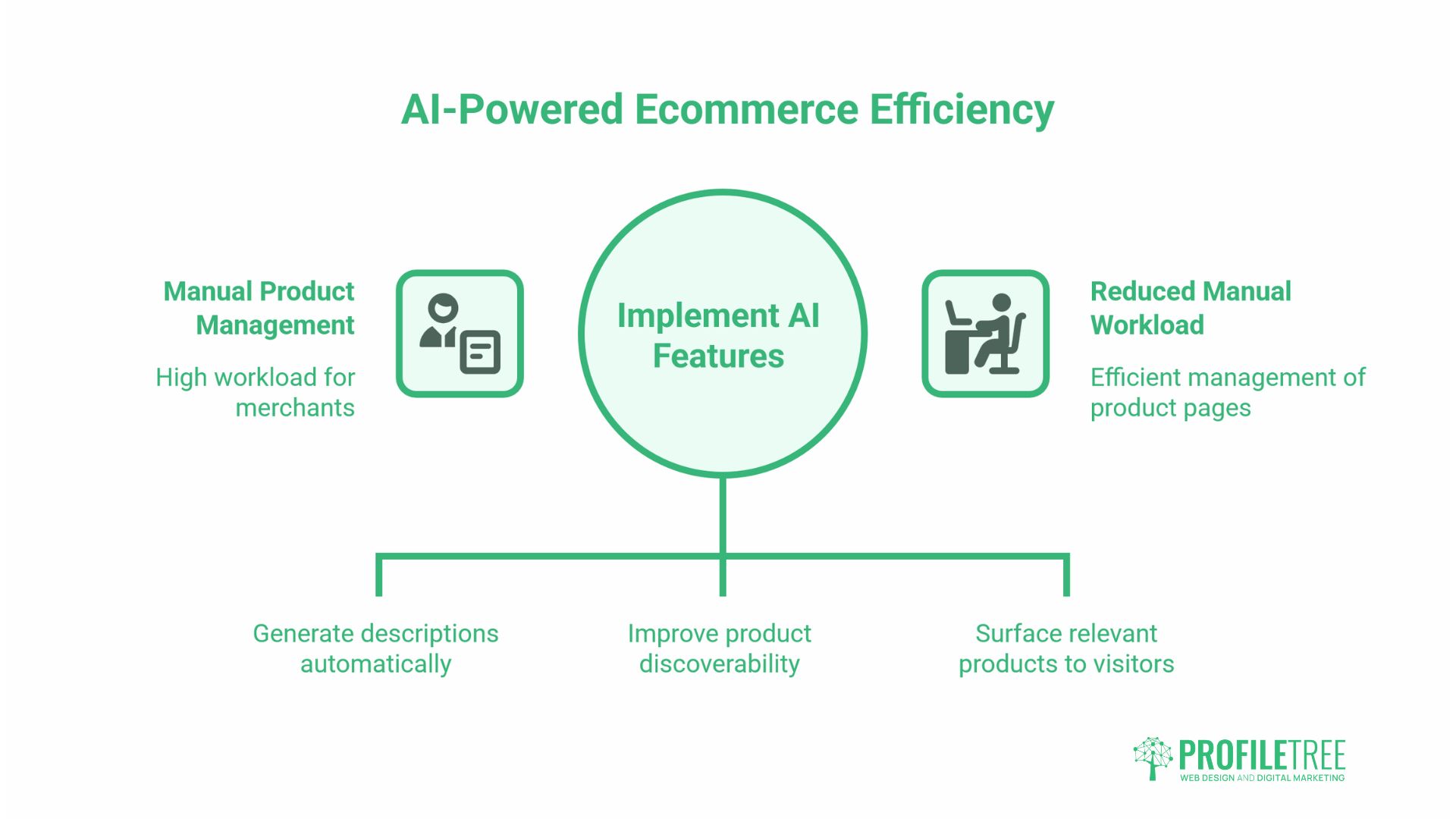
BigCommerce has added AI-assisted features across product description generation, storefront search optimisation, and personalisation tools that surface relevant products to returning visitors. These are useful for reducing manual work at scale, particularly for merchants managing hundreds or thousands of product pages.
Beyond the platform’s own AI features, the integrations available through BigCommerce’s API allow connection to more sophisticated tools: AI-powered inventory forecasting, variable pricing engines, and customer segmentation tools that inform marketing decisions. For businesses ready to move beyond basic ecommerce operations, these integrations represent meaningful operational advantages.
For SMEs exploring what AI implementation looks like in practice, ProfileTree’s AI training and implementation service provides practical grounding in which tools are worth adopting, how to configure them, and how to evaluate their commercial impact.
Migrating to BigCommerce
Migration from another platform (Shopify, Magento, WooCommerce, or a legacy custom build) involves more than moving product data. A full migration covers URL structure and redirect mapping to protect existing search rankings; customer account migration; order history; payment gateway reconfiguration; tax and shipping setup; and theme build or adaptation.
The BigCommerce migration tools handle the data transfer for products, categories, customers, and orders from most major platforms. The surrounding work, specifically SEO preservation, custom functionality, and design configuration, typically requires developer and SEO input to be done properly.
For businesses planning a platform migration, a pre-migration audit covering your current URL structure, organic search rankings, and technical configuration reduces the risk of losing search visibility in the process.
Total Cost of Ownership Summary
The monthly subscription is the most visible cost of running a BigCommerce store, but rarely the largest. A realistic total cost of ownership for a UK merchant covers platform fees, payment processing, apps and integrations, design and development, and ongoing SEO and marketing support.
| Cost Area | Typical Range (per month) |
|---|---|
| Platform subscription | £28 to £262 (Standard to Pro) |
| Payment processing | 1.4% to 2.9% of turnover |
| Third-party apps | £0 to £150 (fewer needed than Shopify) |
| SEO and content | £300 to £1,500+ depending on scope |
| Paid advertising | Variable by channel and budget |
The payment processing figure warrants close examination. A business turning over £200,000 annually pays processing fees of £2,800 to £5,800, regardless of platform. BigCommerce adds nothing on top of that. Shopify adds 0.5% to 2% unless you use Shopify Payments, which amounts to £1,000 to £4,000 annually at that turnover level.
App costs are the other variable where BigCommerce frequently comes out ahead. Features such as B2B pricing, custom checkout, and advanced product filtering are built in rather than bolt-on, removing a recurring cost category that accumulates quickly on Shopify at mid-market scale.
The honest caveat is that professional setup, design, and ongoing SEO support are real costs that should be budgeted for rather than treated as optional. A well-configured and well-marketed BigCommerce store will outperform a poorly supported one on any platform.
When to Bring in Professional Support
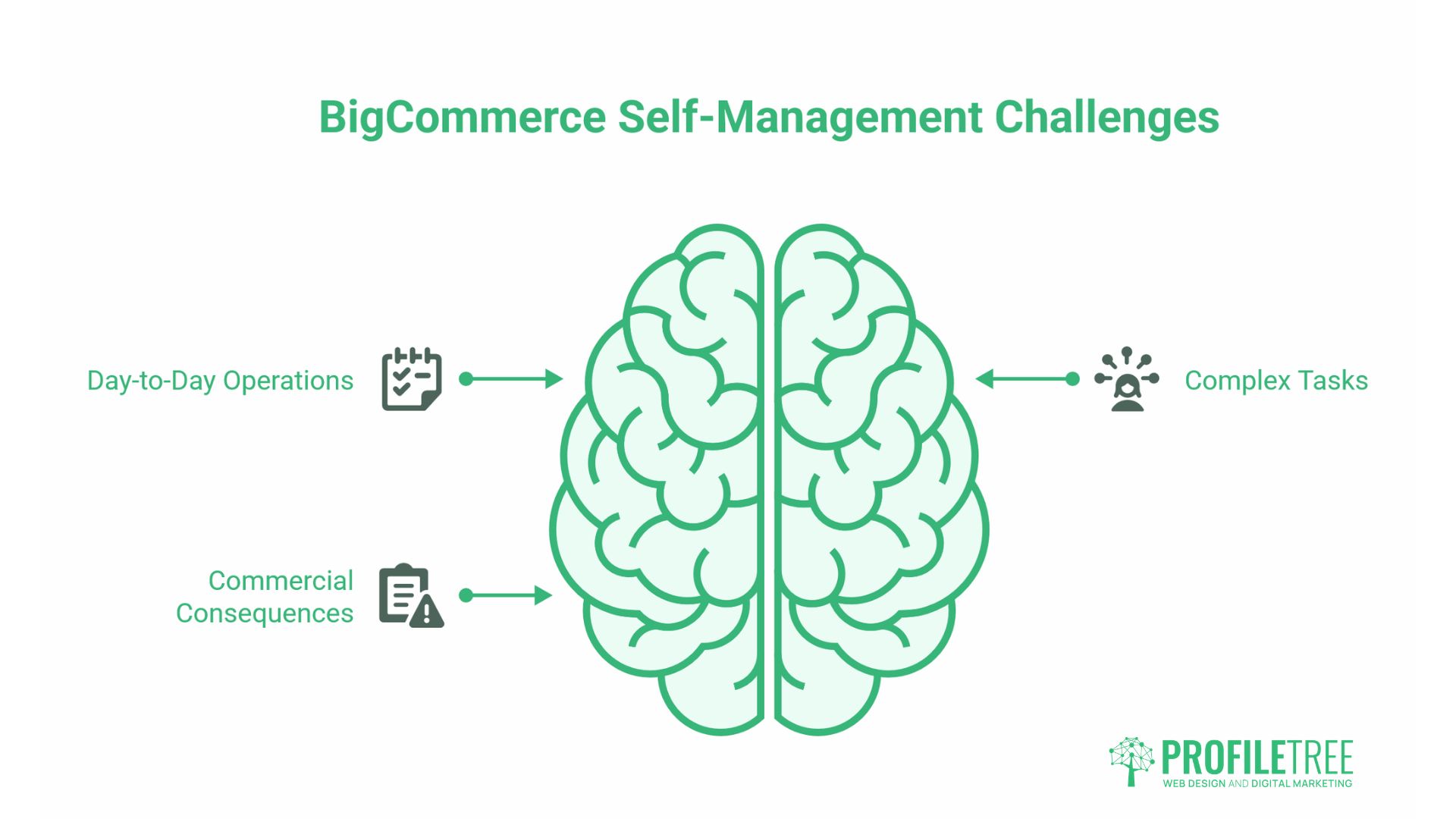
BigCommerce is marketed as a platform businesses can manage themselves, and for day-to-day operations, that’s largely true. The areas where self-management tends to break down are those with the greatest commercial consequences.
Platform setup is the first. Configuring VAT rules, payment gateways, shipping zones, and URL structures incorrectly at launch creates problems that are time-consuming to unpick later, particularly if search rankings or tax compliance are affected. Getting the technical foundations right from the start is considerably cheaper than correcting them after the store is live.
SEO is the second. BigCommerce’s built-in settings are a starting point, not a strategy. Category page architecture, site speed, structured data, and content across product and supporting pages all require ongoing attention if organic search is going to contribute meaningfully to revenue. ProfileTree’s SEO services work with ecommerce businesses at both the technical setup stage and on an ongoing basis.
Design and development is the third. A theme provides a framework; a store that reflects your brand, guides customers through a logical journey, and converts effectively requires deliberate design and development work. This is especially true for businesses migrating from another platform, where the temptation to replicate the old design rather than improve on it is worth resisting.
The fourth is strategy. The platform manages transactions; it doesn’t tell you where to focus your marketing budget, which channels to prioritise, or how to interpret your sales data. For SMEs without a dedicated ecommerce manager, ProfileTree’s digital marketing strategy service provides that layer of commercial thinking alongside the technical build.
Who Should and Shouldn’t Use BigCommerce
BigCommerce is a reasonable choice if you’re a UK retailer or wholesaler turning over more than £100,000 annually with plans to scale, running B2B and B2C operations from a single platform, managing a complex product catalogue that pushes against Shopify’s variant limits, or planning to sell across multiple channels and need centralised inventory management.
It’s a less obvious choice if you’re just starting out and need something quick to configure, running a simple store with fewer than 50 products, or operating on a tight budget where the monthly subscription and development costs represent a significant overhead.
Conclusion
BigCommerce is a capable platform for UK retailers and wholesalers that have outgrown simpler setups and need native B2B functionality, complex product configurations, or centralised multichannel management. The absence of transaction fees and the depth of built-in features make it genuinely competitive at mid-market scale. It isn’t the right starting point for every business, and the platform only performs well when it’s properly built, configured, and supported. Getting that right is where the real work begins.
FAQs
Is BigCommerce better than Shopify for UK businesses?
It depends on turnover and complexity. For annual incomes below £50,000, Shopify’s simpler setup and lower entry cost tend to win. Above £150,000, particularly for B2B requirements or complex product ranges, BigCommerce’s native features and zero transaction fees usually result in a lower total cost.
Does BigCommerce charge transaction fees?
No. BigCommerce charges no per-transaction fees across all plans. You pay your payment processor’s standard rates, but BigCommerce takes no percentage of sales.
Can BigCommerce handle UK VAT and tax compliance?
Yes, through an Avalara integration that automates UK VAT rates, reduced rates, and cross-border EU compliance. It requires proper configuration rather than automatic setup, so budget time for professional onboarding.
Is BigCommerce suitable for small businesses?
It can be, but the platform’s complexity and build requirements make it less practical for early-stage or micro-businesses. Its feature set delivers most value once you’re trading at meaningful volume.