
Conversational Marketing Campaigns: Strategy Guide
Table of Contents
Most website visitors leave without saying a word. They land, scroll, and disappear, taking their intent with them. Conversational marketing campaigns exist to interrupt that silence, replacing the passive wait for a form submission with a live, guided exchange that qualifies and converts in real time.
For UK and Irish businesses, the opportunity is real. Yet most implementations still get it wrong. A poorly designed bot creates frustration rather than momentum, and a chat widget bolted on without strategy is worse than no chat at all.
ProfileTree, the Belfast-based digital marketing agency, has seen this play out across dozens of client projects. The difference between a campaign that delivers measurable pipeline and one that simply annoys visitors almost always comes down to the same five structural decisions. This guide works through each one, alongside GDPR guidance and ROI benchmarks drawn from publicly available industry data. For a broader context, see our digital marketing strategy service.
What Are Conversational Marketing Campaigns?
Conversational marketing is a strategy built around real-time, one-to-one dialogue between a brand and its prospects or customers. Rather than sending visitors to a static form and waiting for a response, conversational campaigns guide people through a structured chat flow, gather zero-party data, and move intent forward in the same session.
The term comes from the mid-2010s live chat era. Today, it covers conversational AI platforms, AI-powered chatbots, hybrid bot-to-human flows, and WhatsApp business messaging. For UK businesses, this represents a direct opportunity to lift conversion rates and improve lead generation quality without increasing ad spend.
| Legacy lead generation | Conversational marketing | Outcome difference |
|---|---|---|
| Static contact form | Real-time qualifying chat | Response time: days vs seconds |
| 24-hour email follow-up | Instant lead routing | Conversion rate lift: up to 28% in SaaS |
| Cold outbound sequence | Warm, intent-driven handoff | Pipeline quality improves noticeably |
| One-size-fits-all messaging | Personalised based on page context | Engagement rates typically double |
The shift from chatbots to conversational AI is also worth naming. Early chatbots followed rigid decision trees. Modern conversational AI uses natural language processing to understand intent, adapt tone, and escalate at the right moment. The terminology matters less than the outcome: does the conversation move the right prospect towards the right action? If it doesn’t, the tool is wrong.
The State of Play: Key Insights for UK and Irish Markets
The global data on conversational marketing is dominated by US research from SaaS vendors with a commercial interest in the results. UK and Irish businesses operate in a different context, and some of those differences aren’t trivial.
Consumer Sentiment: UK and Irish Engagement Rates
UK consumers report higher bot fatigue than their US counterparts. Research from the Chartered Institute of Marketing has consistently shown that British audiences have a lower tolerance for automated responses that fail to resolve their query quickly. The threshold for abandonment is shorter, and that’s a design constraint, not just a cultural observation.
This changes how you’d design the opening of any conversational campaign. For UK and Irish audiences, getting to a specific, useful question in the first two exchanges is more important than a warm greeting. Campaigns with a direct opening question rather than a generic welcome see materially better engagement on B2B and professional services pages.
The Shift from Chatbots to Conversational AI
The tools available to UK businesses have changed considerably in recent years. Most enterprise-grade conversational AI platforms now offer intent detection, sentiment analysis, and CRM integration as standard. Conversational AI can handle multi-turn dialogue, detect frustration signals, and route prospects to the right human agent within a single live chat session, making the barriers to a useful deployment far lower than they were.
What has not changed is the need for strategic design before selecting technology. The platform choice should follow the conversation design, not precede it; that’s a discipline most UK businesses skip. Our marketing automation overview covers how live chat and conversational AI sit within a wider marketing automation stack, which is the right starting point before evaluating specific tools.
The Five Pillars of a High-Performance Conversational Marketing Campaign
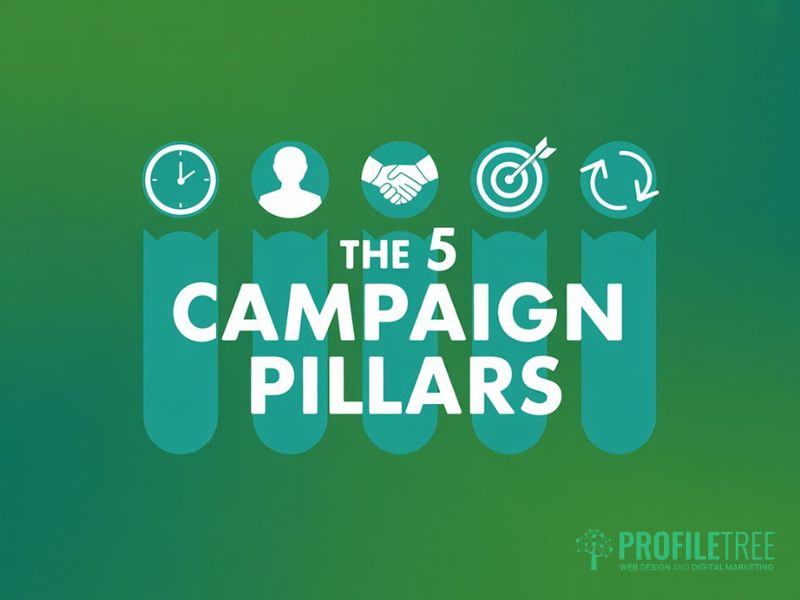
High-performing conversational marketing campaigns share five structural characteristics. Missing any one of them typically explains why a campaign underdelivers.
1. Real-Time Engagement vs Asynchronous Messaging
The speed advantage of conversational marketing is its primary commercial justification. Research by Lead Connect found that response times of 5 minutes or less increase lead qualification rates by nearly 400% compared to 30-minute responses. That figure applies to live chat and bot-initiated flows alike.
For UK businesses investing in lead generation, the speed gap between a live chat response and a next-day email is often the difference between a booked call and a lost prospect. If real-time engagement is possible during business hours, prioritise it on high-intent pages: pricing, contact, and service-specific landing pages.
2. Personalisation at Scale Using Zero-Party Data
Zero-party data is information a prospect deliberately shares during a conversation, as distinct from behavioural data gathered passively through cookies. A prospect who has told you their company size, their problem, and their timeline is far easier to qualify than one who has merely submitted an email address.
For GDPR compliance, zero-party data is far less problematic than third-party or inferred data. Connecting it to your CRM is non-negotiable: conversational data’s wasted if it doesn’t feed into your marketing automation sequences. Our digital marketing strategy service helps UK businesses build that CRM-to-campaign connection from the ground up.
3. The Human-in-the-Loop Handoff
The single most common failure mode in conversational marketing campaigns is an over-reliance on automation. Bots are effective at qualification and information delivery. They’re not effective at empathy, complex negotiation, or managing complex objections. Knowing when to trigger a human-in-the-loop handoff is as important as building the chat flow in the first place.
“The moment a prospect expresses frustration, asks for a manager, or begins describing a problem that falls outside your bot’s decision tree, you need a human in the conversation within 60 seconds. Anything longer and you lose the trust the bot just spent five exchanges building.”
Ciaran Connolly, founder of ProfileTree, makes the point this way: designing a human-in-the-loop trigger isn’t an admission that your conversational AI has failed. It’s the acknowledgement that some conversations require empathy that AI cannot yet provide. Many UK businesses find that a hybrid model, where conversational AI handles qualification and a live chat agent closes, outperforms both full automation and full human staffing on a cost-per-lead basis.
Practically, this means defining three things before launch. First, the triggers that initiate a human-in-the-loop handoff: sentiment flags, keyword detection, or explicit requests. Second, the routing logic decides which team receives the handoff. Third, the briefing was passed to the agent so the prospect doesn’t repeat themselves.
4. Contextual Deployment
Placing a chat widget on every page of a website is not a conversational marketing campaign. High-intent pages, such as pricing, product comparison, and contact pages, justify a sophisticated qualifying chat flow. Information pages justify at most a lightweight live chat prompt. UK businesses that deploy context-specific flows on high-intent pages consistently see better conversion rates than those using one generic chatbot across the entire site.
A high-intent B2B chat flow should follow this logic:
- Visitor lands on pricing page
- The bot opens with a direct qualifying question
- Qualified leads: routed to calendar booking
- Early-stage visitors: relevant guide offered, email captured
- Frustrated visitors: human-in-the-loop handoff within 60 seconds
5. Continuous Optimisation
Conversational campaigns aren’t set-and-forget. The opening question, the qualification logic, the human-in-the-loop handoff triggers, and the marketing automation sequences downstream all need to be reviewed against outcome data at least monthly.
Tracking conversion rate by chat flow variant and by page gives you the data to make targeted improvements. UK businesses using live chat for lead generation should pay particular attention to the out-of-hours drop-off rate, which is often where the most recoverable lost leads sit. The audit checklist below provides a starting framework.
Conversational campaign audit checklist:
- Does the opening message reach a specific question within two exchanges?
- Is the chat flow logic different for your highest-intent pages?
- Are human-in-the-loop handoff triggers clearly defined and tested?
- Does conversational AI data feed automatically into your CRM and marketing automation?
- Is GDPR consent captured explicitly before any zero-party data is stored?
- Are you reviewing conversion rate data and drop-off points at least monthly?
- Do you have a clear live chat escalation path for out-of-hours conversations?
GDPR and Privacy-First Conversational Strategies
UK-GDPR and the Irish Data Protection Acts create specific obligations for businesses collecting personal data through conversational interfaces. This is one of the most important differences between UK/Irish deployments and the US-centric playbooks that dominate most conversational marketing guides. The ICO’s guidance on direct marketing is the definitive reference for UK businesses designing GDPR-compliant chat flows.
Most US platforms default to opt-out data models. UK and Irish businesses must operate on an opt-in basis. Collecting a name and email address through a chat flow constitutes processing personal data under UK-GDPR, and that processing requires a lawful basis.
For most commercial conversational campaigns, the lawful basis will be either consent or legitimate interests, and the correct choice depends on how you intend to use the data afterwards. Our content marketing services team regularly advises on building GDPR-compliant engagement flows for SMEs across Northern Ireland and Ireland.
Privacy by design means building consent into the chat flow, not adding it as a disclaimer at the end. For UK businesses, this is the foundation of a GDPR-compliant lead generation process:
- Telling the user what zero-party data you are collecting and why before they share it
- Making consent active, not passive (a pre-ticked box does not constitute consent under UK-GDPR)
- Providing a clear way to opt out of follow-up messaging at the point of data capture
- Storing only what you need and deleting it when the purpose has been fulfilled
- Using conversational AI and live chat platforms with UK or EU data residency options where possible
Bot fatigue in UK markets is a trust problem. Building explicit consent into your chat flow isn’t just a legal obligation; it’s also a conversion rate strategy. Prospects who trust you with their zero-party data convert at higher rates than those who feel ambushed by a follow-up sequence they didn’t agree to.
Measuring Success: ROI Benchmarks and KPIs
Sessions and widget open rates tell you nothing about whether a conversational marketing campaign is working. The metrics that matter connect directly to the pipeline and revenue. HubSpot’s State of Marketing report consistently identifies speed to lead and conversation-to-MQL rate as the most commercially predictive metrics for chat-driven campaigns.
| KPI | Why it matters |
|---|---|
| Speed to lead (minutes to first meaningful response) | Directly correlates with qualification rate |
| Conversation-to-MQL rate | A high rate may signal bot is under-qualified |
| Bot-to-human handoff rate | A high rate may signal bot is underqualified |
| Lead-to-opportunity conversion | Tracks full-funnel impact on pipeline |
| Revenue influenced (pipeline attribution) | Connects campaign to commercial outcome |
| Conversation abandonment rate | Identifies drop-off points in the flow |
| CSAT score post-chat | Measures experience quality |
Published benchmarks from Drift, Intercom, and HubSpot suggest: professional services see a 15–20% lift in qualified lead volume within 90 days; SaaS businesses see a 25–30% reduction in time-to-first-sales-conversation; e-commerce sees a 10–15% reduction in cart abandonment when a proactive chat trigger is deployed.
Publisher note: These benchmark figures are drawn from published vendor research and should be treated as directional ranges, not guarantees. Actual results will vary considerably depending on traffic volume, conversation design quality, and the sales process downstream of the chat.
Return on investment should be calculated by comparing the cost of the tool and campaign design against the incremental revenue from conversations that would not otherwise have converted. Most UK businesses find that this calculation becomes clearer after 90 days of live data, particularly once the marketing automation sequences downstream of the chat flow are also attributed. Lead generation ROI from conversational campaigns should always be measured at the pipeline stage, not just at the conversation stage.
Three Sector Case Studies: B2B, Finance, and Professional Services
The following are illustrative examples based on documented industry practices; they’re not ProfileTree client data.
B2B Technology: Qualifying High-Intent Traffic
A mid-size UK software company deployed a conversational AI chat flow on its pricing and product comparison pages. The flow opened with a direct question about company size and use case, routed enterprise-level enquiries to a live chat agent within two exchanges, and offered a whitepaper download for early-stage visitors.
Within 90 days, the conversion rate from page visitor to qualified lead improved markedly, driven by the human-in-the-loop routing logic. The key design decision was treating the chat flow as a lead generation layer, not a customer service tool.
Financial Services: Compliance-First Deployment
A Northern Ireland-based financial services firm introduced a conversational chat flow to handle initial enquiries for mortgage and protection products. Given FCA regulatory obligations, the flow was deliberately limited: it captured zero-party data (contact details and appointment preferences) and explicitly stated that no advice would be provided through the live chat interface.
Consent was captured before any data was stored. The bot handled out-of-hours contact capture, with a human adviser following up the next working day, meaningfully reducing missed lead-generation opportunities without creating compliance risk.
Professional Services: The Out-of-Hours Opportunity
A Belfast solicitors’ firm found that a large proportion of its website traffic arrived outside business hours, driven by evening searches for conveyancing and employment law queries. A lightweight live chat flow that captures zero-party data (name, email, area of law, brief description of issue) and includes an explicit next-day callback promise, converting that traffic into booked consultations.
Fewer than five exchanges, no conversational AI complexity, no attempt to answer legal questions. It’s a lead-generation model, not a customer-service model. The clearest results came in the first two weeks, as several years of previously lost out-of-hours enquiries were recovered.
Moving from Pilot to Pillar: Next Steps
Most conversational marketing campaigns start as a pilot on one or two pages, and that’s the right approach. The organisations that move from pilot to strategic capability treat the first 90 days of live data as a diagnostic, not a verdict.
UK businesses that treat their chat flow as a living system consistently see better lead generation outcomes than those who set up a chatbot and leave it. Connecting your conversational AI to your marketing automation platform closes the loop between the first conversation and the final conversion.
For SMEs across Northern Ireland and Ireland looking to build a full digital marketing strategy around their conversational capabilities, the place to start is always the same: design the conversation before choosing the tool.
FAQs
1. How do you measure the success of a conversational marketing campaign?
The most reliable metrics are speed to lead, conversation-to-MQL rate, and pipeline influence: not session counts or widget opens. Most conversational AI platforms provide these natively; the challenge is defining what counts as a qualified lead before the chat flow goes live.
2. Is conversational marketing GDPR compliant?
Yes, with deliberate design: UK-GDPR requires a lawful basis for processing personal data, and for most chat-driven campaigns, that means explicit, active consent, since pre-ticked boxes don’t meet the standard. UK businesses should also confirm their conversational AI platform offers UK or EU data residency, which is a separate compliance consideration from consent itself.
3. What is the difference between a bot and a live agent in conversational marketing?
A bot handles structured, repeatable exchanges: qualifying questions, routing logic, and information delivery within a defined chat flow. A live chat agent handles empathy-dependent conversations, including complex objections, complaints, and high-value negotiations. The hybrid model, using conversational AI for qualification and a human-in-the-loop for closing, consistently outperforms either approach in isolation for high-ticket B2B lead generation.
4. Can conversational marketing work for small businesses?
Yes, particularly for out-of-hours lead generation: a simple live chat flow with a same-day callback promise can convert traffic that would otherwise be lost entirely. Small businesses don’t need an enterprise-grade platform, as several affordable tools offer sufficient functionality for a basic qualifying chat flow. The investment in conversation design time is more important than the platform budget.
5. Which tools suit UK businesses running conversational marketing campaigns?
Intercom, HubSpot, and Tidio cover most UK SME requirements for live chat and automated chat flows; Drift and WhatsApp Business API suit enterprise B2B and high-mobile sectors respectively, and all offer UK or EU data residency for GDPR compliance. When evaluating any platform, check CRM integration first, since zero-party data captured in a chat flow has limited value if it does not feed your marketing automation sequences automatically.