
Social Media for Product Launch: A Practical UK Guide
Table of Contents
Using social media for product launch success means running a planned six-week campaign in three phases: building anticipation before launch, responding in real time on the day, and turning first buyers into proof afterwards. ProfileTree, a Belfast agency, plans organic launches this way for businesses across Northern Ireland, Ireland and Great Britain, judged by enquiries and sales.
Why Product Launches on Social Media Underperform
Most social launches that disappoint had a sound product behind them and no plan around it. The familiar pattern is that content gets made in the final week and then posted everywhere at once on launch day, with likes as the only measure. That approach produces plenty of activity and very few enquiries.
Posting fills a content calendar. Planning means deciding who you need to reach on which platforms, and which business number the launch has to move. A post seen 2,000 times that brings in 40 enquiries has done more for the business than one seen 20,000 times that brings in none, even though the second will look better in a standard report.
Most launch advice online is also written for large American software companies with paid media budgets and dedicated launch teams. A manufacturer in Northern Ireland adding a product line, or a professional services firm in Dublin introducing a new offer, works with a smaller audience and a different set of rules. This guide is written for those businesses, and it sticks to organic activity: the posts and conversations a business owns, with no paid promotion. If you would like a team to plan and run that work with you, our social media marketing Belfast service covers launch campaigns for businesses here and further afield.
Set the Commercial Objective Before the First Post
Before any content is planned, agree what success looks like in sales or enquiries, who exactly the buyer is, and how long that buyer takes to decide. A product bought on impulse within a day needs a very different launch from one that goes through a three-month procurement process.
Write the answers down and share them with everyone involved in the launch. They decide how long the build-up runs and which numbers you report at the end, and they stop the campaign drifting towards whatever gets the most likes.
The Three Phases of a Social Media Product Launch
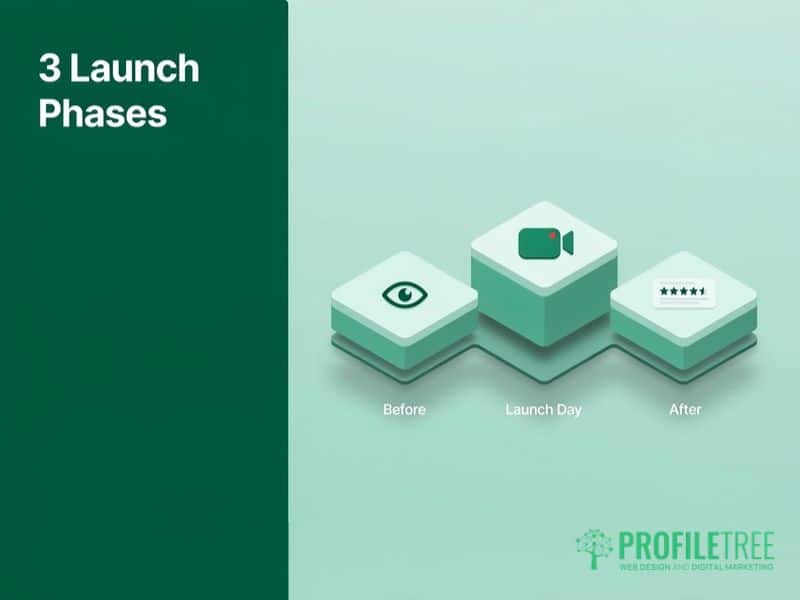
Treating pre-launch, launch day, and post-launch as separate phases, each with its own goal and measure of success, is where most of the difference is made. Many businesses run all three together as one burst of activity, and the launch peaks before buyers are ready.
Pre-Launch: Building Informed Anticipation
The pre-launch phase carries most of the strategic work and usually gets the least time. Its goal is informed anticipation: your audience knows something is coming and cares enough to watch for it, even before they know the details. Immediate sales are not the aim at this stage.
For B2B products, the build-up works best when it starts with the problem the product solves. Ask your audience about that problem through polls and questions, then present the product as the answer once you have shared what they told you, so the reveal feels earned. A consistent social media content strategy keeps the tone and order of these posts steady when several people are writing them.
Seed the announcement privately first. Existing customers and your own professional network are the most credible people to share a launch, because their word carries a trust that a brand post cannot. A short personal message to each of them a few days ahead, with an early look at the product, often produces the first wave of shares.
Launch Day: Real-Time Response and Live Video
Launch day is when the plan meets real people, and the two rarely match exactly. The businesses that handle it well have someone watching comments and messages all day with prepared answers to the objections they expect. That person also needs the authority to change the messaging if the audience reads the product differently from the way the team intended.
Video carries much of the weight during the first 24 hours. A short founder statement or a live product demonstration gives people a face to trust, as long as the presenter is comfortable and the technical setup has been tested. Record a short, well-produced video in advance as a fallback, because it can be reused for weeks after the launch. Our video marketing team produces this kind of launch content at whatever scale the product needs.
Post-Launch: Moving From Persuasion to Proof
The 30 days after a launch are when buyers make their final decisions and first users form the opinions they will share in public. Many businesses go quiet in this window because their energy went into launch day, and the attention they built drains away.
After launch, the tone of your posts should shift from persuasion to proof. Early customer comments, short case studies, answers to common questions, and honest replies to criticism all show that real people are using the product. Thank first buyers personally and make it easy for them to share their experience, because a customer who feels noticed is far more likely to recommend you.
Pre-Launch Social Media Post Examples, Week by Week
Good pre-launch posts move from the problem to the product over several weeks, with each post giving the audience a little more than the last. The examples below show that progression for a business software firm and for a consumer food producer; swap in your own product, audience, and voice.
In weeks six to four, post about the problem without naming the product. The software firm might write: “Most finance teams we speak to still spend the last three days of every month reconciling spreadsheets by hand. How long does month-end take your team? Tell us in the comments.”
The food producer might share a photo with the line: “We spent a year trying to make a gluten-free loaf that tastes like the bread we grew up on. Here is attempt number 47.” Posts like these invite replies, and the replies tell you which words your buyers use for the problem.
In week three, hint at the answer. Share a close-up of the product or a short clip from development, with a line such as “Something we have been building for a year is nearly ready” and an invitation to follow for news.
In week two, name it and open a waitlist. State the product name and who it is for, and link to a sign-up page. For the software firm, this might be a waitlist for a free trial; for the food producer, first access to a limited first batch.
In the final week, count down with behind-the-scenes content. Show the team, the packaging, the testing and the people who will use it, and answer the questions that came in during the earlier weeks in short posts or videos. Our guide to content for product launches covers producing these assets on a small team’s timescale.
Social Media for Product Launch: A Six-Week Plan
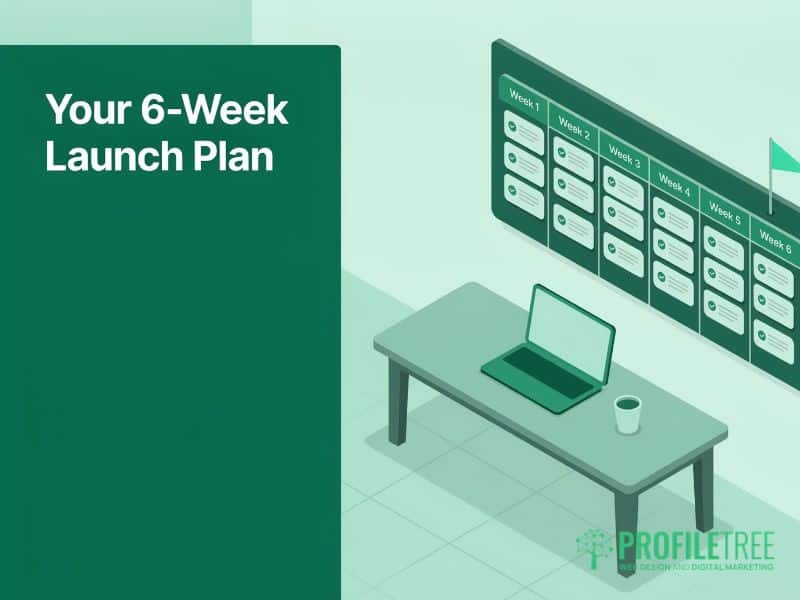
A written timeline stops all the activity piling into launch week. The table maps the six weeks before launch and the month after, with an objective for each stage. Adjust the timings to your product’s complexity and to how long your buyers take to decide.
| Timeframe | Objective | Key activities | Lead platforms |
|---|---|---|---|
| Six to four weeks before | Raise the problem | Problem-led posts, polls and questions; brief any creators you will work with | LinkedIn, Instagram |
| Three weeks before | Hint at the answer | Product hints and development clips; seed existing customers privately | LinkedIn, Instagram |
| Two weeks before | Build the list | Named reveal; waitlist sign-up; reshare early responses | LinkedIn, Instagram, email |
| Final week | Build urgency | Countdown posts; behind-the-scenes content; answers to buyer questions; creator content goes live | All active platforms |
| Launch day | Convert attention | Founder video or live session; email to the waitlist; comment monitoring all day | All active platforms |
| First two weeks after | Show proof | Early customer comments; demonstrations; replies to objections | LinkedIn, Instagram, YouTube |
| Weeks three and four after | Keep momentum | Short case studies; product education posts; review against sales targets | LinkedIn, YouTube, email |
Choosing Platforms for a B2B or B2C Launch
Choose platforms by where your buyers already spend time, not by where your team is most comfortable posting. A platform that suits the audience lends the launch credibility, while one that does not puts the announcement in front of people with no reason to care.
| Platform | Best for | B2B or B2C | Role in a launch |
|---|---|---|---|
| Professional buyers, founder-led posts, thought leadership | Mainly B2B | Usually the lead B2B channel | |
| Visual products, short video, direct product discovery | Mainly B2C | Usually the lead consumer channel | |
| TikTok | Product demonstrations, younger audiences, creator content | Mainly B2C | Demonstrations and creator partnerships |
| YouTube | Longer demonstrations, tutorials, content that keeps being found | Both | Launch video and post-launch education |
| Local communities, groups, older consumer audiences | Mainly B2C | Community groups and local reach | |
| WhatsApp broadcast lists | Warm contacts, partners and existing customers | Both | Personal preview ahead of the announcement |
WhatsApp deserves a mention because it is so often left out of launch plans. A short, well-timed message to a curated broadcast list of people who already know your business can start word of mouth ahead of the announcement. Keep the list to people who have agreed to hear from you, and make the message useful and personal, never a forwarded advert.
Organic activity is enough for most small business launches when it is planned this way. The posts that earn the strongest response in the first fortnight tell you what to repeat; turn them into short videos, carousels and customer stories through the following weeks instead of producing new material from scratch.
UK and Irish Rules That Apply to Your Launch
Most launch guides skip the rules, and in the UK and Ireland the rules carry real penalties. Two areas matter most: how influencer content is labelled, and how you collect personal details for a waitlist.
Influencer Posts Under the ASA and CMA Guidance
Any post that a creator has been paid for, gifted, or otherwise rewarded for must make clear that it is advertising. The Advertising Standards Authority (ASA), the Committee of Advertising Practice and the Competition and Markets Authority (CMA) set this out in their joint Influencers’ guide to making clear that ads are ads, published in a new edition in October 2026. Its core message is unchanged: ads must be obviously ads.
In practice, that means a clear label such as “Ad” or “Advert” at the start of the post or caption, visible before anyone taps “more”. The responsibility sits with the brand as well as the creator, so check every launch post before it goes live. Research reported in the October 2026 edition found that only about half of participants correctly identified the ads in a test social media feed, which is why the regulators want the label upfront.
The penalties have grown. Since 6 April 2025, the Digital Markets, Competition and Consumers Act 2024 has allowed the CMA to decide for itself whether consumer law has been broken and to fine businesses up to 10 per cent of global turnover, without going to court first. An ASA ruling or a CMA investigation in the weeks after a launch would do far more damage than any label. Our guide to the types of social media influencers covers choosing creators who suit a smaller business.
Data Protection for Waitlists and Sign-Up Forms
A pre-launch waitlist collects personal data, so it has to meet data protection law from the first sign-up. Where you rely on consent, the Information Commissioner’s Office explains in its guidance on valid consent that it must be freely given, specific, informed and given by a clear positive action, such as ticking an unticked box.
Your form should say what people are signing up for, how you will use their details, who holds them and how to unsubscribe. A bare “sign up for updates” box with no further information falls short. Businesses selling into both Northern Ireland and the Republic of Ireland work under UK GDPR for UK sign-ups and EU GDPR for Irish ones; the two are closely aligned, but check the details with a qualified data protection adviser before the waitlist opens.
Measuring a Launch by Enquiries and Sales
Reach and follower growth tell you how many people saw the launch; they say very little about whether it worked. A launch with 500,000 impressions and six sales has done worse than one with 8,000 impressions and 60 sales, yet the first will look better in a typical social media report.
Three numbers connect a launch to the business. Conversion rate is the share of visitors from social media who complete the action you want, such as joining the waitlist or buying. Cost per enquiry or sale is the time and production cost of the launch divided by the number of enquiries or buyers it produced. Share of voice is your brand’s portion of the conversation about your product category during the launch window, and a launch that dominates it creates a sense of market leadership that lasts beyond the campaign.
Building a Feedback Loop Between Social and Sales
The comments, questions, and objections that appear during a launch are some of the most useful market research a business will ever get. They show what is stopping buyers from going ahead and which features they care about most.
Nominate one person to collect and sort these each day of the launch period and send a short summary to the sales and product teams. The habit costs nothing and lets you correct the messaging mid-campaign. It also makes the next launch easier, because you begin with a record of what buyers asked.
When to Adjust and When to Hold Your Course
Knowing when falling engagement means something is wrong, and when it is just the natural curve of a launch, is one of the harder calls. A practical rule we use: if a type of content or a platform falls short of its targets for three days in a row, change it; if it has one weak day within a broader run of good results, leave it alone.
Changing direction too quickly is a common cause of muddled launch messaging, because a team abandons a working plan after a single post fails to land. If your team would like more confidence in making these calls, our digital training sessions cover planning and measuring organic social media for in-house marketing teams, from £350 plus VAT.
Ciaran Connolly, founder of ProfileTree, puts it this way: “ProfileTree does not sell paid advertising, and that is deliberate. When we plan a product launch with a business in Northern Ireland, the social media marketing is organic, so the audience and the know-how stay with the client long after launch week is over.”
Getting Help Planning Your Launch
The next step is to write down your commercial objective and launch date, then work back six weeks using the timeline above. ProfileTree is a Belfast web design and digital marketing agency, founded in 2011 and based at the McSweeney Centre, with more than 500 Google reviews and a 5.0 rating. If you want a team to plan and run the campaign with you, our organic social media management for UK and Irish businesses covers launch planning and content, quoted on request.
FAQs
1. How far in advance should I start social media for a product launch?
Start at least four weeks before launch, and six if you can. That gives you time to raise the problem, build a waitlist, brief any creators, and produce content for each phase without rushing. Products with long buying cycles, such as business software or equipment, benefit from a longer build-up still, because buyers need time to involve colleagues and budget holders before launch day arrives.
2. What should pre-launch social media posts say?
Pre-launch posts should start with the problem your product solves and move towards the product itself over several weeks. Early posts ask questions and share the audience’s answers. Later posts hint at the solution with development clips, then name the product and invite people to sign up for first access. Each post should give a little more than the one before.
3. Which social media platform is best for a B2B product launch?
LinkedIn is the lead platform for most B2B launches in the UK and Ireland, because decision-makers use it for work and founder-led posts reach them directly. YouTube suits longer demonstrations, and a WhatsApp broadcast list gives existing clients a personal preview a few days early.
4. Can I launch a product on social media without a paid budget?
Yes, a planned organic launch with a problem-led build-up, a waitlist, personal outreach to existing clients, and video on launch day is enough for most small business launches. The investment is time and content production. Watch which posts earn the strongest response in the first fortnight and reuse them across formats in the weeks that follow.
5. What are the ASA rules for influencer posts during a launch?
Any post a creator has been paid, gifted, or otherwise rewarded for must be clearly labelled as advertising, with a label such as “Ad” at the start where people see it straight away. The brand shares responsibility with the creator, and since April 2025 the CMA has been able to fine businesses directly for hidden advertising under the Digital Markets, Competition and Consumers Act 2024.