
Social Media Phishing Statistics: Staying Protected in the UK
Table of Contents
Social media phishing has become one of the most direct threats to business reputation and revenue in the UK and Ireland. Unlike the clumsy scam emails of a decade ago, today’s attacks are personalised, AI-assisted, and built to look exactly like the platforms your staff use every day. For SMEs across Northern Ireland, Ireland, and the wider UK, the risk is not abstract: a compromised LinkedIn account can expose client relationships, and a hijacked Facebook page can let attackers impersonate your brand to thousands of followers within hours.
This guide sets out the current statistics on social media phishing, explains what the data means for a business at SME scale, and covers the practical, ongoing steps that build genuine social media security. As you’ll see throughout, the strongest defence against social media phishing is rarely a single tool. It’s the combination of a secure website, professionally managed social channels, staff with real cyber awareness, and a habit of treating your digital presence as something that needs maintaining, not just launching.
What Is Social Media Phishing, and Why Is It Getting Harder to Spot?
Social media phishing is any attempt to steal credentials, money, or sensitive information through a social platform, typically via a direct message, a fake ad, a cloned login page, or a fraudulent connection request. It works the same way email phishing always has: an attacker impersonates someone or something the target trusts, then asks them to click, log in, or hand over information. What’s changed is the setting and the sophistication.
Why Social Media Is the Ideal Phishing Channel
Social platforms are built on trust signals: profile photos, mutual connections, verified badges, and familiar interfaces. Attackers exploit exactly those signals. A fake LinkedIn message from a convincing recruiter profile is more likely to get a response than a cold email from an unknown address, because it arrives in a context where professional outreach is normal. The UK’s National Cyber Security Centre has repeatedly flagged phishing as the most common attack method used against organisations of every size, and social platforms are increasingly the delivery channel of choice rather than email alone.
The Scale of Social Media Phishing Today
Phishing as a category keeps growing, and the numbers behind it explain why. Verizon’s Data Breach Investigations Report has found that the median time for a user to click a malicious link after opening a phishing message is around 21 seconds, with credential entry following roughly 28 seconds after that. In practice, that means an organisation has under a minute from the moment a phishing message lands to the moment it does damage, which is why detection after the fact is rarely enough on its own.
For UK and Ireland businesses, Action Fraud (the UK’s national fraud and cybercrime reporting centre) and the National Cyber Security Centre Ireland both continue to list phishing, including social-media-based phishing, among the most commonly reported attack vectors each year. A closer look at social media hacking statistics shows a similar pattern: account compromise rarely stays contained to one platform, since staff frequently reuse credentials or connect business accounts to personal email addresses.
Platform by Platform: Where the Risk Concentrates
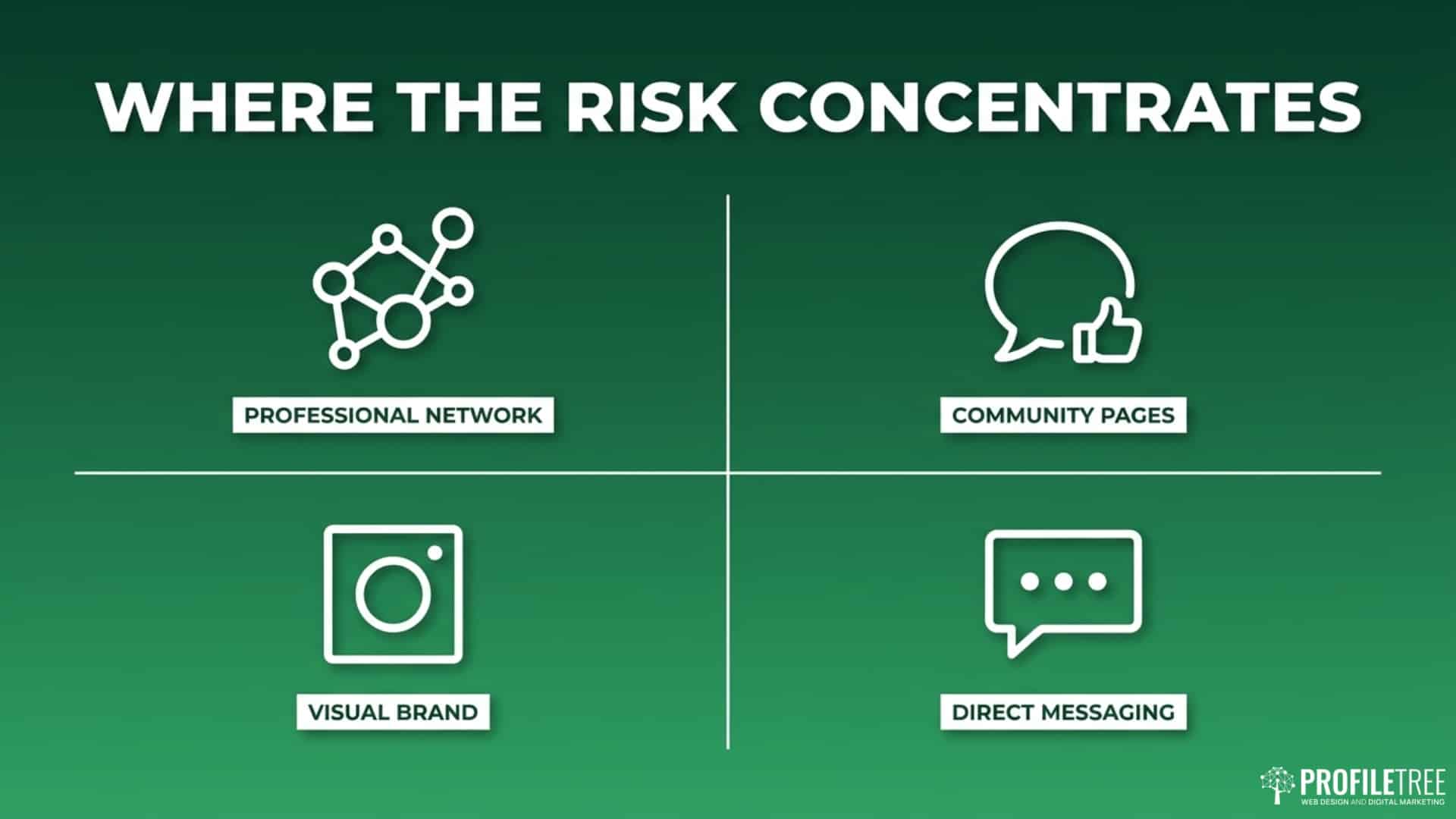
Understanding which platforms carry the highest risk helps a business prioritise where to strengthen controls, rather than trying to defend everywhere at once. Social media security isn’t a single setting to switch on; it looks different on each platform, which is why the risks below are worth reviewing one at a time.
LinkedIn carries the greatest risk for B2B businesses. Its professional context makes users more trusting of unsolicited messages, and the platform holds exactly the kind of information attackers value: job titles, company structures, email patterns, and client relationships. Common attack patterns include fake job offers, fraudulent connection requests from profiles impersonating executives, and invoice fraud aimed at finance staff.
Facebook remains the dominant platform for brand impersonation attacks on SMEs. Attackers clone business pages, run fake promotions under the business name, and use the cloned pages to harvest customer details or redirect followers to fraudulent websites. For businesses running paid social advertising, a compromised Business Manager account can also cause direct financial loss through unauthorised ad spend.
Instagram sees high volumes of fake verification scams and influencer impersonation. For businesses using Instagram for brand marketing or product sales, a spoofed account can divert customer enquiries and damage reputation quickly, particularly when the fake account starts messaging real customers directly.
WhatsApp Business
WhatsApp Business is an emerging vector. Attackers compromise personal WhatsApp accounts and use them to send fraudulent messages to existing contacts, exploiting the trust built into established relationships. For businesses using WhatsApp for client communication, this is a genuine and growing vulnerability, not a theoretical one.
The AI Pivot: Why “Bad Grammar” No Longer Works as a Warning Sign
The most significant shift in social media phishing over the past two years is not volume, it’s quality. Generative AI tools have effectively eliminated the most commonly taught indicator that a message was fraudulent: poor grammar and spelling. For years, security training told employees to look for typos and awkward phrasing as red flags. That heuristic is now largely obsolete. Large language models can produce grammatically flawless, contextually appropriate messages in seconds, tailored to a recipient’s LinkedIn profile, recent posts, or publicly available company information. Security agencies including the NCSC now advise that language quality alone should never be treated as a reliable signal, because AI tools have lowered the technical bar for producing convincing phishing content.
Deepfake audio and video add a further layer of AI phishing awareness businesses now need. Voice-cloned phone calls that accompany a social media phishing attempt, asking staff to verify credentials or authorise a transfer, are no longer rare. These attacks aren’t primarily targeting large enterprises. SMEs are frequently the target precisely because they’re less likely to have formal verification procedures in place.
“The businesses we work with across Northern Ireland are increasingly seeing phishing attempts that are indistinguishable from genuine communications,” says Ciaran Connolly, founder of ProfileTree, the Belfast-based digital agency. “The implication for SMEs is that technical controls matter, but so does the quality and consistency of your digital presence. A clearly branded, well-maintained online identity is harder to convincingly impersonate.”
The table below sets out how the threat has shifted, and why relying on outdated advice leaves a gap in social media security.
| Signal | Old-school phishing | AI-enhanced phishing |
| Spelling and grammar | Frequent errors, easy to spot | Typically flawless |
| Personalisation | Generic, mass-sent | Tailored using public profile and company data |
| Voice or video | Not applicable | Deepfake audio and video calls used to add pressure |
| Timing | Random, untargeted | Often timed around real business events (new hires, funding news, product launches) |
| Detection method needed | Read the message carefully | Verify identity through a separate, known channel |
What This Actually Costs an SME
Global breach cost figures don’t tell an SME owner in Belfast or Cork much that’s actionable about social media phishing specifically. The real costs at SME scale are different in character, though no less serious.
Direct financial loss from account takeover typically includes fraudulent ad spend, unauthorised purchases through compromised payment-linked accounts, and costs stemming from invoice fraud initiated via social media. Reputational damage is often the highest and longest-lasting cost: a cloned Facebook page running scam promotions under your brand name reaches your existing customers directly, and even after the page is removed, the trust lost from customers who sent money or followers who were misled doesn’t automatically come back.
Operational disruption follows close behind, since regaining access to a compromised Meta Business Manager or LinkedIn company page is often a slow process that can leave a business without its social channels for days or weeks. Data exposure is the highest-stakes outcome of all: if social media credentials match or resemble those used elsewhere, a single successful phishing attack can become a gateway into customer data, financial records, or client-facing systems.
The UK and Ireland Regulatory Picture
UK businesses operating under the UK GDPR have a duty to report personal data breaches to the Information Commissioner’s Office within 72 hours of becoming aware of them. A social media account compromise that exposes customer data, including names, contact details, or purchase history, may trigger this obligation. In Ireland, the Data Protection Commission applies the same 72-hour standard under the EU GDPR, and businesses operating across both jurisdictions, which includes many Northern Ireland companies with clients in the Republic of Ireland, may need to satisfy both frameworks at once.
The NCSC’s Cyber Essentials certification, while not mandatory, provides a recognised baseline that covers many of the technical vectors exploited in social media phishing, including access control, multi-factor authentication, and patch management. Businesses that want a structured starting point for staff-facing cyber awareness policy can also draw on this GDPR training guidance for teams, since data protection awareness and phishing awareness overlap more than most staff realise.
Building a Defence: A Practical Framework for Social Media Security
No single control eliminates social media phishing risk, but the combination of the following measures, spanning account settings, a secure website, cyber awareness training, and ongoing monitoring, significantly reduces it. Treat this as a layered social media security framework rather than a checklist to complete once.
Multi-Factor Authentication and Account Separation
Multi-factor authentication on every business social account is the single highest-value social media security control available. Even if credentials are compromised through social media phishing, MFA prevents an attacker from getting in without the second factor. All major platforms support authenticator-app-based MFA; SMS-based MFA is better than nothing, but it remains vulnerable to SIM-swapping. Alongside this, staff should manage business accounts through platform-native business tools (Meta Business Manager, LinkedIn Campaign Manager) rather than personal logins, with role-based access so that one compromised account doesn’t hand over full admin rights.
A Secure Website Is Harder to Clone
Attackers who impersonate a brand often need a fake website to send victims to, and a secure website, professionally built and actively maintained, is a genuinely harder target to convincingly copy than a generic template with outdated plugins and no clear ownership signals. This is where website development work connects directly to social media security.
A secure website with properly configured logins, such as the secure login practices, and consistent branding, verifiable contact details, and a visible team page, gives customers a genuine reference point to check against, making a cloned page or fake ad easier for them to spot as fraudulent. A secure website is also where cyber awareness starts for most SMEs, since staff who understand why their own site is locked down tend to apply the same scrutiny to the platforms they use every day.
Consistent, Professionally Managed Social Channels
Brand monitoring matters here too. Setting alerts for your business name across platforms, combined with periodic manual checks for impersonator accounts, allows a business to identify and report fake pages before they reach significant numbers of followers. A business with a clear, consistent brand identity across every platform, the same logo, tone, and posting rhythm, is harder to impersonate convincingly than one with inconsistently updated accounts or missing profile information. This is a genuine overlap between social media security and day-to-day digital marketing management: an agency that already handles a client’s content calendar and visual identity is well placed to notice when something looks off across a channel, because they know what “normal” looks like for that brand.
Staff Cyber Awareness Training That Actually Sticks
The NCSC’s free Exercise in a Box programme offers phishing simulation exercises designed for SMEs, and running these regularly, rather than as a one-off session, is what builds a culture of cyber awareness that doesn’t fade over time. This is precisely the gap that structured digital training is built to close. Staff who manage brand social accounts don’t need to become security specialists, but they do need repeated, practical cyber awareness training in what a modern phishing attempt looks like, since digital training matters for SMEs far beyond a single induction session. Genuine cyber awareness comes from repetition, not a single slide deck read once and filed away.
Using AI as a Monitoring Tool, Not Just a Threat
Generative AI has made phishing messages harder to spot by eye, but the same technology has a defensive use too, and building genuine AI phishing awareness into a team means treating AI as a monitoring ally rather than only a threat. AI-based anomaly detection tools can flag unusual login locations, sudden changes in posting behaviour, or message patterns that don’t match a genuine account’s history, catching what a distracted staff member might miss.
Evaluating and rolling out tools like this is part of a wider AI implementation strategy, and it depends on staff actually understanding what the tools are telling them, which is where training your team to work with AI becomes relevant well beyond marketing use cases. AI phishing awareness and AI implementation are, in practice, two sides of the same project for most SMEs.
What to Do If Your Account Is Compromised
Speed matters. If a business social account is compromised, the priority is account recovery through the platform’s official process, not through any link or email that arrives claiming to help, since these are frequently secondary phishing attempts targeting businesses that have just been hacked. Report the incident to Action Fraud in the UK or the Garda National Cyber Crime Bureau in Ireland as soon as possible, and if customer data has been accessed, bring in your legal or data protection adviser immediately to assess your reporting obligations under UK GDPR or EU GDPR.
Notify followers through uncompromised channels, your website, your email list, or another social account, as quickly as you can. Transparent, timely communication reduces reputational damage significantly compared with going silent while the incident is resolved.
| Platform | Report in-app | UK/IE authority to also contact |
| Report/Block on the profile or message | Action Fraud (UK) / An Garda Síochána (IE) | |
| Meta Business Help Centre | Action Fraud (UK) / An Garda Síochána (IE) | |
| Report via the app’s built-in tools | Action Fraud (UK) / An Garda Síochána (IE) | |
| WhatsApp Business | Block and report the contact | Action Fraud (UK) / An Garda Síochána (IE) |
Building a More Resilient Digital Presence
Social media phishing isn’t going away, and the AI tools making it harder to spot aren’t either. What changes the odds for an SME is treating social media security as an ongoing discipline rather than a one-off fix: a secure website, professionally managed social channels, and staff with real cyber awareness, maintained continuously rather than set up once and left alone. If you’d like help reviewing where your business is exposed, from a secure website through to staff cyber awareness training, get in touch with ProfileTree for a conversation about what would make the most difference first.
Frequently Asked Questions
What is social media phishing?
Social media phishing is an attempt to steal login details, money, or sensitive information through a social platform, usually via a direct message, fake ad, cloned login page, or fraudulent connection request that impersonates someone or something the target trusts.
Which social media platform has the most phishing?
LinkedIn accounts for the highest share of B2B phishing attempts, largely because of its professional context and the value of the data it holds. For consumer-facing brand impersonation, Facebook remains the dominant platform by volume.
How has AI changed social media phishing?
Generative AI allows attackers to produce grammatically flawless, contextually relevant messages at scale, removing the spelling and grammar errors that used to be the most commonly taught warning sign. Verification through a separate, known channel now matters more than reading a message carefully.
Can someone compromise my account just by sending me a message?
In the overwhelming majority of cases, no. Genuine compromise almost always requires the target to click a link, enter credentials on a fake page, or approve a fraudulent login request. Attacks that require no interaction at all exist but are rare and usually reserved for high-value, targeted operations rather than routine business phishing.
Does multi-factor authentication stop social media phishing?
MFA prevents most standard credential-based takeover attempts, since a stolen password alone isn’t enough to get in. It does not fully protect against session hijacking, where an attacker captures an already-active login session rather than the password itself, which is why it should be one layer of a wider social media security approach, alongside staff cyber awareness, rather than the only control in place.
What should an SME do after a social media account is compromised?
Recover the account through the platform’s official process, report the incident to Action Fraud (UK) or the Garda National Cyber Crime Bureau (Ireland), assess your GDPR reporting obligations if customer data was exposed, and notify followers through channels that haven’t been compromised.
How do I report social media phishing in the UK or Ireland?
In the UK, report through Action Fraud and, for suspicious emails, forward them to the NCSC’s reporting service. In Ireland, incidents can be reported to An Garda Síochána’s National Cyber Crime Bureau. Most platforms also have in-app reporting tools that should be used alongside, not instead of, official reporting.
What Is an App? A Guide for Business Owners