
The Psychological Contract in UK SMEs: A Practical Guide!
Most small business owners have never heard the term psychological contract, yet they feel its consequences every time a promising employee quietly disengages, or someone who seemed happy hands in their notice with little warning. The concept describes something every employer already knows: the unwritten deal between a business and its people, built on expectations, implied promises, and mutual trust.
For SMEs across Northern Ireland, Ireland, and the wider UK, this unwritten deal carries more weight than it does in large organisations. When your team is eight people rather than eight hundred, every expectation that goes unmet is felt immediately, and the cost of losing even one experienced member of staff can be substantial.
This guide explains what the psychological contract is, the types that exist within different SME cultures, and the practical steps you can take to manage it before it breaks.
Table of Contents
What is the Psychological Contract?

A psychological contract is an unwritten, informal agreement between an employer and employee that defines each party’s expectations, perceived obligations, and values within the employment relationship. It sits alongside the formal, signed contract of employment, but governs far more of the daily working experience.
Where the written contract covers pay, hours, and notice periods, the psychological contract covers everything else: whether the employer is expected to support career development, whether flexible working is genuinely available or just mentioned in an interview, whether a promise of promotion made six months ago is still being remembered.
The term was formally developed by organisational psychologist Denise Rousseau in 1989, building on earlier work by Argyris and Levinson, and has since become central to how HR researchers understand employment relationships.
What distinguishes it from a formal contract:
| Feature | Written Employment Contract | Psychological Contract |
|---|---|---|
| Documentation | Signed legal document | Unwritten, implicit |
| Legal status | Legally enforceable | Not legally binding in itself |
| Coverage | Pay, hours, duties, notice | Expectations, trust, development, culture |
| When it forms | At point of hire | From the first interaction, including recruitment |
| When it changes | By formal agreement | Constantly, as circumstances evolve |
Four characteristics define it across all employment settings. It is informal: no document captures it, and it is built through communication, action, and observed behaviour over time. It involves mutual expectations: both parties hold them, not just the employee. It is dynamic: it shifts as the business changes, as roles evolve, and as the wider economy creates new pressures. And it carries perceived obligations: if an employee believes a promise was made, the breach is real regardless of whether the employer intended it.
Why the Psychological Contract Matters More in an SME
In a large corporation, an employee who feels let down by management can remain professionally distant, find their motivation through team relationships, or transfer internally. In a small business, there is nowhere for that friction to hide.
Research consistently shows that employees whose psychological contracts are being met report higher engagement, stronger commitment, and lower intention to leave. When the contract breaks, the reverse follows: disengagement, reduced output, and eventually turnover — often without the employer understanding why.
For UK SMEs, the financial case is direct. The Chartered Institute of Personnel and Development (CIPD) estimates that the average cost of replacing an employee in the UK, accounting for recruitment, onboarding, and the time before a new hire reaches full productivity, runs into thousands of pounds per role. For a business with fifteen employees, losing two or three in a year because of unmet expectations that were never discussed is a meaningful commercial problem.
The SME actually has a structural advantage here that larger businesses do not. Smaller teams allow for the kind of direct, personal communication that makes the psychological contract explicit rather than invisible. The founder who takes ten minutes to talk with a new joiner about what they’re hoping to get from the role over the next two years is doing psychological contract management, without needing to call it that.
“Businesses that take people management seriously from the start build a much stronger foundation for growth,” says Ciaran Connolly, founder of ProfileTree. “When expectations are clear — on both sides — people feel respected, and that changes everything about how they show up.”
The challenge for most SMEs is that as businesses grow from five people to twenty, and then to fifty, those informal conversations become harder to maintain consistently. Understanding how good and bad leadership qualities affect team trust is a useful starting point for any owner-manager trying to scale their culture alongside their headcount.
Relational vs Transactional: Which Contract Are You Building?

Rousseau’s model identifies four types of psychological contracts. Understanding which one describes your organisation is the first step in managing it deliberately.
The four types sit on two dimensions: time horizon (short-term to long-term) and scope (narrow task focus to broad relationship investment).
Transactional contracts are short-term and task-focused. The employee delivers defined duties; the employer pays an agreed rate. Career development, loyalty, and emotional investment are not expected from either side. This is common with contractors, agency staff, and seasonal workers. There is nothing wrong with a transactional contract where both parties understand and accept it — the problem arises when an employer expects loyalty and discretionary effort from a relationship they have structured as purely transactional.
- Relational contracts involve a longer-term commitment on both sides. The employer invests in the person through training, stability, and career progression; the employee reciprocates with dedication, adaptability, and effort beyond the minimum. This is the dominant contract type in established SMEs with strong employer cultures, and it is the type most likely to be damaged by sudden changes to working conditions, unexpected redundancies, or promises that are made and then forgotten.
- Balanced contracts combine both. They are long-term relationships that are also performance-sensitive. The employer and employee both invest in growth and review expectations as the business evolves. This is arguably the most appropriate model for scaling SMEs: it offers stability without rigidity, and it builds in the regular expectation reviews that prevent breaches.
- Transitional contracts arise during periods of change or uncertainty. When a business is restructuring, adopting new technology, merging with another firm, or navigating a difficult economic period, the normal rules shift. Employees seek reassurance; employers need flexibility. Transitional contracts are not inherently negative, but they are high-risk: unmanaged, they create exactly the ambiguity that breeds distrust.
Most SMEs are operating with a mix of these types at any one time, often without realising it. The marketing manager on a relational contract and the freelance designer on a transactional one require entirely different approaches to expectation management.
Identifying which contract type dominates in your business is also a useful lens when thinking about recruitment. The expectations you signal at interview are the foundation of the psychological contract, and a clear content marketing strategy that honestly reflects your culture is one of the most practical ways to attract candidates whose expectations are already aligned with what you can genuinely deliver.
Managing the Contract in a Hybrid and Remote SME
One of the clearest gaps in existing guidance on psychological contracts is the remote and hybrid working context. The unwritten deal between an employer and employee has always depended partly on physical proximity: the overheard conversation, the visible effort, the daily signals of culture and commitment. When the team is distributed, those signals disappear.
For SMEs that shifted to hybrid working after 2020, many have found that expectations set during the office era no longer translate. An employee who understood the culture through daily interaction may now be working in a context where the implicit rules are genuinely unclear. What constitutes “going above and beyond” when no one can see the extra hours? What does career visibility look like when decisions are made in meetings the remote worker is not physically present for?
The practical answer is to make the unwritten explicit. This does not require a new document — it requires deliberate communication. Regular one-to-ones that include a specific question about how the employee is experiencing their role, not just their output. Clear statements from leadership about what the business is trying to do and what it expects from the team. Honesty when things are difficult.
Digital tools can support this, but cannot replace it. A business that has invested in internal communications platforms, regular video check-ins, and structured onboarding for remote staff is better placed to maintain the psychological contract across a distributed team. ProfileTree’s digital training programmes for SMEs include practical guidance on building digital communication habits that support team culture, not just productivity.
The Role of Psychological Contracts in Organisational Culture
The psychological contract and organisational culture are not separate things. The culture of a business is, in large part, the aggregate of the psychological contracts operating within it.
When contracts are consistently fulfilled — when promises made at interview are honoured, when development opportunities appear as described, when the business behaves with transparency during difficult periods — the culture that results is one of trust, fairness, and commitment. Employees who feel secure in their expectations are more likely to share knowledge, support colleagues, and take the kind of initiative that drives small businesses forward.
When contracts are consistently breached — through broken commitments, opaque decision-making, or expectations that shift without explanation — the culture reflects that too. Cynicism replaces engagement. People do the minimum. Knowledge is hoarded rather than shared.
How culture shapes the contract in return
The existing culture also shapes new employees’ expectations. A business with a strong reputation for developing its people will attract staff who arrive expecting development. If those expectations are then unmet, the breach is more damaging precisely because the expectation was so clearly signalled during recruitment.
This has a direct implication for how SMEs present themselves externally. The content a business publishes about its culture — on its careers page, in team blog posts, through social media — forms part of the implied promise. A company that describes itself as a place where “everyone is treated like family” and then runs a rigid, impersonal performance management process has already created a breach before the first day of work. Employer brand content, when managed well, is a tool for aligning expectations. Managed poorly; it is a liability.
A business’s website and social presence are the first places most candidates form expectations about what working there will be like. ProfileTree’s web design services for SMEs include careers page strategy as part of broader site builds, helping businesses present an employer brand that is honest, consistent, and aligned with the culture they are actually trying to build.
Leadership behaviour is the most powerful single factor in how employees perceive their psychological contracts. Managers who give consistent, honest feedback, who acknowledge when things have changed and explain why, and who follow through on what they say build the kind of perceived contract fulfilment that sustains engagement over time.
Signs of a Breach: Recognising Quiet Disengagement Early
A psychological contract breach rarely announces itself. The employee who has decided their expectations will never be met seldom resigns immediately; they disengage first. Identifying the signs before that disengagement becomes departure is the most cost-effective form of retention.
Early signals include a reduction in voluntary contributions: the person who stopped offering ideas in meetings, the team member who used to stay late occasionally and no longer does, the individual whose communications have become shorter and more perfunctory. These are not evidence of laziness — they are typically evidence of withdrawn discretionary effort, the most reliable indicator that the psychological contract is under strain.
More Specific Breach Triggers
Broken promises — a promotion that was discussed but not delivered, a training budget that was mentioned and then quietly removed, a flexible working arrangement that was agreed verbally and then reversed.
Shifts in expectations without explanation — a role that has expanded significantly beyond its original scope, or new performance expectations introduced without a conversation about what has changed and why.
Lack of transparency — employees who feel kept in the dark about the direction of the business, particularly during difficult periods, reliably report lower psychological contract fulfilment.
Workload overload without recognition — when employees consistently give more than their contract requires, and that contribution is neither acknowledged nor rewarded — the relational contract erodes.
The CIPD recommends that businesses conduct regular “expectation audits” — structured conversations in which managers specifically explore what each team member understood they were signing up for, and how that compares to their current reality. For SMEs without a dedicated HR function, this need not be formal. A well-run quarterly one-to-one that includes the right questions achieves the same outcome.
The Legal Reality: When Breach Leads to a Tribunal
The psychological contract is not a legal document, and a breach of it does not by itself give rise to a legal claim. What it can do is create the conditions for a legal claim through the implied contractual term of “mutual trust and confidence.”
Every employment contract in the UK — including Northern Ireland — contains an implied term that the employer will not, without reasonable cause, act in a way calculated or likely to destroy or seriously damage the relationship of trust and confidence between employer and employee. This is not a clause anyone drafts explicitly; it exists by law.
When an employer’s actions amount to a serious enough breach of this implied term, an employee can treat themselves as constructively dismissed: they resign and then bring a claim at tribunal on the basis that the employer’s conduct forced them to leave. Constructive dismissal claims are notoriously difficult to defend, and they are more common in small businesses than most employers realise.
The Northern Ireland Distinction
Businesses operating in Northern Ireland should be aware that employment law here differs in several respects from Great Britain. The relevant tribunal is the Industrial Tribunal, not the Employment Tribunal. The enforcement body for employment rights guidance is the Labour Relations Agency (LRA) rather than ACAS, and the LRA publishes its own Codes of Practice that are taken into account by the Industrial Tribunal when assessing conduct.
For NI-based SMEs navigating a situation where employee trust has broken down, the LRA’s guidance on handling workplace disputes, grievances, and disciplinary matters is the appropriate starting point, not ACAS documentation.
For NI-based businesses looking to understand the wider landscape of compliance and operational planning, ProfileTree’s business strategy resources cover a range of challenges specific to SMEs operating in the Northern Ireland market.
Legal risk is not the primary reason to manage the psychological contract well, but it is a concrete one, and it is often the most persuasive for business owners who have not previously engaged with people management as a strategic priority.
How to Repair a Broken Psychological Contract
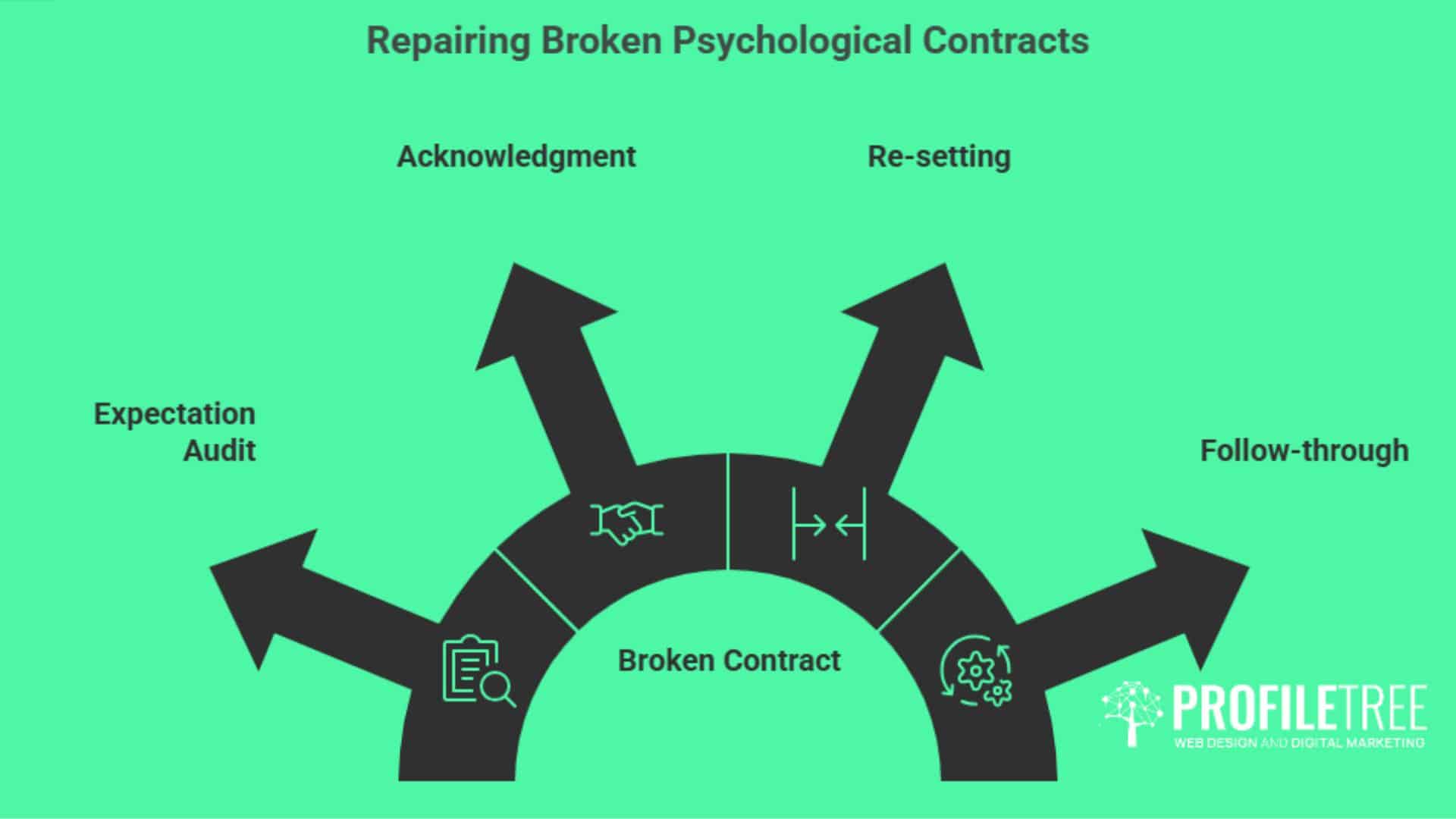
A psychological contract can be repaired after a breach, but it takes deliberate effort and time. The repair process is not primarily about compensation — it is about restoring trust, which requires consistent behaviour over a sustained period.
Step 1: The Expectation Audit
Before attempting repair, the employer needs to understand what the employee believed was promised and how that compares to what was delivered. This requires a direct, honest conversation — not a performance review, not an HR process, but a genuine inquiry into what the person expected and where those expectations were not met. Many employers avoid this conversation because it is uncomfortable. Avoiding it makes the breach worse.
Step 2: Acknowledge what happened
A psychological contract breach does not require a legal settlement; it requires acknowledgement. An employer who says directly, “I know we talked about X and that hasn’t happened, and I understand that’s frustrating”, has done more to begin rebuilding trust than one who offers a pay increase without addressing the underlying expectation.
Step 3: Re-set expectations explicitly
Once the breach is acknowledged, both parties need to agree on what the relationship looks like going forward. What can the employer genuinely deliver? What does the employee need in order to re-engage? This conversation should be direct and honest, even when the answers are not what either party hoped for.
Step 4: Follow through consistently
Trust is rebuilt through consistent action over time. A single gesture — a pay review, a new title, a development opportunity — is not sufficient on its own. The employee is watching to see whether the pattern of behaviour that led to the breach has changed. If it has not, no one-off action will restore the relationship.
For SME owners navigating this process without an HR function, external support can be valuable — whether from an employment consultant, a leadership coach, or through structured digital training. ProfileTree’s work supporting SMEs in AI adoption and digital transformation regularly surfaces people management challenges as a primary barrier: the technology is often the straightforward part; the human expectations around change are harder.
Psychological Contracts and HRM in Small Businesses
The relationship between formal HR practices and the psychological contract is direct. Every HR process either supports or undermines the unwritten deal employees have with the business.
- Recruitment and onboarding lay the foundation for the contract. What is communicated during the interview process — about culture, career prospects, flexibility, and the nature of the role — becomes part of the employee’s expectation set from day one. Onboarding that reinforces those signals builds trust; onboarding that contradicts them creates an immediate breach.
- Performance management either fulfils the relational contract or damages it. Employees in relational contracts expect regular feedback, honest conversations about their progression, and genuine investment in their development. A business that sets annual targets and then has a single review conversation twelve months later is failing to maintain the contract it implicitly offered.
- Communication and transparency are the most consistent predictors of whether the psychological contract is being met. Employees who understand what the business is trying to do, why decisions are being made, and where they fit in the plan report significantly higher levels of contract fulfilment than those who feel uninformed.
- Digital tools and training are playing an increasingly important role here. As SMEs adopt new platforms, new workflows, and — increasingly — AI tools, the psychological contract around skills and capability becomes a live issue. An employee who was hired for a specific set of skills and then finds their role is changing significantly due to technology adoption needs to understand what the business expects of them going forward, and what support it will provide.
Businesses at the earlier stages of this journey may find the cost-benefit analysis of AI implementation for SMEs a useful reference point before committing to new tools — particularly where those tools will change how roles are structured and what skills employees need.
ProfileTree works with SMEs across Northern Ireland, Ireland, and the UK on AI implementation and digital transformation, and the most successful transitions consistently involve clear communication about how roles will change and what training will be provided. Introducing new technology without that conversation is one of the fastest ways to trigger a transitional contract breach.
Conclusion
Understanding the psychological contract transforms people management from a reactive to a proactive exercise. SMEs that take the time to communicate expectations clearly, review them regularly, and address breaches directly build cultures that retain good people for longer. For businesses across Northern Ireland, Ireland, and the UK navigating growth, technology change, or the pressures of a tighter labour market, the ability to maintain trust at scale is a genuine competitive advantage.
If your business is growing and you want practical support building the communication habits and management structures that sustain it, get in touch with the ProfileTree team to find out how our digital training and business development programmes can help.
FAQs
Is a psychological contract legally binding?
No. The psychological contract has no legal status in itself. However, a serious breach of the trust and confidence that underpins it can give rise to a constructive dismissal claim at tribunal, via the implied contractual term of mutual trust and confidence.
What is an example of a psychological contract in the workplace?
A common example is the promise — explicit or implied — of a promotion after a period of strong performance. If that promise is made during appraisals, mentioned in one-to-ones, and then quietly dropped without explanation, the employee has experienced a breach even if nothing was ever written down.
What are the three main elements of the psychological contract?
The three core elements are promises (what each party has committed to, explicitly or implicitly), expectations (what each party anticipates will happen), and mutuality (the shared understanding that both parties recognise and accept the same obligations). Breach typically occurs when one party believes the other has failed on promises or expectations, regardless of intent.
What are the types of psychological contracts?
Rousseau’s model identifies four: transactional (short-term, task-focused), relational (long-term, relationship-focused), balanced (long-term with performance elements), and transitional (occurring during periods of change or uncertainty). Most SMEs operate with a mix across their workforce.
How does the Northern Ireland context differ?
Employment rights in Northern Ireland are largely similar to those in Great Britain but administered separately. The relevant enforcement body is the Labour Relations Agency (LRA) rather than ACAS, and claims are heard at the Industrial Tribunal rather than the Employment Tribunal. The LRA publishes its own guidance and Codes of Practice, which are referenced in NI tribunal decisions.