
When Marketing Campaigns Turn Tasteless: The Governance Gap
Table of Contents
Most tasteless marketing campaigns aren’t the work of careless people. They’re the output of a normal creative process that skipped a question somewhere along the way. Pepsi, Dove, Heineken and Ryanair all had experienced teams, proper sign-off chains and genuine intentions, and they still ended up on lists like this one. That pattern matters more than any single advert, because it means the fix isn’t better creative talent. It’s a better approval process.
This guide looks at some of the most instructive tasteless marketing campaigns of the past two decades, including the UK and Irish cases that most global roundups skip entirely. Rather than treating each one as a punchline, it breaks down the governance failure behind it and sets out a practical framework any SME marketing team can use before a campaign goes live.
Beyond Bad Taste: Defining The Commercial Risk Of Offensive Content
A tasteless marketing campaign is one that a meaningful share of its audience finds offensive, out of touch or exploitative, whether or not that was the brand’s intent. For an SME, the commercial risk isn’t really reputational embarrassment. It’s the direct cost: pulled media spend, an ASA investigation, a news cycle that outlasts the campaign, and the time a small team spends firefighting instead of running the business.
Most tasteless marketing campaigns, and bad advertising campaigns more broadly, fall into one of three categories. Cultural insensitivity happens when a brand borrows the symbols or dialect of a group it doesn’t understand, usually because no one from that group sat in on the review. Tragic timing turns an otherwise fine advert into something that reads as callous, simply because of when it landed. Misjudged satire assumes the audience is in on the joke when they aren’t, so the brand absorbs the backlash instead of the target.
The Legal Reality: ASA And ASAI Standards In The UK And Ireland
In the UK, the Advertising Standards Authority enforces the CAP Code, the rulebook that covers broadcast and non-broadcast advertising. Its provisions on harm and offence sit alongside separate sections on misleading claims and social responsibility, and a single advert can breach more than one at once. Ireland’s Advertising Standards Authority for Ireland (ASAI) runs a comparable code, and both bodies can order an advert removed from specific channels or withdrawn entirely.
For a UK or Irish SME, the practical point is that a tasteless campaign isn’t only a public relations problem. It can trigger a formal ruling that follows the brand into future press coverage, long after the original advert is gone.
The Psychology Of A Marketing Fail: Why Good Teams Approve Bad Ads
The most useful question about any of these examples isn’t “how could they think this was fine?” It’s “who in the room could have said no, and why didn’t they?” Creative teams that work closely together for months tend to develop a shared blind spot. Everyone in the meeting already agrees the idea works, so no one plays the outside voice, and the assumption goes unchallenged all the way to launch.
“Most tasteless campaigns are not created by bad people. They are approved by teams who never had someone in the room willing to ask the uncomfortable question before launch,” says Ciaran Connolly, founder of ProfileTree.
This is why external review matters. A team that has lived with a campaign for eight weeks cannot see it the way a first-time viewer will. Bringing in someone with no stake in the creative, whether that’s a colleague from another department or an outside marketing partner, is one of the simplest ways to catch a problem before it becomes a bad marketing campaign that makes the news.
Case Studies: High-Stakes Failures And The Governance Breakdowns Behind Them
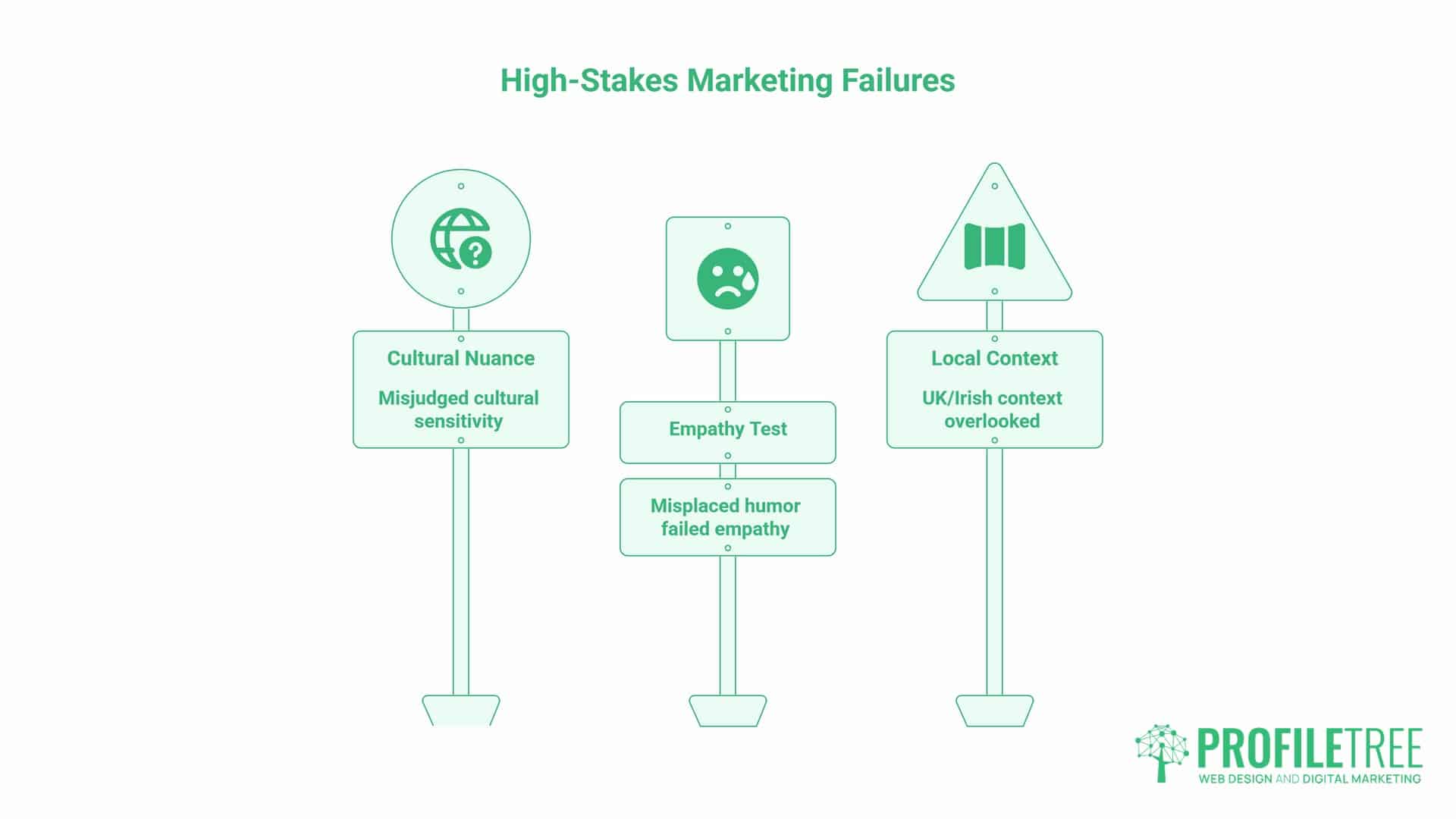
These tasteless marketing campaigns did not fail for lack of a good creative brief. Each one had a clear governance gap behind it, and naming that gap is more useful than laughing at the result.
The Protest Ad That Misjudged Cultural Nuance
Pepsi’s 2017 advert showed Kendall Jenner leaving a photoshoot to join a protest and handing a police officer a can of Pepsi. Critics accused the brand of trivialising the Black Lives Matter movement by reducing a serious civil rights issue to a branded moment. Pepsi pulled the campaign within 24 hours and issued a public apology, and the speed of that withdrawal limited some of the damage, though brand sentiment research in the following months still showed a dip among younger audiences.
The Misplaced Humour That Failed The Empathy Test
Dove built its brand around body-positive messaging, which made it worse when a 2017 Facebook advert showed a Black woman removing her top to reveal a white woman underneath. The sequence was almost certainly unintentional, but a creative team closer to the work would have caught what audiences noticed immediately. Heineken had a similar problem the following year: a 2018 advert showed a bartender sliding a light beer past several darker-skinned party-goers before it reached a lighter-skinned woman, under the line “Sometimes, lighter is better.” Heineken pulled the advert and admitted it had missed the mark.
The Local Blunder: When the UK And Irish Context Is Overlooked
Ryanair’s 2020 “Jab and Go” campaign encouraged customers to book summer holidays once they had been vaccinated against COVID-19. It drew 2,370 complaints to the ASA, reportedly the third-highest complaint volume in the authority’s history at the time, and the ASA upheld the complaints on the grounds that the advert implied vaccination would remove travel restrictions.
Protein World’s “Are You Beach Body Ready?” campaign ran on the London Underground in 2015 and became a flashpoint in the wider debate about body image in advertising; one survey found that 61% of women who saw it said it made them feel ashamed of their bodies. The ASA banned it, and London’s mayor later extended the ban to all body-shaming adverts on Transport for London property.
Both cases show why a UK or Irish SME cannot simply copy a US playbook on what counts as acceptable. The regulatory response here is faster and more specific, and it can permanently change what is allowed on an entire advertising channel.
AI-Generated Tastelessness: The New Frontier Of Brand Risk
Artificial intelligence has added a genuinely new category to the list of tasteless marketing campaigns, one built on missing cultural judgement rather than a deliberate creative decision. The clearest recent example is the Glasgow Willy Wonka Experience in February 2024. The marketing materials, reportedly produced using AI image tools, depicted a lavish fantasy setting that bore no resemblance to the sparse warehouse space ticket-holders actually walked into. Parents who had paid for a children’s experience found minimal decoration and a script that attendees described as surreal, and police were called after customers demanded refunds.
The deeper issue goes beyond one bad event. AI image models trained primarily on Western datasets often produce culturally flat or stereotyped depictions of people and places outside those datasets. A campaign aimed at audiences in Northern Ireland or Ireland can end up with generic, placeless imagery that has no grounding in how people there actually live, and when AI-generated copy accompanies AI-generated imagery, the result can feel alien to the exact audience it’s meant to reach.
None of this argues against using AI in marketing production. It argues for building human review into the process rather than skipping it to save time. A brand that publishes AI-generated content without a person checking it for cultural assumptions isn’t saving time; it’s deferring the cost of a future failure to a worse moment.
This is where practical AI implementation support earns its keep: not by writing the copy, but by putting a workable review step around it before anything goes live, and by training the team that manages your social media output to spot the same red flags a human creative director would.
The SME Brand Safety Framework: A Practical Campaign Approval Process
Most of the businesses behind the tasteless marketing campaigns in this guide had approval processes. What they lacked was a step built specifically to catch this kind of failure. A workable framework for an SME doesn’t need a legal department; it needs three deliberate checks before anything is signed off.
Step 1: The External Perspective
Before a campaign goes live, someone outside the creative team, and ideally outside the business altogether, should see it with fresh eyes. This is the single most effective safeguard against the “good team, bad ad” problem, because it replaces internal agreement with an honest outside reaction. For SMEs without the internal capacity for this, an external digital strategy review can provide exactly that outside perspective before a campaign commits real budget.
Step 2: The Regulatory Compliance Check
Every campaign should be checked against the CAP Code categories most likely to cause a problem: harm and offence, misleadingness, and social responsibility. This doesn’t need to be a formal legal review for most campaigns, but someone on the team should own the question directly, rather than assuming creative approval already covers it.
Step 3: Sentiment Modelling And Worst-Case Planning
Before launch, ask a straightforward question: what is the worst plausible reading of this campaign, and could we defend it publicly if that reading became the dominant one? If the honest answer is no, the campaign needs work before it goes out, not after.
The table below sets out where tasteless marketing campaigns cross the line that bold, provocative ones do not.
Table 1: Bold Versus Tasteless
| Element compared | Bold and provocative | Tasteless and offensive |
|---|---|---|
| Audience reaction | Energised, in on the joke | Alienated, excluded from the joke |
| Target of the humour | A shared frustration or absurdity | A group’s identity, suffering or grief |
| Brand’s own risk exposure | Controlled, reversible | Uncontrolled, regulatory exposure likely |
| Typical outcome | Free media coverage, brand recall | ASA complaints, forced withdrawal |
Table 2: Common ASA Breach Categories
| Breach category | What it typically covers |
|---|---|
| Harm and offence | Content that causes serious or widespread offence, including on grounds of race, religion or vulnerability |
| Misleadingness | Claims that consumers are likely to interpret differently from what is actually true |
| Social responsibility | Content that could encourage harmful behaviour or irresponsible decisions, such as health claims during a public health crisis |
The Pre-Launch Red Flag Audit
- Has someone outside the creative team reviewed this with fresh eyes
- Has the campaign been checked against harm and offence, misleadingness and social responsibility categories
- Would this still feel acceptable if the joke or symbol involved your own family
- Have you modelled the worst plausible public reading of this content
- Is there a named person who can approve or halt this campaign within the hour if it goes wrong
- Does the creative rely on AI-generated imagery or copy that hasn’t had human cultural review
- Would this survive being read aloud, out of context, to someone who has never seen your brand before
Marketing teams that build this checklist into their content approval workflow catch most of these problems before a single pound is spent on media. Teams that have never run this kind of review often benefit from structured digital training that walks through real examples like the ones above, so the checklist becomes a habit rather than a document nobody reads.
The Anatomy Of Recovery: How To Respond When You Miss The Mark
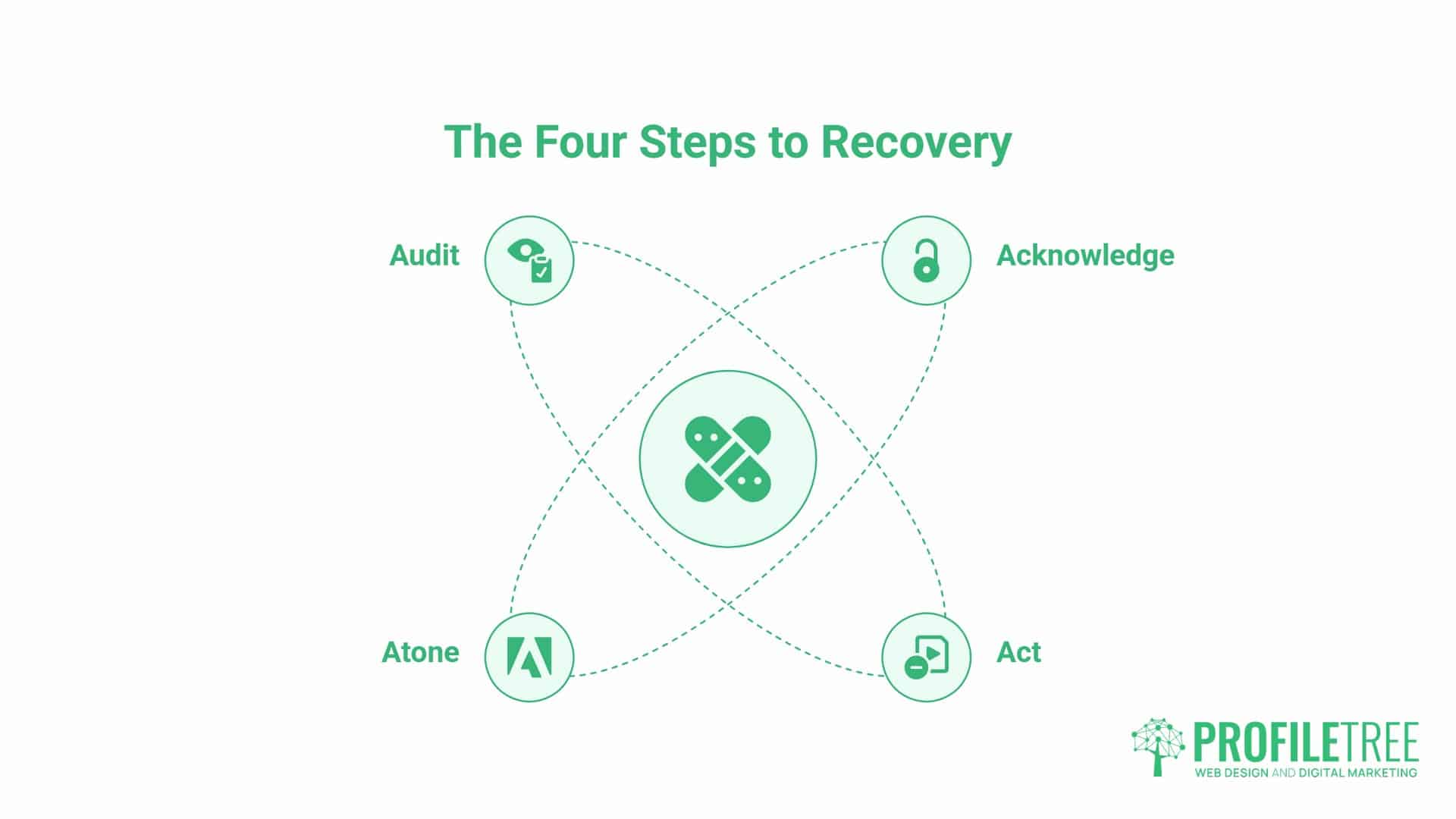
Even a solid approval process won’t catch everything, so every business running paid or public campaigns needs a plan for what happens if one goes wrong. The brands that recover well from tasteless marketing campaigns tend to follow the same four steps: acknowledge, act, atone and audit.
Acknowledge means stating plainly and quickly that the campaign caused offence and that the brand takes responsibility. A vague line like “we’re sorry if anyone was offended” does more damage than staying quiet, because it signals the brand still doesn’t understand what went wrong. Dove’s response to its 2017 advert was fairly direct: it admitted the work had missed the mark and removed it.
Act means pulling the content from every channel at once; leaving it live in one place while announcing its removal elsewhere only extends the story. Atone means taking a visible step beyond the apology itself, such as Heineken’s decision to work with cultural consultants on future campaigns. Audit means asking what the approval process allowed to happen, not just what went wrong with the specific advert.
The window for all four steps has shrunk dramatically. Before social platforms accelerated public reaction, sometime around 2012 to 2014, a brand had days to respond through normal media relations. By 2020, that window had compressed to hours: the Dove advert was live for a matter of hours before screenshots were circulating widely enough to generate press coverage. Every business running public campaigns now needs a pre-agreed escalation plan, decided before launch rather than improvised afterwards, and that kind of planning sits naturally inside a wider digital marketing strategy engagement rather than being bolted on after a crisis hits.
Making Brand Safety A Competitive Advantage
Some brands, Ryanair and Paddy Power among them, treat controversy as a deliberate strategy rather than stumbling into tasteless marketing campaigns by accident, and have built genuine commercial value out of it by treating complaints as free media coverage. There is evidence this can work, but it depends on years of accumulated brand equity and a marketing budget large enough to redirect quickly if the provocation backfires. For most SMEs, that safety net doesn’t exist, making the deliberate-controversy route a high-risk strategy with a low ceiling rather than a shortcut worth copying.
The businesses that avoid becoming the next entry on a list of tasteless marketing campaigns aren’t the ones with the most cautious creative teams. They’re the ones with a process that gives someone permission to ask the awkward question before launch, and a plan ready for the day a campaign misjudges its audience anyway. Building that process is less exciting than the campaigns it prevents, but it’s the difference between a brand that recovers from a bad marketing campaign and one that never has to.
If your business needs a second pair of eyes on a campaign before it goes live, or wants a proper approval process built around your marketing, the ProfileTree team can help.
FAQs
What is a tasteless marketing campaign?
A tasteless marketing campaign is one that a large share of its audience finds offensive, inappropriate or out of touch. It typically relies on cultural stereotypes, lands at the wrong moment relative to a tragedy or crisis, or trivialises a serious social issue for commercial gain.
What are the legal consequences of offensive ads in the UK?
The ASA can rule that an advert breaches the CAP Code and order it removed from specific channels or withdrawn entirely. A ruling becomes part of the public record and often resurfaces in future press coverage, which makes the reputational cost longer-lasting than the original media spend.
How do I know if my ad is edgy or just offensive?
The honest test is whether your target audience would feel energised or excluded by the joke, and whether you could defend your worst-case reading of the content in public. If the answer relies on hoping nobody reads it that way, it’s offensive rather than edgy.
Can AI-generated marketing be tasteless?
Yes. AI image and copy tools trained mostly on Western datasets often produce culturally flat or stereotyped content, and that risk grows when nobody reviews the output before it goes live. Human cultural review remains necessary regardless of how the content was produced.
What should a brand do immediately after a PR disaster?
Acknowledge the problem clearly, remove the content from every channel at once, and take a visible step beyond the apology itself. A slow or inconsistent response tends to extend the news cycle rather than end it.