
Display Advertising for UK Small Businesses: The Complete Strategy Guide
Table of Contents
Display advertising is not a shortcut to immediate sales. It works through visibility, repetition and trust — a fundamentally different mechanism from search advertising. Understanding that distinction before you spend a single pound is the difference between a campaign that builds your brand and one that burns through budget with nothing to show for it.
Most small business owners encounter display advertising at the wrong entry point. They see a banner on a news site, wonder how much it costs, and either decide it is out of their budget or jump straight into Google Ads without a clear plan.
This guide covers what display advertising actually is, how the UK media landscape works, what realistic budgets look like in sterling, and how to stay on the right side of UK privacy law — written for business owners and marketing managers in Northern Ireland, Ireland and the UK who want practical guidance.
What is Display Advertising? (And Why It Is Not Just Google Ads)
Display advertising uses visual formats, images, responsive ads and video, to show your brand to people as they browse websites, apps and other digital content. Unlike search advertising, which catches people at the moment they are actively looking for something, display advertising reaches people who are not yet in buying mode.
That distinction matters enormously for strategy. Search is a pull channel; display is a push channel. Paid search intercepts existing demand. Display creates familiarity before demand even exists. A Belfast accountancy firm running search ads for “tax return help” is targeting people who already know they need an accountant. Running display ads on local business news sites puts that firm in front of people who will need an accountant in six months, before they have started looking.
The Google Display Network (GDN) is the dominant platform for display advertising, reaching a very large proportion of internet users across partner websites and apps. It is not the only option, and for some UK businesses, it is not even the best starting point. The platform you choose should follow your strategy, not the other way around.
Search vs Display: A Direct Comparison
| Search Advertising | Display Advertising | |
|---|---|---|
| Intent | High — user is actively looking | Low to medium — user is browsing |
| Format | Text only | Images, responsive ads, video |
| Goal | Direct response, conversions | Brand awareness, retargeting |
| Typical CTR | 2%–5% | 0.1%–0.5% |
| Cost model | CPC (cost per click) | CPM (cost per thousand) or CPC |
| Best for | Capturing existing demand | Building brand, staying visible |
The Strategic Benefits of Display Advertising for UK SMEs
Brand awareness is the primary reason most UK small businesses should consider display. If your potential customers do not recognise your name when they are ready to buy, you will not be in the shortlist they search for. Display advertising addresses that problem over time, not instantly. Retargeting is where display earns its keep most clearly for SMEs. When someone visits your website and leaves without converting, a retargeting campaign keeps your brand visible as they browse other sites. For a Northern Ireland hospitality business running seasonal promotions, retargeting people who visited the website but did not book is often a more cost-effective use of budget than targeting cold audiences.
A service business with a longer sales cycle — a solicitor, a business consultant, a web design agency — benefits particularly from display. The purchase decision is not made in one session. Staying visible over the weeks between first contact and final decision is exactly what display advertising does well.
Where display underperforms for SMEs is in direct response to cold audiences. If you need leads this week on a tight budget, paid search will outperform display for most business types. The two channels work best together, with display building initial awareness and search capturing the intent when it crystallises.
Understanding the Key Metrics
These four terms come up in every display advertising conversation. Getting them clear at the start will save confusion when you review your campaign data.
Reach is the number of unique people who have seen your ad. If your reach is 2,000, that represents 2,000 distinct individuals.
Impressions count every time an ad is shown, including multiple views by the same person. Your impressions figure will always be higher than your reach figure. The ratio between the two tells you how often the average person sees your ad — known as frequency.
Click-through rate (CTR) is the percentage of people who click after seeing the ad. Display CTRs are typically much lower than search CTRs, often between 0.1% and 0.5%. A low CTR does not automatically mean a failing campaign; display works through exposure as well as clicks.
Conversion rate is the percentage of people who click and then complete a desired action — a purchase, a form submission, a phone call. This is where your landing page does its job. Even a well-targeted, well-designed ad will convert poorly if it leads to a slow or unclear landing page.
The relationship between these metrics tells the story of your campaign. Deep impressions with low CTR are normal for brand awareness. If CTR is reasonable but the conversion rate is low, the problem is usually the landing page, not the ad.
The UK Media Landscape: Beyond the Google Display Network
Most guides focus exclusively on the Google Display Network. That is a reasonable starting point — GDN offers extensive reach, solid targeting options and relatively low minimum spend. However, UK businesses have access to media environments that GDN alone cannot replicate.
Reach plc operates a large portfolio of regional news titles in the UK, including titles in Belfast, Manchester and London. Display advertising within trusted local news environments tends to carry higher credibility than generic blog placements, because readers have a relationship with the publication. For a Northern Ireland business targeting a local audience, placement on a recognised Belfast title reaches a very different mindset than a generic GDN placement on an unspecified website.
Sky AdSmart allows businesses to serve different TV ads to different households watching the same channel, with targeting available down to postcode district level. For local service businesses — a car dealership, a solicitor, a building firm — this means spend is not wasted on viewers outside your service area. Entry costs have become more accessible to SMEs in recent years, though it remains a higher-investment option than GDN.
Local news publishers often sell direct display inventory at rates that are competitive with programmatic buying, with the added credibility of a recognised local masthead. If you serve a specific town or region, it is worth contacting the digital advertising teams at local titles directly.
The Google Display Network remains the most practical starting point for most SMEs. The alternatives above are worth exploring once you have baseline data from GDN campaigns and understand which audiences respond to your advertising.
Display Ad Types: Choosing the Right Format for Your Budget
Banner ads are fixed-size image ads in standard dimensions. They require the least creative effort but are also the most easily ignored. Clear messaging and strong visuals are essential.
Responsive display ads are the GDN default for most campaigns. You upload headlines, descriptions and images, and Google automatically assembles them in formats that fit available ad spaces. They require less design work and tend to outperform static banners in reach and cost efficiency.
Video ads on the Display Network appear on YouTube and partner sites. For SMEs with video content already produced, repurposing it as a display campaign adds significant reach at low incremental cost. Short-form video assets produced specifically for paid distribution perform differently from organic social video — the first three seconds carry most of the weight.
Interstitial ads fill the full screen, typically on mobile. They have higher engagement but also higher annoyance risk. For most SMEs, responsive display ads and standard banners are more appropriate.
UK Small Business Budget: What Does Display Advertising Actually Cost?
Display advertising can be started with a modest daily budget, but results at low spend levels are limited to local or niche campaigns. Understanding the relationship between spend, reach and outcome is more useful than a single budget figure.
| Monthly Budget | Estimated GDN Reach | Best Use | Realistic Outcome |
|---|---|---|---|
| £300–£500 | Limited, local reach | Consistent brand visibility across a region; supports the performance of other channels | Brand recall within a small area; useful for retargeting existing website visitors |
| £500–£1,500 | Regional reach | Regional brand awareness or product launch | Measurable lift in branded search; retargeting plus cold audience testing |
| £1,500–£5,000 | Broader regional reach | Multi-region campaigns, video pre-roll, layered audience targeting | Consistent brand visibility across a region; supports performance of other channels |
| £5,000+ | National scale | National campaigns, multi-format strategy | Sustainable brand awareness at scale |
These figures are indicative for UK GDN campaigns and will vary based on industry, targeting criteria and ad quality. Competitive sectors such as finance, legal and insurance command higher CPMs than less competitive verticals.
CPM (cost per thousand impressions) on the GDN varies considerably depending on audience targeting and sector. CPC for display is generally lower than search, but the intent behind those clicks is also lower.
“The biggest mistake small businesses make with display is treating it like search. You are not buying immediate sales — you are buying the right to be remembered. A consistent modest budget over three months achieves something a single large spend never will.” — Ciaran Connolly, founder, ProfileTree
UK Privacy and GDPR: Running Compliant Display Campaigns
This is the section most display advertising guides skip, usually because they are written for a US audience. For UK businesses, ignoring it carries genuine risk.
The UK GDPR and the Privacy and Electronic Communications Regulations (PECR) govern how you can track and target users online. The key practical points for display advertising are:
- Cookie consent must be a genuine opt-in. For cookie-based retargeting, users must actively consent. Pre-ticked boxes and “continued browsing implies consent” mechanisms do not meet the standard the ICO expects.
- Implement consent mode correctly. Most major platforms, including Google Ads, offer consent mode integrations that respect users’ choices. You need to configure these — they do not work automatically.
- First-party data must be disclosed. If you are uploading email lists or CRM data for audience matching, your privacy policy must accurately describe how that data is used, including for advertising purposes.
- Contextual targeting is a compliant alternative. Showing ads based on page content rather than user behaviour does not require tracking consent. It is gaining traction as third-party cookie availability declines.
The ICO publishes guidance on cookies and tracking that is worth reading before you launch any retargeting campaign. Non-compliance carries both reputational and regulatory risk.
How to Launch Your First Display Campaign: A Five-Step Framework
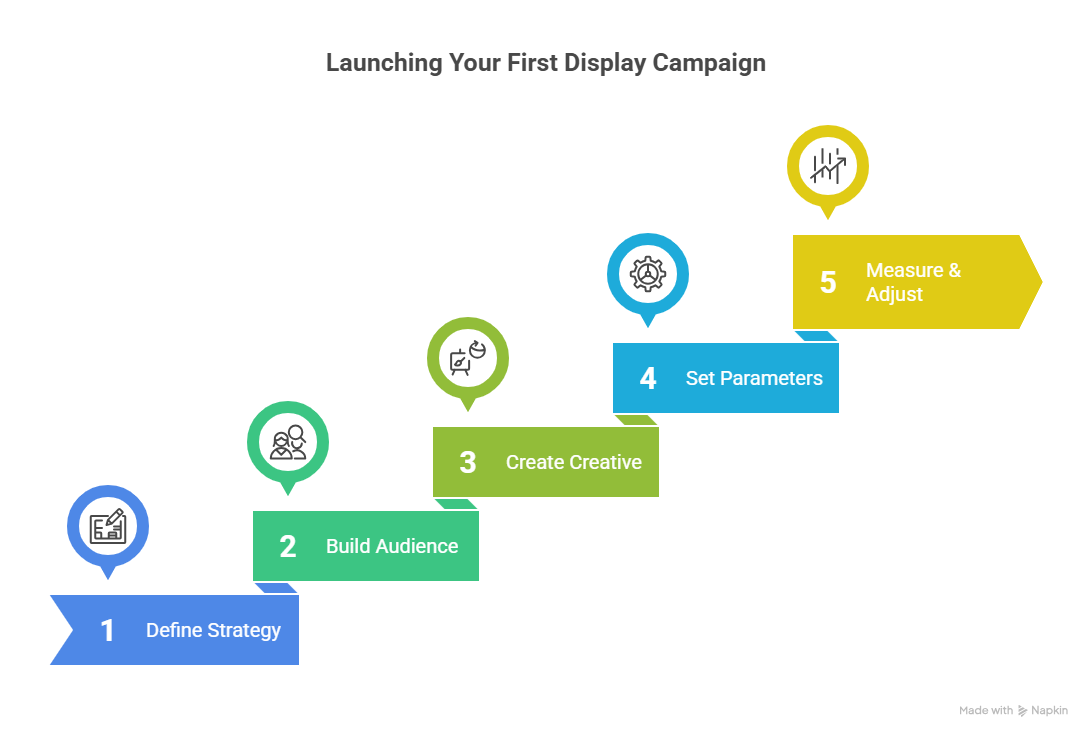
Step 1: Define Your Strategy Before You Open the Platform
Before you set up a single campaign, decide what success looks like. Are you trying to reach people who have never heard of you, or re-engage people who have visited your site? Are you building brand recognition over six months, or supporting a specific promotion over four weeks? Each goal requires a different campaign type, audience and measurement approach.
Step 2: Build Your Audience
For most SMEs starting out, two audience types are most useful: remarketing audiences (people who have previously visited your website) and custom intent audiences (people Google has identified as actively researching topics related to your product or service). For remarketing to work, you need the Google Ads tag or GA4 audience feature installed on your website, and sufficient website traffic to build an audience.
Step 3: Create Your Ad Creative
Responsive display ads are the practical starting point. You will need several headlines (under 30 characters), descriptions (under 90 characters), and image assets at the sizes Google specifies. The most common reason display ads underperform is a mismatch between the ad and the landing page. If the ad promotes a specific service or offer, the landing page must deliver exactly that — sending display traffic to a generic homepage is a reliable way to waste budget.
Step 4: Set Your Campaign Parameters
For brand awareness, target CPM gives you cost-per-impression control. For direct response, targeting CPA or maximising conversions works better if you have existing conversion data. At launch, use automatic placements and review them after two weeks, then exclude irrelevant or low-quality sites from your placement report. Set a frequency cap to avoid overexposure — three to seven impressions per user per day is a common starting point.
Step 5: Measure, Review and Adjust
Give new campaigns at least two weeks before drawing conclusions. Review your placement report and exclude low-quality sites. Check which audience segments are performing. Adjust bids, pause underperforming ad variants and test new creative every four to six weeks. Display campaigns improve significantly with active management.
Measuring Success Beyond the Click
Display advertising is consistently undervalued because most businesses measure it with the wrong metrics. If you judge display campaigns purely by click-through rate and last-click conversions, you will likely conclude they are not working — and you will be wrong.
View-through conversions count users who saw your display ad, did not click, but later converted through another channel. Google Ads and GA4 both track this. It is an imperfect metric, but a much better indicator of display’s contribution than last-click alone.
Assisted conversions show the display’s role in the customer journey even when it was not the final touchpoint. A customer might see your display ad three times, then search for your brand name, then convert via a search ad. Last-click attribution credits the search ad entirely. Assisted conversion data shows the display’s earlier role.
Branded search volume is the clearest signal that display is building awareness. If people are searching for your business name more frequently during a display campaign, the campaign is doing what it should. Monitor branded keyword impressions in Google Search Console alongside your campaign data.
Clicks and CTR are worth tracking, but they should not be the primary success metric for brand awareness campaigns. A campaign that generates a strong volume of impressions at a low CPM, contributes to assisted conversions and lifts branded search is doing its job, even if the CTR is 0.2%.
Conclusion
Display advertising rewards businesses that treat it as a long-term investment rather than a quick fix. Set a clear goal, choose the right platform for your audience, build compliant campaigns from the outset, and measure what actually matters — brand recall, assisted conversions and branded search growth — rather than clicks alone. Consistent, well-targeted display activity compounds over time.
If you want support building a display advertising strategy that fits your budget and business goals, get in touch with the ProfileTree team to discuss how paid media fits into your wider digital marketing plan.
FAQs
How much does display advertising cost for a UK small business?
Workable campaigns can start from around £300–£500 per month for tightly localised retargeting. At that budget, you will not build mass awareness, but you can stay visible to people who have already visited your website. For a meaningful regional brand awareness campaign, £1,000–£2,000 per month is a more realistic starting point.
What is the average CTR for display ads in the UK?
Display CTR across the GDN typically ranges from 0.1% to 0.5%. This is substantially lower than search advertising CTRs, but that comparison misunderstands how display works. Display reaches passive audiences who aren’t actively seeking your product. A CTR of 0.2% for a brand awareness campaign is normal.
Are display ads GDPR compliant?
Display advertising can be fully GDPR compliant, but compliance requires active steps. Cookie-based retargeting requires opt-in consent from UK users under PECR. Your website needs a compliant cookie consent mechanism, one that gives users a genuine choice and does not pre-tick consent boxes.
What is the difference between GDN and programmatic advertising?
The Google Display Network is a specific inventory of websites and apps that Google owns or has partnerships with. Programmatic advertising uses automated bidding to buy display inventory across multiple ad exchanges, often reaching a wider range of publishers.
Do display ads help with SEO?
Display advertising has no direct effect on organic search rankings. However, if a display campaign increases brand awareness and more people search for your business name, that growth in branded search can contribute to improved organic visibility over time.