
How to Combat Blue Monday: Guide for People and Employers
Table of Contents
January is grey, cold, and expensive. After the noise of Christmas, the third Monday of January arrives with a particular weight: the bills have landed, the days are still short, and the return to full working rhythm is well underway. That Monday has a name. Combat Blue Monday has become shorthand for the collective mid-January slump, and while the date itself was invented by a travel company in 2005, the feeling it describes is experienced by a significant number of people across the UK and Ireland every year.
This guide covers the biology behind why January is hard, practical steps individuals can take to manage it, and what employers and business owners can do to support their teams through the first quarter. Because the advice that helps one person through a difficult week looks very different from the actions that help an entire team stay engaged and productive in January.
What is Blue Monday? The Myth and the Reality
Blue Monday was invented. In 2005, Sky Travel commissioned a formula claiming the third Monday of January was the “most depressing day of the year.” It was designed to sell holidays. No scientific study has ever supported it, and the psychologist who lent his name to it has since distanced himself from the concept.
The date is made up. The feeling it describes is not.
The PR origin
The “most depressing day of the year” formula was created by Dr Cliff Arnall for a Sky Travel press release in 2005. The formula factored in weather, debt, time since Christmas, and broken resolutions. No peer-reviewed study has validated it, and Arnall himself has since distanced himself from the concept.
Blue Monday is not a recognised date in any clinical or psychological framework. However, the cultural resonance it has built over 20 years reflects something genuine: mid-January is a difficult period for many people, particularly in the UK and Ireland, where January brings short days, limited natural light, post-Christmas financial strain, and a long stretch before any bank holiday.
The myth vs. Seasonal Affective Disorder
It is worth distinguishing between a rough January and a clinical condition. The table below sets out the difference.
| Blue Monday (cultural concept) | Seasonal Affective Disorder (SAD) | |
|---|---|---|
| Origin | 2005 Sky Travel PR campaign | Recognised clinical diagnosis |
| Duration | Single day or short period | Months (typically October to March) |
| Symptoms | General low mood, tiredness | Clinical depression, sleep disruption, appetite changes |
| Treatment | Lifestyle adjustments | Medical support, light therapy, CBT, antidepressants |
| Who experiences it | Most people at some point | Estimated 2 million people in the UK (NHS) |
If your low mood persists beyond a few weeks, affects your ability to work or maintain relationships, or feels qualitatively different from ordinary tiredness, speak to your GP. SAD is a treatable condition and should not be managed with advice designed for a passing January slump.
Why January Feels So Hard
The combination of factors that makes mid-January difficult is not imaginary, even if the specific date is invented. Understanding the mechanics helps because it shifts the framing from “why am I like this” to “this is a predictable physiological and financial response to a specific set of conditions.”
The biology of dark mornings
Natural light drops significantly across the UK and Ireland between November and February. The body’s production of serotonin, which regulates mood and contributes to feelings of calm and focus, is directly influenced by light exposure. When light levels fall, serotonin production drops and melatonin production rises, making the body want to sleep more and do less.
This is not a character failing. It is the same biological mechanism that drives hibernation in other mammals. In Northern Ireland, which sits further north than most of England, the effect is more pronounced. Belfast receives around seven hours of daylight in mid-January compared to around 16 hours in June. That is a significant physiological shift, and most workplaces and working schedules make no accommodation for it whatsoever.
A second layer compounds this: reduced light disrupts the circadian rhythm, which governs sleep quality, appetite regulation, and hormone balance. People who sleep poorly feel the effects across every area of functioning, including motivation, patience, and concentration. A team that slept poorly in December and returned to full workloads in January is operating below capacity for reasons unrelated to attitude or work ethic.
The financial pressure that arrives in January
The emotional weight of post-Christmas debt differs from that of debt at other times of the year. Christmas spending carries a social obligation. People overspend on gifts, food, and festive events because not doing so carries a social cost. The result is that January credit card statements contain spending that felt unavoidable at the time, which makes the debt harder to process emotionally than spending driven by choice.
Research from StepChange consistently shows that January is the peak month for debt enquiries in the UK. The charity typically handles significantly more contact in January than in any other month. For households already managing cost-of-living pressures, the additional December spend amplifies an existing strain rather than creating a new one. For employees and small business owners, January cash flow is often tighter than at any other time of year.
The psychological gap after Christmas
December is unusually social compared to the rest of the year. Family contact, work events, and the general expectation of festivity mean people are more connected and stimulated than usual. January is the structural opposite: social commitments drop away, most people are spending less, and the working routine resumes at full intensity.
This contrast is itself a trigger. The transition from high stimulation to low stimulation is reliably uncomfortable. The January feeling is not just about the month itself; it is partly about how different it is from December.
7 Practical Ways to Combat the January Blues
None of the following requires a gym membership, a wellness budget, or a complete lifestyle overhaul. They are practical adjustments that address the actual causes of January low mood: limited light, financial stress, disrupted sleep, and reduced social contact. Start with whichever feels most relevant to where you are right now.
1. Tackle financial anxiety first
If post-Christmas debt is a source of stress, address it directly rather than working around it. Write down what you owe and to whom, set a monthly repayment figure you can actually meet, and put that plan in a place you can see it. Defined debt feels smaller than undefined debt, even when the numbers are the same.
Contact StepChange (stepchange.org) or Citizens Advice (citizensadvice.org.uk) if the numbers feel unmanageable. Both offer free, non-judgemental guidance and are well-resourced for January demand. Budgeting apps such as Money Dashboard or Emma (both available in the UK and Ireland) can help if you prefer a self-directed approach.
Avoid January retail sales as a mood-management strategy. Spending money you do not have on things you do not need to feel better about the debt you already have is a cycle that runs well into February.
2. Get outside in the morning
Natural light exposure in the first two hours after waking has a measurable effect on cortisol regulation and alertness. A ten-minute walk before work, or sitting near a window during breakfast, can shift your baseline energy for the day. You do not need sunshine; daylight on a grey January morning in Belfast or Dublin still provides significantly more light than indoor lighting.
If getting outside in the morning is genuinely not possible, a SAD lamp, which produces high-intensity light that mimics natural daylight, is a practical alternative. NHS guidance supports their use for managing seasonal low mood. They range widely in price, but a basic 10,000 lux lamp is widely available for under £40.
3. Move in whatever way works for you
Exercise is consistently effective for managing low mood, but the barrier to entry matters. A 20-minute walk, a home workout, or cycling to work counts. NHS guidance recommends 150 minutes of moderate activity per week. In January, consistency matters more than intensity.
The specific mechanism is well established: physical activity increases serotonin and endorphin production, reduces cortisol, and improves sleep quality. You do not need a gym membership or a fitness plan. You need to move your body regularly, and any format you actually use is the right one.
4. Reconnect socially without spending money
Social isolation amplifies low mood. A phone call, a walk with a friend, or a shared meal at home has the same neurological effect as an expensive social outing. January has a particular tendency to compound isolation because the combination of cold weather and a depleted post-Christmas budget makes people less likely to make plans.
Actively scheduling social contact, even informally, interrupts this. One commitment per week is enough to maintain the sense of connection that the social activity of December briefly provided.
5. Audit your sleep routine
Poor sleep and low mood reinforce each other in a reliable cycle. January is a common time for disrupted sleep patterns, particularly after the later nights and looser routines of December. Keeping a consistent wake time, even on weekends, is the single most effective sleep adjustment according to sleep research. Reducing screen exposure in the hour before bed and keeping the bedroom cool and dark are well-evidenced supporting measures.
If you are waking early and unable to return to sleep, this can be a specific symptom of seasonal depression rather than general tiredness. It is worth noting the pattern and mentioning it to your GP if it persists.
6. Use micro-breaks during the working day
Sustained desk work without breaks increases cortisol and reduces cognitive performance. A short break every 90 minutes, a screen-free lunch, or a brief walk at midday interrupts the accumulation of fatigue. The Pomodoro technique, which involves 25 minutes of focused work followed by a five-minute break, is one structured approach to this that works well for people who find it difficult to step away from a task.
For remote workers, this requires deliberate scheduling. The natural interruptions of an office environment, a conversation, a coffee break, and moving between meeting rooms are largely absent when working from home. Building equivalent breaks into a home working day is not an indulgence; it is a performance management decision.
7. Know when to seek support
If low mood is affecting your ability to work or function, reach out. The UK and Ireland have strong support networks, several of which are free and available immediately.
| Organisation | Focus | Contact |
|---|---|---|
| Samaritans | Crisis and emotional support | 116 123 (free, 24/7) |
| Mind (England and Wales) | Mental health information and support | mind.org.uk |
| AWARE NI | Depression and bipolar support in Northern Ireland | aware-ni.org |
| Pieta House | Suicide and self-harm support (Ireland) | pieta.ie |
| StepChange | Debt and financial stress | stepchange.org |
| Citizens Advice | Benefits, debt, housing advice (UK) | citizensadvice.org.uk |
Seeking support is not a last resort. Reaching out early, before a period of low mood becomes entrenched, produces better outcomes and requires less recovery time. If you are unsure whether your situation warrants professional support, your GP is the right first contact.
How Employers Can Support Their Teams on Blue Monday
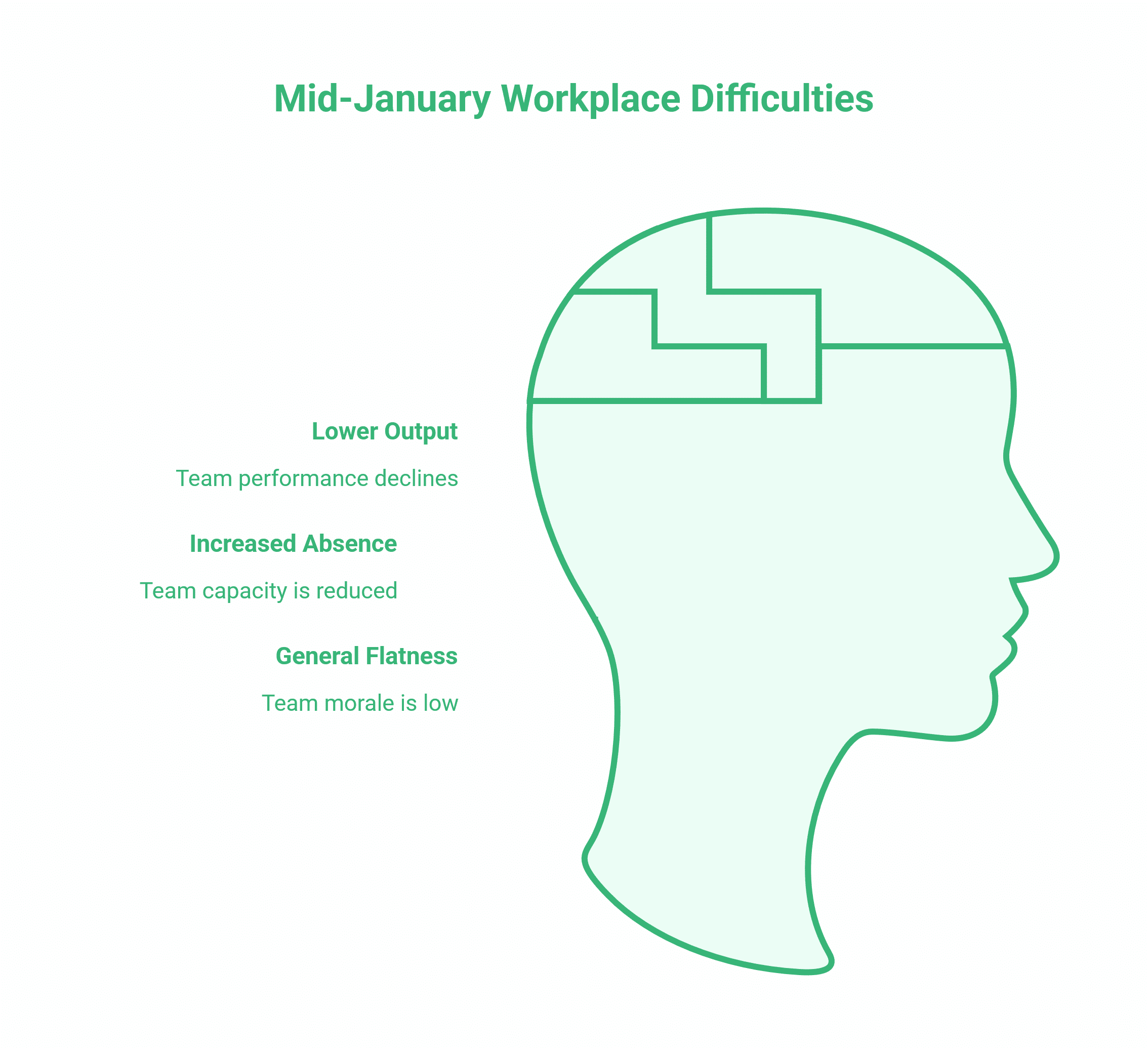
Most Blue Monday articles stop at personal advice. That is a gap, because a significant portion of mid-January difficulty plays out at work: reduced motivation, lower output, increased absence, and a general flatness that affects team dynamics. For SMEs in Northern Ireland, Ireland, and the UK, where teams are often small, and each person’s contribution is directly felt, this matters practically.
Business owners and managers do not need elaborate wellbeing programmes to make a meaningful difference. The following are practical actions any SME can take.
Recognising the signs of burnout in your staff
January burnout often looks like disengagement rather than distress. Staff who were high-performing in October and November may seem slower, quieter, or harder to reach in January. This is frequently misread as an attitude or a performance issue when the underlying cause is accumulated exhaustion from an end-of-year push that typically intensifies from October onwards.
Watch for a cluster of signals rather than a single indicator: reduced responsiveness to messages, lower-quality output, withdrawal from team interaction, or an increase in small errors. None of these, in isolation, is diagnostic, but several together in January suggest a person who is running low rather than one who has stopped trying.
The appropriate response is a brief, private, informal check-in. Not a performance conversation. Not a structured wellbeing review. Simply asking how someone is doing, without an agenda and with genuine attention to the answer, is often sufficient to signal that you have noticed and that the person is not invisible to you.
Practical wellbeing initiatives for small businesses
Large corporate well-being budgets are not a realistic model for most SMEs. The following approaches cost little or nothing and are proportionate to smaller team structures.
A flexible start time on the third Monday of January acknowledges the day without making a fuss. Removing non-essential meetings in the first two weeks back reduces the pressure of return. Reminding staff of any Employee Assistance Programme provision, if you have one, takes five minutes in a team message and reaches people who would not otherwise ask for help.
A shared team lunch, even a simple one, in the first week of January costs very little and recreates a version of the social connection that December provides. For remote teams, a video call with no agenda or a shared online activity serves the same function.
If you run a January planning session, keep it genuinely forward-looking. A meeting that begins with a detailed debrief of what went wrong in Q4 is not a morale exercise. A meeting that focuses on what the team wants to achieve in Q1 and how the business will support them in doing so.
Building digital skills to re-engage your team in January
January is consistently the strongest month for professional development uptake. Staff who feel they are developing are more resilient to motivational dips than those who feel static in their roles. This is particularly true for employees in marketing, communications, and client-facing functions, where the pace of change in tools and platforms means skills gaps accumulate quickly.
A structured digital training programme in January serves two functions. It gives your team practical skills they can apply immediately, and it signals that the business is investing in them at a time of year when that signal carries extra weight.
ProfileTree’s digital training programmes are designed specifically for business teams in Northern Ireland, Ireland, and the UK. Workshops covering content strategy, SEO fundamentals, AI tools for business, social media management, and video production can be delivered for small teams and adapted to the specific tools and channels your business uses. Running a half-day skills session in January tends to produce a measurable lift in team engagement through the first quarter.
Blue Monday as a Content Opportunity for Your Business
One aspect of Blue Monday that is almost entirely absent from competitor articles is its value as a content planning trigger. Blue Monday is a predictable, annual cultural moment with consistent media coverage and genuine search volume in the weeks leading up to the third Monday of January. For businesses in wellness, hospitality, retail, fitness, HR, financial services, and many others, it represents a low-cost opportunity to publish timely, relevant content that meets people where they are.
Planning ahead rather than reacting
The businesses that capture the most value from seasonal content moments are those that plan for them in advance. A blog post published on the day is rarely indexed and ranked in time to attract meaningful traffic. A post published in the first week of January, optimised for the queries people are actually searching, can rank in time to be found. A post published in December, building authority ahead of the search spike, performs better still.
This is the practical difference between a reactive content approach and a planned editorial calendar. ProfileTree’s content marketing service helps SMEs map seasonal moments like Blue Monday, Valentine’s Day, the Spring Budget, and others into a structured content plan that produces measurable search traffic rather than one-off posts that disappear into the archive.
Social media and video content around Blue Monday
Short-form video performs particularly well around emotionally resonant cultural moments. A brief video from a business owner acknowledging that January is hard, offering one or two genuine suggestions, and connecting those suggestions naturally to what the business does tends to generate stronger engagement than promotional content. It works because it is honest and because it meets the audience’s emotional state rather than working against it.
For businesses already producing video content through ProfileTree’s video production service, Blue Monday is one of several annual trigger points where a short, well-produced social video can reach a significantly larger audience than a standard post. The production does not need to be elaborate. A direct-to-camera piece, recorded cleanly with good lighting and clear audio, is sufficient. What matters is that it says something true.
Email marketing in January
January has high email open rates in B2B sectors. Decision-makers return from Christmas with renewed intent and are genuinely receptive to useful, well-timed communication. An email campaign that acknowledges the time of year with empathy, offers something genuinely useful, and connects that to a relevant service or resource consistently outperforms generic January promotions.
The framing matters. “Here is something that might help right now” performs better than “January sale” because it is oriented toward the reader rather than toward the sender. ProfileTree’s digital marketing training covers exactly this kind of audience-led campaign thinking for SME marketing teams who want to build better email habits across the year.
Conclusion: Combat Blue Monday
Blue Monday is a marketing invention, but January is genuinely hard for many people, and the reasons are biological, financial, and social rather than vague or personal. Addressing those reasons directly, whether you are managing your own wellbeing or supporting a team through the first quarter, produces better outcomes than reframing the day with forced optimism. Small, consistent adjustments add up. And for businesses, January is one of the most reliable windows of the year to reach an audience actively seeking something useful.
FAQs
When is Blue Monday in 2026?
Blue Monday in 2026 fell on Monday, 19 January. It always falls on the third Monday of January.
Is Blue Monday scientifically proven?
No. It was created for a Sky Travel press release in 2005 and has no peer-reviewed scientific basis. The mid-January slump many people experience is real, but the specific date is invented.
What is the difference between the January blues and SAD?
The January blues are a temporary low mood that most people experience to some degree in mid-winter. Seasonal Affective Disorder is a clinically diagnosed form of depression requiring medical assessment and treatment. If your low mood persists for more than 2 weeks or affects your daily functioning, speak to your GP.
How can I boost my mood in January without spending money?
Morning walks for natural light, calling a friend, and keeping a consistent sleep schedule are all free and well-evidenced. StepChange and Citizens Advice can also help if financial anxiety is a factor.