Skip to content

What Is Copywriting? Your Complete Guide to Persuasive Writing

Updated on:
Updated by: Ciaran Connolly
Reviewed byAhmed Samir

Bill Gates declared ‘content is king’ back in 1996, and nearly three decades later, that statement holds more weight than ever. For businesses competing online, written content remains the most direct path to conversions. The words on your website, in your emails, and across your marketing materials determine whether visitors become customers or simply click away. But what is copywriting, and why has it become so critical for business success?

Copywriting is the practice of crafting persuasive written content designed to prompt specific actions from your audience. It’s the strategic text that appears across all your marketing channels—from product descriptions that drive purchases to landing page headlines that capture attention in seconds, email campaigns that generate responses, and social media posts that build engagement. Professional copywriting combines psychology, market research, and precise language to guide prospects through your sales funnel. Unlike creative writing, which aims to entertain, or journalism, which seeks to inform, copywriting has a clear commercial objective: converting readers into customers.

For UK business owners and marketing managers, understanding professional copywriting means recognising how strategic communication directly impacts revenue. This isn’t about elaborate prose or impressive vocabulary—it’s about clear, persuasive messages that resonate with your target audience and drive measurable results. Whether you’re developing a new website, launching products, or building your digital marketing strategy, copywriting forms the verbal foundation that gives meaning to every customer interaction.

Copywriting Fundamentals

The core definition of copywriting centres on creating persuasive content that motivates specific actions. This encompasses everything from a product description that drives purchases to a landing page headline that captures attention in milliseconds. Professional copywriting blends psychological understanding, market research, and linguistic precision to move prospects through your sales funnel.

Modern copywriting operates at the intersection of multiple disciplines. It combines design elements that guide the eye, SEO strategies that attract organic traffic, and content marketing frameworks that build long-term relationships. For digital agencies like ProfileTree, copywriting isn’t an isolated service; it’s the verbal component that gives meaning to web design, video production, and overall digital strategy.

The materials produced by copywriters span both digital and traditional channels: website copy, email campaigns, social media posts, video scripts, print advertisements, direct mail, billboards, and promotional materials. Each format demands different approaches, but all share the same objective: connecting with your target audience in ways that generate measurable business results.

Why Copywriting Matters for UK Businesses

British businesses face unique challenges in the digital space. The UK market rewards subtlety, authenticity, and a specific communication style that differs markedly from American marketing approaches. Professional UK copywriting accounts for regional spelling conventions, cultural references, and the understated tone that British audiences expect from credible brands.

Search engines increasingly prioritise content quality over quantity. Google’s algorithms can now detect generic, templated writing that adds no real value. For businesses in Belfast, across Northern Ireland, and throughout the UK, investing in skilled copywriting means creating content that both humans and search engines recognise as authoritative and useful.

The shift from outbound interruption marketing to inbound content strategies has made copywriting more critical than ever. Rather than shouting at potential customers through advertisements, modern businesses attract them through helpful, informative content that addresses genuine needs and questions.

Professional Copywriter Roles

Professional copywriters function as strategic partners in your marketing efforts, not just word producers. They research your industry, analyse your competitors, understand your target audience’s pain points, and craft messages that resonate with the people most likely to buy from you.

The responsibilities of a professional copywriter extend well beyond writing. Research forms the foundation of effective copy—understanding market trends, customer behaviour, competitive positioning, and industry-specific terminology. This investigative work informs every sentence, ensuring that the content remains factually accurate and commercially relevant.

Modern copywriters handle multiple tasks throughout the content creation process:

  • Conducting market and competitor research
  • Writing initial drafts aligned with brand guidelines
  • Editing content for clarity and impact
  • Proofreading to eliminate errors
  • Sourcing or specifying visual elements
  • Optimising content for search engines
  • Managing project timelines
  • Contributing to broader content strategy
  • Implementing copy across various platforms

Many professional copywriters now possess skills across digital marketing disciplines. They understand how SEO works, can analyse website analytics, grasp the requirements of social media platforms, and know how to write video scripts that complement visual storytelling. This breadth of knowledge makes them valuable contributors to comprehensive digital strategies.

How Businesses Use Copywriters

Organisations that engage professional copywriters report more effective marketing campaigns and higher engagement rates. Copywriting takes your business objectives and translates them into messages that speak directly to your target audience’s interests and concerns, effectively conveying your brand’s message.

Whether promoting products or services, professional copy performs the subtle work of selling without appearing overtly sales-focused. Skilled copywriters become your brand’s voice, which is why establishing a consistent tone of voice is so important. This voice should reflect your brand values and resonate with the specific people you want to reach.

By following brand guidelines, copywriters help build brand awareness and foster customer loyalty. This consistency applies across all touchpoints: your website copy, blog posts, white papers, social media presence, and email communications. Each piece of content reinforces your brand identity while moving prospects closer to conversion.

Sharing your message with potential customers becomes more effective when you work with copywriters who understand how to reach specific audiences. They know which emotional triggers work for different demographics, how to structure arguments that overcome objections, and which calls to action generate the highest response rates.

Content Writing vs Copywriting

Whilst both involve creating written content, content writing and copywriting serve distinct purposes within your digital marketing strategy. Copywriting focuses specifically on persuasive sales and marketing materials designed to drive immediate actions—such as purchasing products, signing up for services, or contacting your business.

Content writing typically refers to informational and editorial material that appears on websites. This includes blog posts, articles, guides, and resource pages. The primary goal of content writing is to inform, educate, and engage readers whilst establishing your authority in your field.

However, the lines between these disciplines have blurred. All web content includes persuasive elements—even educational blog posts contain calls to action that encourage readers to explore more of your site, subscribe to newsletters, or contact your team. Content writing has become a subset of copywriting, as both aim to keep visitors engaged and moving through your sales funnel.

The key difference lies in the primary intent. Sales copy explicitly promotes specific products or services with direct conversion goals in mind. Content writing takes a softer approach, building relationships and trust through valuable information that positions your business as a helpful resource rather than just a seller.

Types of Copywriting

Professional copywriting encompasses multiple specialisms, each requiring different skills and approaches. Understanding these categories helps you identify which type of copywriter your business needs for specific projects.

Web Content

Website content forms the foundation of your online presence. This copy informs and engages visitors whilst guiding them toward specific actions. Web content encompasses a wide range of materials, including social media posts, articles, blog posts, product descriptions, service pages, and landing pages.

Effective web content combines several key elements: persuasive sales techniques, technical accuracy that builds credibility, creative storytelling that maintains interest, and SEO optimisation that attracts organic traffic. This complex mixture makes web copywriting one of the most challenging disciplines.

Rather than overwhelming visitors with promotional messages, quality web content tells a story through your brand’s offerings. It builds relationships with your target audience by addressing their questions, solving their problems, and providing genuine value. This approach aligns with how modern consumers research and make purchasing decisions.

Developing engaging, useful content is crucial for attracting audiences searching for solutions your products or services offer. Well-crafted articles, how-to guides, infographics, video scripts, and tutorials deliver information in digestible formats while establishing your authority in your industry.

For businesses working with digital agencies like ProfileTree, web content represents a strategic investment. Articles and guides that rank well in search engines continue attracting potential customers long after publication. This creates a compounding effect, making your content library an increasingly valuable marketing asset.

Technical Copy

Technical copywriting focuses on promoting products or services through detailed explanations, supported by data and research. This type of content typically appears in white papers and in-depth guides, demonstrating expertise and industry authority.

Creating technical copy requires substantial research and the ability to synthesise complex information into accessible formats. These documents provide a detailed explanation of why users should choose your brand, utilising evidence and insights that appeal to analytical, research-driven buyers.

Well-structured technical copy presents comprehensive arguments that readers can follow logically. This format works particularly well for specialist products, B2B services, and industries where purchase decisions involve multiple stakeholders and significant investment.

Organisations commission technical copywriting when they need to make research widely accessible or create authoritative guides for specialist products. This content type is particularly suited for technology companies, professional services firms, and businesses selling to technical audiences who value depth over brevity.

Creative Copy

Creative copywriting embodies what most people envision when they think of advertising. This includes commercials, jingles, billboard messages, print advertisements, and promotional campaigns. Creative copy appears on television, radio, in newspapers and magazines, and on outdoor advertising.

Despite appearing simple, creative copywriting demands a deep understanding of buyer personas and the ability to craft memorable slogans and taglines that resonate across diverse audiences. The best creative copy distils complex value propositions into phrases that stick in people’s minds.

Creative copywriters work closely with art directors, designers, and creative directors to produce campaigns where words and visuals blend seamlessly. The copy must complement the design whilst standing strong enough to work independently when necessary.

This specialism requires the ability to think conceptually, understanding how a few well-chosen words can encapsulate an entire brand position or product benefit. Creative copywriters often brainstorm dozens or hundreds of options before finding the perfect phrase that makes a campaign memorable.

Sales Copy

Sales copy makes up the bulk of commercial writing, online and offline. This includes advertisement text, advertorials in online publications and magazines, product descriptions, category descriptions, and promotional materials designed to drive direct purchases.

Copywriters producing sales content require a diverse set of skills. They must tap into audience psychology and understand what motivates different customer segments. They write creatively and persuasively while synthesising large amounts of information into concise, easy-to-digest packages.

Sales writers research the detailed specifications and features of products, then extract the most important benefits that matter to customers. This requires knowing which technical details actually influence purchase decisions and which are simply noise.

Grammar and spelling accuracy become particularly important in sales copy. Errors undermine credibility and make companies appear unprofessional or unreliable. Professional sales copywriters maintain meticulous attention to detail whilst crafting compelling messages.

As Better Than Success notes, success in this field requires “mastering the art of writing sales copy without sounding salesy. The best way to do this is to just tell the truth about your product. What problems does your product or service solve, and how does it add value to your target audience?”

SEO Copy

Search engine optimisation fundamentally shapes how businesses approach online content. SEO copywriting strategically incorporates keywords and search terms that help content rank higher in search engine results pages. This type of writing is commonly found in web content, product descriptions, blog posts, and service pages.

Effective SEO copy requires a combination of technical and creative skills. Writers conduct keyword research to identify terms that potential customers actually use when searching for products or services. They then weave these terms naturally into content that remains engaging and informative rather than stilted or keyword-stuffed.

The best SEO copywriters think strategically about search intent. They consider the questions audiences have when using specific search terms and create content that comprehensively answers them. This approach satisfies both search engine algorithms and human readers.

For businesses in competitive markets, SEO copywriting represents a major opportunity. Well-optimised content can attract consistent organic traffic for years, reducing reliance on paid advertising. This makes SEO copy one of the highest-ROI investments in digital marketing.

ProfileTree’s approach to SEO copywriting combines technical optimisation with genuine value creation. Rather than simply targeting keywords, the focus is on creating content that establishes authority, builds trust, and guides visitors toward business goals.

PR Copy

Public relations copywriting maintains and protects brand reputation through carefully crafted communications. This includes press releases announcing company news, product launches, or partnerships, as well as statements responding to public enquiries or addressing negative publicity.

PR content requires a neutral, balanced tone whilst maintaining a positive brand image. The writing style typically draws on journalistic conventions, presenting facts clearly and objectively without promotional language that might undermine credibility.

Press releases follow specific formats that journalists expect. They lead with the most important information, provide supporting details, include relevant quotes from company spokespersons, and end with standard company background information. This structure enables media outlets to easily use or adapt the content.

When organisations face negative publicity, skilled PR copywriters craft statements that address concerns directly whilst protecting the brand’s long-term reputation. This requires striking a balance between transparency and strategic messaging, acknowledging issues without creating further problems.

The purpose of PR copywriting is clear: represent your organisation professionally and respond to public interest effectively. Whether announcing positive developments or managing difficult situations, PR copy requires precision, diplomacy, and understanding of how messages will be received by different audiences.

UK Market Requirements

What Is Copywriting

British businesses operate within a distinctive regulatory and cultural context that affects how copywriting should be approached. Understanding these UK-specific requirements separates professional services from generic content providers.

The British Voice in Copywriting

The linguistic differences between UK and US English extend far beyond spelling variations. British communication tends toward understatement, irony, and a more reserved tone compared to American marketing’s typically enthusiastic style. This isn’t merely a matter of preference—it’s about cultural authenticity, which UK audiences use to assess brand credibility.

Professional UK copywriters tend to avoid the hyperbolic language commonly used in American marketing. Phrases like “the most incredible solution ever” feel uncomfortable and untrustworthy to British audiences. Instead, UK copy typically adopts a measured, authoritative tone that lets facts and benefits speak for themselves.

Cultural references and idioms require particular attention. Terms like “condos” and “HOAs” have no meaning in UK property markets, where “flats,” “residents’ associations,” and “service charges” are standard. These details matter because they indicate whether a brand genuinely understands the local market or is merely adapting international content.

“The difference between good copy and great copy often comes down to cultural authenticity,” notes Ciaran Connolly, Director of ProfileTree. “UK businesses need content that sounds like it was written by someone who actually lives and works here, not adapted from American templates.”

Regulatory Compliance for UK Copywriting

The Advertising Standards Authority (ASA) and Competition and Markets Authority (CMA) maintain strict guidelines for marketing claims. UK businesses remain legally responsible for all statements made in their copy, regardless of whether the content was written by employees, contractors, or generated through AI tools.

The ASA Code requires that marketing claims be truthful, substantiated, and not misleading. If your copywriter makes statements about product performance, industry statistics, or competitive comparisons, you must be able to prove those claims. Professional UK copywriters understand this requirement and build fact-checking into their process.

Copyright considerations also differ in the UK compared to other jurisdictions. The Copyright, Designs and Patents Act 1988 includes specific provisions for “computer-generated works,” defining the author as “the person by whom the arrangements necessary for the creation of the work are undertaken.” This has implications for businesses that use AI tools in their content creation processes.

Working with UK-based copywriters who understand these regulatory frameworks reduces legal risk whilst maintaining compliance. They know which claims require substantiation, how to phrase benefits without making misleading implications, and when to include necessary disclaimers or qualifications.

Avoiding Generic AI Language Patterns

Search engines and human readers have become adept at identifying generic, AI-generated content. Certain words and phrases now serve as indicators of low-quality, mass-produced content. Professional UK copywriters actively avoid these patterns to maintain authenticity and credibility.

Common AI-generated writing often employs unnecessarily formal vocabulary and adheres to predictable sentence structures. It often includes transition words such as “however,” “furthermore,” and “therefore” at the start of sentences. It also gravitates toward dramatic but meaningless phrases that add no real value.

Quality copywriting employs plain English that conveys clear communication. It naturally varies in sentence length and structure. Most importantly, it provides specific information and actionable insights rather than generic statements that could apply to any business or product.

For UK businesses, this attention to authentic voice is increasingly important as audiences become more adept at detecting templated content. Professional copywriting services focus on creating genuinely useful content that reflects real expertise rather than recycling common knowledge through slightly different phrasing.

Building Your Copywriting Skills

Professional copywriters come from diverse backgrounds, but certain foundations make developing these skills more straightforward. Understanding the path to becoming a skilled copywriter enables businesses to evaluate potential hires and contractors effectively.

Educational Background

Whilst formal degrees aren’t essential, education in relevant fields provides valuable foundations. Degrees in journalism, communications, English literature, or marketing teach critical thinking, research methods, and deadline management—all fundamental to professional copywriting.

Academic training develops the analytical skills needed to evaluate sources, construct logical arguments, and present complex information clearly. These capabilities transfer directly to commercial copywriting, where research accuracy and logical structure drive results.

Numerous online courses are specifically designed for aspiring copywriters. These programmes often cover practical elements that traditional degrees may not address: persuasion psychology, conversion optimisation, digital marketing fundamentals, and industry-standard tools and processes.

However, education alone doesn’t create effective copywriters. The skill develops through practice, feedback, and continuous learning. Many successful copywriters combine formal education with self-directed learning, constantly studying effective copy and refining their approach based on results.

Gaining Practical Experience

Experience forms the most important qualification for copywriters. Demonstrating your capability requires building a portfolio of work that showcases your skills across different formats and industries. Without proven work samples, securing paying clients or employment becomes significantly more difficult.

Internships with local marketing agencies or advertising firms provide structured learning environments. These positions offer exposure to professional workflows, client relationships, and the reality of commercial writing constraints—particularly deadlines and revision processes.

If formal internships aren’t available, approaching local businesses directly can create opportunities. Small companies often need copywriting help but lack the budget for major agencies. Offering to write copy for their advertisements, websites, or promotional materials not only builds your experience but also helps businesses in your community.

Creating speculative copy demonstrates your skills when you lack client work to show. This involves selecting products or brands you admire and developing campaigns for them, including headlines, body copy, taglines, and full advertisements. Whilst theoretical, well-executed spec work proves your creative abilities.

Starting your own blog not only provides writing practice but also serves as a platform for showcasing your expertise. Select a niche you are familiar with and consistently produce content that showcases your expertise. This approach works particularly well for copywriters targeting specific industries, as a focused blog establishes credibility in that sector.

Building Your Portfolio

A professional portfolio collects your best work in a format that’s easily shared with potential clients or employers. For copywriters, portfolios typically live online, making them accessible to anyone evaluating your capabilities. This remains with you throughout your career, constantly evolving as your skills develop.

If you’re building a portfolio with speculative work, research the portfolios of successful copywriters for inspiration. Study how they present projects, what context they provide, and how they demonstrate the thinking behind their creative choices. This research informs decisions about your own portfolio structure.

Portfolios should demonstrate a range across different formats and industries whilst maintaining quality throughout. Include your strongest pieces rather than everything you’ve written. Each project should show different aspects of your capabilities—perhaps one demonstrates SEO expertise, another shows creative advertising skills, and a third proves your technical writing abilities.

Tailor your portfolio to suit specific opportunities. If you’re applying for a position that involves writing healthcare copy, ensure your portfolio prominently features any relevant medical or pharmaceutical work. This focused presentation shows potential clients or employers that you understand their specific needs.

Establishing Your Online Presence

Professional copywriters need robust online presences. A website showcasing your portfolio serves as your primary business card, providing a central location where potential clients can learn about your services, view your work, and contact you directly.

Social media platforms offer additional opportunities to demonstrate your skills and connect with potential clients. LinkedIn works particularly well for B2B copywriters, allowing you to share industry insights, engage with other professionals, and showcase your expertise through regular posts and articles.

Instagram can work for copywriters targeting creative industries or consumer brands. Regular posts that share writing tips, offer behind-the-scenes glimpses of your process, or feature examples of effective copy you’ve encountered demonstrate your expertise while building your audience.

Regardless of the platforms you use, maintain professionalism throughout. Your online presence represents your brand, and potential clients will evaluate your communication skills through everything you post. This doesn’t mean being stuffy or overly formal—it means being thoughtful about how you present yourself.

Real-World Copy Examples

What Is Copywriting

Examining specific examples illustrates the difference between effective copywriting and generic content. These comparisons help you recognise quality when evaluating copywriters or assessing your own content.

Effective Example: Apple AirPods Pro “Silence the world. Hear what matters.”

This tagline succeeds through simplicity and emotional resonance. It uses strong verbs that create clear images in readers’ minds. The copy communicates the product’s core benefit—noise cancellation—whilst framing it as an advantage: focusing on what’s important to you. In just six words, it conveys both product features and customer benefits.

Effective Example: Airbnb Listing “Cosy cottage escape in the heart of the mountains. Hike, explore, and unwind in this charming retreat. Coffee on the porch with stunning views awaits.”

This description creates vivid mental images that help potential guests imagine themselves at the property. It appeals to specific desires—escaping daily life, connecting with nature, and relaxing in comfortable surroundings. The concrete details (“coffee on the porch”) feel authentic and inviting rather than generic.

Ineffective Example: Software Company Website “Our software provides cutting-edge solutions for all your business needs.”

This statement fails because it’s entirely generic. Every software company could make this claim. It provides no specific information about what the software actually does, which problems it solves, or how it differs from competitors. The phrase “cutting-edge solutions” sounds impressive but means nothing concrete.

Ineffective Example: Email Subject Line “Don’t miss out! Limited-time offer!”

This approach has been overused to the point where it triggers spam filters and reader scepticism. It creates a false sense of urgency without providing a genuine reason to open the email. A more effective approach would specify the actual offer: “Get 20% off website design this weekend only” provides concrete information that helps recipients decide whether the email is relevant to them.

The ROI of Professional Copywriting

Investing in professional copywriting generates measurable returns across multiple business metrics. Understanding these benefits helps justify copywriting budgets and demonstrates why high-quality writing is essential for achieving commercial success.

Well-crafted copy improves conversion rates across all marketing channels. When product descriptions clearly articulate benefits, landing pages effectively address customer concerns, and calls to action provide compelling reasons to act, more visitors become customers. Even small improvements in conversion rates produce significant revenue increases over time.

Professional copywriting reduces customer acquisition costs by making marketing efforts more efficient. When your messaging resonates strongly with target audiences, you need fewer impressions and clicks to generate each conversion. This improved efficiency means marketing budgets stretch further.

Quality content attracts organic search traffic that continues generating leads long after publication. Unlike paid advertising, which stops working when you stop paying, well-optimised articles and guides continue to attract visitors for months or years. This creates compounding returns where your content library becomes increasingly valuable.

Strong copy builds a brand’s reputation and fosters customer trust. When your content demonstrates genuine expertise, addresses real concerns, and provides useful information, people view your business as credible and authoritative. This perception reduces sales resistance and increases customer lifetime value.

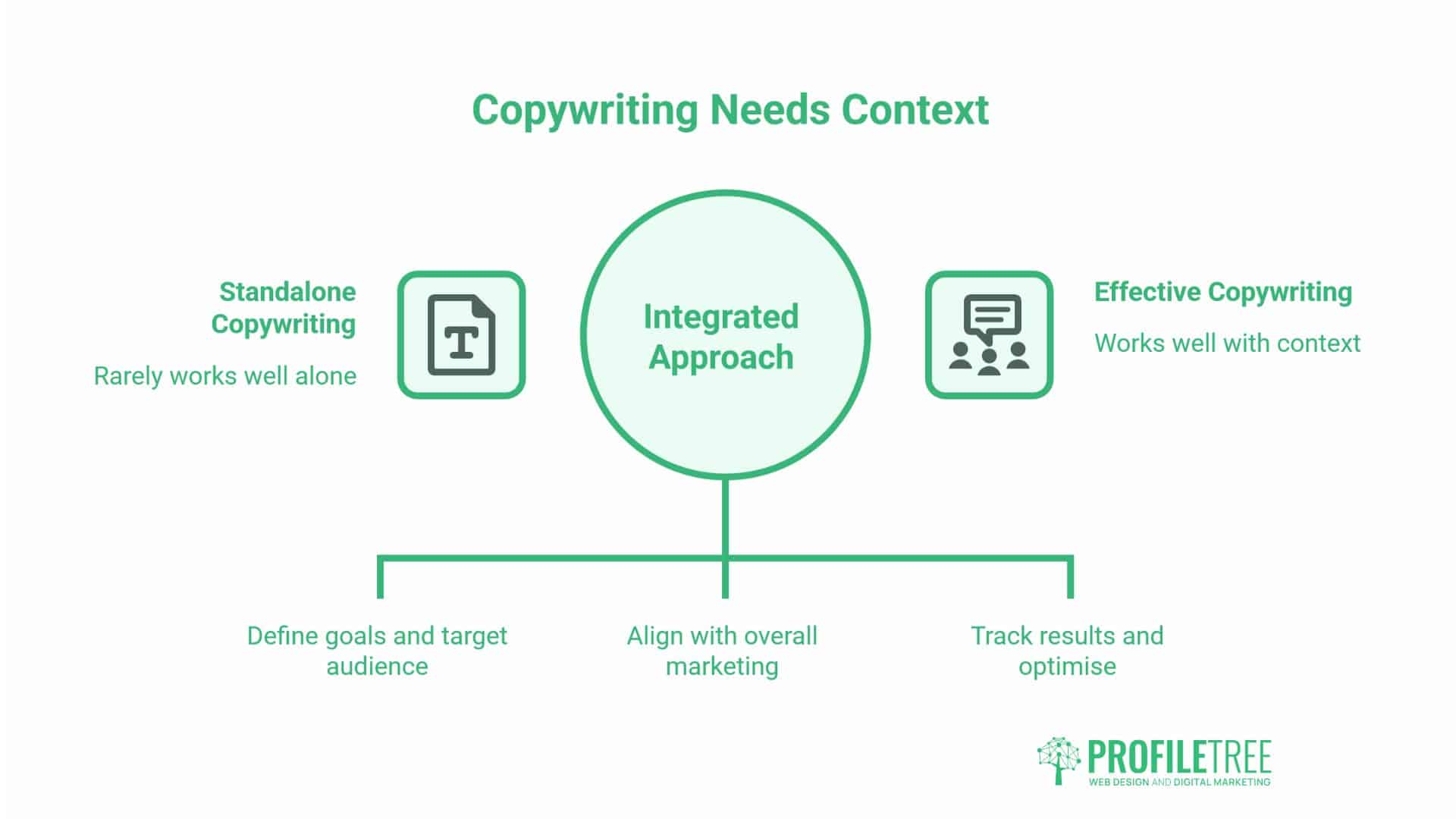
For businesses working with agencies like ProfileTree, professional copywriting seamlessly integrates with other services, such as web design, SEO, video production, and digital strategy, to create cohesive marketing systems. The copy gives meaning and direction to visual design, whilst design elements amplify the impact of written messages.

Choosing the Right Copywriting Partner

Selecting a copywriter or copywriting agency requires evaluating several factors beyond simple writing ability. The right partner understands your industry, shares your business values, and has the technical skills needed for your specific marketing channels.

Review portfolios carefully, looking for experience in your industry or with similar types of businesses. Copywriters who understand your sector bring valuable context that shows in their work. They understand which benefits matter most to your customers, which objections need to be addressed, and which language resonates with them.

Assess their understanding of digital marketing beyond just writing. Modern copywriters should grasp SEO fundamentals, understand conversion optimisation principles, and know how copy integrates with design and other marketing elements. This broader knowledge enables content that works seamlessly within your entire marketing ecosystem.

Evaluate their process and communication style. Professional copywriters ask detailed questions about your business, target audience, and goals. They present clear timelines, explain their approach, and welcome feedback. This collaborative approach produces better results than simply receiving assignments and delivering finished work.

Consider their flexibility and range. Your copywriting needs will vary across projects—sometimes you’ll need concise product descriptions, other times long-form guides or technical white papers. Copywriters who handle diverse formats provide more value than specialists in just one area.

For UK businesses specifically, confirm their understanding of British English, cultural context, and regulatory requirements. Ask about their fact-checking processes and how they handle claims and statistics. Professional UK copywriters build verification into their workflow rather than treating it as an optional extra.

FAQs

What qualifications do professional copywriters need?

Professional copywriters typically have backgrounds in journalism, communications, English, or marketing, though formal qualifications aren’t strictly required. The most important qualification is a strong portfolio that demonstrates their ability to write persuasive copy across various formats.

How much does professional copywriting cost?

Copywriting rates vary significantly based on experience and project complexity. Hourly rates typically range from £50 to £500, whilst project-based pricing depends on scope. Website copy might cost £2,000-£10,000, while blog posts range from £100 to £500.

What’s the difference between copywriting and content writing?

Copywriting focuses on persuasive sales materials designed to drive immediate actions. Content writing creates informational material that builds relationships over time. However, these categories overlap significantly, as most content includes persuasive elements.

How do you measure copywriting effectiveness?

Track metrics aligned with specific goals: conversion rates and revenue for sales copy, organic traffic and search rankings for SEO content, open rates and click-through rates for email campaigns. Establish clear metrics before creating copy, then track performance against those benchmarks.

Taking Action: What Is Copywriting?

Professional copywriting transforms how your business communicates with potential customers, improving conversions, strengthening brand perception, and boosting search visibility.

Start by auditing your existing content. Review your website copy, product descriptions, and email campaigns with a critical eye. Look for generic language, unclear value propositions, and missed opportunities to guide visitors toward specific actions.

For businesses in Belfast, across Northern Ireland, and throughout the UK, working with local copywriting services offers distinct advantages. Local copywriters understand regional markets and cultural context and write in authentic British English while navigating UK regulatory requirements naturally.

ProfileTree offers professional copywriting services as part of comprehensive digital marketing solutions. Our team combines copywriting expertise with web design, SEO, video production, and digital strategy to produce content that drives traffic, generates leads, and supports business growth.

Contact ProfileTree to discuss how professional copywriting can strengthen your digital presence and drive measurable business results.

Leave a comment

Your email address will not be published.Required fields are marked *

Join Our Mailing List

Grow your business with expert web design, AI strategies and digital marketing tips straight to your inbox. Subscribe to our newsletter.