
Marketing Compliance: UK Regulations for Business Owners
Table of Contents
ASA Marketing compliance has become increasingly important for UK businesses as regulatory bodies intensify scrutiny over advertising claims and promotional content. The Advertising Standards Authority (ASA) received over 39,000 complaints in 2023, leading to thousands of advertisements being amended or withdrawn. Poor marketing compliance costs businesses money through wasted campaigns, damages reputation, and in serious cases, attracts regulatory penalties.
Small and medium businesses often lack dedicated legal teams to review every marketing piece for compliance. This creates risk when promotional materials inadvertently breach advertising codes. Understanding marketing compliance requirements protects your business whilst building customer trust through honest, transparent advertising.
ProfileTree helps SMBs across Northern Ireland, Ireland, and the UK develop marketing compliance strategies through digital training and strategic consulting. We work with businesses to create promotional content that achieves marketing goals without crossing regulatory boundaries.
Understanding ASA Marketing Compliance in the UK
ASA Marketing compliance in the UK involves several regulatory bodies with overlapping responsibilities.
The ASA administers the UK Advertising Codes, setting the foundation for compliance across broadcast and non-broadcast advertising, including digital marketing, social media, and websites. The Committee of Advertising Practice (CAP) writes these codes, which apply to all commercial marketing communications.
The Competition and Markets Authority (CMA) enforces marketing compliance through consumer protection laws. The CMA investigates businesses for misleading claims, particularly around pricing and product descriptions. Recent enforcement actions have targeted ‘drip pricing’ (adding fees during checkout) and fake reviews.
Trading Standards services operate at the local authority level, enforcing marketing compliance requirements. They investigate complaints about misleading advertising, fake reviews, and unfair commercial practices affecting local consumers.
Businesses selling to US customers must also consider Federal Trade Commission (FTC) marketing compliance regulations. The FTC requires clear disclosures for endorsements, substantiation for claims, and transparency in advertising. Material differences exist between UK and US compliance requirements, particularly regarding testimonials and social media marketing.
Core Principles
Marketing compliance in the UK rests on fundamental principles that apply across all advertising channels.
Legal, Decent, Honest, Truthful
This foundation principle defines compliance for all advertising content.
Legal compliance means advertising must comply with all relevant laws, including data protection, consumer rights, and sector-specific regulations. A financial services firm cannot make claims that breach Financial Conduct Authority rules. A food business must follow nutrition and health claim regulations.
Decent compliance prohibits content that causes serious or widespread offence. This includes marketing that objectifies people, uses shocking imagery without justification, or targets vulnerable groups inappropriately. Context matters – content acceptable in one medium might breach compliance standards in another.
Honest compliance requires straightforward advertising without deception through omission. A business advertising ‘free delivery’ must not hide that this only applies to orders over £100. A mobile phone contract advertised at £20 monthly must clearly state if this excludes line rental or data charges.
Truthful compliance demands factual accuracy in all claims. Businesses must hold evidence for objective claims before making them. A skincare brand claiming ‘90% saw smoother skin’ needs proper clinical trials. A training provider stating ‘guaranteed job placement’ requires proof that they can deliver this outcome.
Substantiation Requirements for Marketing Compliance
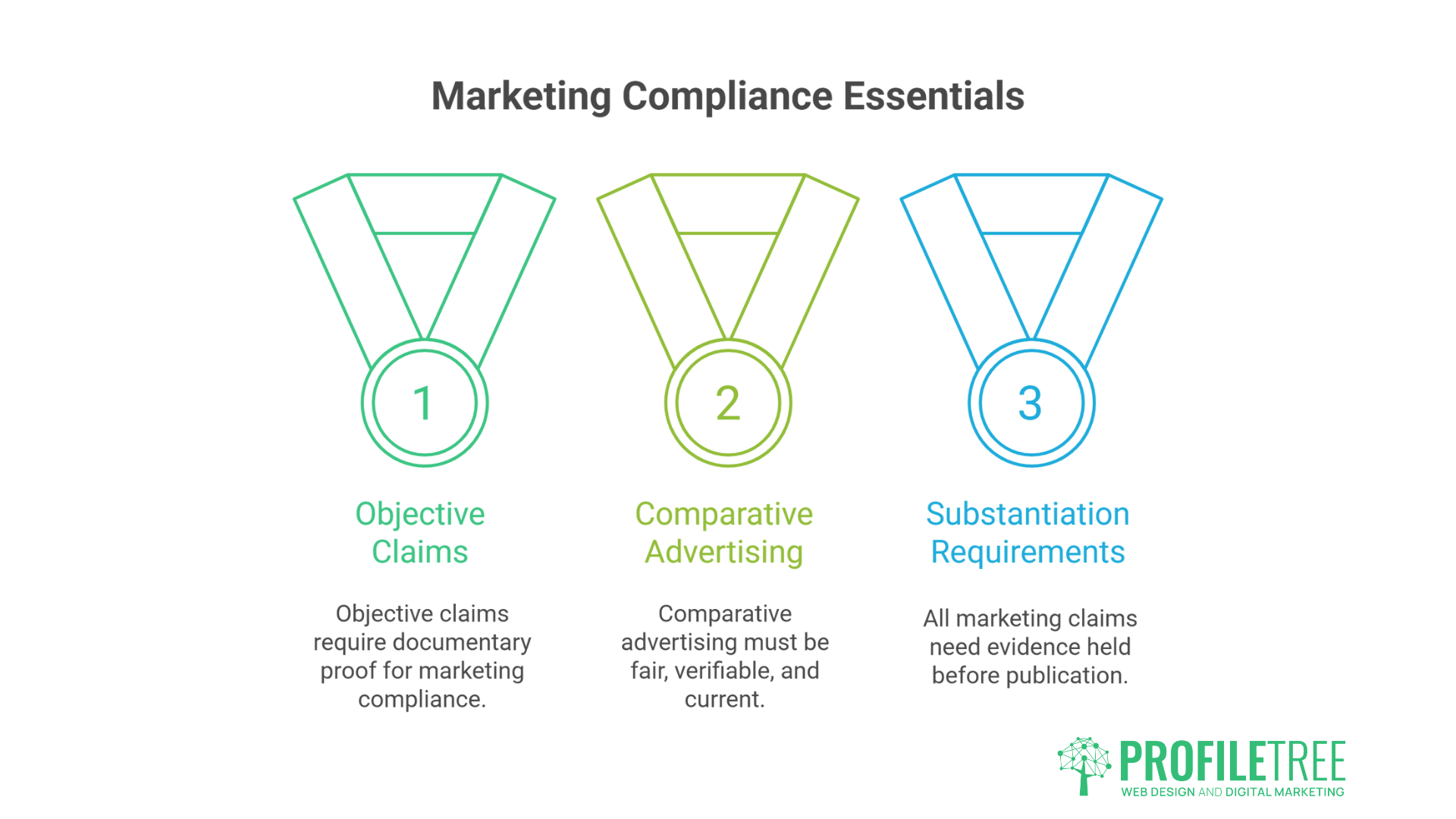
All marketing claims require evidence held before publication to meet compliance standards.
Objective claims need documentary proof for marketing compliance. A web design agency stating ‘websites rank 50% higher’ must hold data supporting this figure. An accounting firm claiming ‘save 30% on taxes’ needs records showing clients achieved these savings.
Comparative advertising carries strict compliance rules. Comparisons must be fair, verifiable, and compare like with like. A Belfast retailer advertising ‘cheaper than Tesco’ must prove this across comparable product ranges, not cherry-picked items. Comparisons must remain current – claims based on last year’s prices breach compliance codes.
Environmental claims face particular marketing compliance scrutiny. The ASA published guidance in 2023 warning against vague terms like ‘eco-friendly’ or ‘green’ without specific supporting evidence. Claims about carbon neutrality require clear information about what this covers and how it’s achieved.
Testimonials and reviews must be genuine to maintain marketing compliance. The CMA’s 2021 enforcement action against fake reviews established clear standards. Businesses cannot pay for reviews without disclosure, incentivise only positive reviews, or suppress negative feedback. Review platforms must take reasonable steps to detect fake reviews.
Digital Compliance Requirements
Online marketing faces specific compliance requirements beyond general advertising codes.
Website Marketing Compliance
Business websites must meet marketing compliance standards when making promotional claims.
Pricing displays require transparency for compliance. The stated price must be the total consumers pay, including VAT and unavoidable charges. Additional optional costs can be shown separately but must be clearly labelled as optional. A web hosting company advertising ‘£5 monthly’ must include that this covers all mandatory costs to get a working website.
Terms and conditions must be accessible before purchase to maintain marketing compliance. Important restrictions or limitations cannot hide in lengthy terms. If an offer only applies to new customers, this fact must appear prominently in the marketing message itself, not just in terms.
Stock availability claims need accuracy for marketing compliance. Advertising products as ‘in stock’ when items are consistently unavailable breaches codes. Limited stock claims like ‘only 3 left’ must be genuine, not manufactured urgency tactics.
Email Compliance
Email campaigns must follow both advertising codes and privacy regulations for full marketing compliance.
The Privacy and Electronic Communications Regulations (PECR) form part of email marketing compliance requirements. Businesses must obtain explicit opt-in consent and provide clear unsubscribe options. Pre-ticked boxes do not constitute valid consent under compliance regulations.
Subject lines must not mislead to maintain email marketing compliance. An email with the subject ‘Your order has shipped’ when actually promoting products breaches rules. Subject lines claiming ‘Final notice’ or ‘Urgent action required’ for marketing purposes misrepresent content and violate compliance standards.
Commercial intent must be clear for marketing compliance. Marketing emails must be obviously identifiable as marketing, not disguised as personal correspondence or service messages. The sender identity must be clear and accurate.
ProfileTree’s content marketing services include email strategy development that balances promotional effectiveness with marketing compliance requirements. We help SMBs build permission-based email programmes that respect subscriber preferences whilst driving business results.
Social Media Compliance
Social media posts with commercial intent must follow advertising codes to maintain marketing compliance.
Influencer marketing requires clear disclosure for compliance. When businesses pay influencers or provide free products for coverage, this relationship must be disclosed. The ASA guidance states disclosure must be upfront, unambiguous, and unavoidable. Hashtags like #ad, #sponsored, or #gifted must appear at the start of posts where followers will see them immediately to maintain marketing compliance.
Business owners promoting their own products must make commercial intent clear for marketing compliance. A bakery owner posting about their new cake range must make clear they own the business. Simply including a business name in the bio does not suffice for compliance – each post needs context.
Time-limited offers on social media need accuracy to meet marketing compliance standards. A Facebook post advertising a ’24-hour sale’ must honour this timeframe. Instagram stories claiming ‘ends tonight’ must genuinely end that evening. Repeatedly running the same ‘limited time’ offer undermines credibility and may breach compliance codes.
Ciaran Connolly, Director of ProfileTree, notes: “Marketing compliance extends to all your social media activity. Many SMBs don’t realise their social posts count as advertising. The same compliance rules that apply to print ads or TV commercials apply to Instagram posts and Facebook updates when you’re promoting your business.”
Sector-Specific Marketing Compliance Requirements
Some industries face additional marketing compliance regulations beyond general advertising codes.
Food and Health Claims Compliance
Food businesses must comply with specific regulations on health and nutrition claims.
The UK maintains a register of permitted health claims for food marketing compliance. Only approved claims can be used. A juice brand cannot claim its product ‘boosts the immune system’ unless the specific claim appears on the register with supporting evidence. General health claims need accompanying approved specific claims to maintain compliance.
Nutrition claims follow strict definitions for compliance. Terms like ‘low fat’, ‘high fibre’, or ‘source of protein’ have specific meanings defined in regulation. Products must meet exact thresholds to use these terms in compliance with rules. A breakfast cereal claiming ‘high protein’ must contain at least 12g of protein per 100g.
Implied health claims face the same marketing compliance scrutiny as explicit ones. Images suggesting health benefits (like a heart symbol) or names implying health effects count as claims requiring substantiation. A supplement called ‘Joint Care’ makes an implied claim about joint health, requiring evidence for compliance.
Financial Services Marketing Compliance
Financial promotions face strict marketing compliance oversight from the Financial Conduct Authority.
Risk warnings must be prominent and clear for financial marketing compliance. Marketing for investment products must include appropriate warnings about value fluctuations and capital risk. The prominence of risk warnings must match the prominence of potential benefits to maintain compliance.
Interest rate claims need context for marketing compliance. Advertising an interest rate must specify whether it’s fixed or variable, what terms apply, and any conditions for receiving the advertised rate. A savings account advertised at ‘5% interest’ must clarify if this requires minimum deposits or fixed terms to remain compliant.
Representative examples serve as mandatory disclosures for credit advertising compliance. When advertising credit, at least 51% of customers must be likely to receive the representative rate shown. The representative example must include interest rate, total amount payable, and monthly payments.
Implementing Marketing Compliance Processes
Systematic approaches to marketing compliance reduce risk and streamline advertising approval.
Creating a Compliance Review Checklist
Standard checklists help catch common marketing compliance issues before publication.
Claims verification should be the first marketing compliance check. List every claim in the marketing piece. Confirm written evidence exists for each claim. Check evidence dates remain current – studies from 2018 may no longer support current claims in fast-moving sectors.
Disclosure adequacy needs checking for marketing compliance. Identify any conditions, limitations, or qualifications that apply. Verify these appear prominently, not hidden in small print or separate pages. Check that qualifications appear close to the claims they modify.
Pricing transparency requires review for marketing compliance. Confirm that stated prices include all mandatory costs. Check that any excluded costs are clearly optional. Verify sale prices have genuine comparative prices – previous selling prices must have been genuine prices at which products sold for reasonable periods.
Target audience appropriateness matters for marketing compliance. Consider whether content could appeal to minors when inappropriate, offend particular groups, or target vulnerable consumers unfairly. Check imagery, language, and placement to suit the intended audience.
Documentation and Record Keeping for Marketing Compliance
Proper records protect businesses if marketing compliance claims face a challenge.
Maintain substantiation files for all marketing claims to support compliance. These should include the source data, date obtained, methodology if research-based, and notes explaining how the data support the specific claim made. Keep these records for at least the duration the campaign runs, plus six months.
Document approval processes for marketing compliance. Record who reviewed marketing materials, what checks were completed, and what changes were made. This demonstrates due diligence if compliance issues arise. Simple approval logs showing date, reviewer, and approval status suffice for small businesses.
Archive marketing materials with their supporting evidence for compliance purposes. When campaigns end, keep copies of the actual advertisements alongside their substantiation. This allows verification of marketing compliance if complaints emerge months after publication.
Training Staff on Marketing Compliance
Everyone creating or approving marketing content needs a compliance understanding.
Start with core compliance principles training. Staff should understand the legal, decent, honest, truthful framework and why it matters. Use examples from your industry showing compliant versus non-compliant approaches. Real ASA rulings provide concrete learning opportunities about marketing compliance.
Cover channel-specific compliance requirements. Social media managers need different compliance knowledge than email marketers. Website content creators need different guidance than those writing print advertisements. Tailor training to the actual work people do.
Create accessible reference materials for marketing compliance. Quick guides showing dos and don’ts for common situations help staff make correct decisions. Templates with built-in compliance checks reduce errors. Reference documents listing forbidden claims in your sector prevent mistakes.
Responding to Marketing Compliance Complaints
Quick, appropriate responses to marketing compliance concerns limit damage.
ASA Compliance Complaint Process
Understanding the ASA investigation process helps businesses respond effectively to compliance issues.
When the ASA receives a compliance complaint about your advertising, they will assess whether it falls under the codes and requires investigation. If they proceed, you will receive a complaint notification letter outlining the concerns and requesting a response.
Response deadlines are strict for marketing compliance investigations – typically five working days for initial responses. Missing deadlines creates negative impressions. Even if you need time to gather evidence, acknowledge receipt and provide a substantive response within the deadline.
Your response should address each marketing compliance point raised. Provide clear evidence for claims under challenge. Explain your reasoning for the decisions made during campaign creation. Avoid defensive language – focus on facts and evidence regarding compliance.
If the ASA finds against you, its marketing compliance ruling becomes public. Businesses must remove or amend non-compliant advertising and avoid similar problems in future campaigns. Failure to comply can lead to sanctions, including referral to Trading Standards or advertising bans.
Immediate Actions When Marketing Compliance Issues Arise
Swift action limits reputational and regulatory impact from marketing compliance problems.
Pause the campaign immediately if you identify compliance problems. The cost of stopping a campaign is less than the cost of continuing non-compliant marketing. Digital campaigns can be paused within minutes. Print or broadcast may have longer lead times, but should still be stopped where possible.
Assess the scope of the compliance problem. Determine whether the issue affects one campaign or multiple materials. Check if the same claim appears in other active marketing. Review whether the problem stems from a single error or indicates systematic compliance gaps requiring broader fixes.
Document what went wrong and why for marketing compliance records. This internal review helps prevent repeat problems and demonstrates good faith if regulators investigate. Note any process failures that allowed the problem through approval, gaps in compliance knowledge that contributed, or external factors that caused the issue.
Communicate appropriately with affected parties regarding marketing compliance issues. If customers made decisions based on incorrect information, consider how to address this fairly. Proactive correction of errors demonstrates good faith and may prevent complaints escalating to regulators.
Common Marketing Compliance Mistakes
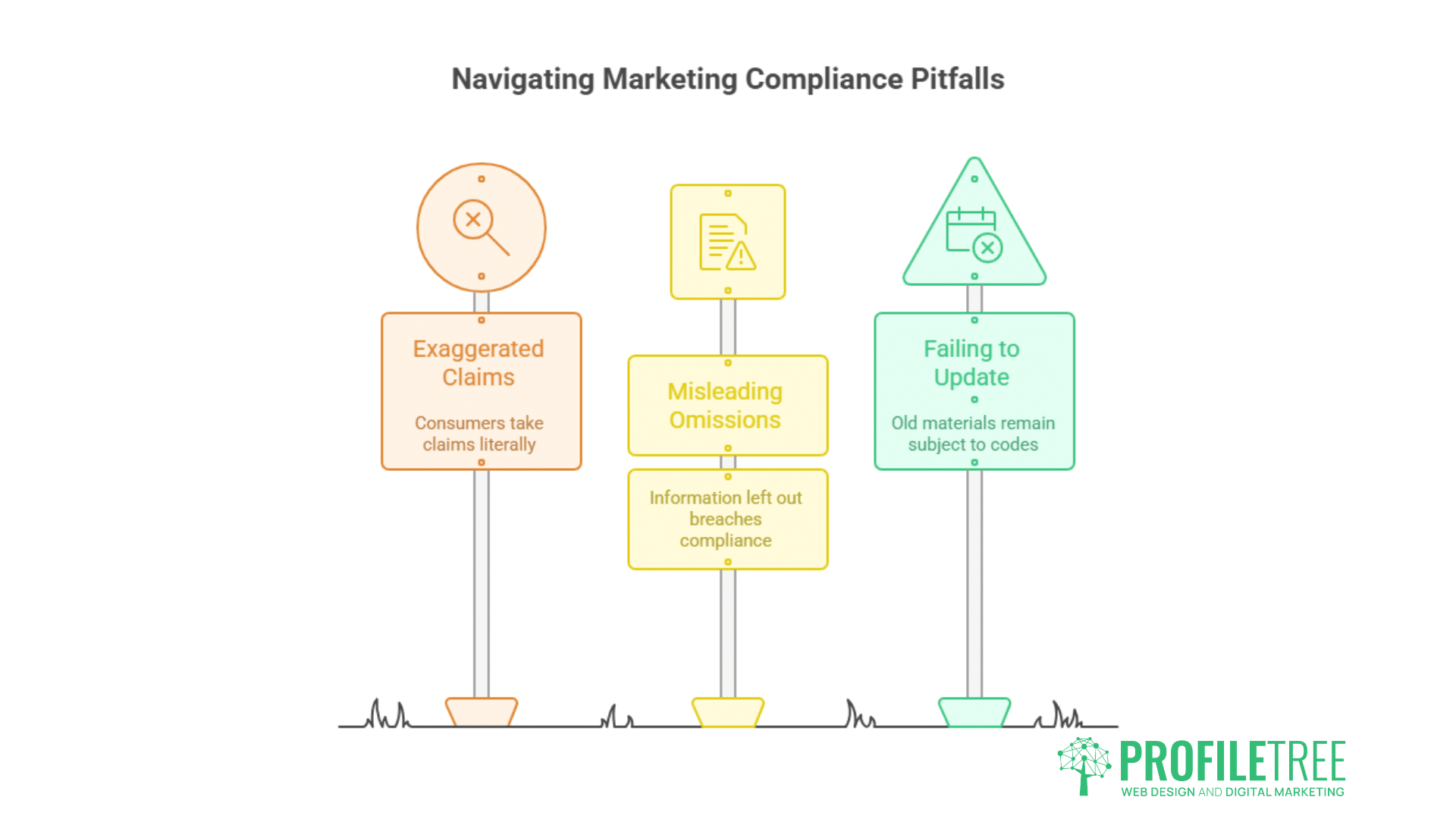
Recognising frequent compliance errors helps businesses avoid them.
Exaggerated or Unsubstantiated Claims
Hyperbole crosses into marketing compliance violations when consumers could take claims literally.
‘Best’ claims require robust evidence for marketing compliance. Advertising your product as ‘best in class’ or ‘number one choice’ needs objective verification. Consumer surveys, independent testing, or sales data may support these claims for compliance, but opinions alone do not suffice.
Percentage improvements need accurate baselines for marketing compliance. Claiming ‘50% more effective’ requires clear reference points. More effective than what? Measured how? Based on which study? Vague comparative claims without context breach compliance codes.
Scientific-sounding language without evidence causes marketing compliance problems. Terms like ‘clinically proven’, ‘scientifically tested’, or ‘laboratory verified’ create expectations of robust evidence. Marketing using these terms must hold appropriate scientific substantiation for compliance.
Misleading Omissions in Marketing Compliance
Information left out can breach marketing compliance as much as false claims.
Free trial offers without clear termination terms violate compliance. Marketing must explain how to cancel, what happens after the trial, and whether payment information is required upfront. Burying this in terms and conditions whilst prominently advertising ‘free trial’ breaches compliance requirements.
Savings claims need context about previous prices for compliance. Advertising ‘40% off’ requires the previous price to have been genuine. Products put on sale immediately after launch at inflated prices breach compliance codes. Previous prices must have been available for meaningful periods.
Service limitations need upfront disclosure for marketing compliance. A broadband package advertised at specific speeds must explain if speeds vary by location, time of day, or network congestion. Mobile phone plans advertising ‘unlimited data’ must disclose any fair use policies or speed restrictions to maintain compliance.
Failing to Update Historic Content for Compliance
Old marketing materials remain subject to compliance codes whilst publicly accessible.
Website content requires regular review for compliance. Pages created years ago may contain claims no longer supportable or describe products no longer available. Outdated testimonials, expired awards, or superseded industry statistics all create compliance risk.
Social media posts persist indefinitely and remain subject to marketing compliance. A Facebook post from 2022 advertising discontinued products or outdated offers remains subject to codes. Businesses should audit old social content and delete or update non-compliant posts.
Video content on YouTube or company websites needs periodic checks for marketing compliance. Product claims in videos must remain accurate and substantiated. Videos showing old prices, discontinued features, or outdated information should be updated or removed to maintain compliance.
Professional Marketing Compliance Support
Expert guidance helps businesses navigate complex marketing compliance requirements.
ProfileTree’s digital strategy services include marketing compliance reviews as part of campaign development. We help SMBs identify regulatory risks before campaigns launch and develop processes that build compliance into regular workflows rather than treating it as an afterthought.
Our approach integrates compliance with creative effectiveness. Marketing that cannot be published wastes resources. We work with businesses across Northern Ireland, Ireland, and the UK to create campaigns that achieve business goals within regulatory boundaries.
Through digital training, we build internal capability so teams can handle routine marketing compliance decisions independently. This approach scales better than checking every marketing piece externally, whilst providing expert support for complex situations.
We also help businesses respond to ASA complaints and marketing compliance investigations when they arise. Early, appropriate responses often resolve issues with minimal business impact. Our experience with regulatory processes helps businesses navigate investigations effectively.
Conclusion
Marketing compliance protects businesses from regulatory penalties, wasted campaign costs, and reputational damage. UK regulations require honest, substantiated marketing with clear disclosure of limitations and conditions. These marketing compliance requirements apply across all channels, from websites to social media posts.
Small businesses without legal teams can implement effective compliance through systematic processes. Standard review checklists, proper documentation, and staff training catch most compliance issues before publication. Understanding core principles – legal, decent, honest, truthful – guides decisions when specific rules are unclear.
ProfileTree helps SMBs across Northern Ireland, Ireland, and the UK develop marketing compliance strategies through our digital strategy and digital training services. Our content marketing team creates promotional materials that meet regulatory standards while driving results. Our social media marketing services manage compliant campaigns across all platforms, while our SEO services implement optimisation techniques that adhere to advertising codes.
For businesses requiring compliant websites, our website design and development teams build platforms with transparency built into pricing displays, terms disclosure, and promotional claims. Our video marketing service produces content that maintains accuracy and substantiation throughout its lifecycle. Through our AI training programmes, we help businesses implement marketing automation tools responsibly.
Whether you need digital training to build internal capability or ongoing support from our digital strategy team for complex campaigns, we provide practical guidance that protects your business whilst achieving marketing objectives.