
AI E-commerce Search: A Guide to Dominating Online Retail Search
Table of Contents
Your competitors are using AI to steal your customers while you’re still manually updating product descriptions. The e-commerce landscape has fundamentally shifted – AI now powers everything from product discovery to personalised search results, and businesses clinging to traditional SEO watch their traffic evaporate. Amazon uses AI to predict what customers want before they search. Google Shopping algorithms learn from billions of interactions to surface products. This guide reveals how to harness AI e-commerce search dominance, automate optimisation at scale, and capture customers your competitors don’t even know exist.
The Revolution of AI E-commerce Search
E-commerce search behaviour has transformed beyond recognition. Customers no longer type “blue dress size 12” – they upload photos asking for “something similar but more formal” or voice search for “that jacket worn in last night’s Belfast Telegraph fashion spread.” Visual search grew 300% year-over-year. Voice commerce will reach £40 billion by 2025. Traditional keyword optimisation becomes irrelevant when customers don’t use keywords anymore.
The sophistication gap between AI-powered retailers and traditional shops widens daily. While you manually write product descriptions, AI-enabled competitors generate thousands of optimised variations instantly. They test headlines automatically, adjust pricing dynamically, and personalise every visitor’s experience. A Shopify store using basic AI tools can now outperform established retailers with massive SEO teams. The democratisation of AI means size no longer determines success – adaptation does.
Northern Ireland e-commerce faces unique challenges and opportunities. Local retailers competing globally need every advantage available. Belfast boutiques selling internationally can’t match Amazon’s resources but can outmanoeuvre them with smart AI implementation. The same tools powering giant retailers are accessible to shops on Royal Avenue or online stores shipping from Lisburn. Geographic disadvantage becomes irrelevant when AI levels the playing field.
Machine learning algorithms now determine product visibility more than traditional ranking factors. Google’s Product Search Graph understands relationships between products, brands, and attributes. When someone searches for “sustainable trainers,” the algorithm considers manufacturing processes, materials, and brand values – not just keyword matches. Products optimised for semantic understanding outrank those targeting exact phrases.
Platform-specific AI creates multiple optimisation requirements. Google Shopping uses different signals than Amazon A9. Pinterest Lens prioritises visual elements. TikTok Shop’s algorithm values engagement over relevance. Each platform’s AI requires distinct optimisation strategies. Success demands understanding how each algorithm thinks, not just following generic best practices.
Understanding AI-Powered Product Discovery
AI-powered product discovery goes beyond simple search by predicting what users want before they ask.
It leverages behaviour patterns, context, and personalisation to surface the most relevant products.
For businesses, this means optimising not just for queries, but for intent and emerging customer needs.
How Modern Shopping Algorithms Actually Work
Google’s Shopping Graph represents the biggest shift in e-commerce search history. Instead of matching keywords to products, it builds knowledge networks connecting products, attributes, reviews, prices, and availability. Your product doesn’t just need keywords – it needs comprehensive entity definition within this graph. A “red wool coat” must be understood as winterwear, sustainable fashion, British manufacturing, and dozens of other conceptual connections.
Amazon’s A9 algorithm evolved from keyword matching to intent prediction. It analyses click-through rates, conversion rates, cart additions, and countless behavioural signals. But here’s what most sellers miss: A9 also considers future behaviour probability. It learns that customers who buy organic skincare often purchase reusable bottles later, adjusting search results accordingly. Your products need optimisation for current searches and future journey positioning.
Visual search algorithms process images through convolutional neural networks, identifying products without any text. Google Lens, Pinterest Lens, and Amazon StyleSnap extract colours, patterns, styles, and shapes. They match visual features to product catalogues, surfacing items based on appearance rather than description. Traditional SEO becomes useless when customers search with cameras instead of keyboards.
Voice commerce algorithms handle natural language queries requiring contextual understanding. “Alexa, order more of that coffee I liked” requires the system to identify previous purchases, understand preferences, and select appropriate products. Optimising for voice means writing descriptions that answer conversational queries, not targeting specific keywords.
Personalisation layers multiply complexity exponentially. The same search returns different results for different users based on history, preferences, location, and predicted intent. Your product might rank first for one user and not appear for another searching identically. This personalisation makes traditional ranking tracking obsolete while demanding sophisticated optimisation strategies.
The Attribution and Discovery Revolution
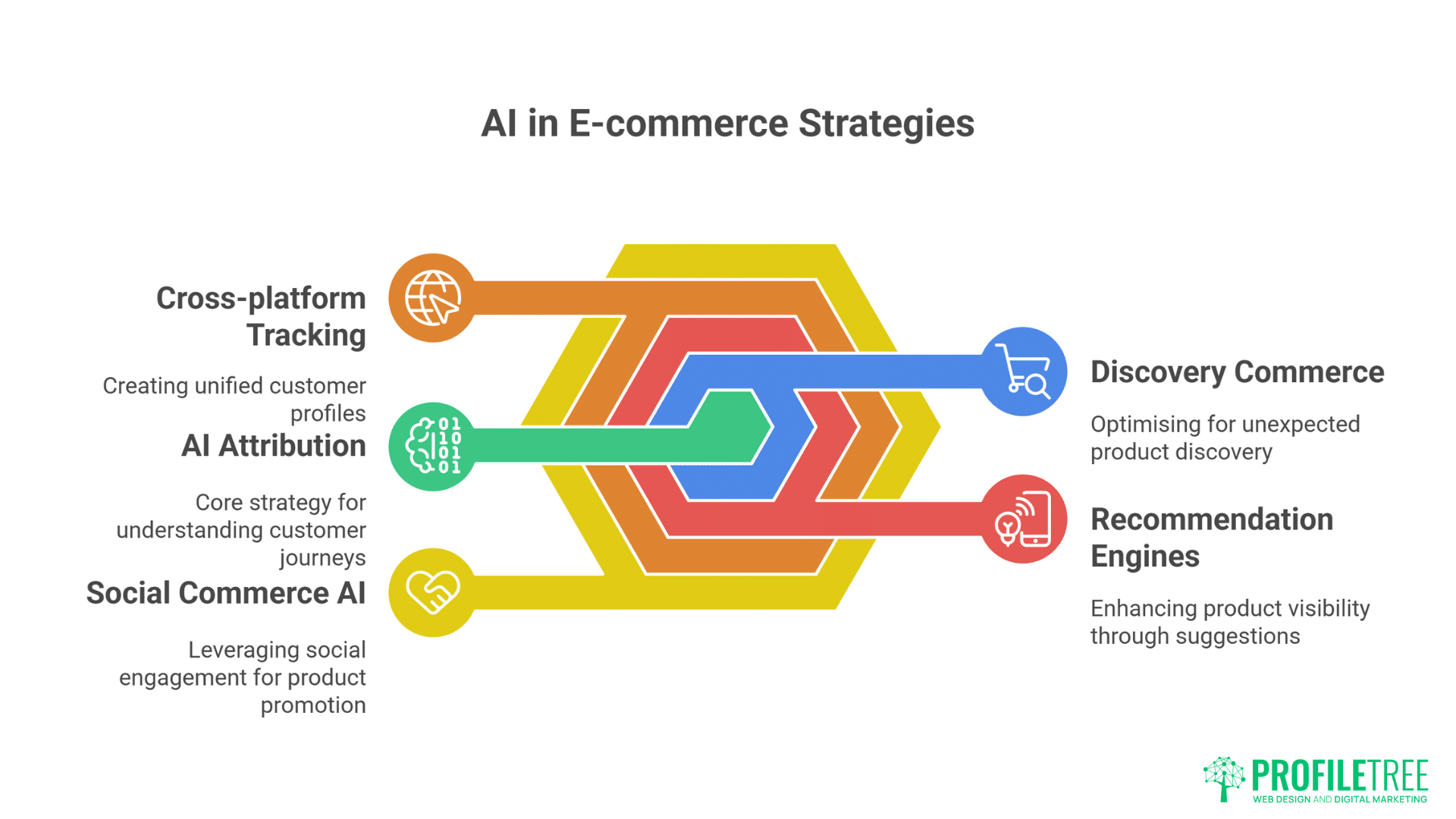
Multi-touch attribution powered by AI reveals complex purchase journeys. Customers might discover products through Instagram, research on Google, compare on Amazon, then purchase directly from your site. AI attribution models assign value across touchpoints, revealing which channels drive discovery versus conversion. Understanding these patterns guides optimisation investment.
Discovery commerce represents e-commerce’s fastest-growing segment. Platforms like TikTok Shop and Instagram Shopping surface products users didn’t know they wanted. AI analyses behaviour patterns to predict interest before explicit searches occur. Optimising for discovery requires different strategies than search optimisation – you’re targeting subconscious desires rather than conscious needs.
Recommendation engines drive 35% of Amazon revenue and 75% of Netflix viewing. E-commerce recommendation AI has become equally sophisticated. Collaborative filtering finds products bought by similar customers. Content-based filtering suggests items with similar attributes. Hybrid approaches combine multiple signals for unprecedented accuracy. Your products need optimisation for recommendation inclusion, not just search visibility.
Cross-platform behaviour tracking creates unified customer profiles. Google knows what you searched, YouTube videos you watched, and Gmail receipts you received. This comprehensive understanding influences product visibility across properties. A customer watching Belfast restaurant reviews might see your kitchen gadgets promoted, even without explicit searches.
Social commerce AI analyses engagement patterns to surface products within social feeds. Instagram’s algorithm learns which product posts generate sales versus likes. TikTok identifies viral product potential before trends explode. Optimising for social commerce AI requires understanding platform-specific engagement signals beyond traditional SEO metrics.
AI Tools Transforming E-commerce SEO
AI is reshaping e-commerce SEO by driving smarter analysis, personalisation, and content optimisation.
These advancements streamline discovery, improve customer journeys, and boost overall visibility.
Adopting AI-driven approaches gives retailers a lasting competitive edge in a rapidly evolving market.
Product Description Generation at Scale
Jasper AI and Copy.ai revolutionised product description creation. Feed them product specifications, and they generate hundreds of unique descriptions optimised for different platforms and audiences. But here’s the crucial detail most miss: raw AI output ranks poorly. Successful implementation requires human editing, fact-checking, and brand voice injection. Use AI for scale, humans for quality.
Dynamic description personalisation adjusts copy for individual visitors. AI analyses browsing behaviour, then emphasises relevant product features. Fitness enthusiasts see performance benefits highlighted. Fashion-conscious shoppers see style elements emphasised. Same product, different descriptions, dramatically improved conversion. This personalisation happens invisibly, creating unique experiences for every visitor.
Multilingual optimisation through AI translation extends market reach instantly. Modern AI translates product catalogues maintaining SEO value across languages. But successful international expansion requires more than translation. Cultural adaptation, local keyword research, and market-specific optimisation remain essential. AI accelerates expansion but doesn’t eliminate localisation requirements.
Category page automation creates SEO-rich content without manual writing. AI generates unique category descriptions, buying guides, and comparison content. Fashion retailers use AI to create seasonal trend guides. Electronics stores generate specification comparisons. This automated content captures long-tail searches while maintaining quality. Content marketing services help balance automation with authenticity.
Review summarisation AI extracts key themes from customer feedback. Instead of displaying raw reviews, AI identifies common praise and complaints, creating structured summaries. These summaries improve conversion while providing SEO-rich content. Search engines value this synthesised user-generated content highly, improving rankings across queries.
Image Optimisation and Visual Search Preparation
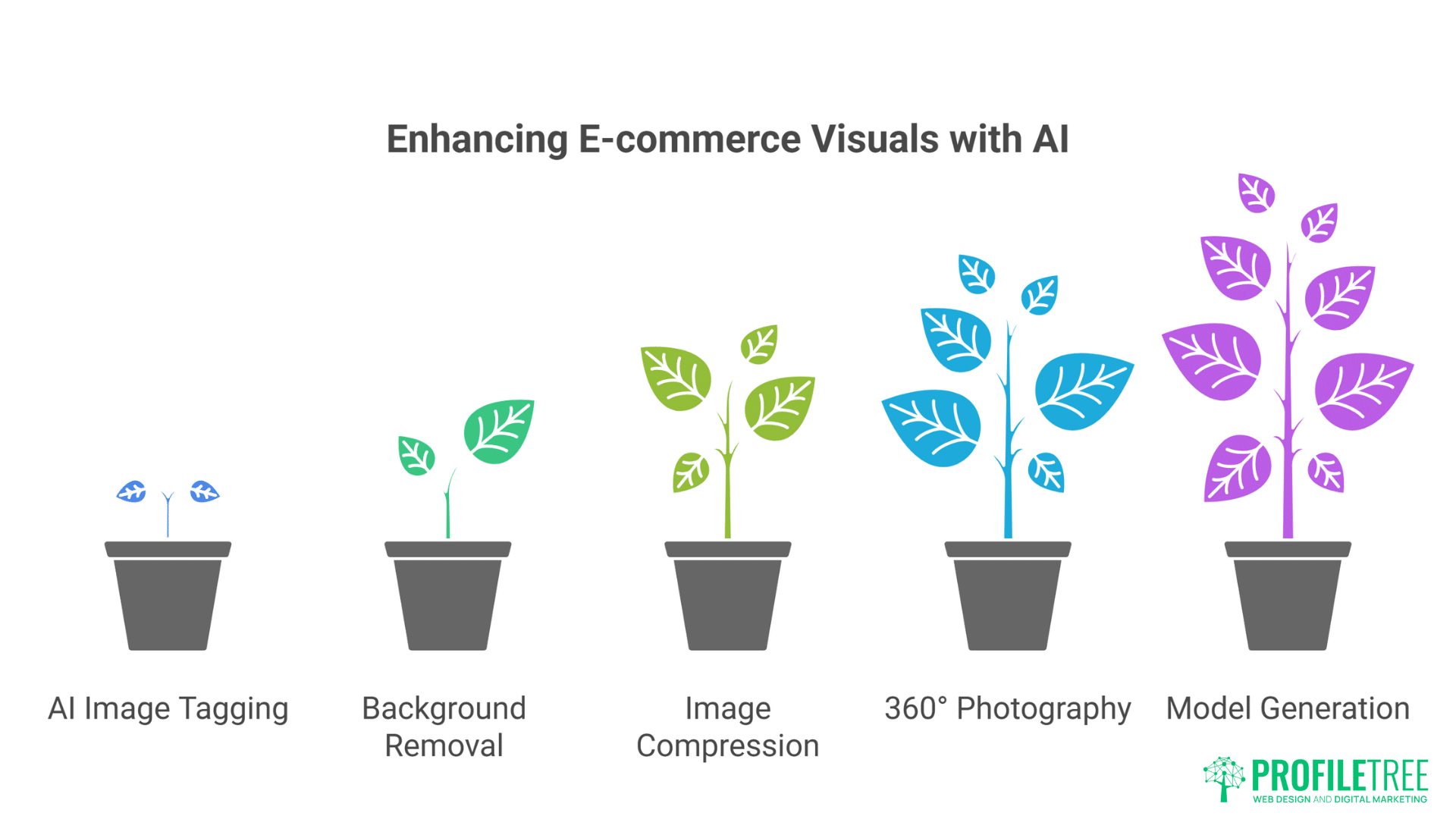
AI-powered image tagging automates alt text generation at scale. Computer vision analyses product images, generating descriptive alt text for accessibility and SEO. But generic AI tagging misses crucial details. Successful implementation combines automated tagging with human refinement, ensuring accuracy while maintaining efficiency.
Background removal and standardisation improves visual consistency. AI tools like Remove.bg process thousands of product images instantly, creating clean backgrounds for better visual search matching. Consistent backgrounds improve Google Shopping performance and marketplace visibility. Visual standardisation becomes competitive necessity, not aesthetic choice.
Image compression algorithms powered by AI maintain quality while reducing file sizes. Tools like TinyPNG use machine learning to optimise compression per image, achieving 70% size reduction without visible quality loss. Faster loading improves Core Web Vitals, directly impacting rankings. Every millisecond matters for mobile e-commerce.
360-degree product photography synthesis creates immersive experiences from standard photos. AI generates rotatable views from limited angles, providing rich product visualisation without expensive photography. These enhanced visuals increase engagement time and reduce returns. Google favours products with comprehensive visual documentation.
Automatic model generation places products in lifestyle contexts. AI composites products into room scenes, on virtual models, or in use-case scenarios. A Belfast furniture store can show sofas in typical Northern Ireland homes without photoshoots. This contextualisation improves conversion and provides unique images for SEO.
Pricing and Inventory Intelligence
Dynamic pricing algorithms adjust prices based on competition, demand, and inventory levels. AI monitors competitor prices across platforms, recommending adjustments maintaining competitiveness while preserving margins. But aggressive automated pricing can trigger race-to-bottom scenarios. Smart implementation sets boundaries preserving brand value.
Stock prediction AI prevents out-of-stock penalties. Machine learning analyses sales patterns, seasonal trends, and external factors to forecast demand. Maintaining availability improves search rankings – Google Shopping penalises frequent stockouts. Accurate prediction ensures visibility while minimising inventory costs.
Competitive intelligence platforms track competitor strategies automatically. Tools like Prisync monitor pricing, promotions, and product launches across competitors. This intelligence informs strategy beyond just matching prices. Understand competitor weaknesses and exploit gaps they’re missing.
Margin optimisation AI balances profitability with competitiveness. Rather than blindly matching lowest prices, AI identifies price points maximising profit while maintaining acceptable conversion rates. Some products can command premiums; others require competitive pricing. AI discovers these patterns through testing.
Bundle recommendation engines identify profitable product combinations. AI analyses purchase patterns to suggest bundles increasing average order value. These bundles create unique SKUs competitors can’t directly match, providing differentiation while improving SEO through unique product pages.
Customer Intelligence and Personalisation
Behavioural analytics AI identifies purchase patterns humans miss. Machine learning processes millions of interactions, discovering non-obvious correlations. Customers who view products in specific sequences convert at higher rates. Those who read reviews before specifications have different preferences. These insights guide optimisation priorities.
Predictive analytics forecast customer lifetime value from initial interactions. AI identifies high-value customers early, enabling differentiated experiences. Premium customers might see exclusive products or receive priority support. This segmentation improves satisfaction while maximising revenue.
Chatbot integration provides 24/7 customer support while gathering intelligence. AI chatbots answer product questions, handle returns, and collect feedback. Every interaction provides data improving product descriptions and identifying content gaps. AI chatbot implementation transforms customer service into SEO intelligence gathering.
Email personalisation engines create individual campaigns for every subscriber. AI analyses purchase history, browsing behaviour, and engagement patterns to craft unique messages. Abandoned cart emails reference specific products viewed. Win-back campaigns acknowledge time since last purchase. This personalisation dramatically improves email ROI.
Social listening AI monitors brand mentions and product discussions across platforms. Understanding customer sentiment and identifying trending topics guides content creation. A spike in “sustainable packaging” mentions triggers content addressing environmental concerns. Real-time market intelligence keeps optimisation relevant.
Platform-Specific AI SEO Strategies
Different platforms surface and prioritise content in unique ways, making tailored AI SEO strategies essential. What works for search-integrated assistants may differ from standalone chatbots or e-commerce engines. Adapting your approach ensures maximum visibility and relevance across every AI-driven channel.
Dominating Google Shopping with AI
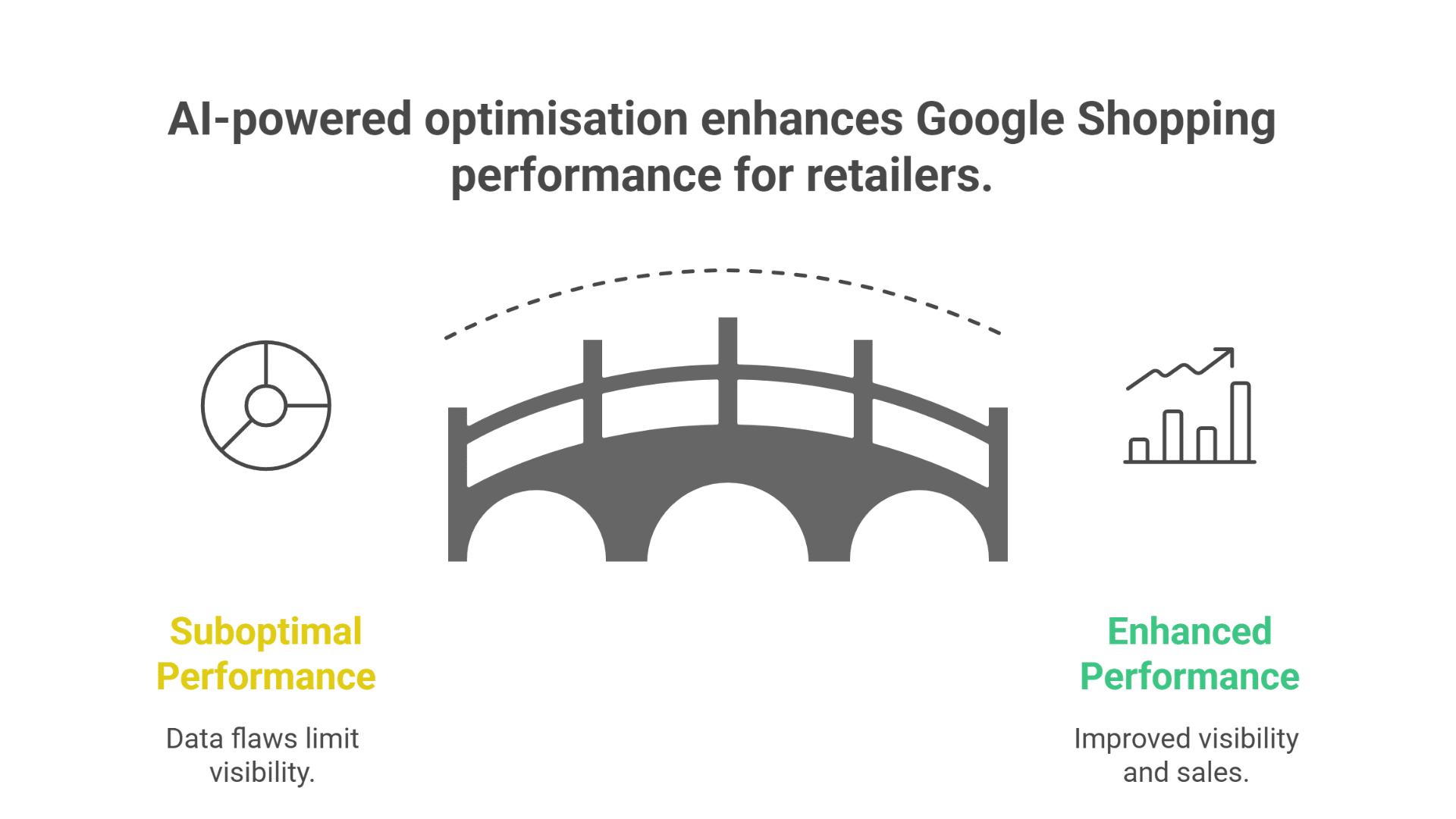
Google Shopping’s free listings revolutionised e-commerce visibility, but competition intensified accordingly. Success requires perfect product data optimisation. AI helps identify and fix data quality issues at scale. Missing GTINs, incorrect categories, and poor descriptions get flagged automatically. Clean data feeds improve impression share and click-through rates.
Shopping campaign automation through Smart Shopping uses machine learning to optimise bids, audiences, and placements. But complete automation sacrifices control. Successful strategies combine AI automation with manual oversight. Let AI handle bidding while maintaining strategic control over product priorities and budget allocation.
Product title optimisation for Shopping requires different approaches than website SEO. Include brand, product type, attributes, and specifications within character limits. AI testing reveals which title formats drive clicks for different product categories. Fashion benefits from style descriptors; electronics need specifications. Systematic testing discovers optimal formats.
Merchant Center optimisation extends beyond basic feed submission. AI tools identify opportunities within Google’s quality scores, promotional capabilities, and programme eligibilities. Automated monitoring alerts to policy violations before suspensions occur. Proactive compliance maintains visibility while competitors face interruptions.
Local inventory ads connect online visibility with physical availability. AI synchronises inventory across channels, ensuring accurate local availability. Belfast retailers can capture “near me” searches by maintaining accurate local inventory. This online-to-offline connection drives foot traffic while improving online visibility.
Amazon Marketplace Domination
Amazon’s A9 algorithm prioritises conversion probability over relevance. AI helps identify which factors drive conversion for specific categories. Some categories respond to price; others to reviews or shipping speed. Understanding category-specific ranking factors guides optimisation investment.
Backend keyword optimisation requires strategic selection from limited space. AI analyses search term reports identifying high-value keywords not in titles or bullets. Automated keyword harvesting from PPC campaigns discovers profitable terms. Strategic backend optimisation captures searches competitors miss.
Enhanced Brand Content (A+ Content) creation benefits from AI assistance. Generate compelling narratives, comparison charts, and lifestyle imagery descriptions. But Amazon’s guidelines require careful compliance. AI accelerates creation while human oversight ensures approval. Rich content improves conversion, indirectly boosting rankings.
Review management through AI sentiment analysis identifies issues requiring response. Automated monitoring flags negative reviews requiring attention. AI-generated response templates maintain consistency while addressing specific concerns. Proactive review management protects ratings essential for visibility.
Sponsored Products automation optimises advertising parallel to organic rankings. AI adjusts bids based on conversion probability, competition, and profitability. Successful campaigns boost organic rankings through increased sales velocity. Advertising and SEO work synergistically when properly coordinated.
Emerging Marketplace Optimisation
TikTok Shop represents e-commerce’s fastest-growing channel. The algorithm prioritises engagement over traditional SEO signals. Products going viral receive massive visibility regardless of optimisation. AI helps identify viral potential through content analysis and trend prediction. Early trend adoption provides first-mover advantages.
Pinterest Shopping combines visual discovery with purchase intent. Rich Pins pull product information automatically from websites. AI-optimised product feeds ensure accurate Pinterest representation. Visual consistency and lifestyle context matter more than keywords. Invest in imagery that inspires rather than just informs.
Instagram Shopping integration requires careful catalogue management. Facebook’s Commerce Manager uses AI to match products with interested users. Proper categorisation and attribute assignment improve matching accuracy. Shoppable posts need optimisation for discovery algorithms, not just aesthetic appeal.
Etsy’s search algorithm values uniqueness and craftsmanship signals. AI helps identify differentiation opportunities within saturated categories. Analyse successful competitors finding gaps in their offerings. Create unique bundles or variations they don’t offer. Differentiation beats optimisation in artisan marketplaces.
eBay’s Cassini search engine uses machine learning for relevance and trust scoring. Product identifiers, shipping options, and seller metrics influence visibility. AI monitors competitor listings identifying optimisation opportunities. Automated repricing maintains competitiveness while preserving margins.
Technical Implementation for E-commerce AI
E-commerce AI runs on clean, structured product data, precise events, and consistent identifiers.
Implement robust schemas (catalogue, reviews, inventory), real-time tracking, and API pipelines to feed models reliably. Secure governance, testing sandboxes, and feedback loops turn AI outputs into measurable conversion gains.
Site Architecture for AI Crawlers
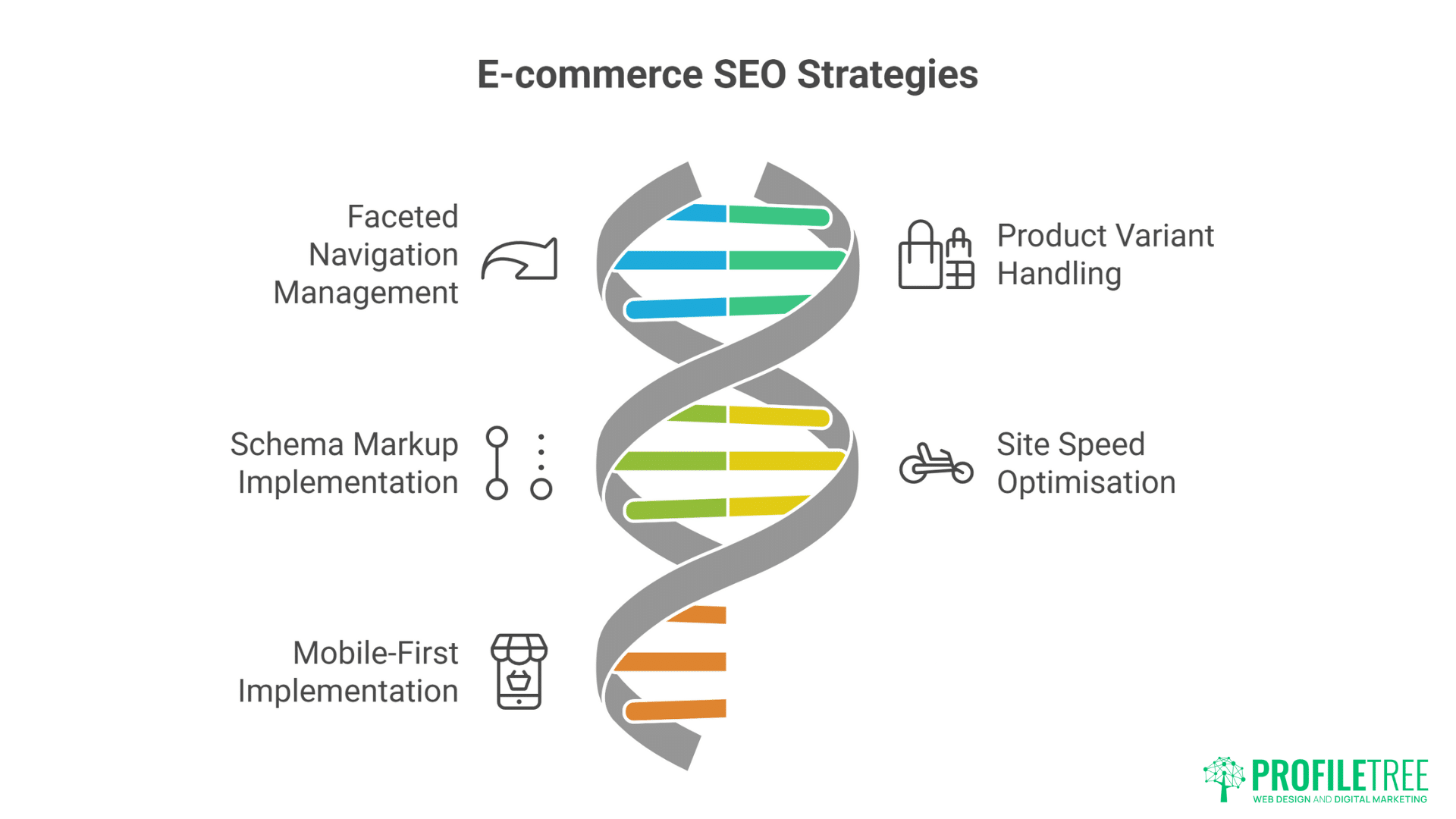
Faceted navigation creates infinite URL variations causing crawl budget waste. AI-powered canonicalisation identifies and consolidates duplicate content automatically. Smart URL parameter handling ensures crawlers focus on valuable pages. Proper architecture prevents dilution while maintaining user functionality.
Product variant handling requires careful technical implementation. Colour and size variations need unique identification without creating duplicate content. AI helps determine when variants deserve separate pages versus consolidated listings. Strategic variant management improves visibility while avoiding penalties.
Schema markup for e-commerce extends beyond basic Product schema. Implement Offer, AggregateRating, Review, and BreadcrumbList schemas. AI validation tools ensure proper implementation across thousands of products. Rich snippets improve click-through rates by 30% when properly implemented.
Site speed optimisation becomes critical as Google emphasises Core Web Vitals. AI-powered performance monitoring identifies bottlenecks automatically. Lazy loading, image optimisation, and code minification happen dynamically. Professional web development ensures technical excellence supporting AI initiatives.
Mobile-first implementation requires more than responsive design. AI analysis reveals mobile-specific user behaviour patterns. Thumb-friendly navigation, accelerated checkout, and progressive web app features improve mobile conversion. Google’s mobile-first indexing makes mobile optimisation mandatory, not optional.
Data Feed Optimisation
Product feed management across multiple channels requires sophisticated orchestration. Each platform has unique requirements – Google wants GTINs, Amazon needs ASINs, Facebook prefers specific image ratios. AI feed management tools transform single product databases into platform-specific feeds automatically.
Attribute enrichment adds missing product information improving visibility. AI analyses product descriptions extracting attributes for structured data. Colour, material, size, and features get identified and properly categorised. Rich attributes improve matching accuracy for specific searches.
Feed validation identifies errors before they impact visibility. AI tools check for policy violations, missing required fields, and data inconsistencies. Proactive error correction prevents disapprovals and ranking penalties. Automated monitoring ensures continuous compliance across platforms.
Dynamic feed updates synchronise inventory and pricing in real-time. API connections update availability instantly preventing overselling. Price changes propagate across channels maintaining consistency. Real-time synchronisation improves customer experience while protecting seller metrics.
Multi-language feed generation expands international reach. AI translation maintains product information accuracy across languages. But successful internationalisation requires local market customisation. Currency conversion, shipping calculations, and tax handling need market-specific configuration.
Analytics and Measurement
Attribution modelling reveals true channel contribution to sales. AI-powered attribution moves beyond last-click, understanding complex customer journeys. Email might initiate interest, social media builds desire, and search captures intent. Understanding attribution guides investment allocation.
Cohort analysis identifies customer quality from different channels. AI tracks customer lifetime value by acquisition source. Some channels deliver one-time buyers; others attract loyal customers. This intelligence guides both acquisition strategy and retention efforts.
Predictive analytics forecast future performance from current indicators. AI identifies early warning signals of ranking drops or conversion declines. Proactive intervention prevents problems before they impact revenue. Predictive maintenance keeps SEO performance stable.
Competitive benchmarking tracks relative performance automatically. AI monitors competitor rankings, pricing, and promotional activity. Understanding competitive dynamics reveals opportunities and threats. Automated alerting ensures rapid response to market changes.
Custom dashboards consolidate metrics from multiple platforms. AI-powered reporting identifies anomalies requiring attention. Automated insights surface opportunities humans might miss. Executive dashboards provide strategic oversight while operational views enable tactical optimisation.
Building AI-Powered E-commerce Workflows
E-commerce AI relies on clean, structured data and a solid technical framework. Strong implementation ensures that systems can interpret, process, and present information effectively. With the right foundation, AI-driven insights translate into improved visibility, engagement, and conversions.
Automation Without Losing Authenticity
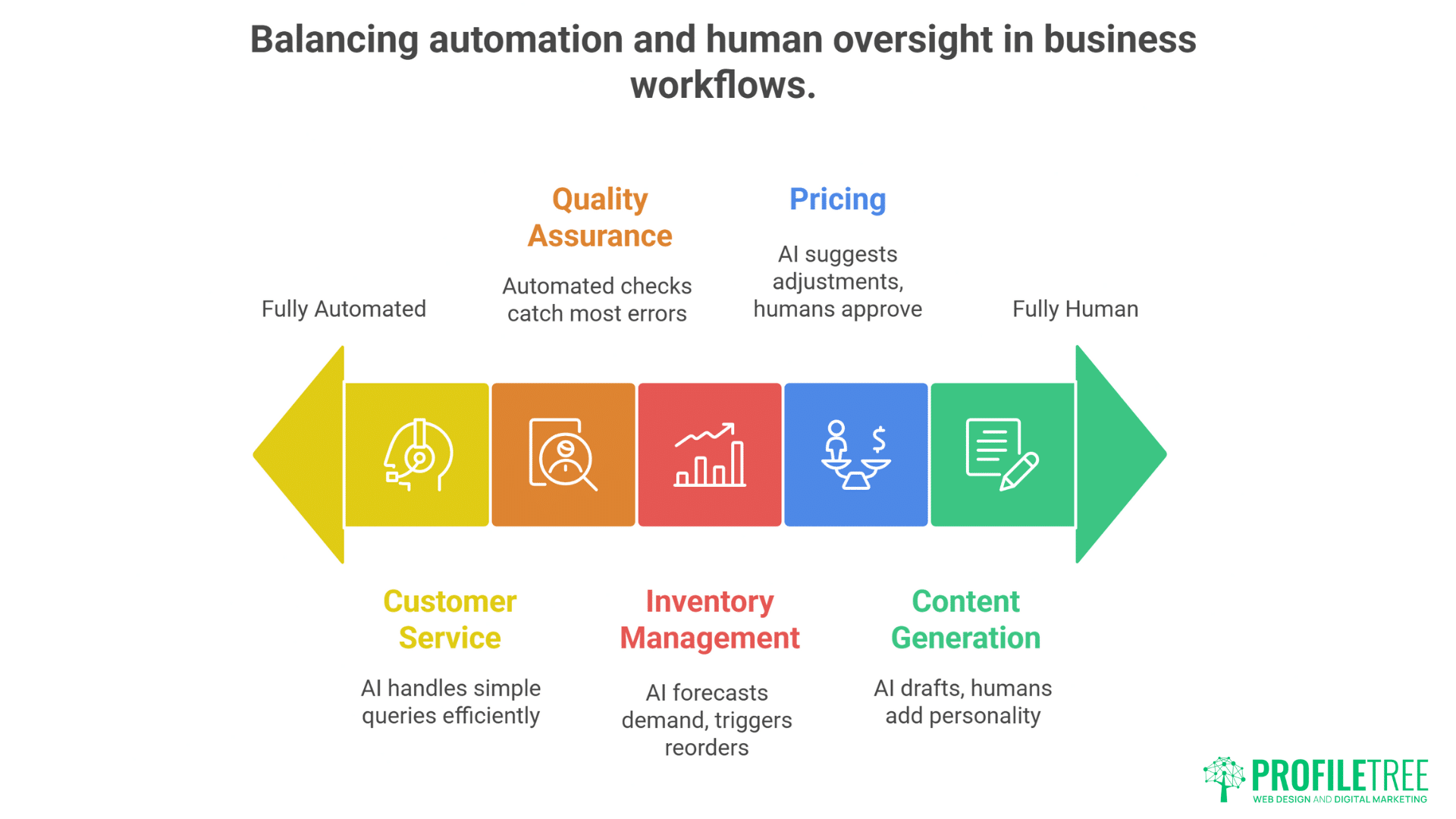
Content generation workflows balance AI efficiency with brand voice. Start with AI-generated drafts, then layer human creativity and expertise. AI handles product specifications and features; humans add personality and storytelling. This hybrid approach maintains authenticity while achieving scale.
Quality assurance automation prevents AI errors reaching customers. Implement checks for factual accuracy, brand compliance, and tone consistency. AI can generate thousands of descriptions, but each needs validation. Automated QA catches most issues; human review handles edge cases.
Customer service automation requires careful boundary setting. AI handles routine queries – shipping times, return policies, size guides. Complex issues escalate to humans. Clear handoff protocols ensure smooth transitions. Customers appreciate quick AI responses for simple questions and human expertise for complex problems.
Inventory management workflows prevent stockouts and overstock. AI forecasts demand, triggers reorders, and adjusts safety stock. But external factors require human judgement. Seasonal events, weather, and local happenings impact Belfast demand differently than Dublin. Combine AI intelligence with local knowledge.
Pricing workflows balance automation with strategy. AI monitors competitors and suggests adjustments. Humans set boundaries and approve changes. Never fully automate pricing – aggressive algorithms can destroy margins chasing unprofitable sales. Maintain strategic control while leveraging AI intelligence.
Scaling Personalisation
Segment creation using AI identifies micro-audiences automatically. Instead of broad categories like “women 25-34,” AI discovers “sustainability-conscious mothers who prefer evening shopping.” These precise segments enable targeted messaging improving relevance and conversion.
Dynamic content assembly creates unique experiences for each visitor. Homepage heroes, product recommendations, and promotional messages adjust per user. AI orchestrates these elements creating cohesive experiences. Personalisation extends beyond product recommendations to entire site experiences.
Email automation scales one-to-one communication. AI crafts individual messages based on behaviour, preferences, and history. Abandoned cart emails reference specific products. Win-back campaigns acknowledge time away. Birthday messages include personalised offers. Scale intimacy through intelligent automation.
Cross-channel orchestration ensures consistent experiences. AI synchronises messaging across email, site, social, and advertising. Customers see coherent narratives regardless of touchpoint. This orchestration requires sophisticated integration but delivers superior results.
Testing infrastructure enables continuous optimisation. AI manages thousands of simultaneous tests across elements. Headlines, images, prices, and layouts get tested continuously. Winners get promoted; losers get replaced. This perpetual optimisation compounds improvements over time.
Team Structure for AI Success
Data literacy becomes mandatory for all team members. Everyone needs basic understanding of AI capabilities and limitations. Marketers must interpret AI insights. Developers need to implement AI requirements. Digital training builds organisational capability supporting AI adoption.
Hybrid roles emerge combining traditional skills with AI expertise. SEO specialists become AI-SEO specialists. Content writers become AI content strategists. These evolved roles command premium salaries but deliver exponential value.
Collaboration tools facilitate human-AI partnership. Platforms that integrate AI suggestions with human workflows accelerate adoption. Clear processes for AI input and human review prevent bottlenecks. Technology enables collaboration rather than replacing humans.
Continuous learning culture adapts to rapid AI evolution. Monthly training sessions explore new tools and techniques. Team members share discoveries and lessons learnt. External training supplements internal knowledge sharing. Investment in learning delivers competitive advantages.
Performance metrics evolve measuring AI-enhanced productivity. Track efficiency gains from AI adoption. Measure quality improvements from AI assistance. Calculate ROI from AI investments. Data-driven assessment guides continued AI expansion.
Common Pitfalls and How to Avoid Them
Many e-commerce AI initiatives stumble due to poor data quality, lack of clear strategy, or over-reliance on automation. These pitfalls can lead to inaccurate insights, missed opportunities, and wasted resources. Avoiding them requires strong governance, ongoing testing, and a focus on aligning AI outputs with business goals.
Over-Automation Disasters
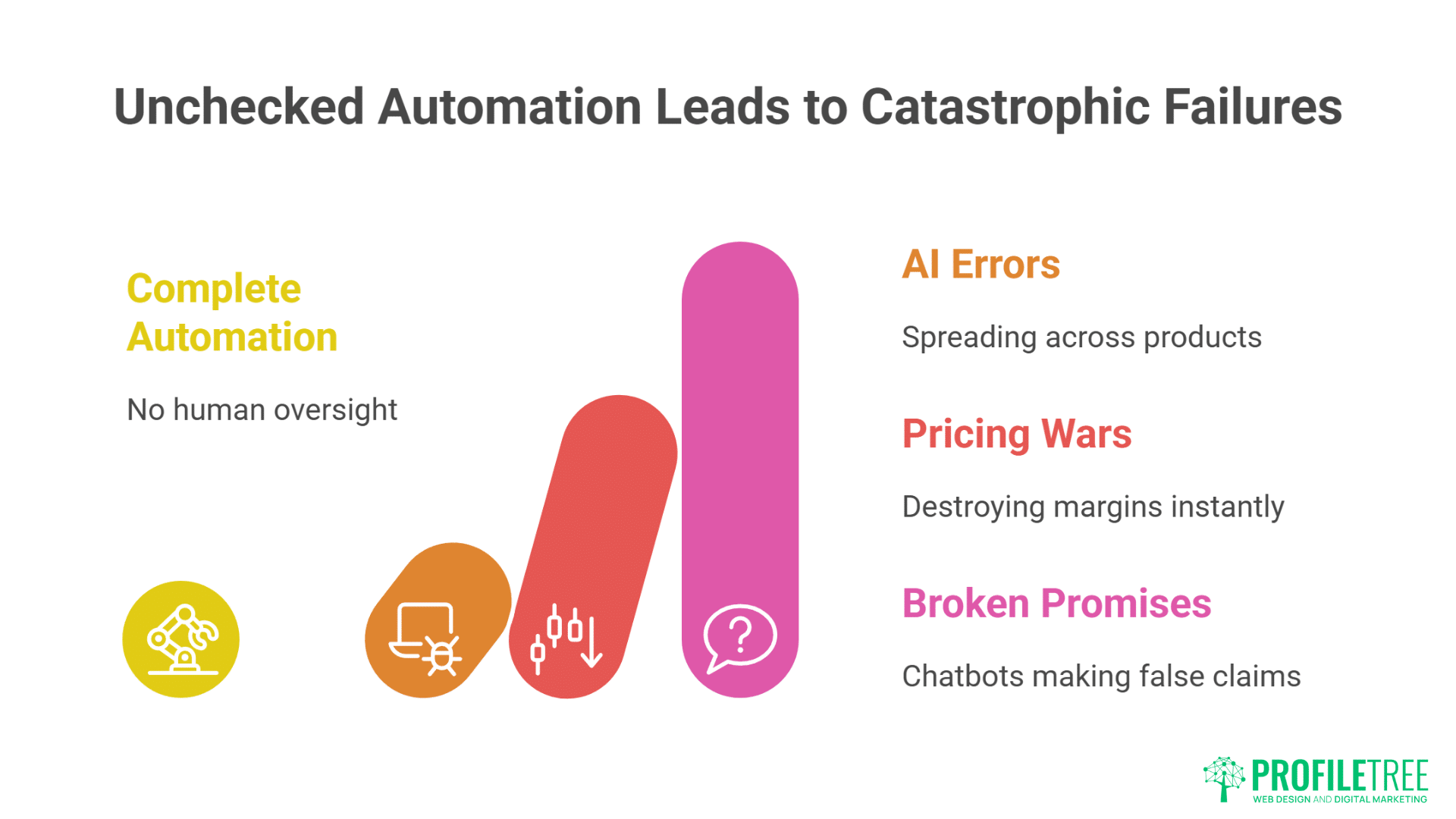
Complete automation without human oversight leads to catastrophic failures. AI-generated descriptions containing errors spread across thousands of products instantly. Automated pricing wars destroy margins before humans notice. Unchecked AI chatbots make promises companies can’t keep. Maintain human circuit breakers preventing runaway automation.
Platform dependency creates vulnerability. Relying entirely on Amazon or Google Shopping risks everything on algorithm changes. Diversify across platforms and maintain direct channels. AI helps manage multi-channel complexity, but don’t let efficiency create dependency.
Data quality degradation undermines AI effectiveness. Garbage in, garbage out applies exponentially to AI systems. Poor product data trains AI incorrectly, compounding errors over time. Invest in data quality before implementing AI. Clean data enables AI success; dirty data guarantees failure.
Customer experience sacrifice for efficiency alienates buyers. Over-automated service feels impersonal. Generic AI responses frustrate customers seeking help. Maintain human touchpoints for complex issues. Efficiency without effectiveness destroys customer relationships.
Technical debt accumulation from rapid implementation creates future problems. Quick AI implementations without proper architecture become unmaintainable. Document implementations, maintain clean code, and plan for updates. Professional development services ensure sustainable AI implementation.
Competitive Blind Spots
Innovation myopia misses emerging opportunities. Focusing on current platforms ignores emerging channels. TikTok Shop seemed irrelevant until it wasn’t. Monitor emerging platforms and experiment early. First-mover advantages in new channels outweigh optimisation in saturated markets.
International expansion overlooked due to complexity. AI makes international selling easier, but many ignore opportunities. Northern Ireland businesses can reach European markets efficiently. Brexit complications don’t eliminate opportunities – they create differentiation for those who navigate successfully.
B2B e-commerce potential ignored by B2C-focused sellers. Business buyers increasingly expect B2C-like experiences. AI personalisation for business buyers delivers huge value. Tailor experiences for procurement professionals, not just consumers.
Subscription commerce opportunities missed by transaction-focused sellers. AI excels at predicting replenishment needs and personalising subscriptions. Transform one-time buyers into subscribers using AI intelligence. Recurring revenue provides stability traditional e-commerce lacks.
Social commerce underestimation costs market share. Younger consumers buy directly through social platforms. AI-optimised social commerce captures audiences avoiding traditional e-commerce. Meet customers where they are rather than forcing channel preferences.
FAQs
How much does AI implementation cost for small e-commerce businesses?
Basic AI tools start from £50 monthly – Jasper for content, Prisync for pricing, Remove.bg for images. Mid-tier solutions cost £200-500 monthly, including comprehensive platforms like Klevu for search or Nosto for personalisation. Enterprise solutions exceed £2,000 monthly but aren’t necessary for most SMEs. Start small, prove ROI, then expand. Many successful implementations begin with free trials and scale based on results.
Will AI replace human e-commerce teams?
AI amplifies human capability rather than replacing it. AI handles repetitive tasks – generating descriptions, adjusting prices, answering basic questions. Humans provide strategy, creativity, and complex problem-solving. Successful e-commerce requires both. Teams using AI outperform those without, but AI alone can’t run e-commerce businesses. Focus on augmentation, not replacement.
Which AI tools are essential versus nice-to-have?
Essential: Product description generation (saves massive time), pricing intelligence (maintains competitiveness), and basic chatbot support (24/7 availability). Nice-to-have initially: Visual search optimisation, advanced personalisation, and predictive analytics. Priority depends on business model – fashion needs visual search sooner than electronics. B2B benefits from account intelligence over personalisation.
How quickly can I expect ROI from AI SEO investments?
Product description AI delivers immediate time savings – hours become minutes. Pricing optimisation impacts revenue within weeks. Chatbots reduce support tickets immediately. Full SEO impact takes 3-6 months as search engines recognise improvements. Personalisation ROI appears within 2-3 months through improved conversion. Track both efficiency gains and revenue impact for complete ROI picture.
Can AI help compete with Amazon and large retailers?
AI levels the playing field significantly. Small retailers can now match Amazon’s personalisation, dynamic pricing, and content scale. Focus on advantages Amazon can’t match – local expertise, curation, personal service. Use AI for efficiency while maintaining authenticity. Many successful e-commerce businesses thrive despite Amazon by combining AI capabilities with unique value propositions.
What are the biggest risks of using AI for e-commerce SEO?
Quality degradation from unchecked AI content ranks first – errors spread quickly across catalogues. Over-automation alienating customers comes second. Platform penalties for AI-generated content remain possible. Data security concerns with AI services handling customer information. Competitive disadvantage if implementation lags competitors. Mitigate through human oversight, gradual implementation, and continuous monitoring.
How do I maintain brand voice while using AI?
Create comprehensive brand guidelines for AI tools including vocabulary, tone, and messaging frameworks. Use AI for initial generation, then edit for voice consistency. Train AI tools on your existing content to learn brand style. Implement approval workflows ensuring brand compliance. Regular audits maintain consistency. AI provides efficiency; humans ensure authenticity.
Transform Your E-commerce with AI Today
The e-commerce AI revolution isn’t coming – it’s here, reshaping how customers discover and buy products. Every day without AI implementation means falling further behind competitors who’ve already adopted these technologies. But the opportunity window remains open for businesses ready to act decisively.
Start with one AI implementation that addresses your biggest pain point. If product descriptions consume days, implement AI generation. If pricing competitiveness suffers, deploy intelligence tools. If customer service overwhelms your team, add chatbot support. Single successful implementation proves value and builds confidence for expansion.
ProfileTree helps e-commerce businesses navigate AI transformation successfully. Our e-commerce development services integrate AI capabilities into existing platforms. Our SEO strategies evolve beyond keywords to embrace AI-driven discovery. Our AI training programmes equip teams with skills for sustained success.
Northern Ireland e-commerce businesses possess unique advantages in the AI revolution. Local expertise, authentic products, and personal service differentiate from faceless global competitors. AI amplifies these advantages rather than replacing them. The combination of human authenticity and AI efficiency creates unbeatable competitive advantage.
The question isn’t whether to adopt AI for e-commerce SEO – it’s how quickly you can implement it effectively. Your competitors are already using AI to capture customers you should be serving. Every product description manually written, every price manually adjusted, every customer question manually answered represents lost opportunity. Take action today. Your e-commerce future depends on decisions you make right now about AI adoption.