
How Social Media Boosts Retail Sales: A Guide for SMEs
Table of Contents
Social media has made it possible for a small retail business in Belfast to reach the same audience a national chain might have spent six figures to access ten years ago. The opportunity is real. But so is the noise, and most retail businesses are not getting much back for the time they put in.
The reason is usually strategy, or the absence of one. Posting product photos and hoping for shares is not a plan. Neither is being active on every platform because a competitor seems to be. The retailers seeing real returns from social media are the ones who have matched platform choice to audience behaviour, aligned their content to where customers are in the buying journey, and built campaigns around measurable outcomes rather than vanity metrics.
“Social media gives retailers a direct line to their customers, but most SMEs underuse it because they treat it as a broadcast channel rather than a sales tool,” says Ciaran Connolly, founder of ProfileTree. “The businesses that see results are the ones thinking about what action they want the customer to take next.”
This guide covers the practical side: how to identify your audience, which platforms work for retail, how to build content that earns trust and drives transactions, and how to measure whether any of it is working.
Why Social Media Matters for Retail Sales
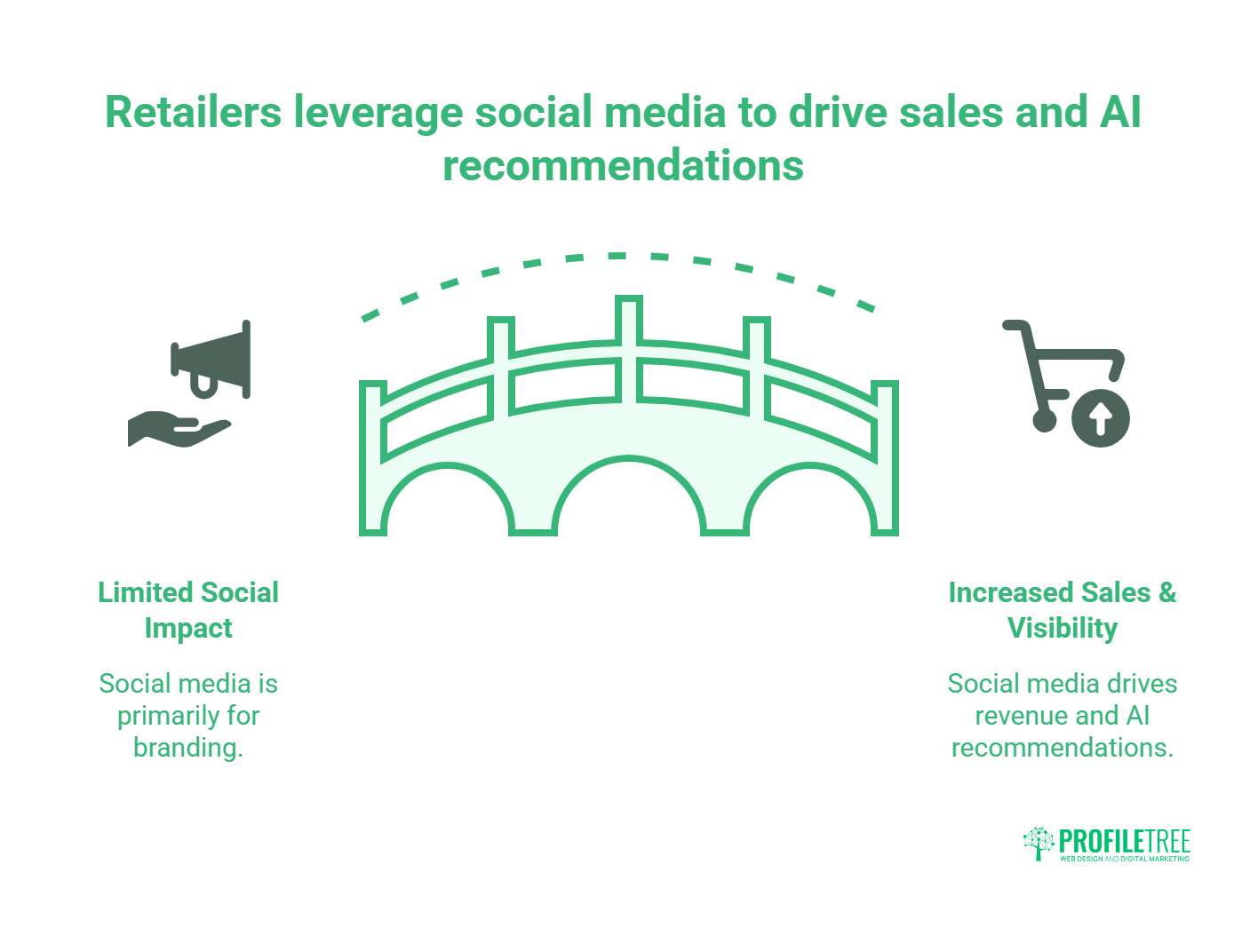
Social media is now embedded in how people discover, evaluate, and buy products. According to a 2024 report by Sprout Social, 68% of consumers have made a purchase directly influenced by a brand’s social media content. That figure rises sharply among 18 to 34-year-olds, where social media is often the first point of contact with a retail brand rather than a search engine or a physical store.
Social media as a sales channel, not just a brand tool
The distinction matters. Brand-building on social media has value, but it is a long-term play. Retailers who need social media to contribute to revenue targets need to think about it as a sales channel with its own funnel: awareness, consideration, intent, and purchase.
That means different content for different stages. A first-time follower seeing a brand for the first time needs a reason to trust it. A customer who has browsed the website twice and followed the account is much closer to buying and needs a different prompt.
How Google and AI systems read your social presence
Social media activity builds entity associations that matter beyond the platform. When AI systems like Google’s Gemini, ChatGPT, or Perplexity are asked to recommend retail businesses, they draw on the web’s accumulated signals about a brand: mentions, links, content, and the associations built up across platforms. A retailer with a consistent, active, and well-named presence across social channels is more likely to appear in AI-generated recommendations than one with a dormant account or inconsistent branding.
This is one of the reasons ProfileTree’s digital marketing services treat social media as part of a broader entity-building strategy rather than a standalone activity.
Knowing Your Retail Audience on Social
Before choosing a platform or writing a single post, retail businesses need a clear picture of who they are trying to reach and where those people actually spend time online.
Demographics and platform behaviour
Age is the most practical starting point. TikTok’s core retail audience skews 18 to 34. Facebook’s most commercially active users are now 35 to 54. Instagram spans both groups but performs differently by category: fashion, beauty, and homeware tend to outperform categories like tools or industrial supplies.
Job title and income level matter for B2C and B2B retail alike. A business selling premium kitchen equipment to hospitality buyers needs a different social strategy from one selling the same products to home cooks. The platforms overlap; the content tone, the call to action, and the proof points are completely different.
Location is often underweighted in social media planning. For Northern Ireland and Irish retailers in particular, audience segmentation by region can meaningfully improve ad performance. A Belfast retailer running a £500 Facebook ad campaign targeting the whole UK is likely wasting most of that budget.
Reading engagement signals
Once an account is active, the data tells you a great deal. Which product posts get saved rather than just liked? Which stories prompt direct messages? Saves and shares are significantly stronger buying signals than likes, because they indicate that a user wants to return to the content or share it with someone they think will buy.
Most retail businesses track follower count and likes. The more useful habit is tracking saves, link clicks, direct messages generated, and, where social commerce is set up, direct revenue attributed to social.
Choosing the Right Platforms
Not every platform deserves equal attention. Spreading effort thinly across five platforms usually produces poor results on all of them. Most retail SMEs are better served by doing two or three platforms well.
Instagram and Facebook for retail
Instagram remains the most effective platform for visually-led retail categories. The shopping features, product tagging, and Stories format give retailers multiple touchpoints within a single session. Facebook’s audience is older and the organic reach has declined significantly, but its advertising infrastructure remains unmatched for granular targeting, particularly for retargeting customers who have already visited a website.
The two platforms share an advertising backend through Meta Ads Manager, which makes running integrated campaigns across both practical and cost-effective.
TikTok’s retail opportunity
TikTok has moved well beyond its early reputation as an entertainment platform. TikTok Shop, launched in the UK in 2023, has seen significant growth, with the platform reporting that over 200,000 UK sellers were active by mid-2024. For retail categories with strong visual or demonstration potential, including fashion, beauty, food, and home goods, TikTok offers reach that Facebook and Instagram cannot match with younger buyers.
The creative requirement is different. Content that feels like a traditional ad performs poorly. Short-form video that feels native to the platform, whether that is an honest product review, a behind-the-scenes look at sourcing, or a before-and-after transformation, tends to outperform polished advertising content.
Pinterest for discovery and intent
Pinterest occupies a specific but valuable role in the retail funnel. Users come to Pinterest with purchase intent, often researching products well before they are ready to buy. For home, fashion, food, and craft retail, Pinterest drives steady discovery traffic that converts later rather than immediately. It is often undervalued because the attribution is harder to trace.
Platform comparison for retail SMEs
| Platform | Best for | Primary audience | Commerce features |
|---|---|---|---|
| Visual products, fashion, beauty, food | 18–44 | Shopping tags, product catalogue | |
| Targeted advertising, local reach | 35–54 | Facebook Shops, Marketplace | |
| TikTok | Video-led categories, younger buyers | 18–34 | TikTok Shop, live shopping |
| Discovery, home, fashion, food | 25–44 (predominantly women) | Product pins, shopping | |
| B2B retail, trade buyers | 25–54 | Limited, but strong for B2B lead gen |
Building a Content Strategy That Sells
A content strategy is not a posting schedule. It is a plan that maps content to customer intent, ensures consistency of message, and gives every piece of content a purpose beyond filling a feed.
Content across the buying journey
- Discovery content introduces your brand to people who do not know it yet. This is top-of-funnel material: short-form video, educational posts, behind-the-scenes content, and posts that answer questions your potential customers are already asking. The goal is trust and familiarity, not immediate sale.
- Consideration content is for people who know your brand but have not committed. Product comparisons, customer reviews, detailed demonstrations, and explainer content all serve this stage. This is where social proof matters most.
- Decision content is what tips someone from interest to purchase. Limited-time offers, social-exclusive discount codes, clear calls to action, and frictionless shopping links belong here. This content works best when it is targeted: retargeting ads, email-aligned social campaigns, and personalised offers to followers who have shown strong intent signals.
Consistency over frequency
Most retail businesses overestimate how often they need to post and underestimate how consistent they need to be. Three high-quality posts per week, every week, with a coherent message, will outperform seven inconsistent posts that cover different topics and do not build on each other.
ProfileTree’s content marketing services work with retail businesses to build editorial frameworks that make consistency achievable without the daily scramble to produce new material.
Video and visual standards
Across every platform, video outperforms static images for reach and engagement. Instagram Reels, TikTok, and Facebook Video all receive preferential distribution. For retail businesses that have not yet invested in video, a smartphone with a ring light and a simple filming protocol for product demos, customer testimonials, and behind-the-scenes content is a practical starting point.
The quality bar for social video is lower than many retailers assume. Authenticity performs better than high production value in most retail categories. A genuine “here is how this product is made” video on a phone typically generates more engagement than a polished brand film.
Social Commerce and Integrated Shopping
Social commerce, the ability to complete a purchase without leaving a social media app, has removed one of the biggest drop-off points in the social retail funnel. Customers no longer need to click through to a website, wait for a page to load, and navigate to a product page. The transaction can happen in the same session as discovery.
Instagram and Facebook Shopping
Meta’s shopping infrastructure allows retailers to build a product catalogue, tag products in posts and Stories, and direct customers to a checkout within the app or to a linked website. Setting this up requires a Facebook Business account, a connected product catalogue, and approval through Meta Commerce Manager.
For retailers with strong web design infrastructure, the transition from social browsing to website checkout can be seamless. ProfileTree’s web design and development services include shopping integrations that ensure the handoff from social platforms to the purchase page does not create friction.
TikTok Shop
TikTok Shop allows retailers to list products directly within the app, run live shopping sessions, and collaborate with creators who can sell directly through their content. For categories where demonstration adds value, live shopping has proved particularly effective: viewers watch a product being used, ask questions in real time, and buy without leaving the session.
Shoppable posts: what actually works
The mistake most retailers make with shoppable posts is tagging every product in every post without thinking about context. A product tag on a post that does not naturally feature that product as the focus creates friction rather than removing it. The posts that convert are the ones where the product is front and centre, the visual is compelling, and the path to purchase is obvious.
Influencer and Creator Partnerships
Influencer marketing has matured significantly since its early years. The days of paying for follower counts are largely gone; the focus has shifted to engagement rates, audience alignment, and authentic content.
Micro-influencers over macro reach
For most retail SMEs, micro-influencers (accounts with 5,000 to 50,000 engaged followers) deliver better returns than large accounts with millions of followers. Engagement rates are typically higher, the audience is more tightly defined, and the cost per placement is manageable for smaller budgets.
The key criterion is not follower count but audience alignment. A Belfast-based food retailer working with a Northern Ireland food blogger with 15,000 highly engaged local followers is likely to see more direct commercial impact than a partnership with a London-based lifestyle influencer with 200,000 followers spread across the UK.
What to ask for in a creator brief
Rather than directing influencers to produce specific content, retail brands tend to get better results when the brief is outcome-focused: “show our product being used in a real setting and explain why you like it” generates more authentic content than “film a 30-second video saying these three things.”
The Federal Trade Commission (FTC) and the UK Advertising Standards Authority (ASA) both require that paid partnerships are disclosed. Every piece of paid influencer content should include a clear “#ad” or “Paid partnership” label. This is a legal requirement, not optional.
Long-term partnerships versus one-off campaigns
One-off posts generate a spike of attention and then disappear. Long-term creator partnerships build genuine associations between a brand and a person’s audience over time. A creator who mentions a retailer across multiple posts over six months creates a cumulative trust signal that a single sponsored post cannot.
Analytics, Social Listening, and Performance Tracking
The most common analytics mistake in retail social media is measuring the wrong things. Reach and follower growth are easy to track and feel significant. Revenue attributed to social, customer acquisition cost from social channels, and retention rates among customers who engage on social are harder to measure but are the numbers that matter.
Setting up proper attribution
For retailers with e-commerce sites, UTM parameters on all social links allow Google Analytics to distinguish which platform, campaign, and post drove a specific purchase. Without UTM parameters, social traffic gets lumped into a broad “referral” or “direct” category that makes it impossible to evaluate what is working.
Setting this up takes less than an hour and changes the quality of every subsequent decision about where to invest social media time and budget.
Key metrics for retail social media
| Metric | What it tells you | Why it matters |
|---|---|---|
| Revenue attributed to social | Direct commercial impact | The most important number |
| Conversion rate from social traffic | Quality of social audience | Higher than average suggests good targeting |
| Cost per acquisition (paid social) | Efficiency of ad spend | Compare against other channels |
| Engagement rate | Content quality and audience fit | Falling rate is an early warning signal |
| Save rate | Purchase intent | Strong signal that content is in the consideration stage |
| Direct messages generated | Intent and customer service load | Track topics to improve FAQ content |
Social listening beyond your own brand
Social listening, monitoring what people say about your brand and your category, is one of the most underused tools in retail social media. Tracking mentions of your brand name, your product category, and your key competitors tells you:
- What language customers use to describe problems your products solve (use this in your content)
- What complaints are recurring (address these before they escalate)
- What questions customers ask before buying (answer these in your content strategy)
Tools like Mention, Brand24, and Sprout Social offer social listening at different price points. Even a free Google Alerts setup for your brand name is better than nothing.
Building Customer Loyalty Through Social
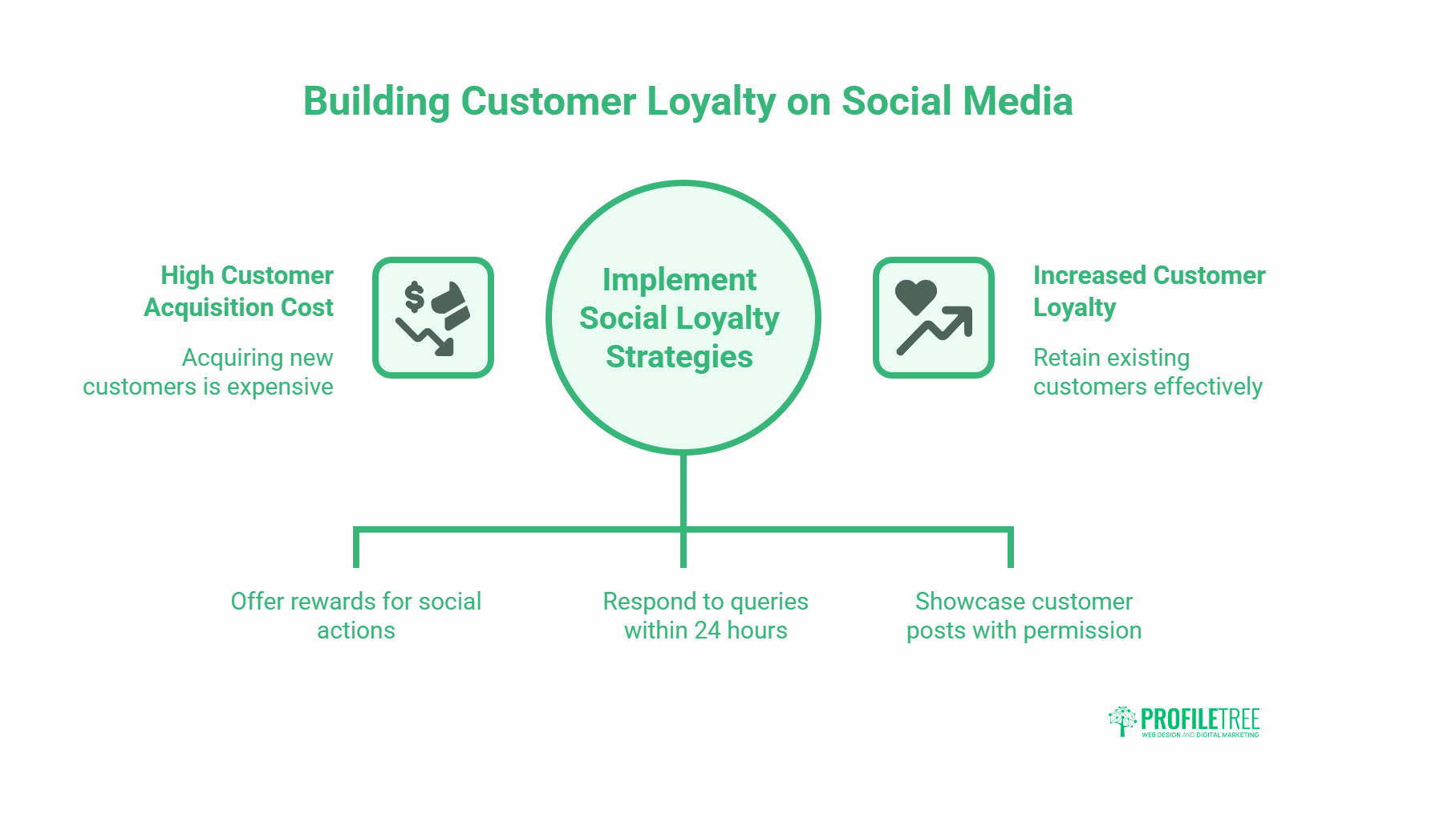
Acquiring a new customer through paid social costs five to seven times more than retaining an existing one. Social media’s loyalty function is therefore as commercially important as its acquisition function, but it requires a different approach.
Rewarding engagement directly
Loyalty programmes that incorporate social engagement, whether that is sharing a post for early access to a sale, tagging a friend for a competition entry, or posting a review for a discount, create a cycle where your best customers become active advocates. The key is making the reward proportionate and the ask genuine: asking customers to write a detailed review in exchange for a meaningful discount tends to generate useful, specific content rather than generic five-star ratings.
Handling customer service on social
Response time on social media is a loyalty factor that most retailers underestimate. A study by Sprout Social found that 79% of customers expect a response to a complaint or query within 24 hours on social media. Brands that respond within an hour see significantly higher customer satisfaction scores than those that respond the next day.
This does not require a dedicated social media team. It requires a protocol: who monitors the accounts, what questions can be answered immediately, and what requires escalation. Even a small retail team with clear ownership of the social inbox can meet this expectation.
User-generated content as a retention signal
When existing customers post about your products unprompted, it signals genuine satisfaction. Sharing this content (with permission) does two things: it provides authentic social proof to potential customers, and it signals to the creator that you value them. Both outcomes strengthen loyalty.
Running Social Media Campaigns That Convert
A campaign is a coordinated set of content and paid activity with a defined objective, a start and end date, and measurable success criteria. Most retail businesses run promotions rather than campaigns: they post about a sale without a strategy for who sees it, when, or what happens next.
Campaign structure for retail
A basic retail campaign structure has three phases:
- Awareness phase (days 1 to 7): Broad content introducing the offer to both existing followers and a paid lookalike audience. Goal is reach and initial engagement.
- Consideration phase (days 7 to 14): Social proof content (customer reviews, product demonstrations) targeted at people who engaged with the awareness phase. Goal is building purchase intent.
- Conversion phase (days 14 to end): Direct response content with a clear call to action, targeted at people who have shown strong intent signals: website visitors, product page viewers, cart abandoners. Goal is purchase.
Hashtag strategy
Hashtags on Instagram and TikTok extend organic reach by putting content in front of people who do not already follow the account. The most effective approach combines three types: broad category hashtags with high volume (where competition is fierce but discovery happens), mid-range niche hashtags (where a smaller audience is specifically looking for what you sell), and branded or campaign-specific hashtags that aggregate all content related to a specific initiative.
Avoid using the same hashtag set on every post. Rotate them and monitor which sets generate the strongest engagement and reach.
Paid social for retail SMEs
Meta Ads remain the most cost-effective paid social channel for most retail SMEs because of the depth of audience targeting. Campaigns that perform consistently well for retail include:
- Retargeting website visitors who did not purchase (lowest cost per conversion)
- Lookalike audiences built from existing customer lists (strong ROI when the customer list is large enough, typically 1,000+ contacts)
- Local awareness campaigns for physical retail locations (driving footfall rather than e-commerce sales)
ProfileTree’s digital marketing services include paid social strategy and campaign management for retail businesses across Northern Ireland, Ireland, and the UK.
User-Generated Content and Brand Identity
User-generated content sits at the intersection of social proof and brand identity. When customers share genuine content about your products, it tells potential buyers something that any amount of brand-created advertising cannot: real people buy this, use it, and think it is worth telling others about.
How to generate more UGC without paying for it
The most effective UGC strategies do not rely on paid incentives alone. Retailers who consistently generate customer content share a few common practices:
Packaging is underused. Including a small card in the package asking customers to share their purchase and tag the brand, with a genuine reason (“we feature customer photos on our website and social channels”), generates a steady stream of content from customers who would not have thought to post otherwise.
Post-purchase email sequences are another underused trigger. An email sent three to five days after delivery, when the customer has had time to use the product, asking for a photo or review, generates higher response rates than a request sent immediately after purchase.
Using UGC in paid advertising
Customer photos and videos used in Meta ads consistently outperform brand-created creative in retail categories. Meta’s own data shows that ads featuring user-generated content achieve click-through rates 4x higher than polished studio creative in many retail verticals. For retailers with a growing bank of customer content, this is an advertising asset that costs very little to produce.
Managing brand identity alongside UGC
UGC is authentic by nature. Trying to over-direct it strips out the authenticity that makes it valuable. The retail brands that manage this well give customers a clear framing (“show us how you use it in your everyday life”) without dictating the result. They curate what they amplify rather than controlling what gets created.
For retailers thinking about how their brand identity translates across digital platforms, ProfileTree’s AI transformation services include guidance on how AI tools can help analyse brand perception signals across social platforms and identify the content themes that resonate most strongly with different audience segments.
Frequently Asked Questions
Which social media platform is best for retail sales in the UK?
There is no single answer, as it depends on your product category and target audience. Instagram and Facebook combined cover the widest range of retail categories and offer the strongest commerce infrastructure through Meta. TikTok is the strongest choice if your audience is primarily under 35 and your products have strong visual or demonstration appeal. Most retail SMEs benefit from prioritising two platforms rather than spreading thinly across five.
How much should a retail SME spend on social media advertising?
A starting budget of £500 to £1,000 per month is enough to test Meta advertising properly and gather meaningful data on what works. Spending less than this typically results in too few impressions to reach statistical significance. Once you have identified which campaign types and audiences perform, scaling up spend becomes a lower-risk decision.
How do I measure whether social media is actually driving retail sales?
UTM parameters on all social links allow Google Analytics to attribute website purchases to specific platforms, campaigns, and posts. For physical retail, tracking footfall through social-only promotional codes gives a comparable attribution signal. Without measurement infrastructure in place first, it is very difficult to answer this question accurately.
What type of content performs best for retail on social media?
Short-form video consistently outperforms static images for reach. Customer-generated content and genuine product demonstrations outperform polished brand creative for conversion. Educational content (how to use, how to style, how to maintain) generates high save rates, which is a strong purchase intent signal. The format that works best varies by platform, but authenticity is the consistent factor across all of them.
How often should a retail business post on social media?
Consistency matters more than frequency. Posting three to four times per week on your primary platform, every week, produces better results than posting daily for two weeks and then going quiet. Quality and consistency are the variables to prioritise. Frequency can increase once the content process is established.
Can a small retail business compete with large chains on social media?
Yes, and in some ways small retailers have an advantage. Authenticity, local knowledge, and genuine personality are harder for large chains to replicate. A local retailer who knows their customers, shows genuine expertise, and responds personally to comments and messages builds a type of trust that national brands struggle to match. The constraint is time, not capability.
What is social listening and should retail businesses use it?
Social listening means monitoring what people say about your brand, your products, and your category across social platforms, review sites, and forums. For retail businesses, it reveals recurring customer questions (useful for content strategy), emerging complaints (useful for operations), and how people actually describe your products (useful for copywriting and advertising). Free tools like Google Alerts provide a basic version; paid tools like Mention or Sprout Social provide more comprehensive monitoring.