
YouTube SEO: Ranking Videos for Maximum Visibility
Table of Contents
YouTube is the second-largest search engine in the world, processing billions of searches and video views every day. Most businesses in Northern Ireland, Ireland and the UK treat it as a place to park finished videos rather than a search channel to be optimised, and that single assumption is why their content sits unseen. Getting found on YouTube is less about luck than about applying the same discipline you would bring to ranking a web page: clear keywords, well-structured metadata, strong engagement signals, and content built around what people actually search for.
This guide covers the techniques that move videos up the search results and into recommendation feeds: how the algorithm works, how to research keywords, how to optimise titles and descriptions, and how to keep viewers watching long enough to send the right signals back to YouTube.
If you want a shorter primer before working through the details below, our guide to mastering YouTube SEO is a good starting point.
Understanding the YouTube Ecosystem and Search Algorithm
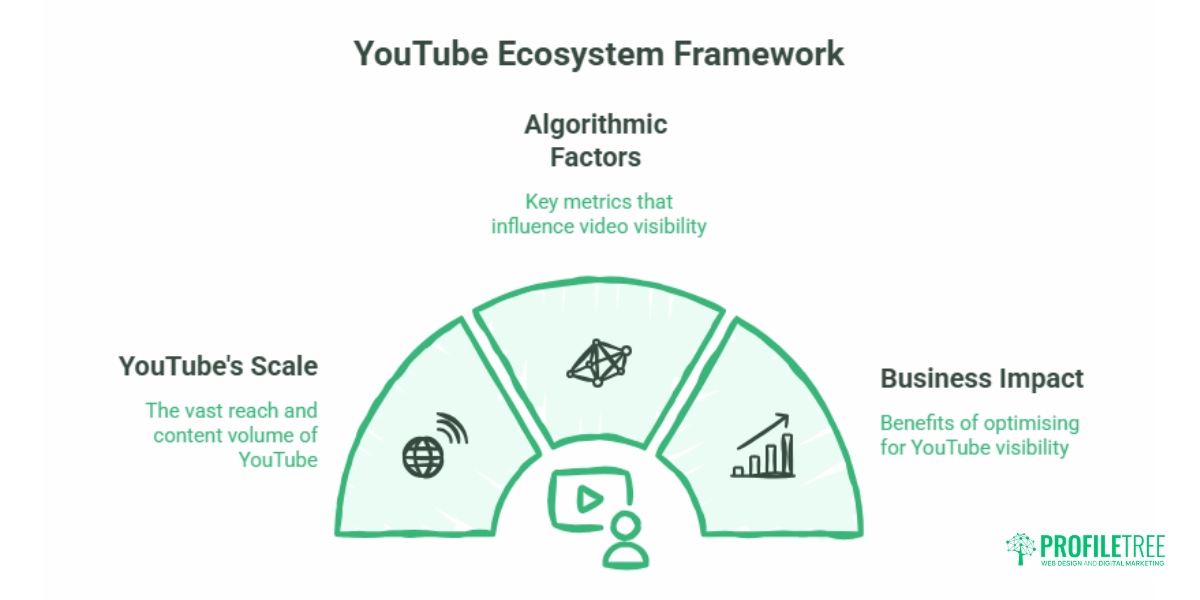
YouTube’s ecosystem runs on a search and recommendation system that weighs relevance, engagement and watch time. Understanding how metadata, viewer behaviour and AI-driven recommendations shape visibility is the foundation for everything else in this guide.
The Scale and Scope of YouTube
YouTube’s reach as a discovery platform is hard to overstate. It has more than 2.6 billion monthly active users across almost every demographic and region. More than 500 hours of content are uploaded every minute, covering entertainment, education, product reviews and technical tutorials. It processes billions of searches a day, functioning as a specialised search engine for video, and its recommendation engine accounts for roughly 70% of all watch time. That scale creates both opportunity and competition for anyone trying to be seen.
Key Algorithmic Factors
YouTube’s algorithm has shifted steadily toward viewer satisfaction. The factors that matter most are:
- Watch time and retention: the total time viewers spend on your videos and the percentage of each one they complete.
- Engagement metrics: likes, comments, shares and subscriptions generated by your content.
- Click-through rate (CTR): the share of impressions that turn into actual views.
- Session time: how long viewers stay on YouTube after watching your video.
- Recency and upload frequency: how recently you published and how consistently you do so.
- Topical relevance: how closely your content matches viewer interests and search intent.
These factors are the basis of any sensible YouTube SEO strategy.
The Business Impact of YouTube Visibility
Optimising for YouTube’s search and recommendation systems pays off in several ways. It builds an audience of subscribers who return to your content, raises brand awareness among people actively searching for what you offer, and drives qualified visitors to your website or landing pages. It also captures leads through well-placed calls to action, opens monetisation routes through the Partner Programme and memberships, and helps establish authority in your sector.
For an SME, the value is usually narrower and more practical than chasing raw views. A joinery firm in Lisburn or an accountancy practice in Galway does not need millions of subscribers. It needs a small set of videos that appear when local customers search for the services it sells. That is where treating YouTube as a search channel, supported by a clear video marketing strategy, starts to matter.
Comprehensive Keyword Research for YouTube
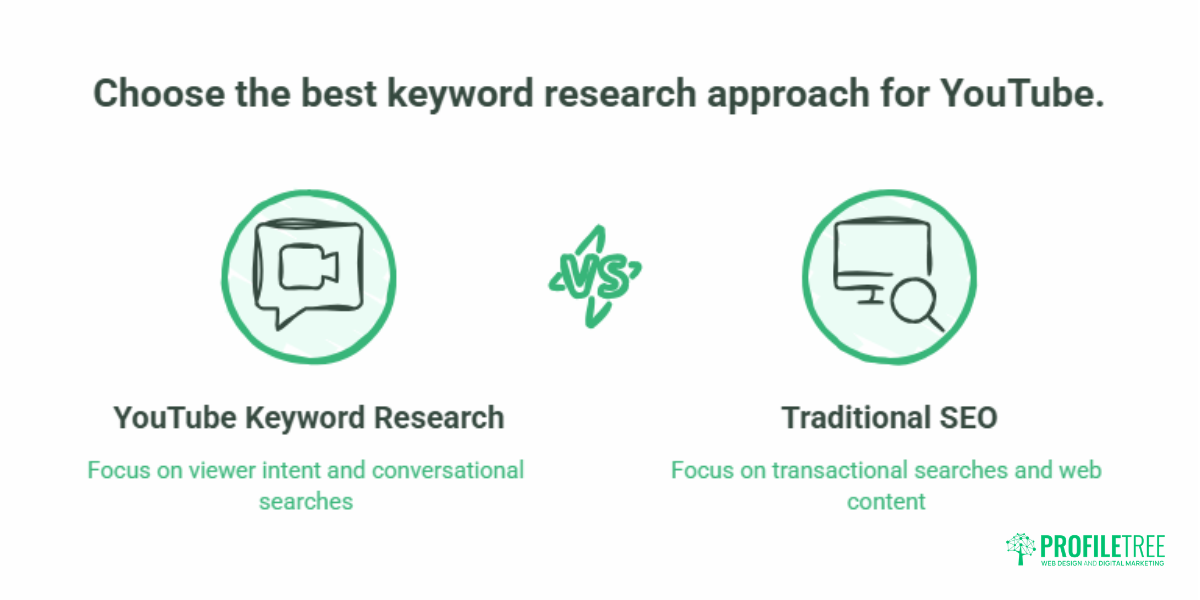
Good YouTube keyword research goes past surface search terms to consider intent, competition and trending topics. YouTube’s own autocomplete and analytics, alongside third-party tools, help you find terms with real demand that you can realistically rank for.
YouTube Keyword Research vs Traditional SEO
Researching keywords for YouTube differs from web SEO in a few ways. Viewer intent is often instructional, entertainment-led or review-focused rather than transactional. Searches tend to be more conversational and question-based. Keywords have to account for what can actually be shown on screen, and topics cycle faster on YouTube because of trends and current events.
Keyword Research Methods and Tools
Several approaches surface useful opportunities. Within YouTube itself, you can type seed terms into the search bar to see autocomplete suggestions, scan the trending section for timely topics, study which terms competitors rank for, and use YouTube Studio analytics to see what already drives traffic to your videos. Dedicated tools extend this: vidIQ and TubeBuddy add keyword and competitive data, Google Keyword Planner shows broader search trends, and Ahrefs or SEMrush offer YouTube-specific research.
A workable sequence is to start with broad topic ideas, expand them using autocomplete and related searches, check volume and competition with a dedicated tool, identify long-tail variations with clearer intent, then group keywords by content type and audience.
Keyword Categorisation and Prioritisation
Organising keywords gives you a content plan rather than a list. Sort them into informational terms (“how to”, “tutorial”, “guide”), commercial terms (“review”, “comparison”, “vs”), navigational terms (brand or product names), and trending terms with short-lived interest. Then prioritise by search volume, competition level, relevance to your expertise, conversion potential and how feasible the content is to produce.
For UK and Irish SMEs, the highest-value terms are usually local and specific. A term like “kitchen fitting Belfast” or “VAT return help for sole traders” will have lower volume than a generic phrase, but the people searching it are far closer to buying. This is the same intent-first thinking we apply in our SEO services, and it transfers directly to video.
Our wider video SEO best practices cover how to carry these keywords through into transcripts and on-page elements once a video is embedded on your site.
On-Page Optimisation Elements for YouTube Videos
Optimising a video means crafting a strong title, a detailed description and relevant tags, then supporting them with a high-quality thumbnail and clean metadata. Each element gives YouTube and viewers a clearer signal about what the video is and who it is for.
Title Optimisation Strategies
Titles are the strongest single relevance signal to both the algorithm and the viewer. Place your primary keyword near the start. Keep the length to around 60 to 70 characters so it is not truncated in results. Add a specific number or qualifier where it fits, create a clear benefit or hook, and keep recurring elements consistent for series content.
A reliable structure is: primary keyword, then a specific detail or number, then a benefit or hook, then your brand name. It helps to draft three to five title variations per video and judge each on keyword placement, clarity and click appeal before choosing.
Description Optimisation
A well-written description improves discoverability and gives viewers context. Put your primary keyword and core message in the first 100 to 150 characters, since that is what shows before the “show more” cut-off. Follow with a fuller summary that uses your keywords naturally, timestamps or chapters for navigation, links to resources mentioned, links to your website and social profiles, and a clear next step.
Aim for at least 200 to 300 words, written in natural language rather than stuffed with keywords, with two or three relevant hashtags at the end. Revisit older descriptions periodically to keep them accurate.
Tag Selection and Implementation
Tags carry less weight than they once did, but they still help YouTube categorise your content. Use specific, relevant tags rather than broad generic ones. Start with your primary keyword phrase, add close variations and related terms, include a couple of category-defining tags, and stop at around 10 to 15 genuinely relevant tags rather than filling every slot. Reviewing the tags on high-ranking videos for the same topic can point to useful patterns.
Thumbnail Design for Maximum CTR
The thumbnail often decides whether anyone clicks. Use high contrast and colours that stand out in a results page, a single clear focal point, and consistent branding so viewers recognise your channel. If you add text, keep it to three or four words. Human faces showing genuine emotion tend to perform well, and the composition needs to read well at both mobile and desktop sizes.
Technically, thumbnails should be 1280 x 720 pixels at a 16:9 ratio, in JPG, GIF or PNG format under 2MB, sharp, and legible on a phone screen. A/B testing different versions through YouTube Analytics will tell you what works for your specific audience. This is one area where production quality shows quickly, and where a consistent content marketing approach across thumbnails, titles and series branding pays for itself.
Engagement Optimisation: The Key to YouTube Algorithm Success
Engagement — likes, comments, shares and watch time — tells YouTube your content is worth recommending. The work here is encouraging genuine interaction through clear prompts and active community management, rather than chasing vanity metrics.
Maximising Watch Time and Retention
Watch time is the most important ranking factor in the algorithm, so structure matters. Open with a hook that addresses the viewer’s main need, preview the specific value to come, and cut the slow introduction that delays your actual content. Move through the material in a logical order with clear transitions, change the visual pace every 30 to 60 seconds to hold attention, and close by delivering on the promise you opened with.
To improve retention, study your audience retention graphs to find drop-off points, answer obvious objections before viewers leave to look elsewhere, and front-load value in the first 15 seconds. A simple framework runs: hook (10 to 15 seconds), brief introduction (20 to 30 seconds), a short roadmap of what is coming, the main content in clear segments, a recap, then a clear call to action.
For more on cards and end screens specifically, see our piece on SEO for video content.
Building Active Engagement
Engagement signals help YouTube identify content worth surfacing. To draw out comments, ask specific questions tied to your content, invite opinions or experiences, and reply promptly in the first 24 hours after publishing. Pin the most useful comments and handle criticism constructively.
For likes and shares, add natural reminders after you have delivered real value rather than at the start, build in genuinely shareable moments, and suggest who the video might help. To grow subscribers, state your channel’s value clearly, time the request after a useful section, and use series content that gives people a reason to come back.
Session Time Enhancement
YouTube rewards videos that keep people on the platform afterwards. Group related videos into themed playlists ordered from beginner to advanced, and feature them on your channel page. Use end screens in the final 20 seconds to point viewers to your strongest related content, keeping the subscribe element in a consistent position. Reference related videos naturally within your content and use cards to suggest them at the right moment.
Video Length Optimisation
The right length depends on content type and audience expectations. As a rough guide: tutorials and educational content sit at 7 to 15 minutes, vlogs and entertainment at 10 to 20, single product reviews at 5 to 10, news and commentary at 8 to 12, and in-depth analysis at 15 to 30. Match length to the complexity of the topic, focus on retention percentage rather than hitting an arbitrary runtime, and cut anything that drags. Testing different lengths on similar content will show what your audience prefers.
Technical and Accessibility Optimisation
Strong technical preparation and accessibility features both improve performance and widen your reach. Clean files, captions and transcripts make videos easier for YouTube to process and easier for everyone to watch.
File Optimisation Before Upload
Prepare files properly before they reach YouTube. Export in MP4 with the H.264 codec at a 16:9 ratio, with a minimum resolution of 1080p and a frame rate of 30 or 60fps depending on the content. On audio, aim for clean sound with minimal background noise, peak levels between -6dB and -3dB, consistent volume through light compression, and export at 320kbps AAC. Include your primary keyword in the filename itself, using hyphens rather than underscores.
Caption and Subtitle Implementation
Captions improve accessibility and add an SEO benefit. You can use auto-generated captions as a starting point, edit them for accuracy, or commission professional transcription for important content. Always review auto-captions before publishing, include non-verbal cues such as [applause] or [music], and format for readability. Uploading the transcript into the description gives search engines extra text to work with, and adding other-language versions extends your reach internationally.
Card and End Screen Strategy
Cards and end screens are YouTube’s interactive tools for improving session time. Place cards at natural transition points or when you reference related content, limiting them to three to five per video so they do not overwhelm. For end screens, leave 15 to 20 seconds of space at the end, feature both a specific recommended video and a playlist, and keep the subscribe element in the same position every time.
Channel-Level Optimisation Strategies
A well-optimised channel lifts discoverability across all your videos. Cohesive branding, keyword-rich descriptions, organised playlists and consistent themes all strengthen your channel’s authority.
Channel Page Optimisation
Your channel page is effectively your YouTube homepage. Put your primary keyword and value proposition in the first 100 to 150 characters of the channel description, then describe the content types you cover and your upload schedule, and add links to your website and social platforms. A channel trailer under 90 seconds for new visitors should communicate what the channel offers and end with a clear prompt to subscribe.
On branding, design a banner at 2560 x 1440 pixels with a focal point that survives cropping across devices, keep a consistent colour scheme, and make sure the profile picture (800 x 800 pixels) is recognisable at small sizes. This is the kind of consistent visual identity we build for clients through our web design work, where the same brand needs to hold together across a website, a YouTube channel and social profiles.
Community Tab Engagement
The Community tab keeps you connected between uploads. Use it for behind-the-scenes updates, polls that gather feedback, teasers for upcoming videos and relevant industry news. Two or three posts a week suit an active channel, timed around when your audience is online. Treat it as a supplementary touchpoint and a low-cost way to test content ideas before committing to a full production.
Publishing Schedule and Consistency
Consistent publishing builds both algorithm confidence and viewer habit, but it has to be sustainable. Align frequency with your real production capacity rather than an ambitious target you cannot keep. Many SMEs are better served by a fortnightly or monthly schedule of solid videos than a weekly cadence that collapses after a month. Build a buffer of two to four videos to cover busy periods, and use YouTube’s scheduling feature to stay consistent.
If you plan to host these videos on your own site as well, our guide to video content and SEO explains how embedding affects dwell time and rankings.
Analytics and Continuous Improvement
Reviewing analytics regularly is what turns a scattershot channel into a strategy. Tracking watch time, retention, click-through rate and engagement reveals what is working and where to focus next.
Key Performance Metrics to Monitor
Watch three groups of metrics. Discovery metrics include impressions, impression click-through rate, traffic sources and the search terms bringing viewers in. Engagement metrics include average view duration, audience retention, likes, comments, shares and the balance of new versus returning viewers. Outcome metrics include subscriber growth, any revenue, clicks through to your website, and how your cards and end screens perform.
Competitive Analysis Framework
Studying competitors sharpens your own approach. At the channel level, look at their content formats, publishing patterns, playlist structure and engagement style. At the video level, study the titles and thumbnails behind their best performers, their description structure and their calls to action. A practical method is to pick 5 to 10 channels of similar or larger size, analyse their 10 most-viewed recent videos, and adapt the patterns that fit your own voice.
Iterative Improvement Process
Sustainable growth comes from steady review. Audit your videos roughly quarterly, grouping them by type and performance and cross-referencing results against the effort each took. Update underperforming titles and thumbnails on older content, A/B test changes through impression CTR, and gradually shift resources toward the formats and topics that consistently perform.
Building Authority Through E-E-A-T Principles
Experience, expertise, authoritativeness and trust apply to video as much as to written content. Well-researched, genuinely useful videos that show real credibility build the trust that improves visibility over time.
Show experience through behind-the-scenes footage, real examples from your own work, and practical demonstrations rather than theory alone. Communicate expertise by explaining your reasoning, referencing the tools and standards you use, and including credentials in your channel description and video descriptions. Build authority by covering your subject area systematically and citing credible sources, and earn trust by disclosing any sponsorships clearly, correcting errors promptly, and keeping your production and brand voice consistent.
“Too many businesses approach YouTube like another social media platform, but that’s a fundamental mistake. YouTube is a search engine first, and successful optimisation requires understanding how your customers search for solutions. We’ve helped businesses across the UK and Ireland improve their video results by treating YouTube with the same strategic discipline we use for Google SEO: search intent, keyword optimisation, and content that genuinely solves a problem.” — Ciaran Connolly, Director, ProfileTree
Many SME teams have the subject knowledge but not the time to build this consistency. That is often where digital training helps: giving an in-house marketer the skills to research keywords, write descriptions and read analytics, so the channel can be run sustainably from inside the business.
A Practical Implementation Framework
A structured framework keeps optimisation consistent across both new and existing videos, covering keyword research, on-page elements, engagement, technical preparation and analytics-led refinement.
Video Launch Strategy
For new content, work in phases. In pre-production, research keywords, analyse competing videos and write a brief covering your key points. In production, build target keywords into the script naturally and film with retention in mind. At publication, upload with an SEO-friendly filename, write a keyword-rich title and description, add a custom thumbnail, and set up cards and end screens. Then promote: share across your email list, social channels and website, and engage actively in the comments during the first 24 to 48 hours.
Existing Content Optimisation
Your back catalogue is often the fastest win. Export your analytics, identify videos with potential (low CTR but good retention), and prioritise by likely impact. Refresh titles to match current search patterns, expand descriptions, update thumbnails on below-average performers, and add cards or end screens to older videos. Track changes for two to four weeks and apply what works elsewhere.
The Future of YouTube SEO
YouTube SEO is being shaped by AI-driven recommendations, voice and visual search, and a continued shift toward satisfaction metrics. The algorithm is putting more weight on the typical viewer journey and session quality, and developing a more sophisticated understanding of video meaning beyond simple keywords.
AI-powered search is the change worth watching most closely. As tools like Google’s AI Overviews and assistant-style search pull answers from across the web, content that clearly answers specific questions is more likely to be surfaced and cited. The practical response is to develop content that addresses multiple related questions within a topic, build clusters with a natural progression between videos, and keep production quality consistent. For businesses thinking about how AI search affects their visibility more broadly, this is an area we cover through AI-enhanced marketing.
For a deeper look at how the ranking system itself works, read our guide on how to beat the YouTube algorithm.
Balancing Optimisation With Genuine Value
Effective YouTube SEO balances technical optimisation with content people actually want to watch. Understanding the algorithm and getting your metadata right are necessary foundations, but lasting visibility comes from serving viewer needs rather than gaming a system. Treat SEO as a way to connect useful content with the audience that benefits from it, and growth tends to follow.
For an SME in Northern Ireland, Ireland or the UK, the realistic goal is not viral reach but reliable visibility for the searches that matter to your business. Build a focused set of well-optimised videos around the terms your customers use, keep the quality consistent, and review the data regularly. Done that way, YouTube becomes a search channel that earns its place alongside your website rather than a folder of forgotten uploads.
For the technical details on how Google indexes video, Google’s own video SEO documentation sets out exactly what it looks for on a page hosting a video.
To go further on specific parts of this process, see our guides to video SEO best practices, YouTube SEO essentials, mastering YouTube SEO, SEO for video content, and using multimedia for higher rankings.
Frequently Asked Questions
What is YouTube SEO?
YouTube SEO is the practice of optimising your videos and channel to rank higher in YouTube search and recommendations. It covers keyword research, titles, descriptions, tags, thumbnails and engagement signals such as watch time.
How long should my videos be to rank well?
There is no single ideal length. Match it to the content type and focus on retention percentage rather than runtime. Most tutorials work well at 7 to 15 minutes.
Do tags still matter on YouTube?
Tags carry less weight than they once did, but they still help YouTube categorise your content. Use 10 to 15 specific, relevant tags rather than filling every available slot.
How often should a small business post on YouTube?
Consistency matters more than frequency. A fortnightly or monthly schedule you can sustain beats a weekly target you abandon. Build a small buffer of videos to cover busy periods.
How important is the thumbnail?
Very important, as it largely decides whether anyone clicks. Use high contrast, a clear focal point and consistent branding, and test variations through YouTube Analytics.