
What Is a Unique Selling Point? A Practical Guide for SMEs
Table of Contents
Most small businesses can describe what they do. Far fewer can explain, in a single clear sentence, why a customer should choose them over anyone else. That gap is where a unique selling point (USP) shines.
A unique selling point is the one specific thing that makes your business a better choice than the alternatives for a particular group of customers. It is not a slogan, a mission statement, or a list of features. It is a focused, defensible reason to buy from you rather than someone else.
This guide covers what a USP is, how it differs from related concepts like a value proposition, how to identify yours, and how to communicate it across your website, content, and digital marketing. If you have ever struggled to explain what sets your business apart, this is where to start.
What Is a Unique Selling Point?
A unique selling point (USP) is the specific quality, benefit, or approach that differentiates your product or service from competitors in a way that matters to your target customers. The word “unique” carries weight: if your competitors can honestly say the same thing, it is not a USP.
The concept originated in 1940s advertising theory. The underlying logic has not changed. Customers facing a choice between similar options need a reason to pick one. Your USP gives them that reason.
A useful USP has three properties. It is specific enough to be verifiable (not “great service” but “same-day response guaranteed”). It is relevant to the customer’s actual decision (not something only you find interesting). And it is difficult for competitors to copy quickly, whether because it is rooted in expertise, process, location, relationships, or a proven track record.
“We hear a lot about differentiation, but when we look at how SMEs actually win clients, it almost always comes down to a very specific thing they do better or differently,” says Ciaran Connolly, founder of Belfast-based digital agency ProfileTree. “The businesses that struggle to grow are often the ones that haven’t articulated that thing yet.”
USP vs Value Proposition vs Positioning Statement
These three terms are used interchangeably in much marketing content. They are not the same thing.
| Concept | What it answers | Who it’s for | Typical length |
|---|---|---|---|
| Unique Selling Point | Why choose us over a specific competitor? | Customers at the decision stage | One sentence |
| Value Proposition | What do we do, for whom, and what outcome do we deliver? | Customers at the awareness stage | Two to four sentences |
| Positioning Statement | Where do we sit in the market relative to alternatives? | Internal teams and strategy documents | One paragraph |
Your USP sits inside your value proposition. A value proposition explains the full offer; a USP sharpens the competitive edge. A positioning statement captures both for strategic planning purposes.
If a customer asks, “Why should I choose you over the other three companies I’m considering?”, your answer is your USP. If they ask, “What do you actually do?”, your answer is your value proposition.
Why Your USP Matters More Than Your Marketing Budget
A weak USP does not just make marketing harder. It makes every part of business development less efficient.
When you cannot articulate what makes you different, your website tries to appeal to everyone and ends up persuading no one. Your sales conversations drift toward price, because price is the only differentiator left when everything else looks the same. Your marketing spend goes further when the message is sharp, because it attracts the right people rather than generating enquiries from customers who will never convert.
The four Ps of marketing (product, price, placement, and promotional strategy) all offer potential USP territory. Price is the most common but the weakest choice; it is easily undercut and unsustainable for most SMEs. The stronger positions are built around product quality, specialisation, location, process, or relationships that competitors cannot replicate overnight.
The businesses that maintain a clear USP also tend to find it easier to train their teams, because everyone understands what the business stands for and what it promises customers.
How to Find Your Unique Selling Point: A Five-Step Process
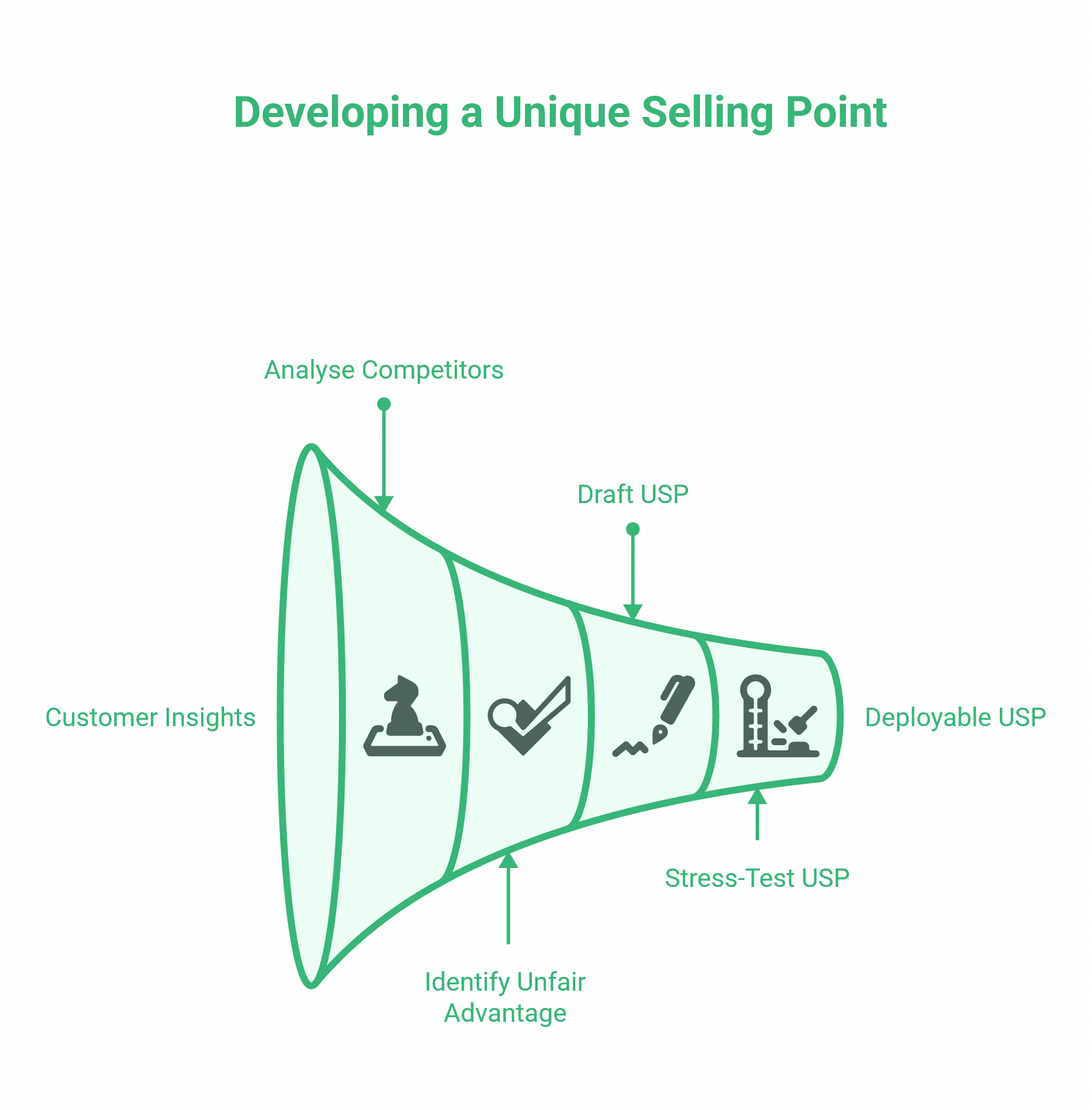
Finding your USP is less about brainstorming and more about looking carefully at what already exists: what your customers value, where your competitors fall short, and what your business does that is genuinely difficult to replicate. The five steps below give you a structured way to work through that analysis, moving from customer insight to a tested, deployable statement.
Step 1: Map What Your Customers Actually Value
The most common USP mistake is building it around what the business is proud of rather than what customers are actually choosing you for. Ask your best clients why they hired you, why they stayed, and what they would miss if you stopped trading. Their language will often reveal the USP more clearly than any internal strategy session.
If you are working on a buyer persona, include motivations and switching triggers, not just demographics. A Northern Ireland manufacturing firm might choose a local digital training provider not because of price, but because the trainer understands the industry context and can deliver on-site sessions. That specificity is where USPs live.
Step 2: Audit Your Competitors’ Positioning
Look at what your direct competitors claim to offer. Read their websites, check their Google reviews, and note the language they use in their marketing. You are looking for two things: what everyone in your sector claims (these are table stakes, not USPs) and genuine gaps.
A gap might be a service nobody offers at your price point, an underserved geographic area, a niche audience larger competitors ignore, or a process that delivers faster or more reliably. A competitive matrix with four or five factors scored across your main competitors will often make the gap visible.
ProfileTree’s digital marketing strategy services include competitor analysis as a starting point. Understanding where rivals position themselves is as important as understanding where your customers want to go.
Step 3: Identify Your Unfair Advantage
An unfair advantage is something you have that competitors would struggle to replicate in the short term. This might be a long-standing relationship with a specific industry, a proprietary process developed over years, a team with qualifications nobody else in the region holds, or a track record of work in a specific niche.
For SMEs in Northern Ireland and Ireland, regional expertise is often undervalued as a differentiator. Understanding local procurement processes, funding schemes such as Invest NI support, or the specific regulatory environment for a sector is genuinely useful to local clients and genuinely difficult for a company based elsewhere to replicate.
Step 4: Write a Draft USP and Stress-Test It
A practical USP formula: “We help [specific customer type] achieve [specific outcome] through [specific approach or advantage], which is why [reason you are the best choice for this].”
You do not need to use this formula verbatim. But the discipline of filling in each section forces specificity. “We help Northern Ireland food producers develop an export-ready online presence using a structured content and web design process, because we have completed over 40 food sector projects and understand the specific compliance and branding requirements involved” is a USP. “We help businesses grow online” is not.
Once you have a draft, test it against two questions. Would a competitor be embarrassed to make the same claim? And would your target customer find it genuinely relevant to their decision? If the answer to both is yes, you have something worth developing.
Step 5: Embed Your USP Across Every Customer Touchpoint
A USP that lives only in a strategy document does nothing. It needs to appear consistently across your website homepage headline, service page copy, social media bio, sales conversations, and content marketing.
This is where working with a digital agency becomes practical. ProfileTree’s web design process includes a brand clarity stage specifically because many clients arrive with strong services, but no articulated USP, and a website without a clear USP tends to underperform regardless of how well it is built technically.
USP Examples for UK and Irish Service Businesses
Branded USP examples dominate most guides on this topic. Zappos and Apple appear in almost every one. They are useful illustrations, but they are not directly applicable to a professional services firm or an SME in Belfast or Dublin, making a practical business decision this week.
Here are more relevant patterns.
Specialisation USP: A solicitor’s firm that focuses exclusively on commercial property transactions for technology businesses can charge a premium and win clients that a general practice firm cannot, because the specific expertise is visible and verifiable.
Process USP: A web development agency that guarantees a first draft within five working days and publishes its process publicly is harder to compare on price alone, because the proposition is about predictability, not just output.
Geographic USP: A digital training provider that delivers in-person sessions across Northern Ireland, understands local business culture, and has worked with businesses through Invest NI and InterTradeIreland programmes, is offering something genuinely different from an online course platform.
Track record USP: A content marketing agency that has produced content in a specific sector, say legal, financial services, or engineering manufacturing, for more than five years has reference points and credibility that a generalist does not. ProfileTree’s content marketing service works this way across several sectors.
The common thread is specificity. Vague claims (“passionate about results,” “committed to excellence”) do not serve as USPs because they cannot be verified or help a customer make a decision.
How to Validate Your USP Before You Build a Campaign Around It
Writing a USP is the starting point. Knowing whether it actually resonates with customers requires testing.
Website A/B testing: If your homepage headline carries your USP, test a variation against it over a meaningful period. Track time on page, scroll depth, and conversion rate rather than just clicks. Most website analytics platforms can support this. Your web design or development partner should be able to set this up without a full site rebuild.
Ad copy testing: Running a small paid social or Google Ads campaign with two different USP framings is one of the fastest ways to get real market feedback. You are not testing whether people buy; you are testing which framing generates more engagement and enquiry at a fixed spend.
Direct customer interviews: Ask five to ten recent clients why they chose you. Ask them to describe your business to a colleague. The language they use is often more accurate and more persuasive than anything you would write yourself. Customer feedback gathered this way regularly changes how businesses articulate their USP.
Google Search Console: If your website already has some content around your USP claim, GSC can show you which queries people are using to find you and whether there is a gap between how you describe yourself and how customers search for what you offer. The SEO data is not just about rankings; it is a window into customer language.
Your USP and Your Digital Presence
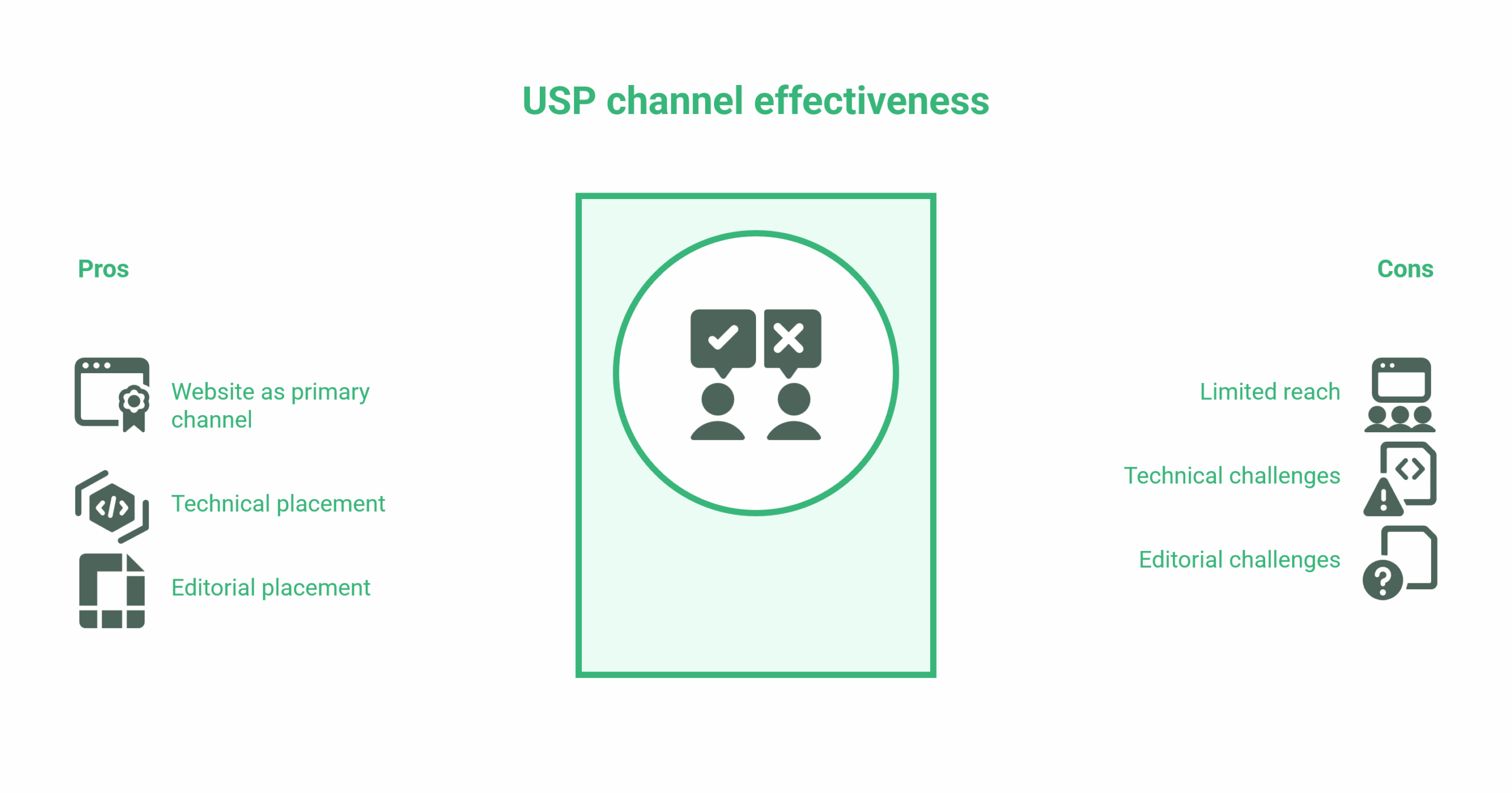
A USP is only as effective as the channels in which it appears. For most SMEs, the website is the primary vehicle, so the USP needs to be in the right places, both technically and editorially.
Homepage: The H1 heading and the first paragraph of body copy should reflect your USP. If a customer lands on your homepage and cannot tell within ten seconds what you do and why you are different, the USP is not present in a meaningful way.
Service pages: Each service page should carry a version of the USP relevant to that specific service. A general USP about specialisation in Northern Ireland SMEs needs to be specific to web design on the web design page, specific to SEO on the SEO page, and so on.
Content marketing: Articles, guides, and blog posts can demonstrate a USP rather than just stating it. A solicitor’s firm specialising in technology commercial law can write guides on data protection for SaaS businesses. A digital agency with deep experience in the food sector can produce visual branding content for food producers. The content proves the claim.
Video: Video is particularly effective at communicating USPs rooted in people, process, or personality. A short film that shows how a team works, why they take a specific approach, or what a client experience looks like can convey things that written copy cannot. ProfileTree’s video production service covers this kind of credibility content alongside standard promotional formats.
For businesses running YouTube marketing as part of their strategy, a video specifically addressing the question “why us?” performs consistently well in search and tends to rank for branded queries as more people research the business before making contact.
Common USP Mistakes to Avoid
Claiming table stakes as a USP. “We provide excellent customer service” is not a USP because every business claims it. If a competitor would be comfortable saying the same thing on their website, it is not a differentiator.
Building the USP around price. A low-price USP is defensible only if you have a structural cost advantage. For most SMEs, it leads to a race to the bottom and attracts clients who will leave the moment someone undercuts you.
Making unverifiable claims. “We are the leading agency in Northern Ireland” is not a USP; it is a claim that cannot be substantiated and most customers will discount. “We have completed over 1,000 web projects for businesses in Northern Ireland, Ireland, and the UK” is verifiable and specific.
Changing the USP too frequently. A USP builds recognition over time. Revising it every year in response to market trends undermines the cumulative effect of consistent messaging. Review it when there is a significant change in your market or your offer. Otherwise, stay consistent and put the effort into communicating it better rather than replacing it.
Targeting everyone. A USP aimed at all businesses in all sectors is effectively aimed at no one. The more specific the audience, the more precisely the USP can be calibrated to their actual priorities.
USP and the Role of Digital Training
Many SMEs in Northern Ireland and Ireland have never formally worked through a USP exercise. The knowledge exists within the business, in the heads of the founder, the sales team, and those who manage client relationships. It has just never been extracted and made explicit.
Digital training programmes that include brand strategy and marketing fundamentals can help with this. ProfileTree’s digital training service covers marketing strategy for small businesses, including the practical process of identifying and articulating a USP in a format that can be used across digital channels.
Training your team to understand and communicate the USP consistently is as important as defining it in the first place. If a customer asks any member of your team why they should choose you, the answer should not vary.
Conclusion
A unique selling point is not a tagline or a marketing exercise. It is the clearest answer your business has to the question every potential customer is asking: why you, not someone else? Getting that answer right, and communicating it consistently across your website, content, and marketing, is one of the highest-leverage things an SME can do.
If you want help articulating your USP and embedding it across your digital presence, ProfileTree works with businesses across Northern Ireland, Ireland, and the UK on exactly this kind of strategy work. Get in touch to talk through where your business stands.
FAQs
What is a unique selling point in simple terms?
A unique selling point is the specific reason a customer should choose your business over a competitor. It is not a general claim about quality or service. It is a focused, verifiable, and relevant statement of what makes your offer different in a way that matters to your target customer.
What is the difference between a USP and a value proposition?
A value proposition describes what your business does, who it is for, and what outcome it delivers. A USP is more specific: it answers the question of why you are a better choice than your alternatives. Your USP is embedded in your value proposition as your competitive edge.
Can a small business have more than one USP?
Having multiple USPs dilutes the message. Focus on one primary differentiator that applies across your business. If you serve distinct customer segments with genuinely different needs, you might develop a separate USP for each, but each should still be a single, focused claim.
How do I test whether my USP is working?
The most practical methods are A/B testing the homepage or ad copy with different USP framings, running small paid social campaigns to compare engagement, asking recent customers directly why they chose you, and reviewing your website’s search data for gaps between how you describe yourself and how customers search for you.