
Social Commerce: How to Sell on Social Media
Table of Contents
Social commerce is the practice of selling products directly within social media platforms, without customers ever leaving the app. For UK and Irish businesses, it represents one of the most direct ways to reach buyers where they already spend several hours a day. ProfileTree, the Belfast-based digital agency, works with SMEs across Northern Ireland, Ireland, and the UK to build social selling strategies that connect with real audiences and generate measurable results.
“Social commerce represents the convergence of community and commerce. Businesses that succeed don’t just sell products on social media , they build relationships, provide value, and create shopping experiences that feel natural within the social environment. For UK and Irish SMEs, the opportunity is real, but it requires strategic thinking beyond simply listing products.” , Ciaran Connolly, Founder, ProfileTree
The UK social commerce market reached £4.6 billion in 2023 and is projected to hit £12 billion by 2027, growing at roughly 27% per year. That growth rate significantly outpaces traditional e-commerce. TikTok Shop alone processed more than £500 million in UK transactions monthly by early 2024. This is no longer a trend to watch; it’s a sales channel to act on.
What Is Social Commerce?
Social commerce is e-commerce built into social media platforms. When a customer scrolls through Instagram, sees a product they like, taps the tag, and completes a purchase without opening a browser or visiting a separate site, that is social commerce in action.
How It Differs from Traditional E-Commerce
Traditional e-commerce requires businesses to pull customers to their websites, typically through paid ads, SEO, or direct visits. Social commerce flips this model. You meet customers inside the apps they already use.
The practical differences matter:
| Traditional E-Commerce | Social Commerce | |
|---|---|---|
| The platform algorithm surfaces you | Separate website | Inside the social media app |
| Traffic source | You drive it | Platform algorithm surfaces you |
| Cart abandonment | High (industry average exceeds 70%) | Lower due to fewer steps |
| Discovery type | Intentional search | Impulse and serendipitous |
| Social proof | Reviews on your site | Visible comments, likes, shares |
Both approaches have merit. Traditional e-commerce works well for considered purchases that require detailed research. Social commerce excels at impulse purchases driven by visual discovery and peer influence.
Why Social Commerce Works
Several factors are making social commerce more effective for SMEs right now.
Over 72% of e-commerce transactions happen on mobile devices. Social media apps are built for mobile, making them a natural environment for mobile shopping. Customers don’t need to switch apps or reenter payment details; many platforms store this information and make checkout a matter of two or three taps.
Trust through community is the second factor. Customers increasingly rely on peer recommendations over traditional advertising. Social commerce allows buyers to see real people using products, read comments in real time, and make decisions based on what their network thinks. That social layer is difficult to replicate on a standalone website.
Shorter purchase journeys reduce hesitation. When a customer sees a product in a video, taps a tag, and checks out within the same app, the number of steps between interest and ownership drops dramatically. Fewer steps mean fewer opportunities to abandon.
Social Commerce Platforms for UK and Irish Businesses
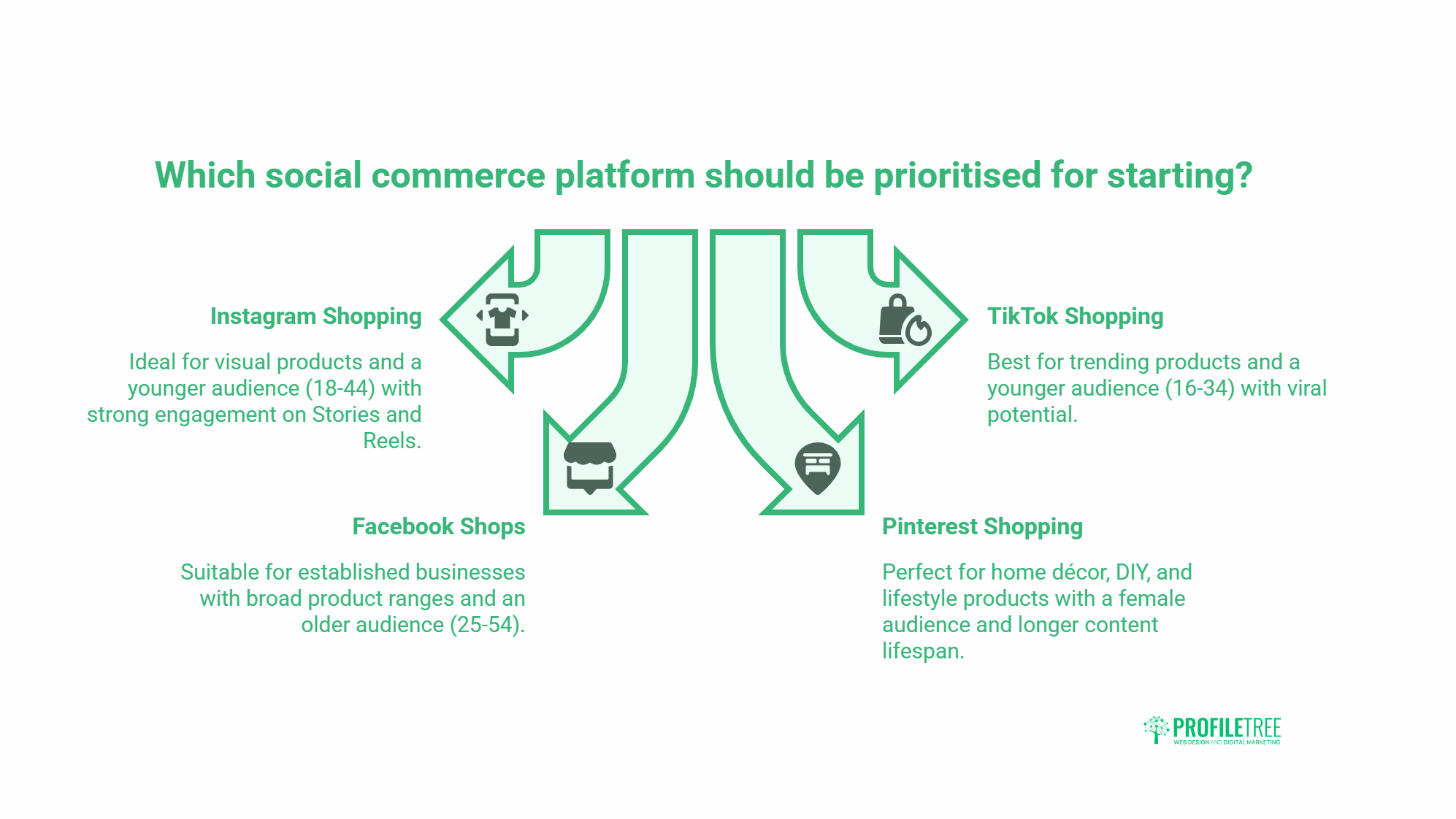
Choosing the right platform depends on your target audience, product type, and how comfortable you are creating different content formats. Most established businesses eventually use more than one platform, but starting with the best fit for your products is the right approach.
Instagram Shopping
Instagram is the most established social commerce platform for UK and Irish businesses. Its features include shoppable posts that tag products directly in photos, product stickers in Stories, Live Shopping for real-time product demonstrations, and a dedicated Instagram Shop storefront within the app.
The platform reaches 31 million active users in the UK and 3.2 million in Ireland. Its core audience sits between 18 and 44, with strong engagement rates particularly on Stories and Reels. Instagram suits visual products, fashion, beauty, lifestyle, artisan goods, where appearance and aesthetics drive the purchase decision.
Success here requires consistent, high-quality visual content. Products need to be photogenic and positioned within a coherent brand identity. The platform rewards frequent posting and engagement, and user-generated content thrives when customers share photos of products they love.
TikTok Shopping
TikTok Shop launched in the UK in September 2021 and disrupted the social commerce market quickly, particularly among younger demographics. The platform’s algorithm can surface products to large audiences regardless of follower count; a single video demonstrating a product can generate thousands of sales if it resonates.
TikTok suits trending products, items with viral potential, and businesses comfortable with authentic, unpolished video content. The platform rewards entertainment first and promotion second. Businesses that jump on trending sounds, create genuine product demonstrations, and partner with creators see stronger results than those posting traditional advertising-style content.
TikTok’s reach among 16 to 34-year-olds is unmatched. If your target customer is in that age bracket and you’re not yet on TikTok, you’re missing a growing sales channel.
Facebook Shops
Facebook remains the highest-reach platform for UK businesses, with 44 million active users and 3.7 million in Ireland. Its social commerce features are mature: a full Shop storefront, product catalogue integration, Marketplace for local sales, and deep advertising targeting.
Facebook’s audience skews older than Instagram or TikTok; the 25 to 54 bracket is the primary demographic. It works well for established businesses with broad product ranges, suburban and rural audiences, and products that appeal to homeowners, families, and the over-35 market. Facebook Groups also create communities around products and brands in ways other platforms don’t replicate easily.
Organic reach on Facebook has declined significantly. Most businesses selling through Facebook Shops need to combine organic content with paid advertising to achieve consistent visibility.
Pinterest Shopping
Pinterest users have purchase intent built in , 89% use the platform specifically for purchase inspiration. Product Pins update automatically when prices or availability change, and the visual search feature helps customers find your products when browsing similar items.
The platform works best for home décor, DIY, weddings, crafts, recipes, and fashion inspiration. Its audience is predominantly female and skews toward higher-income households. Pins drive traffic for months after posting, giving Pinterest a longer content lifespan than other platforms.
Choosing Your Starting Platform
For most UK and Irish SMEs, the decision comes down to two questions: where does your target audience spend time, and what content can you realistically create consistently?
If your products are visual and your audience is 18 to 44, Instagram is the natural starting point. If you’re targeting a younger audience and can produce short-form video content, TikTok is worth prioritising. If your customer base skews older or you have a broad catalogue, Facebook Shops offers the most complete infrastructure. Pinterest is the right choice if your product category involves planning, aspiration, or home and lifestyle content.
Start with one platform. Master it before expanding. Splitting attention across four platforms at launch typically means doing none of them well.
Social Commerce in the UK and Irish Markets
Understanding the regional context helps businesses avoid common mistakes and capitalise on audience-specific preferences.
UK Market Characteristics
The UK social commerce market is growing at roughly 27% per year. Instagram and Facebook account for approximately 60% of social commerce transactions, though TikTok Shop has taken significant market share among younger buyers.
Regional patterns exist within the UK. London and the Southeast show the highest adoption rates, but the gap between urban and rural areas is narrowing as mobile internet coverage improves. Scottish consumers show strong engagement with locally made products on social platforms, where “Scottish-made” goods outperform the same products sold through traditional channels. Northern Ireland’s market is smaller but growing, with businesses in Belfast increasingly using Instagram and TikTok to reach both domestic and cross-border audiences in the Republic.
British consumers respond well to subtle, authentic content over obviously promotional posts. Sustainability messaging resonates strongly; products with clear environmental credentials see higher engagement rates on social platforms.
Irish Market Characteristics
Ireland’s social commerce market reached approximately €650 million in 2023, with projections suggesting €1.8 billion by 2027. Per capita, Irish consumers are among Europe’s most active social commerce participants.
Irish consumers engage heavily on Instagram and Facebook, with engagement rates 15 to 20% above the European average. WhatsApp Business is also more embedded in Irish commerce than in most other markets, with small businesses using it for customer service and repeat orders.
Products with Irish heritage, artisan foods, crafts, whiskey, and locally made goods perform particularly well in social commerce settings where storytelling adds to the product appeal. Irish businesses have successfully used social commerce to reach UK customers without establishing a physical presence, and UK brands do the same in reverse.
Dublin’s concentration of international tech companies has created a sophisticated digital commerce hub with strong knowledge and talent available for businesses building out their social selling operations.
Regulatory Considerations for Both Markets
GDPR applies to all customer data collected through social commerce transactions across both markets. Privacy policies must clearly explain what data you collect, how you use it, and how customers can request deletion. Most social platforms include privacy policy links in the checkout process, but you need to verify your settings are configured correctly.
Consumer protection laws apply equally to social commerce. The UK Consumer Rights Act 2015 gives customers 14 days to return most goods purchased online. In Ireland, the Consumer Protection Act 2007 provides equivalent protections. Return policies, accurate product descriptions, and transparent pricing are legal requirements, not optional extras.
How to Set Up Social Commerce: A Practical Guide
Getting your social commerce operation running requires technical setup, product content, and an ongoing content strategy. Here’s how to approach it without spreading resources too thin.
Step 1: Set Up Your Business Accounts
Personal accounts cannot access social commerce features. Switch to business accounts on your chosen platforms before doing anything else.
On Instagram, go to Settings, then Account, then Switch to Professional Account and select Business. On Facebook, create a Business Page if you don’t have one. On TikTok, switch to a Business Account through Settings and Manage Account. On Pinterest, convert through Settings and Account Settings.
Business accounts give you access to product tagging, shop storefronts, analytics, and paid advertising capabilities.
Step 2: Connect Your Product Catalogue
If you use Shopify, WooCommerce, or a similar platform, connect it directly to your social channels. Shopify offers one-click integration with Instagram, Facebook, Pinterest, and TikTok Shop. Product changes in Shopify automatically update across connected channels.
WooCommerce integrations exist for the major platforms, but require more manual setup. If you’re using a custom website without a supported e-commerce platform, you can upload a product catalogue manually through Facebook Business Manager using a CSV file. This approach works but requires you to update the catalogue manually whenever stock, pricing, or product details change.
Each product entry needs high-quality images from multiple angles, a concise description with the most important information front-loaded, accurate pricing including all applicable taxes, real-time or regularly updated inventory counts, and product variants such as sizes and colours configured correctly.
Step 3: Configure Payments and Shipping
UK customers expect card payments as a baseline, with Apple Pay and Google Pay increasingly standard for mobile transactions. Buy Now Pay Later options (Klarna, Clearpay) have grown significantly, particularly for fashion and electronics orders above £50. Offering these can increase average order values.
In Ireland, PayPal is more popular than in the UK, with many customers trusting its buyer protection for online purchases.
Set up shipping zones and rates clearly before promoting your social commerce capability. Unexpected shipping costs are the primary driver of abandoned checkouts. Businesses selling across the Irish Sea need to understand post-Brexit VAT rules, which may require separate VAT registration depending on sales volume.
Step 4: Create Shoppable Content
With the technical infrastructure in place, the next step is turning your social presence into a shopping destination.
On Instagram, tag products directly in feed posts and use product stickers in Stories. Organise your Instagram Shop into collections such as bestsellers, seasonal ranges, or price-based categories. Tag products in Reels as well as static posts. On TikTok, add product links to video descriptions and feature items in your TikTok Shop tab. Live Shopping events on both platforms drive urgency and allow real-time customer questions.
Product photography is the single biggest determinant of conversion rate in social commerce. Shoot in natural light, use clean backgrounds, photograph from multiple angles, and include lifestyle shots showing products in real settings. Images should be at least 1080 by 1080 pixels. If photography isn’t your strength, a single professional shoot to build a content library will pay back quickly.
Step 5: Build a Content Calendar
Consistent posting is more important than volume. Three posts a week, maintained over six months, outperforms a burst of daily content followed by weeks of silence. Algorithms penalise inconsistency, and your audience expects regular activity.
A workable content mix for most businesses is roughly 60% value and entertainment content (behind-the-scenes, educational posts, customer features) and 40% direct product promotion. Batch your content creation, photograph 15 to 20 products in one session, write all descriptions at once, then schedule posts through a tool like Later or Hootsuite.
A useful starting structure:
- Monday: Behind-the-scenes or production content
- Tuesday: Educational content related to your product category
- Wednesday: Customer photo or user-generated content
- Thursday: New product or bestseller showcase (shoppable)
- Friday: Weekend promotion or seasonal content (shoppable)
Influencer and Community Strategy
Influencer marketing sits at the core of social commerce for many product categories, but the approach that works has changed. Partnering with a high-follower account rarely delivers the returns it once did. Micro-influencers (10,000 to 100,000 followers) in relevant niches now typically generate higher engagement rates and better conversion than broad celebrity partnerships.
Working with Influencers Effectively
Start by identifying creators whose audience genuinely matches your customer profile. A beauty brand partnering with a home improvement influencer with a large following will underperform against a smaller creator whose audience is already interested in beauty products.
Build real relationships before pitching collaborations. Engage with their content, share their posts where relevant, and approach them with a specific idea rather than a generic sponsorship request. The most effective influencer content feels like a natural recommendation, not a paid advertisement.
Product demonstration content consistently outperforms static promotional posts. A creator showing how they actually use a product, including genuine reactions and even minor criticisms, builds more trust than a polished endorsement. Trust translates into sales.
User-Generated Content as Social Proof
User-generated content is more persuasive than anything you produce yourself. Customers making purchase decisions trust photos and videos from real buyers more than professional product shots. Actively encourage customers to share content by asking at the point of purchase and reposting (with permission) what they share.
Simple incentives help: “Share a photo of your purchase and tag us for a chance to win a £50 gift card” generates a stream of authentic content while building community. Over time, this library of real customer content becomes one of your most valuable marketing assets.
Measuring Social Commerce Performance
Knowing which metrics to track prevents wasted effort and helps you scale what works.
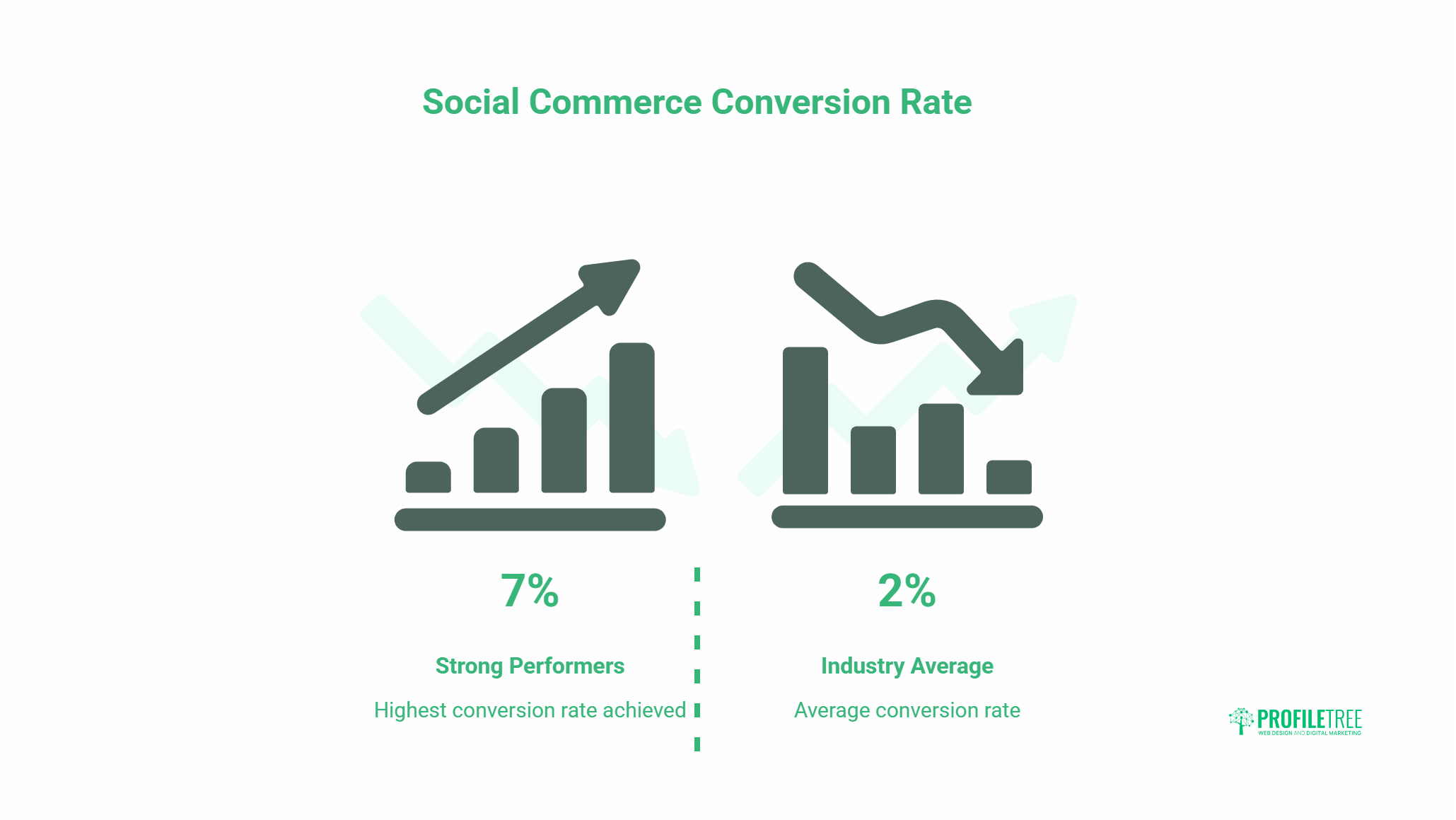
- Conversion rate is the most important number: the percentage of product views that result in purchases. Industry average sits between 1% and 3%, though strong performers achieve 5% to 7% on social platforms.
- Average order value tells you whether customers are purchasing one item or multiple. Track whether promotions, product bundles, or free shipping thresholds increase this figure over time.
- Customer acquisition cost is the total marketing spend divided by new customers acquired. Compare this across channels to understand where social commerce sits relative to paid search or email.
- Engagement rate measures likes, comments, shares, and saves as a percentage of impressions. Higher engagement leads to better organic reach as algorithms interpret it as quality content. On Instagram, saves are a particularly strong signal of purchase intent.
- Return customer rate shows what percentage of buyers come back for a second purchase. High return rates indicate product satisfaction and build a sustainable business model. Social commerce businesses with low return rates often win impulse purchases without building lasting customer relationships.
Review these numbers monthly. When you find content types or products that consistently drive results, focus more of your effort there rather than continuing to spread resources evenly across approaches that perform unevenly.
How ProfileTree Helps SMEs with Social Commerce
Getting social commerce right requires the right website foundation, a content strategy built for the platforms you’re using, and increasingly, AI-powered tools to personalise and scale your efforts.
ProfileTree’s web design and development services help SMEs build the e-commerce infrastructure that sits behind a social selling operation, fast, mobile-optimised product pages that work seamlessly when customers click through from a social platform, and checkout experiences that don’t lose buyers at the final step.
The digital marketing services team works with businesses across Northern Ireland, Ireland, and the UK to build social media strategies that combine organic content with targeted paid advertising, reaching the right audiences on the right platforms without wasting budget.
For businesses looking to build a consistent presence on social media, content marketing services cover everything from platform-specific content strategy to photography briefs and post production, giving teams the tools to show up consistently without the content creation becoming a full-time distraction.
As AI-powered tools change how social platforms surface products and personalise recommendations, ProfileTree’s AI transformation services help SMEs understand how to use these tools practically, from AI-assisted product tagging and audience segmentation to automating routine customer service interactions through social channels.
Common Mistakes to Avoid
- Treating social commerce as an afterthought. Businesses that add social selling as an extra task for someone already running the business rarely build momentum. It needs dedicated time, a consistent posting schedule, and someone responsible for monitoring and responding to comments.
- Poor quality photography. Grainy, badly lit images don’t convert on visually competitive platforms. If in-house photography isn’t possible, a single professional shoot building a library of 30 to 50 images will cover weeks of content.
- Neglecting customer service. Buyers ask questions through social media comments and DMs. A question unanswered for 48 hours is a sale lost. Set aside time each day to respond, or use a scheduling tool that centralises messages.
- Inconsistent posting. Posting heavily for three weeks, then going quiet, resets your algorithmic standing and confuses your audience. A modest, consistent schedule beats an unsustainable burst.
- Over-promotion. Feeds full of product pitches drive unfollows. The 60/40 split between value content and promotional posts exists because that ratio works; it builds the relationship before making the ask.
Frequently Asked Questions
What is social commerce?
Social commerce is the practice of selling products directly within social media platforms such as Instagram, TikTok, Facebook, and Pinterest. Unlike traditional e-commerce, where customers leave a social app to complete a purchase on a separate website, social commerce allows the full journey from discovery to checkout to happen inside a single app. This reduces friction at every step and capitalises on the impulse-driven nature of social media browsing.
Which social commerce platforms work best for UK businesses?
Instagram and Facebook are the most established social commerce platforms for UK businesses, accounting for around 60% of transactions. TikTok Shop has grown rapidly since its UK launch in 2021 and now dominates for younger demographics. Pinterest works particularly well for home décor, lifestyle, and wedding-related products. The best platform depends on where your specific customers spend time and what content format suits your products. Most successful businesses eventually use two or three platforms rather than one.
How much does it cost to start selling through social commerce?
Basic setup is free on most platforms. Business accounts, product catalogues, and shop storefronts cost nothing to create. Reaching a meaningful audience typically requires advertising spend: most UK SMEs invest £200 to £500 per month initially, scaling up as they identify what delivers return. Additional costs include product photography, content creation time, and any e-commerce platform fees if you use Shopify or a similar service.
Do I need a website to sell through social commerce?
Technically no. Many platforms allow checkout within the app without customers visiting your website. That said, a website remains valuable for credibility, organic search visibility, email capture, and as a backup sales channel. Most businesses treat social commerce as one channel within a broader strategy rather than a standalone operation.
How does social commerce work with GDPR?
GDPR applies to all customer data collected through social commerce transactions in the UK and Ireland. Your privacy policy must explain what data you collect, how you use it, where it’s stored, and how customers can request deletion. Platforms typically include privacy policy links in the checkout process, but you need to configure this correctly within your business account settings. UK businesses selling to Irish customers, and vice versa, face the same GDPR obligations regardless of which side of the border the sale originates.
How do returns work for social commerce purchases?
Returns are handled the same way as traditional e-commerce. The UK Consumer Rights Act 2015 gives customers 14 days to return most goods purchased online without needing a reason. In Ireland, equivalent protections apply under the Consumer Protection Act 2007. Your return policy should be clearly stated on your social profiles and visible during checkout. Most businesses manage returns through direct messages and email rather than a separate system, though volume will eventually require a more structured process.
What products sell best through social commerce?
Fashion, beauty products, home décor, and lifestyle items consistently perform well. Products that are visually appealing, impulse-driven, and don’t require extensive pre-purchase research see the highest conversion rates. Artisan and craft products with strong storytelling elements also do well on social platforms, particularly in the UK and Irish markets where provenance and heritage resonate with buyers. Products requiring detailed technical comparison or significant financial consideration tend to perform better through traditional e-commerce channels.
How do I get started with social commerce as a small business?
Start with one platform where your target audience is most active. Convert to a business account, connect or upload your product catalogue, and set up payment and shipping configurations. Create 10 to 15 pieces of shoppable content before announcing your social commerce capability. Post consistently for at least six weeks before evaluating performance, social commerce builds momentum gradually, and the first month rarely reflects what the channel can deliver at scale.
Conclusion
Social commerce is no longer an emerging channel; it’s where a growing share of consumer purchasing decisions happen. For SMEs across the UK and Ireland, the opportunity is accessible without major upfront investment: a business account, a product catalogue, and a commitment to consistent content creation are enough to start. The businesses building sustainable social selling operations are those treating it as a genuine channel with its own strategy, not an extension of their existing advertising. Contact ProfileTree to talk through how social commerce fits your digital strategy.