
Content Marketing for Bloggers and Vloggers
Table of Contents
Content marketing for bloggers and vloggers means planning each post and video around a question your customers search for, then measuring the enquiries it produces. ProfileTree, a Belfast web design and digital marketing agency, helps UK businesses turn an existing blog or YouTube channel into a steady source of leads, with UK advertising and data rules built in from the start.
How Content Marketing Differs From Running a Blog or Vlog
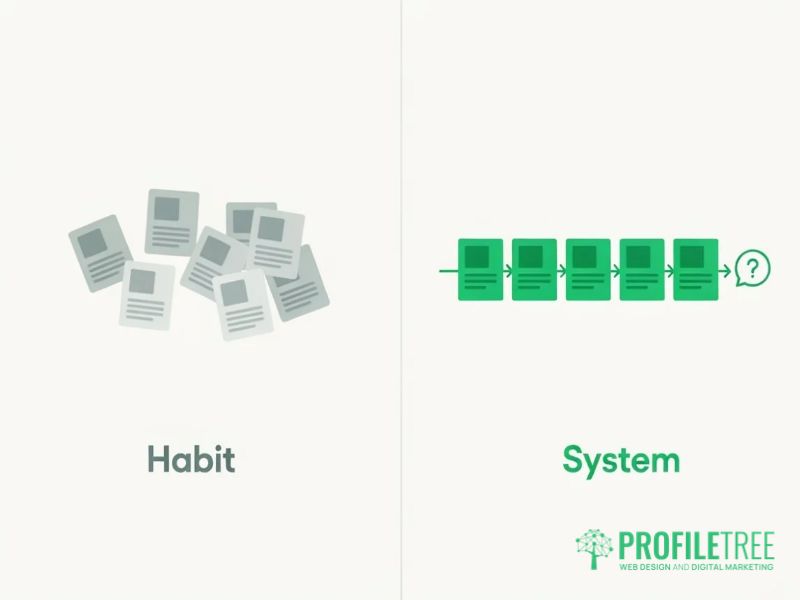
A blog, or a vlog (a video blog, usually published on YouTube), is a publishing format, and content marketing is the plan that decides what goes into it and why. Many business owners start a blog because their web designer added one to the site, then post whenever there is a spare hour. Content marketing starts at the other end, with the questions a buyer asks before choosing a supplier, and works back to the posts and videos that answer them.
The difference shows up in what gets measured. A blog run as a habit is judged by page views and comments, while one run as content marketing is measured by the enquiries and sales it starts. If you would like a team to plan and produce that work for you, our content marketing services cover the strategy, the writing and the video.
| A blog or vlog run as a habit | A blog or vlog run as content marketing | |
|---|---|---|
| What decides the topic | What the owner wants to say | What buyers search for and ask on sales calls |
| When it is published | Whenever there is time | On a calendar tied to search demand |
| What counts as success | Page views and comments | Enquiries, sales and revenue per visit |
| What happens after publishing | It stays on the website | It is reworked for email and social media |
Which format suits you depends on your buyers and on what your team can keep up, and our guide to choosing between a blog and a vlog sets out the trade-offs. Businesses that already publish both will find practical advice in our article on running a blog and a channel together.
Set Goals That Connect Each Post to an Enquiry
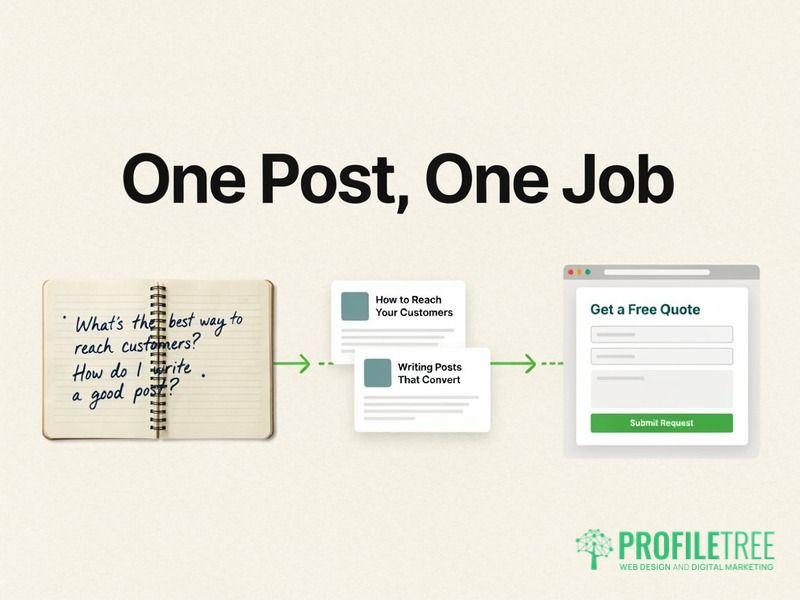
Every post or video should have one job, and for most businesses that job is to answer a question a buyer asks before they get in touch. Write down two or three goals for the next quarter, such as more quote requests from a particular service or more newsletter sign-ups from existing readers. Each topic you consider then has to earn its place against those goals, which stops the calendar filling with posts that nobody searches for.
Map Topics to the Questions Buyers Ask
The most useful topic lists come from the business itself. Your sales calls and the enquiries that arrive by email show the words people use to describe their problem, and those words are usually the ones they type into Google. A plumbing firm and a software company will end up with very different lists, which is why a topic list copied from a national guide rarely brings in local work.
Keep a running document where anyone in the team can add a question they heard from a customer that week. Over a few months, it becomes the most reliable source of topics you have, because every entry is a question a real buyer asked.
Audit What Your Blog and Channel Already Rank For
Before you publish anything new, look at what already exists. Google Search Console (Google’s free tool that reports the searches your pages appear for) shows which posts earn impressions without clicks and which sit on page two, between positions 11 and 20. Those pages are usually the quickest to improve, because a clearer opening answer and a better title can lift them without starting from scratch.
A YouTube channel can be audited in the same way. YouTube Studio shows the search terms that brought viewers to each video, and a video that already attracts the right searches often needs only a better title, description, and thumbnail to reach more of them.
Plan a Blog and Vlog Calendar Around Search Demand
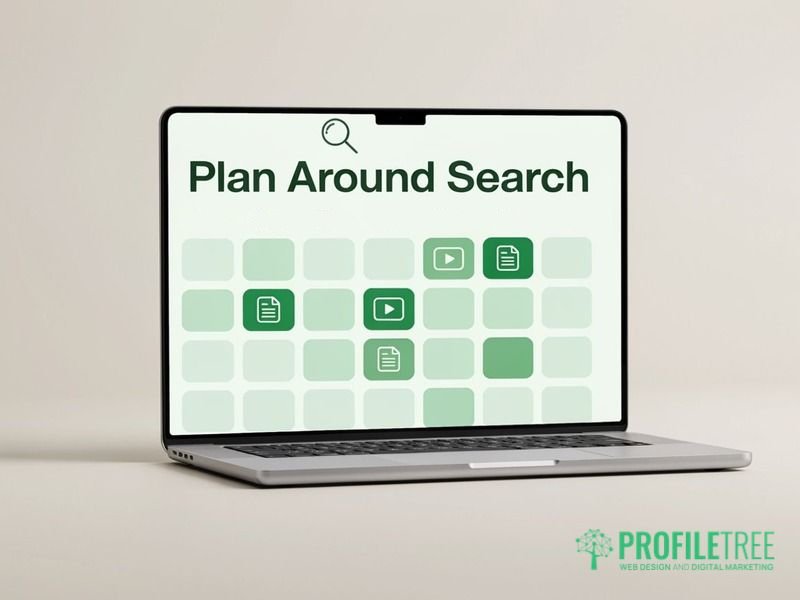
For most small businesses, a steady calendar of fewer, better pieces is easier to sustain than bursts of activity, and it gives readers a reason to come back. Mix posts that target searches you already know about with posts that answer new questions from customers. Keep a small number of foundation pieces, meaning long guides that stay useful for years, and link the shorter posts back to them so that search engines can see how your content fits together.
Use keyword research tools filtered to the United Kingdom, because UK spelling and vocabulary change what people type. A calendar also shows you the gaps: if every post so far is aimed at someone just starting out, a reader who is ready to buy has nowhere obvious to go next.
Write Posts That Answer the Question First
Open every post with a direct answer to the question in its title, in two or three sentences that would still make sense if they were copied out of the page. Readers who find the answer straight away are more likely to stay for the detail, and a passage that stands on its own is the kind that AI assistants such as Google’s AI Overviews and ChatGPT can quote cleanly. Put a named author on each post and say where your facts come from, so that a reader can check them.
Our own site shows how much the format matters. Between June and September 2026, Bing’s AI citation reports recorded 642 citations for our comparison of blogs and vlogs, while our general guide to content marketing recorded none in the same period. The comparison answers its question in the first paragraph and sets the differences out in a table, and that is the pattern we now apply to the guides we write for clients.
Title and Describe Videos the Way Customers Search
A vlog needs the same planning, because YouTube works as a search engine with video attached. Title each video with the words a customer would search, say in the first lines of the description what the business does and where it is based, and add chapters (timestamped sections listed in the description) so viewers can jump to the part they need.
Keep business videos short and put a real person from the team in front of the camera, because it shows a viewer who they would be dealing with. Our video marketing for business services covers filming and YouTube channel set-up for teams who want help with this part.
Distribute Every Post Beyond Your Own Website
Publishing a post and waiting for search traffic is the slow route, so plan where each piece will go before you write it. Send it to your email list, and rewrite its main point as a native post on LinkedIn or whichever platform your buyers use, so that people get the value without having to click away. A buyer who has read several useful posts from your team has a reason to think of you first when the need arises.
Your email list is the one channel you control, because platform algorithms and search rankings change without notice. Send one useful point per email with a link to the full post, and keep purely promotional emails as the exception. A list built this way stays engaged for longer, and the people on it are the most likely to reply when you announce a new service.
Use AI for Research and Drafts, and Keep People for Judgement
AI tools save the most time in the early stages, such as summarising what already ranks for a topic and drafting an outline that covers the questions those pages leave unanswered. They also produce reasonable first drafts of short, structured text such as meta descriptions (the summary shown under a page title in search results) and FAQ answers that you then check and edit.
The parts a reader trusts have to come from someone who knows the business. That means the opening answer, the opinions, the examples from real projects, and the decision about what to leave out. A post that sounds like every other post on the topic gives a buyer no reason to choose you, and a search engine has no reason to rank it above the pages it repeats.
“A post or a video that says something nobody else has said is worth more to a business than ten that round up what is already on page one,” says Ciaran Connolly, founder of ProfileTree. “Google’s own guidance has caught up with that view, and so has the evidence on what AI assistants cite. It is the standard ProfileTree’s content marketing team in Belfast works to for every client, whether they publish articles, YouTube videos or both.”
UK Advertising and Data Rules for Business Blogs and Vlogs
Two areas of UK rules affect most companies that publish online: the advertising rules enforced by the Advertising Standards Authority (ASA), and the data protection rules that cover email lists and cookies (small files a website stores in a visitor’s browser). Treat this section as general guidance and check your own position with a legal adviser before relying on it. Our article on the legal side of content marketing covers copyright, claims and other areas in more depth.
How to Label Ads and Gifted Products Under the ASA Guide
Any article or video you are paid to publish, or that features a product you were given for free, counts as advertising and has to say so clearly at the start. The ASA and the Committee of Advertising Practice (CAP), which writes the UK advertising code, published the latest edition of their influencers’ guide to making clear that ads are ads in October 2026. It asks for plain labels such as “Ad” or “Advert” placed where people see them before they see the content. It also lists labels to avoid, including “Gifted”, “Affiliate,” and “Sponsored”, because they do not make it clear enough that the content is an ad.
The same rule applies to affiliate links (links that pay you a commission when a reader buys). If a whole post is built around affiliate products, the whole post is an ad and needs the label at the top, and if only part of it is, the label goes before that part. In a video, the label needs to appear at the very beginning, because a disclosure partway through does not meet the standard.
Email Consent Under UK GDPR
If you collect email addresses for a newsletter, UK GDPR (the UK’s version of the General Data Protection Regulation) requires a lawful basis, and for most sign-up forms that basis is consent. Consent has to be a clear positive action, so a pre-ticked box does not count, and the form has to say what people will receive. It must be as easy to withdraw as it was to give, which in practice means a working unsubscribe link in every email.
If you offer a free download in return for an email address, keep the marketing opt-in separate from the download itself. Making the download conditional on agreeing to marketing emails is unlikely to count as freely given consent.
Cookies and the Analytics Exception
Until recently, almost every analytics cookie needed a visitor’s consent before it was set. The Information Commissioner’s Office (ICO), the UK’s data protection regulator, published final guidance in April 2026 on the statistical purposes exception. The Data (Use and Access) Act 2025 introduced the exception, and it lets some analytics run without consent. The conditions are strict. The data must be aggregated and must never be used to profile individuals or for advertising; visitors must be told about it and given a simple, free way to object, and any third-party provider must process the data only on your behalf.
Advertising cookies and analytics tools with advertising features switched on still need consent. Check your analytics settings against the ICO’s conditions before removing anything from your cookie banner, and keep your privacy policy clear about what you collect and who receives it.
Measure Enquiries and Revenue Per Visit
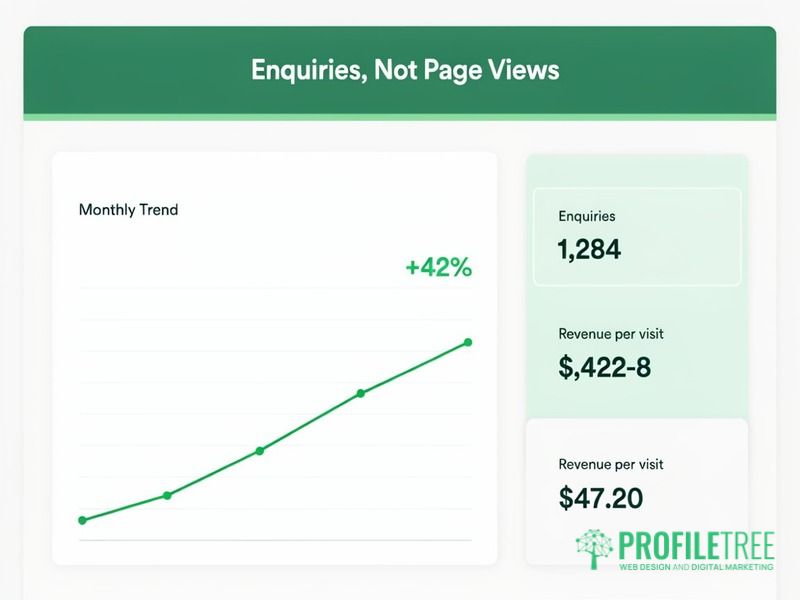
Page views show how many people arrived, but they say little about whether the blog or channel is paying its way. For most businesses, the first measure is the number of enquiries and sales that start on a content page. You can track these as key events (the actions you mark as important, such as a form submission) in Google Analytics 4. There is more on the set-up in our guide to measuring content marketing return.
For blogs and channels that earn directly, revenue per visit is the clearest single figure. Add up the month’s earnings from the content, including any affiliate commission, and divide the total by the month’s sessions. As a worked example, a blog that earned £800 from 25,000 sessions would earn 3.2p for every visit. Calculate the figure separately for search, email and social traffic, and put the next quarter’s effort into the source that returns the most.
Get Help Turning Your Blog or Vlog Into a Lead Source
The most useful first step is an audit of what your blog and channel already rank for, followed by fixing any labelling or consent gaps before you publish anything new. ProfileTree is a Belfast web design and digital marketing agency, founded in 2011 and based at the McSweeney Centre, and we help businesses across the UK and Ireland with content marketing for bloggers and vloggers who want their publishing to bring in work. Content marketing work is quoted on request, and if you would prefer to build the skills in-house, our digital training for your team covers content planning and SEO using your own website and channel, with training from £350 plus VAT.
FAQs
How is content marketing different from blogging or vlogging?
Blogging and vlogging are publishing formats, while content marketing is the plan that decides what you publish, who it is for, and how you measure it. A business blog becomes content marketing when each post answers a question buyers ask, links to the service that solves it and is judged by the enquiries it brings in. Without that plan, a blog is a publishing habit that may build an audience but seldom brings in work on its own.
How do I label affiliate links and gifted products in the UK?
Label them as ads, with a clear “Ad” label at the start of the post or video. The ASA’s October 2026 influencers’ guide treats affiliate content and free products as advertising, and it lists “Affiliate” and “Gifted” among the labels to avoid because they do not make the commercial relationship clear. The label must be visible before people see the content, so a note at the foot of a post or partway through a video does not meet the standard.
Do I need cookie consent for analytics on my blog?
You may not, if your analytics meet the ICO’s conditions for the statistical purposes exception. The data must be aggregated, used only to improve your site and never used for advertising or profiling. Visitors must also be told about it and given a free and simple way to object. Analytics tools with advertising features switched on still need consent, so check the settings before you change your cookie banner.
Should my business start with a blog or a vlog?
Start with the format your buyers already use, and your team can keep up. A blog is cheaper to start and easier to update, which makes it the usual first step for a small team. A vlog suits businesses whose work is easier to show than describe, such as trades and manufacturing, and it gives buyers a look at the people they would deal with. Many businesses start with a blog and add video for the questions customers ask most often.
How long does content marketing take to produce enquiries?
Expect several months before a new blog or channel brings in steady enquiries. Updating posts that already appear on page two of Google can show results sooner, because those pages have already earned some visibility. Email and LinkedIn can also bring early enquiries from people who already know the business while search visibility builds.