
Continuing Professional Development: A Practical Guide for SMEs
Table of Contents
Continuing professional development (CPD) is the structured process of improving and maintaining the skills, knowledge, and experience you need to do your job well and prepare for what comes next. For business owners, marketing managers, and their teams across Northern Ireland, Ireland, and the UK, it is one of the most direct levers for business performance.
Three things worth knowing before you read on:
- CPD works best when it is tied to a specific business outcome, not treated as a box-ticking exercise.
- Digital skills, AI literacy, and marketing capability are now the fastest-moving development priorities for SME teams.
- A structured CPD plan does not require a dedicated HR department or a large training budget.
This guide sets out the core continuing professional development strategies that work for smaller teams, explains how to build a CPD plan from scratch, and shows where funding support is available for businesses in Northern Ireland and the wider UK.
What Is Continuing Professional Development?
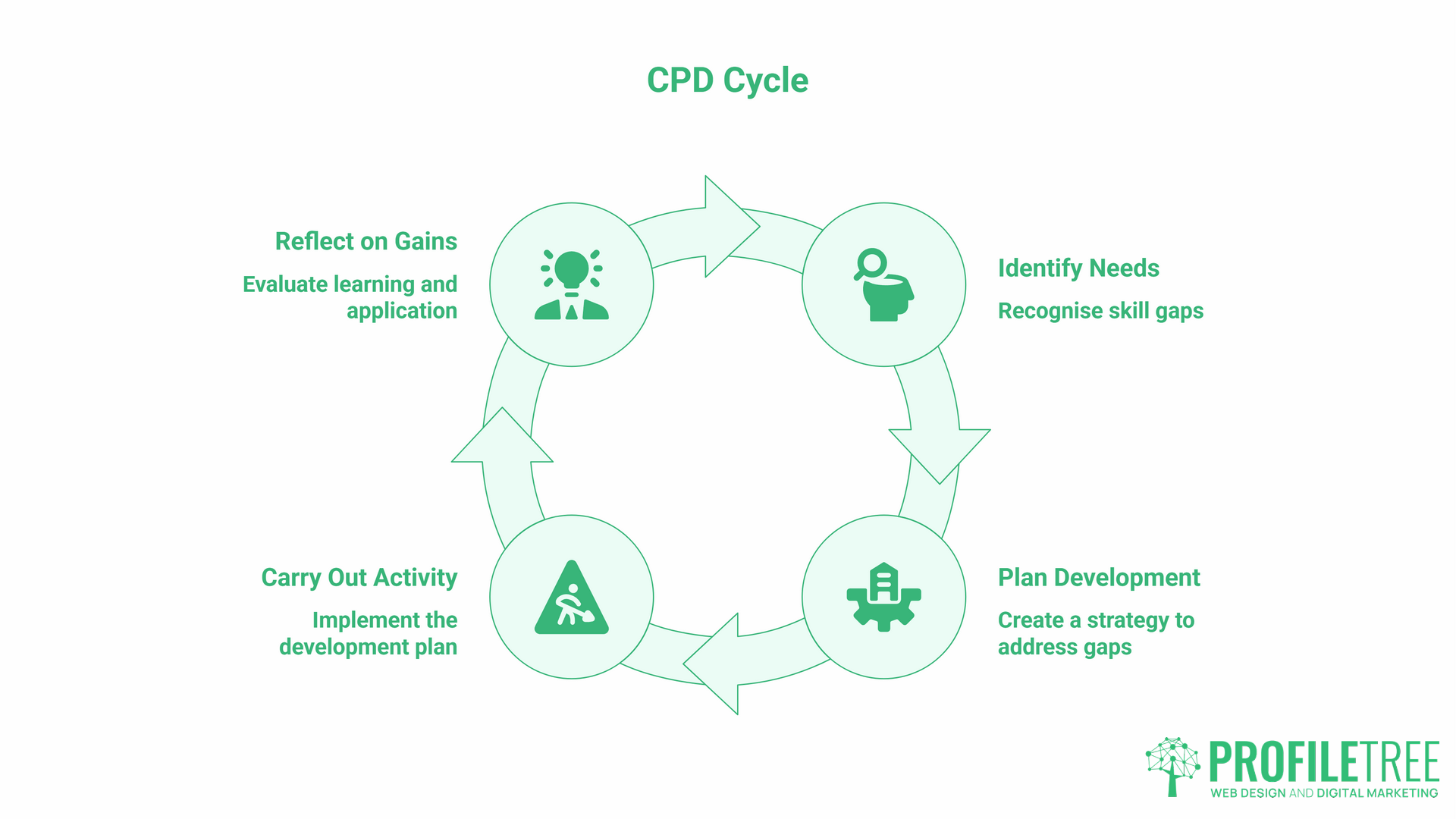
Continuing professional development is the ongoing, intentional process of learning and updating skills throughout a career. The key word is intentional. Picking up things informally as you go is not the same as CPD. CPD involves identifying a gap, planning how to close it, taking action, and reflecting on what changed.
The CPD cycle most professional bodies use follows four stages: identify your learning needs, plan how to address them, carry out the development activity, and reflect on what you gained and how it applies to your work.
CPD in the context of SMEs looks different to CPD inside large corporations. There is rarely an L&D team to organise it. The person identifying the training need is often the same person who does the job, approves the budget, and finds the time. That reality shapes every recommendation in this guide.
Formal vs Informal CPD
| Type | Examples | Best for |
|---|---|---|
| Formal (structured) | Podcasts, industry reading, peer discussion, and video learning | Filling a documented skills gap, professional registration requirements |
| Informal (self-directed) | Staying current, exploring new areas, and low-cost development | Mentoring, feedback sessions, and CPD journals |
| Experiential | Stretch projects, secondments, cross-team collaboration | Applying new knowledge, building confidence through practice |
| Reflective | Mentoring, feedback sessions, CPD journals | Consolidating learning, identifying patterns in performance |
Most effective CPD plans use all four types in combination. Formal training closes specific gaps. Informal learning keeps knowledge current between formal programmes. Experiential learning turns theory into practice. Reflective practice embeds what was learned and surfaces what to develop next.
Why Traditional CPD Strategies Often Fall Short for Small Businesses
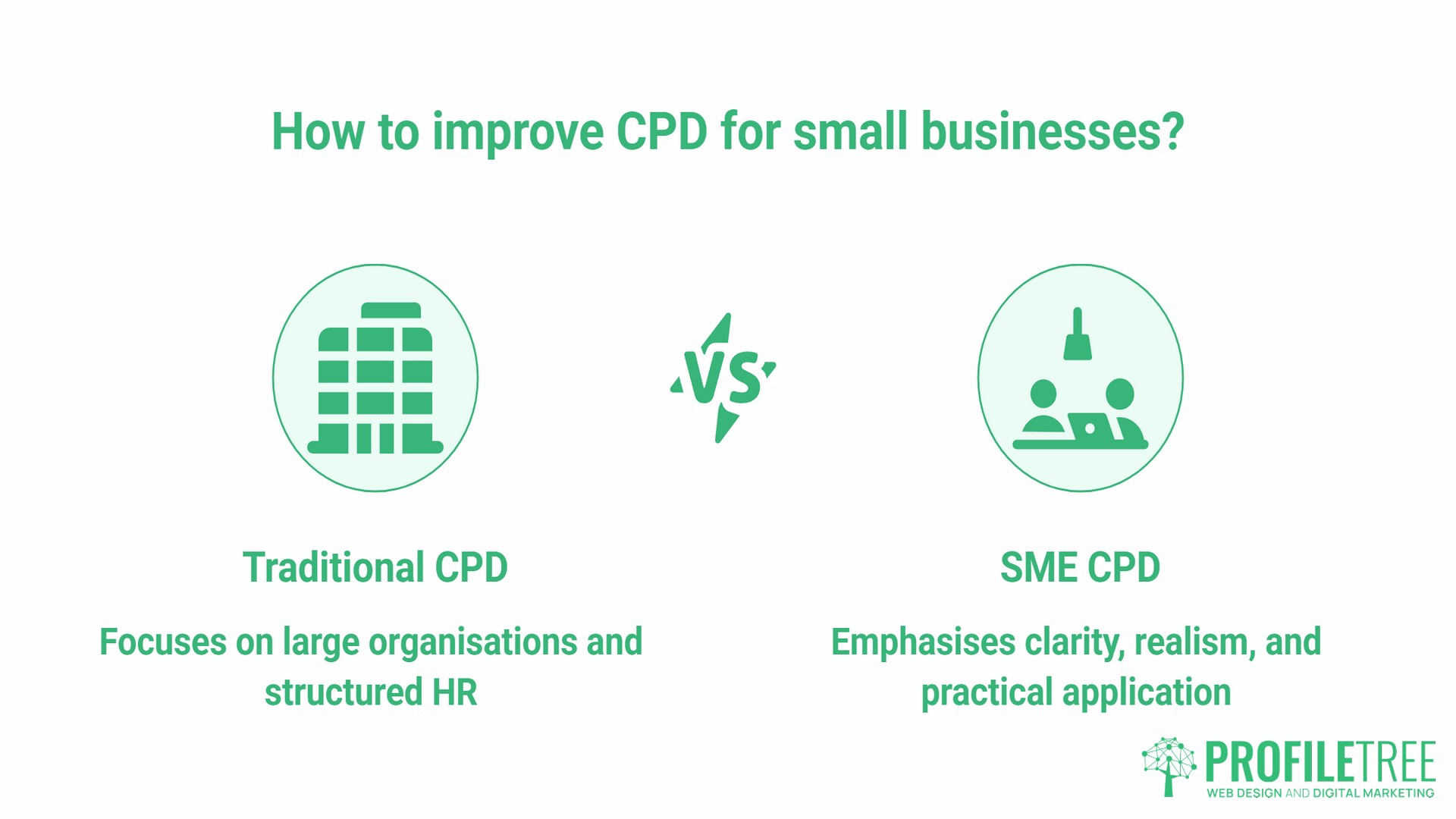
Most CPD guidance is written for large organisations with structured HR functions, annual appraisal cycles, and dedicated training budgets. The advice tends to be sound but impractical for a team of five to fifteen people running a busy business.
The result is that CPD either does not happen at all or happens in a fragmented way. A team member attends a conference and learns something useful, but has no space to apply it. A manager buys a course licence that nobody completes. A business owner reads a lot but never connects what they have learned to a specific improvement in how the business operates.
The fix is not a bigger budget. It is a clearer system.
Good continuing professional development for SMEs requires three things: a definition of what skills the business actually needs, a realistic time commitment that does not collapse under the pressure of everyday demands, and a method for connecting new knowledge to practical change in how the work gets done.
6 Core Continuing Professional Development Strategies
1. Setting Goals That Connect to Business Outcomes
CPD goals that are too vague produce CPD activity that is too vague. “Improve my marketing knowledge” is not a goal. “Complete a structured SEO course and apply keyword research to three service pages by the end of Q3” is.
The SMART framework (Specific, Measurable, Achievable, Relevant, Time-bound) is a reliable starting point. What matters beyond the framework is the connection to something the business is actually trying to do. CPD goals should answer the question: What will be different in how this person performs their job once this development is complete?
For SME owners planning their team’s development around digital capability, a useful starting point is an audit of current skills against the demands of the business’s marketing and sales activity. Where are the gaps between what the team can do and what the business needs them to do? Those gaps are the CPD priorities.
2. Structured External Training for High-Impact Skills
Some skills are learned most efficiently through structured, externally delivered training. This is particularly true for technical disciplines, where the learning curve is steep, self-directed study tends to plateau, and guidance from practitioners who have solved real problems adds genuine value.
Digital marketing, SEO, content strategy, video production, and AI implementation all fall into this category for most SME teams. The knowledge is available through self-directed reading, but the combination of structured curriculum, live feedback, and practical application that comes from a quality training programme typically produces faster, more durable results.
ProfileTree’s digital training services are designed specifically for SME teams who need to build practical digital capability without taking significant time away from the day-to-day running of the business. The training covers digital marketing, SEO, content creation, and social media strategy, with the emphasis on applying what is learned to the business immediately rather than in theory.
“CPD isn’t about collecting certificates. It’s about closing the gap between what your business can do today and what the market will demand tomorrow.” Ciaran Connolly, founder of ProfileTree.
3. AI Literacy as a Core CPD Priority
AI literacy is no longer an optional extra for professional development. It is a baseline competency that affects how almost every knowledge-work role functions.
For SME teams, the practical development priorities around AI are not abstract. They include: understanding how to use AI writing and content tools without producing generic output, knowing how to interrogate AI-generated analysis rather than accept it uncritically, using AI tools to speed up research, reporting, and content production without sacrificing quality, and understanding the data privacy and accuracy risks that come with AI-assisted work.
These are not skills that can be developed through casual experimentation alone. A structured approach to AI continuing professional development is more effective. Identifying which AI tools are relevant to the team’s specific work, testing them in a controlled way, reviewing the outputs critically, and building standard operating procedures around the ones that add genuine value is a more systematic method than trial and error.
ProfileTree’s AI training and team collaboration work with businesses across Northern Ireland and the UK covers exactly this ground. For a detailed assessment of the costs and returns involved in upskilling a team around AI, the cost-benefit analysis of AI implementation for SMEs is a useful reference point.
4. Learning Through Experience and Stretch Projects
Structured training creates knowledge. Experience converts it into competence. The two work together, and CPD plans that rely only on courses and certifications tend to produce people who know more but do not perform differently.
Experiential CPD involves deliberately putting new knowledge to work in real conditions. A team member who completes a content marketing course consolidates that learning by taking ownership of a content project, not by waiting for someone to assign them content work after they already know how to do it well.
Practical approaches to experiential CPD for SME teams include assigning stretch projects that sit slightly beyond a team member’s current capabilities, cross-departmental involvement in projects where someone from another function can observe and contribute, and job shadowing or temporary responsibility for a process they do not normally own.
The important element is reflection. Experiential learning that is not reflected on becomes experience without insight. A brief structured debrief at the end of a stretch project, reviewing what worked, what did not, and what the team member would do differently, closes the loop.
5. Peer Learning and Mentoring
Mentoring is among the most cost-effective continuing professional development strategies available to small businesses, partly because it requires no external budget and partly because it produces benefits for both the mentor and the mentee.
For the mentee, access to someone who has already navigated the challenges they are facing shortens the learning curve and provides a sounding board for real-time decision-making. For the mentor, the process of explaining what they know and why deepens their own understanding of their subject.
For SME teams building digital capability, the mentoring relationship need not be formal. A more experienced team member who has already completed a digital marketing training programme and applied it to a real project is a valuable resource for a colleague just starting out with content or SEO work. Formalising even a lightweight version of this, with regular check-ins and a focus on a specific skill area, creates a structured CPD activity at no external cost.
Networking with other business owners and digital practitioners through professional groups in Northern Ireland and across Ireland serves a similar function for business owners. The most useful professional development often comes from candid conversations with peers facing the same challenges.
6. Self-Directed Learning and Knowledge Maintenance
Self-directed learning is the ongoing background activity that keeps knowledge current between formal development programmes. It is not a substitute for structured training, but it is an important complement to it.
For SME teams working in digital marketing, content, and technology, self-directed learning activities include industry newsletters and publications, podcasts from practitioners in relevant fields, webinars from tools and platforms the business uses, and video content from credible sources.
The practical challenge is curation. There is more content available on any digital marketing topic than any person can consume. A simple filter for SME teams: prioritise sources that deal in specific, tested results over sources that deal in trends and predictions. A detailed case study of how a specific business improved its organic search performance is more useful than an article about the general importance of SEO.
ProfileTree’s YouTube channels, including @Profiletree and @profiletreedigital, cover practical digital marketing and web development topics specifically relevant to SMEs in Northern Ireland and the UK.
How to Build a CPD Plan for Your Team
A CPD plan does not need to be complicated. For most SME teams, a straightforward document covering the following is sufficient.
- Step 1: Identify learning needs. Start with the business’s goals for the next 12 months. What skills does the team need to deliver on those goals? Where are the gaps between current capability and required capability? This can be done through a structured conversation with each team member, a simple self-assessment against a list of relevant skills, or a review of where the business is losing time or producing below-standard outputs.
- Step 2: Prioritise. Not all gaps are equal. Prioritise the skills that are most directly connected to business-critical activities, the areas where a capability gap is having a visible impact on performance.
- Step 3: Match gaps to activities. For each priority gap, identify the most appropriate development activity: a formal course, a stretch project, a mentoring arrangement, or a period of structured self-directed learning. Note the estimated time commitment and any associated cost.
- Step 4: Schedule it. Development that is not scheduled does not happen. Block time in the calendar for CPD activities in the same way you would block time for a client meeting.
- Step 5: Review quarterly. At the end of each quarter, review what was planned against what was completed. What changed? What was learned? What should be adjusted for the next quarter?
A sample 12-month digital skills roadmap for an SME marketing team might cover content strategy and SEO in Q1, social media and paid traffic fundamentals in Q2, analytics and reporting in Q3, and AI tools and automation in Q4. The specifics depend on where the gaps are, but the structure of progressive, applied learning across a year produces measurably more capable teams than ad hoc training.
Tracking CPD Activity
Professional bodies typically require members to log their CPD activity. Even if no formal requirement applies, keeping a simple CPD record is good practice. A record of what was learned, when, how long it took, and what changed in practice as a result serves as useful evidence for appraisal conversations, tender documents, and grant applications.
A basic CPD log can be as simple as a shared spreadsheet with columns for: date, activity, time spent, skills area, and reflection notes. The reflection column is the one most people skip. It is also the one that does most of the work in converting activity into learning.
Measuring the Value of Continuing Professional Development
CPD that cannot be connected to a business outcome is hard to justify and harder to sustain.
The most direct measures depend on what the development was for. A team member who has completed SEO training should be able to produce better-optimised content, visible in search performance data over time. A manager who has completed a project management course should be running tighter projects, visible in delivery timelines and budget adherence. AI training should reduce time spent on specific tasks or improve output quality, both of which are measurable with basic tracking.
Where the impact of CPD is harder to quantify directly, useful proxy measures include staff retention, the breadth of work a team can take on without external support, and the speed at which new team members become productive when joining a team with a strong learning culture.
Funding Your Team’s Continuing Professional Development
For SMEs in Northern Ireland, the Digital Transformation Flexible Fund (DTFF), delivered through local councils and supported by Invest NI, provides funding for small and micro businesses to adopt digital technologies. Invest NI also offers the Business Innovation Grant, which provides between £5,000 and £20,000 at a 70% grant rate for eligible SMEs pursuing innovation activities, and is worth reviewing for projects that include digital capability development.
Across the UK, Skills Bootcamps are government-funded, flexible training courses for adults aged 19 and over, covering digital and IT skills, among other sectors. Wave 6 of the programme, funded by the Department for Education, runs through the current financial year and covers digital skills as one of its seven priority sectors. These programmes can substantially reduce the cost of structured external training for SME teams.
For businesses in the Republic of Ireland, Enterprise Ireland’s suite of supports includes management and capability development grants worth exploring for teams investing in digital skills.
For teams that need a broader view of the current digital marketing landscape before deciding where to focus their development efforts, the overview of digital marketing tools and the guide to digital marketing channels are useful starting points.
Professional development is not a single event. For SME teams, the most effective approach to continuing professional development is a consistent rhythm of structured learning, practical application, and reflection, adjusted each quarter to align with what the business actually needs. The skills that matter most right now are the ones that let your team work more effectively in a digital environment, and there is structured support available to help you build them.
To discuss what a digital training programme for your team might look like, get in touch with the ProfileTree team.
Frequently Asked Questions
What are the four types of CPD?
The four types are structured (formal courses and workshops), self-directed (reading, podcasts, online learning at your own pace), experiential (learning through practice, stretch projects, and job shadowing), and reflective (mentoring, feedback sessions, CPD journals). Effective CPD plans use all four in different proportions depending on what is being learned and how quickly the skill needs to be operational.
What is the best CPD strategy for a small team with no dedicated HR?
The most practical approach for small teams is to combine short structured training for specific high-priority skills with peer learning and self-directed development for ongoing maintenance. Identify one or two capability gaps that are directly affecting business performance, invest in structured training to close them, and build a lightweight culture of peer learning for the rest.
How much time should I dedicate to CPD each week?
The 70-20-10 rule, developed by researchers McCall, Lombardo, and Eichinger at the Center for Creative Leadership, suggests that roughly 70% of professional learning comes from on-the-job experience, 20% from learning from others, and 10% from formal training. In practice, setting aside a consistent block of time each week for deliberate learning, even if it is only 30 to 60 minutes, produces better results than irregular intensive sessions. Consistency matters more than duration.
Is AI-related learning valid CPD in the UK?
Yes, provided it contributes to professional competence and is documented. Most professional bodies accept any structured learning that is relevant to your role as a qualifying CPD activity. AI literacy, prompt engineering, and AI tools relevant to your professional practice all qualify under this definition.
How do I fund CPD for my employees in Northern Ireland?
Invest NI offers a range of business support programmes, including the Business Innovation Grant and the Digital Transformation Flexible Fund, which may be relevant depending on your project scope. Skills Bootcamps, funded by the Department for Education across the UK, cover digital and IT skills and are free for eligible adults aged 19 and over. It is worth contacting Invest NI or NI Business Info directly to confirm which programmes are currently open for applications and whether your business meets the eligibility criteria.
Do I need a formal certificate for CPD to count?
No. For most professional bodies, what matters is that the learning activity contributed to your professional competence and that you have a record of it. A detailed reflection note on what you learned from reading, a webinar, or a stretch project is sufficient evidence for many CPD schemes. Check the specific requirements of your professional body if formal certification matters for your role or registration status.
What is the difference between CPD and a performance review?
A performance review assesses what has been done. Continuing professional development planning addresses what skills and knowledge are needed for what comes next. The two are related but distinct. CPD works best when it is not subordinated to the annual appraisal cycle; development conversations should happen more frequently and focus on growth rather than retrospective evaluation.